
Japan · Hidden Gems · A Local’s Hub
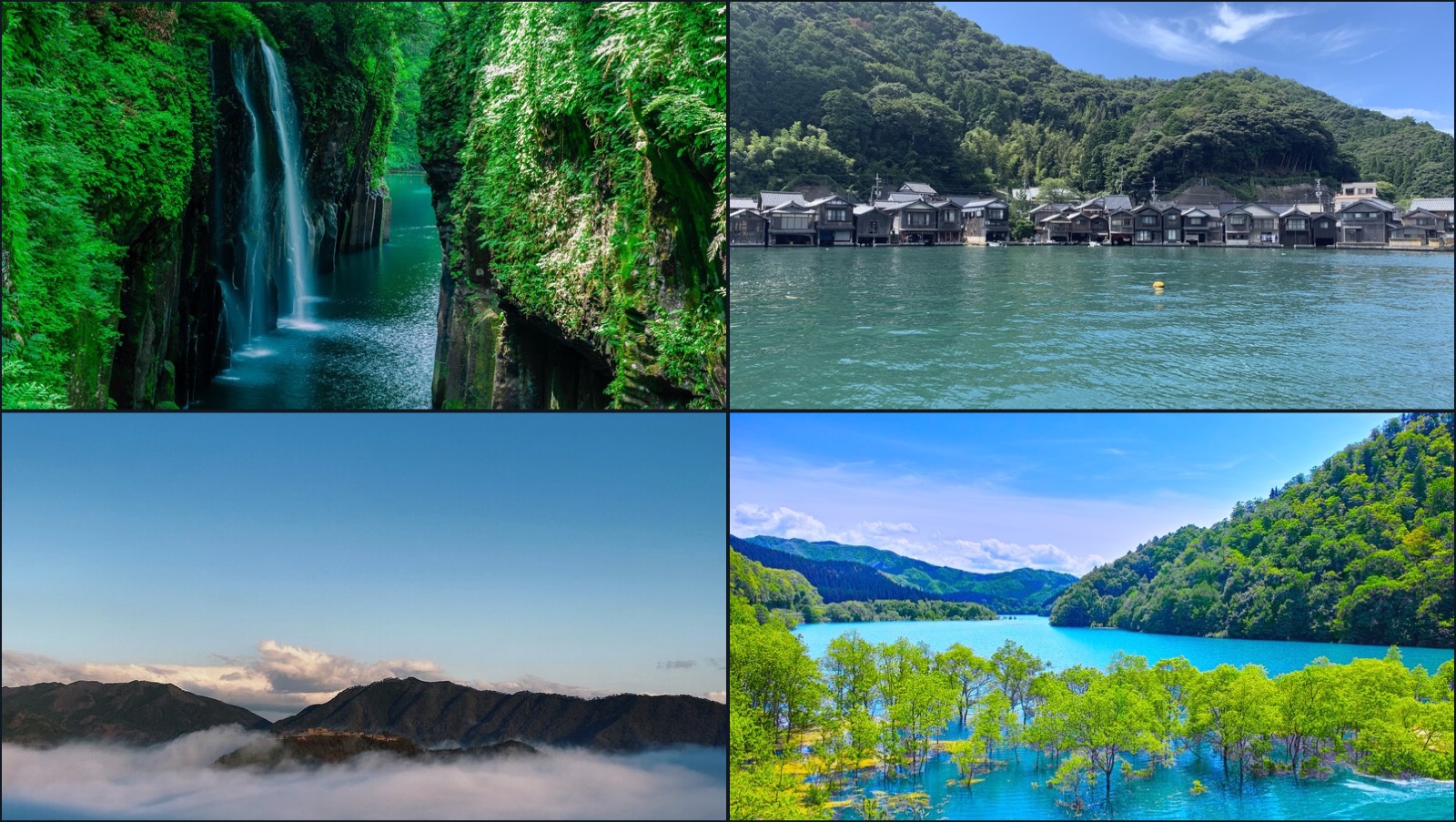
Japan’s hidden gems aren’t really a secret list — they’re the places locals quietly come back to: a cobalt dam-lake full of drowned silver trees in Akita, a village of boat-houses on the Sea of Japan, a castle that floats above a sea of clouds. This is my running guide to the best of them, organized by region, and every place here is one I’ve been to and written up in full. Skip nothing on the Golden Route if it’s your first trip — but when you’re ready to go deeper, start here.
How to use this: pick a region you’re already heading to, then add one or two of these nearby. Each card links to a detailed guide with access, timing and what it’s actually like. I add new gems as I publish them, so it grows.
Trip two and beyond: where to start
If Tokyo and Kyoto are already stamped in your passport, skip the reassurance and go straight to depth. Three directions repay a second trip fastest:
Deeper Kansai
Same region, different century — mountain temples and pilgrimage trails a week deep, no repeat of trip one.
The north
Sendai, Yamadera and Ginzan Onsen off the Tohoku Shinkansen — five days through country the golden route never touches.
Shikoku
Naoshima’s art islands, the Iya Valley, Dogo Onsen — an island that runs at its own pace.
Prefer to compare everything at once? Every route on this site is collected in the itinerary index, and if the trip length itself is still open, start with how many days do you need in Japan? The gems below are the raw material for all of it.
What counts as a “hidden gem” here
Not “secret” in the sense of undiscovered — Japan has very little that’s truly unknown. I mean places that sit just off the main tourist track: a stop most first-timers skip, a town one valley over from the famous one, a view that takes a little more effort to reach. They reward you with space, quiet and a stronger sense of place than the headline sights, which in 2026 are busier than ever. The honest trade-off is usually time and transport — many need a car or a slower train — so I’ve noted that in each full guide.
Lake Shūsenkō, Akita
A cobalt dam-lake studded with the silver trunks of a drowned forest.
Ōuchi-juku, Fukushima
A thatched Edo post town where you eat soba with a single long leek.
Akita Kantō Festival
Around 280 lantern poles balanced on palms and foreheads (early August).
Lake Shikotsu Ice Festival, Hokkaidō
Ice sculptures lit from within beside one of Japan’s clearest lakes.
Kawagoe (Little Edo), Saitama
Warehouse streets and a wooden bell tower, a half-day from Tokyo.
Harmonica Yokocho, Kichijōji
A postwar maze of tiny bars and counters in west Tokyo.
Ōi Racecourse Flea Market
Tokyo’s biggest flea market — hundreds of stalls on race-free weekends.
Hard Off & Off House Hachioji Owada
A giant reuse complex in Hachioji, west Tokyo — old kimono, ceramics and a basement Showa-retro corner.
Nakaminato Fish Market, Ibaraki
A working fishing-port market most visitors never reach.
Jindaiji, Tokyo
A soba-and-daruma temple town on the city’s quiet western edge.
Shichirigahama, Kamakura
A dawn beach walk with Enoshima and, on clear days, Mt Fuji.
Kaisei Hydrangea Village, Kanagawa
Kilometres of June hydrangea threaded through rice paddies.
Tone River Grand Fireworks, Ibaraki
One of Japan’s largest-class fireworks nights (September).
Asumiko Pond, Fujiyoshida
A quiet Fuji-worship lotus pond with a July hydrangea slope.
Lake Saiko
The calm, undeveloped Fuji lake right next to busy Kawaguchiko.
Lake Motosu
The exact Mt Fuji view printed on the ¥1,000 note.
Iyashi-no-Sato, Saiko
A rebuilt thatched-roof village under Mt Fuji.
Obasute Rice Terraces, Nagano
Moon-reflecting hillside paddies, a view prized since the Heian era.
Narai-juku, Kiso Valley
A 1 km Edo post town on the old Nakasendō highway.
Togakushi Shrine, Nagano
A 400-year cedar avenue leading to a mountain shrine.
Kamikōchi, Nagano
A car-free alpine valley of clear rivers below the Hotaka peaks.
Haha-no-Shirataki
A sacred waterfall near Mt Fuji that freezes solid in winter.
Ine no Funaya
A village of wooden boat-houses on the Sea of Japan, north of Kyoto.
Takeda Castle, Hyōgo
The ‘castle in the sky’, floating above an autumn sea of clouds.
Ashiu Forest, Kyoto
Primeval woods you can only enter on a guided trek.
Shirahige Shrine, Lake Biwa
A vermilion torii gate standing out in the lake.
Murō-ji, Nara
A misty mountain temple long known as the ‘Women’s Kōya’.
Okadera, Asuka
A flower-filled temple in Japan’s ancient first capital.
Minoo Falls, Osaka
A waterfall walk — and fried maple leaves — 30 minutes from the city.
Takashima, Lake Biwa
A quiet lakeshore day trip north of Kyoto.
Tsunoshima Bridge, Yamaguchi
A long, low bridge arcing over impossibly blue water.
Onomichi, Hiroshima
A temple-dotted hillside town of slopes, cats and sea views.
Hiruzen Highlands, Okayama
Alpine meadows, cycling and a Kengo Kuma pavilion.
Tottori Sand Dunes
Japan’s great coastal dunes, on the Sea of Japan.
Shōji Ueda Museum, Tottori
A stark concrete museum that frames Mt Daisen in its pools.
Takachiho Gorge, Miyazaki
Row a boat beneath a 17 m waterfall in a basalt canyon.
Yakushima
A rain-forest island of moss, waterfalls and 1,000-year cedars.
Amami Ōshima
Heart-shaped tide pools and mangrove kayaking, far south.
Udo Jingū, Miyazaki
A shrine tucked inside a cliff-face sea cave.
Cape Toi, Miyazaki
Wild horses grazing on headland cliffs above the sea.
Nabegataki Falls, Kumamoto
A waterfall you can walk all the way behind.
Unzen Onsen, Nagasaki
Steaming volcanic ‘hells’ and a mountain hot-spring town.
Obi, Miyazaki
‘Kyūshū’s Little Kyoto’ — a walled samurai castle town.
Kusasenri, Aso
Grassland and grazing horses inside a live volcanic caldera.
Nanzoin, Fukuoka
The world’s largest bronze reclining Buddha, in the hills.
How to find your own hidden gems in Japan
Go one valley over
Pick the famous spot, then look at what’s 30–60 minutes beyond it. The crowds rarely follow.
Follow the season, not the list
Hydrangea in June, lotus in July, a sea of clouds in autumn — timing turns an ordinary place into a gem.
Rent a car for a day
The best of these are where trains don’t go. A single day with a car opens a whole region.
Eat where the farmers shop
Roadside markets and local diners are half the reason to leave the city — and the cheapest.
FAQ
What are the best hidden gems in Japan?
It depends on where you’re going. A few of my favourites across the country: Lake Shūsenkō’s sunken forest (Akita), Ine no Funaya boat-house village (Kyoto), Takeda Castle’s sea of clouds (Hyōgo), Takachiho Gorge (Miyazaki) and Yakushima’s ancient cedar forest. This page lists them by region with a detailed guide for each.
Where should I go beyond Tokyo and Kyoto?
For a first step off the Golden Route, try Kanazawa-side Chūbu (the Kiso post towns, Kamikōchi), the Mt Fuji lakes beyond Kawaguchiko (Saiko, Motosu), or north Kyoto (Ine, Lake Biwa). For a bigger leap, Kyūshū (Takachiho, Yakushima) and the Sanin coast (Tottori, Tsunoshima) reward the extra travel.
Are Japan’s hidden gems hard to reach?
Some are. Many of the best need a rental car or a slower local train rather than the Shinkansen, and a few are seasonal or tide-dependent. Each linked guide gives the realistic access, timing and effort so you can plan around it.
When is the best time to visit?
Spring (cherry blossom, late March–April) and autumn (foliage, late October–November) are the classic windows, but several gems here peak in summer (lotus, fireworks, alpine valleys) or winter (frozen waterfalls, ice festivals, a snow-dusted Mt Fuji). Pick the season first, then the place.
Is it rude to visit “hidden” local places as a tourist?
Not at all — these are public places that welcome visitors. Just travel lightly: keep noise down in residential areas, follow photography etiquette, carry your rubbish out, and spend a little money locally. That’s what keeps them worth visiting.
This is a curated hub of Hidden Japan Gems guides, updated as new places are published. Every spot links to a full first-hand guide with verified access and timing.
Most hidden gems work as day trips from a city base. Top-rated stays on Agoda in Tokyo, Kyoto and Osaka:
Resol Poshtel Tokyo Asakusa
Agoda 9.6/10 · 2★ · 2,668 reviews
MIMARU Tokyo Asakusa Station
Agoda 9.5/10 · 3.5★ · 1,240 reviews
Guesthouse Engawa
Agoda 9.9/10 · 2★ · 267 reviews
Guesthouse KYOTO COMPASS
Agoda 9.8/10 · 1.5★ · 259 reviews
Hotel 88 Shinsaibashi
Agoda 9.5/10 · 3★ · 5,299 reviews
Acro Capsule Hotel Namba Dotonbori
Agoda 9.4/10 · 3★ · 8,305 reviews
We may earn a commission from Agoda bookings, at no extra cost to you.
Join travelers discovering Japan's hidden side
Weekly dispatches from off-the-beaten-path Japan — spots and stories you won't find in guidebooks.
No spam. Unsubscribe anytime.
Welcome aboard!
You're in. See you in your inbox soon.