Nagano · Chikuma
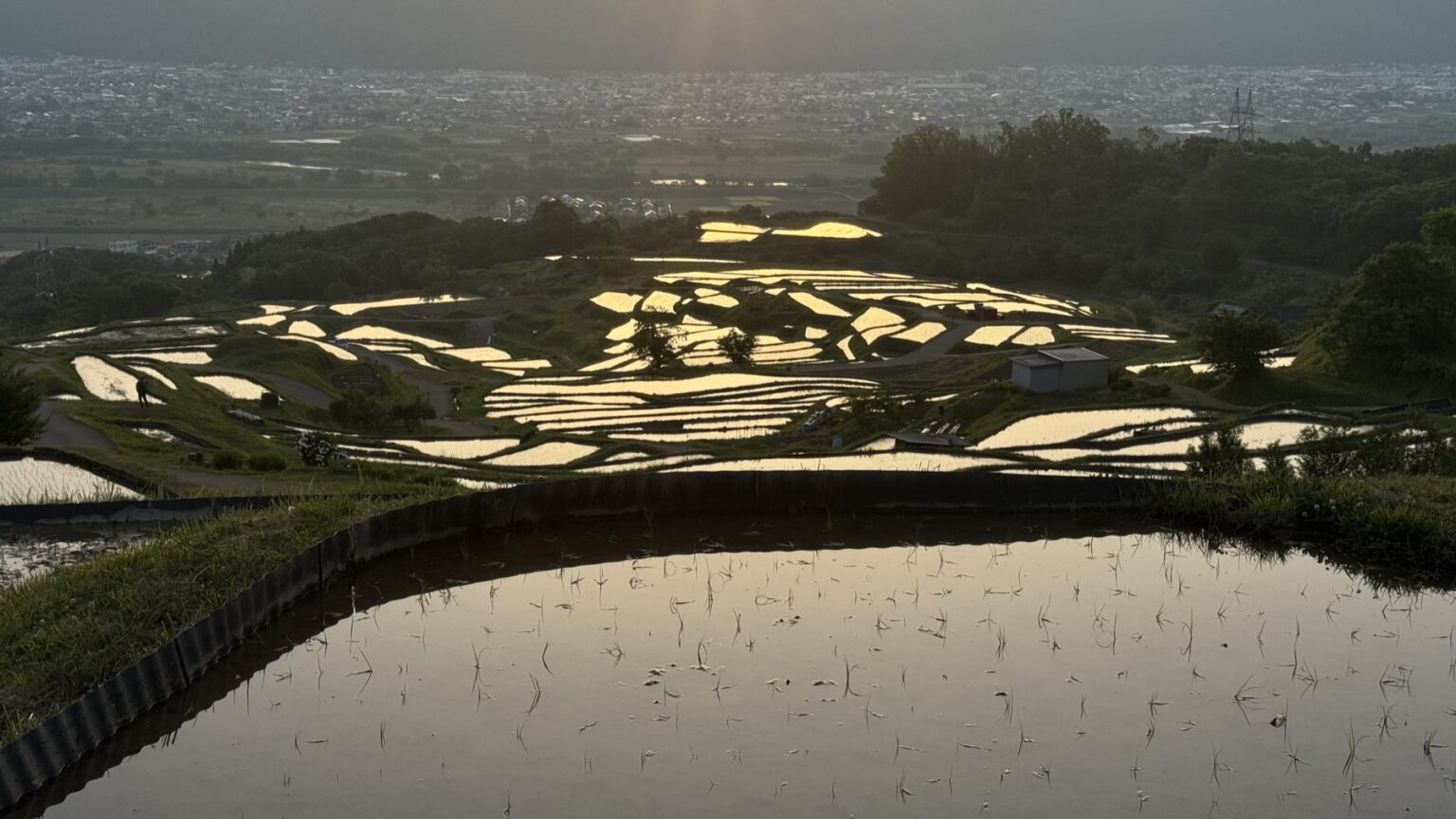
On a hillside above the city of Chikuma in Nagano, more than a thousand small rice paddies step down toward the Zenkoji plain — and for a few weeks in late May, when the farmers flood them before planting, each paddy turns into its own separate mirror of the sky. In 1999 this view, called tagoto-no-tsuki — the moon in every paddy — became the first farmland in Japan ever named a National Place of Scenic Beauty.
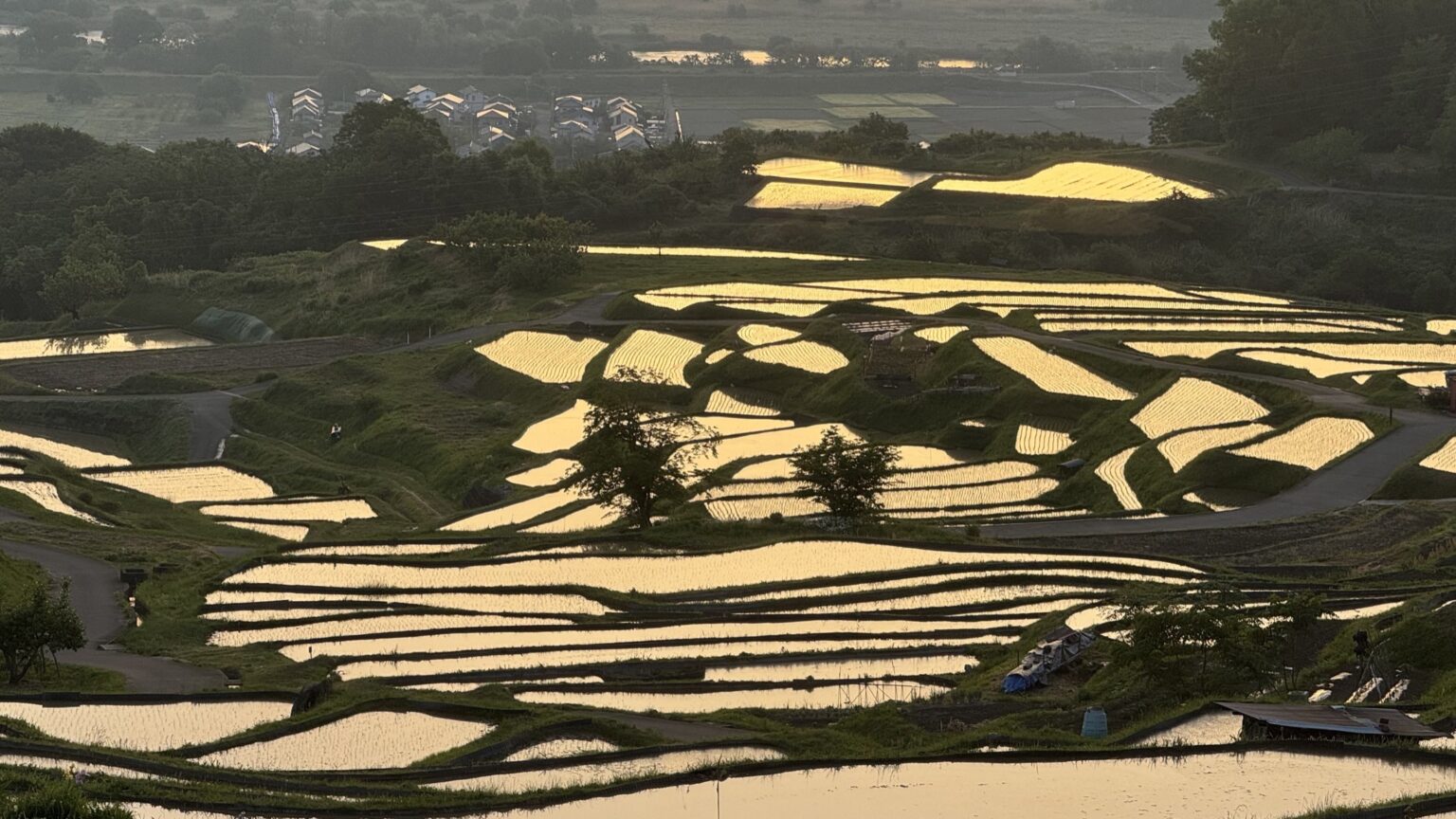
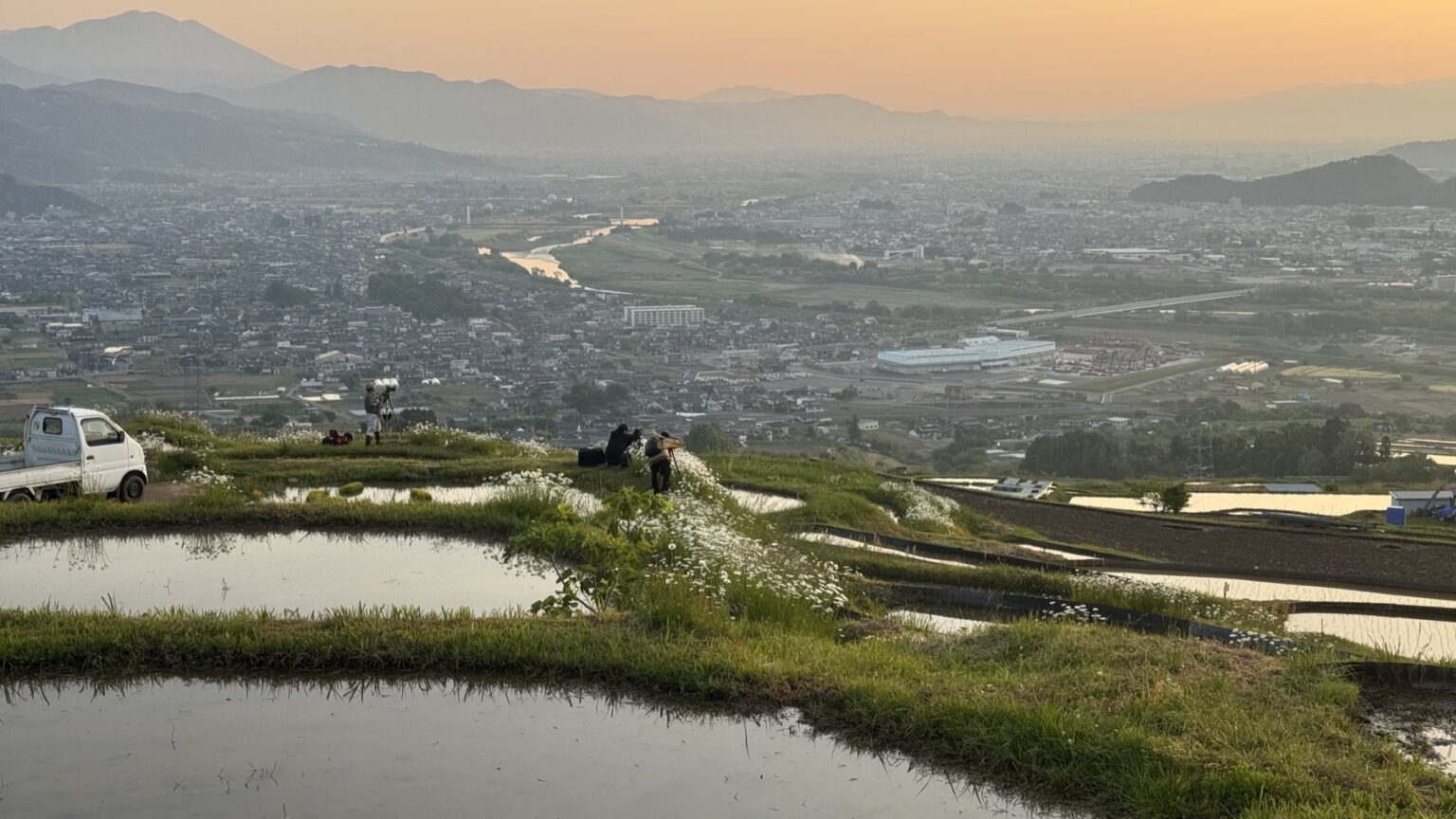
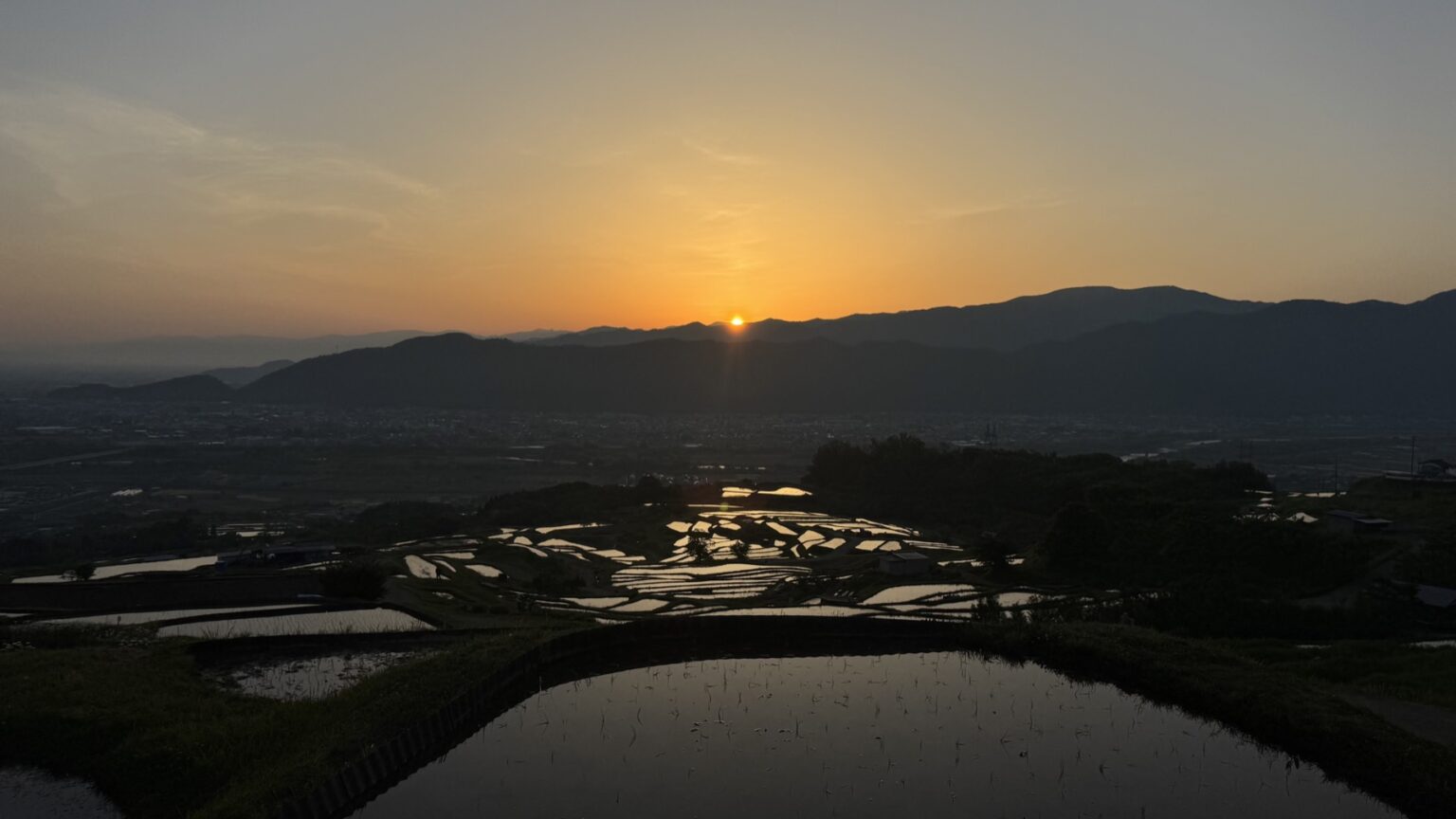
I came up the hill before dawn, expecting a pretty view and a few photographers. What I did not expect was how quiet it gets. The paddies had been flooded a day or two earlier, the surface dead still, and as the sun came up over the far ridgeline the whole staircase of water lit up one shelf at a time, gold then silver-bright. A farmer’s white kei-truck was already parked on the grass; somebody was out checking the channels between the fields. It is a working farm that happens to be one of the most painted views in Japan, and both of those things are true at the same time.
What “tagoto-no-tsuki” actually means
The name you will see everywhere is tagoto-no-tsuki (田毎の月), usually translated as “the moon in each paddy.” It is worth being precise about it, because the photos can oversell it. There is no single night when one moon sits inside all 1,500 paddies at once. What happens is gentler: when the fields are full of water and the moon is up, you walk along the ridges and the reflection slips from one paddy to the next as your angle changes, so the moon seems to travel down the hill with you. People have been chasing that small, moving moon here since at least the medieval period.
That long history is why this is more than a nice photo stop. The poet Matsuo Bashō detoured here on his travels; Kobayashi Issa wrote about the moon over these fields; and Utagawa Hiroshige drew the spot — “Sarashina, the moon in the paddies of Shinano” — in his series of famous places. In 1999 the Agency for Cultural Affairs made it a National Place of Scenic Beauty, the first time farmland had ever been protected that way in Japan. In 2010 it was added as an Important Cultural Landscape, and in 2020 it became the heart of a national “Japan Heritage” story, Tsuki-no-Miyako — “the City of the Moon.”
When to come
The terraces are good in every season, but they are a completely different photograph depending on the month. If you specifically want the mirror — the reason most people make the trip — you want the short window when the fields are flooded but the rice is barely planted.
| Season | What you’ll see | Worth knowing |
|---|---|---|
| Mid-May – early June | Flooded paddies, full reflections — the tagoto-no-tsuki season | The mirror only works while the water is in. Aim for a still, clear morning around dawn. |
| June – August | Bright green young rice down the whole slope | No reflections, but the greenest, most alive the terraces ever look. |
| Late September | Gold, ripe rice and the harvest | Cutting usually starts late September, threshing in early October. |
| Winter | Bare, sometimes snow-dusted terraces | Quiet and stark. Roads can ice over — check conditions before driving up. |
There is no single night when one moon sits in all 1,500 paddies. You walk, and the moon walks with you.
Getting there
The easiest way without a car is the train, and the train is half the point. JR Obasute Station, on the Shinonoi Line, is one of Japan’s “three great train-window views” — the platform benches face away from the tracks so that you sit and look out over the Zenkoji plain instead. From the station it is roughly a ten-minute walk up to the terraces. Some local trains even use the old switchback into the station, which is a small thrill in itself.
By car, it is about fifteen minutes from the Koshoku IC on the Nagano Expressway, or a few minutes from the Obasute Smart IC. Do not park on the farm lanes — leave the car at the designated lots by the Japan Heritage Center (the former visitor hall) or the Shinkumoibashi lot, and walk in.
It’s someone’s livelihood — visit it that way
The terraces survive because people still farm them, partly through a long-running “rent-a-paddy” owner scheme the city has run since the 1990s, where members come up to plant, weed and harvest their own small field. That is why the place still looks like this and hasn’t gone to weeds like so many other terraces in Japan. A few simple things keep it that way for the next person.
Stay on the paths
The grassy ridges between paddies are walkways and planting edges, not viewpoints. Don’t step into the water or onto a planted bank to line up a shot.
Give farmers room
The lanes are narrow and the kei-trucks are working. Pull aside, don’t block channels or gates, and don’t move anything.
Go early or late
Best light is the hour after sunrise or before sunset. Parking by the viewpoints fills up fast on clear weekends in the flooded season.
Make a half-day of it
Pair the terraces with Chōrakuji temple just below — its “forty-eight paddies” are the classic moon view — and the switchback at Obasute Station.
Make a night of it — Togura-Kamiyamada Onsen
The closest hot-spring town to the terraces sits on the Chikuma River about fifteen minutes away. A riverside ryokan with an open-air bath makes an easy base if you want to be up at the paddies before dawn.
The other reason for the name
“Obasute” carries an old, sadder story. In a legend retold in the Yamato Monogatari and the Sarashina Diary, a man is pressured into carrying his aging aunt up this mountain to abandon her, then can’t go through with it and brings her home. It is a legend, not recorded history, and the truth of it was never the point — but the melancholy of the name is part of why the moon here has felt so loaded to poets for a thousand years. You feel a little of that standing in the quiet before sunrise, the plain still grey far below while the first light slides across the water.
On the map
Good to know
When is the best time to see the Obasute rice terraces?
For the famous mirror reflections, come in the short window from about mid-May to early June, when the paddies are flooded before planting. The slope is bright green through summer, gold at the late-September harvest, and bare in winter.
What does “tagoto-no-tsuki” mean?
It means “the moon in each paddy.” There is no single moment when one moon fills every paddy at once — as you walk the ridges with the fields flooded and the moon up, the reflection moves from paddy to paddy, so the moon seems to follow you down the hill.
How do I get to Obasute?
Take a local train on the JR Shinonoi Line to Obasute Station, then walk about ten minutes uphill. By car it’s roughly fifteen minutes from the Koshoku IC, or a few from the Obasute Smart IC. Park at the Japan Heritage Center or Shinkumoibashi lots, not on the farm lanes.
Is there an entry fee?
No. The terraces are an open, public landscape you can visit any time of day for free. Just remember it is a working farm and stay on the paths.
Why is Obasute so famous?
In 1999 it became the first farmland in Japan ever designated a National Place of Scenic Beauty; it was later named an Important Cultural Landscape (2010) and a core site of the “City of the Moon” Japan Heritage story (2020). Obasute Station is also one of Japan’s “three great train-window views.”
Can I actually see the moon reflected like in the old woodblock prints?
On a clear night near a full moon during the flooded weeks, yes — but it’s subtle and it moves as you change position, rather than appearing in every paddy simultaneously. The woodblock prints compress the idea into one image.
Ringo no Ki, Chikuma
Apple pie from the shop’s own orchard and anzu jure (apricot jelly), a short drive down from the terraces.
Lake Suwa, Nagano
A short hop down the valley — Mt. Fuji views, summer fireworks and lakeside onsen.
Matsumoto Castle
Japan’s oldest original wooden keep, an easy run west on the Shinonoi/Azusa line.
Narai-juku post town
The longest preserved Edo post town in the Kiso valley, south of Chikuma.
Kamikochi valley walk
The flat Taisho Pond to Myojin Bridge trail through the Northern Alps.
Join travelers discovering Japan's hidden side
Weekly dispatches from off-the-beaten-path Japan — spots and stories you won't find in guidebooks.
No spam. Unsubscribe anytime.
Welcome aboard!
You're in. See you in your inbox soon.