Nara · Asuka · Temple & Flowers
Update, 26 July 2026: the valley below this temple was inscribed on the World Heritage list on 26 July — the news, and the full planning guide to the 19 sites. Okadera itself is not a component site, which suits it fine.
Okadera — formally Ryūgaiji — in the old capital village of Asuka, Nara, is known as Japan’s first yakuyoke temple, the place people come to ward off bad luck. It’s the 7th stop on the Saigoku Kannon pilgrimage, founded in the 7th century around a pond where a priest is said to have sealed a dragon, and home to Japan’s largest clay Buddha. These days it’s just as loved as a flower temple: about 3,000 rhododendrons in spring, a pond of floating dahlias over Golden Week, and hydrangeas through June. Admission is ¥500.
Japan’s first temple for warding off bad luck
The temple traces its founding to the priest Gien, who is said to have established it in the 7th century (traditionally 663) by imperial wish. Its formal name, Ryūgaiji — “dragon-lid temple” — comes from the pond by the entrance: local legend has Gien subduing a dragon that was tormenting the farmers of Asuka, sealing it into the pond and capping it with a heavy stone. That stone is still there, and the spot is why Okadera became known as the country’s first yakuyoke temple, where people pray to turn away misfortune.
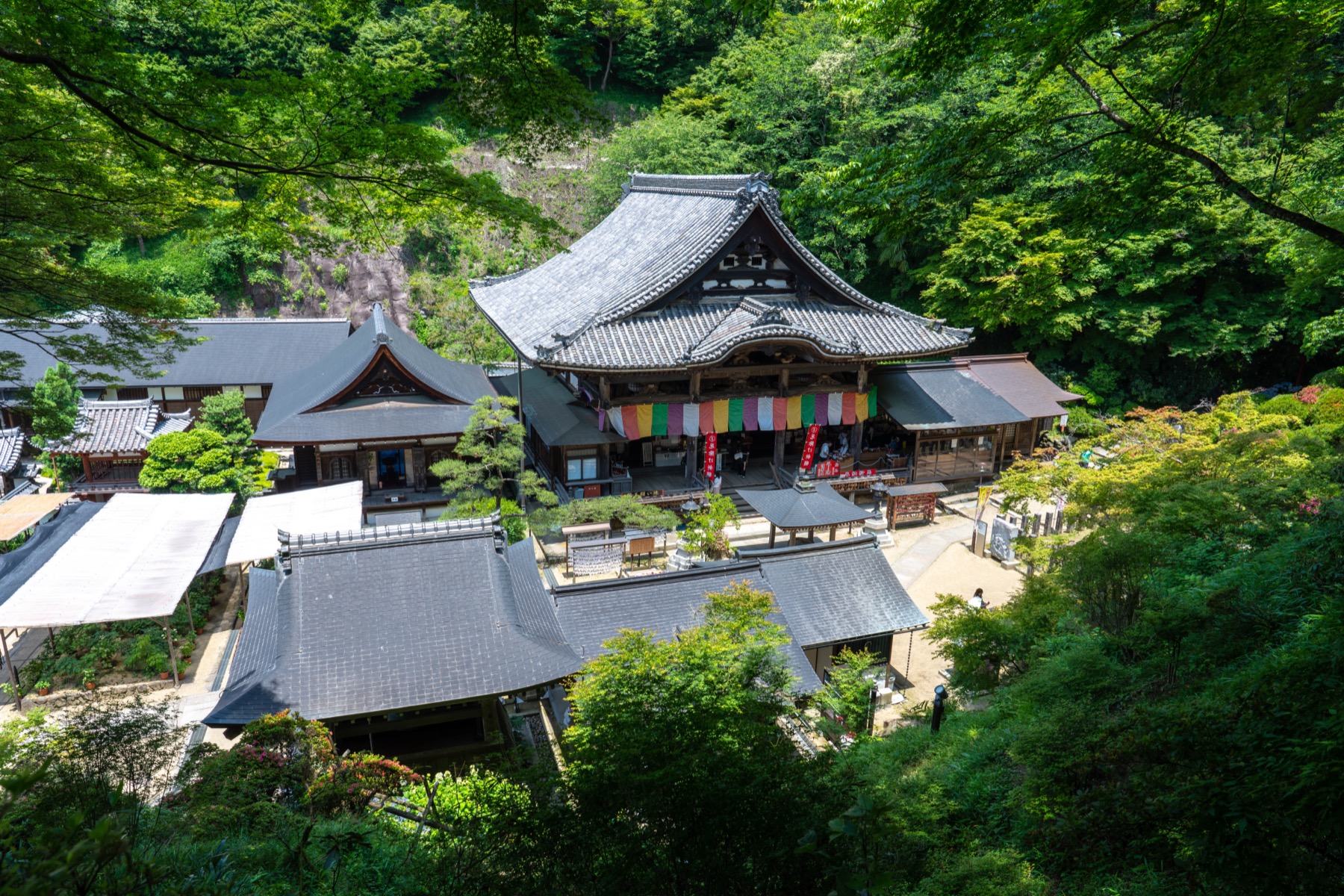
Inside the main hall sits the reason the pilgrims come: a seated Nyoirin Kannon from the Tenpyō era, 4.6 metres tall and made of clay — the largest clay Buddhist statue in Japan, and an Important Cultural Property. It’s long been venerated as a Kannon who protects women in particular. You’ll also pass the Niōmon gate and an Edo-period shoin, both Important Cultural Properties, and the temple’s vermilion three-story pagoda on the slope above.
The flowers — and when to come for them
Okadera earns its nickname as a flower temple honestly. The grounds hold around 3,000 rhododendrons, and when the “rhododendron path” up to the inner sanctuary fills in, the whole hillside turns pink — usually mid-April into early May. Over Golden Week the temple floats dahlias across its pond and water basins in the famous flower pond (hana-no-ike) by the gate; in 2026 that runs April 25 to May 6. Then come the hydrangeas: Okadera is one of four temples in the Yamato Kannon “Ajisai Corridor” (with Murōji, Hasedera and Tsubosaka-dera), and in 2026 the joint event runs June 6 to July 5, with the hydrangeas themselves good from late May into early July.
| Flower | When (2026) | Where to look |
|---|---|---|
| Rhododendron (~3,000) | Mid-April – early May | The “rhododendron path” to the inner sanctuary |
| Dahlia flower pond | Apr 25 – May 6 (Golden Week) | The pond and water basins by the Niōmon gate |
| Hydrangea (Ajisai Corridor) | Jun 6 – Jul 5 | Paths, steps and flower water-basins around the grounds |
| Autumn foliage | November | Across the hillside grounds |
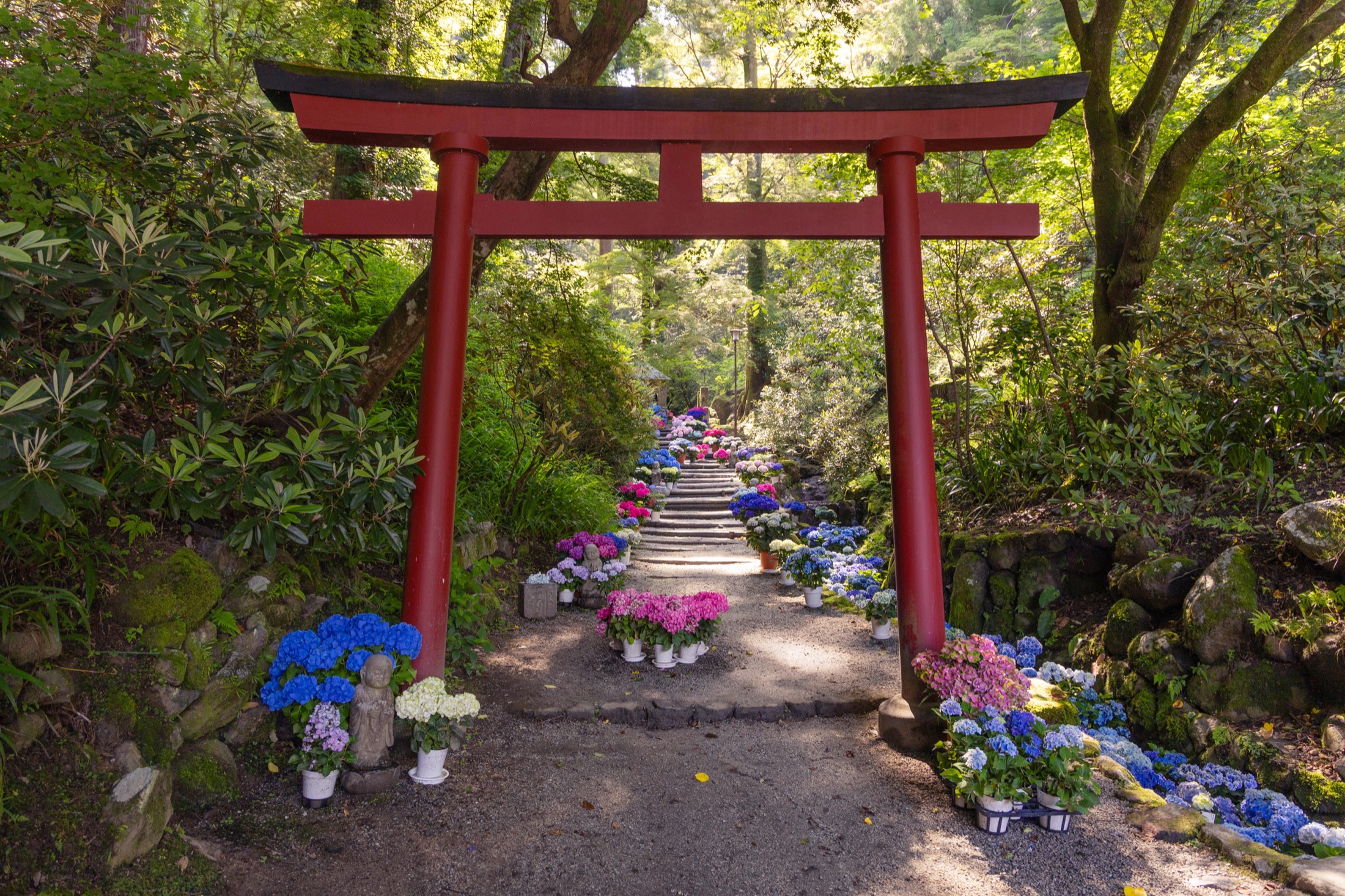
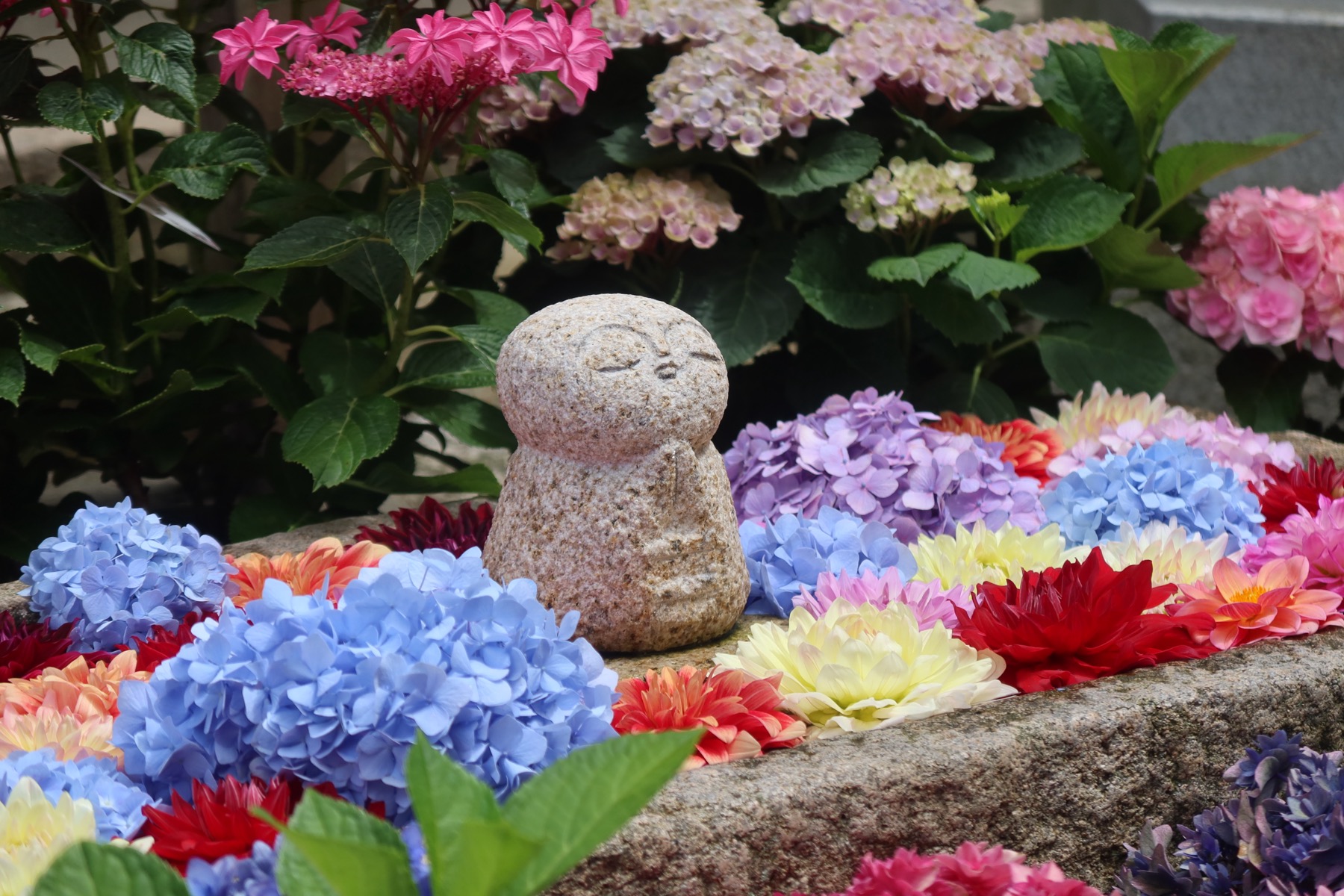
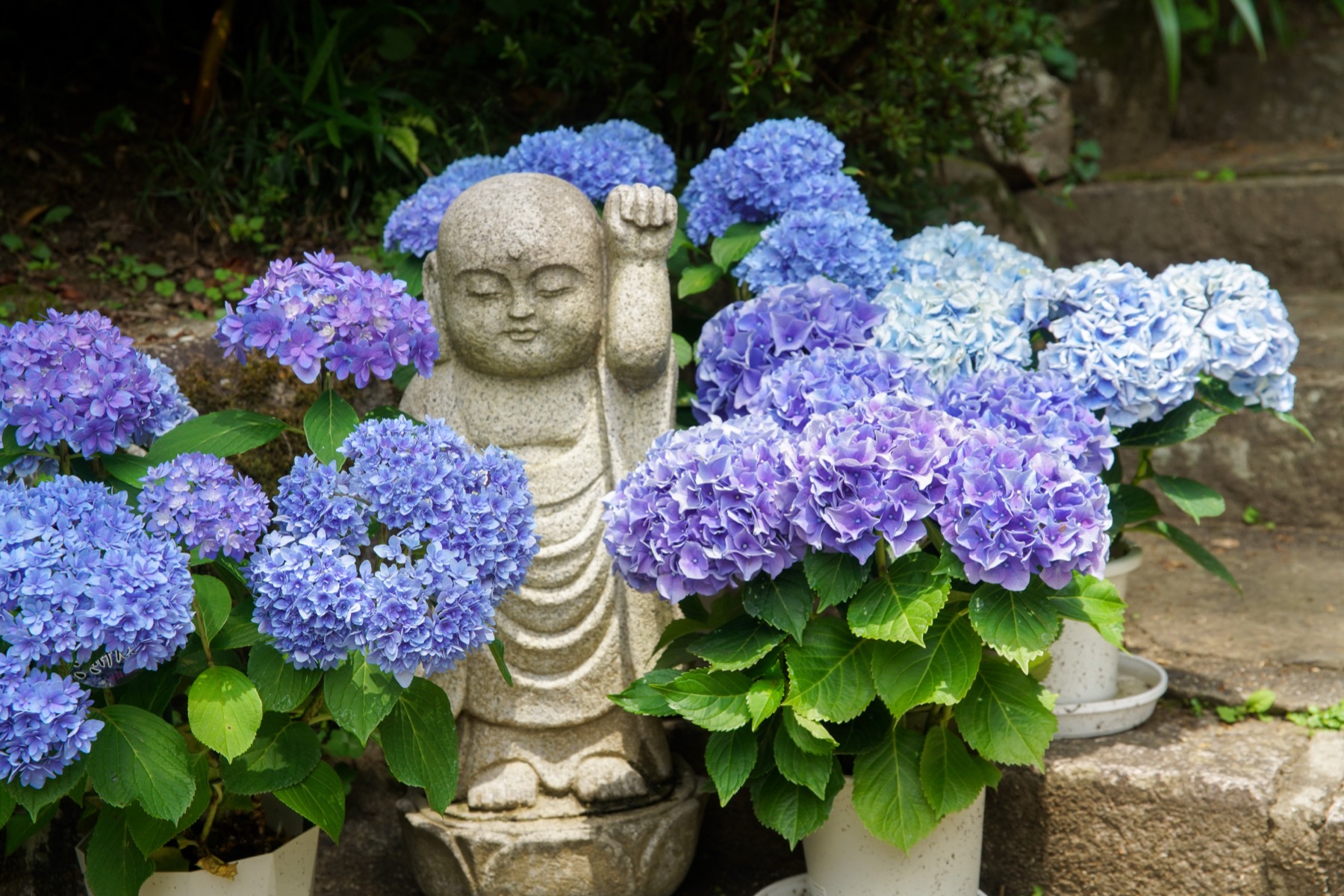
The detail people photograph most is the hana-chōzu — the stone water-basins filled with floating blooms. In hydrangea season they brim with blue and pink heads, often mixed with dahlias, and a small stone Jizō sits in the middle of it all.
What to see on the grounds
The dragon pond
The stone-capped pond by the entrance — the legend that gave the temple its name and its reputation for warding off bad luck.
Nyoirin Kannon
The 4.6 m clay Kannon in the main hall — Japan’s largest clay statue, an Important Cultural Property, prayed to for women’s protection.
Niōmon gate
The Important Cultural Property gate at the entrance, with its guardian figures — your first stop after the ticket window.
Three-story pagoda
The vermilion pagoda on the slope above the hall, the temple’s most photographed silhouette against the green.
Getting there
Okadera sits halfway up a hillside on the east side of Asuka. By train, take the Kintetsu line to Kashiharajingū-mae or Asuka station, then the Asuka loop bus (Asuka-shūyū bus) to the Okadera-mae stop — from there it’s about a 10-minute walk up to the gate. Asuka is small and flat at its centre, so plenty of people rent a bicycle at the station and ride between the village’s tombs, temples and the Ishibutai burial mound, with Okadera as the climb at the end. There’s parking near the temple if you drive.
Where to base for Asuka
Asuka itself is rural, so most people stay in Nara city, Kashihara (right by the Kintetsu gateway) or Asuka village, and ride or bus in. Booking has the widest spread around Nara; Rakuten Travel is stronger for the ryokan and onsen stays.
Good to know
What is Okadera known for?
It’s known as Japan’s first yakuyoke (bad-luck-warding) temple, the 7th stop on the Saigoku Kannon pilgrimage, and home to Japan’s largest clay statue — a 4.6 m seated Nyoirin Kannon. It’s also a famous flower temple, with rhododendrons, a dahlia “flower pond,” and hydrangeas.
How much is admission and what are the hours?
Admission is ¥500 for adults and university students, ¥400 for junior- and senior-high students, and free for elementary children and younger. Open 8:30–17:00 (8:30–16:30 December to February), with last entry shortly before closing.
When is the best time to see the flowers?
Rhododendrons (about 3,000 of them) peak mid-April to early May; the floating-dahlia “flower pond” runs over Golden Week (April 25–May 6 in 2026); hydrangeas are good late May into early July, with the four-temple “Ajisai Corridor” event June 6–July 5 in 2026.
How do I get to Okadera?
Take the Kintetsu line to Kashiharajingū-mae or Asuka station, then the Asuka loop bus to the Okadera-mae stop, and walk about 10 minutes uphill. Many visitors rent a bicycle at the station and ride around Asuka instead.
What does “Ryūgaiji” mean?
It means “dragon-lid temple.” Legend says the founding priest Gien sealed a dragon that was troubling Asuka’s farmers into the pond by the entrance and capped it with a large stone — the origin of both the name and the temple’s reputation for warding off misfortune.
Can I combine Okadera with other Asuka sights?
Yes — it pairs naturally with the Ishibutai burial mound, the village’s ancient tombs and palaces, and a bicycle loop of Asuka. For more hydrangea temples nearby, Murōji and Hasedera are on the same Ajisai Corridor.
Skip the Crowds in Japan (2026)
Beat the Nara-deer crush with calmer temples like this one.
Murōji Temple
The “women’s Kōya” in the Nara mountains — another Ajisai Corridor temple.
Two Hasedera in Hydrangea Season
The Nara and Kamakura Hasedera temples compared, both at their June best.
Tōdaiji & the Nara Deer
The Great Buddha and the deer park, an easy add-on in Nara city.
Yakushiji
The World Heritage temple in western Nara — its original 730 pagoda and bronze Yakushi Triad.
Plan an Asuka Day Trip
Okadera is an easy half-day from Nara, Osaka or Kyoto. Three ways to set it up.
Asuka village townscape
The old townscape and ancient sites of the village right around Oka-dera.
Join travelers discovering Japan's hidden side
Weekly dispatches from off-the-beaten-path Japan — spots and stories you won't find in guidebooks.
No spam. Unsubscribe anytime.
Welcome aboard!
You're in. See you in your inbox soon.