
Nagano · Temples
Zenkoji in Nagano City runs on a different clock from most famous temples: its morning service starts at dawn — roughly 5:30 in high summer to 7:00 in midwinter, shifting daily with the sunrise — and the inner sanctum opens a full hour before that. The temple has also fixed the dates for its next Gokaicho, the once-in-roughly-seven-years unveiling of the Maedachi Honzon: April 4 to June 19, 2027. This guide covers the dawn rituals, the 2026 tickets, and how to plan either trip.
Why I plan Zenkoji around dawn
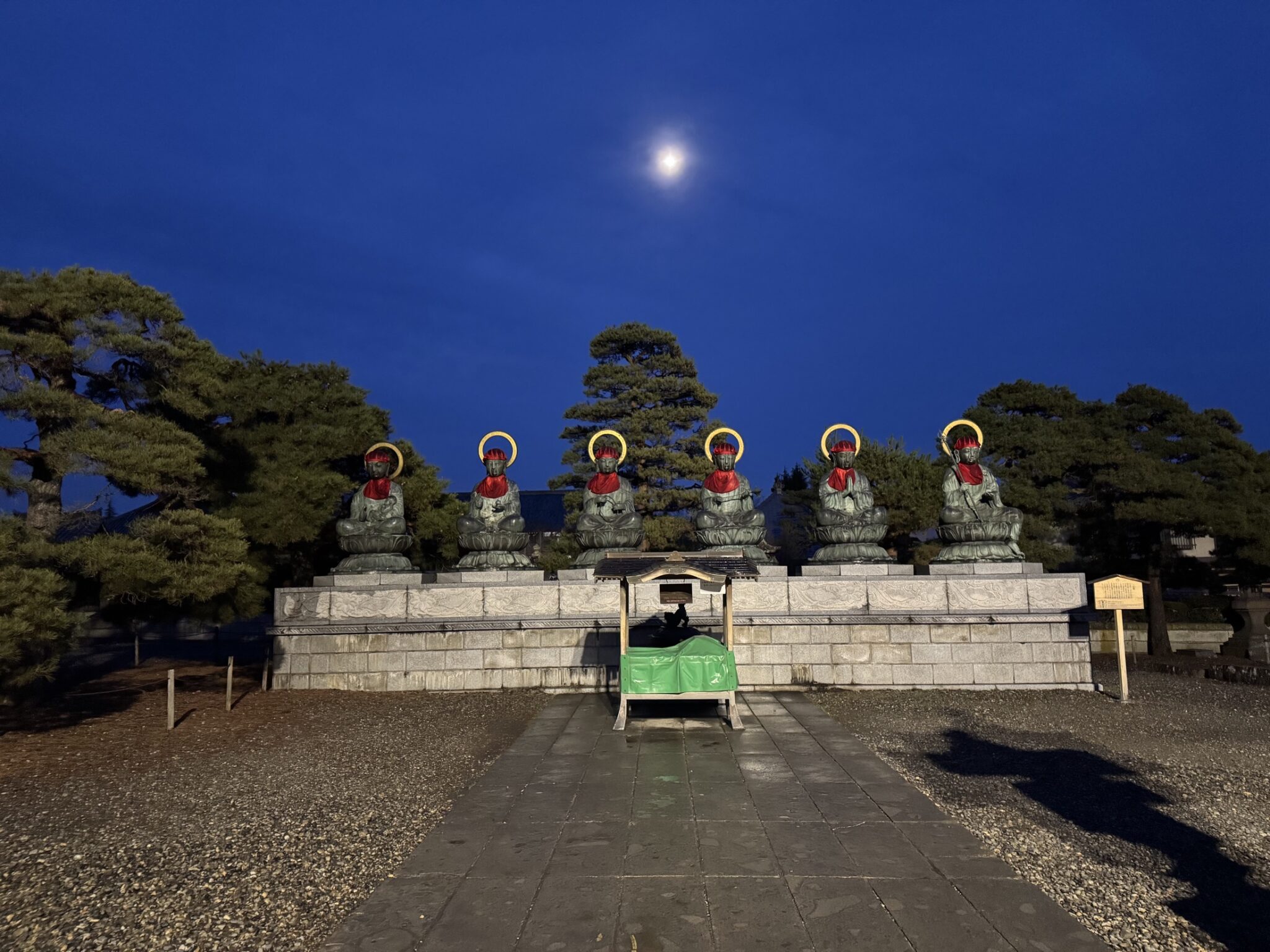
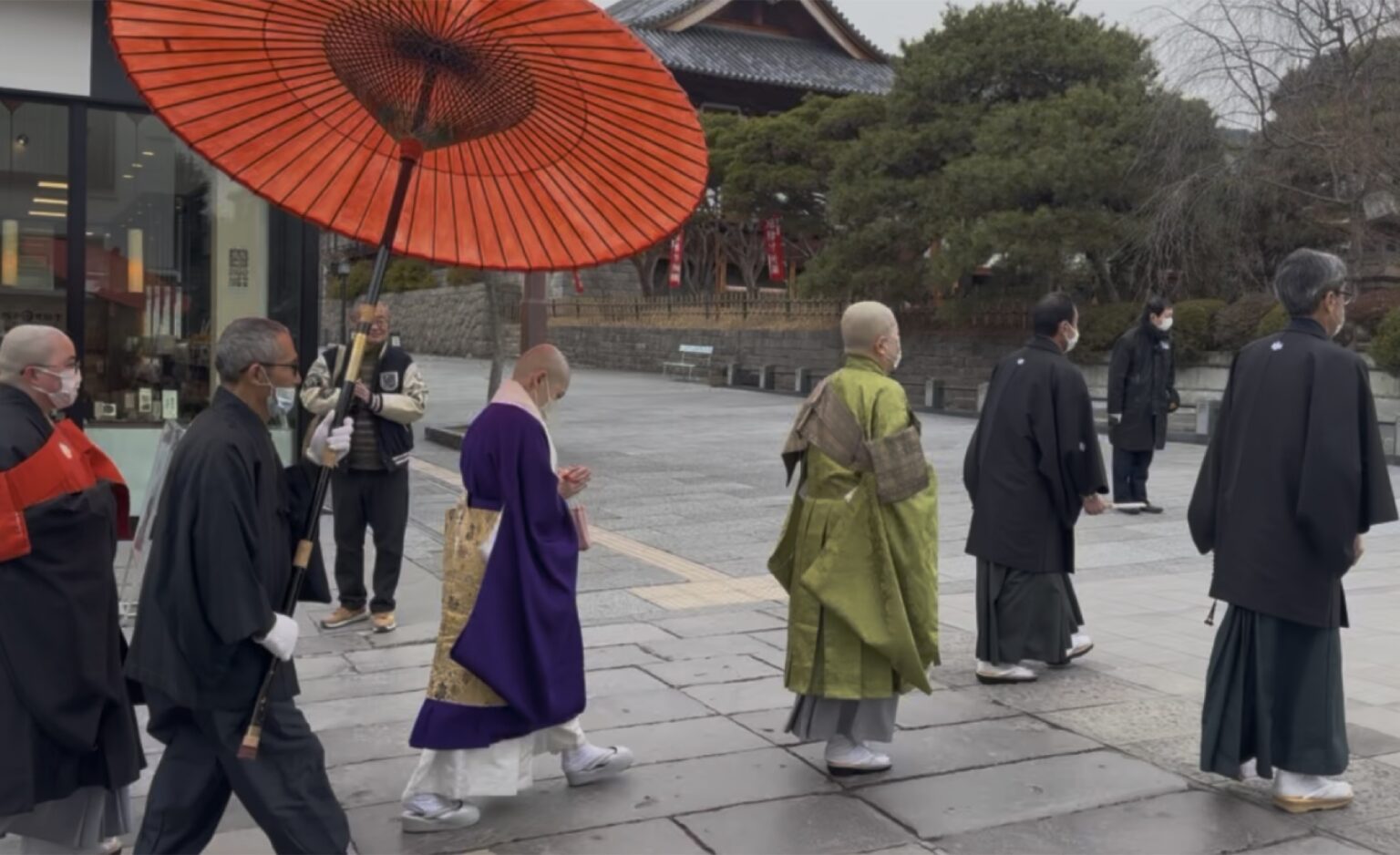
Most people see Zenkoji as a two-hour stop between Nagano Station and the snow monkeys. That works — but the temple’s whole character lives in the first hour of the day, when the o-asaji morning service fills the National Treasure Main Hall with chanting and the approach is quiet enough to hear pigeons on the gate. I walked up before first light with the moon still over the six Jizo statues, and by the time the priests processed past under a red umbrella, the day-trip crowds were still asleep in Tokyo. If you can spend one night in Nagano, this is the version of Zenkoji to plan for.
The Buddha nobody sees: a short history
The important fact first: Zenkoji’s principal image, the Ikko Sanzon Amida Nyorai, is an absolute hidden Buddha — hibutsu — never shown to anyone, not to the public, not to the temple’s own priests. What the famous Gokaicho unveils is the Maedachi Honzon, a designated stand-in statue made for exactly this purpose. Plenty of writing muddles the two; if you read that you can “see Zenkoji’s main Buddha”, you can’t.
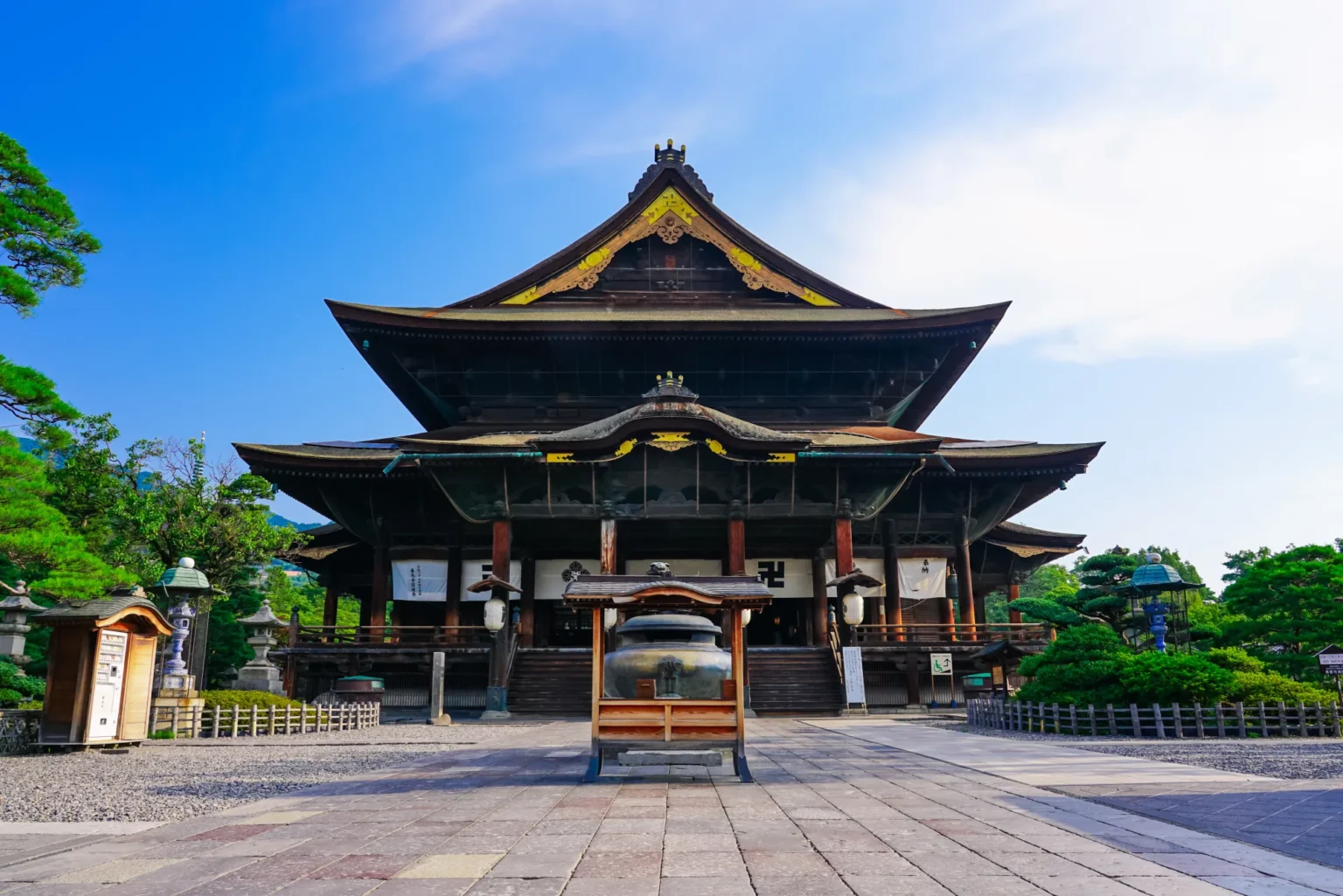
By the temple’s own account the image was moved to the present site in 642, and the halls were built and named Zenkoji in 644 — which makes this one of Japan’s oldest Buddhist sites, predating the sects that later organised Japanese Buddhism. That’s why Zenkoji is formally non-sectarian: it is jointly run by Daikanjin, a Tendai temple, and Daihongan, a Jodo (Pure Land) convent led by a female head priest. The saying “even a cow can lead you to Zenkoji” (ushi ni hikarete Zenkoji mairi) comes from the temple’s founding legends and still captures how it works — everyone ends up here eventually, whatever they believe. The current Main Hall, rebuilt in 1707 after fires and designated a National Treasure in 1953, is one of the largest wooden structures in Japan — about 54 metres deep and 26 metres tall.
What time is the morning service — and can tourists join?
The o-asaji starts at sunrise, so there is no fixed time: it drifts from about 5:30 at midsummer to about 7:00 in the depths of winter, changing day by day. The temple posts the current schedule, and your shukubo or hotel can tell you the exact time for tomorrow. Anyone can attend — buy the inner sanctum ticket (¥800, or the ¥1,500 combined ticket) at the hall, sit where directed, and stay through the service, following the attendants’ lead. The service is held by both of Zenkoji’s resident traditions in turn each morning — the Tendai side and the Jodo side each conduct their own rite.
Two things to know so your expectations are accurate. First, this is a working religious service, not a show: no photos inside, and you follow the attendants’ directions. Second, at points in the service the brocade curtain in front of the altar is raised — what becomes visible is the Ruri-dan altar platform and the closed zushi shrine — never the hidden image itself. It is still, in the half-dark with the hall filled by chanting, one of the most atmospheric things I’ve experienced at any Japanese temple.
Can visitors receive the o-juzu chodai blessing?
Yes — this is the ritual that makes arriving early worth it even if you skip the service itself. Every morning, on their way to and from the Main Hall, Zenkoji’s two head priests — the Kanshu of Daikanjin and the Shonin of Daihongan, who is one of the most senior female clerics in Japanese Buddhism — walk the approach under a red umbrella and touch their prayer beads to the head of each person kneeling along the route. It happens four times each morning in total (each priest passes twice), it costs nothing, and no reservation exists. Kneel at the edge of the stone approach in front of the Main Hall, lower your head, and wait; an attendant will gesture if you’re in the wrong spot. I photographed the procession once from a respectful distance and put the camera away for my own turn.
Okaidan-meguri: the corridor in total darkness
Under the innermost altar runs a pitch-black passage — not dim, but genuinely lightless. You feel your way along the right-hand wall until your fingers find a heavy metal lock, said to sit directly beneath the hidden Buddha and to form a connection with it when touched. That’s the whole experience: you see nothing, which is the point. It’s included in the inner sanctum and combined tickets, takes about five minutes, and is the single thing I’d tell a first-timer not to skip. The passage is completely dark and narrow: keep your right hand on the wall, move slowly, and follow the attendants’ instructions. If darkness or enclosed spaces are a real problem for you, sit this one out — go right after the morning service if you want it at its quietest.
Tickets and hours in 2026
Zenkoji revised its prices on April 1, 2026 — older English pages (including some official ones) still show the pre-revision figures, so treat anything quoting ¥600 for the inner sanctum as out of date.
| Ticket | Adult | Junior/senior high | Elementary | Covers |
|---|---|---|---|---|
| Combined (recommended) | ¥1,500 | ¥600 | ¥200 | Inner sanctum + Okaidan-meguri + Sanmon gate + sutra hall + history museum |
| Inner sanctum | ¥800 | ¥300 | ¥100 | Inner sanctum, Okaidan-meguri & history museum |
| Sanmon gate | ¥800 | ¥300 | ¥100 | Climb to the gate’s upper storey |
| Sutra hall (Kyozo) | ¥500 | ¥300 | ¥100 | Turn the revolving sutra repository |
Preschool children are free throughout. The inner sanctum opens one hour before the morning service and closes at 16:30 from April to October, 16:15 in March and November, and 16:00 from December to February. The Sanmon gate, sutra hall and museum keep simpler hours: 9:00 to 16:00. The grounds themselves are open around the clock — which is what makes the dawn visit possible without a ticket until you enter the hall.
Around the grounds and down the Nakamise
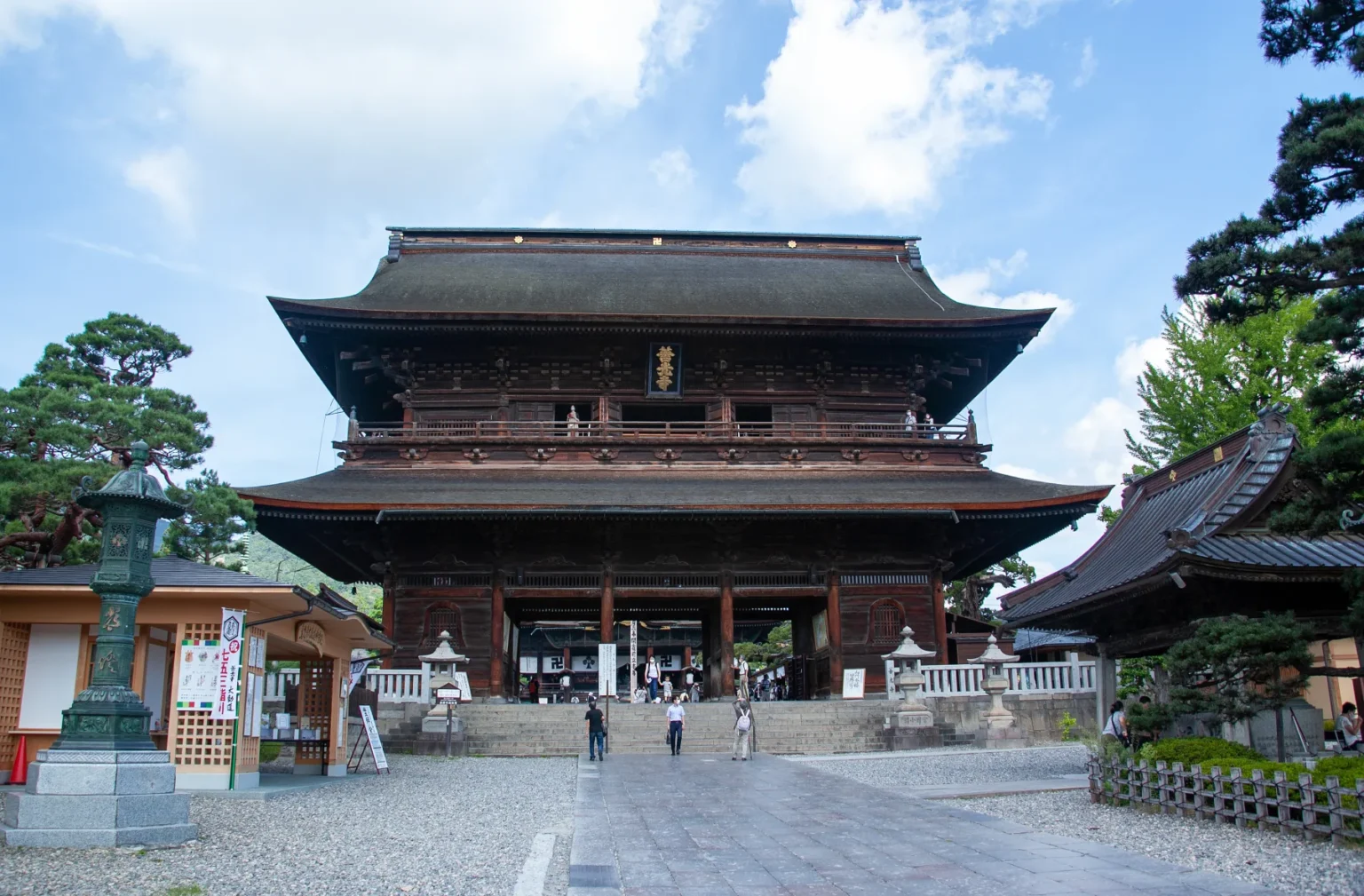
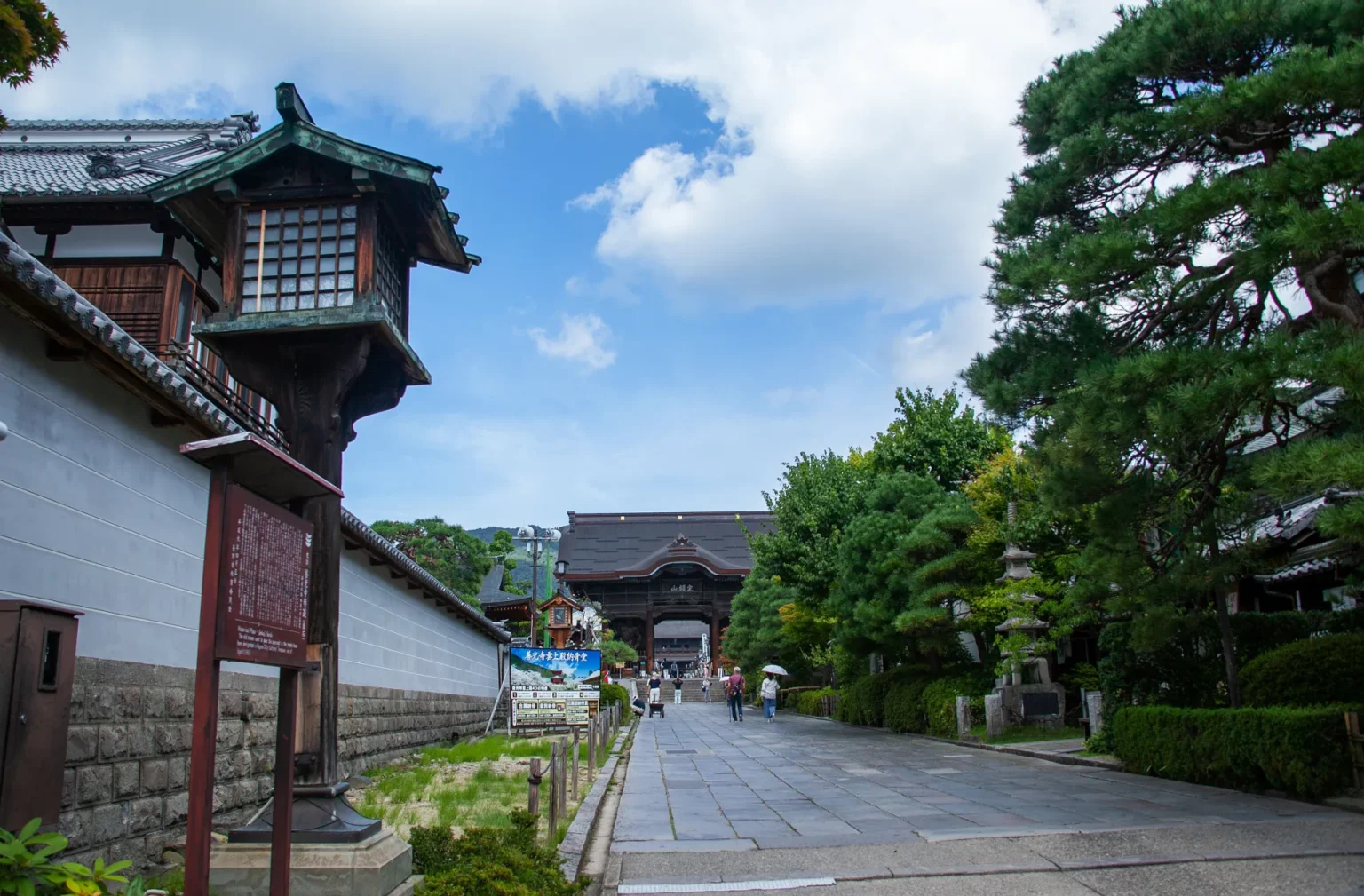
Give the precinct more time than a temple-stamp visit. The two-storey Sanmon gate (1750) is climbable, with a view straight down the approach; look for the famous plaque in which five pigeons hide in the calligraphy. The Kyozo sutra hall holds a revolving repository of the complete Buddhist canon — pushing it around once is held to equal reading the whole thing. Just inside the Niomon gate sit the Six Jizo, one for each realm of existence, and beside them the seated Nurebotoke (“wet Buddha”) Jizo, bright with a red hood against the weather. The Nakamise street running between the gates is where Nagano’s temple-town character shows: soba restaurants, oyaki dumpling stands, shichimi chili shops and apple-everything souvenirs. Soba noodles and oyaki — wheat buns stuffed with mountain vegetables — are the two local things actually worth queueing for.
Should you plan your 2027 trip around the Gokaicho?
If you’ll be in Japan between April 4 and June 19, 2027 — yes, and book accommodation the moment your dates firm up. The Gokaicho is Zenkoji’s biggest event, traditionally held once every seven years by Japanese inclusive counting (about every six years in practice; the 2027 edition follows the 2022 one, which had itself been postponed a year): the Maedachi Honzon is enthroned in the Main Hall, and a 10-metre pillar, the ekobashira, is raised in front of the hall and joined to the statue by a thread of five colours. Touching the pillar is held to create the same connection as touching the statue itself — this is the ritual millions come for. The temple has published the key 2027 dates: the pillar arrives March 28, the statue is enthroned April 3, and the opening ceremony is April 4, with closing rites on June 19 and the return transfer ceremony on June 20. The previous Gokaicho in 2022 drew crowds across 88 days; 2027 runs 77. Weekends and the ceremony dates will be the crush points — a weekday dawn visit works even then.
Don’t want crowds at all? Any other year, Zenkoji gives you the same rituals with a fraction of the people — the o-asaji and o-juzu chodai happen every single morning, Gokaicho or not.
How do I get to Zenkoji from Tokyo?
Take the Hokuriku Shinkansen from Tokyo Station to Nagano: Kagayaki trains take around 80 minutes, Hakutaka around 90, and Asama around 105. Unreserved seats (¥7,920) are available on Hakutaka and Asama; Kagayaki is all-reserved, and a reserved seat runs roughly ¥8,250–8,850 depending on ticket type and season. From Nagano Station’s Zenkoji exit, take any bus from stop 1 to Zenkoji Daimon (about 15 minutes, ¥190), then walk five minutes up the approach. Or simply walk the whole way: 1.8 km, about 30 minutes, gently uphill along Chuo-dori. For the morning service, allow 20 minutes on foot from the Daimon area — buses don’t run early enough in most seasons, which is the practical argument for sleeping near the temple.
Where to stay for a dawn visit
Two honest options. First, the temple’s own shukubo: 39 lodgings run by Zenkoji’s sub-temples line the streets around the approach, taking guests from ¥13,200 per person with two meals. Staying in one puts you two minutes’ walk from the morning service, usually with a priest from the house walking you over and explaining the ritual — the full version of the experience. Booking is by phone through the temple’s lodging association and works best with some Japanese or a hotel concierge’s help; the standard rate assumes two or more adults, and solo travellers are asked to enquire directly.
Second, a hotel near Nagano Station or along Chuo-dori — simpler to book, and you’re still a 20–30 minute pre-dawn walk or short taxi from the hall. Compare Nagano City hotels on Booking.com; for the 2027 Gokaicho window, prices near the temple will climb as the dates approach, so booking early matters far more than which platform you use.
Best time to visit
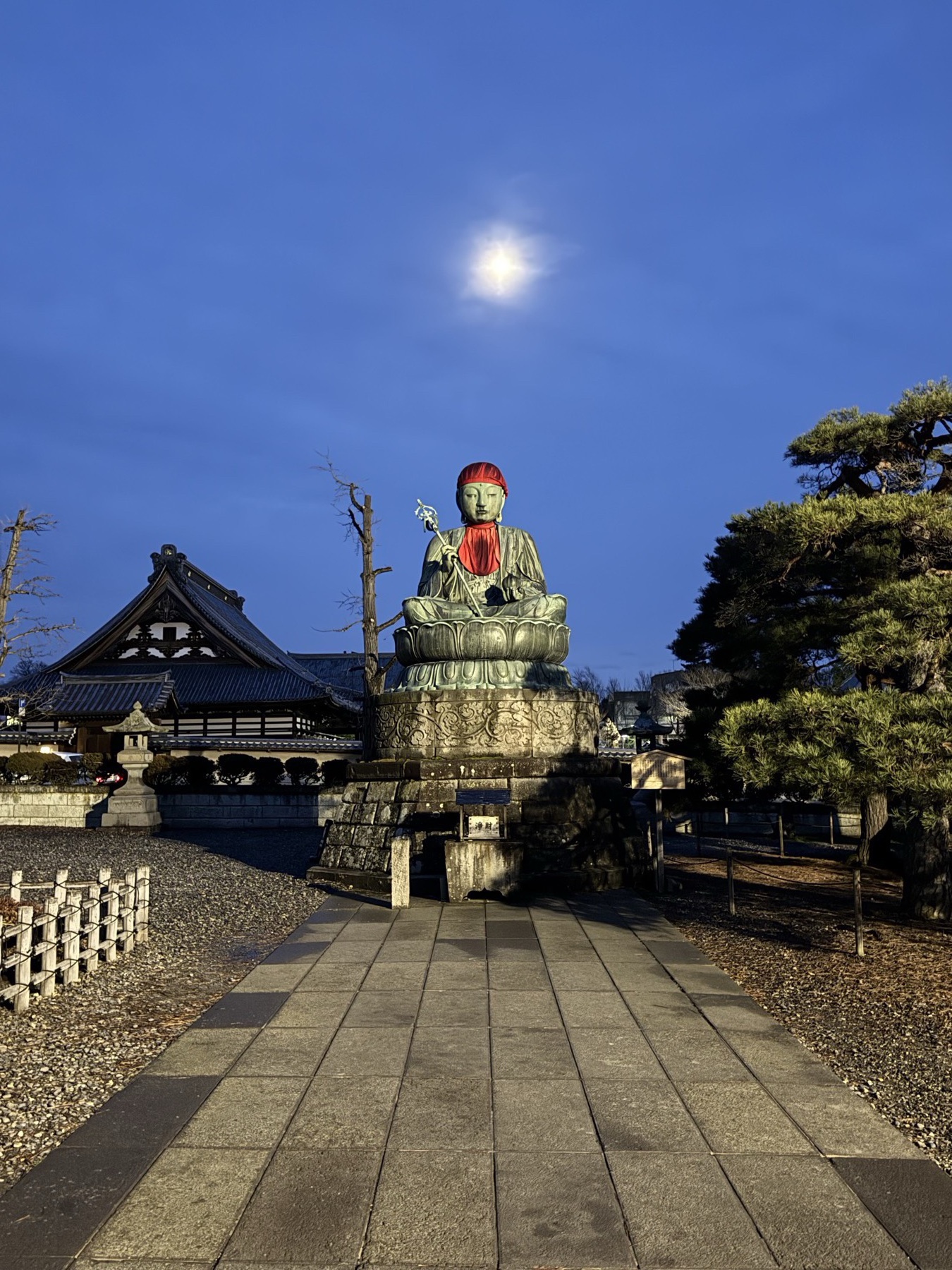
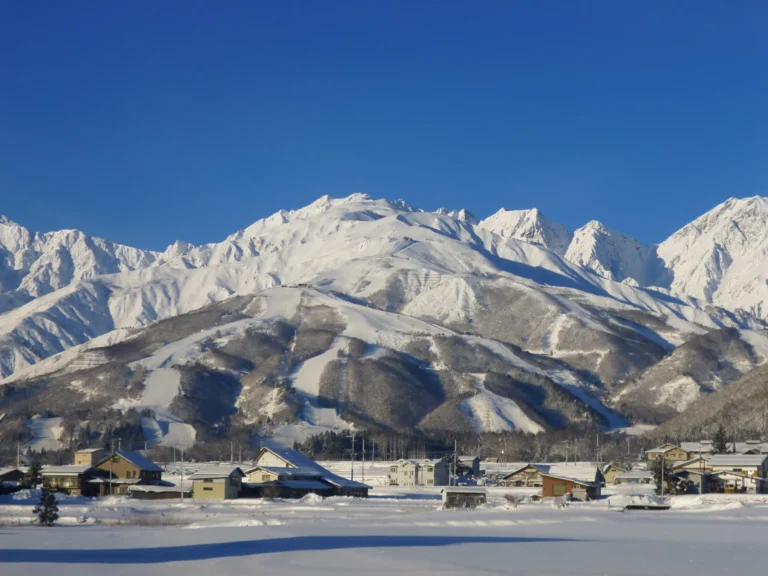
Zenkoji works year-round, but the character changes. Winter mornings are the most atmospheric — and the coldest: Nagano sits at 370 m and pre-dawn temperatures from December to February are regularly well below freezing, so dress for it (if you’re arriving from Singapore or Bangkok, this is jacket-gloves-and-thermals weather, not sweater weather). My photos here are from a winter dawn with the moon still up. Spring brings cherry blossoms to the adjacent Joyama Park in mid-April, summer gives you the earliest services around 5:30 with comfortable mornings, and autumn colour peaks in early-to-mid November. The one crowd warning outside the Gokaicho: the Nagano Tomyo lantern festival in February and New Year’s hatsumode both fill the approach.
Make Nagano the trip, not the stopover
Zenkoji pairs naturally with the rest of northern Nagano. The cedar avenue of Togakushi Shrine is an hour’s bus ride from Nagano Station and makes the classic same-day combination — temple at dawn, forest shrine by mid-morning. In winter, the Jigokudani snow monkeys are the other half of most itineraries. With an extra day, Matsumoto Castle is under an hour away by limited express on the Shinonoi Line, and the moon-viewing rice terraces at Obasute sit on the same line if you like slow windows. All of them work from a Nagano City base. And if you are returning toward Tokyo on the Chuo Line side, the four shrines of Suwa Taisha around Lake Suwa break the journey with one of Japan’s oldest shrine complexes.
FAQ
What time does the morning service start at Zenkoji?
At dawn — roughly 5:30 in midsummer and closer to 7:00 in midwinter, changing daily with the sunrise. Check the temple’s posted schedule or ask your accommodation for the exact time on your date, and arrive 15–20 minutes early to see the priests’ procession.
Can tourists attend the o-asaji and receive the o-juzu chodai blessing?
Yes to both. The service is open to anyone with an inner sanctum ticket, and the blessing is free: kneel along the stone approach as each head priest passes to and from the hall, and they will touch their prayer beads to your head. It happens every morning, four passes in total.
Can you see Zenkoji’s main Buddha statue?
No — never. The Ikko Sanzon Amida Nyorai is an absolute hidden Buddha, shown to no one including the temple’s priests. During a Gokaicho (next: April 4 – June 19, 2027), the temple displays the Maedachi Honzon, a historic stand-in statue, and visitors touch a pillar connected to it by a five-coloured thread.
How much does Zenkoji cost to visit in 2026?
The grounds are free. The combined ticket — inner sanctum, the dark Okaidan-meguri corridor, the Sanmon gate climb, the sutra hall and the history museum — is ¥1,500 for adults after the April 2026 price revision. The inner sanctum alone is ¥800.
Is the Okaidan-meguri scary or claustrophobic?
It is genuinely pitch-black and the corridor is narrow, so people with strong claustrophobia may prefer to skip it. There are no steps or obstacles — you trail your right hand along the wall until you reach the key-shaped lock, and you’re out in about five minutes.
Is Zenkoji worth staying overnight for, or is a day trip enough?
A day trip from Tokyo comfortably covers the temple, gate and Nakamise street. But the morning service and blessing happen at dawn, before day-trip trains arrive — so if you want the temple at its best, stay one night in a shukubo lodging or a Nagano City hotel and walk up before first light. If a temple stay is new to you, our shukubo and minshuku guide explains how it works.
When is the next Zenkoji Gokaicho and how crowded will it be?
April 4 to June 19, 2027 — 77 days, per the temple’s official announcement. The 2022 edition drew millions of visitors over 88 days, with weekends around the major ceremonies the busiest. Weekday mornings are the workable window, and accommodation will book out well ahead.
Can I take photos at Zenkoji?
Personal snapshots are fine on the outdoor grounds and approach — but not inside the Main Hall, during the service, or in the Okaidan-meguri corridor. For the priests’ procession, photograph from a distance and put the camera down when you kneel for the blessing. Note that the temple treats the precinct as private grounds and asks that photography for publication or commercial use go through its permission process.
Sources checked (August 2026): Zenkoji official — tickets & hours · April 2026 price revision notice · Reiwa 9 (2027) Gokaicho announcement · Zenkoji official — history · Zenkoji shukubo lodgings · Zenkoji official — access.
Join travelers discovering Japan's hidden side
Weekly dispatches from off-the-beaten-path Japan — spots and stories you won't find in guidebooks.
No spam. Unsubscribe anytime.
Welcome aboard!
You're in. See you in your inbox soon.