Nara · Temples & mountains
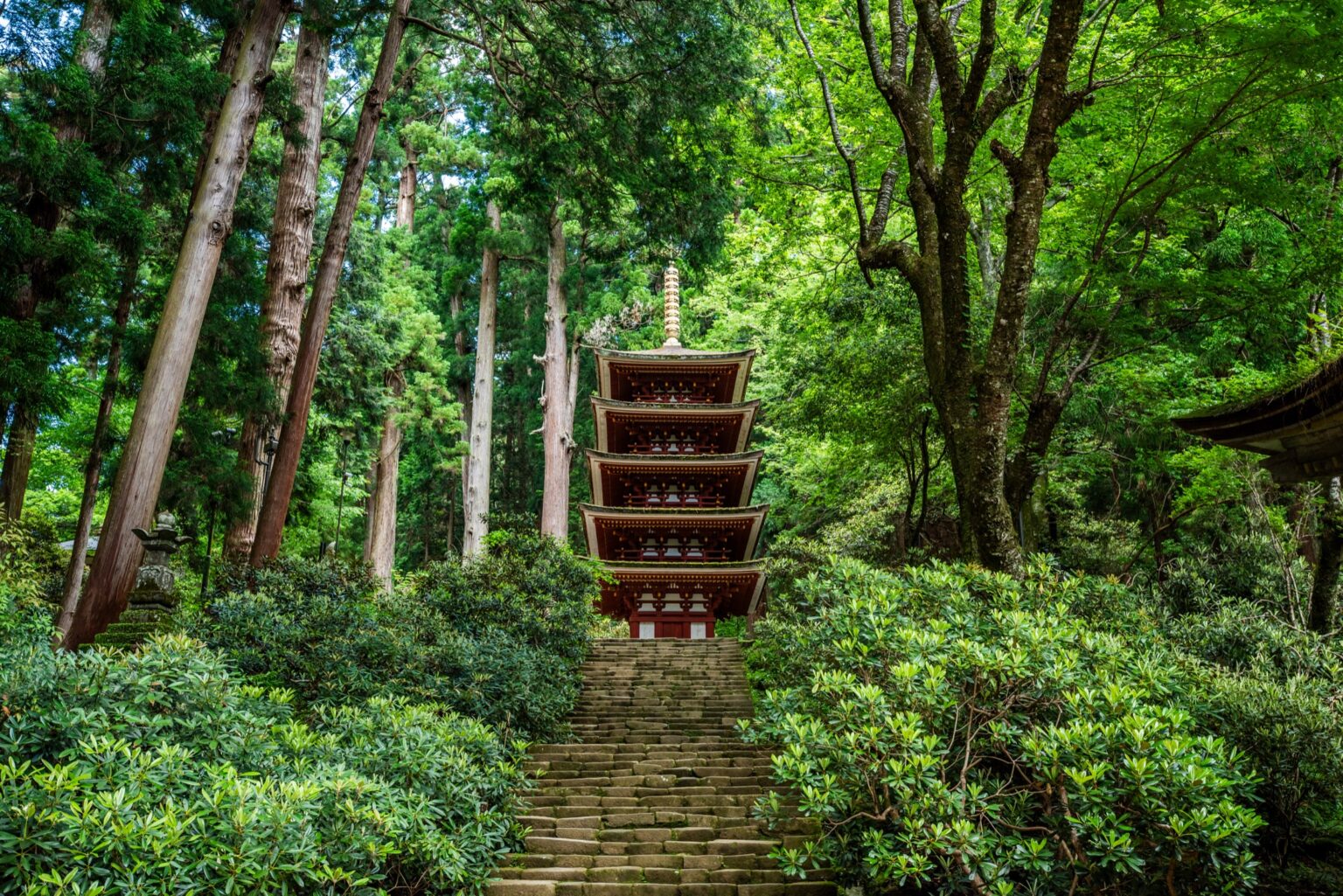
Murō-ji is a 1,200-year-old Shingon temple buried in the cedar mountains of Uda, in eastern Nara Prefecture, long nicknamed the “Women’s Kōya” (女人高野) because it welcomed female pilgrims when nearby Mount Kōya turned them away — and its roughly 16-metre five-story pagoda, raised around the year 800, is the smallest outdoor pagoda of its kind in Japan and the second-oldest after Hōryū-ji.
Most people who come to Nara never get past the deer in Nara Park and the Great Buddha at Tōdai-ji. Murō-ji is the opposite of that day: a small mountain temple an hour and a half out of the city, reached by one country bus, where the main hall and the pagoda sit halfway up a forested slope and the loudest thing is usually the river. It is one of my favourite places in Kansai to send someone who has “done” Kyoto and Nara and wants the older, quieter thing underneath them. Here’s what to see, when the flowers and the maples peak, and exactly how to get there on the bus that matters.
What makes Murō-ji different
Murō-ji belongs to Shingon, the esoteric “mountain Buddhism” brought back from China by Kūkai (Kōbō Daishi). It was founded in the Hōki era (770–781) on the orders of the imperial court — the monk Kenkei is named as founder, and his successor Shuen (771–835) is credited with actually building the place up. From the start it was a temple of the deep mountains, the kind of site Shingon chose on purpose: hard to reach, surrounded by old cedar, a long way from the politics of the capital.
Its better-known nickname comes much later. The great Shingon centre of Mount Kōya (Kōyasan) barred women from its precincts until 1872. Murō-ji never did — it let women in to worship — and so by the Edo period it had earned the name Nyonin Kōya, the “Women’s Kōya.” That single fact is why a lot of Japanese visitors make the trip, and it’s worth carrying up the stairs with you: for centuries this was the mountain temple women could actually enter.
The red bridge and the Niō gate
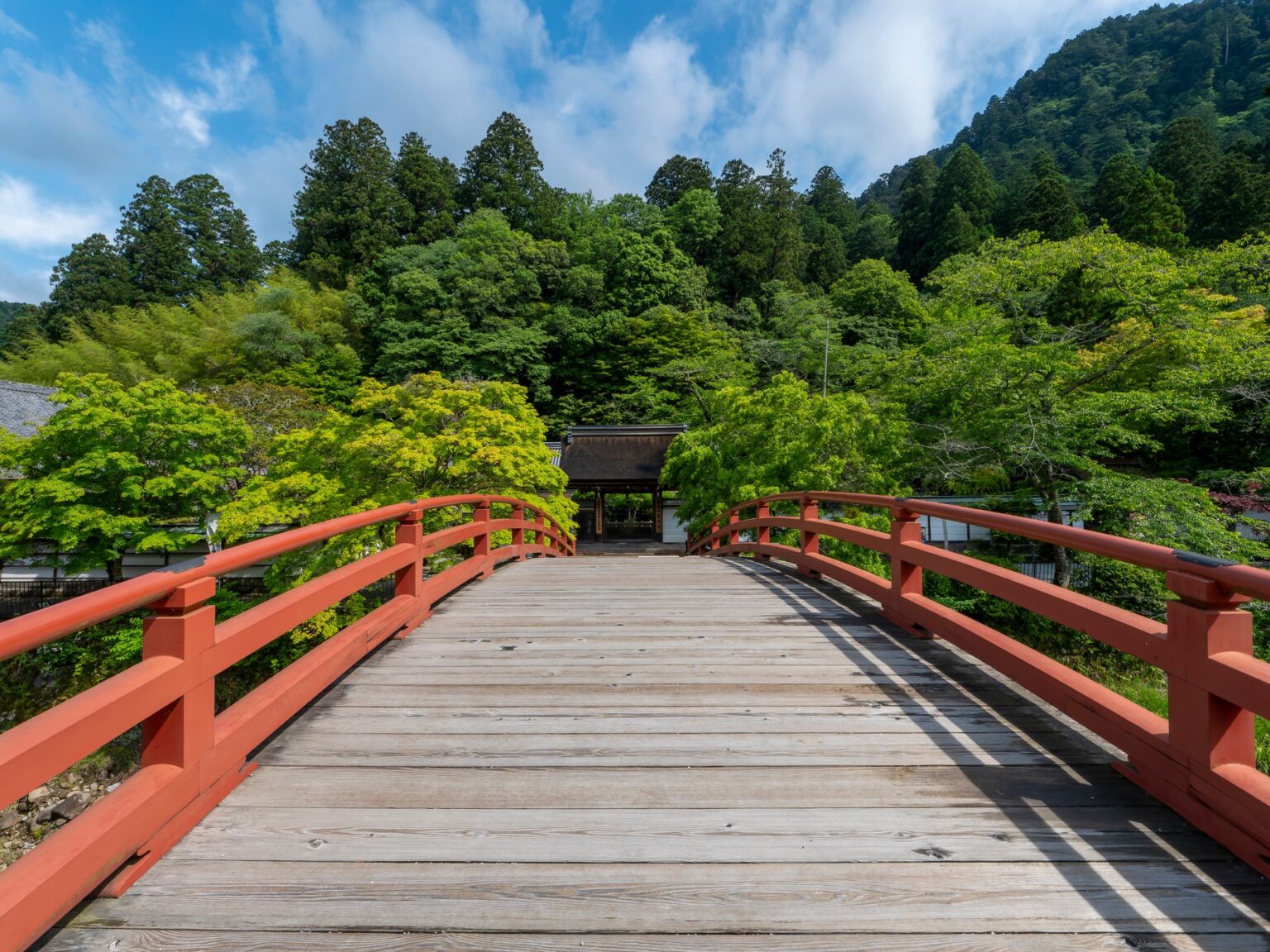
You arrive at the bottom. The temple sits across the Murō River, and the way in is over the Taiko-bashi, a humpbacked red bridge that frames the whole approach — green mountains on every side, the water running underneath, the grounds beginning on the far bank. It’s the photograph everyone takes first, and for once the obvious shot is the right one.
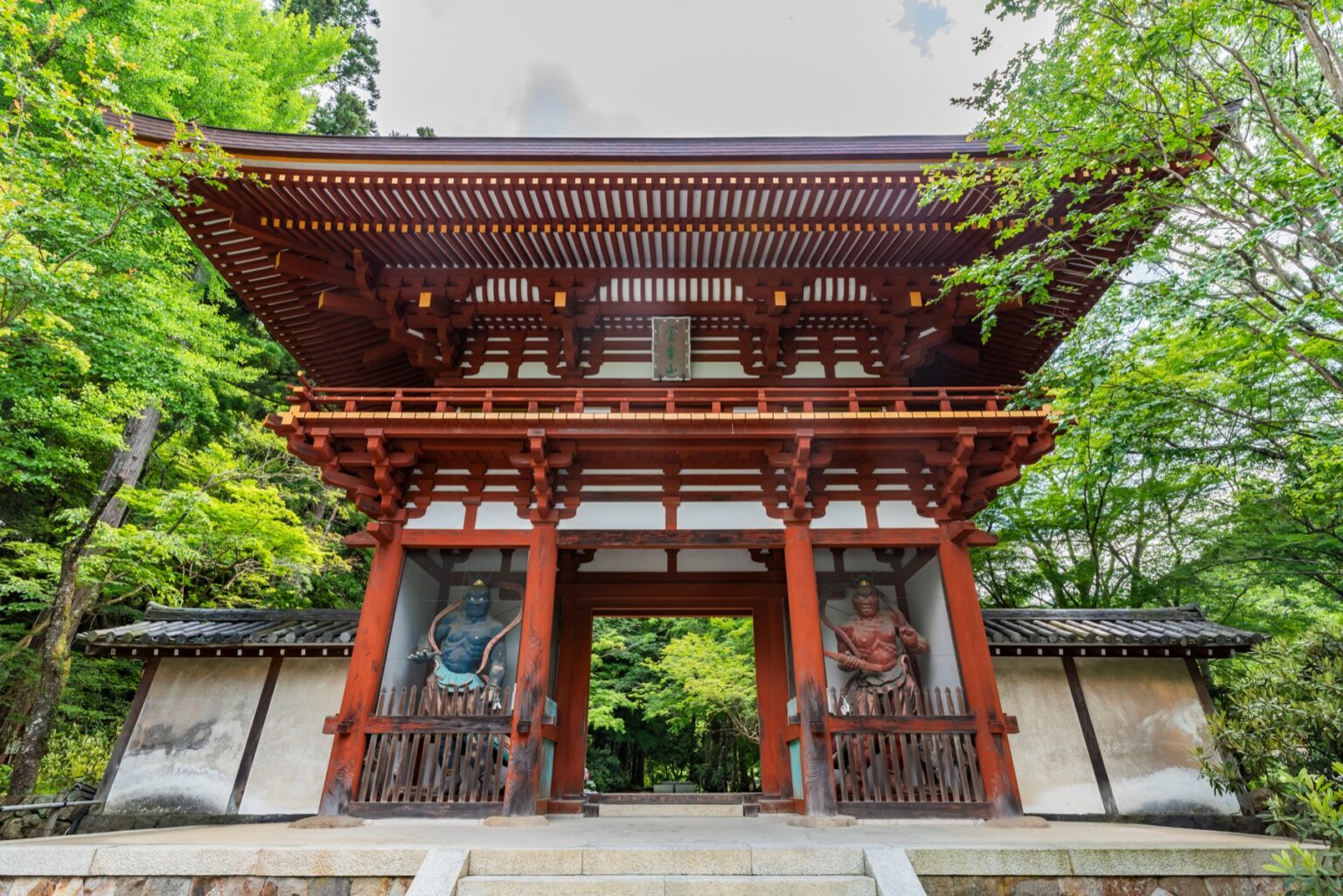
Past the bridge you reach the Niōmon, the two-story vermillion gate with a pair of Niō guardian kings standing in its side bays, glowering at everyone who passes. The current gate is a 1965 rebuild, but it does its job: it’s the line between the riverbank and the climb, and beyond it the maples close in overhead.
Up the Yoroizaka to the Golden Hall
From the gate the path becomes the Yoroizaka — the “armour slope” — a stairway of rough natural stones banked on both sides with rhododendron. In late April and early May it is the single most photographed spot at Murō-ji, the grey steps disappearing up into pink blossom. It climbs to the Kondō (Golden Hall), a 9th-century wooden hall and a National Treasure, built into the slope on a stilted veranda the way mountain halls are.
The Kondō is closed for re-roofing from 5 October 2026 until some time in 2027, so check the temple notice before you count on seeing inside. Inside is the reason art historians make this trip. The Kondō holds a standing Shaka Nyorai (Historical Buddha) of about 237 cm and an Eleven-Headed Kannon of about 195 cm, both carved in the 9th century and both National Treasures, along with a row of the Twelve Heavenly Generals whose faces here are oddly gentle rather than fierce. These are early Heian sculptures — heavy, serene, carved when the temple itself was young.
The five-story pagoda
Keep climbing and you reach the building Murō-ji is known for. The five-story pagoda stands only about 16 metres tall — small enough that it surprises people who expect something towering — and that is exactly the point: it is the smallest five-story pagoda standing in the open air in Japan, and the second-oldest of any after the one at Hōryū-ji, raised around the year 800. Set among cedars that dwarf it, with the stone steps leading your eye straight up to it, it is one of the most quietly perfect structures in the country. Until the roof works finish (the temple expects autumn 2027), visits to the pagoda are suspended; see the note at the top.
It nearly didn’t survive the last century. In 1998 a typhoon brought down a cedar said to be around 50 metres tall, and it fell across the pagoda and crushed much of the roof and upper stories. The restoration took two years, finishing in 2000, and the building you see now is that careful repair. Standing under it, knowing how close it came, changes how you look at it.
| What it is | Status | Detail |
|---|---|---|
| Five-story pagoda | National Treasure | ~16 m, built c. 800; smallest outdoor pagoda of its kind in Japan |
| Kondō (Golden Hall) | National Treasure | 9th-century hall on the slope; houses the treasure statues |
| Hondō / Kanjō-dō (main hall) | National Treasure | Built 1308; enshrines a six-armed Nyoirin Kannon |
| Shaka Nyorai, standing | National Treasure | ~237 cm, 9th century (Kondō) |
| Eleven-Headed Kannon | National Treasure | ~195 cm, 9th century (Kondō) |
| Shaka Nyorai, seated | National Treasure | ~106 cm, early Heian (Mirokudō) |
For a temple this small and this remote, that is an extraordinary concentration — three National Treasure buildings and a clutch of National Treasure sculpture, on one forested hillside. It’s why Murō-ji punches so far above its size.
The climb to the inner sanctuary
Above the pagoda the path crosses a small bridge, the Mumyō-bashi, and turns into a serious staircase: about 370 stone steps up through the cedars to the Oku-no-in, the innermost sanctuary, where a hall honours Kōbō Daishi. Counting the whole site, you climb something like 700 steps from the river to the top. Not everyone goes up — plenty of visitors stop at the pagoda — but the Oku-no-in is where the forest feels oldest, and where you’ll have the place close to yourself.
When to go: rhododendron, hydrangea, maples
Murō-ji is a flower temple as much as a relic, and the season you choose changes the whole visit.
Rhododendron · mid-Apr to mid-May
The headline season. Around 3,000 rhododendron (shakunage) bushes bank the Yoroizaka and the slopes from the Niōmon up to the pagoda. This is the busiest, most photographed window of the year.
Hydrangea · June into early July
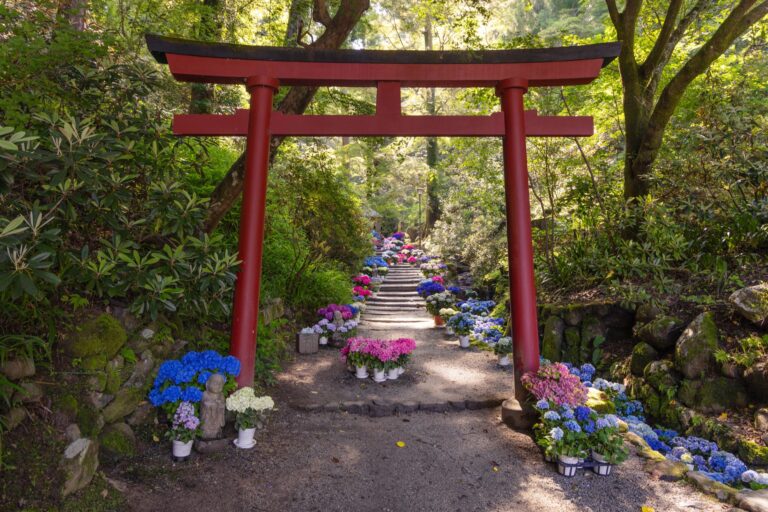
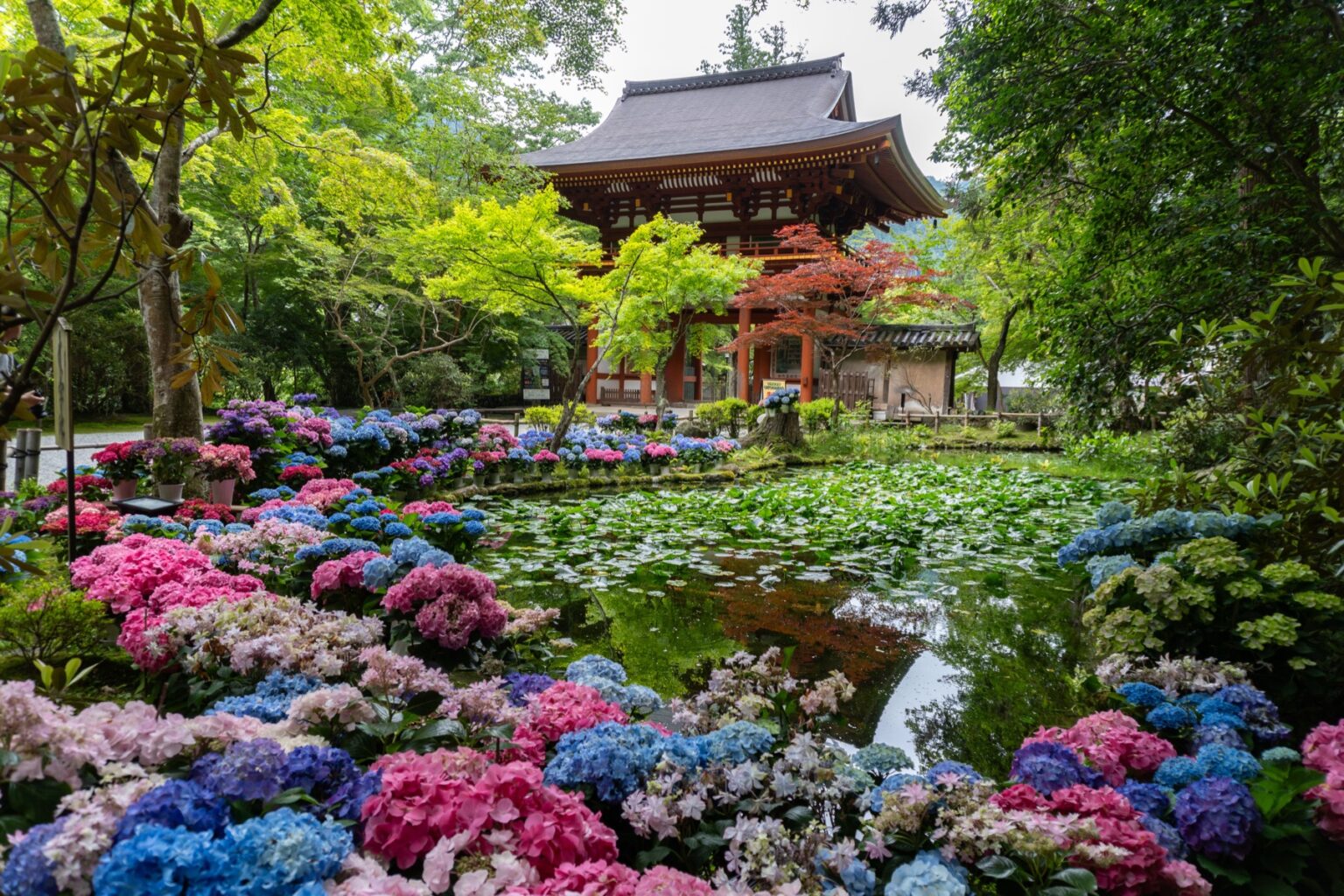
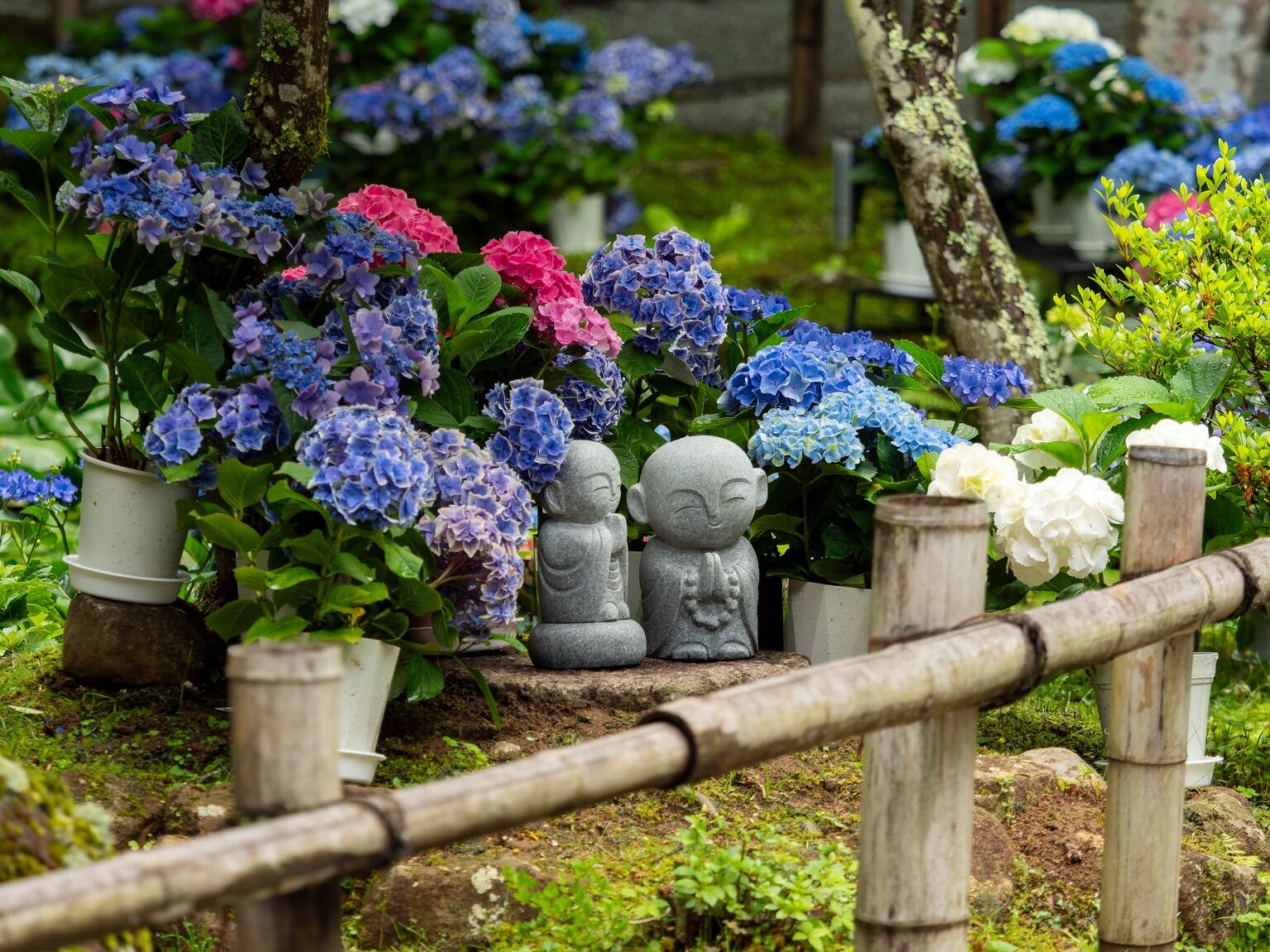
Quieter and underrated. Murō-ji joins the “Yamato Kannon Hydrangea Pilgrimage” with Hase-dera, Oka-dera and Tsubosaka-dera, lining the grounds with potted blue-and-pink hydrangeas and offering special papercut goshuin stamps.
Autumn maples · mid–late Nov
The maples over the bridge and the stairways turn deep red, and the dark cedars make the colour read even stronger. A cold, clear November morning here is hard to beat.
Getting there
The trip has two legs: a train to Murōguchi-Ōno Station (室生口大野) on the Kintetsu Osaka Line, then a short bus up the valley. There is no station at the temple itself, and the bus is the part people get wrong — it runs roughly hourly, so check the return before you commit to the climb.
| From | Route | Time (approx.) |
|---|---|---|
| Osaka (Ōsaka-Namba / Tsuruhashi) | Kintetsu Osaka Line to Murōguchi-Ōno, then bus | ~1h40–2h |
| Nara / Kyoto | Kintetsu via Yamato-Saidaiji to Murōguchi-Ōno, then bus | ~1h30–2h |
| Murōguchi-Ōno Station | Nara Kōtsū bus #44 to “Murōji-mae,” then ~5-min walk over the bridge | ~14 min + walk |
The bus is the Nara Kōtsū #44 (Murō line), about 14 minutes and ¥500 to the Murōji-mae stop. Off-season it’s roughly one bus an hour from mid-morning to mid-afternoon; in the rhododendron and autumn peaks they often add a second. From the stop it’s a five-minute walk down to the red bridge.
Plan This Day Out
Planning your visit
How long
Allow 1.5–2 hours for the bridge, halls and pagoda; closer to 2.5–3 if you climb to the Oku-no-in.
Bring cash
This is a small mountain temple. Carry yen for admission, the Treasure Hall and the bus — don’t count on cards.
Treasure Hall
The Hōmotsuden costs an extra ¥400 and gathers some of the temple’s most important sculpture under one roof.
Watch the last bus
Returns are roughly hourly. Note the departure from Murōji-mae before you start up the stairs.
Pair it with Hase-dera
Hase-dera sits on the same Kintetsu line and shares the June hydrangea pilgrimage — the two make a natural day together.
Footwear
Stone stairs, often wet. Flat shoes with grip beat anything fashionable here.
Where to stay
Almost everyone visits Murō-ji as a half-day from a city base, and that’s the sensible play: there’s very little right at the temple. Stay where the trains are easy and come out in the morning. For an early start before the day-trippers, basing near Hase-dera or Sakurai on the same line — or in Nara itself — puts you within an hour of the bridge.
Find a base on the line
Booking has the widest choice of mainstream hotels in Nara and Osaka, both within easy reach of the Kintetsu Osaka Line. Rakuten Travel has the better inventory for traditional ryokan and small inns out toward Hase and Sakurai, closer to the mountains.
Murō-ji: common questions
What is Murō-ji known for?
It’s a 1,200-year-old Shingon mountain temple in Nara Prefecture famous for three things: its National Treasure five-story pagoda (one of the oldest and the smallest outdoor pagoda of its kind in Japan), its nickname the “Women’s Kōya,” and its spring rhododendron, which banks the stone stairways in pink from mid-April to mid-May.
Why is Murō-ji called the “Women’s Kōya” (Nyonin Kōya)?
Because the main Shingon centre at Mount Kōya barred women from its precincts until 1872, while Murō-ji admitted women to worship. By the Edo period that had earned it the nickname Nyonin Kōya — the “Women’s Kōya” — and the name has stuck ever since.
How do I get to Murō-ji from Osaka, Nara or Kyoto?
Take the Kintetsu Osaka Line to Murōguchi-Ōno Station, then the Nara Kōtsū bus #44 to the “Murōji-mae” stop (about 14 minutes, ¥500), followed by a five-minute walk over the river. It’s roughly 1.5–2 hours each way from Osaka, Nara or Kyoto. The bus runs about once an hour, so check the return time before you set off up the stairs.
How much does it cost and what are the opening hours?
Admission is ¥600 for adults and ¥400 for children. The Treasure Hall (Hōmotsuden) is an extra ¥400. Opening hours are 8:30–17:00 from April through November and 9:00–16:00 from December through March. Bring cash.
When do the flowers and autumn leaves peak?
Rhododendron (shakunage) — around 3,000 bushes — peaks from mid-April to mid-May. Hydrangeas fill the grounds in June into early July, when Murō-ji takes part in the Yamato Kannon hydrangea pilgrimage. The maples turn from mid to late November.
How long does a visit take, and is it a hard climb?
Plan 1.5–2 hours for the halls and pagoda, or 2.5–3 if you climb the roughly 370 steps to the Oku-no-in inner sanctuary. The stairs are uneven natural stone and get slippery when wet, so wear flat shoes with grip and take your time.
Can I combine Murō-ji with another temple?
Yes — Hase-dera is on the same Kintetsu Osaka Line and pairs naturally, especially in June when both join the Yamato Kannon hydrangea pilgrimage. Doing the two as a single day out of Nara or Osaka is a common and rewarding plan.
Murō-ji rewards the effort of getting there. You trade the easy crowds of central Nara for a country train, a once-an-hour bus and a climb up wet stone — and in return you get a thousand-year-old pagoda standing alone in the cedars, three National Treasure halls on a single hillside, and a temple that, when most of Japan was closing its mountains to women, kept its gate open. Go in the rhododendron, the hydrangea or the maples, watch the bus times, wear real shoes, and give the Oku-no-in the extra half hour.
Join travelers discovering Japan's hidden side
Weekly dispatches from off-the-beaten-path Japan — spots and stories you won't find in guidebooks.
No spam. Unsubscribe anytime.
Welcome aboard!
You're in. See you in your inbox soon.