Akita · Tōhoku · Summer Festivals
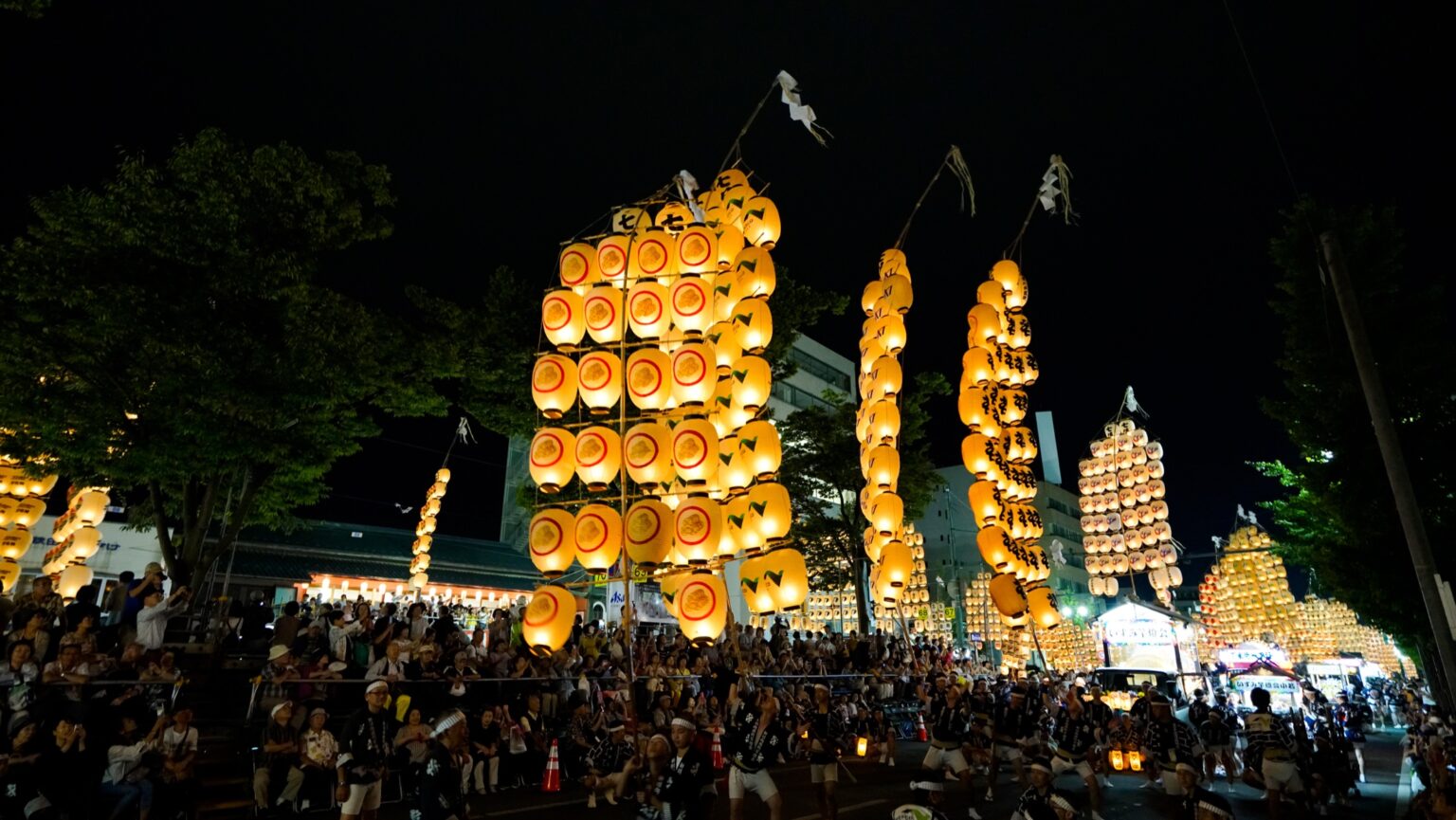
Every year from 3 to 6 August, around 280 bamboo poles strung with roughly 10,000 paper lanterns rise over Kantō Ōdōri in central Akita City — and the performers balance them not with both hands, but on a palm, a forehead, a shoulder or a hip. The Akita Kantō Festival is one of the three great festivals of Tōhoku and a nationally designated cultural property, and in 2026 it runs Monday 3 August through Thursday 6 August.
What you’re actually looking at
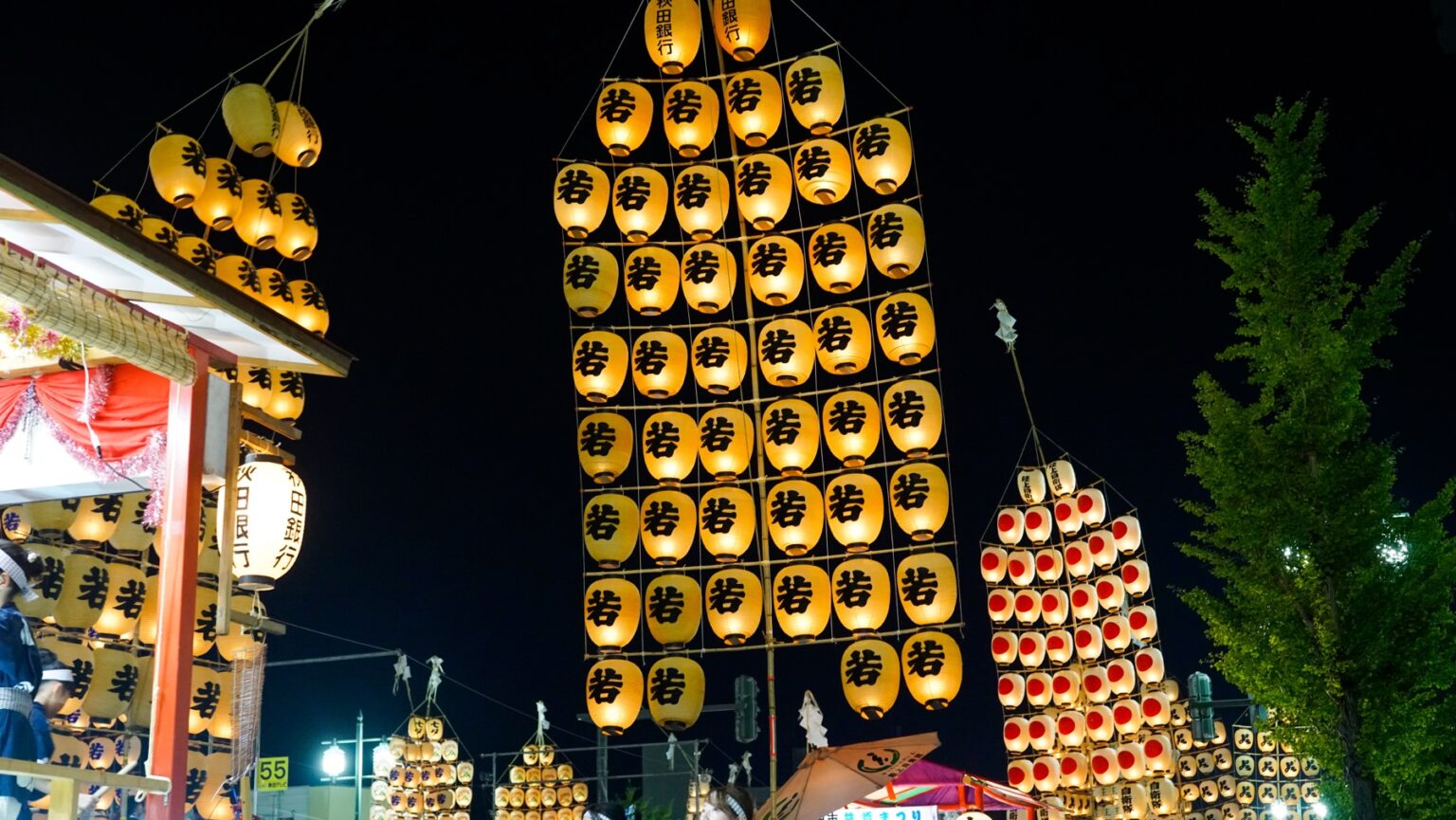
A kantō is a long bamboo pole fitted with horizontal cross-pieces, from which rows of paper lanterns hang in a tall rectangular grid. The whole thing is deliberately shaped like a head of rice: the pole is the stalk, and the swaying lanterns are the rice ears, heavy and golden. That’s the heart of the festival — it’s a prayer for a good harvest and for health through the punishing Tōhoku summer, dressed up as one of the most physically astonishing things you’ll see in Japan.
Because once a pole is hoisted, a single performer — a sashite — takes the full weight on one point of the body and lets it ride there. A big pole bends and sways in the night breeze, the lanterns flickering, and the crowd holds its breath while the performer shifts it from palm to forehead to hip without ever catching it in two hands. When it wobbles and they save it, the street erupts.
The four sizes of kantō
Not every pole is the giant you picture. Kantō come in four sizes, so that children grow into the festival — children start on a smaller yōwaka and may one day shoulder an ōwaka. These figures are from the official festival site.
| Size | Height | Weight | Lanterns |
|---|---|---|---|
| 大若 Ōwaka (the big one) | ~12 m | ~50 kg | 46 |
| 中若 Chūwaka | ~9 m | ~30 kg | 46 |
| 小若 Kowaka | ~7 m | ~15 kg | 24 |
| 幼若 Yōwaka (the smallest) | ~5 m | ~5 kg | 24 |
A full-grown ōwaka is about 12 metres tall, weighs around 50 kg, and carries 46 lanterns — balanced, remember, on one hand.
The five ways to hold it up
The skill is in the transitions. Performers move the pole through five classic positions, each harder than the last, and these techniques are central to the daytime competition, where judges also weigh stability, form, staying inside the set circle, hand use and the hayashi music.
流し Nagashi
The set-up — the pole is brought up and steadied before the balancing begins.
平手 Hirate
Balanced flat on an open palm, arm straight up.
額 Hitai
Shifted onto the forehead — hands off, eyes up.
肩 Kata
Settled onto a shoulder, the pole towering overhead.
腰 Koshi
Balanced on the hip or lower back — the most advanced of all.
Listen for the call — “Dokkoisho! Dokkoisho!” — that goes up as a pole is hoisted, a shared rhythm between performer and crowd.
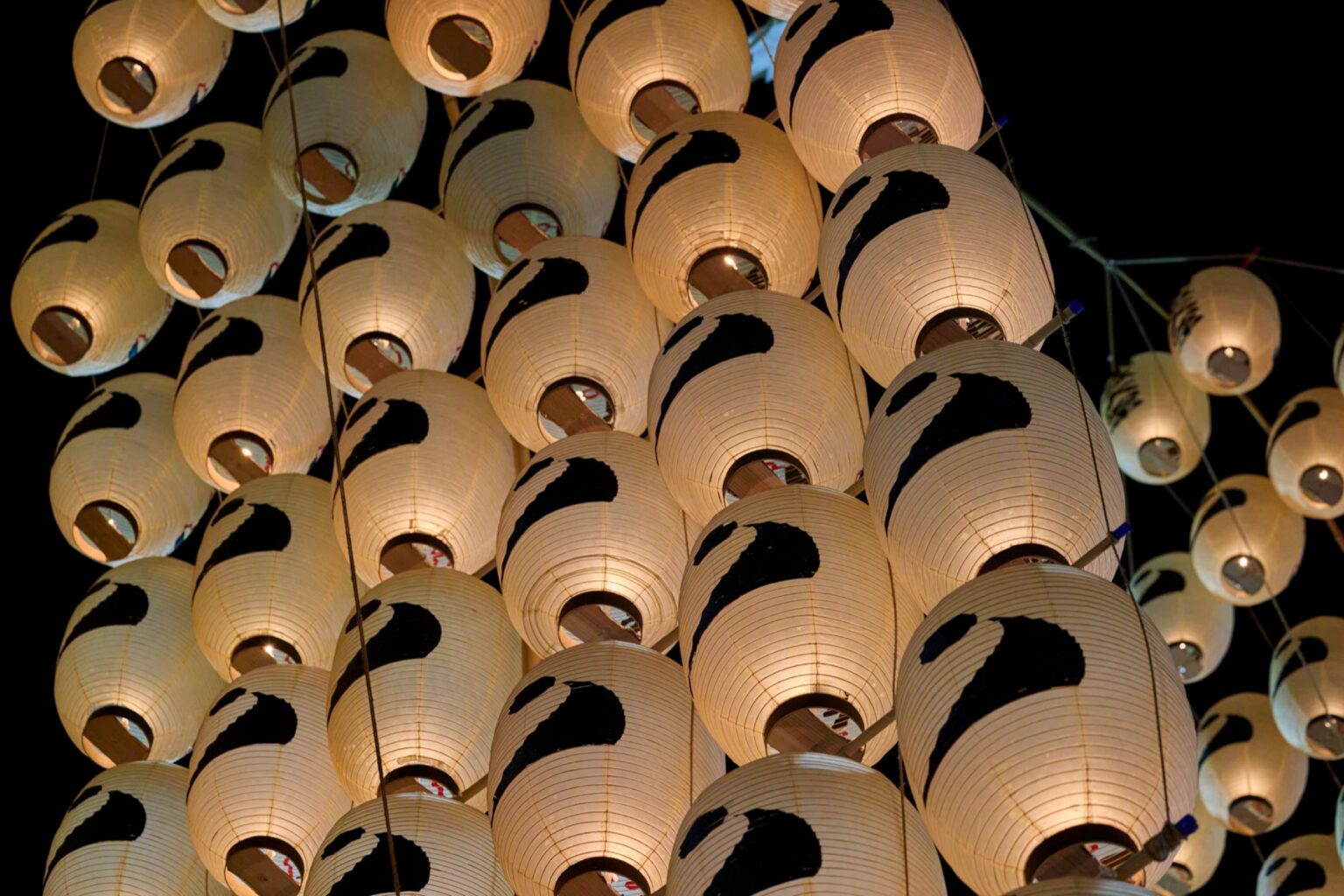
Look closely at the lanterns and you’ll see they aren’t plain. Each one carries the crest (chōmon) of the neighbourhood team that built and carries the pole — the festival is a competition between communities as much as a performance, and those crests are how Akita reads the street.
One of Tōhoku’s three great festivals
If you’re planning a northern Japan trip in early August, the Kantō Festival is one corner of a famous trio. The three great festivals of Tōhoku run back-to-back in the same first week of August: Aomori’s Nebuta (huge illuminated floats), Sendai’s Tanabata (streets draped in paper streamers), and Akita’s Kantō. With the Akita Shinkansen and the Tōhoku Shinkansen, ambitious travellers chain all three in a single trip.
From floating away summer sickness to balancing 50 kg
The festival grew out of an old midsummer custom called Neburi Nagashi — “floating away drowsiness.” People wrote wishes on paper strips, tied them to bamboo or silk-tree branches, paraded them through town, and set them adrift on the river to carry off summer illness and bad spirits. Over time it merged with Tanabata and Obon observances and picked up the harvest prayer that still defines it.
The oldest surviving written record dates to 1789 (Kansei 1), in a travelogue by Tsumura Sōan titled Yuki no Furu Michi, which describes a Neburi Nagashi held on the sixth day of the seventh lunar month — already with long poles carried crosswise and hung with many lanterns, paraded to drumming. The prototype is thought to have taken shape in the mid-1700s, when candles and the tall gate-lanterns of Obon combined with the older ritual to create Akita’s distinctive form. The competitive skill display we see today was formalised in 1931, when the Akita City Kantō Association was founded and held the first technique competition. In 1980 the festival was designated a National Important Intangible Folk Cultural Property.
2026 schedule
Plan the trip to Akita
| When | What |
|---|---|
| Mon 3 – Thu 6 Aug 2026 | The festival, four days |
| Each evening (Aug 3-6) | Aug 3 & 6: poles enter ~18:45, performance ~19:10, drone show ~20:35. Aug 4 & 5: poles enter ~18:50, performance ~19:15, “Fureai” ~20:35, poles exit ~20:50, on Kantō Ōdōri |
| Daytime competition (昼竿燈) | Technique contest at Area Nakaichi Nigiwai Plaza — Aug 4 & 5: 9:00–15:40; Aug 6: 9:20–15:00 |
| Road closure on Kantō Ōdōri | ~18:15–21:30 each evening |
The two halves of the festival have completely different moods. The daytime competition is where you see the technique cold and clear — individual performers judged in daylight, no crowd of poles to blur it. The evening main event is the spectacle: hundreds of poles rising together along the avenue in the dark. If you can, see both.
Seats and tickets
You can watch for free from the public stretches of the avenue, but the prime, head-on views are the paid seats — and they’re worth understanding. These are the 2026 prices from the official festival site.
| Seat | Price | Notes |
|---|---|---|
| Masu (box, up to 6 people) | ¥28,000 / box | Allocated by lottery if oversubscribed |
| S seat (front tiered stand) | ¥4,500 | Best individual view |
| A seat (stand / pipe chair) | ¥4,000 | |
| B seat (bench) | ¥3,500 |
Booking note: adults and children pay the same rate, and infants who don’t need a seat are free. Reservations run through the official Viewing Seat Reservation Center (tel 018-866-9977), and the windows open months ahead — for 2026, group bookings opened in mid-April and individual bookings in mid-May, so by summer they have usually closed. If you’re reading this with a 2027 trip in mind, set a reminder for spring.
Getting there
By train: everything centres on JR Akita Station. Kantō Ōdōri, the evening venue, is about a 15-minute walk from the West Exit; the daytime competition at Area Nakaichi is about 10 minutes. From Tokyo, the Akita Shinkansen “Komachi” reaches Akita in roughly three and three-quarter hours (about four hours all in).
By air: from Akita Airport, a limousine bus runs to JR Akita Station’s West Exit in about 40 minutes for ¥1,200 (IC cards accepted).
What if it rains?
August in Tōhoku can turn wet, and the festival is built for it. The evening event is, in principle, not cancelled — performances may be shortened and run during breaks in the weather rather than called off. The daytime competition simply moves indoors, to CNA Arena Akita. It isn’t only theory: on the final night of 2025, rain picked up partway through and the planned third performance was dropped, but 266 poles still went up that evening. Bring a thin rain poncho rather than an umbrella, which blocks the view for everyone behind you.
Can’t make early August? See it year-round
If your trip falls outside the festival dates, you can still meet a kantō. The Akita City Folk Performing Arts Heritage Center — nicknamed Neburi Nagashi Hall — displays full-size festival poles you can get close to, and on weekends and holidays from April through October (except Aug 1-2 in 2026), Kantō Association members give live balancing demonstrations (usually around 13:30). It’s open 9:30–16:30 (last entry 16:15), adult admission ¥130, closed 29 December–3 January.
Southeast Asia traveler tip: early August in Akita is hot and humid, and the show is at night after a long, sticky day — carry water, and don’t underestimate how draining standing in a summer crowd is. For free viewing, stake out a spot along Kantō Ōdōri an hour or so before the 18:50 start. If you want a guaranteed seat, that’s a spring booking, not a same-week one. And book your hotel early: the whole city fills up for these four nights.
Where to stay: Akita City hotels sell out months ahead for the festival, so book as early as you can. Search hotels in Akita →
We may earn a small commission from bookings, at no extra cost to you.
Make a trip of it
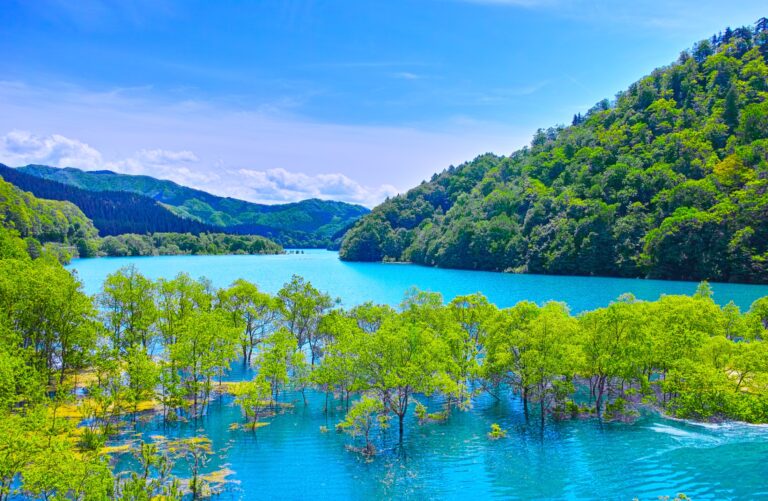
Shūsenko’s sunken forest
Still in Akita — a drowned forest of standing trees in a dam lake, a quiet counterpoint to the festival.
Summer in Japan 2026
Where the Kantō Festival sits in the wider summer of festivals, heat and fireworks.
Tone River Grand Fireworks
If you’re chasing summer spectacle, one of Japan’s largest-class fireworks nights.
Gion Matsuri, Kyoto
The other end of the festival spectrum — Kyoto’s grand July procession.
FAQ
When is the Akita Kantō Festival in 2026?
Monday 3 August to Thursday 6 August 2026. It’s held on the same dates (3–6 August) every year. The evening main event runs on Kantō Ōdōri roughly from 18:50 to 20:50 on all four nights.
How big are the poles?
The largest, the ōwaka, is about 12 metres tall, weighs around 50 kg, and carries 46 lanterns. There are four sizes in all (ōwaka, chūwaka, kowaka and yōwaka), so children take part on smaller poles. Around 280 poles and some 10,000 lanterns appear over the festival.
Do I need a paid seat?
No — you can watch for free from public stretches of Kantō Ōdōri if you arrive early. Paid seats (from ¥3,500 for a bench up to ¥28,000 for a six-person box) give the best head-on views, but they’re booked months ahead through the official reservation centre and usually sell out by summer.
How do I get to Akita?
By rail, the Akita Shinkansen “Komachi” runs from Tokyo to Akita in about three and three-quarter hours. From JR Akita Station, the evening venue on Kantō Ōdōri is about a 15-minute walk. From Akita Airport, a limousine bus reaches the station in about 40 minutes for ¥1,200.
What happens if it rains?
The evening event isn’t normally cancelled — performances may be shortened and run between rain showers. The daytime competition moves indoors to CNA Arena Akita. Bring a poncho rather than an umbrella so you don’t block the view.
Can I see a kantō outside the festival?
Yes. The Akita City Folk Performing Arts Heritage Center (Neburi Nagashi Hall) displays full-size poles year-round, with live demonstrations on weekends and holidays from April to October. It’s open 9:30–16:30, admission ¥130, closed 29 Dec–3 Jan.
What are the three great festivals of Tōhoku?
Akita’s Kantō Festival, Aomori’s Nebuta Festival and Sendai’s Tanabata Festival. All three fall in the first week of August, and many travellers see them in one trip using the Akita and Tōhoku Shinkansen.
Sources: official Akita Kantō Festival site (kantou.gr.jp) — about, FAQ and viewing-seat pages; Akita City tourism (akita-yulala.jp); Agency for Cultural Affairs Cultural Heritage Online (designation, 1980-01-28); Akita Sakigake Shimpō (attendance). Dates, times, specs and 2026 prices verified June 2026 and can change — confirm on the official site before you travel.
Related: Getting there scenically: the Resort Shirakami coastal train, in our JR sightseeing-trains guide
Join travelers discovering Japan's hidden side
Weekly dispatches from off-the-beaten-path Japan — spots and stories you won't find in guidebooks.
No spam. Unsubscribe anytime.
Welcome aboard!
You're in. See you in your inbox soon.