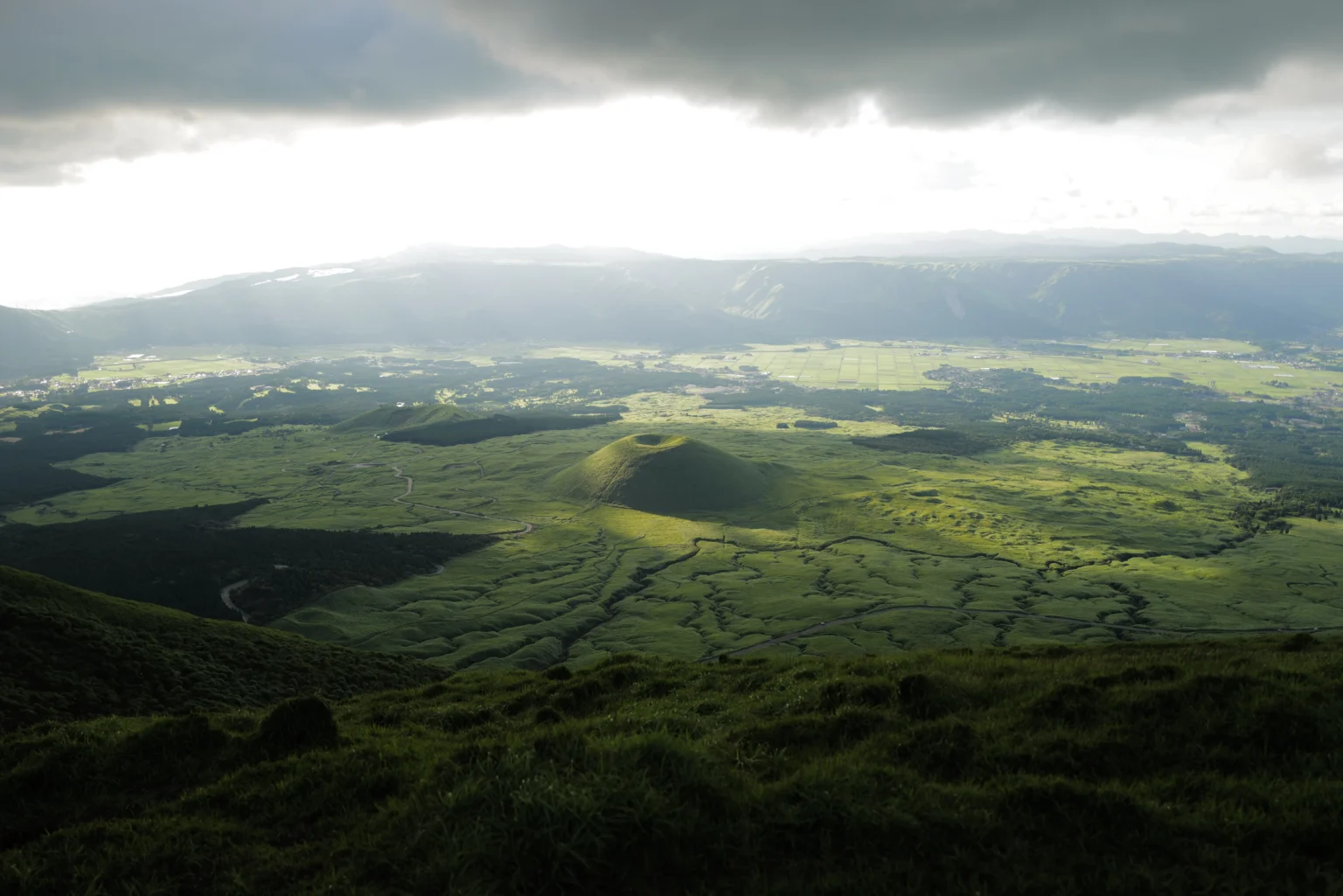

Kusasenri (草千里ヶ浜) is a vast grassland plateau in Aso, Kumamoto Prefecture, with grazing horses, a crater lake, and the active Mt. Aso volcano in the background. The closest analog to its landscape isn’t typical Japan — it’s closer to Iceland or Mongolia. The plateau is free to enter, open 24 hours, and accessible by ~30 minutes bus from Aso Station. Horse rides ¥6,000-14,000. Parking ¥500 at the main lot; free parking available on the upper road near the observation platform.
Kusasenri is one of the few places in Japan where the dominant feature of the view is sky. The grassland stretches across roughly 780,000 square meters, and the horses graze in small herds that move slowly across the field. Mount Aso’s active crater smolders to the east. If you arrive at sunrise on a clear day, the entire scene runs in soft gold light with almost no other human visible. This is not the manicured Japan of temples and bento boxes — it’s the volcanic Kyushu that the Tokyo postcards never show.
Quick Facts
| Name | Kusasenri (草千里ヶ浜, Kusasenrigahama) and Kusasenri Observatory (草千里展望所) |
|---|---|
| Location | Aso, Kumamoto Prefecture, Kyushu |
| Entry fee | Free (the plateau and main viewing areas) |
| Hours | 24/7 open. Most facilities operate during daytime hours. |
| Parking | ¥500 standard car at main facility lot · Free further up the road near the observation platform |
| Best time | Sunrise (06:00-07:00) or late afternoon (16:00-18:00). Spring and autumn for weather. |
| Drone use | Prohibited without special permission |
| Atmosphere | Wide-open grassland, grazing horses, active volcano backdrop. Solitude. |
The landscape: not a typical Japan
Kusasenri sits at roughly 1,100 meters elevation inside the Aso caldera — the largest volcanic crater in Japan and one of the largest in the world. The plateau itself is the result of millennia of volcanic activity that flattened a section of caldera floor. The grass grows because the volcanic soil holds water, and the soil holds water because the underlying basalt creates an impermeable layer.
The horses are owned by local ranches. They graze across the plateau from late spring through autumn — the rough estimate is 50-80 animals at any given time. There’s no fencing around most of the field; the horses move where the grass is freshest. You can walk among them on the designated paths, but don’t approach or feed them. Mount Aso’s crater is roughly 6 km to the east. On clear days you can see steam rising from the active vent.
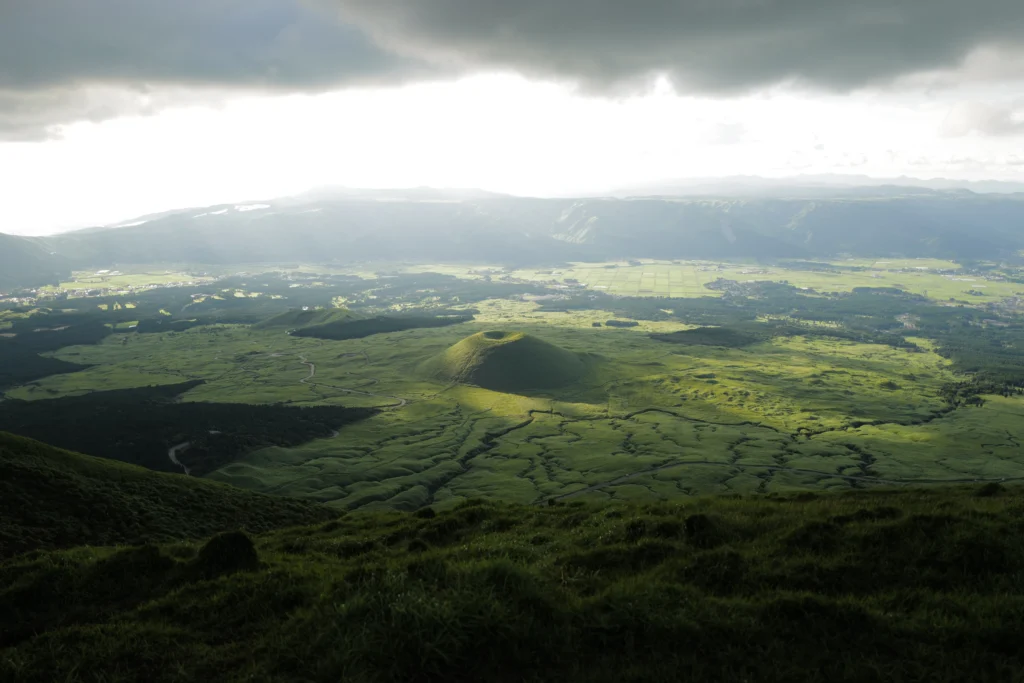
Kusasenri grassland with horses and Mt. Aso’s smoking crater behind. The scale doesn’t translate to photo well — it’s much larger in person.
How to get there
Reaching Kusasenri: the two realistic doors
Fly to Kumamoto Airport
JAL/ANA Tokyo Haneda → Kumamoto Airport, ~1h15-1h30. From Kumamoto Airport, ~50 min by car to Kusasenri.
Shinkansen + limited express
Shinkansen to Kumamoto Station (~7-8 hours from Tokyo). Limited express train to Aso Station (~70 min, ¥2,000-3,000). Covered by Japan Rail Pass and Kyushu Rail Pass.
Aso Fire Crater Line bus
Bus from Aso Station, 30-35 minutes. Get off at “Kusasenri Aso Volcano Museum Mae” (草千里阿蘇火山博物館前). Short walk to the plateau. Bus frequency: limited — check timetable.
From Kumamoto City
~80 minutes from Kumamoto City. ~50 minutes from Kumamoto Airport. A rental car is the most flexible way to explore the wider Aso region.
Fees & activities
Practical info for foreign travelers
English support
Basic English signage at major facilities. Aso volcano museum has English exhibits. Individual shops and the horse riding club have limited English — translation app recommended.
Payment
Cash strongly recommended. Larger facilities may accept cards, but most food stalls, souvenir shops, and the horse riding club are cash-only. Bring ¥10,000-20,000 in small bills.
Photography
Encouraged. Landscape is a photographer’s dream, especially sunrise and sunset. Drone use requires special permission from local authorities — assume not allowed.
Crowdedness
Far less crowded than major Japanese sites. Weekday mornings are essentially empty. Weekends and holidays see increased numbers.
Etiquette & safety
Do not approach or feed horses. Respect private property and stay on designated paths. The plateau is exposed — bring layers, wind protection. Weather changes rapidly.
Best times
Sunrise (06:00-07:00) for golden light and solitude. Late afternoon (16:00-18:00) for dramatic shadows. Spring and autumn are most pleasant; winter sees frost on grass.
- Weather variability: The Aso region is at elevation. Wind is common. Bring a jacket and wind-resistant layer even on mild days.
- Horse riding restrictions: Rides may be restricted or unavailable in winter (particularly December) or due to weather. Check availability before planning.
- Limited public transportation: Buses to Kusasenri run a limited schedule. Memorize the timetable to avoid being stranded.
- Volcanic activity: Mount Aso is active. Eruptions are rare, but occasional volcanic gas emissions can close access to the crater area (not Kusasenri itself, but the nearby crater rim). Check current conditions before visiting.
If the crater is closed (August 2026 status)
As of this update, Mt. Aso stands at volcanic alert Level 2 (raised June 21, 2026): the Nakadake crater area sits inside a roughly 1 km exclusion zone and the crater road is closed. Kusasenri itself lies outside that zone and stays open: the grassland, its walking paths and the horses are unaffected. The closure changes how you plan the day around it.
| Crater-day alternative | Why it works |
|---|---|
| Aso Volcano Museum, facing the grassland | Live crater cameras and eruption exhibits fill the gap; 9:00–17:00, last entry 16:30 |
| The Kusasenri loop walks and viewpoint | The grass bowl, twin ponds and grazing horses are the classic Aso picture anyway |
| Shift your hours | Early morning and late afternoon dodge the midday tour-bus window — and the light is better |
Levels move in both directions with little warning — check the JMA volcano page or the Aso volcano disaster-prevention council’s live status on the morning of your drive.
What else to combine with Kusasenri
Aso Volcano Museum. Insights into the geology and history of the active volcano. Worth 60-90 minutes if the weather is poor and you can’t do the outdoor walk.
Aso Visitor Center. Information about hiking trails and the broader Aso-Kuju National Park.
Kurokawa Onsen. Traditional hot spring village ~40 minutes away by car. Excellent overnight pairing with Kusasenri — sunrise at the plateau, hot springs by afternoon.
Sleep in Kurokawa Onsen or Aso town
Kurokawa Onsen is one of Kyushu’s most atmospheric ryokan villages and lets you reach Kusasenri in ~40 minutes. Aso town has fewer atmospheric inns but is closer (15 min). Rakuten Travel indexes traditional onsen ryokan better than Booking for this region.
Plan the Trip
Three doors into a Kusasenri visit. Renting a car is the easiest move for the Aso region.
Related reading
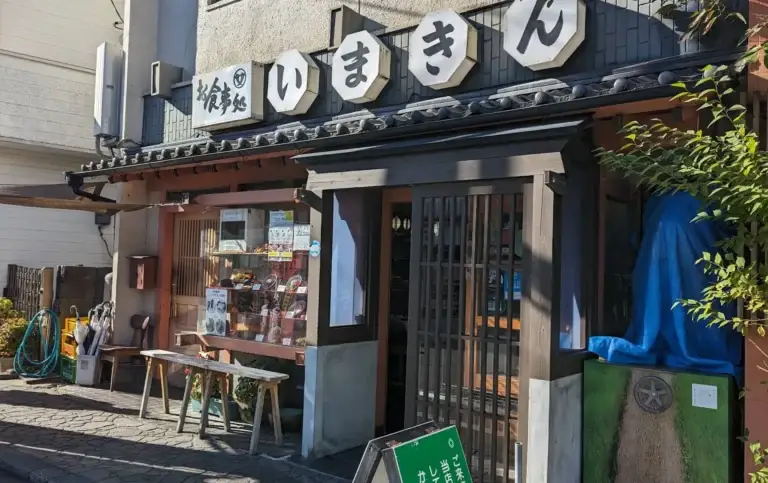
- Imakin Shokudo: The Legendary Akaushi Beef Bowl in Aso — the food stop near Kusasenri
- African Safari Oita 2026 — another Kyushu wildlife stop, drive-through style
- Pizzeria Tre Passo Kurokawa Onsen — wood-fired pizza pairing with the hot springs
Join travelers discovering Japan's hidden side
Weekly dispatches from off-the-beaten-path Japan — spots and stories you won't find in guidebooks.
No spam. Unsubscribe anytime.
Welcome aboard!
You're in. See you in your inbox soon.