Kanagawa · Kaisei · Early June — 2026 festival has ended
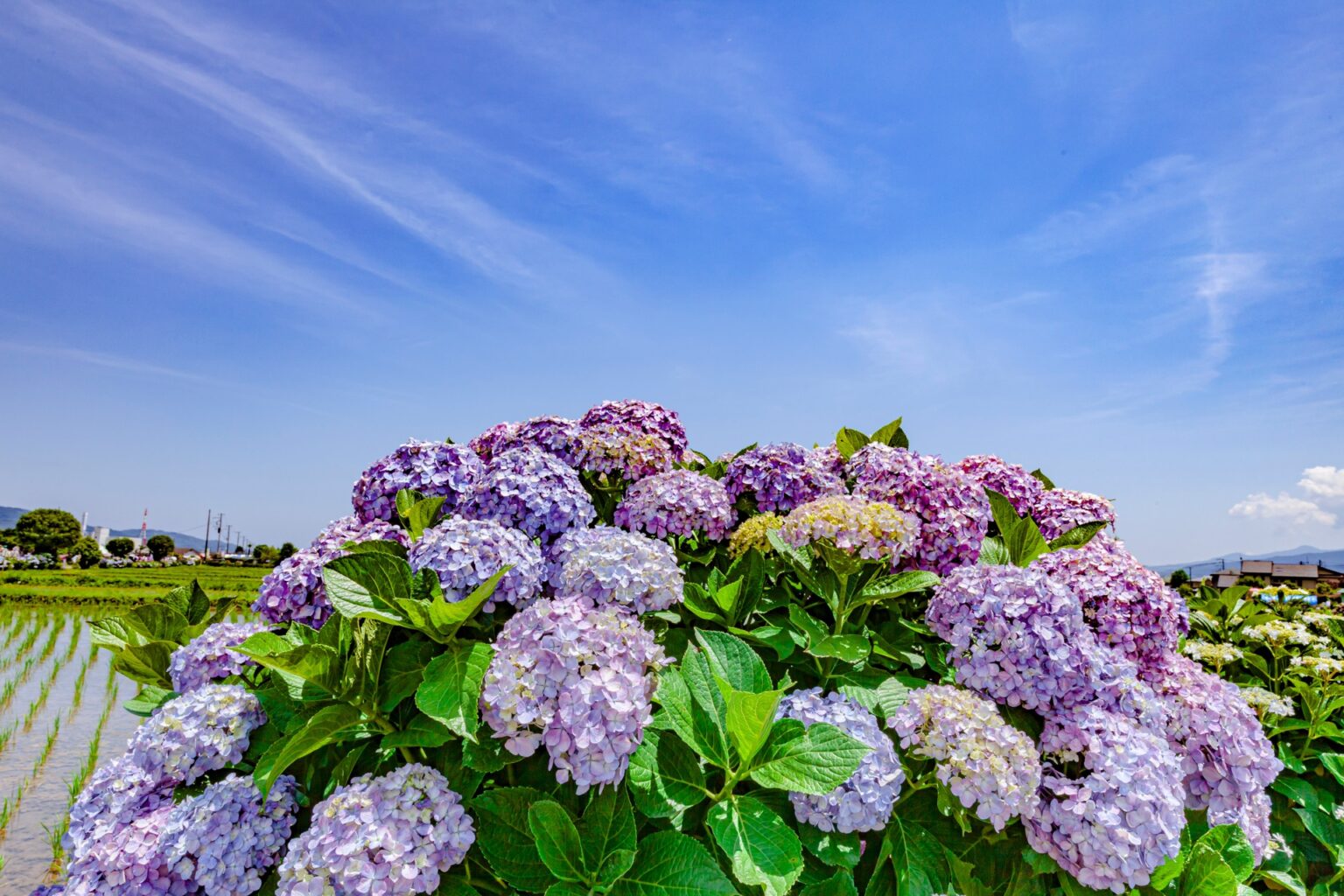
Kaisei Ajisai no Sato is a 10.6-kilometer agricultural-road trail through the rice paddies of Ashigara-Kami District in western Kanagawa, planted with about 5,000 hydrangeas along the bunds and waterways. The 39th Ajisai Matsuri ran June 6–14, 2026 and has now ended — the committee confirmed peak bloom around June 12 before it closed. The next event, the 40th, is expected in early-to-mid June 2027 (dates are usually announced in spring); use this guide to plan a 2027 visit. The entry corridor is free, parking is ¥1,000, and the appeal is the layered landscape — hydrangeas, green rice paddies, the Tanzawa range, and Mount Fuji on a clear morning — that does not exist at any temple-based hydrangea site in Japan.
I first went to Kaisei in 2023, on a Saturday in mid-June, riding the Odakyu line down from Shinjuku and getting off at Kaisei Station with maybe forty other visitors at 9:30 AM. The shuttle bus from the station takes you up to the festival grounds in ten minutes, and you step out into a landscape that, for me, is the most uniquely Japanese ajisai setting I have stood in. Kamakura Hasedera is hydrangeas on a hillside. Meigetsu-in is hydrangeas in a temple garden. Ajisai no Mori in Kita-Ibaraki is hydrangeas in a forest. Kaisei is hydrangeas in a working agricultural village — planted along the ridges of flooded rice paddies in the middle of June planting season, when the young rice is bright fluorescent green and the water reflects the sky. That layered, ankle-to-horizon composition is the thing.
30-second summary
What it is: 5,000 hydrangeas planted along 10.6 km of agricultural roads, irrigation ditches and rice-paddy bunds across 17 hectares of Kaisei Town in western Kanagawa.
What is unique: The rice paddies. Hydrangea + paddy + Tanzawa range + Mount Fuji is a four-layer composition you cannot frame at any temple.
2026 logistics: Festival June 6–14. ¥1,000 parking, free walking trail. Shuttle from Odakyu Kaisei Station, 10 minutes.
Quick Facts
Location
Kanaijima 1421, Kaisei Town, Ashigara-Kami District, Kanagawa Prefecture. Western edge of greater Tokyo, against the Tanzawa mountains.
Scale
~5,000 hydrangeas along 10.6 km of agricultural roads. Equivalent to 3.6 Tokyo Domes / 17 hectares.
Festival 2026
39th Ajisai Matsuri: Saturday June 6 to Sunday June 14, 2026. Weekend illumination of the new Ajisai Pond.
Admission
The trail itself is free. Parking is ¥1,000 per car. Some illumination/event sections may charge separately during the festival.
Access
Odakyu Kaisei Station + paid shuttle bus 10 min. By car: Tomei Oimatsuda IC, 10 minutes. Parking opens 9:00, closes 17:00.
Town flower since
1977. Large-scale agricultural-road planting from 1983. The town has spent forty years building this.
The Rice-Paddy Setting: What Kaisei Is Not
Kaisei Ajisai no Sato is not a garden, not a park, not a temple grounds. It is a working agricultural village whose residents planted hydrangeas along the irrigation and access infrastructure of their rice paddies, then opened the walking corridor to visitors during the bloom window. Understanding this changes how you visit and what you photograph.
The hydrangeas line three different surfaces:
First, the noudou (農道, agricultural roads) — narrow asphalt service roads that farmers drive between paddies. These are the main walking corridor during the festival. Hydrangeas are planted on the field side, so you walk with flowers at hip height and the paddy beyond. Most photographs from Kaisei are taken from these roads.
Second, the azemichi (畦道, rice-paddy bunds) — the narrow raised earth ridges between paddies, planted with sparser hydrangea groupings. These are not for walking; they exist for irrigation and crop access. Photographers shoot across them to get hydrangea in foreground + paddy + mountains.
Third, the suiro (水路, irrigation channels) — concrete-lined ditches that carry mountain water through the paddies. Hydrangeas are planted on both sides of certain channels, with the running water visible underneath in the gaps.
None of this is decorative landscaping. It is functional agricultural infrastructure that has been gradually re-greened with hydrangeas since 1983. The town designated hydrangea as its official flower in 1977 and turned the planting into a regional-revitalisation project over the next four decades. Forty years of one town’s work is what you walk through.
The Iconic Frames: Three Photographs to Find
Three specific compositions are what people come to Kaisei to make. None of them exist at a temple-based ajisai site.
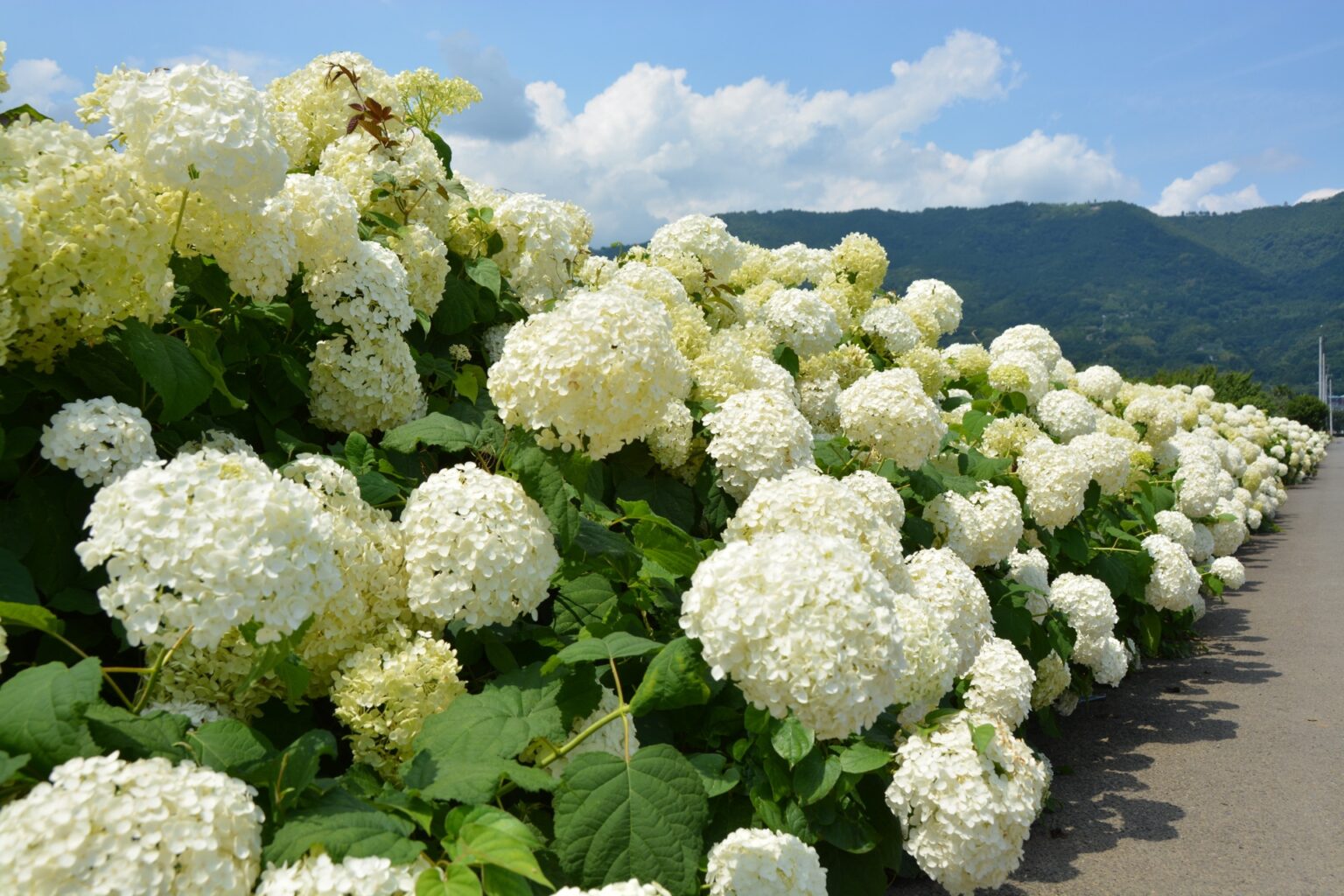
1. The Annabelle white corridor against Mount Fuji
There is a south-facing stretch where the town has planted a roughly 80-meter run of Annabelle — the American smooth hydrangea cultivar that produces large pure-white spherical blooms. Behind the Annabelles, across two paddies, is the open western horizon, and on a clear morning Mount Fuji rises directly above them. The Tanzawa range is closer and visible in any weather; Fuji is the bonus if the air is dry.
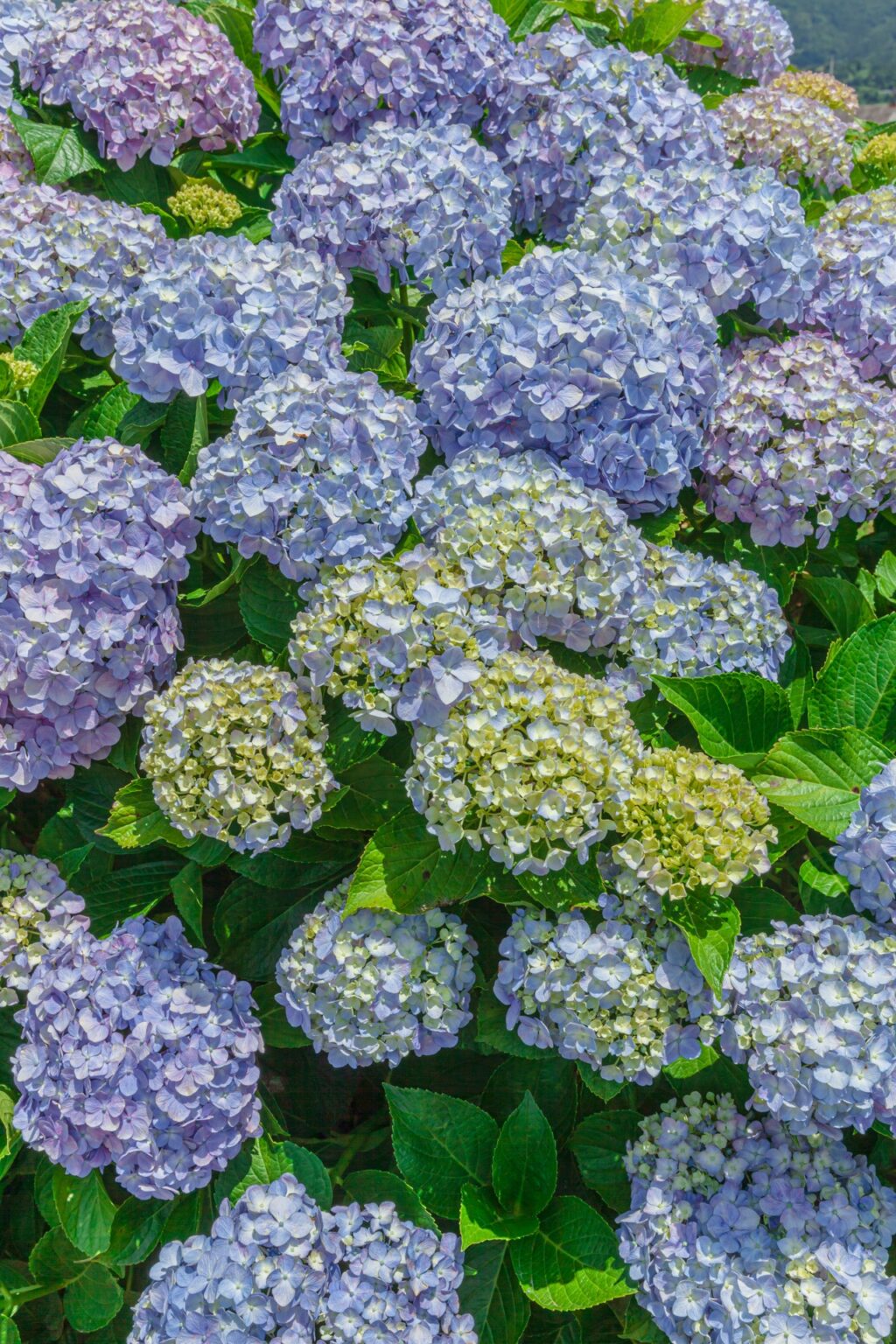
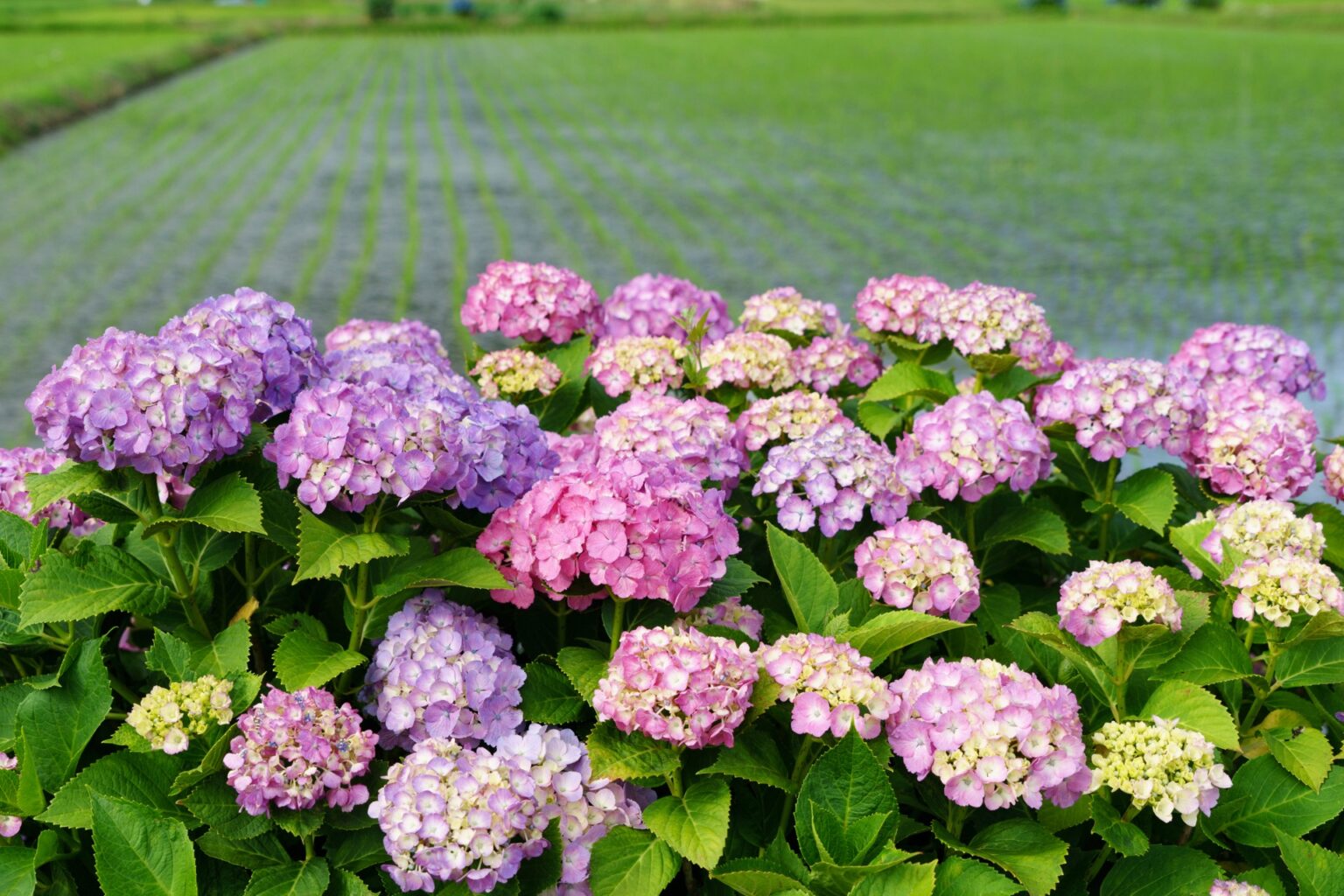
2. The mophead cluster with paddy reflection
The classic Kaisei frame is a dense mophead cluster — pink, purple, lavender, sometimes intermixed — at the front of the shot, with a paddy in the background reflecting the sky. The trick is timing: the paddy must still have visible standing water (not yet fully covered by rice growth) and the sky must be either clear blue or have visible cloud structure. Mid-morning works. Overcast midday flattens the sky and kills the composition.
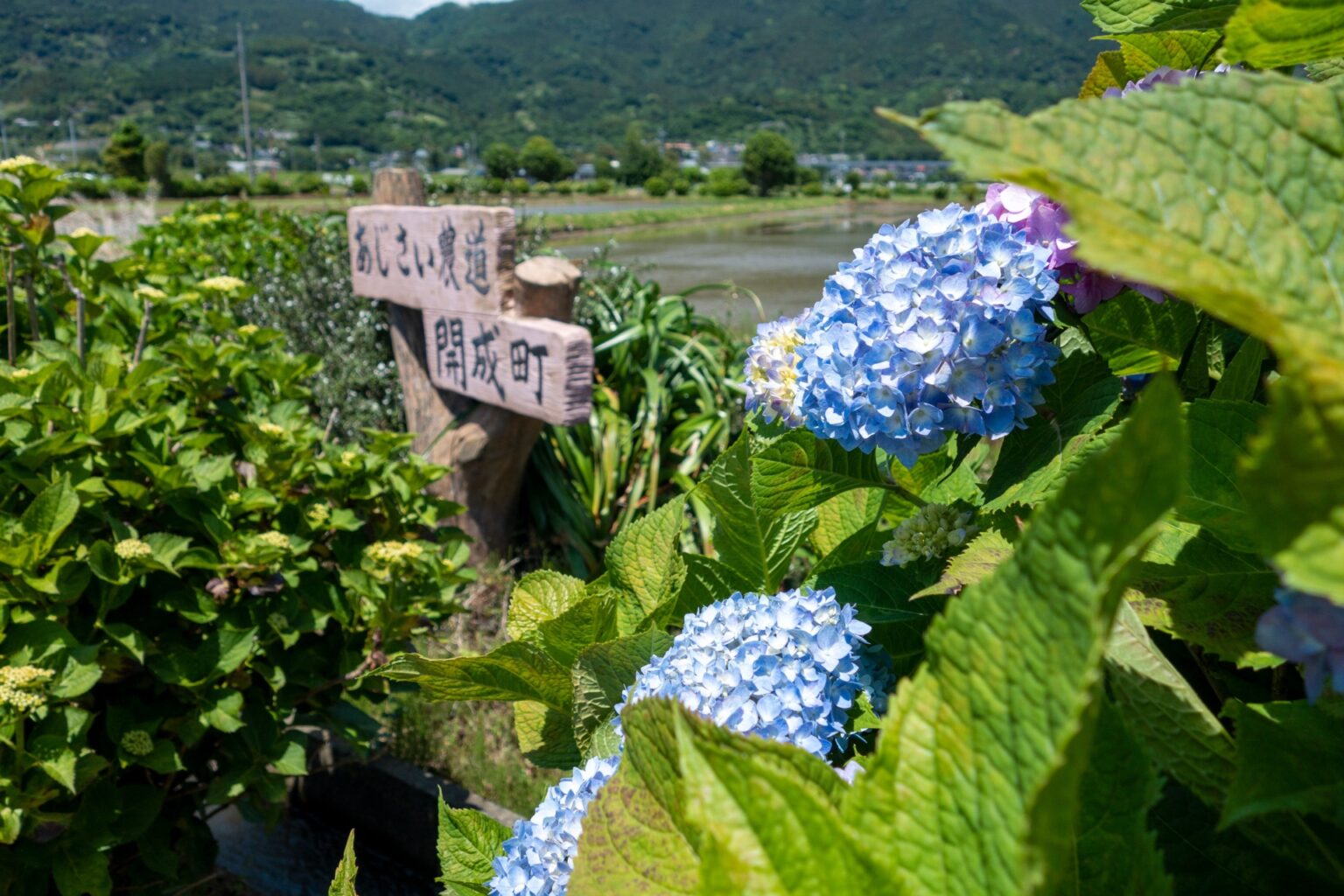
3. The signpost frame at Ajisai Noudou
The wooden signpost reading 「あじさい農道 開成町」 (Ajisai Noudou, Kaisei-machi) is the only piece of formal signage and the most-photographed object in the corridor. Frame it with hydrangea in the lower-left third and the open paddy behind. Two of these signposts exist along the main walking loop; the one closer to the Seto Yashiki historic house is the cleaner backdrop.
2026 Festival Schedule and What Is New
Opening day. Shuttle starts. Yatai (food stalls) open from 10:00.
Peak bloom typically begins. First weekend pond illumination.
Second weekend illumination. Heaviest crowds — arrive by 9:30 or after 15:00.
Closing day. Trail still walkable through late June without festival infrastructure.
Parking open. Last entry to paid parking ~16:30.
The agricultural roads are public corridor — free to walk year-round.
What is new for 2026
Three additions to the 2025 festival format:
Ajisai Pond + weekend illumination. A new ornamental pond installation at the festival central plaza, lit from 18:30 to 20:30 on Saturdays and Sundays during the festival. This is the headline draw for evening visits.
Seto Yashiki harvest experience. The 300-year-old thatched-roof farmhouse on the festival grounds (now a designated cultural property) hosts rice-related harvest activities during the festival window. Free with admission.
Photo contest. Open submission across the festival week; winners announced post-festival on the town tourism site.
“Hydrangeas planted along forty years of one farming town’s irrigation roads — not landscaping, not garden, infrastructure.”
How to Get There
Kaisei is the easiest rural hydrangea site to reach from Tokyo — 75 minutes from Shinjuku door-to-door on the Odakyu line. This is uncommon for sites that look this rural; most agricultural-corridor flower spots require a car. Kaisei is the exception because Odakyu’s express service makes the town a realistic day-trip.
| Route | From | Time | Notes |
|---|---|---|---|
| By train (recommended) | Shinjuku | ~75 min + shuttle | Odakyu Express to Kaisei Station, then festival shuttle bus 10 min. Easiest end-to-end. |
| By train | Tokyo Station | ~80 min + shuttle | JR Tokaido to Kozu, transfer to Gotemba Line to Matsuda, then taxi or short walk to Kaisei. Slower than Odakyu. |
| By car | Tokyo (Tomei) | ~70 min | Tomei Expressway to Oimatsuda IC, then 10 minutes on local roads. ¥1,000 parking on arrival. |
| From Hakone | Odawara | ~30 min | If you are already in Hakone, Kaisei is an easy half-day side trip. Odakyu south to Odawara then north to Kaisei. |
| From Kamakura | Kamakura Hasedera | ~2h | If you want to combine with the temple ajisai cluster — but timing-wise these peak in the same window, so do one fully rather than both rushed. |
The shuttle bus, in plain language
From Odakyu Kaisei Station, the festival shuttle bus runs continuously throughout the day during the festival period, with a small fee (2026: ¥240 each way for adults, ¥120 for children, free under 6). It is the only realistic way to reach the festival central plaza without a 25-minute walk. The same shuttle returns to the station.
Walking from Kaisei Station is technically possible (about 25 minutes through suburban streets), but the festival corridor begins after the walk — you save no time by skipping the shuttle.
Pairing Kaisei With Other Stops
Kaisei works well as a half-day, freeing the rest of the day for one of three nearby anchors.
Same day: Hakone (30 minutes south)
Hakone’s hot-spring core is a 30-minute Odakyu hop south of Kaisei. The classic combination: Kaisei in the morning while light is still good for hydrangeas, then onsen and dinner in Hakone-Yumoto in the afternoon and evening. This is the most common Kaisei itinerary for international travellers.
Same day: Matsuda sakura ridge (autumn return)
Matsuda Town next door is the host of February’s famous Kawazu-zakura cherry festival on the slope above the station. In June it is green and quiet — but visiting now and seeing the sakura tunnel in February the next year is a worthwhile pre-visit. The ridge offers the best Mount Fuji and Tanzawa overview in the area.
Overnight: Odawara Castle and Pacific coast
Odawara is 15 minutes south of Kaisei by Odakyu — the historic castle town with the Hojo clan castle, a Pacific seafront, and direct Tokaido Shinkansen access back to Tokyo. Kaisei morning → Odawara afternoon and overnight → Shinkansen back to Tokyo or onward to Kyoto. The overnight makes Kaisei feel less rushed.
Plan This Trip
Plan This Trip
For Southeast Asian Visitors
Kaisei is the most accessible “rural Japan” ajisai experience for travellers basing in Tokyo — direct, English-friendly train station, official shuttle, and a walkable agricultural corridor. The biggest difference from Singapore, Bangkok or KL flower-park expectations is the lack of perimeter fencing. You are walking through a working village. Residents live in the houses you pass. Stay on the marked agricultural roads, do not step onto paddy bunds or pick flowers, and remember that the corridor closes at dusk except during weekend illumination. Convenience stores in Kaisei town accept most foreign cards; the festival yatai food stalls are cash-only. Mid-June in Kaisei is roughly 23°C with 80% humidity — slightly cooler than Singapore but more variable. The walking surface is paved, so closed-toe walking shoes are fine. Sun is intense between 11:00 and 14:00; the trail has limited shade, so a hat and sunscreen are not optional.
FAQ
Do I need to buy a ticket in advance for the Kaisei Ajisai Matsuri?
No. The walking trail itself is free and uncontrolled. The only paid components are parking (¥1,000 per car) and the shuttle bus from Kaisei Station (small fee, paid on board). Some specific events at Seto Yashiki may charge separately, but the main hydrangea corridor is free walking. The 2026 festival runs June 6–14.
What is the best time of day to visit?
Mid-morning, 9:30–11:00, is the photographic sweet spot — paddy water is still still, light is soft, and crowds are manageable. Weekend illumination from 18:30 onward is the alternative window, with the Ajisai Pond lit and the corridor evening-quiet. Avoid 12:00–14:00 on weekends; both crowds and overhead sun damage the experience.
Can I walk the whole 10.6 km trail?
Technically yes, but most visitors do a 2–3 km loop around the festival central area, which captures the densest planting. The full 10.6 km figure refers to the total planted length across all agricultural roads in the town, much of which is more spread out and less photogenic than the festival core. Plan for 90 minutes to two hours on foot in the central loop.
How does Kaisei compare to Kamakura Hasedera or Meigetsu-in?
Different categories. Kamakura sites are temple-grounds hydrangea — formal planting, ocean view (Hasedera), 2,500-plant density. Kaisei is rural-agricultural hydrangea — 5,000 plants spread across a town, paddy reflections, mountains. If you only have one June day in Japan, Kamakura is the easier and more iconic visit; if you have two, do Kamakura early-week and Kaisei on the weekend for the festival energy. Detail on Kamakura in Two Hasedera, Two Hydrangea Weeks.
Is Mount Fuji visible?
On clear mornings yes, mostly framed by the Annabelle stretch in the western corridor. June is rainy season — on clear early mornings you may glimpse Mt Fuji beyond the paddies, though visibility is never guaranteed and fades as heat haze builds. Early arrival (9:30 or earlier) significantly improves the odds. The Tanzawa range behind is visible in any weather and is the more reliable backdrop.
Can I combine Kaisei with Hakone in one day from Tokyo?
Yes, comfortably. Leave Shinjuku 8:00 on Odakyu Romance Car to Kaisei, walk the festival 9:30–11:30, shuttle back to station, Odakyu south to Hakone-Yumoto by 13:00, afternoon in Hakone, dinner and onsen, back to Tokyo on Romance Car. Long day but two of Kanagawa’s best June experiences in one ticket. Hakone Free Pass covers both legs.
Is the trail wheelchair-accessible?
The main agricultural roads in the festival corridor are paved asphalt and largely level — wheelchair-passable. Side spurs onto paddy bunds are not. Disabled parking is available at the festival central lot with prior notice (call the Kaisei Town Industrial Promotion Division: 0465-84-0317).
Booking the Trip
Booking the Trip
Three doors into a Kanagawa hydrangea weekend. The Hakone overnight makes Kaisei feel less rushed.
Related Reading
- Two Hasedera, Two Hydrangea Weeks: Kamakura and Nara Twin Temples (June 2026) — The temple-based alternative on the same weekend. Pair with Kaisei if you have two days in Kanagawa.
- Ajisai no Mori Kita-Ibaraki 2026: 1,500 Hydrangea Varieties in a Cedar Forest — The botanical alternative — same flower, completely different setting, two weeks later.
- Japan Tsuyu 2026: Regional Calendar + 4 Tested Hydrangea Spots — Where Kaisei fits in the Japanese rainy-season calendar.
- Japan in June 2026: Hydrangeas, Fireflies and the Cheapest Week of the Year — Month-wide hub for June planning.
Join travelers discovering Japan's hidden side
Weekly dispatches from off-the-beaten-path Japan — spots and stories you won't find in guidebooks.
No spam. Unsubscribe anytime.
Welcome aboard!
You're in. See you in your inbox soon.