Osaka · Minoo / Mino · Half-Day Walk
Twenty-six minutes from Umeda by train. A paved valley walk through cedar and maple. A waterfall that dropped me back into the kind of quiet I forget exists ten kilometers from a city of nineteen million.
The main paved Takimichi (滝道) was closed for landslide repair from January 19, 2026 through late April 2026, with the closure temporarily lifted for Golden Week (April 29 – May 5). A separate section ~200 m before the falls has been blocked since a November 2025 shop fire — visitors detour via an unpaved mountain path with stairs (not stroller- or wheelchair-accessible).
Verify the latest at mino-park.jp and minohkankou.net within 48 hours of your visit. The falls themselves are visible and the bridge viewpoint is open whenever the trail is.
There is a kind of city park that exists nowhere else in Japan: the kind you reach by metro, walk into through a stone railway tunnel, and end up in a national-park-grade gorge with a 33-meter waterfall. Minoo Falls — written 箕面の滝 — sits at the back of Meiji-no-Mori Minoo Quasi-National Park, just over the prefectural ridge north of central Osaka. The trailhead is a 26-minute Hankyu ride from Umeda. The walk in is 2.7 km of paved valley road following the Minoo River. There is no entry fee. The whole thing is, by any reasonable measure, the easiest waterfall day-trip from any major Japanese city. I’ve walked it in summer rain, autumn red, and February frost. This guide is what I’d hand a friend.
May–early Jun (fresh green)
What follows is a complete walking guide: how to get there from central Osaka, what to see along the way, the food worth stopping for, a clear access summary, and where to stay if you want to base in the area instead of day-tripping. I’ll flag the practical things — toilets, accessibility, weekday vs. weekend timing — without burying the actual experience under logistics.
The walk in: Hankyu Minoo Station to the trailhead
Almost everyone arrives at Hankyu Minoo Station (箕面駅), the terminus of the short Hankyu Minoo Line. The station plaza is small — a tourist information desk, a pharmacy, a coin locker stand — and the trail starts almost from the ticket gates. Walk straight out, cross the small plaza, and follow the Minoo River upstream. You’ll see the first signs for “箕面大滝” (Minoo Otaki) within thirty seconds.
The first ~500 meters is the most touristed section. Souvenir shops, the famous tempura stalls (more on those below), and a low stone-lined channel where the river starts to fall. Around the first bend, the road passes under a 1910-built railway tunnel — the aria-label-defying point where the city ends and the gorge begins.
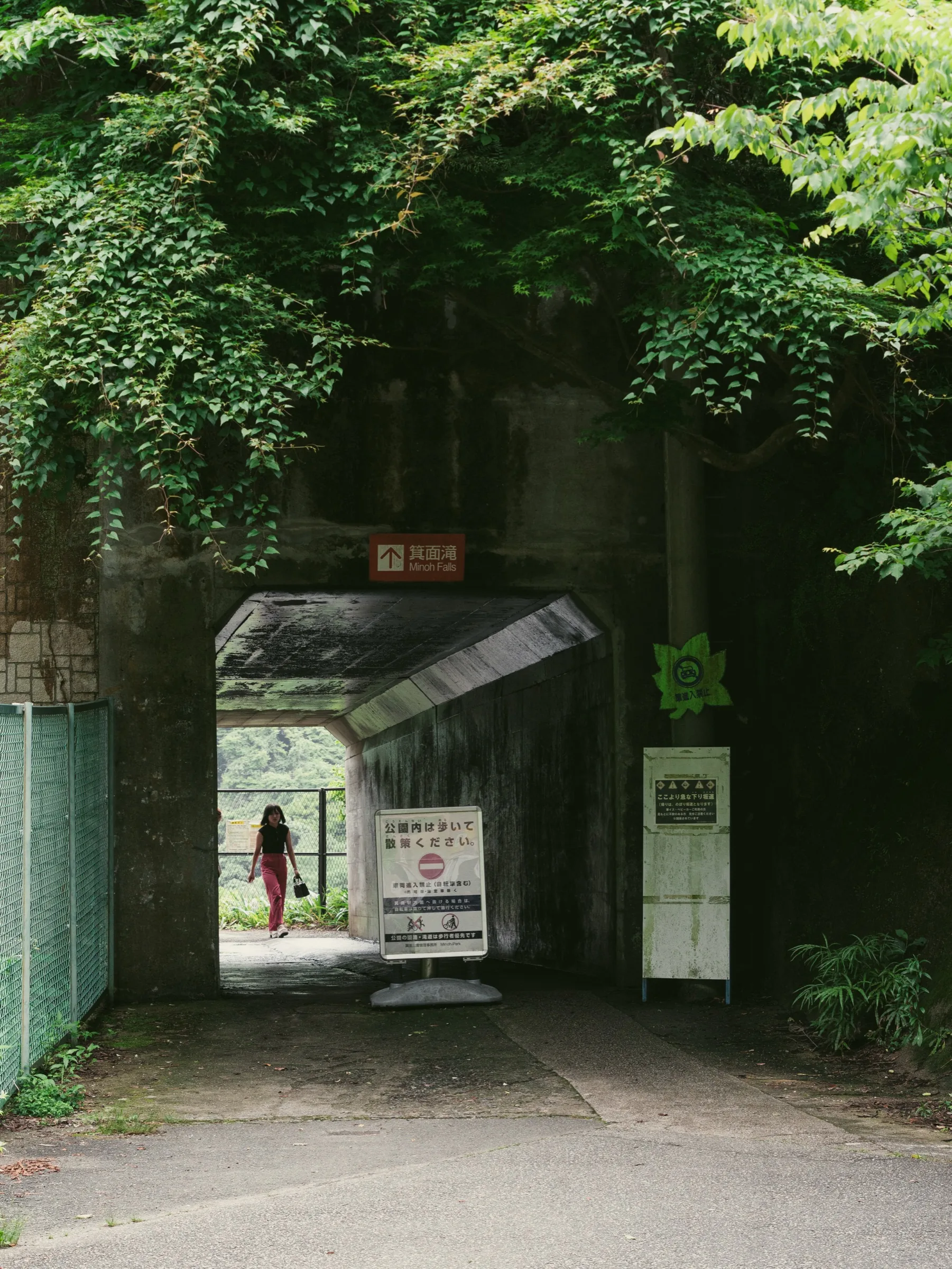
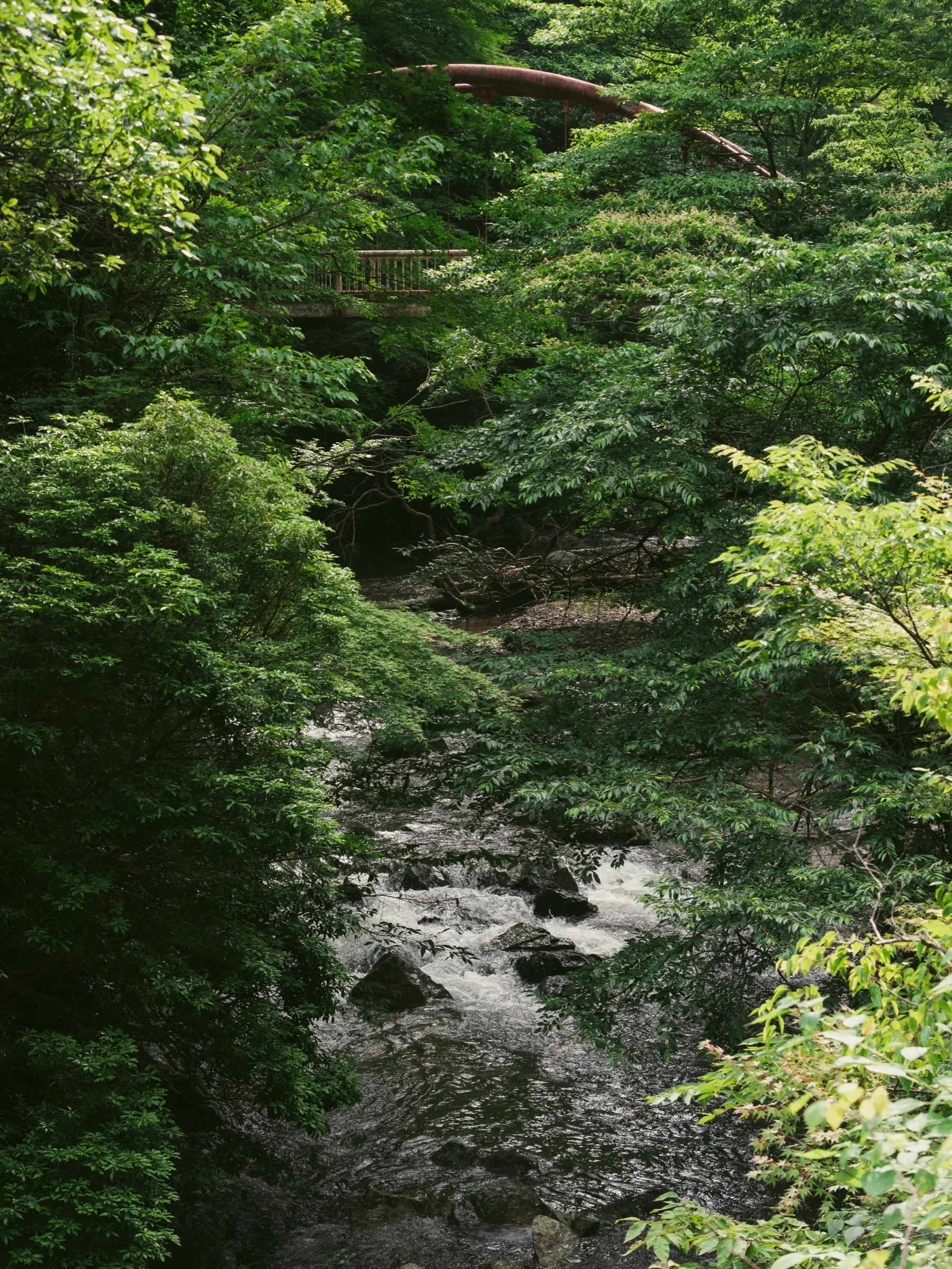
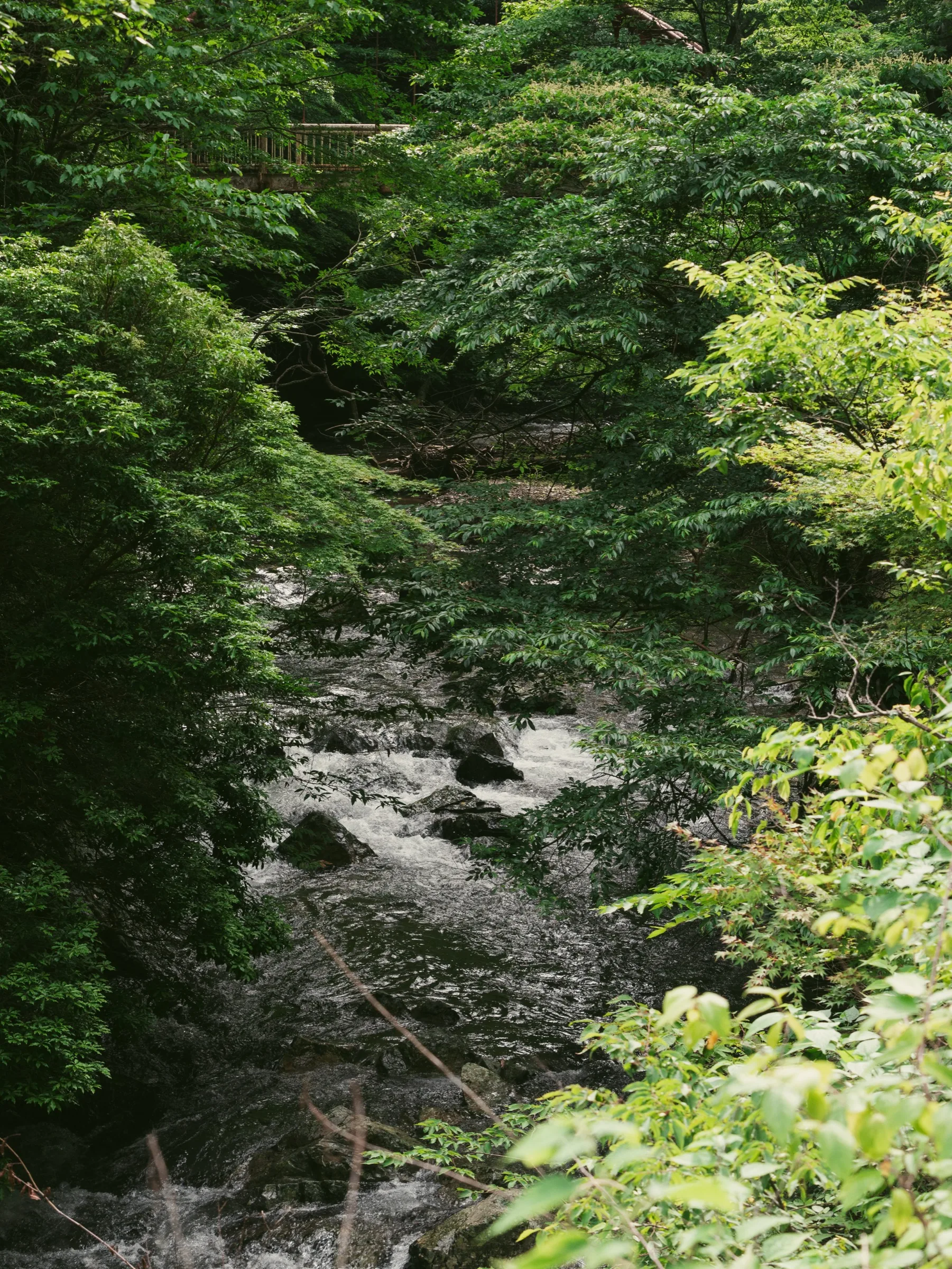
From the tunnel onward, the path is consistently paved and gently uphill. Total ascent is about 80 meters across 2.7 km — gentle enough that I’ve seen people walking it in dress shoes. Signposts in English and Japanese mark every distance milestone (0.5 km, 1.0 km, 1.5 km…). The river runs to your left almost the entire way, sometimes loud over rapids, sometimes glassy in deeper pools.
Toilets and rest stops along the way
There are roughly five public toilet stops along the 2.7 km: at the station plaza, at Ichinohashi (一の橋, ~5 min from station), at Ryūanji Temple, mid-trail near Saiseki/Ishikozume, and at the falls plaza itself. Vending machines are scattered throughout. Strollers and wheelchairs do fine on the paved sections, but the post-fire bypass to the falls (active as of late 2025) involves stairs and is not accessible.
Halfway up: Ryūanji Temple and the rocks with stories
About 1.0 km in, you’ll see a side path climbing right toward an old temple gate. This is Minoosan Ryūanji (箕面山瀧安寺) — note the kanji 瀧安寺, not the 龍安寺 of Kyoto’s rock garden. It’s a different temple entirely. Ryūanji was founded in 658 by En-no-Gyōja, the legendary mountain ascetic credited with starting Shugendō. It enshrines what is widely considered the oldest Benzaiten image in Japan, and it’s long associated with the origin of Japanese lottery tickets — the tomikuji drawn here in the Edo period was the prototype.
It’s a working temple, free to enter, and adds maybe fifteen minutes to your walk. The grounds are quiet on weekdays. There’s a small pavilion overlooking the gorge if you want a sit-down break.
Continuing on the main path: about 1.7 km in, you pass a massive boulder called Toujin Modori-iwa (唐人戻岩) — “the rock that turned the foreigners back.” The story is that Edo-period emissaries from Korea, walking up the gorge, stopped at this rock and decided to head back. Whether or not that’s true, it’s a useful landmark — when you reach it, you’re about three-quarters of the way to the falls.
The falls themselves
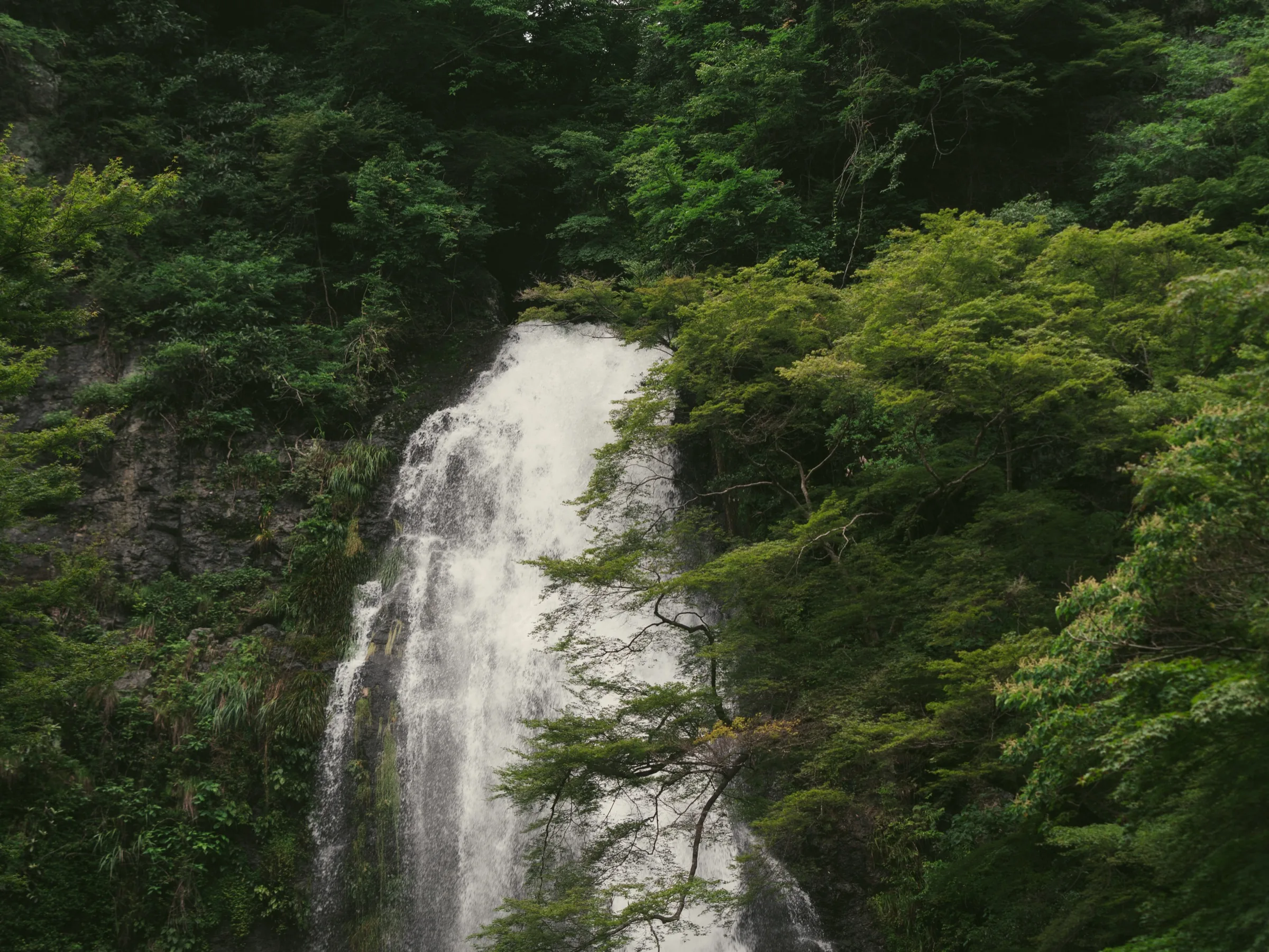
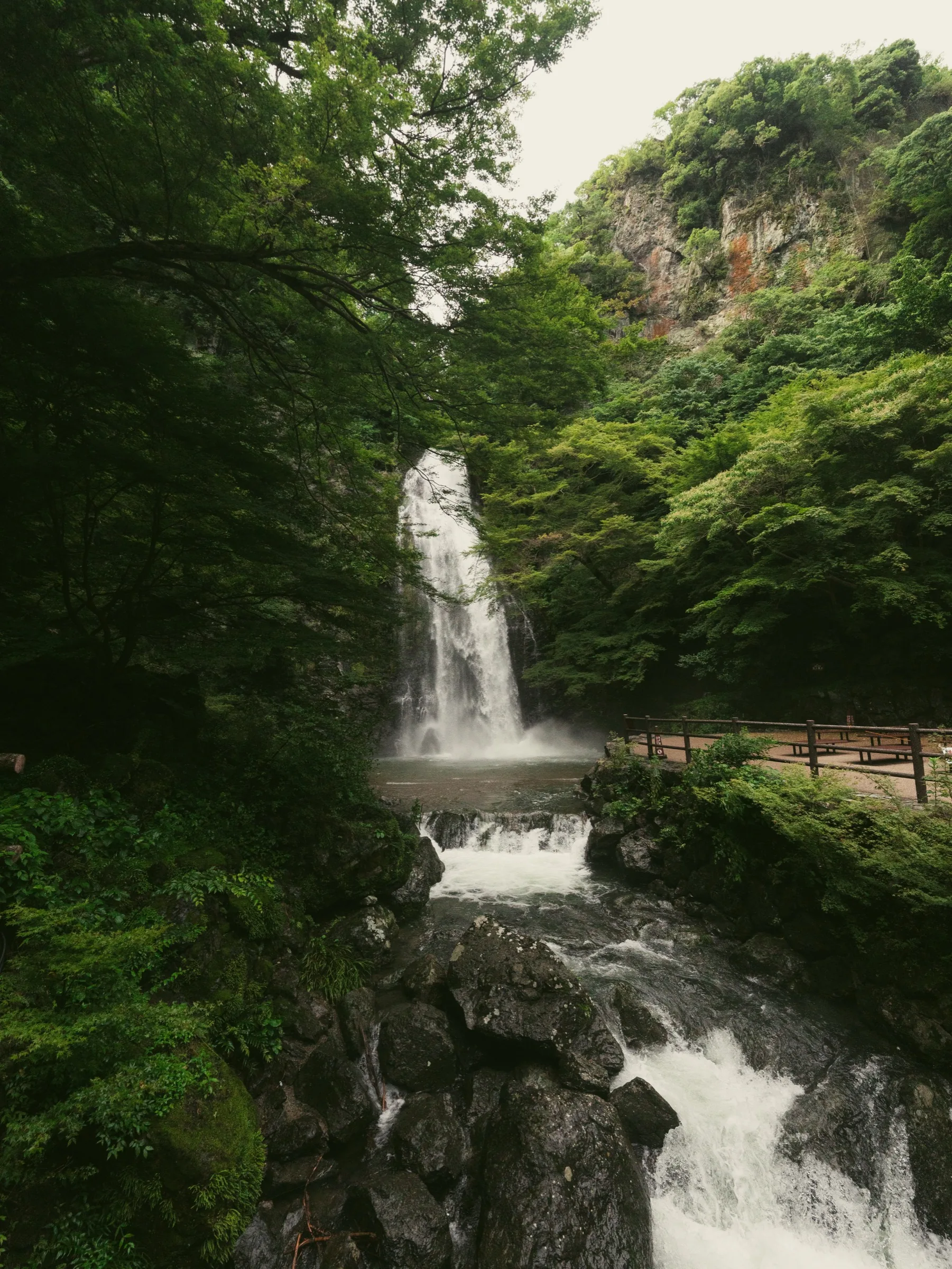
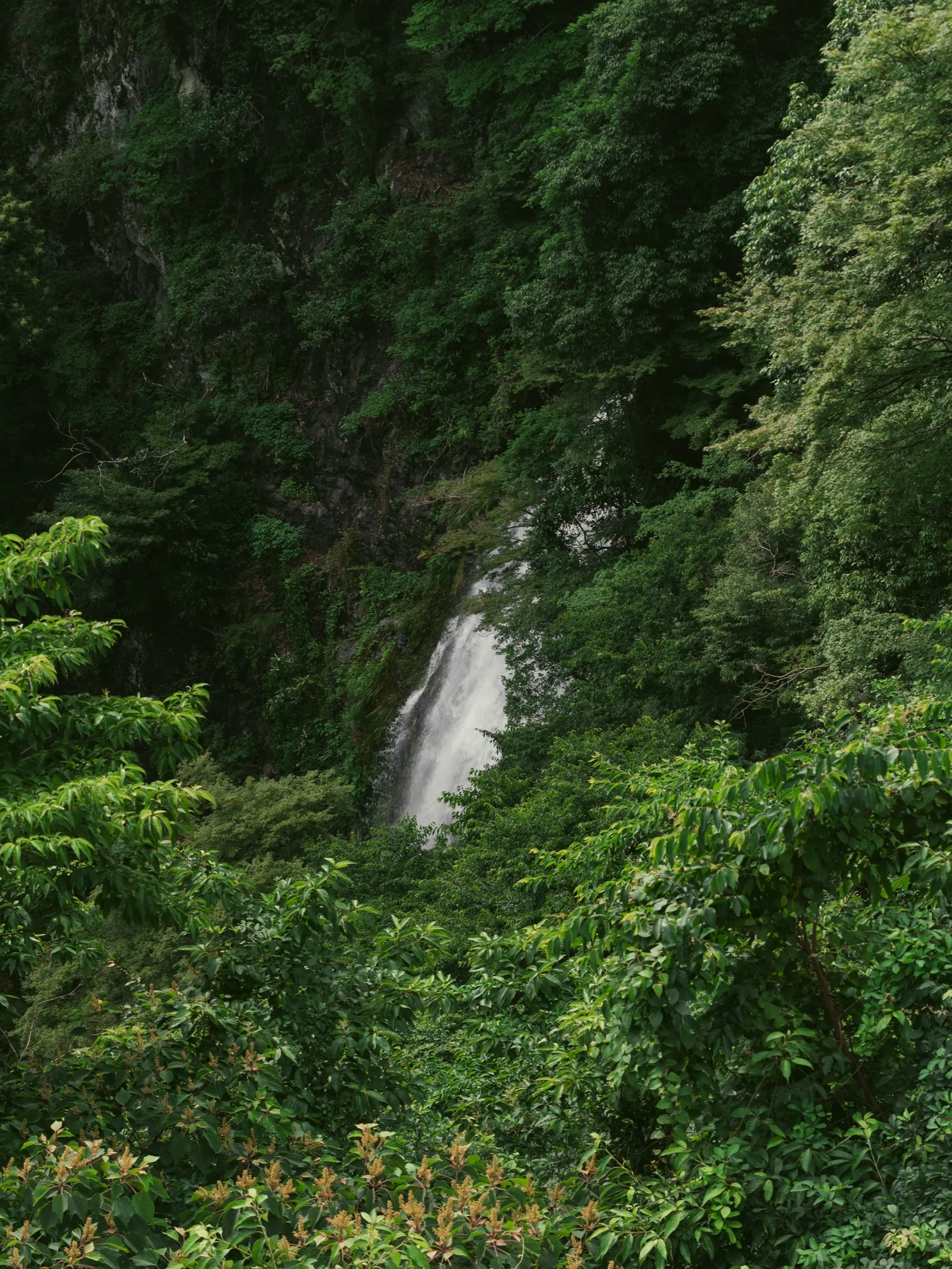
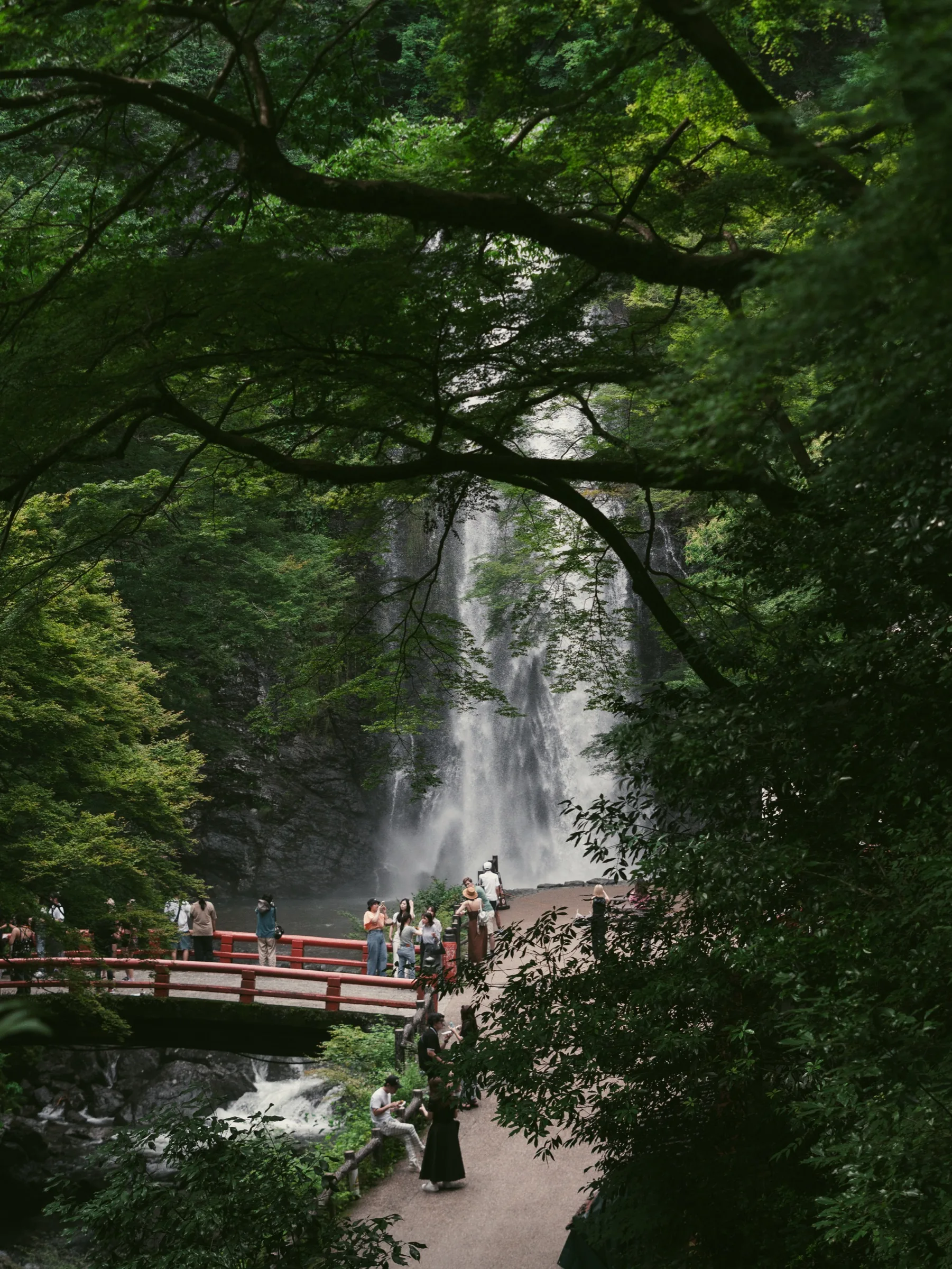
Round the last bend and the falls reveal themselves all at once. Thirty-three meters of single-drop water, narrow at the top and fanning slightly at the base, framed by maples that turn red in November and stay green from May through early October. There’s a small viewing plaza with a vermillion-painted bridge — the photograph everyone takes — and a few benches.
Volume varies. After heavy rain in June or September, the falls roar and the spray reaches the bridge. In a dry February, the flow is thin enough that you can hear individual streams of water hitting the pool. Both versions are worth seeing.
Where to stand for the photograph
The classic frame is from the red bridge, looking up at the falls with maple branches arching over the foreground. Most visitors stop here and don’t look further. Walk past the bridge another fifty meters to a small unmarked viewpoint — the falls are partially hidden by branches, but you get the river and the falls in one frame, with the wooden viewing pavilion adding scale.
For the best light, arrive between 10:00 and 11:00 a.m. The sun crests the eastern ridge around 10 and the falls light up directly. Late afternoon backlights the maples but throws the falls themselves into shade.
Momiji-no-tempura and what to eat along the way
The single food you have to try here is momiji-no-tempura — sweet-battered fried maple leaves. This is a Minoo specialty going back roughly 1,300 years, traditionally credited to En-no-Gyōja, who reportedly fried fallen maple leaves as offerings during his mountain training. The modern version uses cultivated ichigyou-momiji leaves, salted and aged for a year, then dipped in a flour-and-sesame batter sweetened with brown sugar.
It tastes nothing like a wet leaf. It tastes like a thin, crisp, slightly sweet rice cracker — closer to a karinto than to actual tempura. A small bag (~80 g) runs ¥720 as of February 2026 at the most famous shop, Hisakuni Kousendo (久國紅仙堂), est. 1940. Other reliable shops along the trail: Ryūan-do, Nakai Botan-en, and Cobeni near the station.
For a proper meal, options are limited but decent. Several small soba and udon shops sit along the first 500 meters of trail. If you want something more substantial, walk back to the station area and try one of the family-run set-meal restaurants. Avoid lunching at the falls plaza itself — there’s only one small kiosk and it’s expensive.
When to visit — and when to avoid
Autumn (mid-November to early December) — the headline season
Minoo is one of Osaka’s top three foliage destinations, alongside Mt. Kongo and Katsuoji. Peak red typically falls between November 20 and December 5. The 2025 momiji festival illumination ran November 15 to December 7; the 2026 dates are not officially announced as of writing but expect a similar window.
The catch: weekends in late November are severely crowded. The 2.7 km trail can become a slow-moving line of people. Go on a weekday morning if at all possible — Tuesday, Wednesday, or Thursday before 10:00 a.m. is ideal. By 11:30 on a Saturday, you’ll be queuing for the bridge photograph.
Spring (late April – early June) — the underrated season
Minoo isn’t known for cherry blossoms (the trees here are mostly maple, cypress, and cedar), but the fresh-green season — May into early June — is arguably the most photogenic time of year. The maples are bright, the river is full from spring rains, and crowds are negligible.
The park also runs a smaller blue-maple light-up event (April 25 – May 6, 2026) near the insect museum.
Summer (July – August)
Hot and humid in the city below, but the gorge stays noticeably cooler thanks to the river and the canopy. Insects can be aggressive in late July. Carry water.
Winter (December – February)
Foliage is gone. The gorge is quiet. Occasional snow on the upper trail. The falls sometimes ice partially in late January cold snaps. If you want the place to yourself, this is when.
Getting there from central Osaka
Hankyu Umeda is the standard starting point. The route requires one transfer at Ishibashi-Handaimae (since 2022, direct through-trains are no longer offered). From Namba, ride Osaka Metro Midosuji north to Umeda first.
| From | Route | Time | Fare |
|---|---|---|---|
| Hankyu Umeda | Hankyu Takarazuka Line → transfer at Ishibashi-Handaimae → Hankyu Minoo Line → Hankyu Minoo | ~26 min | ¥280 |
| Namba | Osaka Metro Midosuji → Umeda → Hankyu (as above) | ~40 min | ~¥520 |
| Shin-Osaka | Osaka Metro Midosuji → Umeda → Hankyu | ~35 min | ~¥460 |
| Kyoto Kawaramachi | Hankyu Kyoto Line → transfer at Juso → Takarazuka Line → transfer at Ishibashi → Minoo Line | ~70 min | ¥430 |
Note 2026 The new Kita-Osaka Express extension to Minoh-Kayano station, opened March 2024, does not serve the falls. Kayano is about 3 km east; the falls trailhead is still at Hankyu Minoo Station. Don’t let map apps suggest Kayano-via-Senri-Chuo unless you specifically want a transfer to the local Hankyu bus.
Suica, ICOCA, Pasmo, and most other IC cards work on Hankyu and Osaka Metro. The Minoo Line runs roughly every 10 minutes, 06:00 to 21:30. Last train back from Minoo to Umeda departs around 22:30.
If you’re renting a car
Driving from central Osaka takes about 35 minutes via the Hanshin Expressway. Coin parking near Hankyu Minoo Station runs ¥600–800 for the day; spaces fill by 10 a.m. on autumn weekends. There is no parking at the falls themselves — driving up the gorge is restricted.
Where to stay: day trip from Umeda, or sleep near the trailhead?
For 95% of visitors, the right move is to base in Umeda (or Namba, Shin-Osaka) and day-trip out. Minoo is small enough that there’s little reason to overnight unless you specifically want a quiet onsen night before or after the walk. If that appeals, Ooedo Onsen Monogatari Minoh Kanko Hotel sits a six-minute walk from Hankyu Minoo Station with on-site onsen baths, kaiseki dinner, and the kind of slow-paced ryokan stay that pairs well with a half-day mountain walk.
Half-day walking tour, if you’d rather have a guide
Minoo is doable solo with English signage, but several small-group guided tours combine the walk with a meal and an onsen stop. Useful if it’s your first day in Japan and you’d rather not navigate the transfer chain.
Frequently asked questions
Is the trail open right now (April 2026)?
How long does the round trip take?
Is it free to enter?
Can I do this in winter?
Are the wild monkeys still here?
Is it stroller- or wheelchair-friendly?
Combine with anything else in one day?
Should I get the JR Pass for this?
— Nobu, who first walked Minoo in a soaking June rain in 2021 and has been back six times since.
For another half-day escape from central Osaka into the hills, leave the city for a satoyama soba lunch at Sobakiri Tsutaya in rural Nose.
Osaka Castle
Back in the city: Osaka Castle, keep and Edo-era stonework.
Join travelers discovering Japan's hidden side
Weekly dispatches from off-the-beaten-path Japan — spots and stories you won't find in guidebooks.
No spam. Unsubscribe anytime.
Welcome aboard!
You're in. See you in your inbox soon.