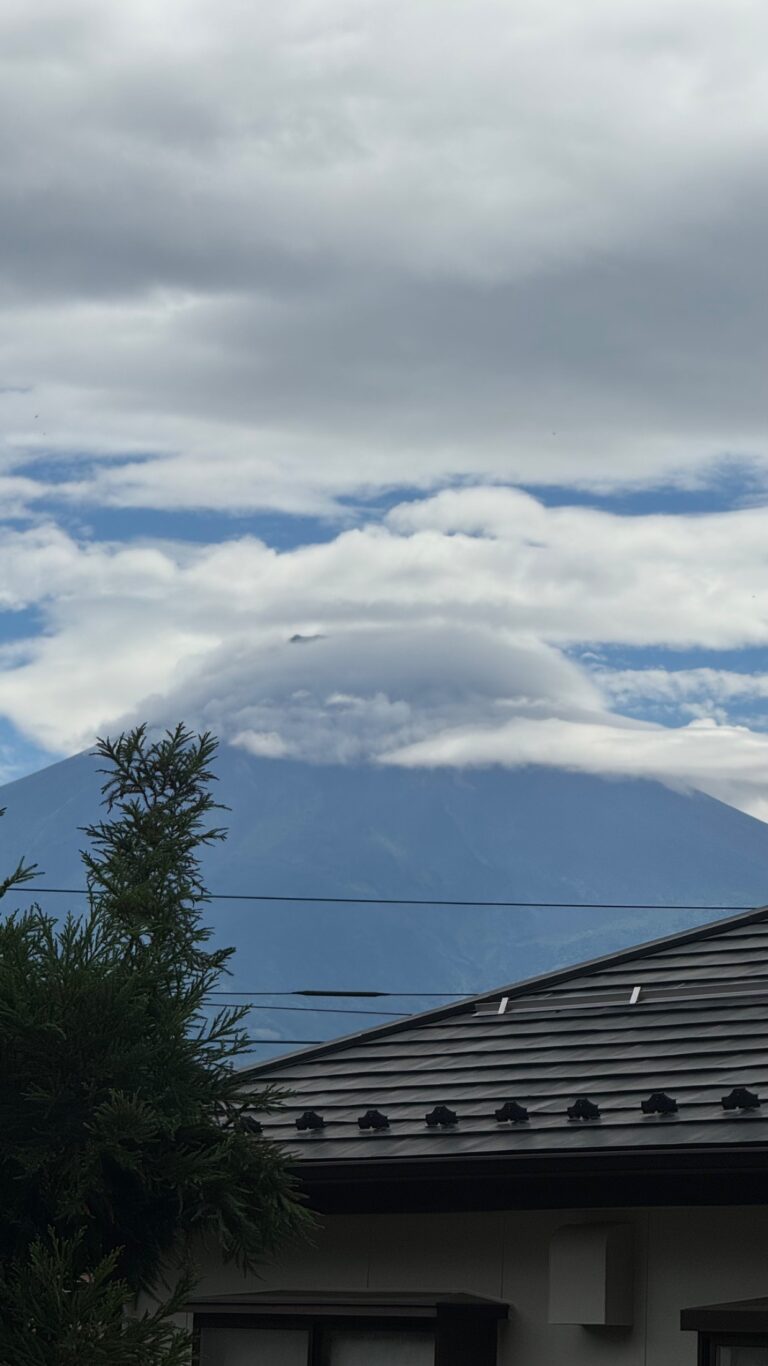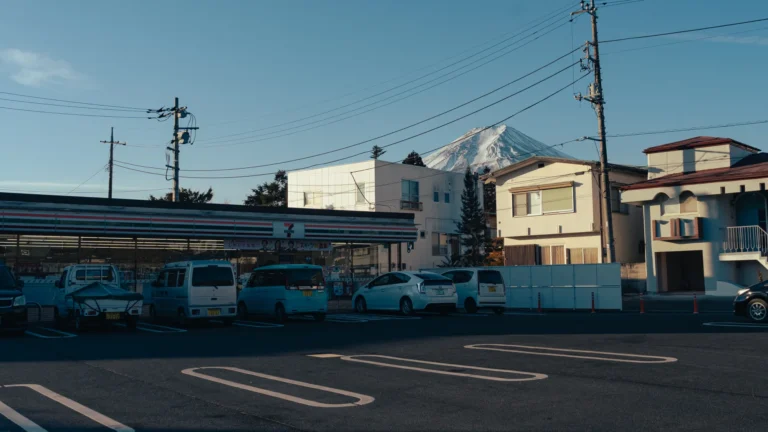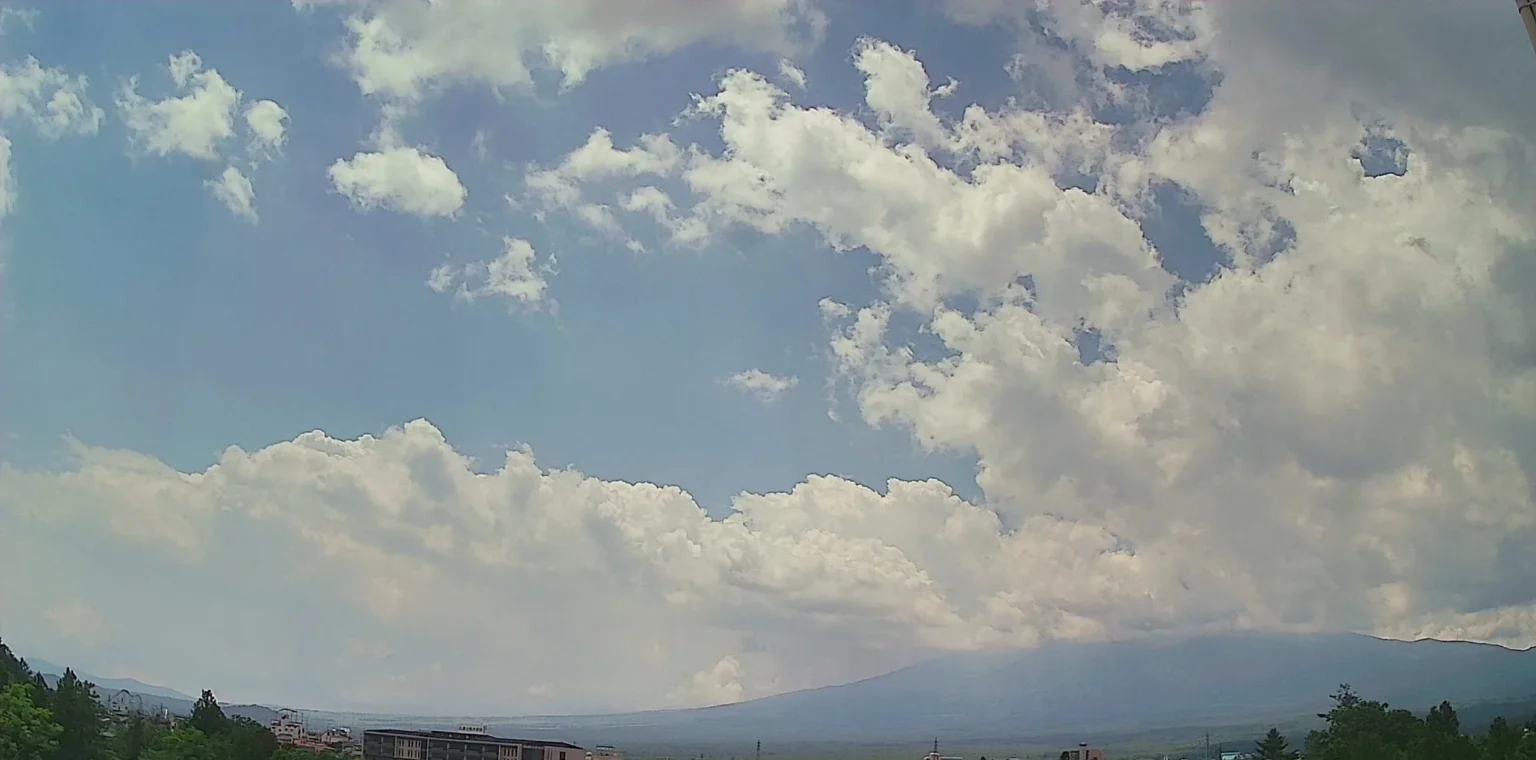

I’m Nobu, and I live in Fujiyoshida, close enough to Mount Fuji that visitors often assume I can see the summit every summer morning. So between May 26 and August 14, 2026, I did the simplest test possible: I looked. Across 80 mornings in that window, from the same spot, I checked with my own eyes and kept a photo of each one. The result was less reliable than most travel plans assume. Across 80 observed mornings, Fuji’s summit was clearly visible only 40% of the time, partly visible 8%, and completely hidden 52%. Even our own visibility score matched what I saw only 62% of the time. Summer Fuji, it turns out, is not a guarantee — it is a daily gamble.
Data snapshot
- 80 mornings observed in person from one spot in Fujiyoshida, between May 26 and Aug 14, 2026 (one July morning missed and left out).
- Summit clearly visible on 32 mornings (40%), partly visible on 6 (8%), completely hidden on 42 (52.5%).
- Any summit view at all: 38 of 80 mornings (48%) — a coin flip, slightly against you.
- June was the worst month in this sample (summit out on just 30% of mornings) — but the single longest blackout was actually July 1–8: eight mornings straight with no summit, just ahead of a seven-day run in late June.
- Our JMA-derived visibility score agreed with what I actually saw on 49 of 79 mornings (62%).
This is a summer, morning, single-viewpoint record — not a full-year climatology. Winter is known to be clearer, and this log does not cover it. Every figure below is drawn from the same 80 in-person observations, and the full dataset is downloadable at the end.
On this page
How I measured it: 80 mornings, one viewpoint, one observer
Every record in this report is a single person looking at the mountain — not a camera, not a model. That is the point, and also the limit.
- One fixed area: Fujiyoshida, on the north side of Mount Fuji.
- One observer: me — Nobu, a long-time resident.
- Each logged morning: a naked-eye check, recorded with a timestamped photo.
- Three categories: summit clearly visible, partly visible (part of the summit or upper ridge out, but not a clean full view), or completely hidden.
- The window: May 26 to August 14, 2026 — 81 calendar days, of which I logged 80. One July morning I missed, and I left it out rather than guess it.
What this is not. It is a summer sample from one place, judged by one pair of eyes. It should not be read as a year-round average — winter mornings around Fuji are generally clearer, and this log does not cover them. It is a record of what an actual visitor, standing where I stand, would have seen this summer.
The 80-morning calendar
Here is every morning at once. Each square is one day I looked at Mount Fuji: blue when the summit was clearly out, amber when it was partly out, grey when it was completely hidden.
Figure 1. Eighty morning observations from Fujiyoshida. Each square is one morning I checked Mount Fuji by eye and recorded with a photo. The longest grey block is July 1–8 — eight mornings straight with no summit — with another seven-day run in late June (June 23–29).
Finding 1: The summit was hidden more often than it was visible
The surprise was not that Fuji was sometimes covered. It was how often it disappeared completely. Across 80 summer mornings, the summit was fully hidden on 52% — more than the 40% when it was clearly out.
Figure 2. Mount Fuji was fully hidden more often than it was clearly visible. Of 80 observed summer mornings, the summit was clearly visible on 32 (40%), partly visible on 6 (8%), and completely hidden on 42 (52%). Any summit view at all happened on 48% of mornings.
Put another way: if your trip gave you exactly one summer morning in Fujiyoshida, and you had walked out to look with me, the odds were slightly against you seeing the summit at all — and clearly against a clean, postcard view. The mountain is right there. Seeing it is a different question.
Finding 2: June was the trap; July and August recovered — but only to a coin flip
The summer was not uniform. June was brutal, with the summit out on just 30% of mornings. July and August climbed back to the low-to-high 50s — better, but still nothing you would call reliable.
Figure 3. Any-summit-view rate by period. The summit appeared on 83% of late-May mornings (a small, partial-month sample), fell to 30% in June, then recovered to 53% in July and 57% in the first half of August. Late May and August are partial months.
The single longest blackout was not even in June: it was July 1 to 8 — eight mornings in a row with no summit at all, just ahead of a seven-day run in late June (June 23–29). From this Fujiyoshida morning viewpoint, a visitor who happened to check that first week of July would not have seen the summit once — a reminder that a good monthly average (July recovered to 53%) can still hide a brutal week. Late May looks strong in the chart, but it is only six mornings, so I would not lean on it; treat it as a promising hint, not a rule. If August is your window, I keep a closer look at how often Fuji is visible in August.
Why summer is the hard season
This pattern is not bad luck — it lines up with the climate. Early summer around Fuji is the rainy season, and warm, humid air builds cloud that sits on the mountain.
Japan’s Kanto-Koshin rainy season (tsuyu) normally runs from about June 7 to July 19, and in 2026 it ran to around July 20; June 2026 was a notably wet month on the Pacific side of eastern Japan. That is exactly when my log bottomed out. As the ground and slopes warm through summer, convection builds cloud that tends to thicken from mid-morning — which is also why an early check beats a late one. The national tourism guidance says much the same: Fuji is often veiled in the June-to-mid-July rains, and clear, distant views are easiest in the cold, dry months. My summer numbers are the on-the-ground version of that story. For the day-to-day mechanics of it, I keep a separate Mt Fuji weather guide, and the deeper “will I see it” logic lives in the Mt Fuji visibility guide.
Finding 3: The forecast helped — but it did not replace looking outside
I also score each morning with our own visibility signal — a non-official measure built from Japan Meteorological Agency weather codes and precipitation probability. It is useful. It is not magic. Across 79 forecastable mornings, it agreed with what I actually saw 62% of the time.
| Actually seen | No summit seen | |
|---|---|---|
| Score said “visible” (≥5) | 32 | 25 |
| Score said “hidden” (<5) | 5 | 17 |
Figure 4. Our visibility score vs. what I actually saw, 79 mornings. The score agreed on 49 of 79 mornings (62%) and disagreed on 30 of 79 (38%). Its biggest weakness was optimism: on the 57 mornings it called “visible,” the summit was actually hidden 25 times — a miss of 44%. Here “seen” means any summit view, clearly or partly visible.
An important label. This is our visibility score, derived from JMA forecast data — not an official Japan Meteorological Agency visibility rating (JMA does not publish one). When it and the mountain disagreed, it usually erred on the hopeful side: a clear-looking forecast that the mountain quietly ignored. That is precisely the gap a live look closes.
If you want that live look without checking yourself, that is the whole idea behind the alert I run — I’ll email you when a clearer window actually looks likely:
Fuji Visibility Alert
Want the clear mornings, not the guesswork?
I check Mt. Fuji from Fujiyoshida and compare it with the JMA forecast. When a clear viewing window looks likely, I'll send you a short email so you can adjust your plans in time.
What this means if you’re planning a summer trip
None of this says “don’t come.” It says: don’t bet your whole Fuji experience on a single summer morning. Here is what I’d actually tell a friend.
A couple of the booking links below are affiliate links — if you use them it helps support this daily record, at no extra cost to you. The data and findings above don’t depend on them.
- Give yourself more than one morning. On this summer sample, any single morning had a 48% chance of a summit view. Two or three mornings stack the odds properly in your favour.
- Be most careful in June. If Fuji is the main reason for your trip and you can only travel in June, plan the most backup — and expect a real chance of a full week without it.
- Stay near the lakes, and check early. This is a morning record; cloud tends to build later. An overnight near Kawaguchiko or Fujiyoshida buys you an early look you can’t get on a day trip arriving at noon. If you want to compare cancellable options, rooms near Lake Kawaguchiko are a sensible base.
- Keep the plan flexible. A tour with free-cancellation options lets you move a Fuji day to a clearer window instead of locking into clouds.
- Use the forecast as a signal, not a promise. A good score is worth acting on — but in this sample, 44% of its “visible” calls still ended hidden, so have a backup either way.
Planning takeaway: If seeing Mount Fuji matters, don’t make one summer morning your only chance. In this 80-morning Fujiyoshida sample, the summit appeared on 48% of mornings and was fully hidden on 52%. Build in multiple mornings — especially in June — and treat any forecast as guidance, not certainty.
How this differs from a webcam or a weather app
Plenty of tools show a live camera view or an automated forecast, and they are genuinely useful. This report adds a different layer: repeated human observations from the same local area, with a photo for every one, across 80 summer mornings. Fuji visibility isn’t a clean yes-or-no weather variable — it’s what a person actually sees when they step outside. That includes the mornings the summit didn’t show, which I keep in the record rather than quietly dropping, because those are the mornings a real traveler needs to plan around.
Get the data
The full 80-morning dataset is open — date, verdict, location, observer, source, whether a photo exists, and the JMA-derived score. Journalists, researchers and fellow travelers are welcome to use it with a link back. If you’d like a chart, a specific cut, or a quote, get in touch.
FAQ
How often is Mount Fuji visible in summer?
What is the worst month to see Mount Fuji in summer?
Is a weather forecast enough to know if I’ll see Mount Fuji?
Why does this only cover summer?
Can I use this data?
Join travelers discovering Japan's hidden side
Weekly dispatches from off-the-beaten-path Japan — spots and stories you won't find in guidebooks.
No spam. Unsubscribe anytime.
Welcome aboard!
You're in. See you in your inbox soon.