Hyōgo · Asago · Castle in the Sky
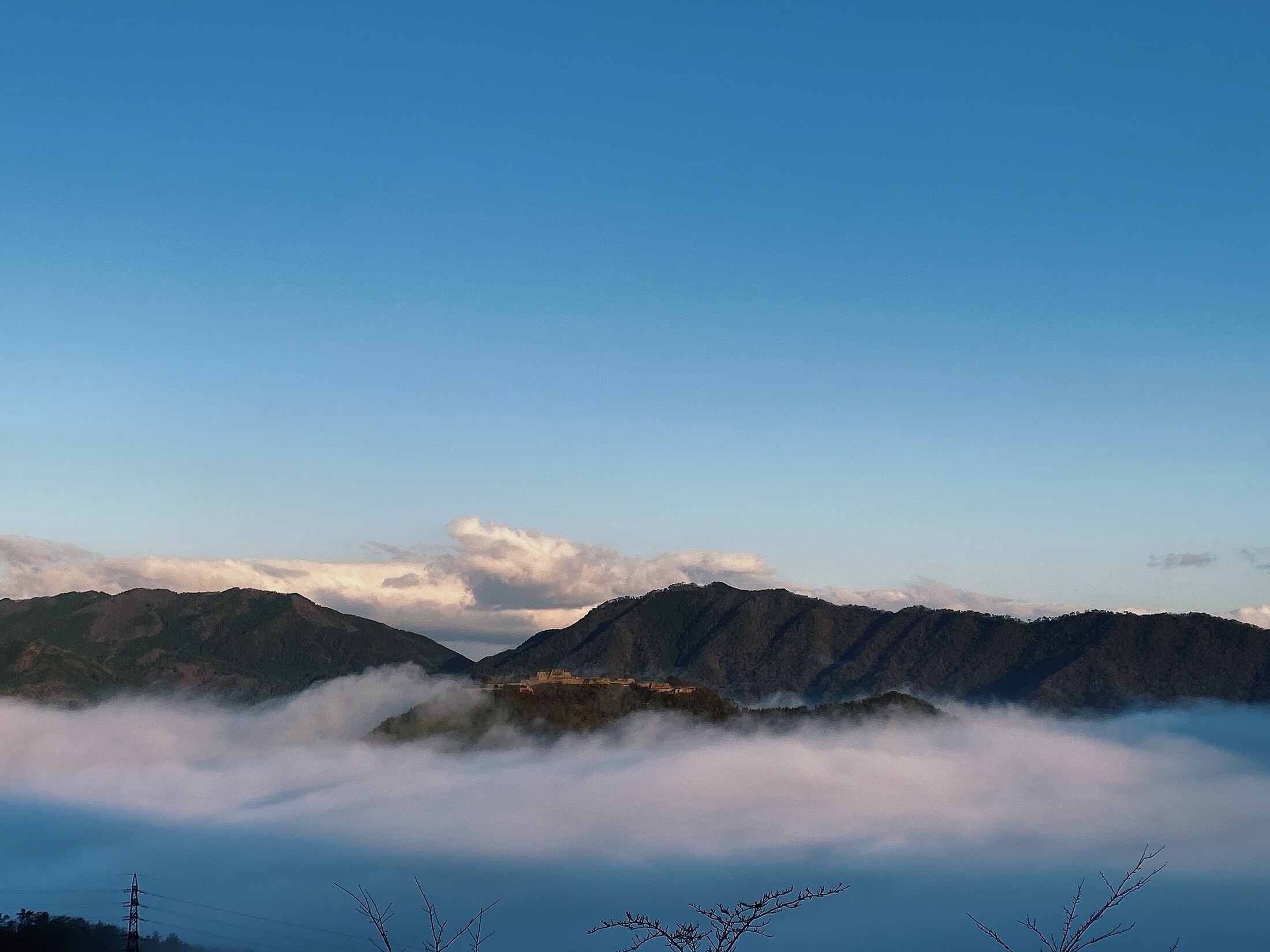
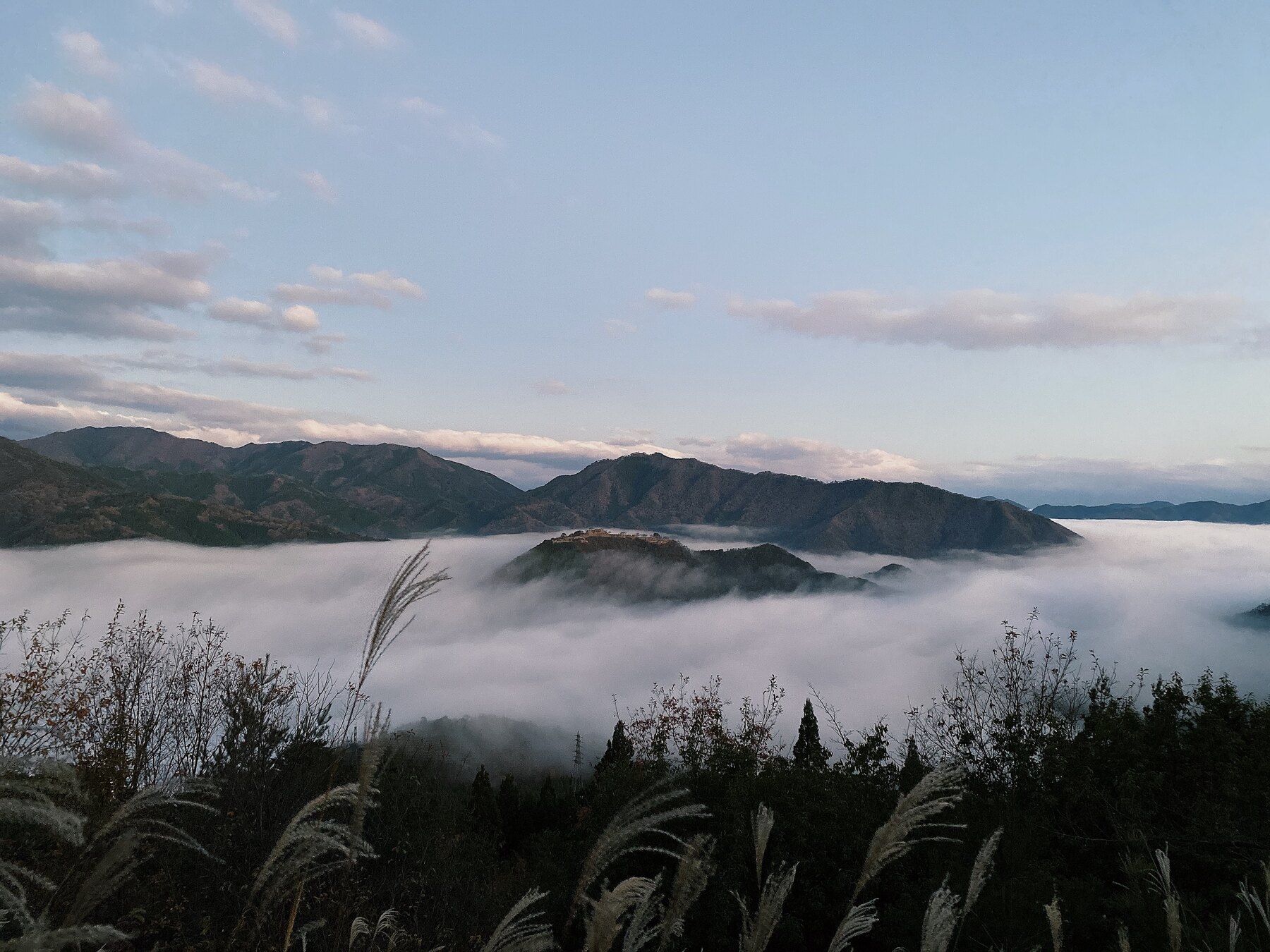
Takeda Castle is a ruined mountaintop fortress in Hyōgo that, on the right autumn morning, appears to float on a sea of clouds — “Japan’s Machu Picchu,” the castle in the sky. The clouds form from late September to early December, between dawn and about 8 a.m., and the postcard view of the castle floating is from Ritsuunkyō, the ridge across the valley. Entry to the ruins is ¥500, and the site closes for winter from January 4.
The castle in the sky
Takeda Castle sits on the 354-metre Mt Kojō above the old castle town of Takeda, in Asago, northern Hyōgo. The keep is long gone, but the stone walls survive almost completely — tier upon tier of fitted stone tracing the ridgeline — which makes it one of Japan’s finest mountaintop ruins even on an ordinary day. What made it famous is the autumn morning trick of light and weather: cold air pools in the river valley overnight, mist forms, and as the sun rises the ruins seem to rise out of a white sea. That image — the “castle in the sky” — is now one of the most photographed scenes in Japan.
A fortress abandoned in 1600 — which is why it survives
The ruins are frozen at a single moment in history. The Yamana clan, governors of Tajima, had the Otagaki family build a fort up here around 1443, and they held it for seven generations. It fell to Toyotomi Hideyoshi’s army during his Tajima campaign in 1580, and the last lord, Akamatsu Hirohide, rebuilt it in the grand all-stone form you see today. Then, after backing the losing side at the Battle of Sekigahara in 1600, he was ordered to take his own life — and the castle was simply abandoned. Because nothing was ever rebuilt on top of it, the Momoyama-era stonework was left to the mountain, which is exactly why Takeda is one of Japan’s most complete mountaintop ruins.
Those tiered walls are the work of the Anō-shū, the celebrated stonemasons from Ōmi (today’s Shiga), in the rough-fitted nozura-zumi style — uncut stones read and stacked, as their saying goes, “where the stone wants to go.” The site is a National Historic Site, one of Japan’s 100 Famous Castles, and counted among the country’s “three great sky castles” alongside Echizen-Ōno in Fukui and Bitchū-Matsuyama in Okayama.
When can you actually see the sea of clouds?
This is the part to plan around, because the clouds are never guaranteed — they need several things to line up at once. Aim for an autumn morning after these boxes are ticked:
| Factor | What you want |
|---|---|
| Season | Late September to early December (peak October–November) |
| Time of day | From dawn until about 8:00 a.m., before it burns off |
| Sky | Clear and settled — high pressure |
| Temperature | A big day–night gap (roughly 10°C or more) |
| The day before | Rain or high humidity feeds the morning mist |
| Wind | Little to none — wind tears the clouds apart |
Where to watch: on the castle, or across the valley
There are two completely different experiences, and it’s worth knowing which you want:
| Where | What you get | Effort & cost |
|---|---|---|
| Ritsuunkyō — 1st (top) deck | The classic shot: the whole castle floating on the clouds | ~40 min uphill · ¥300 fee |
| Ritsuunkyō — 2nd deck | The same scene from a little lower | ~20 min uphill · ¥300 fee |
| On the castle itself | Standing inside the clouds, looking out | castle admission ¥500 |
For the floating-castle photo everyone knows, you want Ritsuunkyō — a trailhead on Mt Asago across the valley, with three viewing decks. Its car park is free and open 24 hours (about 50 spaces) but fills very early in cloud season, so arrive in the dark. There’s a ¥300 environmental cooperation fee for the trail. To instead stand in the clouds, climb to the castle itself.
Visiting: hours, admission & access
The ruins keep seasonal hours, opening very early in autumn for cloud-watchers and closing entirely for winter. Admission is ¥500 for high-school age and up, free for junior-high and younger.
| Period (2026) | Open (last entry) |
|---|---|
| Jun 1 – mid-Sep | 6:00–18:00 (17:30) |
| mid-Sep – early Dec | 5:00–17:00 (16:30) |
| early Dec – Jan 3 | 10:00–15:00 (14:30) |
| Jan 4 – end Feb | Closed (winter) |
By train, take the JR Bantan Line to Takeda Station, then the seasonal “Tenkū” bus (about 20 minutes) to the Takeda-jō-ato stop and walk up roughly 20 minutes. By car, it’s about 10 minutes from the Wadayama IC; park at the “Yamajō-no-Sato” lot and either walk up (around 40 minutes) or take the bus. For Ritsuunkyō, drive or taxi to its own trailhead car park — there’s no direct bus.
A dawn mini-plan
The night before
Sleep in Takeda or Wadayama and check the local sea-of-clouds forecast before bed.
Pre-dawn
Up around 4:30–5:00; drive or taxi to the Ritsuunkyō car park in the dark and climb to the first or second deck by head-lamp.
Sunrise to 8:00
Watch the clouds fill the valley, then burn off — the window is short, so be in position before first light.
Afterwards
Drive round to the castle side and climb up to stand among the ruins themselves.
Staying near Takeda
To catch the dawn clouds you really want to sleep nearby — in Takeda, Wadayama or along the Bantan line. Booking has the local inns and hotels; Rakuten Travel is good for ryokan.
Good to know
When is the best time to see the sea of clouds?
An autumn morning — late September to early December, with October and November best — between dawn and about 8 a.m. You also want a clear, windless day with a big day–night temperature gap, following rain or high humidity the day before.
Is the sea of clouds guaranteed?
No. Even in peak season and good conditions it’s never certain. Check a “sea of clouds forecast” (雲海予報) the night before, and if you can, allow a spare morning.
Where do I get the floating-castle photo?
From Ritsuunkyō, the ridge on Mt Asago across the valley, which has three viewing decks (the first is highest and best, about a 40-minute climb). To stand inside the clouds instead, go up to the castle itself.
How much does it cost?
Entry to the castle ruins is ¥500 for high-school age and up, free for junior-high and younger. Ritsuunkyō asks a ¥300 environmental cooperation fee for its trail.
What are the opening hours?
Seasonal: roughly 6:00–18:00 in summer, an early 5:00–17:00 from mid-September to early December for cloud season, and 10:00–15:00 into early January. It’s closed for winter from January 4 to the end of February.
How do I get there?
By train: JR Bantan Line to Takeda Station, then the seasonal Tenkū bus and a short walk. By car: about 10 minutes from Wadayama IC to the Yamajō-no-Sato car park, then a walk or bus up. Ritsuunkyō has its own separate trailhead car park.
Plan a Takeda Castle Trip
A dawn this special is worth staying over and renting wheels.
Osaka Castle
The reconstructed giant and its Edo-era stones.
Matsumoto Castle
Japan’s oldest original keep, in Nagano.
Kōchi Castle
One of only a dozen original keeps left.
7 Days in Kansai
A week beyond Kyoto, hidden corners included.
Join travelers discovering Japan's hidden side
Weekly dispatches from off-the-beaten-path Japan — spots and stories you won't find in guidebooks.
No spam. Unsubscribe anytime.
Welcome aboard!
You're in. See you in your inbox soon.