
Tokyo · City gardens, ginkgo avenues and western mountains · Autumn leaves
Tokyo autumn leaves come in four kinds of place: the city gardens (Rikugien, Koishikawa Korakuen, Shinjuku Gyoen), the Meiji Jingu Gaien ginkgo avenue, Showa Kinen Park in western Tokyo, and the mountains (Mount Takao, Mount Mitake, Okutama). By the typical windows that GO TOKYO and japan-guide list, Lake Okutama, Mount Mitake and Showa Kinen Park peak first, from late October or early November, and Rikugien and Koishikawa Korakuen peak latest, from late November into December. One classic view is missing in autumn 2026: Koishikawa Korakuen’s red Tsutenkyo bridge has been dismantled for rebuilding.
Tokyo autumn leaves at a glance: four kinds of place
Match the place to the hours you have. If you’re in Tokyo in fall with a free afternoon, a city garden fits; Showa Kinen Park and Mount Takao each want half a day or more, and Mount Mitake or Okutama takes the whole day.
The middle column is the time each kind of place suits. The right-hand column has the train from Shinjuku and the 2026 adult fee or fare.
| Kind of place | Time it suits | From Shinjuku (2026) |
|---|---|---|
| City gardens: Rikugien, Koishikawa Korakuen, Shinjuku Gyoen | A few hours | JR, Tokyo Metro or Toei trains to Komagome, Suidobashi or Iidabashi, or Shinjuku-gyoemmae, then 3–7 min on foot; entry ¥300–¥500 |
| Meiji Jingu Gaien ginkgo avenue | A short stop, easy to pair with a garden | Tokyo Metro to Gaienmae or Aoyama-itchome |
| Showa Kinen Park, western Tokyo | Half a day | Ome Special Rapid or Holiday Rapid Okutama trains straight to Nishi-Tachikawa, 29–34 min on the trains I checked in JR East’s October 2026 timetable (a weekday Rapid is timetabled at 44 min), then about 2 min to a park gate; entry ¥450 |
| Mount Takao | Half a day to a full day | Keio Line to Takaosanguchi, 43–47 min on weekend reserved-seat trains; ¥1,450 ticket including the cable car or lift both ways |
| Mount Mitake and Okutama | A full day | JR with a change at Ome: about 80–90 min to Mitake and 92–108 min to Okutama at weekends, then a bus (and the cable car up Mitake) |
This year’s peak dates live elsewhere. For 2026 timing, the live koyo tracker marks which rows run on a dated 2026 forecast and which are still on a typical-year window. When I checked on 2 October 2026, Mount Takao was the only Tokyo spot on it with a dated forecast.
A few hours. Pick one city garden by where you’re staying and what day it is. Shinjuku Gyoen closes on most Mondays in late autumn, while Rikugien and Koishikawa Korakuen have no weekly closing day. The Gaien avenue fits in before or after.
Half a day. Showa Kinen Park for long ginkgo rows, or Mount Takao by cable car up and down. Trains for both leave from Shinjuku.
A full day. Mount Mitake or Okutama, or a day out of Tokyo to Lake Kawaguchiko, Nikko, Saitama or Kiryu (see day trips out of Tokyo below).
Not booked in Tokyo yet?
Keio trains to Takaosanguchi (Mount Takao) and the direct JR trains to Nishi-Tachikawa (Showa Kinen Park) both leave from Shinjuku, so a hotel near Shinjuku suits either half-day trip. Check each listing’s price and cancellation terms before you book. Affiliate link · HJG may earn a commission at no extra cost to you.
Which turns first: the order colour moves through Tokyo
Tokyo fall foliage usually peaks first at Lake Okutama, Mount Mitake and Showa Kinen Park, and last at Rikugien and Koishikawa Korakuen. In a typical year the earliest listed peak windows open in late October or early November. Mount Takao, Shinjuku Gyoen and the Gaien ginkgo avenue follow from mid-November (japan-guide puts the avenue in late November), then Rikugien and Koishikawa Korakuen from late November. GO TOKYO lists Rikugien, and japan-guide lists Shinjuku Gyoen, into mid-December.
First: late October or early November
Lake Okutama, Mount Mitake, Showa Kinen Park. The ones to aim for if you land in late October or the first days of November.
Next: from mid-November
Mount Takao, Shinjuku Gyoen, the Gaien ginkgo avenue (late November in japan-guide’s list).
Last: late November into December
Rikugien and Koishikawa Korakuen. With Shinjuku Gyoen, the places to aim for in early December.
If you arrive in late October or the first days of November, head west. If you arrive in early December, stay central. These are average-year windows, and each source words them a little differently.
Typical windows, not forecasts. The order above compares the peak windows that GO TOKYO (updated 1 September 2026) and japan-guide (updated 8 September 2026) list for an average year, plus Showa Kinen Park’s own seasonal page. Three more labels you’ll see quoted:
- Showa Kinen Park lists ginkgo from late October to late November and maples from late October to early December, and says the best time varies from year to year.
- The Hachioji Convention & Visitors Association says Mount Takao’s leaves are usually at their best from mid-November to early December (on its 2025 festival page).
- GO TOKYO says mountain areas such as Okutama and Mount Takao start to colour earlier, from late October to mid-November. That is when colour begins, not a peak.
One source sits apart: GO TOKYO’s English page gives Showa Kinen Park late November to mid-December, while the same site’s Japanese page, japan-guide and the park itself all start in late October.
This year’s forecast dates go on the live koyo tracker. For how a forecast date differs from a typical-year window, see who actually forecasts Japan’s autumn colours.
What’s different in autumn 2026
Eight things affect a visit this autumn; the one that changes the most plans is the bridge at Koishikawa Korakuen.
| Place | Autumn 2026 |
|---|---|
| Koishikawa Korakuen | The red Tsutenkyo bridge has been dismantled and removed for a rebuild; one path is closed, with a temporary detour. Tokyo Metropolitan Park Association notice, 20 March 2026 |
| Rikugien | Shoreline repairs, May to November 2026 (planned): the pond and a stream are kept lower than usual, and some paths near the works are closed. Garden notice, 8 May 2026 |
| Rikugien | Visitors are asked not to sketch or paint, with or without easels or chairs, from 1 November to 15 December 2026. Garden notice, 10 September 2026 |
| Todoroki Valley | Reopened on 24 March 2026, riverside path included. Setagaya City, page updated 1 September 2026 |
| Showa Kinen Park | Yellow and Red Leaves Festival from 29 October to 29 November 2026. Free entry on Sat 24 and Sun 25 October 2026 (parking still charged). Park festival page and schedule |
| Mount Takao cable car and lift | From the first service on Sun 1 November 2026, tap a transit IC card at the gate instead of buying a ticket. Takao Tozan Railway notice, 1 September 2026 |
| Mount Takao Trail 6 | Uphill only, all day, from Biwa Falls to the Trail 5 junction, 31 October to 6 December 2026. Takao Visitor Center notice, 2 October 2026 |
| Mount Mitake cable car | Adult fares rose on 1 October 2026: ¥700 one way (was ¥600), ¥1,400 return (was ¥1,200). Mitake Tozan Railway release, 4 September 2026 |
Which central garden fits your day: Rikugien, Koishikawa Korakuen or Shinjuku Gyoen?
Rikugien and Koishikawa Korakuen both charge ¥300, open 9:00–17:00 and have no weekly closing day. Shinjuku Gyoen charges ¥500, opens 9:00–16:30 from 1 October and closes on most Mondays. Pick by station, by day of the week, and by what’s under repair this year.
Swipe the table for the nearest stations and walking times.
| Garden | Hours and entry (2026) | Getting there |
|---|---|---|
| Rikugien | 9:00–17:00, last entry 16:30. ¥300; 65 and over ¥150; free for primary-school age and under (with an adult) and for junior-high students who live or study in Tokyo. Only scheduled closing days: 29 December to 1 January. | JR Yamanote Line to Komagome (South Exit) or Tokyo Metro Namboku Line to Komagome (N14), 7 min on foot |
| Koishikawa Korakuen | 9:00–17:00, last entry 16:30. ¥300; 65 and over ¥150; free for primary-school age and under and for junior-high students who live or study in Tokyo. Children of primary age must come with an adult. Scheduled closing days: 29 December to 1 January. | West Gate: Toei Oedo Line Iidabashi (E06), Exit C3, 3 min. East Gate: JR Sobu Line Suidobashi (JB17), West Exit, 5 min |
| Shinjuku Gyoen | 9:00–16:30 from 1 October to 14 March, last entry 16:00. ¥500; 65 and over, and students from high school up, ¥250; junior high and under free. Closed on Mondays (the next weekday after a Monday holiday), but open on Mondays from 1 to 15 November. Also closed 29 December to 3 January. | Tokyo Metro Marunouchi Line, Shinjuku-gyoemmae Exit 1, 5 min to the Shinjuku Gate |
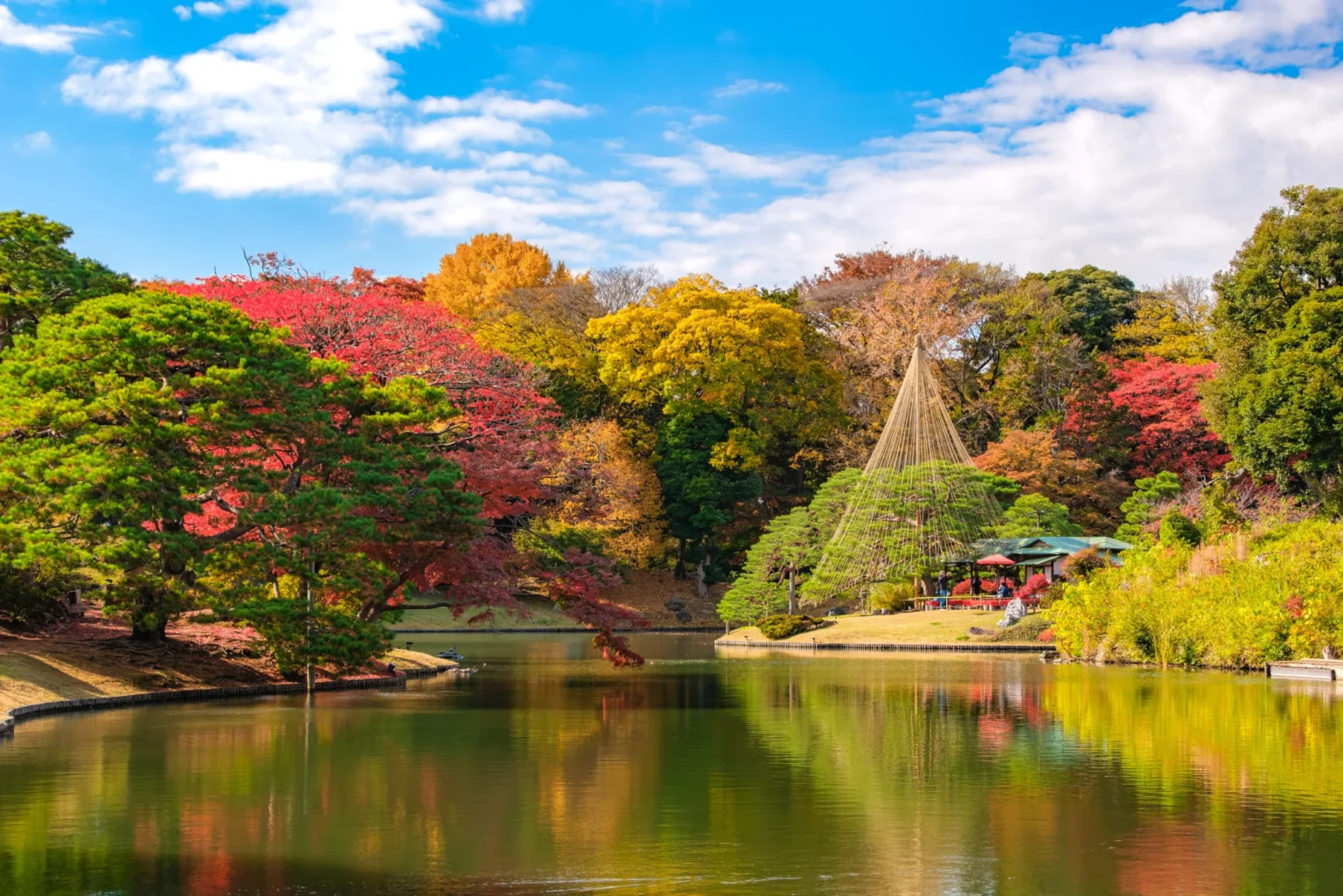
Rikugien this autumn. Shoreline repairs are planned to run from May to November 2026. While they last, the water in the Daisensui pond and in a stream the garden writes as 剡渓流 is kept lower than usual, which the garden says affects part of the scenery, and some paths around the works are closed. Its 2026 notices showed no completion notice when I checked on 2 October 2026. Separately, from 1 November to 15 December 2026 the garden asks visitors not to sketch or paint, with or without easels or chairs, because of the autumn crowds.
On payment, the garden’s page lists transit IC cards, Visa, Mastercard, UnionPay and code payments such as PayPay and Alipay. It prints two lists that differ on other card brands, so carry a second way to pay.
From 10 October to 6 December 2026 the Tokyo Metropolitan Park Association runs an autumn-leaves stamp rally across nine metropolitan gardens, Rikugien and Koishikawa Korakuen among them. Rikugien and Koishikawa Korakuen also run separately ticketed evening openings in autumn; those are outside this guide.
Koishikawa Korakuen autumn 2026: the bridge view is gone
This autumn Koishikawa Korakuen is missing its classic view, the red Tsutenkyo bridge over the Oigawa among the maples. The Tokyo Metropolitan Park Association’s notice of 20 March 2026 says the Tokyo Metropolitan Government is rebuilding the ageing bridge, that the bridge “has been dismantled and removed” (現在のところ通天橋は解体・撤去されております), and that part of the garden’s paths are closed for the time being. The works period is listed as planned: from 1 May 2025 “for the time being” (令和7年5月1日(木)から当面の間), with no end date.
The Oigawa is the garden’s stream, modelled, the park association says, on the Oi River (大堰川) of old Yamashiro Province in present-day Kyoto, a river the shogun Tokugawa Iemitsu was fond of. The Tsutenkyo crossed it upstream. The notice names one closed path and one detour:
| Route | What the notice says |
|---|---|
| Closed | The path from Ryukyu-yama hill past the site of the Kiyomizu Kannon-do hall and over the Tsutenkyo to Tokujin-do (琉球山 → 清水観音堂跡 → 通天橋 ← 得仁堂) |
| Detour | A temporary path at the Sawatari crossing, between Ryukyu-yama and Tokujin-do (琉球山 → 沢渡(仮設通路) ← 得仁堂) |
The garden page still gives its usual 9:00–17:00 hours.
The garden’s own 2026 autumn event page calls the Tsutenkyo and Oigawa foliage a scene visitors cannot see during the works: 工事中でご覧いただけない通天橋と大堰川の紅葉.
Neither that page nor the notice describes what you can see from the Sawatari detour; I read both on 2 October 2026.
The end date has moved before. An archived 2025 version of the notice described preparatory dismantling and removal works with a planned end of 26 December 2025; the March 2026 version replaced the end date with “for the time being”.
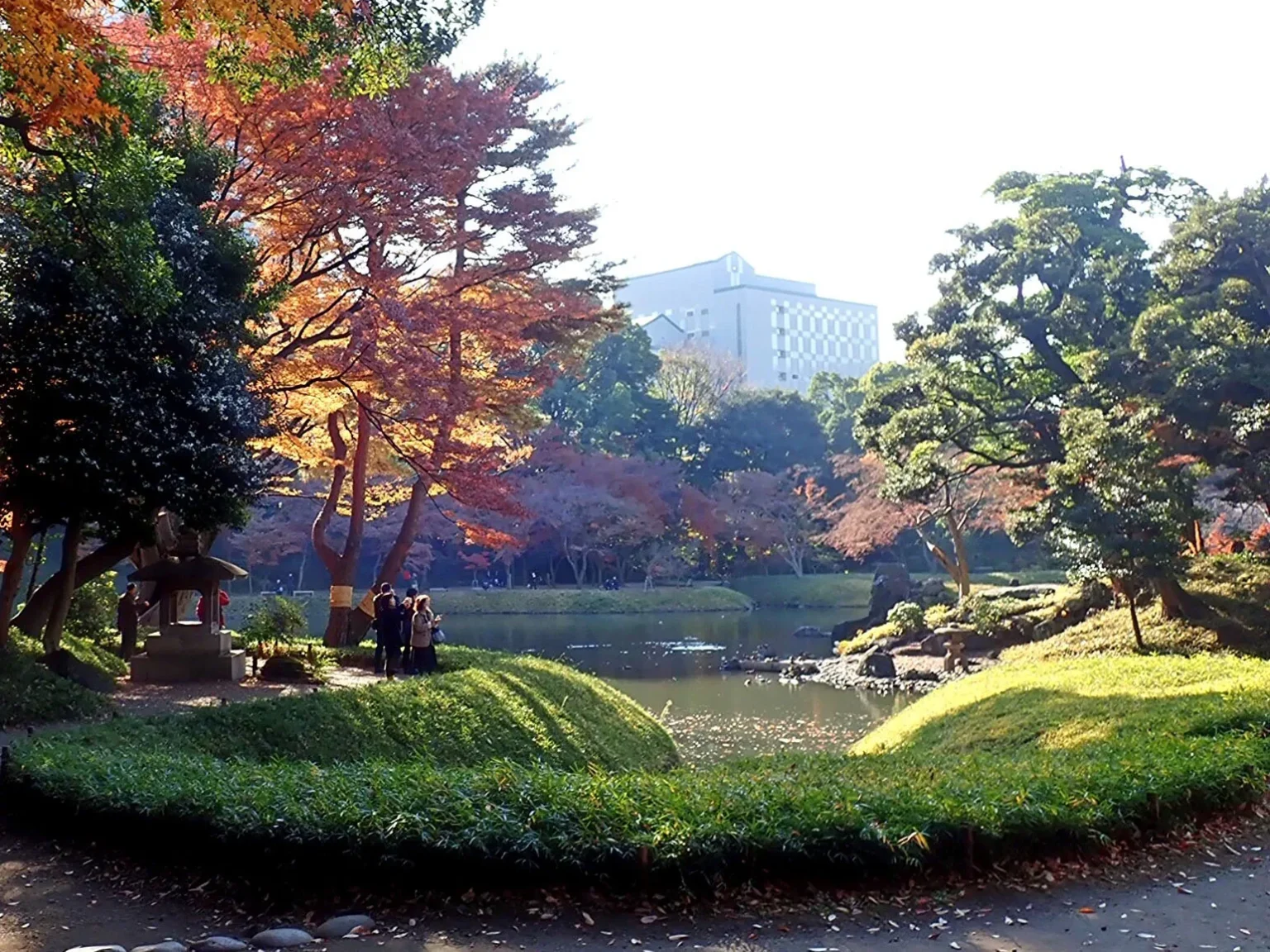
Is it still worth going? The West Gate is 3 minutes from Exit C3 of Iidabashi Station, entry is ¥300, and japan-guide describes the main pond as surrounded by dozens of maples that turn orange and red in late November. If the bridge view was the whole reason, go to Shinjuku Gyoen or Rikugien instead, bearing in mind that Rikugien’s pond is kept lower during this year’s shoreline works.
What the English lists say, read on 2 October 2026. I read seven English autumn-leaf lists for Tokyo: japan-guide, GO TOKYO, Tokyo Cheapo, Time Out, MATCHA, travelynotes and LIVE JAPAN.
- Tokyo Cheapo’s 2026 list is the only one of the seven that says the bridge has been taken down. It says the bridge “has been dismantled for rebuilding, so that classic maple view is off the menu for now”, which matches the notice, though it doesn’t give the notice itself, the planned start date, the closed path or the detour.
- MATCHA’s “Tokyo Fall Foliage 2026” list (first published in 2018, last modified 14 September 2026) still describes the Oigawa view as one that “combines the red Tsutenkyo Bridge with the autumn leaves”.
- LIVE JAPAN’s “Autumn in Tokyo 2026” (last updated 2 September 2026) names “the Oigawa area” as the first of the garden’s two standout viewpoints. Beside it, the garden’s own wording: the Tsutenkyo and Oigawa foliage is a scene visitors cannot see during the works.
- japan-guide (updated 8 September 2026) and GO TOKYO (updated 1 September 2026) give a late-November-to-early-December window and say nothing about the bridge. Time Out doesn’t mention it either.
- travelynotes doesn’t list the garden.
Shinjuku Gyoen on Mondays in late autumn
Shinjuku Gyoen autumn hours run 9:00–16:30 from 1 October, with entry until 16:00. The garden closes on Mondays (on the next weekday when a Monday is a public holiday), except during its chrysanthemum show, 1–15 November, when it opens on Mondays too. Its 2026 calendar marks the late-autumn Mondays, and the Tuesday after the holiday, as follows:
| Date (2026) | Shinjuku Gyoen |
|---|---|
| Mon 2 and Mon 9 November | Open (chrysanthemum show) |
| Mon 16 November | Closed |
| Mon 23 November, Labour Thanksgiving Day | Open |
| Tue 24 November | Closed |
| Mon 30 November | Closed |
| Mon 7 December | Closed |
| Mon 14 December | Closed |
On those closed days Rikugien and Koishikawa Korakuen are open, since neither has a weekly closing day, and so is Showa Kinen Park on the November dates, as it lists no scheduled closing days in October or November. Any of them can close for a storm: the nine metropolitan gardens shut for Typhoon No. 25 on 21 September 2026.
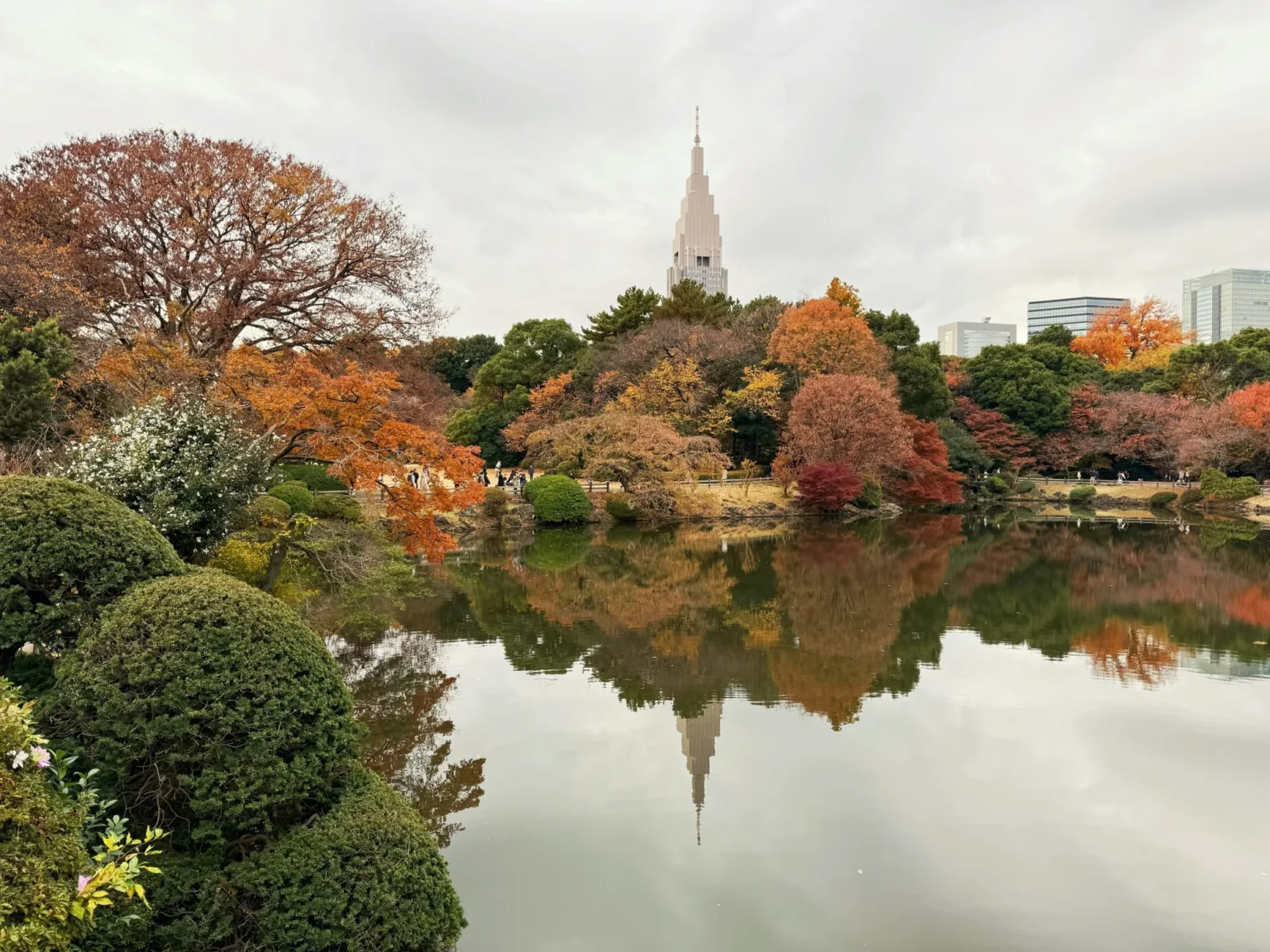
Light is the other limit. In late November central Tokyo’s sunset falls between 16:28 and 16:31 (National Astronomical Observatory of Japan, 2026), so a Shinjuku Gyoen visit ends around dusk, and Rikugien and Koishikawa Korakuen stay open about half an hour past sunset. At Shinjuku Gyoen, transit IC cards work at the entry gates, and a web ticket bought in advance lets you skip the ticket window by showing its QR code at the gate; it’s valid for six months from purchase. Alcohol isn’t allowed in. There are coin lockers (¥300 and ¥500) at the Shinjuku, Okido and Sendagaya gates, and the chrysanthemum show is in the Japanese garden.
Other city options: Todoroki Valley and the Nezu Museum garden
Todoroki Valley Park, in Setagaya, reopened on 24 March 2026, riverside path included; most of the park had been closed since a tree fell in July 2023. It’s 3 minutes on foot from Todoroki Station on the Tokyu Oimachi Line, and the way in is down the steps at the foot of Golf Bridge, near the station.
Setagaya City’s warnings for the valley. The paths are narrow, some riverside stretches have no fence, and the footing is poor in places. Parts have no lighting, so stay out after dark, and keep away from the river in heavy rain, when it rises fast. The 9:00–16:30 hours on the city’s page for November to February belong to the Japanese garden and shoin, not the valley path.
For colour, Todoroki Fudoson, the temple at the valley’s south end, says the autumn leaves in its grounds are exceptional. Neither the temple nor the city gives a peak window.
The Nezu Museum’s garden, 8 minutes on foot from Exit A5 of Omotesando Station, is open only to museum ticket holders, and the museum’s eight garden views include the autumn leaves at the Hikinsai teahouse (披錦斎). Its autumn special exhibition runs from 24 October to 23 November 2026, with adult online timed-entry tickets at ¥1,600 (same-day tickets cost ¥200 more). The 2026 schedule shows nothing on between 24 November and 4 December, and the museum closes during exhibition changeovers, so check before planning a visit in that gap. More on it in museum gardens near Tokyo.
GO TOKYO’s general tips for autumn leaves in Tokyo say weekends and holidays are particularly crowded and suggest weekdays and mornings. My wider approach is in how to skip the crowds in Japan.
Meiji Jingu Gaien ginkgo avenue: the short version
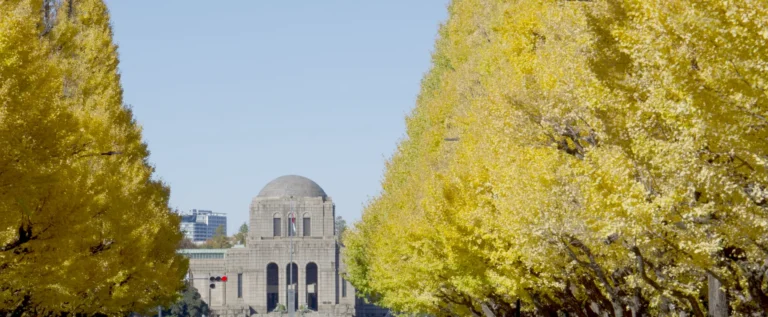
The Meiji Jingu Gaien ginkgo avenue is a short stop, easy to pair with one of the gardens. Meiji Jingu Gaien describes the avenue as four parallel rows of street trees running from the Aoyama-dori entrance to the circular road at the gallery end, with the big ginkgos framing a view of the white Meiji Memorial Picture Gallery.
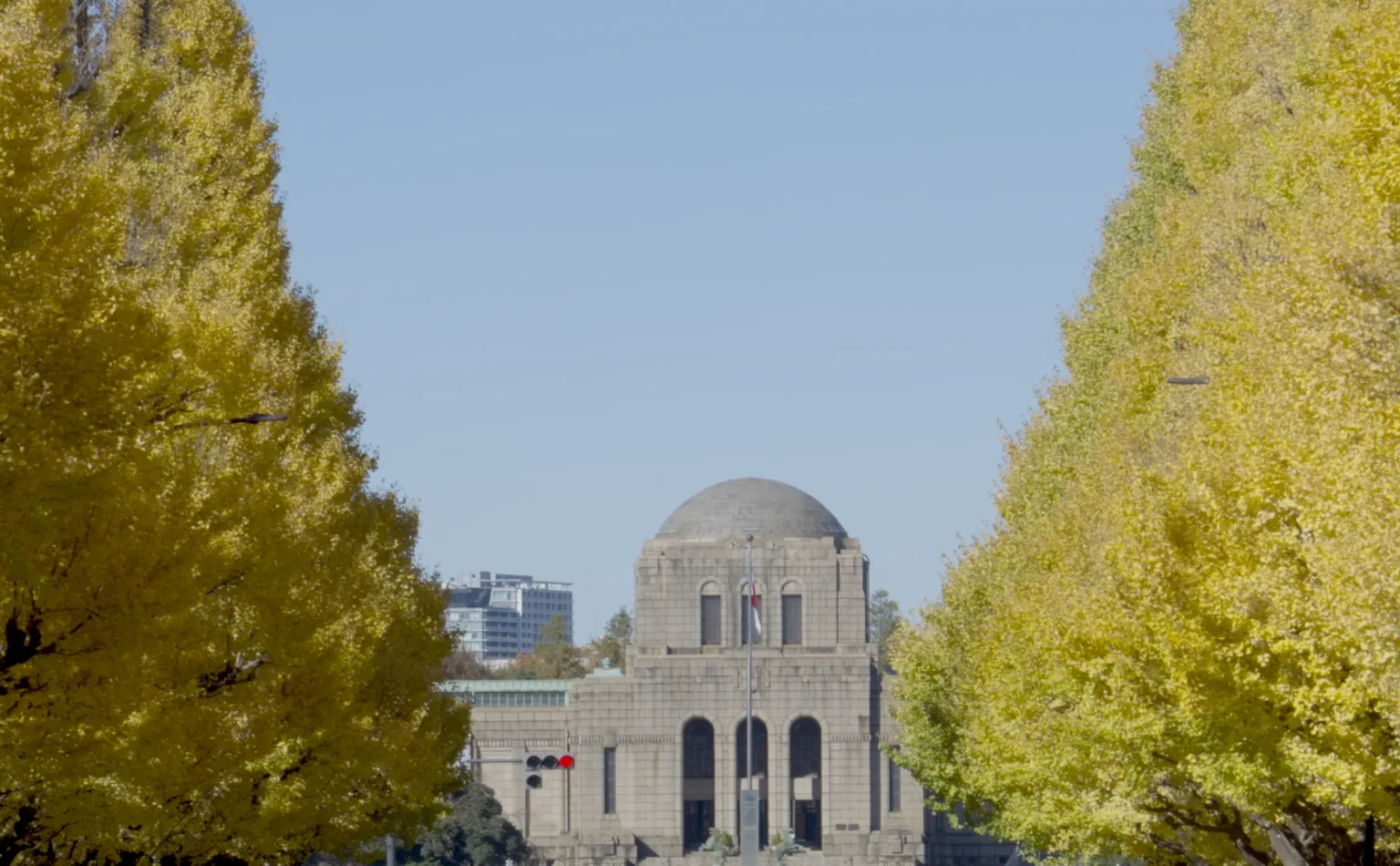
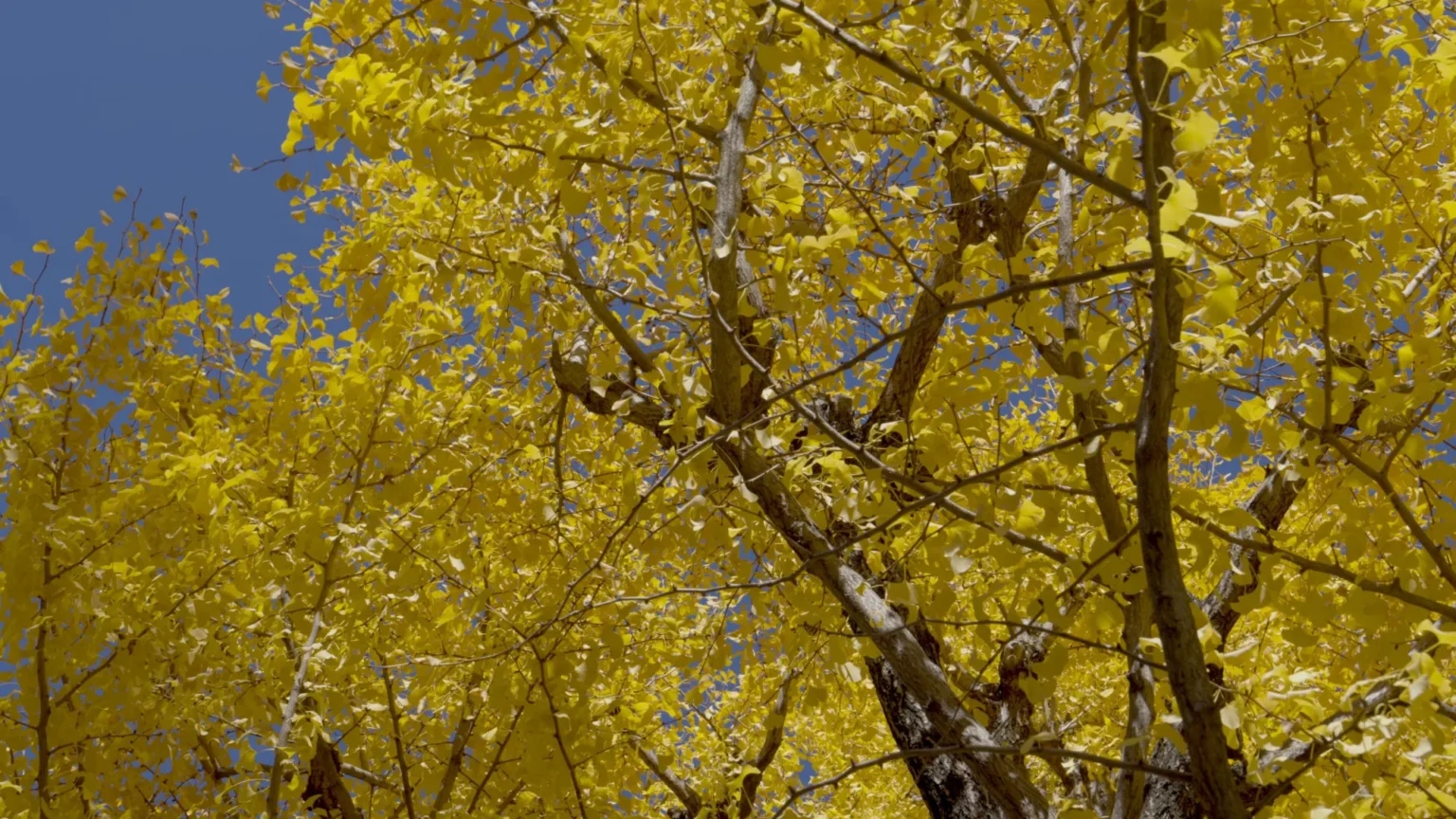
This is the one Tokyo place in this guide I have seen in autumn. I filmed the avenue in late November, under a blue sky. Straight overhead, the canopy was gold against the blue; down the avenue, the trees on both sides of the road closed in on the gallery’s dome. At the gallery end there were tents and a crowd.
The nearest Tokyo Metro stations are Gaienmae, on the Ginza Line, and Aoyama-itchome, on the Ginza and Hanzomon lines and also served by the Toei Oedo Line; the avenue starts at the Aoyama-dori end. GO TOKYO lists the peak from mid-November, japan-guide from late November. Meiji Jingu Gaien’s website did not list 2026 ginkgo festival dates when I checked on 2 October 2026. Who runs the evening light-up, where the festival stands and what has changed at the gallery end are in our Meiji Jingu Gaien ginkgo avenue guide.
Is Showa Kinen Park worth the trip out west?
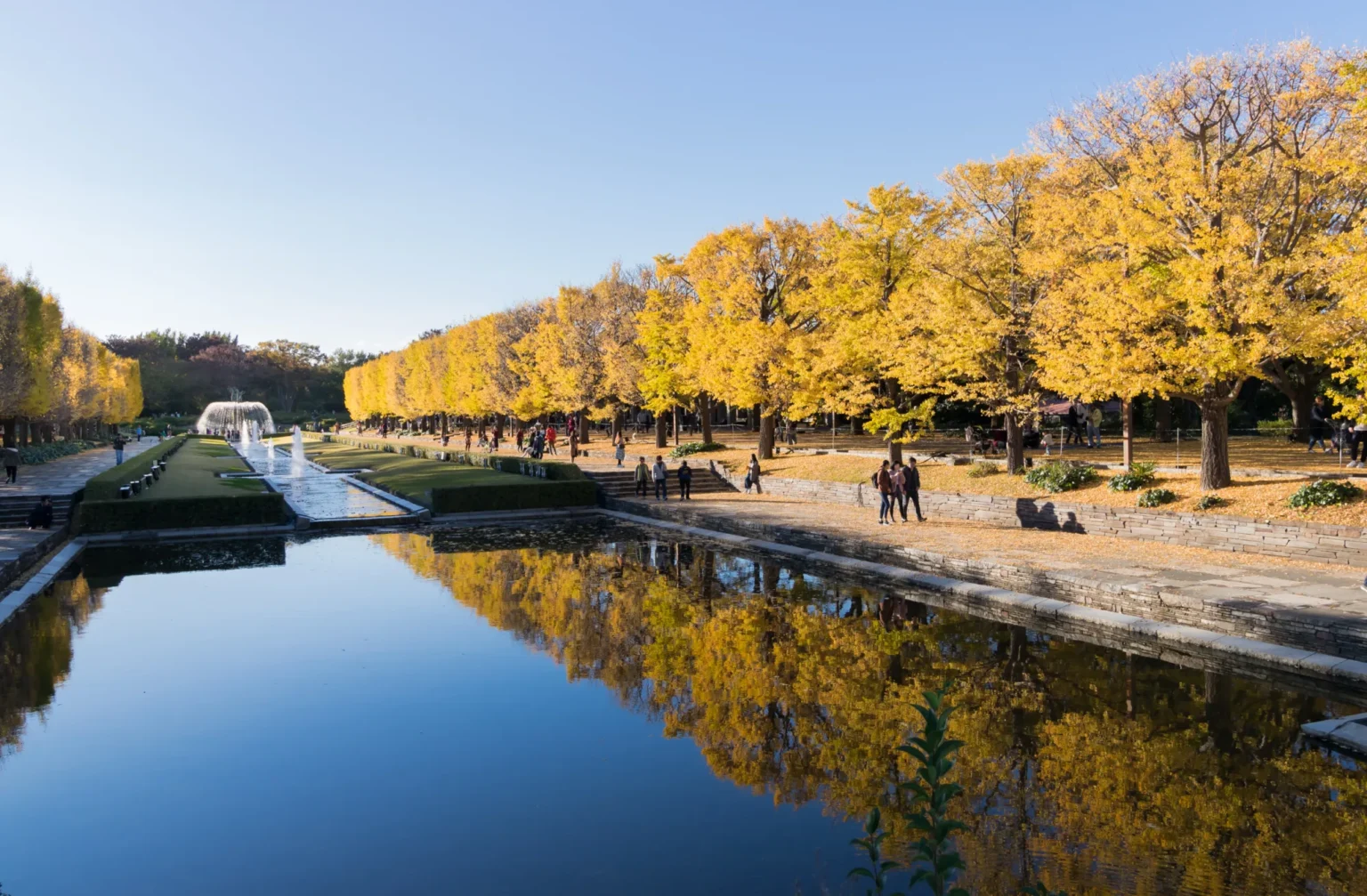
Yes, if you want ginkgo in long rows and have half a day. The park covers 180 hectares by its own count, adult entry is ¥450, and the faster direct JR trains from Shinjuku (Ome Special Rapid, Holiday Rapid Okutama) reach Nishi-Tachikawa, about two minutes from a park gate, in around half an hour.
Entry
Adult (high school and above) ¥450, 65 and over ¥210, junior high and under free; a two-day adult pass is ¥500. Entry is free on Sat 24 and Sun 25 October 2026, though parking is still charged.
Hours
9:30–17:00 in October, 9:30–16:30 from November to February. No scheduled closing days in October or November; closures for bad weather are posted on the park’s site.
Getting there
From Shinjuku, Ome Special Rapid and Holiday Rapid Okutama trains run through to Nishi-Tachikawa (29–34 min in the JR East October 2026 timetable samples I read). Chuo Special Rapid trains reach Tachikawa in 24–28 min; change there for the Ome Line, one stop. The Nishi-Tachikawa Gate is about 2 min from the station’s Park Exit.
Where the colour is
Ginkgo along the Canal and the 300-metre Katarai avenue, among other spots; maples in the Japanese garden (about 300 of them, the park says), the flowering-tree garden (花木園) and Komorebi Hill (こもれびの丘).
Within the park the order is spelled out. On its 2026 autumn event page the park says the Canal ginkgo row colours first and the Katarai row follows, and lists the Canal’s colouring as early to mid-November and the Katarai row’s as mid- to late November. Showa Kinen lists its 2026 Yellow and Red Leaves Festival (黄葉・紅葉まつり) as running from 29 October to 29 November, and the Katarai avenue and the Canal need only park admission.
How do I get to Mount Takao in autumn, and how bad are the crowds?
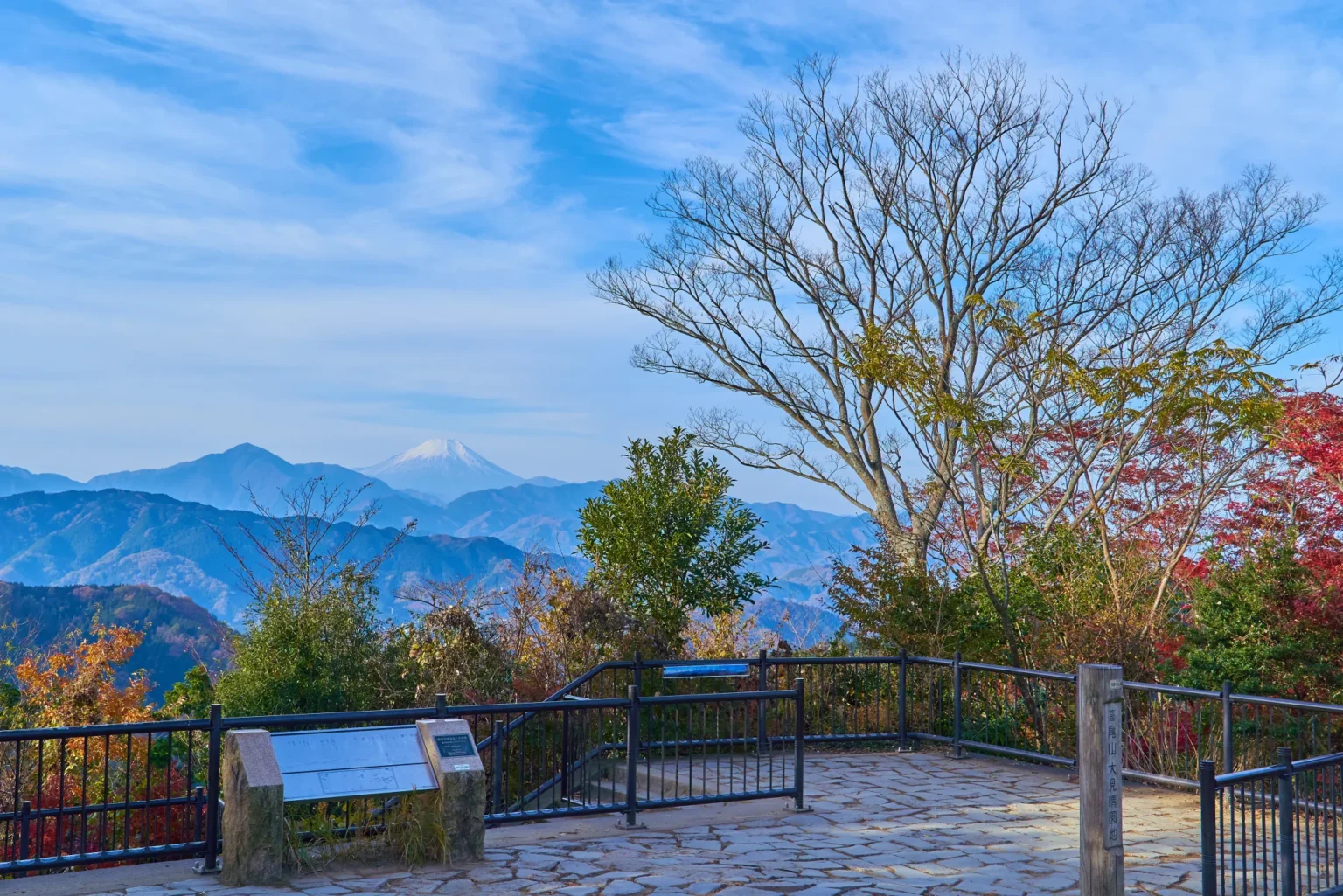
Take the Keio Line from Shinjuku to Takaosanguchi, walk about five minutes to the cable car, and ride up. Keio’s Mt. Takao Discount Ticket from Shinjuku costs ¥1,450 for an adult and covers the Keio return trip plus the cable car or lift both ways. The leaf season is Mount Takao’s busiest time of the year, and the local tourism association suggests avoiding the busiest hours, and weekends and holidays.
- Shinjuku to Takaosanguchi, Keio Line. The regular adult fare is ¥430 each way. On weekends and holidays Keio’s morning reserved-seat trains leave Shinjuku at 8:00 and 9:00 (Keio Liner Nos. 61 and 63, 47 and 43 min) and at 10:00 and 11:00 (Mt.TAKAO, 45–46 min); they need a seat ticket on top of the fare.
- Takaosanguchi to Kiyotaki Station. About 5 min on foot to the cable car.
- Up the mountain. The cable car runs every 15 min from 8:00 (it may start earlier on busy days) and takes about 6 min. The two-seater chairlift takes about 12 min and runs from 9:00, with the last ride at 16:30 on weekdays through November (16:00 from December) and later on weekends and holidays when conditions allow. Both cost the same.
| Ticket | Adult | Child |
|---|---|---|
| Discount Ticket from Shinjuku, cable car or lift both ways | ¥1,450 | ¥740 |
| Discount Ticket from Shinjuku, cable car or lift one way | ¥1,090 | ¥560 |
| Cable car or chairlift, one way | ¥490 | ¥250 |
| Cable car or chairlift, return | ¥980 | ¥500 |
| Keio fare, Shinjuku–Takaosanguchi, one way | ¥430 | — |
— = not checked for this guide. The discount ticket’s Keio part is always a return trip; its fare table was revised on 1 October 2025. Cable car and lift: child = 6 to under 12, adult = 12 and over. The ¥430 regular fare is from Keio’s fare tables revised on 1 October 2023, the same by IC card or paper ticket.
Keio’s notice of 20 August 2026 sets the weekend and holiday reserved-seat fee on Keio Liner trains, from 1 October 2026, at ¥400 bought through its Ticketless service or ¥500 at a ticket machine. The Mt.TAKAO page shares that fee block, but the notice names only the Keio Liner, and some Keio pages still show the earlier ¥410, so check the fee when you book. Keio says the Mt. Takao Discount Ticket can be used as the fare ticket on the Mt.TAKAO trains.
For the ride down, the operator’s timetable gives last cable cars from September to November at 17:45 on weekdays and 18:00 on weekends and holidays, but a note on the same page moves the last car to 21:15 during the summit beer garden’s season, which in 2026 runs to 29 November. Whether that applies on the beer garden’s closing days (13 and 27–29 October) or on November days when it keeps shorter hours, the operator’s pages didn’t say when I checked on 2 October 2026, so check the day’s hours on takaotozan.co.jp. The operator bills its 31°18′ maximum gradient as the steepest cable-car track in Japan.
Suica and PASMO on the cable car from 1 November 2026. From the first service on Sunday 1 November 2026, simple IC readers at the cable car and lift gates let you tap a transit IC card and board without a ticket; the one-way fare comes off the card. One card per person. The balance has to cover the fare, and auto-charge doesn’t work at these readers, Suica and PASMO included. Discount fares still need a ticket from the window or a machine, child fares need a child IC card, and the railway doesn’t sell or refund IC cards. Until 1 November, buy tickets.
On the trails, Trail 6, from Biwa Falls to the Trail 5 junction, is uphill only, all day, from Saturday 31 October to Sunday 6 December 2026, to ease congestion and prevent accidents, so plan to come down another way. When I checked the Takao Visitor Center’s closure list on 2 October 2026, it showed no closed trail on Mount Takao itself, a fallen-tree caution on the Kompiradai course, and a closed bypass path near Kobotoke-Shiroyama; look at it again before you go. The 2026 dates of the Takao momiji festival weren’t yet on the Hachioji Convention & Visitors Association’s page when I checked on the same day.
Mount Takao is also a Diamond Fuji viewpoint; the details are in Diamond Fuji from Mt Takao and the city. For bears, see below.
Mount Mitake and Okutama: earlier colour, a longer day
Both usually colour earlier than central Tokyo, and both take a full day. In the weekend samples I read, JR trains from Shinjuku took about 80–90 minutes to Mitake Station with a change at Ome (96–108 minutes on weekdays), and the Mitake cable car’s adult fare went up to ¥700 one way on 1 October 2026.
japan-guide says Mount Mitake’s colours can be enjoyed a week or two earlier than down in the city centre, and lists early to late November. GO TOKYO gives Lake Okutama late October to mid-November. That early window is for the lake; don’t assume it holds for every valley in the Okutama area.
To reach the cable car, take the JR Ome Line to Mitake Station (御嶽), walk about 3 minutes to the Mitake-eki bus stop (御岳駅), ride a Nishi Tokyo Bus to the Cable-shita stop, then walk about 6 minutes to Takimoto Station. The cable car’s operator says PASMO and Suica work on every leg, and the ride up to Mitakesan Station takes about 6 minutes. In my weekend samples the Holiday Rapid Okutama ran from Tokyo only as far as Ome, with a separate train onward. Okutama Station is at the western end of the JR Ome Line, 92–108 minutes from Shinjuku at weekends in the same samples, and GO TOKYO puts Lake Okutama a bus ride beyond it.
| Ticket | From 1 Oct 2026 | Before 1 Oct 2026 |
|---|---|---|
| Cable car, adult one way | ¥700 | ¥600 |
| Cable car, adult return | ¥1,400 | ¥1,200 |
| Cable car, child one way | ¥350 | ¥300 |
| Cable car, child return | ¥700 | ¥600 |
| Lift, Mitakedaira to Daitenbodai, return | ¥200 | ¥190 |
Cable car between Takimoto and Mitakesan stations. Return tickets are valid for one round trip within two days, one-way tickets on the day only. The lift’s one-way fare stays ¥100. Source: Mitake Tozan Railway’s release of 4 September 2026 and its fare page.
japan-guide’s Mount Mitake page (last updated 8 January 2026) still gave the ¥1,200 return fare when I checked on 2 October 2026. Bus fares and times aren’t covered here.
Bears in western Tokyo: what the city asks hikers to do
Hachioji City says western Tama, including the forests in its own north-west and south-west, is Asian black bear habitat, and asks hikers to ring a bell or play a radio as they walk so that bears know people are there.
What the authorities say.
- Hachioji City (page updated 17 September 2026): the forests in the city’s north-west and south-west, and western Tama, including Okutama, Hinohara, Hinode, Ome and Akiruno, are Asian black bear habitat. Walk with a bear bell or a portable radio, and check the Tokyo Metropolitan Government’s TOKYO Kumap for sightings.
- Takao Visitor Center (16 May 2026): Asian black bears live around Mount Takao, mainly towards Oku-Takao. Especially at dawn or dusk, make noise so they know you’re there, and avoid walking alone.
- Tokyo Metropolitan Government (15 May 2026): announced patrols by armed hunters from the Tokyo hunters’ association, from that day and as needed, in parts of residents’ everyday areas in Hachioji, Ome, Akiruno, Okutama, Hinode and Hinohara where bears have been reported. These are residential areas, not hiking trails.
The Kumap page notes that its sightings can include animals that only looked like bears, such as serows or wild boar. Layers and shoes for a mountain morning are covered in what to wear for Tokyo city days and on an autumn-leaf hike.
Day trips out of Tokyo for autumn leaves
With a full day, you can also leave Tokyo: this site covers four autumn-leaf day trips, to Lake Kawaguchiko, Nikko, Saitama and Kiryu. Lake Kawaguchiko’s Momiji Corridor is in Fujikawaguchiko, the town next door to Fujiyoshida, where I live. The details are in Fujikawaguchiko Autumn Leaves Festival, and doing the trip on your own is covered in getting from Tokyo to Kawaguchiko by bus, train or car.
Rather not sort out the trains and buses yourself? Klook’s Mount Fuji search is one place to look for a tour. Check that the one you pick leaves from Tokyo, returns the same day and stops at Lake Kawaguchiko before you book. Affiliate link · HJG may earn a commission at no extra cost to you.
Browse Mount Fuji tours on KlookNikko
One of Japan’s three great autumn foliage spots, with this year’s dates on that page.
Saitama
Nagatoro and Torii Kannon, the two spots in Saitama’s autumn leaves guide.
Kiryu, Gunma
The floor maples at Hotokuji Temple in Kiryu, with its dates and rules.
For how the whole of November plans out across Japan, week by week, see Japan in November 2026.
Tokyo autumn leaves FAQ
Can I still see the red Tsutenkyo bridge at Koishikawa Korakuen in autumn 2026?
No. The Tokyo Metropolitan Park Association’s notice of 20 March 2026 says the bridge has been dismantled and removed for a rebuild, with the works period listed as planned from 1 May 2025 “for the time being”. The path over it is closed and a temporary path is the detour; the garden page still gives its usual 9:00–17:00 hours.
Is Shinjuku Gyoen open on Mondays in November?
On some of them. It opens on Mondays 2 and 9 November 2026, during the chrysanthemum show, and on Monday 23 November, a public holiday, but it’s closed on Monday 16 November, Tuesday 24 November, Monday 30 November and Mondays 7 and 14 December. From 1 October it opens 9:00–16:30, with entry until 16:00.
When do the autumn leaves peak in Tokyo?
Going by the windows GO TOKYO and japan-guide list for a typical year: from late October or early November at Lake Okutama, Mount Mitake and Showa Kinen Park; from mid-November at Mount Takao, Shinjuku Gyoen and the Gaien ginkgo avenue (late November in japan-guide’s list); from late November into December at Rikugien and Koishikawa Korakuen. This year’s forecast dates go on the live koyo tracker.
Can I use Suica on the Mount Takao cable car?
From the first service on Sunday 1 November 2026, yes: tap a transit IC card such as Suica or PASMO at the cable car or lift gate. One card per person, the balance must cover the fare, and auto-charge doesn’t work there. Before 1 November, buy a ticket.
How much is the Mount Mitake cable car now?
From 1 October 2026, ¥700 one way and ¥1,400 return for an adult, up from ¥600 and ¥1,200, and ¥350 and ¥700 for a child. The ride between Takimoto and Mitakesan stations takes about 6 minutes.
Are there bears on Mount Takao?
The Takao Visitor Center says Asian black bears live around Mount Takao, mainly towards Oku-Takao, and asks hikers, especially at dawn or dusk, to make noise and avoid walking alone. Hachioji City asks hikers to carry a bear bell or radio and to check the TOKYO Kumap sightings map.
Which Tokyo autumn leaves spot suits half a day?
Showa Kinen Park or Mount Takao. The faster direct JR trains from Shinjuku (Ome Special Rapid, Holiday Rapid Okutama) reach Nishi-Tachikawa, by a park gate, in about half an hour, and Keio’s weekend reserved-seat trains reach Takaosanguchi in 43–47 minutes. With only a few hours, pick a city garden instead.
Re-check before you go. Rikugien’s shoreline works are planned to end in November 2026, so look for the garden’s completion notice. The Takao cable car’s IC readers start on 1 November 2026, and its last cars and the visitor centre’s trail notices can change through the season. Neither the Takao momiji festival’s 2026 dates nor the Gaien ginkgo festival’s were posted on the pages I checked on 2 October 2026.
Once you know your dates, the live koyo tracker shows which spots have a dated 2026 forecast.
Sources
Sources behind the figures above, checked on 2 October 2026
- Koishikawa Korakuen (Tokyo Metropolitan Park Association): Tsutenkyo notice, 20 March 2026; 2025 version of the notice (archived); 2026 autumn event page; garden page (hours, fees, access, the Oigawa)
- Rikugien: garden page; shoreline works, 8 May 2026; sketching notice, 10 September 2026; typhoon closure, 21 September 2026; nine-garden stamp rally 2026
- Shinjuku Gyoen (Ministry of the Environment): hours, fees and payment; November 2026 and December 2026 calendars; rules; access
- Todoroki Valley: Setagaya City; Todoroki Fudoson
- Nezu Museum: visit page; 2026 exhibition schedule
- Meiji Jingu Gaien: the ginkgo avenue; access
- Showa Kinen Park: fees; hours, closing days and 2026 free days; seasonal highlights; access; park area; 2026 festival; 2026 autumn event page (colouring order, maple count)
- Mount Takao: Takao Tozan Railway fares and times, IC card notice, 1 September 2026, beer garden season 2026 and access; Takao Visitor Center closures, Trail 6 and bears; Hachioji Convention & Visitors Association
- Keio: Mt. Takao Discount Ticket fares (PDF); fare table (PDF); Mt.TAKAO timetable; Keio Liner timetable; reserved-seat fee notice, 20 August 2026 (PDF)
- Mount Mitake: Mitake Tozan Railway fare revision, 4 September 2026 (PDF), fares and ride time and access
- JR East October 2026 timetable, for example Holiday Rapid Okutama No. 3 and a weekend Chuo Special Rapid; Okutama Station
- Bears: Tokyo Metropolitan Government, 15 May 2026; Hachioji City; TOKYO Kumap
- Sunset: National Astronomical Observatory of Japan, Tokyo, November and December 2026
- Typical windows: GO TOKYO autumn-leaves pages in Japanese and English, updated 1 September 2026; japan-guide’s Tokyo autumn colours page, updated 8 September 2026
- English lists compared on 2 October 2026 (secondary sources): Tokyo Cheapo; MATCHA; LIVE JAPAN; Time Out; travelynotes; japan-guide’s Mount Mitake page
Join travelers discovering Japan's hidden side
Weekly dispatches from off-the-beaten-path Japan — spots and stories you won't find in guidebooks.
No spam. Unsubscribe anytime.
Welcome aboard!
You're in. See you in your inbox soon.
![Wisteria in Japan 2026: 10 Stunning Spots Beyond Ashikaga [With Map]](https://hiddenjapan-gems.com/wp-content/uploads/2026/04/藤花-768x512.webp)