Japan · Autumn 2026
Japan has no government forecast for autumn colours. The Meteorological Agency stopped issuing one in 2008, and even then it only ever covered the Kanto region. Nearly every forecast date you will read this autumn — including the ones on this site — is a private weather company’s output. The agency does still record when the leaves turn, at 51 stations, in a series that runs back to 1953, and its definition of “turned” is not the one you want. Knowing which number you are looking at is most of the skill in planning an autumn trip here.
The forecast you are reading is a company’s, not a government’s
On 31 July 2008 the Japan Meteorological Agency announced it would stop publishing its autumn colour forecast. Its own wording is worth reading, because it explains the whole structure of Japanese seasonal forecasting: the agency had issued a forecast every September since 1965, private operators had begun doing the same thing on a national scale, and so it would stop.
Two details in that sentence matter and are almost never carried into English. The forecast that ended was for the Kanto region only — there was never a nationwide government forecast to lose. And the same split happened to cherry blossoms about seventeen months later: in December 2009 the agency announced it would stop forecasting bloom dates from the following spring, while explicitly continuing to observe them.
Forecasts went to the private sector. Observation stayed with the state. That division is the single most useful thing to understand about Japanese season data.
What the state still measures, and why it is not what you want
Its long phenological tables run from 1953. In November 2020 it announced a drastic cut from January 2021: from 34 plant species and 23 animal species at 58 stations down to six plant species and nine phenomena. Every animal observation was dropped. The reason given was that the environment around weather stations had changed enough that suitable specimen trees were hard to secure and the animals hard to find at all.
Maple and ginkgo survived the cut. The agency’s current observation manual says why: cherry, ginkgo and maple are the three used for monitoring global warming and for century-scale climate analysis, and the others were kept to bracket the year around them. So the maple record continues — at 51 stations for maple and 48 for ginkgo, updated once a day at about 08:35.
The agency’s “colour day” is not peak viewing
The observation manual defines it precisely: the first day on which, looking at the tree as a whole, most of the leaves have changed to reds or yellows and green is essentially no longer visible. There is a separate “leaf fall day” for when about 80 per cent has dropped.
That is a later, narrower moment than the one a visitor is chasing. Weathernews, by contrast, defines its viewing period as running from the day about 70 per cent of a site has coloured until leaves start falling. The two numbers are measuring different things, and a date from one cannot be compared with a date from the other.
What the state record is genuinely good for is the long view, and it is free. The maple table runs from 1953 to 2025 and can be downloaded as a CSV. For Tokyo it gives a 1991–2020 normal of 28 November, with 2025 coming in at 23 November, the earliest on record at 8 November in 1953 and the latest at 5 December in 1990. That is a spread of nearly four weeks between the extremes of a 73-year series — a better guide to how much a single year can move than any seasonal forecast will give you.
As of early September 2026 the agency has not logged a single maple turn anywhere in the country. That is normal for the date, not a signal.
Who is actually forecasting 2026, and what they have said
| Source | 2026 status (checked 10 October) | Scale |
|---|---|---|
| Weathernews | First forecast published 3 September 2026; second published 8 October 2026. Third planned for late October | About 1,200 sites |
| Japan Weather Association (tenki.jp) | First forecast published 1 October 2026, for the iroha maple (in Hokkaido, yama-momiji, o-momiji or itaya-kaede, depending on the site) | Spot pages by prefecture |
| Japan Meteorological Agency | Does not forecast. Observation only, at 51 maple stations | 1953–2025 archive, free |
| Walkerplus and other listings | Said on 4 September that its colour reports would start in mid-September | Ranks sites by page views, not by conditions |
Weathernews’ 2026 call is a late autumn for spots that usually peak from late October onward. Its headline blames warm weather directly: colour timing tracks autumn temperature, cool speeds it up and warm slows it down. In its first forecast, on 3 September, every one of its eight regional blocks carried the same label — later, or somewhat later, than average. Its second, on 8 October, splits the season: repeated cold air since late August, mainly over Hokkaido, has kept spots that usually peak by mid-October mostly around average, while spots that usually peak from late October onward are expected to be somewhat later than average in many places, because it expects temperatures to run high; every one of its eight regional sections says later than average at many sites.
The Japan Weather Association published its first forecast on 1 October; for its forecast dates, see the tenki.jp foliage portal (Japanese). If you are planning around a forecast date, check the site’s own colour reports in the week before you go.
Read the regional windows and the shape of the season becomes clear. Hokkaido runs from mid-September to early November. Tohoku from early October to late November. Kanto from mid-October to mid-December. Kyushu, last of all, from early November to mid-December. That is a season roughly three months long, moving north to south and downhill as it goes.
Read the small print on “later than average”
Weathernews measures its viewing-start normal against 2004–2025, but its weather normal against 1991–2020. The two baselines are different, which is worth knowing before you convert “later than average” into a precise number of days. The company has not said how many days later it means.
One more thing it publishes that most outlets drop: the forecast is not purely a temperature model. Weathernews also surveyed users of its app on the physical state of the leaves — 2,641 responses between 21 and 25 August 2026 — and in its first forecast reported leaf condition as good almost everywhere. Kyushu is the exception, where a dry, hot summer has left the leaves in poorer shape, and the second forecast still says so. The second adds that a lack of sunshine in September has raised concerns about colour in some areas, while Hokkaido, which had more sun, is seeing its most vivid colour in several years.
The English pages you will land on are a year out of date
This is the part that catches people, and it is checkable. On 4 September 2026, japan-guide.com — one of the best-known English sources for Japanese autumn travel — was still showing last season. Its forecast page carried the heading “Autumn Color Forecast 2025”, a status of “Season Finished”, and a last-updated stamp of 14 December 2025. Its autumn hub page was headed “Autumn Colors 2025” and last updated on 3 September 2025. Its 2026 report index existed but contained no reports at all, with a note that the first was scheduled for 17 September.
None of that is a criticism of their reporting, which is first-hand and good — their first 2025 report was filed by a named writer on the mountain, recording the temperature at the upper ropeway station. It is a criticism of using it as a forecast in early September. And it is worth knowing the scale: their season runs to roughly fifteen reports across seven to eleven locations, and in 2025 seven of the sixteen were Kyoto or Tokyo. It is a sampling, not a national survey.
The under-coverage is structural rather than particular to one site. On Tokyo Cheapo’s sitemap, “cherry-blossom” appears in 55 URLs and “sakura” in 26, against one for “foliage” and four for “koyo”. On Time Out Tokyo’s, it is 100 and 107 for spring against four and three for autumn. Those counts suggest how heavily English-language Japan travel writing still leans towards spring, with autumn getting a fraction of the same attention.
How to plan without a forecast you can trust
Use altitude, not dates
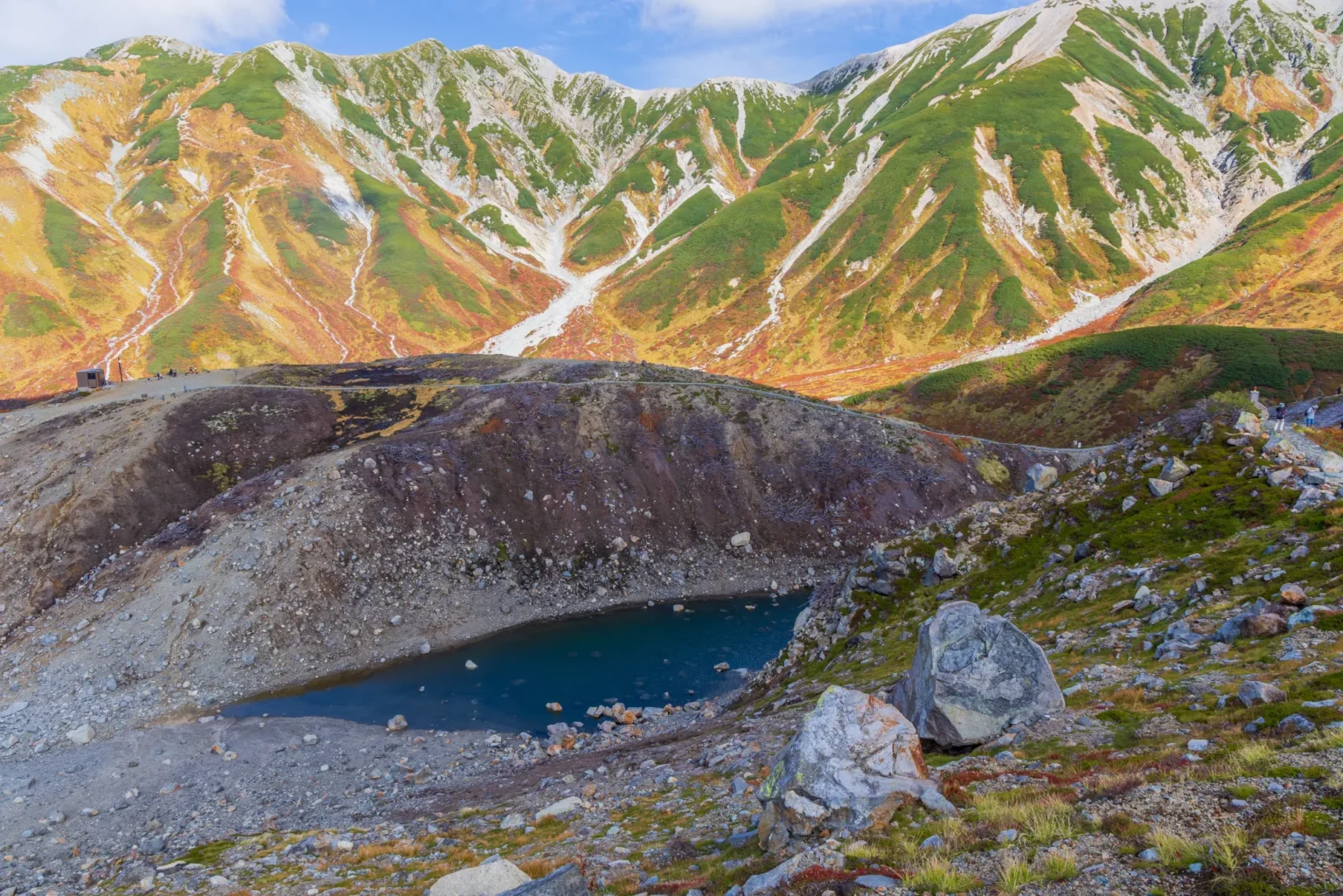
As a rule of thumb, colour starts on high slopes and walks downhill at roughly two to three days per 100 metres. If you are a week early for a valley, go up; if you are a week late, come down. Weathernews’ first forecast gave one altitude reference, Murodo in Toyama, above 2,000 metres, which had already started colouring when it was published on 3 September. By its second, on 8 October, Murodo-daira had reached peak six days later than average, and the Karasawa cirque above Kamikochi, at about 2,300 metres, around the usual time.
Check the venue, not the forecaster
Temples and parks publish their own opening dates, and those beat any model. They also disagree with the forecasts more often than you would expect — at one temple we covered, Weathernews’ first forecast put the start of peak colour two days after its own season ends.
Check which spot the date is for
About 1,200 sites is wide coverage, but one site is often a whole area. Weathernews’ Kawaguchiko entry is the lakeshore, with the Momiji Corridor as its viewpoint, and the JWA treats Nikko’s Irohazaka and Kegon Falls as a single site; within Nikko, Weathernews’ first forecast ran from about 18 October at Ryuzu Falls to about 31 October on the Irohazaka; after its second, its spot pages on 10 October gave about 17 October and 23 October. And a listed date can still fight the venue’s own calendar: on 3 September Weathernews put the start of peak colour at Hotokuji in Gunma on 2 December, after its season ends on 30 November. By 5 October it had moved the date to 29 November, the day before, and by 10 October, after its second forecast, to 27 November.
What a late autumn actually changes about booking
If the forecast holds and colour runs later than average, the risk is not missing it — it is booking the wrong week and finding green. Two practical consequences. Rooms in Kyoto for the last ten days of November are the ones that sell out first and they are the ones a late season makes more, not less, valuable. And if you are chasing the front by altitude, you need to be able to move, so it is worth comparing a rail pass against point-to-point tickets for the itinerary you actually have.
Our live koyo tracker follows each release as it lands rather than on a schedule, and marks clearly which rows are carrying a 2026 date and which are still on a typical-year window. For the month you are actually travelling, we have September, October and November 2026 broken down week by week.
If you want to see the gap between forecast and reality in specific places, the pieces where we checked venue calendars against the forecasts are the useful ones: the Kawaguchiko festival, where the illumination hours changed for 2026 and the English pages still carry the old ones; two Saitama sites whose own opening hours matter more than any forecast date; and the Aigi Tunnels, which open for nine days at the very end of the season.
Where the season is right now
By early October 2026 the colour has come down off the highest ground. The Daisetsuzan range in Hokkaido, the country’s earliest reliable colour (mid to late September, from Kurodake and Ginsendai), is finishing on the high ground; Weathernews’ 8 October release says the season at Sugatami Pond on Asahidake is already over. On 4 October Weathernews reported that Ginsendai’s season was already over, that leaves were falling around Sugatami Pond on Asahidake, and that Asahidake had had its first snow of the autumn, later than normal. The same report said the strongest cold air of the autumn so far had started colour in the Hokkaido lowlands, and showed a Weathernews app user’s photo of ivy turning red on a building in Sapporo.
For most lowland and city destinations, any date you see today is a forecast rather than an observation. Which is where this piece stops and the tracker takes over: it carries the current status region by region, and marks which rows are running on a 2026 date and which are still on a typical-year window.
Questions people actually ask
Does the Japanese government forecast autumn colours?
No. The Japan Meteorological Agency published a forecast every September from 1965 until autumn 2008, when it stopped on the grounds that private companies were doing the same thing nationwide. That forecast covered the Kanto region only. The agency did the same with cherry blossom forecasts from spring 2010. It continues to observe and publish the dates on which leaves actually turn.
Then where do the dates on travel sites come from?
Almost always Weathernews or the Japan Weather Association, whether or not the site says so. Weathernews published its first 2026 forecast on 3 September and its second on 8 October, and covers about 1,200 sites; the JWA published its first on 1 October. A page that gives you a specific day without naming a source may be using either of those, a venue’s own calendar, another listing service, or an old typical-year figure. Treat unsourced dates carefully.
What does the Meteorological Agency’s “colour day” actually mean?
It is the first day on which most of the tree’s leaves have turned and green is essentially gone. That is later and stricter than the moment most visitors want, which is closer to Weathernews’ definition — the period from when about 70 per cent of a site has coloured until the leaves begin to fall. Do not compare a date from one with a date from the other.
Is 2026 going to be late?
That is the forecast. In its second forecast, on 8 October, Weathernews says spots that usually peak by mid-October are mostly around average, but spots that usually peak from late October onward are expected to be somewhat later than average at many places, because it expects autumn temperatures to run high; every one of its eight regional sections says later than average at many sites. It has not given a nationwide figure for how many days later. Note also that its viewing normal is based on 2004–2025 while its weather normal uses 1991–2020, so “later than average” is not a single clean quantity.
Can I still use the agency’s data for planning?
Yes, for the long view. The maple series runs from 1953 to 2025 across 51 stations and is downloadable as a CSV. It tells you how much a given city moves year to year — Tokyo’s normal is 28 November, but the record ranges from 8 November in 1953 to 5 December in 1990. That spread is the honest answer to “when should I book”.
Why did the agency cut its nature observations in 2021?
It announced in November 2020 that from January 2021 it would observe six plant species and nine phenomena instead of 34 plant and 23 animal species at 58 stations. Every animal observation was dropped. The stated reason was that the environment around weather stations had changed: suitable specimen trees were getting hard to secure and the animals hard to find. Maple, ginkgo and cherry were kept explicitly because they are used for climate monitoring. From 2021 the National Institute for Environmental Studies, working with the Environment Ministry and volunteer observers, began continuing phenological monitoring in a different form.
Sources
The primary sources behind every figure above
- Japan Meteorological Agency — press release of 31 July 2008 ending the Kanto autumn colour forecast; press release of 25 December 2009 ending the cherry blossom forecast; press release of 10 November 2020 on the change to phenological observations; the current observation manual (December 2021); the phenological observation portal, the maple and ginkgo station tables for 2025–2026, and the 1953–2025 cumulative tables and CSV downloads
- Weathernews — first 2026 foliage forecast, published 3 September 2026, including its definitions of the viewing period and of its normals, its regional windows and its August leaf-condition survey; second 2026 forecast, published 8 October 2026 (news release and regional maps); the public foliage portal and spot pages, checked 10 October 2026
- Japan Weather Association (tenki.jp) — 2026 foliage portal, and its first 2026 forecast, published 1 October 2026, with its note on which maples the dates are for (checked 5 October 2026; still its latest forecast on 10 October)
- Weathernews — news report of 4 October 2026 on Hokkaido colour (Ginsendai, Asahidake, Sapporo)
- Walkerplus — 2026 foliage listings and prefecture rankings
- National Institute for Environmental Studies — phenology monitoring with citizen observers, via the Climate Change Adaptation Platform · Japan Meteorological Agency press release of 30 March 2021 on the joint trial with the Environment Ministry
- japan-guide.com — autumn colour forecast page, autumn hub, and the 2025 and 2026 report indexes, all checked 4 September 2026 · Tokyo Cheapo and Time Out Tokyo sitemaps, counted the same day
Join travelers discovering Japan's hidden side
Weekly dispatches from off-the-beaten-path Japan — spots and stories you won't find in guidebooks.
No spam. Unsubscribe anytime.
Welcome aboard!
You're in. See you in your inbox soon.