Kawaguchiko · Autumn 2026
Two things changed about the Fujikawaguchiko Autumn Leaves Festival for 2026, and I could not find either of them stated on an English page. The illumination now ends at 21:00 rather than 21:30. And the town is moving to charge for the municipal car park beside the site for the first time, with an ordinance going to the town assembly on 2 September. The scale explains why: the town’s own statistics put the 2025 festival at 550,000 visitors, against 365,000 the year before — 150.7 per cent of the previous year’s figure, or a rise of about half.
What actually changed for 2026
The festival runs from Saturday 7 November to Sunday 29 November 2026. That is the 28th edition, and it is confirmed twice over: the Fujikawaguchiko Tourism Association posted it on 10 July, and the town’s own newsletter carried it in the August 2026 issue under the heading “28th Fujikawaguchiko Autumn Leaves Festival”.
The illumination time is the change most likely to catch someone out. For 2026 both official sources say the same thing — sunset until 21:00. In 2024 and 2025 it ran until 21:30. Thirty minutes is not much unless you have built an evening around it, or unless you are reading an English page that still says 21:30, or 22:00.
| 2026 | 2025 | 2024 | |
|---|---|---|---|
| Illumination ends | 21:00 | 21:30 | 21:30 |
| Town car park | Charge expected | Free | Free |
| Edition | 28th | 27th | 26th |
| Visitors | — | 550,000 | 365,000 |
The parking change is the bigger story locally. On 28 August the mayor, Watanabe Hideyuki, said at a press conference that the town intended to charge for the municipal Nishikawa car park in Kawaguchi during the festival, and that an ordinance would go to the September assembly. The assembly opened on 2 September, and UTY Television Yamanashi reported that evening that the bill had passed.
What is not settled yet
The two outlets that covered this do not agree, and the town has published nothing. The Yamanashi Nichinichi Shimbun gives the capacity as 105 cars plus 18 coaches and says the money will pay for more security staff and more portable toilets; UTY Television Yamanashi says “about 120 spaces” and that the revenue goes to the town’s tourism work. Both describe the fee — ¥1,000 for a car, ¥3,000 for a coach — as proposed or under consideration, not fixed, and the ordinance text is not public. The town’s own website carries none of it, its statute book was last updated on 16 June, and the assembly bulletin covering September has not been printed. So: expect to pay, expect it to be around ¥1,000, and confirm with the tourism office on 0555-72-3168 before you rely on a number.
What the English pages say, and how old it is
I checked ten English sources and ran a control search on each one whose search box works, so that a zero result means absence rather than a broken index.
Two have a dedicated page. Time Out Tokyo published one on 25 October 2023 and has never touched it since — the page’s own published and modified timestamps are identical. It still says “Returning for its 25th year… from Saturday October 28 to Thursday November 23”, still says the corridor is “illuminated from sunset until 10pm”, and still describes a jazz festival on 4 and 5 November in the present tense. Tokyo Cheapo has an events page whose title auto-generates the current year, but the body opens with “We are yet to confirm the dates and details of this event”, gives the dates as “Early ~ Late Nov”, and puts the lights at 9:30 p.m.
The other eight have no dedicated page for it. japan-guide returns two reader forum posts — the one I opened is from 2015 — and a foliage blog entry of 7 November 2025 saying the trees are “illuminated until 21:30”, which was accurate for 2025 and wrong if you carry it into 2026. It maintains a dedicated page for the Fuji Shibazakura Festival, so the machinery for building one exists. JapanTravel returns 101 Kawaguchiko results and has dedicated pages for autumn festivals at Takino, Mount Takao and Hirosaki Castle, but not this one. MATCHA’s own 2026 foliage forecast round-up does not mention Kawaguchiko at all. Voyapon’s main autumn article was updated in July 2026 and contains the string “Kawaguchi” zero times. JNTO’s English sitemap has 5,178 URLs and not one of them is this festival. Yamanashi Prefecture’s English site returns 87 results for “autumn leaves” and none for the festival. The town has no English section at all — /en/ and /english/ both 404.
Neither of the two dedicated English pages carries a visitor number for a festival that drew 550,000 people.
And neither treats parking as a cost or a constraint. In the Time Out piece the words “parking”, “yen” and “¥” each appear zero times; in the Tokyo Cheapo page the word “parking” appears once, as part of a place name.
550,000 people, and a jump of half in one year
The number in the lead is not from a news report. It is from the town’s own 2025 Fujikawaguchiko Tourism Statistics, compiled in March 2026, which lists the festival at 550,000 against 365,000 the previous year — 150.7 per cent of the 2024 figure. UTY reported “about 500,000”, which is the same order but below the town’s number; where they differ I have used the town’s. The 2026 festival runs for 23 days.
For context, Yamanashi Prefecture’s official visitor survey for 2024 puts Fujikawaguchiko’s busiest month at 663,998 people in November — ahead of the cherry blossom months, ahead of August. The town received 5,155,767 visitors in 2024, up 46.4 per cent on 2023 and back to roughly 95 per cent of its 2019 level. Autumn, not summer, is when this town is fullest.
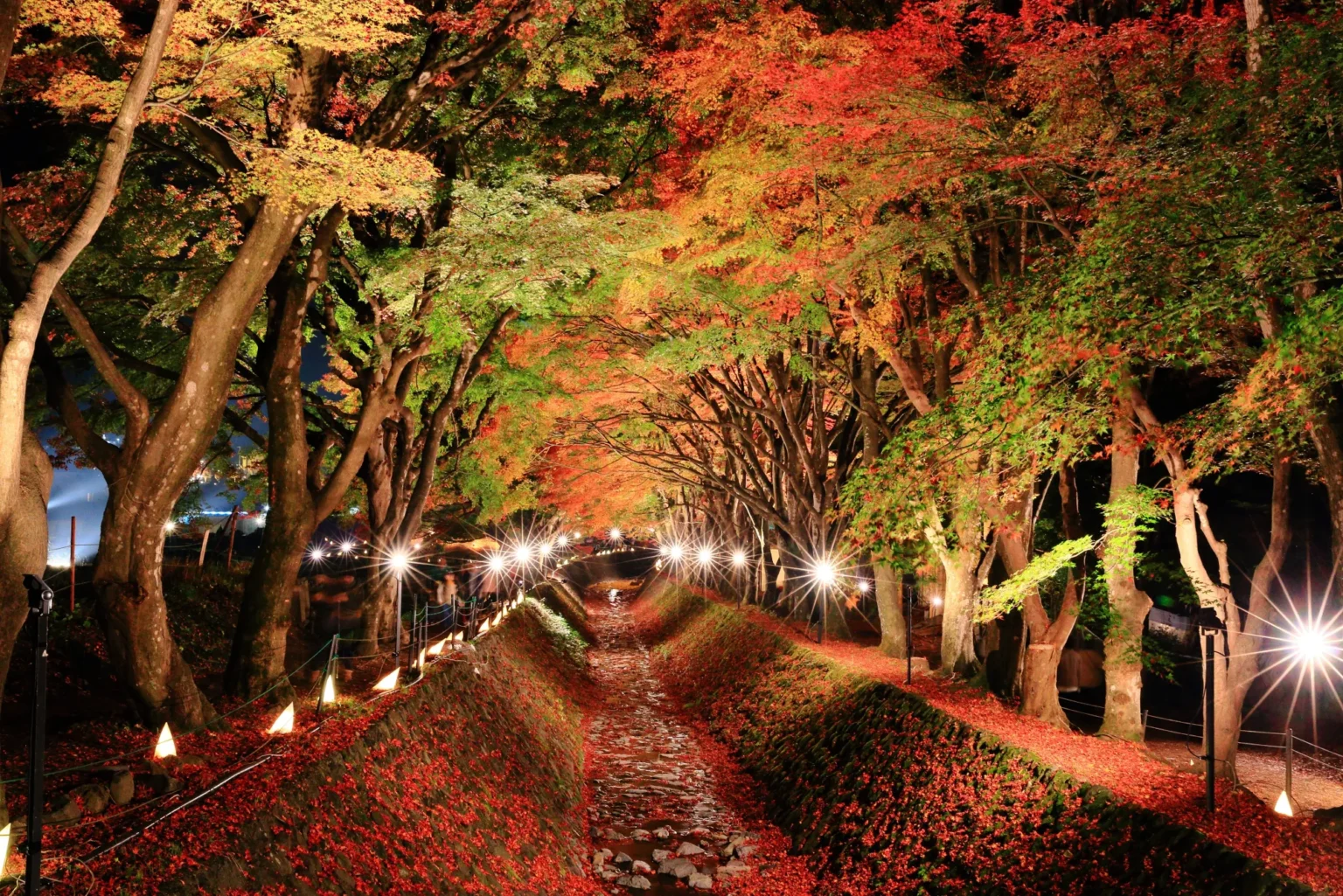
I went on 19 November last year, and I was late
Getting the timing right this year
I live on the other side of Mount Fuji, in Fujiyoshida, so getting to Kawaguchiko is a short trip rather than an expedition. I went to the corridor on Wednesday 19 November 2025, arriving a little after two in the afternoon. The photographs in this article that are not the night shot are mine, taken over about thirty minutes.
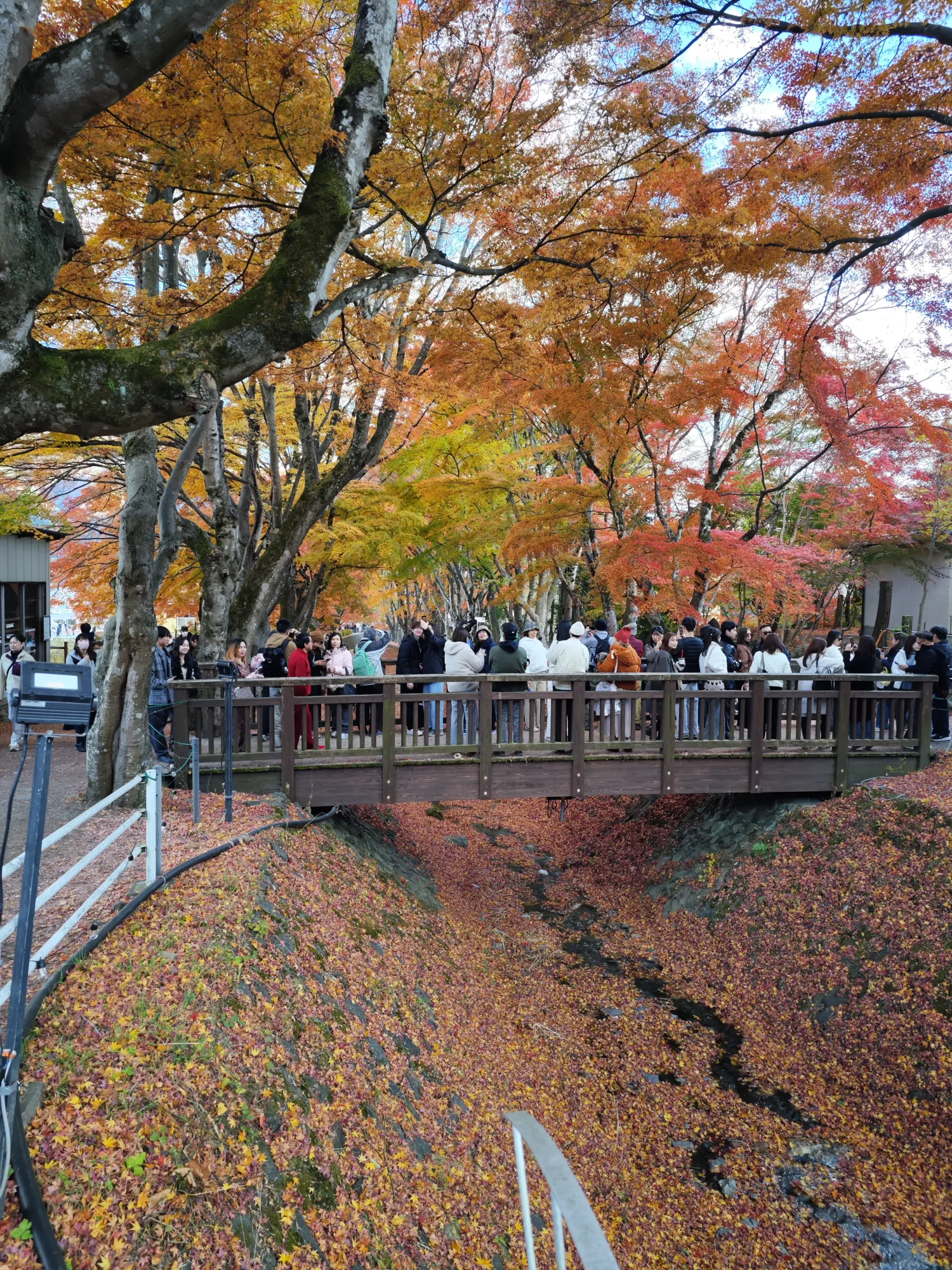
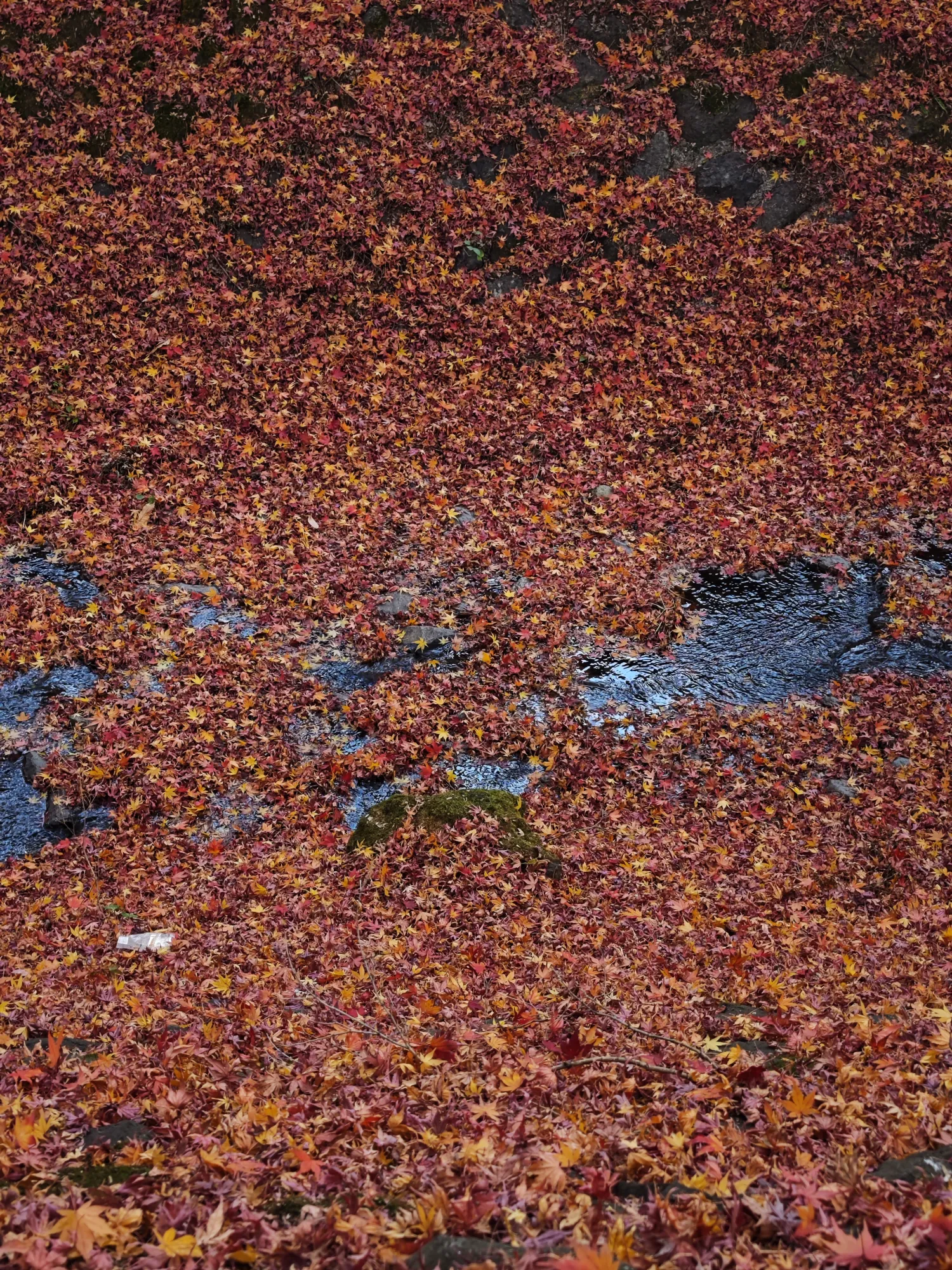
The association’s guidance for the corridor is “late October to mid-November”. By the 19th the tops of the trees were still holding orange and gold, but the stream bed underneath was completely covered — you could see water only in a narrow dark channel running through the leaves. That is what “just past peak” looks like, and it is worth knowing that it is not a disappointment so much as a different subject. The corridor is easy to confuse with the Momiji Tunnel, a maple-covered road in Oishi about ten minutes away by car; what momiji means, and how the two places differ, has its own page.
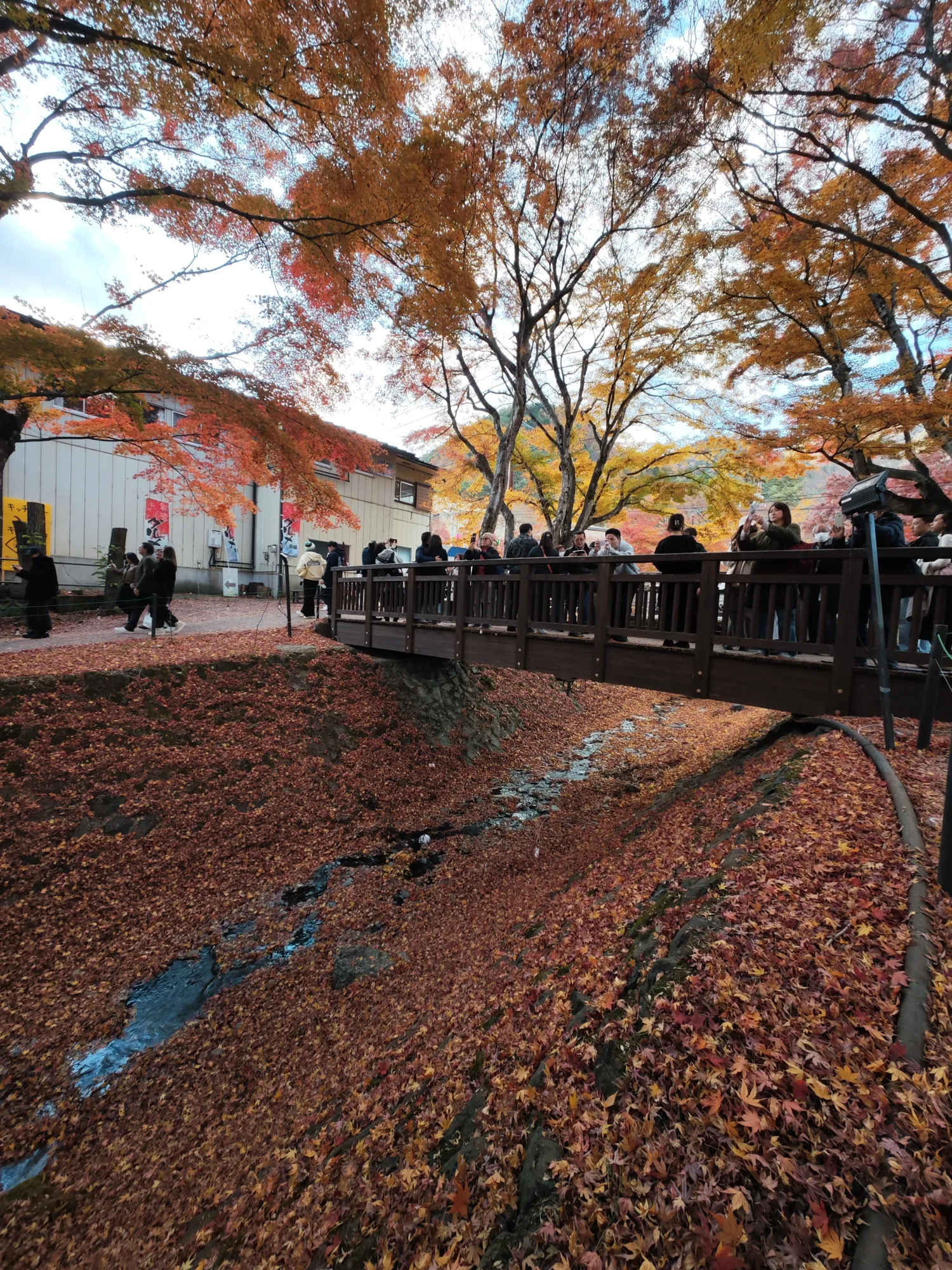
The crowd surprised me more than the leaves did. This was a Wednesday afternoon, not a weekend and not the illumination, and the footbridge over the stream was full end to end — people standing two deep along the rail, waiting for a gap to photograph through. The lighting rigs were already in position on the banks, unlit, waiting for evening.
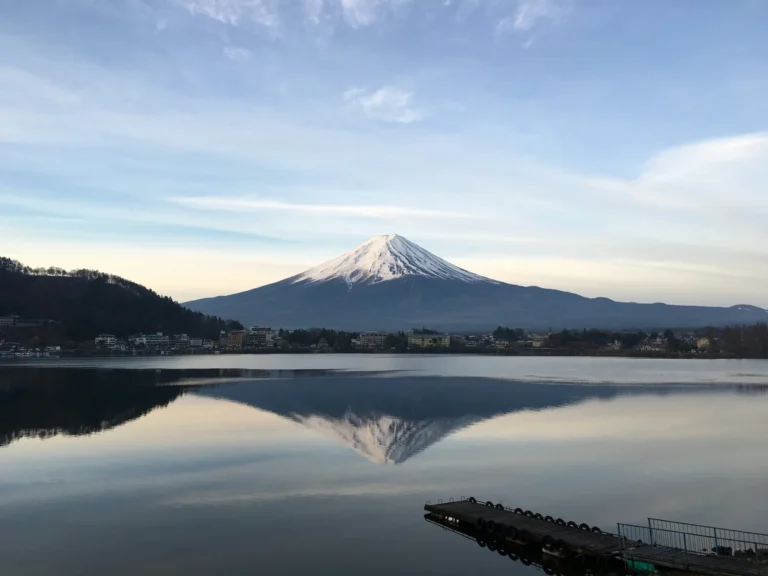
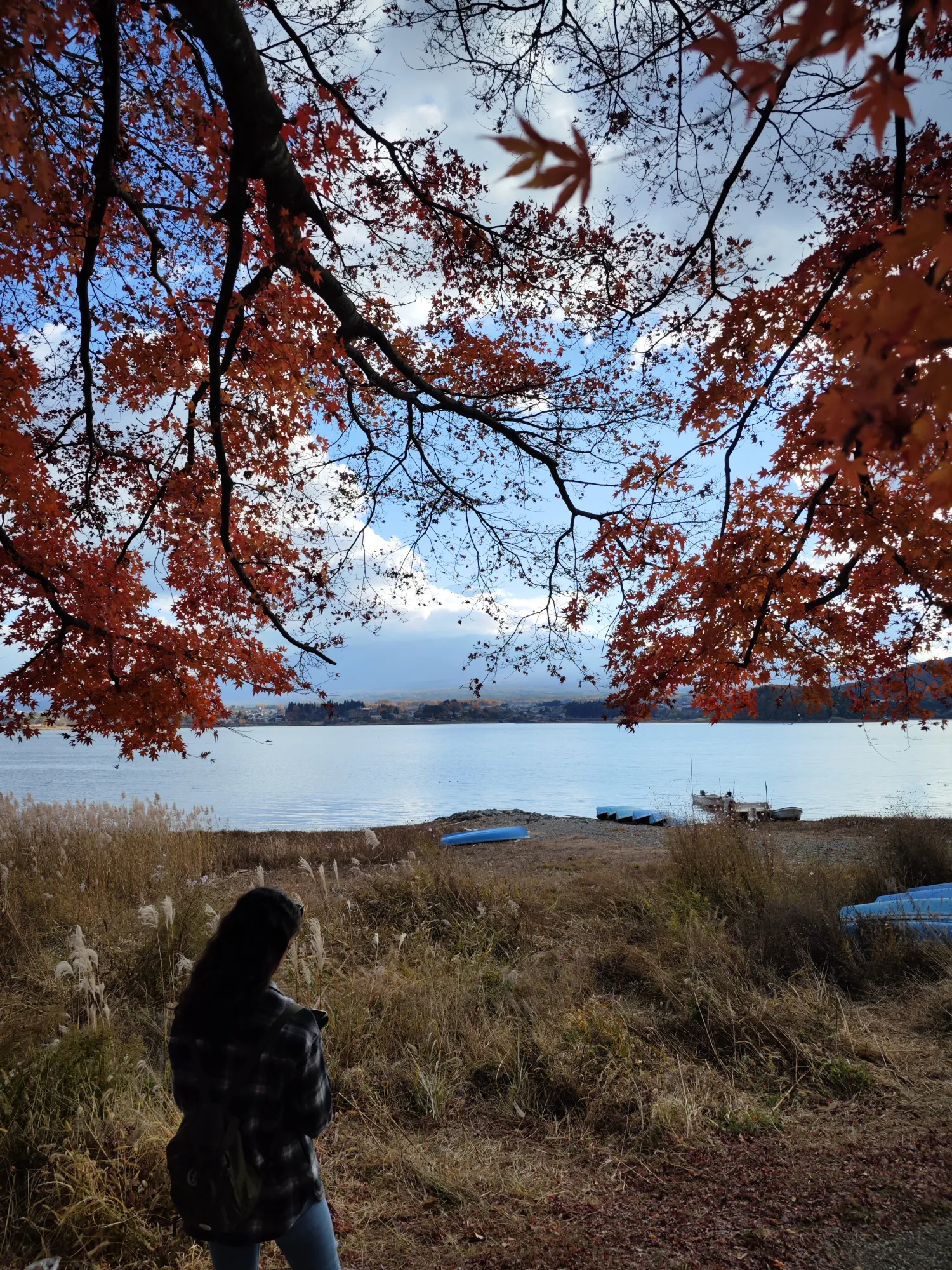
Down on the lakeshore a few minutes away it was quieter, and this is the frame I would go back for. Mount Fuji was mostly behind cloud that afternoon — you can make out the outline and not much else — and the lake was low enough that a wide band of gravel was showing with boats pulled up on it. The maples over the shore had gone a deep rust rather than red. If you want the postcard, you want the first half of the festival. If you want a quiet shoreline, the second half can give you one — it did on my visit.
Getting there, and the bus that leaves before the lights do
The site is on the north shore, along the Nashi River, and the bus stop you want is Kubota Itchiku Art Museum. From Kawaguchiko Station take the Red-Line sightseeing bus: 21 minutes on the current timetable, ¥440 one way, running every fifteen minutes with 36 departures a day from 9:00 to 17:45. It is a scheduled service, so there is nothing to book. From the stop it is a five-minute walk.
Two notes on that. First, the tourism association’s own website contradicts itself — its Momiji Corridor page says the bus takes “about 20 minutes” and its Kubota Itchiku page says “about 30”. The operator’s timetable says 21 minutes, and that is the number I would plan on. Second, do not buy the ¥1,500 one-day pass just for this: the return fare is ¥880, so the pass only pays if you are getting on and off elsewhere as well.
The bus goes home before the festival does
The illumination runs until 21:00. On the Red-Line, the last departure back to Kawaguchiko Station from the Kubota Itchiku Art Museum stop is 18:32. That is the same sightseeing bus every guide points you to, and it means that on the Red-Line the practical window for the lights is sunset to about half past six, not sunset to nine.
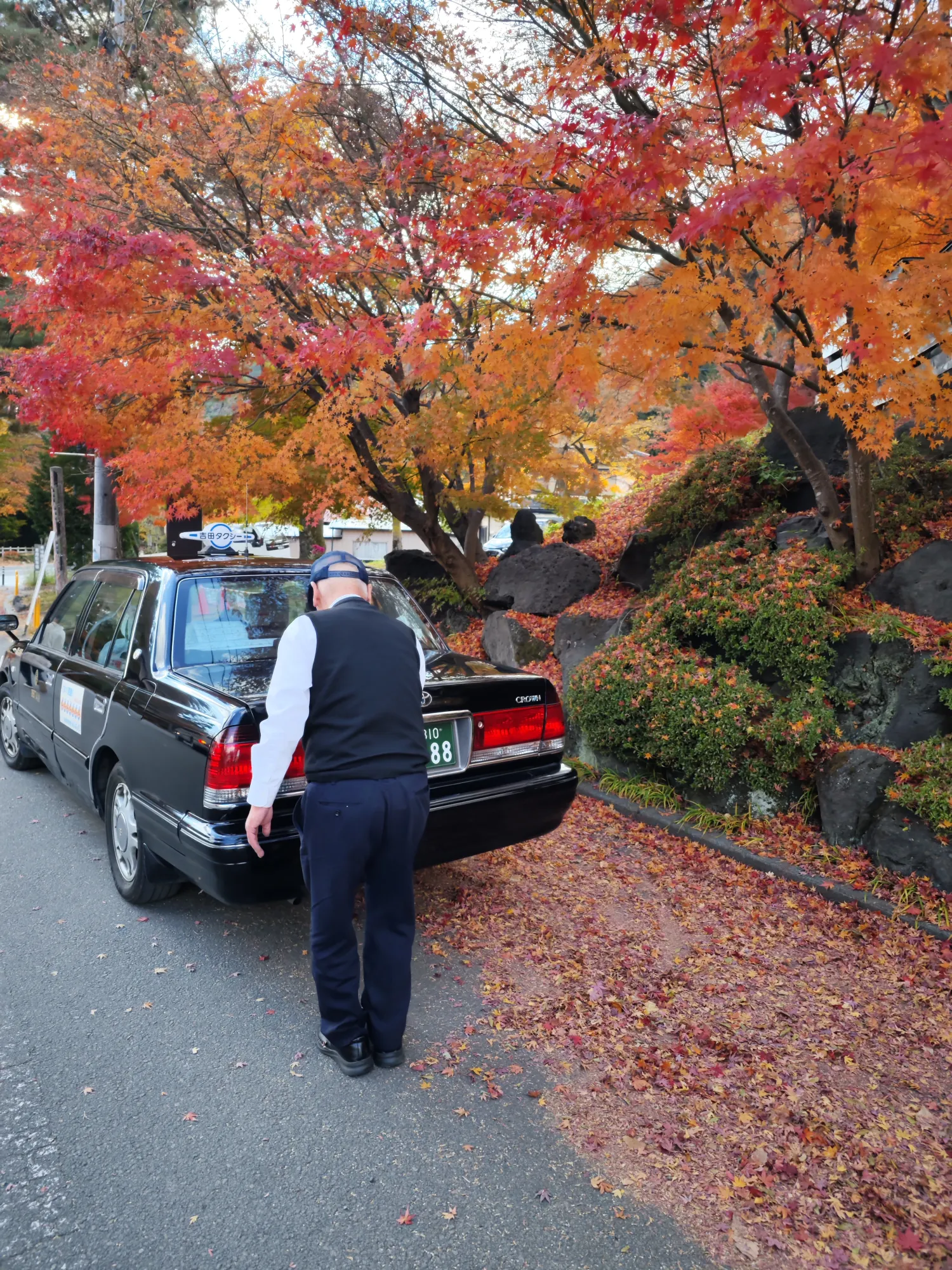
There is also a local P-Line service that uses the same stops along this stretch, and I have not been able to confirm its evening times. If you intend to stay past 18:30, ask at the Kawaguchiko Station bus window — open 6:30 to 19:00 — before you head out. I saw one taxi waiting near the site and photographed it, but one taxi on one afternoon is not a plan.
Coming from Tokyo, the highway bus from Shinjuku takes about 1 hour 45 and costs from ¥2,200, or ¥2,000 if you book online; from Tokyo Station it is about two hours from ¥2,300. By rail, the Fuji Excursion limited express runs direct from Shinjuku to Kawaguchiko for ¥4,200 in about 1 hour 53. One useful piece of 2026 news: the seasonal Fuji Excursion services run on weekdays from 1 October to 30 November and at weekends from 22 August to 29 November, so the whole festival period has five round trips a day rather than four. We have a fuller comparison in our guide to the Shinjuku–Kawaguchiko bus and in Tokyo to Kawaguchiko.
Where this actually matters for booking
The 18:32 bus is the whole argument for sleeping on the lake. Stay in Kawaguchiko and the illumination is a walk or a short taxi ride; day-trip from Tokyo and you are leaving the festival at half past six with three hours of lighting still to run. It is the same reasoning I would give a friend, and the only reason there is a booking link in an article about a free festival.
Why the town is charging, and what came before it
This is not a one-off. It fits a pattern that has been running across the Fuji area for three years.
| When | What | Where |
|---|---|---|
| May 2024 | A screen put up to block the convenience-store Fuji view, completed 21 May | Lawson Kawaguchiko Ekimae, Fujikawaguchiko |
| July 2024 | Climbing toll of ¥2,000 introduced on the Yoshida route | Yamanashi Prefecture |
| March 2025 | Climbing toll doubled to ¥4,000 and merged with the old voluntary donation | Yamanashi Prefecture |
| April 2025 | Municipal car parks charged, ¥1,000–¥1,500 per six hours | Arakurayama Sengen Park, Fujiyoshida |
| November 2026 | Festival car park expected to be charged for the first time | Fujikawaguchiko |
| April 2027 | Lodging tax of ¥200 per person per night begins | Fujikawaguchiko |
The town’s position is documented in its own words. Its city-planning department wrote that photography of the convenience store against Mount Fuji “developed into a major local problem” from 2024, that multilingual signs went up in March 2023 and security staff in June 2023, and that the screen was a “bitter choice” made to protect residents and drivers alike. The mayor’s September 2025 policy address described “a situation that can be called tourism pollution”.
The contrast with the neighbouring city is instructive. Fujiyoshida cancelled the cherry blossom festival at Arakurayama; Fujikawaguchiko announced in February 2026 that it would run its own cherry festival anyway, with more security staff and more portable toilets. If the Yamanashi Nichinichi Shimbun is right that the parking money will fund stewards and toilets, this is the same choice made again: charge at the pressure point, spend it on managing the crowd.
If you are driving
Assume the Nishikawa car park costs money this year, budget around ¥1,000, and know that around 120 spaces is nothing against 550,000 visitors. The tourism association’s own traffic guide says the town is ringed by mountains, has few roads, and that in tourist season congestion “is hard to clear” — and separately warns that late October to mid-November brings people hunting the Fuji-and-maples shot, with heavy congestion expected at weekends and on public holidays.
If you are on the bus
Red-Line from Kawaguchiko Station, ¥440, get off at Kubota Itchiku Art Museum. Come out between 10:00 and 16:00 and you are in the association’s own stated peak window; come earlier or later and you are not.
If you want it quiet
A weekday in the last days of the festival. In a typical year the leaves are dropping by then; in 2026 Weathernews has them starting to fall from about 28 November, so expect more canopy than usual for late in the festival, and weekday crowds rather than an empty shore. Avoid 14 and 15 November, when the Fuji–Lake–Maple Walk brings its own crowds to Oike Park.
When to go, and what the forecasts do and do not say
The tourism association gives the corridor’s usual window as late October to mid-November. That is the long-run guide, and my 19 November visit is a reasonable illustration of what the far end of it looks like.
The 2026 forecast overlaps the end of that window and runs past it. Weathernews published its first call on 3 September 2026 and its second on 8 October; on 10 October its page for the Kawaguchiko lakeshore, which lists the Momiji Corridor as its viewpoint, gave peak colour from about 15 November, with leaves starting to fall from about 28 November. The Japan Weather Association also publishes a forecast for the lakeshore and the corridor on its tenki.jp page (Japanese). Walkerplus’s Kawaguchiko page carries an explicit banner saying its content is from 2025 or earlier — its festival dates are last year’s.
Neither the town nor the tourism association publishes a running colour report. I searched the association’s site for the Japanese terms and got nothing, checked the town’s tourism department pages and found the word for autumn colour zero times, and pulled an archived copy of the association’s front page from 19 November 2025 — the day I was there — which showed no colour information at all. If you want to know what the trees are doing this week, there is no official feed to read. Our koyo tracker follows what does get published, and Japan in November 2026 sets the month in context.
For scale: the lake surface sits at 831 metres by the national survey’s elevation data, and the Momiji Corridor is at the same height. Walkerplus puts the higher ground at Tenka Chaya at 1,300 metres and describes the Fuji Subaru Line’s colour as usually running mid-October to early November — roughly two to three weeks ahead of the lakeshore. The practical consequence is that you cannot copy a date from Lake Motosu, Momijidai or Lake Yamanaka onto the Momiji Corridor.
Yamanaka, in fact, runs its own leaf festival on that earlier clock — the Lake Yamanaka Autumn Leaves Festival is planned for 30 October–15 November 2026, and the nine days the two festivals overlap (7–15 November) are the window for an evening at each lake.
Questions people actually ask
Is the Fujikawaguchiko Autumn Leaves Festival free?
Yes. Entry to the site and to the illumination is free, and the tourism association’s Momiji Corridor page states it explicitly. What is changing for 2026 is parking: an ordinance to charge for the municipal Nishikawa car park during the festival went to the town assembly on 2 September and was reported as passed. The amount has been described as ¥1,000 for a car and ¥3,000 for a coach, but both newspapers that reported it used the words “proposed” or “under consideration”, and the town has not published the figures.
What time does the illumination start and finish in 2026?
Sunset until 21:00. Both the tourism association’s July announcement and the town’s August newsletter say the same thing. This is a change: in 2024 and 2025 it ran until 21:30, and English pages still carry 21:30 or even 22:00. Sunset in mid-November comes early enough that you get a full evening of it either way — the constraint is not the lights, it is the last bus.
How do I get to the Momiji Corridor without a car?
Take the Red-Line sightseeing bus from Kawaguchiko Station and get off at Kubota Itchiku Art Museum, then walk five minutes. It costs ¥440 one way, runs every fifteen minutes, and takes 21 minutes on the operator’s timetable. The last bus back from that stop is 18:32, so if you are staying for the illumination, plan how you are getting home before you go out.
Is the one-day bus pass worth buying?
Not for the festival alone. A return to the Kubota Itchiku stop is ¥880 against ¥1,500 for the one-day pass. It starts to pay if you are also stopping at Oishi Park, the art museums or the lakeside cafés on the same day, which many people do — the Red-Line runs the whole north shore.
When is the best week to go?
The association’s usual window for the corridor is late October to mid-November, which points to the first half of the festival. For 2026, Weathernews’ Kawaguchiko lakeshore forecast puts the start of peak colour at about 15 November, in the middle of the festival. I went on 19 November 2025 and the tops were still colourful but the stream bed was carpeted. Note that 14 and 15 November 2026 bring the Fuji–Lake–Maple Walk to Oike Park, which adds its own crowds to the lakeshore.
Will there be extra buses during the festival?
Nothing has been announced. As of 4 September 2026 there is no notice of extra or additional buses on the Fujikyu Bus news page or on the tourism association’s site. The railway is a different matter: seasonal Fuji Excursion services run on weekdays from 1 October to 30 November and at weekends until 29 November, which covers the whole festival. Check the Fujikyu Bus news page and the tourism association before you travel rather than assume either way.
Can I see Mount Fuji from the festival site?
Sometimes. The corridor itself is a stream lined with maples and the mountain is not the subject there; the view comes from the lakeshore a few minutes away. On the afternoon I went, Fuji was largely behind cloud and only the outline was visible, which is a common enough outcome that I would not build the trip around it. For a more reliable Fuji-and-water frame, Oishi Park is further along the same bus route, and there is now a ferry to it from the south shore.
Sources
The primary sources behind every figure above
- Fujikawaguchiko Tourism Association — festival announcement of 10 July 2026, Momiji Corridor and Kubota Itchiku Art Museum pages, transport feature of 2 March 2026
- Fujikawaguchiko Town — Koho Fujikawaguchiko, August 2026 issue, p.6 · 2025 Fujikawaguchiko Tourism Statistics, March 2026 · city-planning department notice on the Kawaguchiko Ekimae works · mayoral policy addresses, March, June and September 2025 · lodging tax ordinance and its Ministry of Internal Affairs consent · September 2026 assembly schedule
- Yamanashi Prefecture — visitor survey reports for 2019, 2022 and 2024 · Mount Fuji Yoshida route toll pages and ordinance · Fuji Hokuroku car park
- Fujikyu Bus — Kawaguchiko sightseeing bus pages, route map and timetable PDF revised 11 April 2026, highway bus pages, news list · Fujikyuko Railway fare table and Fuji Excursion page
- Yamanashi Nichinichi Shimbun, 30 August 2026, via Fujisan NET · UTY Television Yamanashi, 2 September 2026, via TBS NEWS DIG · Sankei Shimbun, August 2024, May 2025 and August 2025 · YBS Yamanashi, May 2024
- Weathernews 2026 foliage forecasts, published 3 September and 8 October 2026, and its Kawaguchiko lakeshore spot page (checked 10 October 2026) · Japan Weather Association, Kawaguchiko lakeshore (Momiji Corridor) page on tenki.jp · Walkerplus · Geospatial Information Authority of Japan elevation data
- Time Out Tokyo, japan-guide.com, JapanTravel, Tokyo Cheapo, MATCHA, Voyapon, JNTO and Yamanashi Prefecture’s English site, all checked 4 September 2026
Join travelers discovering Japan's hidden side
Weekly dispatches from off-the-beaten-path Japan — spots and stories you won't find in guidebooks.
No spam. Unsubscribe anytime.
Welcome aboard!
You're in. See you in your inbox soon.