
Saitama · Autumn 2026
Two of Saitama’s best autumn sites have no dedicated English guide on any major travel site, and each hides the same kind of trap: the thing you travelled for is only available in a window nobody writes down in English. At Tsuki-no-Ishi Momiji Park in Nagatoro the maple illumination runs until 21:00, and the last train out of Kami-Nagatoro will strand you — it leaves at 22:31 and reaches Kumagaya at 23:21, ten minutes after the last JR train to Tokyo has gone. The train you actually want is the 21:53 on a weekday, or the 21:41 at a weekend. At Torii Kannon in Hanno, the great white Kannon everyone photographs can normally only be entered on Saturdays, Sundays and public holidays, 9:00 to about 15:00, between the first Saturday of April and the last Sunday of November — with one exception in late November that the temple announces separately each year.
What the English internet actually has on these two
I want to be precise about the gap, because “no English coverage” is the kind of claim that falls apart the moment somebody checks. So I searched seven English travel publishers plus the prefecture’s and the two towns’ own English pages, and on each site with a working search I also ran a control query to prove the search box was returning results at all.
Nagatoro as a destination is well covered. japan-guide.com returns about 411 results for it and has dedicated pages for the river boat cruises and for Hodosan Shrine. JapanTravel has nine Nagatoro articles. Tokyo Cheapo returns about 117 results and builds proper place pages for the Nagatoro Rhine Cruise and the Hodosan Ropeway. MATCHA has fifteen Nagatoro articles.
None of them has a page for the park. On japan-guide the only two hits for “tsukinoishi” are a 2023 forum post and a 2018 foliage blog entry. On JapanTravel it appears in exactly two sentences inside a general Nagatoro day-plan. MATCHA gives it one timestamped line — “17:00 The Illuminations at Tsukinoishi Momiji Park” — inside a 1,838-word itinerary. JNTO has one 2020 festival page. Tokyo Cheapo’s paragraph inside its Nagatoro Autumn Leaves Festival page is, as far as I can tell, the thickest English writing that exists on the place, and it opens with “We are yet to confirm the dates and details of this event.”
Torii Kannon is emptier still. japan-guide, JapanTravel, Voyapon, MATCHA and JNTO return nothing at all — not a page, not a mention. Time Out returns nothing either, but its index is thin enough that I would not treat that as proof; a search for “Saitama” returns a single result. What does exist in English is one page on Saitama Prefecture’s own tourism site and one section inside Tokyo Cheapo’s prefecture guide from 2020. Meanwhile Moominvalley Park, in the same city, has dedicated pages on japan-guide, JapanTravel and Tokyo Cheapo. Hanno is covered. Torii Kannon is simply skipped.
Three official sources, three different addresses
Saitama Prefecture’s tourism site and JNTO both give the park’s address as 1417-1 Nagatoro. The Tourism Association’s own English page says 1164 — while the same association’s Japanese press release says “near 1417-1”. MATCHA says 947. The walk from Kami-Nagatoro Station is “about 3 minutes” on the prefecture’s page and “5 minutes” on the association’s, on JNTO’s and on Tokyo Cheapo’s. I do not think the address is settled, so I would not navigate by it. What every version of the association’s own material agrees on is the walk: five minutes from Kami-Nagatoro, fifteen from Nagatoro. Use that.
Tsuki-no-Ishi Momiji Park: 2,000 square metres, and Nagatoro’s most-photographed autumn spot
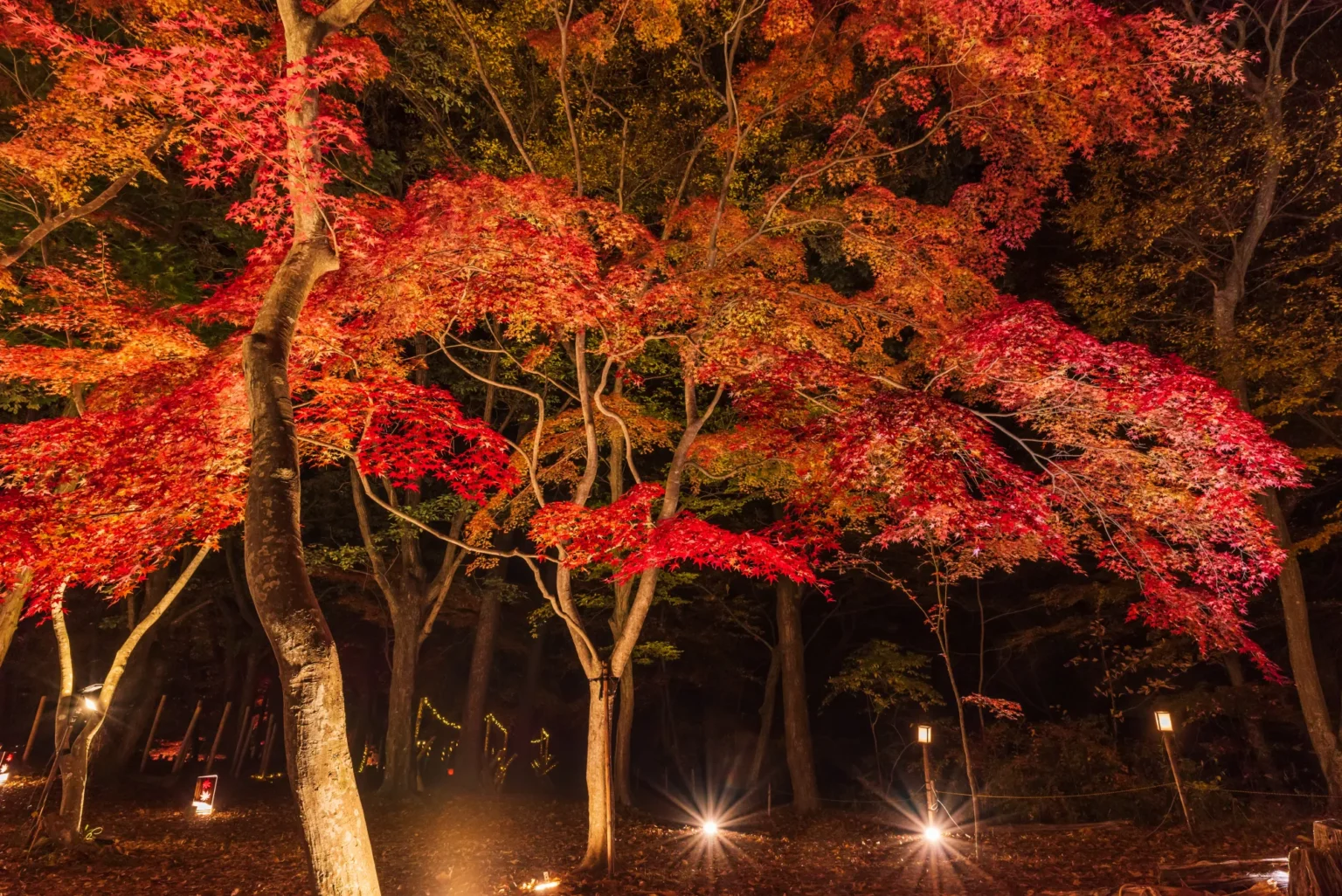
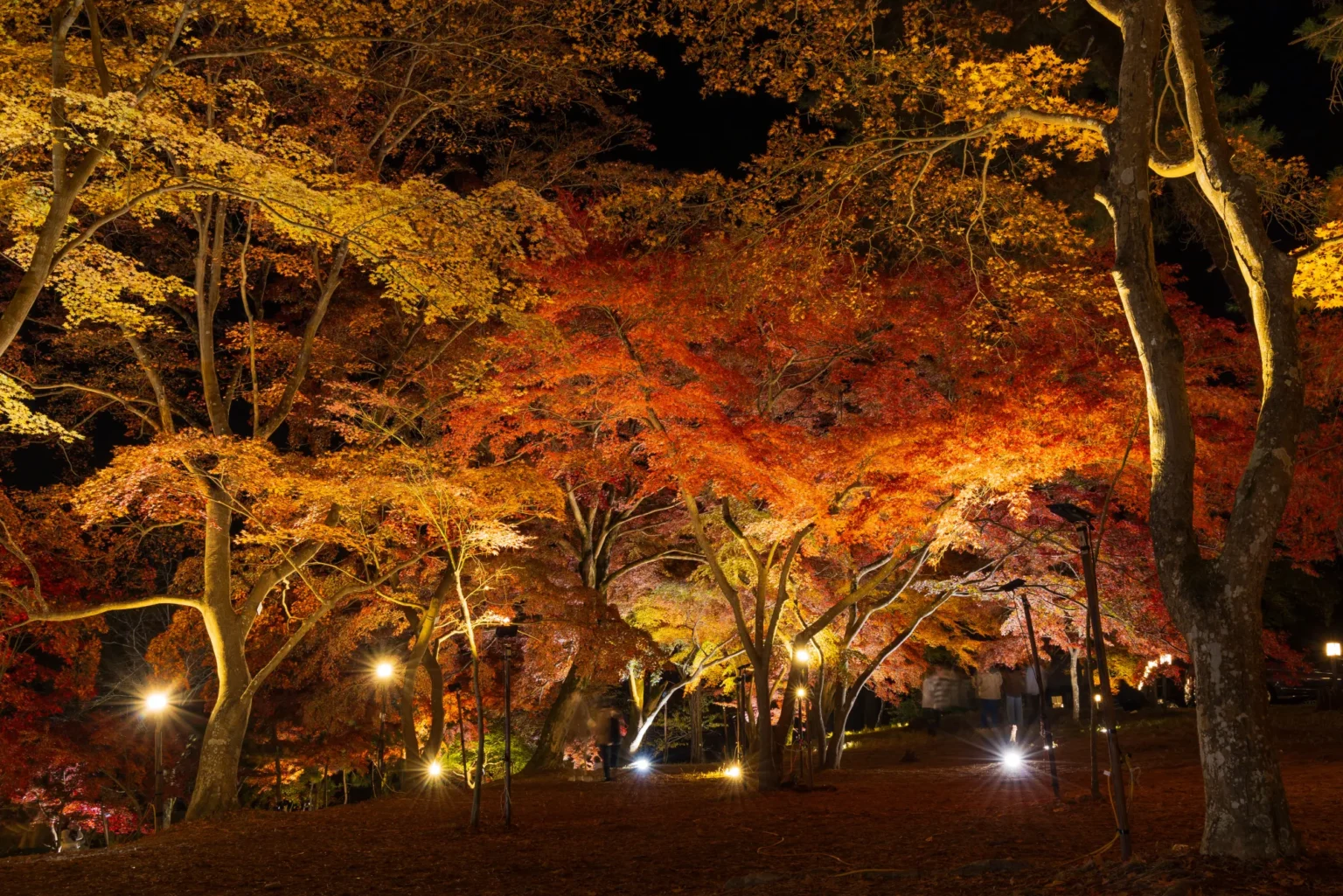
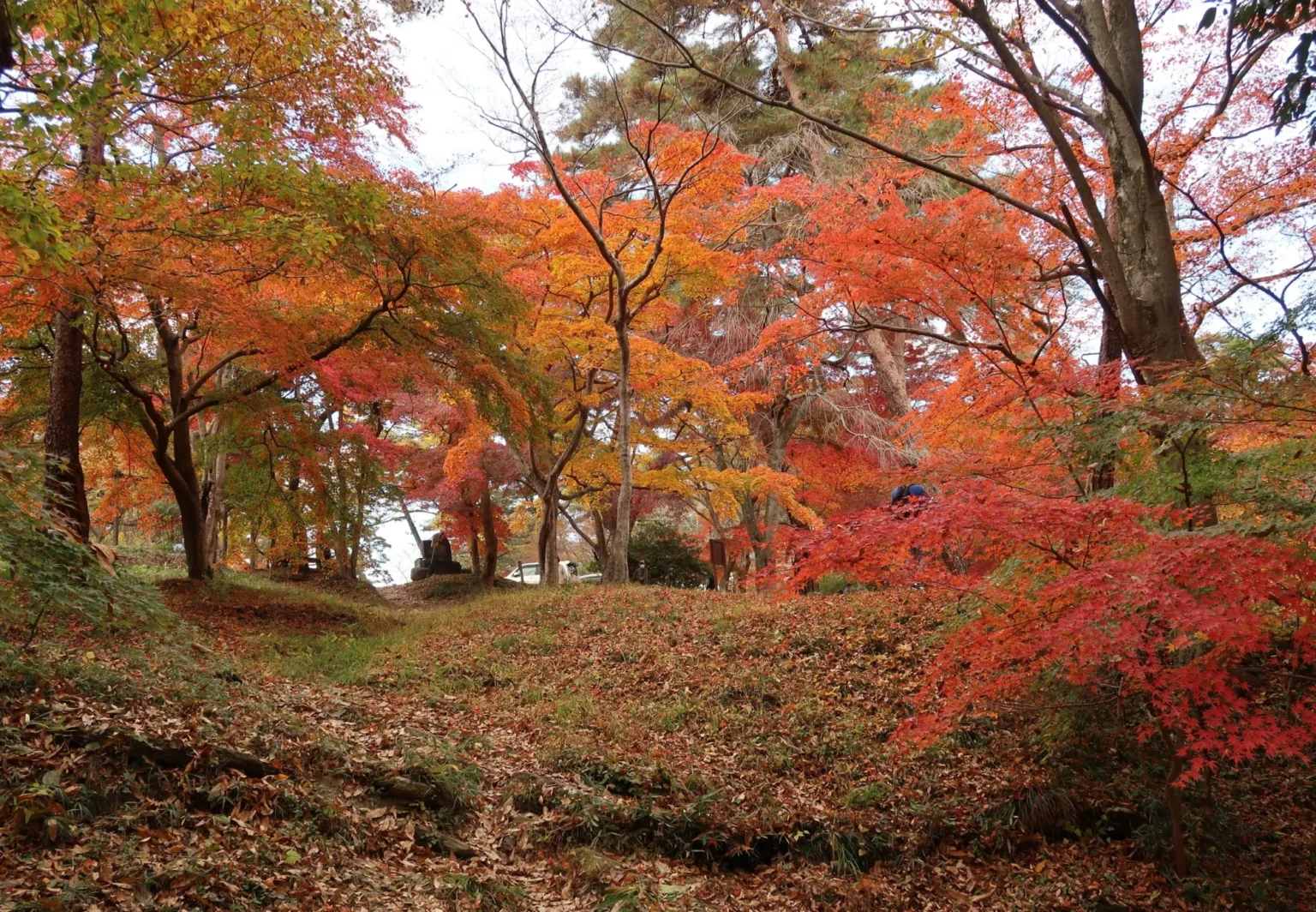
The park is small. The Tourism Association’s own press release puts it at about 2,000 square metres — call it a quarter of a football pitch — planted mainly with iroha maples plus some sawtooth oak and fir. You can stand at one end and see the other end. That is not a criticism; it is the reason the illumination works at all, because roughly 150 LED lamps are enough to light the entire thing from below.
The name comes from a haiku monument inside the park by Takahama Kyoshi, which reads koko ni ware / ku o todomu beki / tsuki no ishi — the moon stone where the poet leaves his verse. Not a rock formation, a poem.
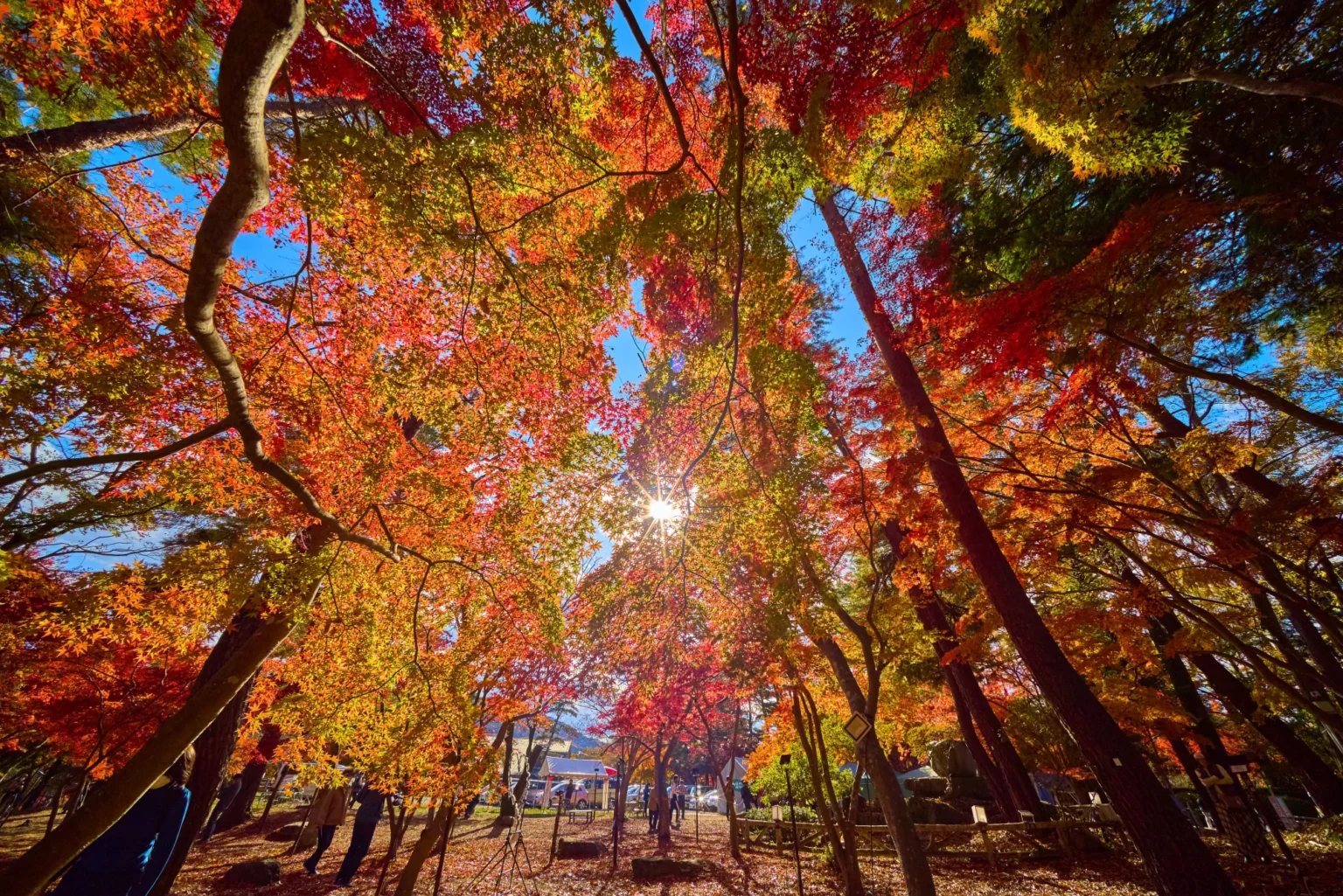
One honest note on ranking. The association’s printed flyer calls the park “the number one autumn spot in Nagatoro”. But the same association’s own list of Nagatoro’s three great autumn spots is Iwadatami, the Kaneishi Suikan Bridge and Mount Hodosan — the park is not on it. Where the park does come first is on the association’s separate list of illumination spots. Both things are true: it is what the association promotes hardest and what fills up in the evening, and it is also not what that same association sends you to if you only have daylight.
The ¥500 that can be ¥300
This is the part I have never seen written in English, and it is worth real money if you are visiting twice in a day.
During the illumination period, entry after 16:00 costs ¥500 in 2026 (it was ¥300 in 2024 and 2025) for anyone of middle-school age and up. Elementary schoolchildren, pre-schoolers, disabled visitors and pets are free. But between 10:00 and 16:00 the park asks for a voluntary contribution instead, and the association’s wording is specific: give ¥100 or more in the daytime and you are handed a postcard, and that postcard turns the ¥500 evening entry into ¥300.
| How you visit | What you pay | Note |
|---|---|---|
| Evening only, 16:00–21:00 | ¥500 | Middle-school age and up |
| Daytime only, 10:00–16:00 | ¥100 or more, voluntary | A contribution, not a ticket price |
| Daytime, then come back at night | ¥100 + ¥300 = ¥400 | The daytime postcard discounts the evening entry |
| Under 13, disabled visitor, pet | Free | Disabled visitor free for the holder only |
Two things follow from that. First, the cheapest way to see the park lit is to see it twice. Second, “¥100 daytime admission” — which is how this sometimes gets summarised — is wrong. There is no daytime admission. There is a request for ¥100 or more, and a reward for giving it.
Tickets are sold at the park itself only while the lights are on. If you want to arrive at 16:00 without queueing, you can buy in advance at the Nagatoro Tourist Information Centre in front of Nagatoro Station between 9:00 and 17:00, or at two convenience stores — the 7-Eleven Nagatoro Iwadatami branch and the 7-Eleven Nakanogami branch.
The 21:00 problem, and why the last train is not the last train home
Here is the thing that decides your whole evening, and I have not found it stated anywhere in English.
The lights run until 21:00. Almost every English page routes you to Nagatoro via Seibu-Chichibu, because that is the line with the limited express. On that route the last Ikebukuro-bound train leaves Seibu-Chichibu at 21:24, weekdays and weekends alike — after which there is one local as far as Hanno and nothing through to Tokyo. To make it you have to be on the 20:48 out of Kami-Nagatoro on a weekday, or the 20:46 at a weekend. In other words, on the Seibu route the illumination ends at about 20:45 for you.
Go the other way and it opens up. The Chichibu Railway also runs east to Kumagaya, where you pick up the JR Takasaki Line. Take the 21:53 from Kami-Nagatoro on a weekday, or the 21:41 at a weekend, and you are at Ueno at 23:57 — which means you can watch the lights until they switch off, walk five minutes to the station, and still get home.
The 22:31 is the last train. The 21:53 is the last train that takes you anywhere.
What you must not do is take the actual final service. It leaves Kami-Nagatoro at 22:31 on a weekday and 22:32 at a weekend, reaches Kumagaya at 23:21 — and JR’s last Tokyo-bound train out of Kumagaya left at 23:11. Ten minutes. The other exit fails too: change at Yorii for the Tobu Tojo Line and you reach Ogawamachi at 23:44, where the last Ikebukuro train went at 23:04. Both routes deposit you at a station with no onward service until about 04:47, arriving Ikebukuro at 05:28.
| Where you want to end up | Leave Kami-Nagatoro, weekday | Leave Kami-Nagatoro, Sat / holiday |
|---|---|---|
| Ueno — the latest that works | 21:53, in at 23:57 | 21:41, in at 23:57 |
| Tokyo, Ikebukuro or Shinjuku | 21:02 — Tokyo 23:33, Ikebukuro 23:19 | 20:57 — Tokyo 23:11, Ikebukuro 23:08 |
| Ikebukuro on the Seibu route | 20:48, for the 21:24 out of Seibu-Chichibu | 20:46, for the same 21:24 |
| Nowhere — the actual last train | 22:31, Kumagaya 23:21 | 22:32, Kumagaya 23:21 |
Kami-Nagatoro to Kumagaya is ¥850 on the Chichibu Railway. And do not assume the shinkansen rescues you: the last Tokyo-bound shinkansen out of Kumagaya is the 22:30 Asama, 41 minutes earlier than the last ordinary train at 23:11, and it costs ¥3,310 against ¥1,230. The bullet train is the fast way out of Kumagaya, not the late one.
It is also worth knowing what the extra autumn trains do and do not do. Chichibu Railway did run extras in November 2025 — the notice covers weekends and holidays through the month plus Friday 14 November, all stopping trains between Nagatoro and Kagemori, and all of them calling at Kami-Nagatoro. But every one of them was a daytime or late-afternoon service; the latest reached Nagatoro at 16:01. Nothing was added after the lights came on, and the last train was not moved.
Or remove the arithmetic entirely
The 21:53 works, but it is still a two-hour journey home from a place where the restaurants shut at 21:00 or 22:00. The Tourism Association lists three places within a five-minute walk of the park — Yokotei, Minshuku Nagatoro-so and Kominka Nagatoro — plus three more ryokan that run a shuttle to the illumination for their guests. That is the only reason I would push a booking link into an article about a ¥500 park.
The 2026 dates are out
The Nagatoro Tourism Association announced the 2026 dates on 14 September 2026: the Nagatoro Autumn Leaves Festival runs 1–30 November, and the Tsuki-no-Ishi Momiji Park light-up runs 6–29 November, 16:00–21:00, though the dates can move with the colour. Evening entry is now ¥500 for middle-school age and up (free for elementary schoolchildren and younger), and the daytime postcard brings it down to ¥300. Its 2026 festival page was still marked “in preparation” when we checked on 20 October.
The announcement date moves around a lot: the 2024 dates went up on 30 August 2024 and the 2025 dates on 23 October 2025. The table shows how the last two years ran, for comparison.
| Previous years (2026 above) | 2024, as it ran | 2025, as it ran |
|---|---|---|
| Nagatoro Autumn Leaves Festival | 1–30 November | 1–30 November |
| Park illumination | 8–24 Nov, extended to 30 Nov | 12–24 Nov, extended to 30 Nov |
| Hours | 16:00–21:00 | 16:00–21:00 |
| Adult entry | ¥300 | ¥300 |
| When it was announced | 30 August 2024 | 23 October 2025 |
Both of the last two years were extended to 30 November after the fact, which tells you something useful: if the leaves are late, the lights follow them. What moves the dates is colour, not weather — the association and the town both say the schedule can be brought forward or extended according to how the leaves are turning, and neither publishes a rain policy for the illumination at all.
One more thing on driving: don’t. The Tourism Association’s FAQ states flatly that Nagatoro has no free tourist parking, and the lots nearest the park run ¥500 to ¥700 for a normal car. The association’s own advice for weekends is to take the train, and it asks coaches not to drive past Kami-Nagatoro Station at all.
Torii Kannon: a Chinese pilgrim’s relic on a Saitama hillside
The second site is stranger, and I think it is the better story.
Hakuunzan Torii Kannon was built by one man. Hiranuma Yatarō was born on this mountain in 1892 and went on to become the first president of Saitama Bank and chair of the House of Councillors’ finance committee. His mother, a devout follower of Kannon, left him an instruction: build the hall for me. In 1940, called up as an infantry lieutenant, he finally acted on it and put up a small hall — the building that is now the Onjūdō — with a Shō-Kannon he had carved himself inside it. Then he took the art name Tōkō, apprenticed himself to the sculptor Miki Sōsaku, and spent more than thirty years cutting into the mountain and filling it with his own carvings and with buildings.
The result covers about 30 hectares. The prefecture’s tourism body calls the comparison for you: six and a half Tokyo Domes.
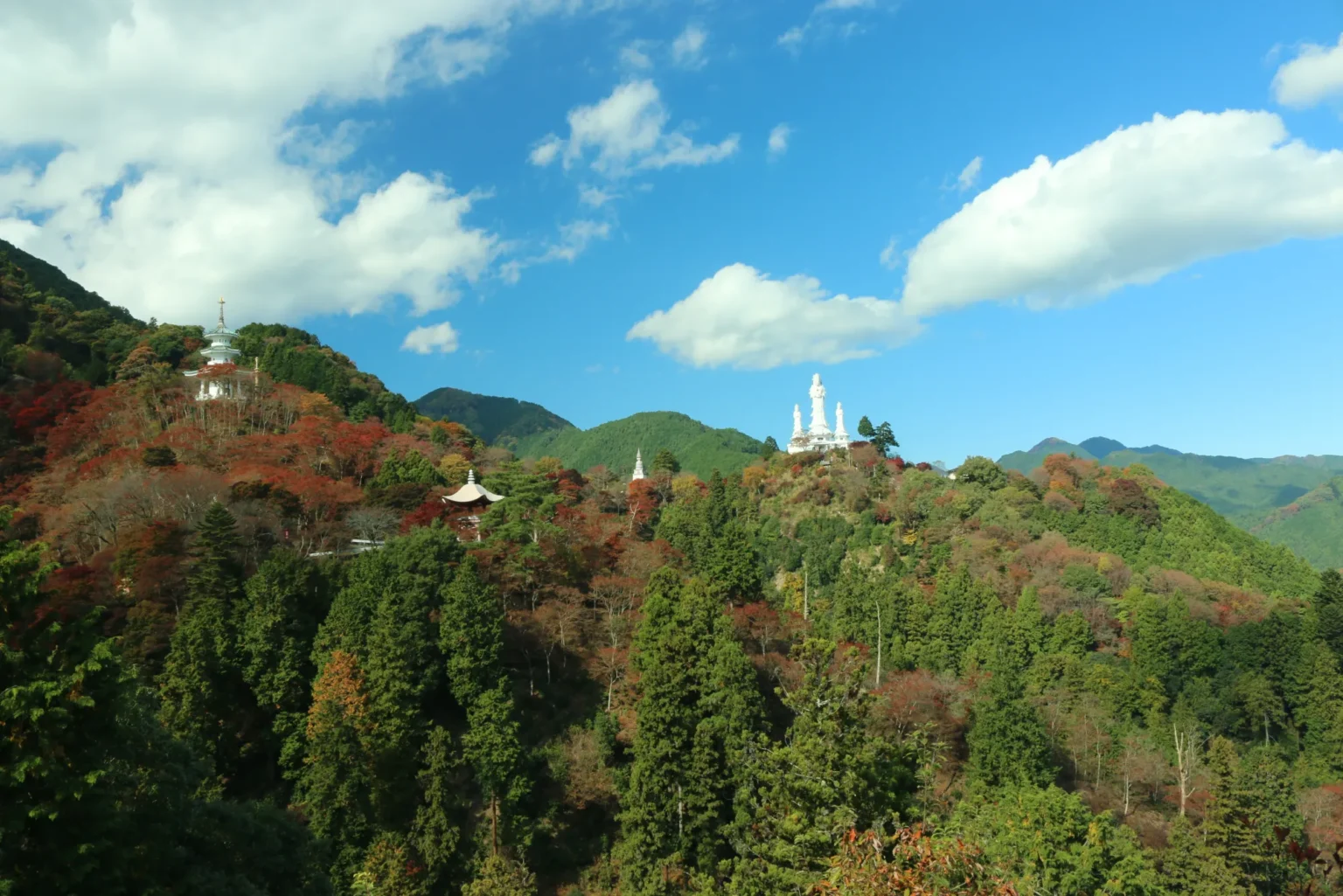
Two structures dominate. The Genjō Sanzō tower, finished in 1960, is 33 metres of reinforced concrete built in three tiers — square at the base for Japan, octagonal in the middle for China, sixteen-sided at the top for the south. It holds relics of Xuanzang, the Tang-dynasty monk who walked to India for the sutras and who English readers know as Tripitaka, the priest in Journey to the West. The temple states plainly that the relics were passed to Hiranuma through the priest Mizuno Baigyō, and that the tower was raised with the backing of some three hundred political and business figures. The founders include three former prime ministers — Yoshida Shigeru, Ishibashi Tanzan and Hatoyama Ichirō — alongside Matsushita Kōnosuke of Panasonic and Honda Sōichirō.
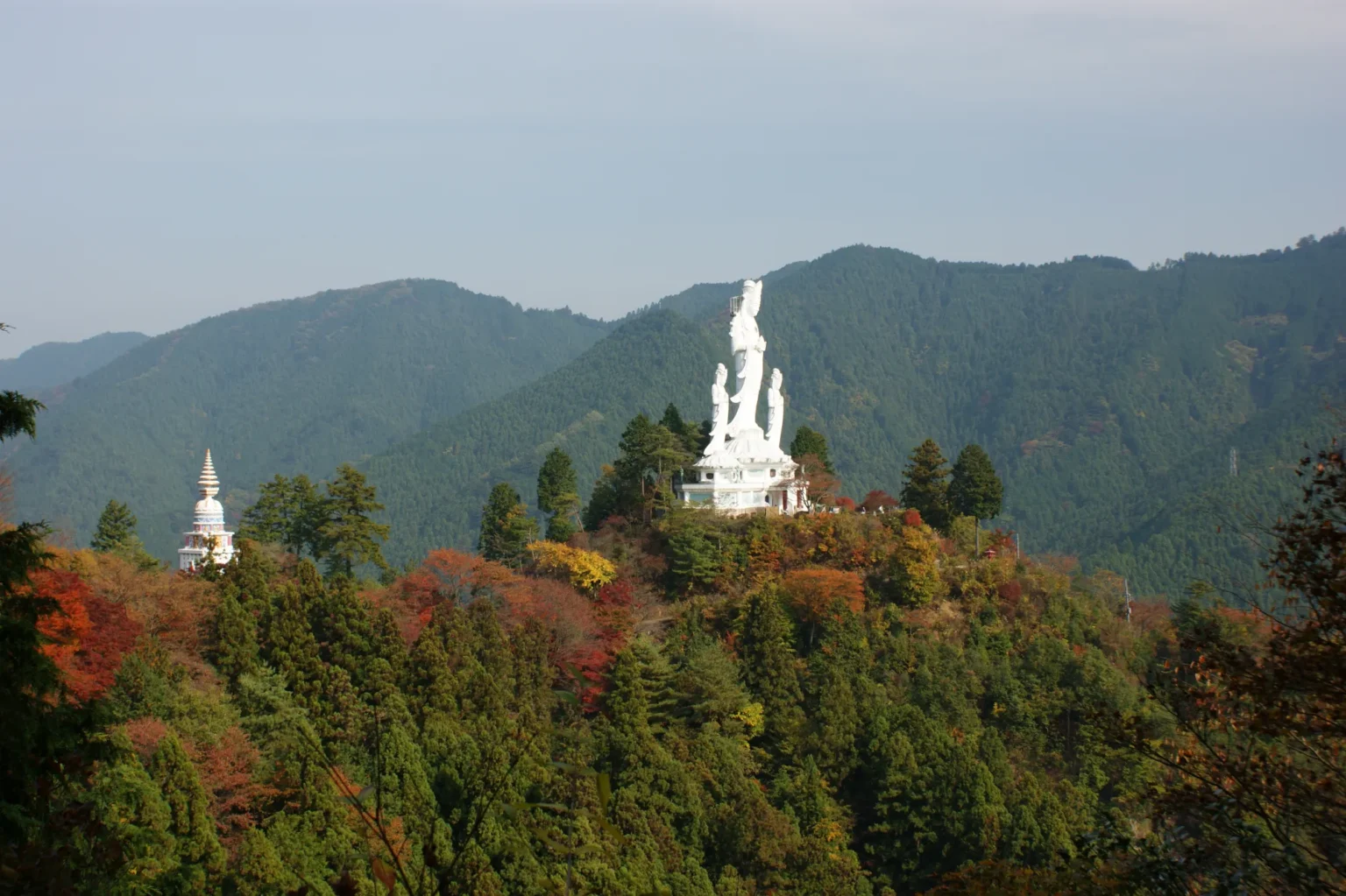
The other is the Kusei Dai-Kannon on the summit, put up in 1971. Almost everything in English calls it “a 33-metre statue”, which is true of the whole assembly and misleading about the figure. The temple’s own detail page breaks it down: the central Kannon is 23 metres, the two flanking figures of Bonten and Taishakuten are 23 metres each, and the base is a further 10. And it is not solid — inside are an Amida Nyorai and ten thousand small Kannon figures, each 33 centimetres, placed for perpetual memorial services, with a viewing platform 27 metres up looking out over the Oku-Musashi hills. The architecture borrows from India and the Near East; the temple notes that the central entrance columns copy the inverted columns of the palace at Knossos, on Crete.
Two fees, and a door that only opens at weekends
This is the trap. Torii Kannon charges twice, and the second charge comes with a calendar attached.
| What | Cost | When |
|---|---|---|
| Entry to the mountain, on foot | ¥200 adult · ¥100 child | 9:00–16:00. Child rate is elementary age and up |
| Entry by car | ¥500 per car | Road closed roughly mid-Dec to mid-Mar for ice |
| Entry by motorcycle | ¥300 | Same road closure applies |
| Inside the Kusei Dai-Kannon | ¥200 adult · ¥100 child, on top of entry | Normally Sat, Sun and public holidays only, 9:00 to about 15:00. See the late-November exception below |
| Parking, normal days | Free, about 30 spaces | Unavailable on 16 August and on the autumn festival day |
| Parking, 2025 peak period | ¥500 car · ¥300 motorcycle | Lower lot charged, summit lot capacity-limited |
| Main hall | No separate charge | Mountain entry still applies. Open to visitors |
The standing rule is set by weekday rather than by date: from the first Saturday of April to the last Sunday of November, weekends and public holidays only. You can watch that rule run in the temple’s own notices — the interior closed for the season on 30 November 2025 and reopened on 4 April 2026. Turn up on a Tuesday in October and you can walk the whole mountain and stand at the foot of the statue, and the door will be shut. The temple will discuss opening it out of season if you ring the office first, on 042-979-0666.
There is one exception, and it lands exactly when you would want to go. For 2025 the temple declared 15 to 30 November a kōyō tokujitsu period — peak-foliage special days — and during it the Kusei Dai-Kannon opened on weekdays too, Wednesdays included, running 9:00 to 16:00 rather than closing at three. The trade was parking: the large lot at the foot of the mountain became ¥500 for a car and ¥300 for a motorcycle, and the summit lot went capacity-limited. Nothing has been announced for 2026, so treat late November as the one window where the weekend rule may not apply — and check the temple’s notices before you plan a weekday around it.
Go on a Saturday or Sunday, unless it is late November
Everything that makes this place worth two hours on trains and buses — the inside of the Kannon, the 27-metre viewing platform, the ten thousand small figures — is weekend-only for most of the year. The one likely exception is the peak-foliage fortnight in the second half of November, which in 2025 opened weekdays as well. If your trip is a weekday in mid-to-late November, ring 042-979-0666 and ask whether the tokujitsu period is running before you commit the day.
One bus an hour, forty minutes each way
From Ikebukuro to Hanno is ¥560 on the Seibu Ikebukuro Line, ¥557 with an IC card. The Laview limited express adds ¥600 and takes 40 to 45 minutes; the Hanno tourism association quotes about 42.
From Hanno the Kokusai Kogyo bus leaves from stop 3 on the north side. You want anything signed for Yunosawa, Naguri Shako or Nagō — six services use the stop — and you get off at Renkeibashi, the 54th stop, then walk five minutes. It takes 40 to 42 minutes and costs ¥760 for an adult, the same on cash or IC. There are 21 departures on weekdays and 24 at weekends, which in the middle of the day means roughly one an hour.
The return is slower: 48 to 49 minutes. The last bus from Renkeibashi towards Hanno is 20:25 on weekdays and 19:45 at weekends. Since the mountain closes at 16:00 anyway, that is not the constraint it looks like — but it does mean the 16:17 and the 17:10 on a weekday, or the 16:02 and 16:30 on a Saturday, are the departures to plan around.
Once you are through the gate, the summit is about five minutes by car or 45 minutes to an hour on foot. The temple’s own map splits that walk into 35 minutes from the main hall to the Xuanzang tower and 10 more from the tower to the Kannon. It asks walkers to be back down by 16:00. And when the road is busy in autumn the temple holds cars at the gate and tells you outright that walking is better.
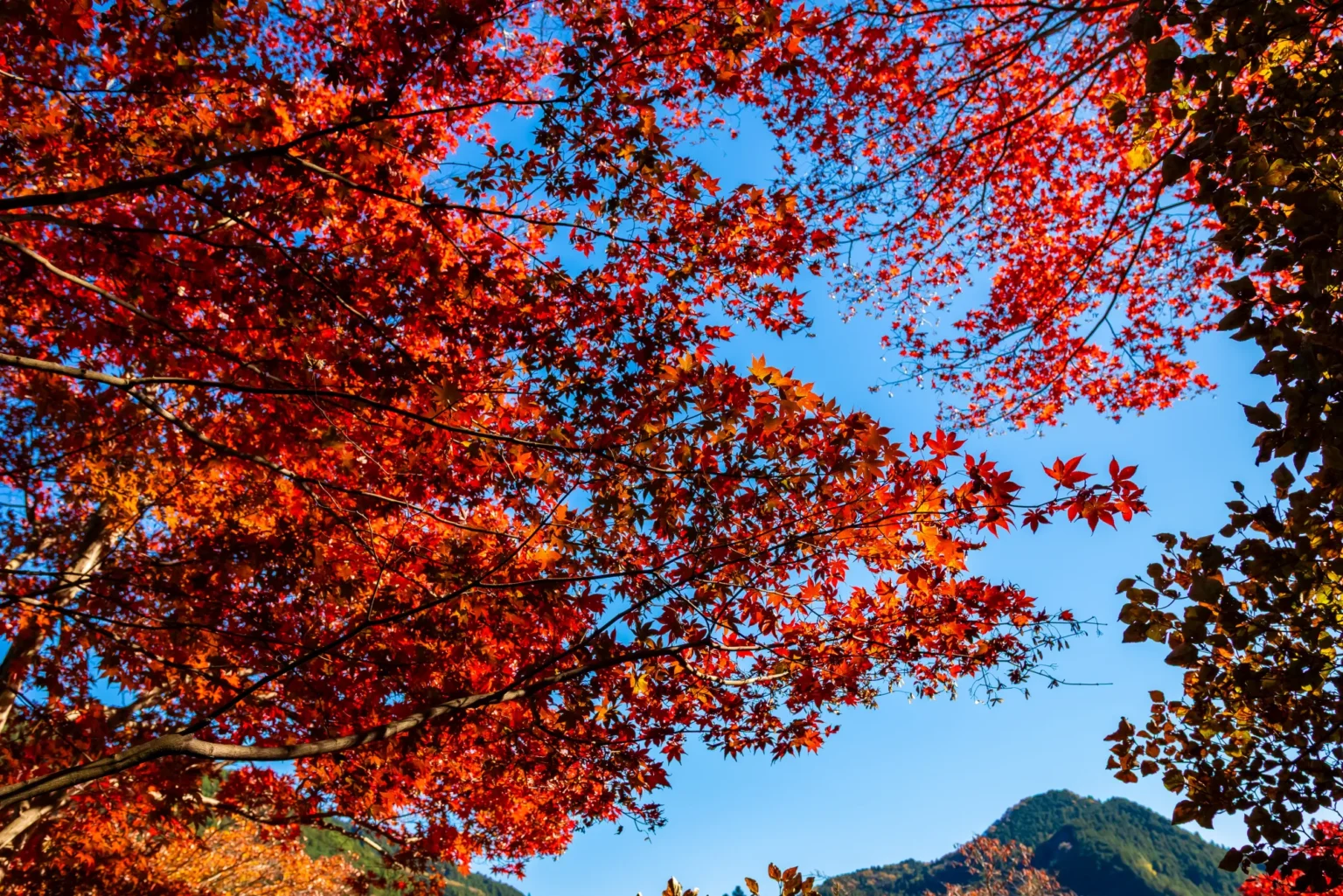
One nice consequence of a temple that runs its own foliage page: it tells you where on the mountain to look. The road from the great bell tower up to the Xuanzang tower usually turns in early November; the stretch from the tower to the sutra hall and the area around the Niōmon in early-to-mid November; the ground behind the main hall and the priests’ quarters in mid-November. During the season the temple updates a status table one or two times a week. In 2025 it posted readings for 1, 7, 14, 21 and 28 November and then closed the page for the year. The 2026 page has not opened yet.
The road closes in winter, and nobody announces when
The published rule is that the vehicle road shuts from around mid-December to mid-March for ice, with the walking paths staying open. What actually happens is less tidy, and the temple is unusually frank about it: the closing date is undecided, and once snow falls and the surface ices, the mountain closes immediately and without notice. Reopening is around the spring equinox, and only after the paths have been repaired.
The last two years show the spread. In the winter of 2024–25 the mountain stayed open until 3 March. The following winter it shut on 3 January 2026, the day snow settled on Naguri, and reopened on 4 April. If you are planning anything in December, ring first.
A small footnote for film people: the temple states that its autumn scenery was used in Dolls, Kitano Takeshi’s 2002 film.
When the colour actually arrives
Weathernews published its first 2026 foliage forecast on 3 September 2026 and its second on 8 October. The second expects spots that usually peak from late October onward to be later than average in many places because of a warm autumn. For these two: Tsuki-no-Ishi Momiji Park from about 19 November on its 8 October map, Torii Kannon from about 19 November, with leaf fall at Torii Kannon starting around 5 December (its spot pages on 10 October; the Tsuki-no-Ishi page gives the 20th). In the first forecast they were the 19th and the 18th. On 3 September both were recorded as “not started”.
When I first wrote this in September, the Japan Weather Association’s own 2026 forecast was not out, so Weathernews’ was the only 2026 forecast available; the Association published its first on 1 October on tenki.jp. I would not treat any single forecast as gospel — I checked Weathernews’ again in October, and its second forecast moved these two by a day at most. Our live koyo tracker follows the revisions as they land.
What is more useful than any single date is the spread across the prefecture, because Saitama is unusually stretched for a small place. Weathernews dates 25 Saitama spots for 2026. As of 10 October, after its second forecast:
| Where | 2026 forecast peak | Character |
|---|---|---|
| Mitsumine, Nakatsu-kyo | 3–9 November | Deep Chichibu mountains |
| Torii Kannon, Lake Naguri | 19 November | Oku-Musashi hills, Hanno |
| Tsuki-no-Ishi Momiji Park, Iwadatami, Hodosan | 19–20 November | Nagatoro, along the Arakawa |
| Omiya Park, Musashi Kyuryo Forest Park | 27–28 November | The Kanto plain |
| Kuroyama Sandaki | 6 December | Eastern edge, latest in the prefecture |
That is 33 days between the earliest and latest forecast in one prefecture, which is why “Saitama in late November” is not a plan. It also means that if you arrive in Tokyo in the first week of December and think you have missed everything, you have not — you have missed Chichibu, and the plain is still turning. That logic runs through our month guides for October and November.
Where the sources disagree, don’t pick one
Torii Kannon’s “usual” peak is given as late October to mid-November by Weathernews and by the temple itself, and early to mid-November by Walkerplus. Nobody is wrong; they are averaging different years. If you need a single number to plan around, use the 2026 forecast date and accept a week either side of it.
Should you do both in one day? I would not
They are on the same railway in the loosest sense — Hanno is a stop on the Seibu line that continues to Seibu-Chichibu, and Nagatoro is 20 minutes beyond that on the Chichibu Railway. So it is not geometrically impossible: Torii Kannon in the morning, back down to Hanno, on to Kami-Nagatoro for the lights at four. But that gives you two hours on a 30-hectare mountain, misses the statue’s 15:00 closing unless you start very early, and adds a 48-minute bus at the front of a day that already ends after 21:00. No published journey time between the two exists, so you would be building it from same-day timetables. I would take them as two separate trips.
Pick Nagatoro if
You want the picture everyone else has, at night, in a small park you can cross in ninety seconds — and you are happy to route home east via Kumagaya on the 21:53, or to sleep locally. It also stacks well with Hodosan Shrine and the river, both a short walk from Nagatoro Station.
Pick Torii Kannon if
You would rather trade the famous night scene for thirty hectares of hillside and a story nobody at home has heard. Go on a weekend so the statue is open, budget about ¥3,040 return from Ikebukuro including both entry fees and the bus, and give it four hours on the ground.
Pick neither if
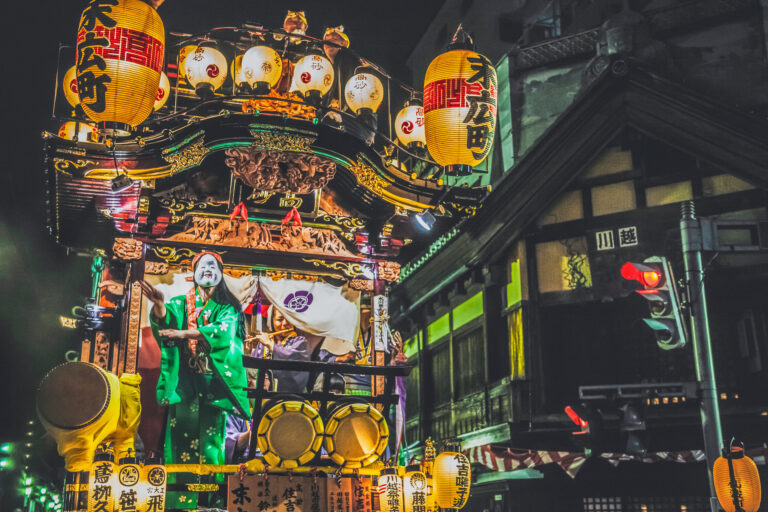
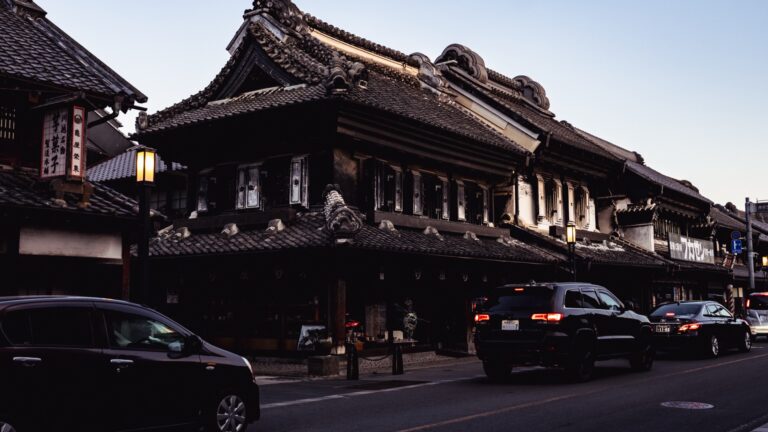
You have one autumn day and no appetite for logistics. Kawagoe is 30 minutes from Ikebukuro (time it for the float festival on 17–18 October if you can), and Kinchakuda in Hidaka is on the same Seibu line as Hanno with none of the bus problem.
If you like this kind of site — a real place with almost nothing written about it in English — the same logic produced our pieces on the Aigi Tunnels near Nagoya, which open for nine days a year, and on Yujaku Park and Raizan Sennyoji in Kyushu. If you are arriving before the maples do, September colour starts a long way north. And for the wider Tokyo-radius question, our day trips from Tokyo guide ranks by travel time.
Booking notes, plainly
Nagatoro itself has only a handful of rooms and they go early in November — the walk-to-the-park places are linked above. Chichibu is the realistic fallback: far more inventory, and 20 minutes from Nagatoro by rail. Torii Kannon has no accommodation problem at all, because it closes at 16:00 and you go home the same afternoon, so a Tokyo base is fine for that one.
Questions people actually ask
Is Tsuki-no-Ishi Momiji Park free?
In the daytime, effectively yes — the park asks for a voluntary contribution of ¥100 or more between 10:00 and 16:00 rather than charging admission. From 16:00 during the illumination period (6–29 November in 2026) it costs ¥500 for anyone of middle-school age and up, or ¥300 with the daytime postcard, and it is free for elementary schoolchildren and younger. It was ¥300 in 2024 and 2025.
Which station is closest, Nagatoro or Kami-Nagatoro?
Kami-Nagatoro, five minutes on foot. Nagatoro Station is fifteen. This matters more than it sounds, because Kami-Nagatoro is not an express stop — the Chichibu Railway’s express trains and the SL Paleo Express both call at Nagatoro and run straight through Kami-Nagatoro. If you are on an express you will get off at Nagatoro and walk, or change to a local for one stop.
Can I see the illumination and still get back to Tokyo the same night?
Yes, if you go east rather than back the way most guides send you. Take the Chichibu Railway from Kami-Nagatoro to Kumagaya and change to the JR Takasaki Line: the 21:53 on a weekday or the 21:41 at a weekend puts you at Ueno at 23:57, so you can stay until the lights go off. If you need Tokyo, Ikebukuro or Shinjuku rather than Ueno, leave earlier — 21:02 on a weekday, 20:57 at a weekend. On the Seibu route via Seibu-Chichibu the deadline is 20:48 or 20:46. Do not take the actual last train at 22:31: it reaches Kumagaya at 23:21, ten minutes after JR’s last Tokyo-bound service, and there is nothing onward until the small hours.
Can I go inside the big Kannon statue at Torii Kannon?
Yes, but normally only on Saturdays, Sundays and public holidays, from 9:00 to about 15:00, and only between the first Saturday of April and the last Sunday of November. It costs ¥200 for adults on top of the ¥200 mountain entry. Inside there are ten thousand small Kannon figures and a viewing platform 27 metres up. On an ordinary weekday you can reach the statue but not enter it. The exception is the peak-foliage period in the second half of November: in 2025 the temple opened the interior on weekdays as well, Wednesdays included, and extended closing to 16:00. That is announced year by year, so ring ahead.
Do I need a car for Torii Kannon?
No. The bus from Hanno Station to Renkeibashi runs 21 times on weekdays and 24 at weekends, takes 40 to 42 minutes and costs ¥760, and the temple gate is a five-minute walk from the stop. Driving in is ¥500 rather than ¥200, parking is free but limited to 30 spaces, and the temple itself recommends walking when the road is busy in autumn. Parking is also unavailable on the day of the autumn festival.
Are tripods allowed at the illumination?
There is no published rule either way. The Nagatoro Tourism Association’s event conditions cover litter, smoking, parking and privacy when posting photos online, and ask visitors not to get in each other’s way — but a full-text search of its site returns nothing at all on tripods. Drone flights and cosplay shoots each have their own notification process; tripods do not. Given how small the park is and how busy the weekends get, I would leave it at home. If it matters to your trip, the association takes calls on 0494-66-3311.
When will the 2026 dates be announced?
Nagatoro has announced them: on 14 September 2026 the Tourism Association set the festival for 1–30 November and the Tsuki-no-Ishi light-up for 6–29 November, 16:00–21:00. Torii Kannon had not posted its 2026 autumn notices on its own site when we checked on 20 October; in 2025 its peak-foliage notice came on 1 November.
Sources
The primary sources behind every figure above
- Nagatoro Tourism Association — 2025 and 2024 autumn festival pages, press release PDF, official flyer, access page, FAQ
- Nagatoro Town — Koho Nagatoro No. 751, November 2025, p.8
- Hakuunzan Torii Kannon — official site (history, admission, Kusei Dai-Kannon, Genjō Sanzō tower, foliage page, notices) and the temple’s walking-map PDF
- Hanno City — designated cultural properties, tourist toilets · Okumusashi Hanno Tourism Association
- Chichibu Railway — station pages, fare table (revised 1 October 2024), timetables (revised 15 March 2025), November 2025 extra-train notice
- Seibu Railway — fare search, Laview fare table and limited express timetable, Chichibu Free Pass
- JR East — Kumagaya station timetables for the Takasaki Line, Shonan-Shinjuku Line and Joetsu / Hokuriku Shinkansen · Tobu Railway timetable notice and the Yorii and Ogawamachi departures on the operator’s own timetable provider
- Kokusai Kogyo Bus — Renkeibashi and Hanno Station timetables (revised 1 April 2025), October 2026 fare revision notice
- Weathernews — 2026 foliage forecasts, published 3 September and 8 October 2026, and its Saitama spot pages, checked 10 October 2026 · tenki.jp · Walkerplus
- Saitama Prefecture tourism (Chocotabi Saitama) · JNTO · japan-guide.com · JapanTravel · Tokyo Cheapo · MATCHA · Voyapon · Time Out, all checked 4 September 2026
Join travelers discovering Japan's hidden side
Weekly dispatches from off-the-beaten-path Japan — spots and stories you won't find in guidebooks.
No spam. Unsubscribe anytime.
Welcome aboard!
You're in. See you in your inbox soon.