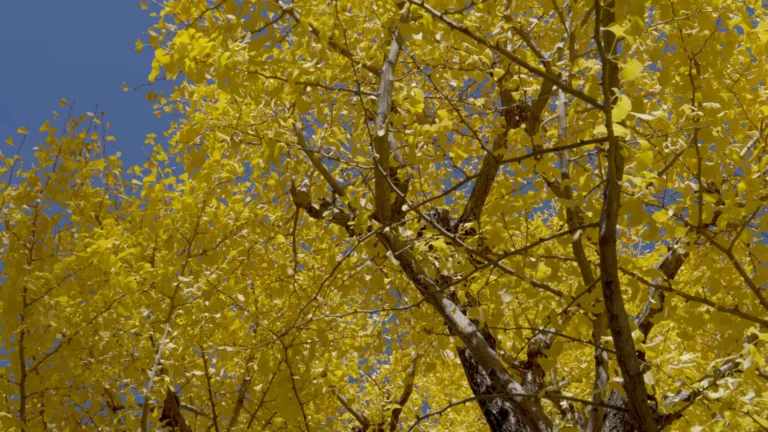

Tokyo · Meiji Jingu Gaien · Ginkgo avenue in autumn
The Meiji Jingu Gaien ginkgo avenue (Icho Namiki, いちょう並木) is a free public road in Tokyo’s Kita-Aoyama: about 300 metres of four ginkgo rows running north from Aoyama-dori toward the domed Meiji Memorial Picture Gallery. Tokyo, not Meiji Jingu Gaien, runs its evening light-up, and it had not announced 2026 dates when I checked on 3 October 2026; it announced the last two on 5 November 2024 and 7 November 2025. At the far end, the rubber-ball baseball grounds in front of the gallery have been under survey and demolition since 7 May 2026, and the ginkgo festival that several English pages still list last appears in its organiser’s listings for 2019.
This is the long version of one stop in my Tokyo autumn leaves guide, which weighs the avenue against the city gardens, Showa Kinen Park and Mount Takao. Here I stay on the avenue. Several different bodies decide what happens on and around it this autumn, each posts its decisions somewhere different, and some English pages still describe an earlier year.
What’s at the gallery end of the avenue in 2026
A works area, going by the notices. Meiji Jingu Gaien’s rubber-ball baseball grounds in front of the Meiji Memorial Picture Gallery (聖徳記念絵画館) have been under survey and demolition since 7 May 2026, and the gallery itself is closed for seismic reinforcement and conservation repair until the end of May 2027 (planned).
The middle column below is the status as I found it on 3 October 2026; the right-hand column says who decided it and where they posted it.
| At the gallery end | Status on 3 October 2026 | Who decides, and where it was posted |
|---|---|---|
| Rubber-ball baseball grounds (軟式球場) | Survey and demolition of the existing facilities since 7 May 2026. Hinomaru, Himalaya and Sakura fields closed on 6 May, Keyaki on 5 July; Oicho and Kobushi were still taking bookings for October 2026 | Meiji Jingu Gaien, notices of 28 May and 21 September 2026 |
| Meiji Memorial Picture Gallery | Closed from 1 April 2025 to the end of May 2027 (planned) for seismic reinforcement and conservation repair | Meiji Jingu Gaien, notice of 27 March 2025 |
| Gallery car park | 296 spaces instead of 396, from 17 March 2025 to the end of May 2027 (planned) | Meiji Jingu Gaien, parking notice of March 2025 |
| Temporary road closures during the works | None planned at present; any would be announced in advance | The four developers’ Q&A |
| Tokyo Christmas Market | Held at Gaien, in front of the gallery, in 2024. In 2026 it runs at Shin-Toyosu (20 November to 25 December) and Shiba Park (4 to 25 December) | The market’s organisers: archived 2024 site and news of 15 September 2026 |
| Area in front of the gallery | Existing buildings to be demolished from 2026; a plaza and outdoor tennis courts planned for 2038 onward | Project material for Shinjuku City’s landscape council, 12 February 2026 |
The baseball grounds are the newer change. Meiji Jingu Gaien’s notice of 28 May 2026 was published as an image, so its dates are absent from the page text; it said the survey and demolition would start on 7 May, and the booking notices of 21 September state in plain text that they did. The May notice doesn’t say where the grounds are. The developers’ Q&A places them in the area in front of the gallery, which it plans to turn from a facility used only by people playing baseball into a plaza anyone can enter.
The gallery closure is already in English. GO TOKYO’s spot page says it is “closed until May 31, 2027, due to construction”, leaving out the “planned” (予定) in Meiji Jingu Gaien’s Japanese notice. Meiji Jingu Gaien’s own English gallery page, read the same day, carries no closure notice at all: it still gives regular hours of “9 a.m. to 5 p.m. (last admission 4:30 p.m.)” and the note “Open year round (The gallery may be closed on certain days. Please inquire.)”. When I checked on 3 October 2026, its English site had no page on the ginkgo avenue.
On roads, the developers say no closures are planned for their works at present. Separately, they do plan to abolish the Minato City road that runs from the avenue to the rugby ground’s east gate, with the procedure due before work in that area starts, which they plan for 2028.
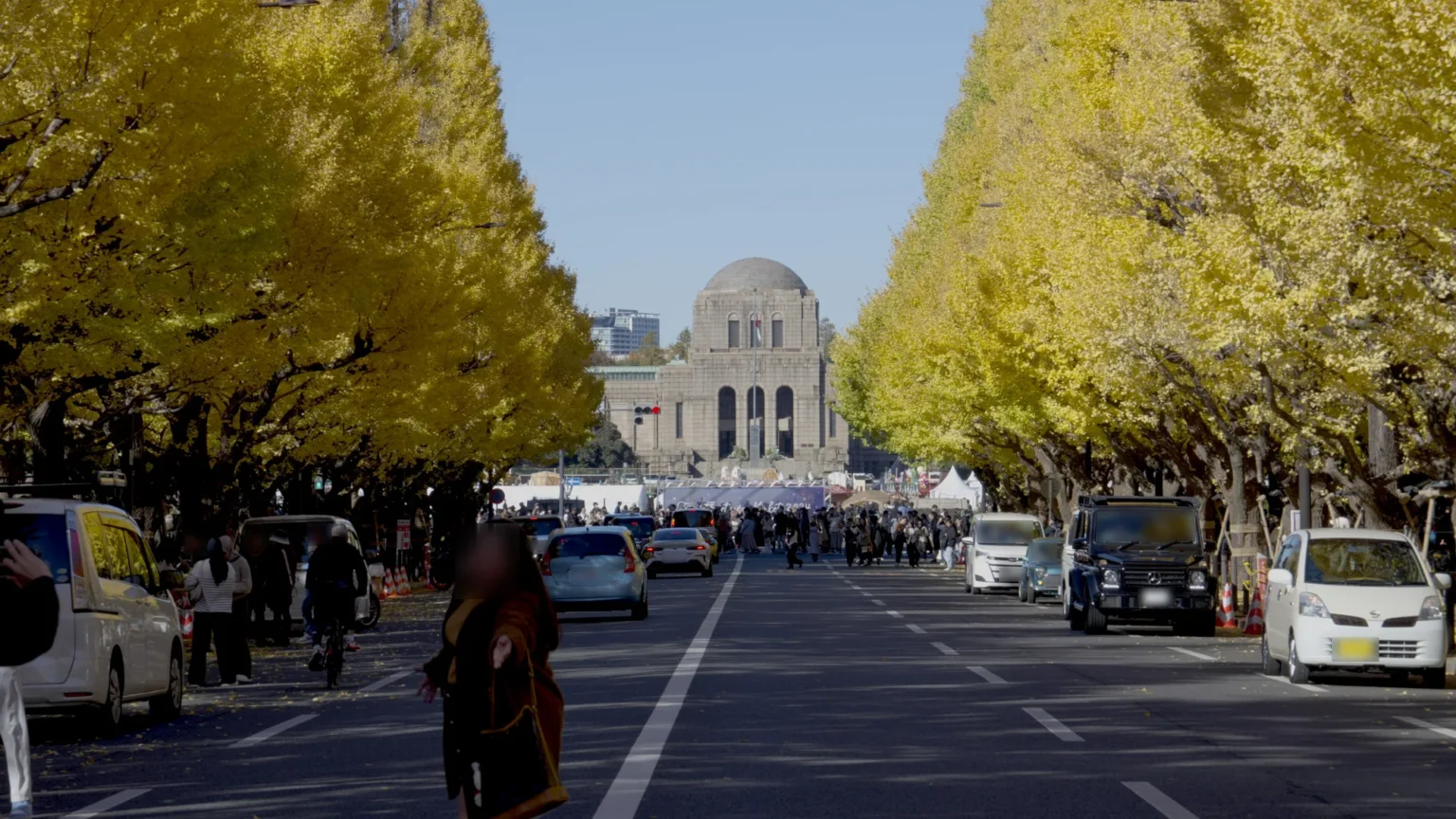
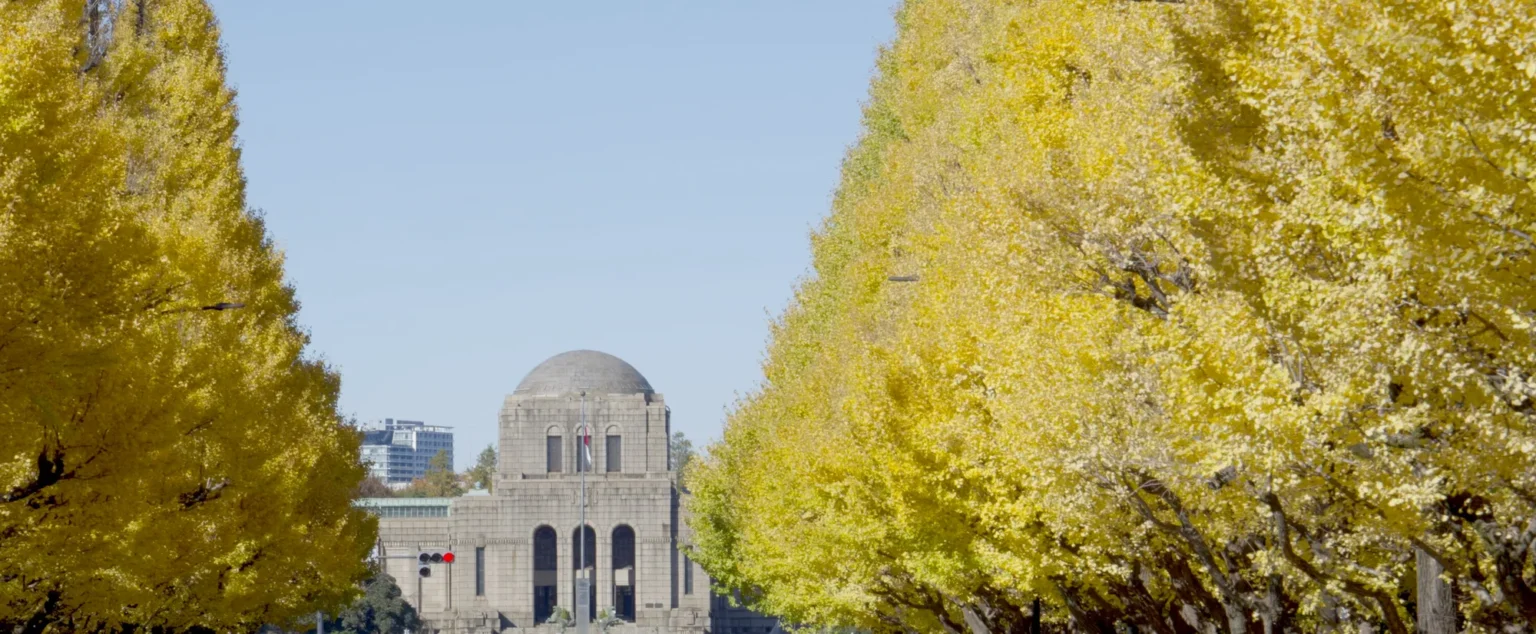
My footage of that end predates the 2026 works. I filmed it on a late-November day in an earlier autumn, and the avenue is working as a street. Vans, a small kei car and an SUV with its headlights on and someone at the wheel are parked along the kerbs, two more cars are in the lanes, facing the gallery, and orange-and-white cones run along both sides. A cyclist is riding in the left-hand kerb lane, people stand at the road’s edge, and a woman is posing for a photo in the traffic lane.
At the far end, white marquees and a dense crowd walking in the road fill the space in front of the gallery, under a banner over market stalls. The dome has no scaffolding on it, there’s a Japanese flag on the pole in front, and the traffic light is on red. I haven’t been back since the baseball-ground works began in May 2026, so I can’t tell you what that end looks like now.
Not confirmed by any official notice I found. Tokyo Cheapo says that, as of September 2026, construction fencing closes off the final stretch in front of the gallery. I found no fencing notice from the operator or the developers in the developers’ news list (to 11 September 2026), Meiji Jingu Gaien’s baseball-ground notices (to 2 October 2026) or the gallery’s notices. Which side is fenced, and whether the gallery’s front steps can be reached, needs someone on the spot, and I haven’t seen it.
Is there a ginkgo festival at Jingu Gaien this year?
Not as far as the official pages I checked show. The Jingu Gaien Ginkgo Festival (神宮外苑いちょう祭り) began in 1997, and the last edition its organising committee listed ran from 15 November to 1 December 2019, with 32 stalls and free entry at two venues, Gondawara and Niconico Park.
In October 2020 Meiji Jingu Gaien posted that the festival was cancelled because of COVID-19, that Tokyo’s light-up and the traffic regulation on the avenue were not planned that year, and that a small food and souvenir market, 絆の森 森の職人展, would open on the Gondawara plaza instead. I found no statement that the festival has ended. On 3 October 2026 Meiji Jingu Gaien’s event page still listed the 2019 festival as its newest, and the festival’s old website domain had lapsed into a parked page offering it for sale, so I don’t link it.
Several English pages still carry an earlier year’s festival, light-up or gallery details. On a phone, the middle column gives the primary record; swipe right for each page’s own wording.
| English page | What the primary record shows | What it says |
|---|---|---|
| Tokyo Cheapo, festival event page (2026 schedule) | meijijingugaien.jp/icyo/ is the 18th festival’s page, for 15 November to 8 December 2014 | Calls meijijingugaien.jp/icyo/ “an official Ichō Festival page” that “is already up” |
| Tokyo Cheapo, same page | Tokyo’s release: Saturday 22 to Sunday 30 November 2025 | The 2025 light-up ran “from November 23 to 30” |
| JapanTravel, “Jingu Gaien Ginkgo Festival 2026” | 2019 is the last edition its organiser listed | A body dated 20 November 2019, with that year’s 15 November to 1 December schedule |
| Time Out Tokyo, festival page dated 10 September 2019 | The festival’s old domain has lapsed: a parked page offering it for sale on 3 October 2026 | Links the festival’s old domain |
| Time Out Tokyo, light-up page dated 21 October 2025 | The dates in its text, 22 to 30 November, are 2025’s | Its event link goes to Tokyo’s 2024 release |
| Rakuten Travel guide | The same page says the festival was last held in 2019 | Food booths and craft stalls, in the present tense |
| ANA, information “as of March 2025” | The gallery has been closed since 1 April 2025 | The lighting is “annual”, with the gallery “in the background”; its website link returned a 404 on 3 October 2026 |
What the official record does show near the avenue is a crafts fair. The organiser of the 全国工芸職人展 (a national crafts fair, formerly the 森のやきものフェア) listed it at the Gondawara site, which it describes as next to the ginkgo avenue, for 17 November to 3 December 2023, 21 November to 8 December 2024 and 21 November to 7 December 2025, with Meiji Jingu Gaien cooperating. Its 2025 outline gave free entry and 10:00 to 17:00, going ahead in rain but called off in a storm. The 2026 dates were not posted on the organiser’s updates page when I checked on 3 October 2026. Earlier announcements went up on 12 October 2023, 16 October 2024 and 17 November 2025, four days before that year’s opening, so a late post wouldn’t be unusual.
Will the avenue be lit up, and when will Tokyo announce it?
Tokyo hasn’t said yet: it had not announced a 2026 light-up when I checked its press lists on 3 October 2026. In each of the last four years its release came out between 2 and 7 November, and each release set nine evenings starting on a Saturday.
The organiser is the Tokyo Metropolitan Government’s Bureau of Construction, not Meiji Jingu Gaien. Its releases describe lighting the ginkgo trees on the metropolitan road from Kita-Aoyama 1-chome to 2-chome, under Tokyo’s basic policy for lighting up public facilities (公共施設等のライトアップ基本方針).
| Year | Release date, then the evenings it set |
|---|---|
| 2022 | Released 4 November 26 November to 4 December |
| 2023 | Released 2 November 25 November to 3 December |
| 2024 | Released 5 November 23 November to 1 December (the 23rd was a holiday) |
| 2025 | Released 7 November 22 to 30 November |
All four releases gave 16:30 to about 19:30. Tokyo’s 2025 release also lists a contact office for traffic regulation during the period without saying what it involves, and japan-guide’s 2025 report captions a photo saying cars are not allowed to park along the road during the illumination time.
Status as of 3 October 2026 (the date I checked, not a page date). Tokyo’s press-release lists for September 2026, and for October up to 2 October, had no ginkgo light-up release. All four titles, 2022 to 2025, carried 神宮外苑イチョウ並木, so search Tokyo’s November press list for that phrase; last year’s release shows what it looks like.
After dark: the lit hours and the cold
Tokyo’s 2024 and 2025 releases gave 16:30 as the start, and the National Astronomical Observatory of Japan’s Tokyo tables put sunset within three minutes of that on every one of those evenings (16:28 to 16:31). An evening visit means standing outdoors from about sunset, and the lights were on for about three hours each evening. The rest of the time the avenue is a city road with its trees and no event hours to plan around.
For the evening cold, my notes on what to wear when standing at a night light-up in November cover the layer for standing still, plus hands, head and neck.
If you’d like heat packs waiting at your hotel when you arrive, a 20-pack of stick-on heat packs on Amazon Japan can be sent there, as long as the front desk agrees to hold a parcel for you (how hotel delivery works). The listing says to stick them on clothing, not directly on skin.
As an Amazon Associate I earn from qualifying purchases.
When the avenue turns gold
japan-guide’s correspondent found the avenue at peak colour on 19 November 2025, in that site’s first Tokyo report of the season, so the peak may have begun earlier. A Mainichi photo taken on 28 November 2024 is captioned as the trees at their peak. Each is one observation on one day, not a range.
My live koyo tracker lists the usual window for the Gaien avenue. A row there switches to a dated forecast or a field report only when I add one, so check which kind you’re reading.
Open the koyo tracker“If strong winds blow, it will be over in a flash.” A representative of the area’s management office, quoted by the Mainichi in late November 2024.
When the forecasts you find disagree, who actually forecasts Japan’s autumn colours is my explainer on where they come from. A thin stretch in an otherwise gold row isn’t necessarily the weather either: the developers report that since November 2019 some of the avenue’s trees have dropped their leaves earlier than others (more below).
How the four rows work, and where to stand
Stand at the Aoyama-dori end and look north. Meiji Jingu Gaien says the trees were planted in order of height going down a slope from that end, with the ground about 1 m lower toward the gallery: a perspective device, in its words, for viewing the gallery.
The redevelopment developers’ English Q&A says who owns which row. The inner two rows are owned and managed by the Tokyo Metropolitan Government and the outer two by Meiji Jingu, while the 18 ginkgos on the Minato City road to the rugby ground belong to Minato City. Meiji Jingu Gaien counts 146 trees planted 9 m apart, and its count includes the two rows that turn west partway along toward Chichibunomiya Rugby Ground. Minato City’s shorter description, four rows of 146, leaves that branch out.
Every four years, between January and March while the trees are bare, they’re shaped back into a cone (円錐三角). Ginkgo was picked, Meiji Jingu Gaien says, for its plentiful greenery, its dignified form and its resistance to pollution. A survey commissioned for the redevelopment measured all 146 trees in October 2023: average heights by section ran from about 25 m to 31 m, and the tallest was 34.0 m.
Meiji Jingu Gaien’s own page suggests the view from the top of the gallery’s front steps. With the building closed for repairs until the end of May 2027 (planned), I couldn’t confirm the steps are open, so this guide works from the Aoyama end.
Where to stand. Start on Aoyama-dori and frame the shot looking north up the rows, the way the planting was laid out to be seen. It’s an open road, and in my footage a woman is posing for a photo out in the traffic lane, so step back to the kerb before you raise the camera.
Getting there: Gaienmae or Aoyama-itchome, and which exit
Take the Tokyo Metro to Gaienmae or Aoyama-itchome; both are on Aoyama-dori at the avenue’s southern end. JR Shinanomachi and Sendagaya, on the Chuo-Sobu Line, and Toei Oedo Line Kokuritsu-Kyogijo are on the north side, toward the gallery.
From Shibuya, the Ginza Line reaches Gaienmae in two stops via Omote-sando: board toward Asakusa and get off at Gaienmae (G03). Aoyama-itchome (G04) is the next stop.
The middle column has the exit and its lift; the right-hand column, what has changed around it for autumn 2026.
| Station | Exit and lift | Autumn 2026 note |
|---|---|---|
| Gaienmae, Ginza Line (G03) | Ginkgo-avenue gate (外苑いちょう並木方面改札): a lift links the Asakusa end of the platforms with it, and another runs from the gate to exit 4. Exit 4a has a street-level lift (Tokyo Metro exit list, revised August 2023) | Exit 4a’s listed landmark is the Itochu building, due for demolition from September 2026 (plan). On 3 October 2026 Tokyo Metro still listed 4a with its lift; neither Tokyo Metro nor the demolition briefing says whether it stays open during the works |
| Aoyama-itchome, Ginza (G04), Hanzomon and Toei Oedo lines | Exit 1 has a street-level lift (landmark: Honda Aoyama Building); JNTO calls it the closest exit to the avenue | Honda moved its head-office functions out in May 2025 and plans to rebuild the building; its announcement of 29 August 2025 doesn’t say whether exit 1 is affected |
| JR Shinanomachi and Sendagaya; Toei Oedo Kokuritsu-Kyogijo | North side, toward the gallery | Meiji Jingu Gaien’s site map predates the 2026 works, so I can’t say which paths round the area in front of the gallery are open |
Itochu planned to start demolishing its former Tokyo head office, beside Gaienmae Station on Aoyama-dori, in September 2026, for about 30 months behind a 3 m hoarding, according to its briefing of 7 August 2026. I haven’t confirmed the work has begun. The developers’ Q&A, checked on 3 October 2026, also says the timing of works on the planned underground passage from Gaienmae Station hasn’t been decided.
No walking minutes here. English guides give walking times from the two stations that disagree with each other, even on which station is nearer, so I’ve left minutes out.
Where to stay for an early walk or a return at dusk
A base near Shibuya or Omote-sando keeps the avenue one or two Ginza Line stops away. These are area searches, not hotel picks.
Sleeping a short ride from the avenue
A Shibuya base suits an early walk on the avenue or a return at dusk. Compare the total with taxes and the cancellation terms before you book. Affiliate links · HJG may earn a commission at no extra cost to you.
Is the redevelopment cutting down the ginkgo trees?
Not the four rows, according to the developers: their plan says the four rows of ginkgo will be preserved without felling. Elsewhere in the plan area, 619 tall trees are to be felled, and the developers report that some of the avenue’s trees have shed their leaves early since November 2019, which they say the plan did not cause.
The Jingu Gaien redevelopment is led by four developers: Mitsui Fudosan, Meiji Jingu, the Japan Sport Council and Itochu. Demolition began in March 2023 with Jingu No. 2 Stadium. The new Chichibunomiya Rugby Stadium has been under construction since 3 February 2026, with opening planned for 2030; a new ballpark with a hotel is planned for 2033, and overall completion for 2038. Every line in the table is the developers’ own statement or document, and the right-hand column says which.
| What the developers say | Where and when |
|---|---|
| The four rows of ginkgo will be preserved without felling (4列のいちょう並木は伐採せずに保全します) | Plan page, read 3 October 2026 |
| Across the whole plan area, 619 tall trees will be felled; the number of trees goes from 1,904 to 2,304 | Japanese Q&A and plan page |
| The new ballpark’s basement will sit about 18.3 m back from the avenue’s kerb, up from about 8 m in the original plan: a policy set in September 2024, to go into a later change to the business plan | Q&A, Japanese and English |
| Since November 2019 some of the ginkgos have shed their leaves earlier than others; the developers state this is not caused by the plan | Green page |
| In October 2025, five trees in the westernmost row were graded C, “considerably deteriorated” on the survey’s four-step scale; across the four rows, 88 of 128 trees were graded A, up from 75 a year earlier | Survey report filed with the Tokyo government, March 2026 |
| A third round of soil loosening and an irrigation check ran from 13 to 17 April 2026 | Notice of 20 April 2026 |
| 19 ginkgos east of the rugby ground, 18 on the Minato City road and 1 on Meiji Jingu land, are being studied for transplanting; a survey of the remaining 17 was scheduled from February 2026. They are not part of the four rows | Notice of 29 January 2026 |
The developers also say the five graded trees are doing better than in 2023 and 2024; their survey notes record less early leaf drop than in October 2024, and they suggest the recovery work is part of the reason. Earlier measures on their green page include clearing ivy and undergrowth, loosening the soil with water pressure, laying rice-straw mulch, automatic irrigation, removing the paved base of an old path, and raised wooden decking on the shop terraces along the avenue; eight trees have carried dendrometers since April 2024. They say visits to the transplant survey work without their permission won’t be accommodated.
Tickets, food and practical notes
Walking the avenue is free; it’s a public road.
Gaien is not the shrine
Meiji Jingu Gaien (外苑, the “outer garden”) belongs to Meiji Jingu and was dedicated to it in October 1926, but the shrine itself is in Yoyogi, Shibuya, entered from its Harajuku, Yoyogi and Sangubashi gates. The avenue is in Kita-Aoyama, Minato City.
Food
Don’t plan around festival stalls. Shake Shack’s first store in Japan, Gaien Icho Namiki, is on the avenue near the Aoyama-dori end; its page listed 11:00 to last order 20:30 on 3 October 2026, so check before you go.
Toilets
Minato City’s public-toilet list, dated 1 April 2026, has one at the Gondawara crossing: about 440 m, or roughly six minutes on foot, from the avenue’s gallery-end junction by a map router’s estimate.
Fallen seeds
japan-guide’s correspondent noted the smell of fallen ginkgo fruit around the trees on 19 November 2025. NC State Extension says the seed flesh smells foul and the plant can cause contact dermatitis, so don’t pick the seeds up bare-handed.
Worth the detour with the gallery closed: the trees’ history and a half-day in Aoyama
Yes, if you come for the trees. The gallery is the backdrop, but the rows are what you walk through, and they go back further than the building.
Meiji Jingu Gaien says the seeds were collected in 1908 from ginkgos already growing in Shinjuku Gyoen and sown in a nursery on the imperial estate that is now inside Meiji Jingu, and that the trees finally planted were picked from 1,600 nursery trees about 6 m tall. The landscaping was by Dr Orishimo Yoshinobu (折下吉延), chief engineer when the Gaien was built, and Minato City dates the avenue’s completion to 1923.
The gallery has a separate date. Meiji Jingu Gaien gives its completion as 22 October 1926, the day the Outer Garden was completed and dedicated, and the gallery building is a national Important Cultural Property. Some English pages get these dates wrong: japan-trails gives 1926 for the avenue itself, and Meiji Jingu Gaien’s own English gallery page says “October 22nd, 1925”, where its Japanese page says 1926.
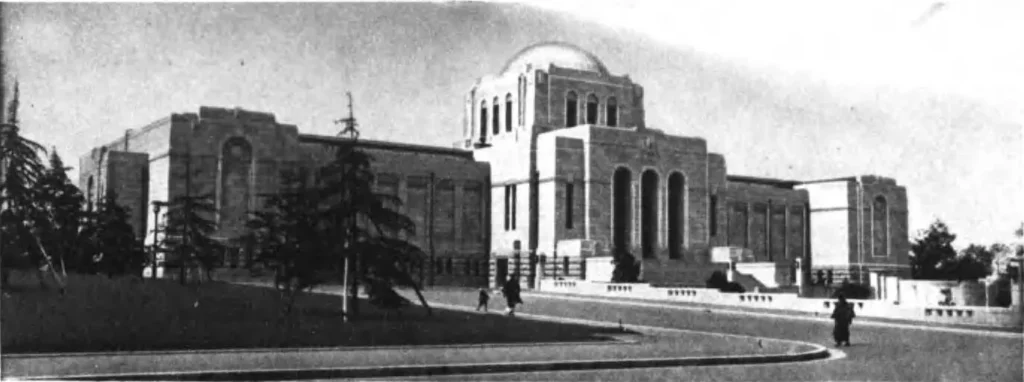
For a half-day in Aoyama, the avenue pairs with a coffee and a garden to the south-west. The walking times below are a map router’s estimates, and the hours are as listed on 3 October 2026.
1. The ginkgo avenue
Start at the Aoyama-dori end, from Gaienmae or Aoyama-itchome.
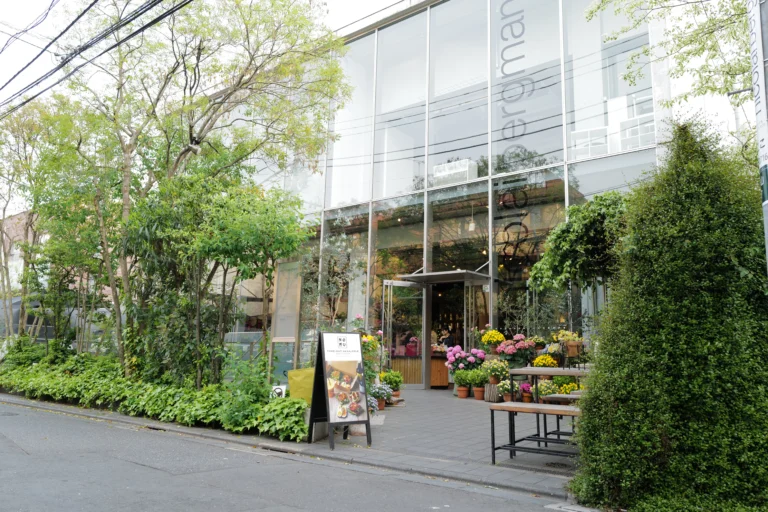
2. Nicolai Bergmann NOMU, for coffee
Nicolai Bergmann NOMU, Minami-Aoyama: about 1.6 km, roughly 21 minutes on foot from the Aoyama-dori end; 10:00 to 19:00 (last order 18:30), irregular closing days.
3. Nezu Museum garden
About 630 m, roughly 8 minutes on foot from NOMU; 10:00 to 17:00 (entry until 16:30); closed Mondays (the Tuesday instead when Monday is a holiday) and between exhibitions. Its autumn exhibition ends on 23 November 2026 and the next opens on 5 December, so check the museum’s calendar before pairing it with a late-November walk. The garden is seen as part of a museum visit; more in museum gardens near Tokyo.
Other ginkgo. For Tokyo autumn ginkgo trees beyond this one avenue, Showa Kinen Park’s long ginkgo rows and the city gardens are in my Tokyo autumn leaves guide. At Kamakura’s Tsurugaoka Hachimangu, the shrine says strong winds brought down its great ginkgo before dawn on 10 March 2010, and shoots from it are now growing beside the transplanted trunk. For the rest of the month, see Japan in November.
Meiji Jingu Gaien ginkgo avenue FAQ
Is the Meiji Jingu Gaien ginkgo avenue free to visit?
Yes. Walking it is free: it’s a Tokyo metropolitan road, open like any other city street. The gallery at the far end is closed for repair until the end of May 2027 (planned).
Is Jingu Gaien the same place as Meiji Jingu shrine?
No. Gaien is Meiji Jingu’s outer garden, dedicated to the shrine in October 1926, while the shrine itself is in Yoyogi, Shibuya, entered from the Harajuku, Yoyogi and Sangubashi gates. The ginkgo avenue is in Kita-Aoyama, Minato City.
Is there a Jingu Gaien ginkgo festival in 2026?
Not on the official pages I checked on 3 October 2026: Meiji Jingu Gaien’s event page still listed the 2019 festival as its newest. The Jingu Gaien Ginkgo Festival was last listed by its organiser for 15 November to 1 December 2019. A crafts fair, the 全国工芸職人展, was listed by its organiser at a site it calls next to the avenue for 2023 to 2025; its 2026 dates had not been posted.
Will the Gaien ginkgo trees be lit up in 2026?
Tokyo hadn’t announced it when I checked on 3 October 2026. From 2022 to 2025 the Tokyo Metropolitan Government announced the light-up between 2 and 7 November, and each release set nine evenings, 16:30 to about 19:30; in 2025 it was 22 to 30 November.
Can I go inside the Meiji Memorial Picture Gallery this autumn?
No. Meiji Jingu Gaien’s notice of 27 March 2025 closes it from 1 April 2025 to the end of May 2027 (planned) for seismic reinforcement and conservation repair.
Are the Gaien ginkgo trees being cut down for the redevelopment?
The developers say the four rows will be preserved without felling. Their Q&A puts the number of tall trees to be felled across the plan area at 619, and 19 ginkgos east of the rugby ground, which are not part of the four rows, are being studied for transplanting.
Which station exits lead to the ginkgo avenue?
At Aoyama-itchome, JNTO points to exit 1, which has a street-level lift, as the closest to the avenue. Gaienmae on the Ginza Line has a gate named for the ginkgo avenue; on 3 October 2026 Tokyo Metro still listed a street-level lift at its exit 4a, beside the former Itochu head office due for demolition, and nothing I read says whether 4a stays open during the works.
Before you go, check Tokyo’s November press list for 神宮外苑イチョウ並木: in each of the last four years the light-up release appeared there between 2 and 7 November. For the gallery end, Meiji Jingu Gaien’s latest notices are the place to look.
Sources
The primary sources behind every figure above, checked on 3 October 2026
- Light-up: Tokyo Metropolitan Government press releases of 7 November 2025, 5 November 2024, 2 November 2023 and 4 November 2022; press lists for September 2026 and October 2026
- Sunset: National Astronomical Observatory of Japan, Tokyo, November 2024, December 2024 and November 2025
- Meiji Jingu Gaien: ginkgo avenue page (count, spacing, slope, pruning, front-steps view, history); site map; access; gallery notices of 27 March 2025 and 18 April 2025; the Japanese and English gallery pages; baseball-ground notices of 28 May 2026 and 21 September 2026; car park notice; 2020 festival notice; event page; history
- Festival in 2019: the organising committee’s site, archived
- Redevelopment developers (Mitsui Fudosan, Meiji Jingu, Japan Sport Council, Itochu): plan; Q&A in Japanese and English; green page; notices of 29 January 2026 (PDF) and 20 April 2026 (PDF); 2025 vitality survey report (PDF); 2023 tree survey report (PDF); Itochu demolition briefing, 7 August 2026 (PDF)
- Rugby stadium construction start, 12 February 2026; project material for Shinjuku City’s landscape council, 12 February 2026 (PDF)
- Minato City: history of the avenue; public toilet list (CSV). Agency for Cultural Affairs: gallery record
- Crafts fair: organiser’s updates and 2025 outline. Tokyo Christmas Market: 2026 venues and archived 2024 page
- Tokyo Metro: Gaienmae and its accessibility page; Aoyama-itchome; Ginza Line stations. JNTO: ginkgo avenue page. GO TOKYO: Meiji Jingu Gaien
- Honda, 29 August 2025; Shake Shack Gaien Icho Namiki; Nezu Museum visitor information and exhibition schedule; NOMU; NC State Extension, Ginkgo biloba; Tsurugaoka Hachimangu precinct page
Join travelers discovering Japan's hidden side
Weekly dispatches from off-the-beaten-path Japan — spots and stories you won't find in guidebooks.
No spam. Unsubscribe anytime.
Welcome aboard!
You're in. See you in your inbox soon.