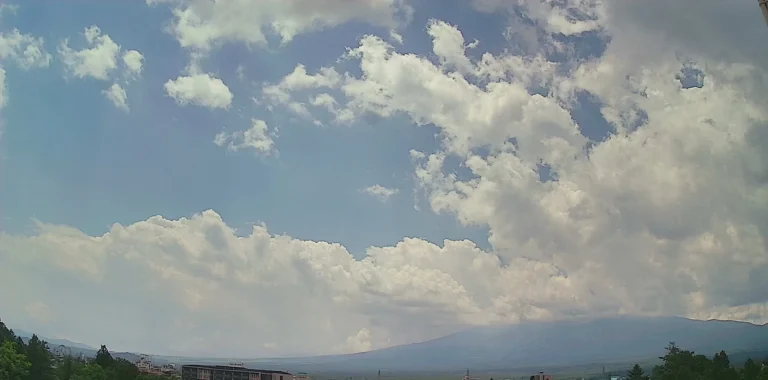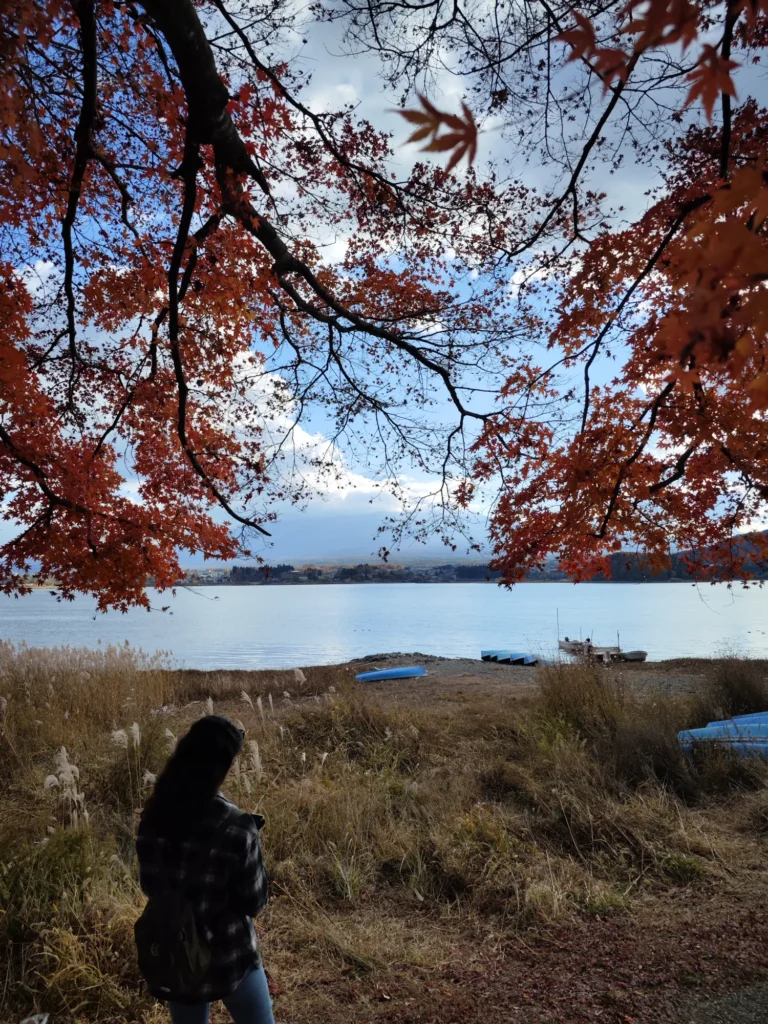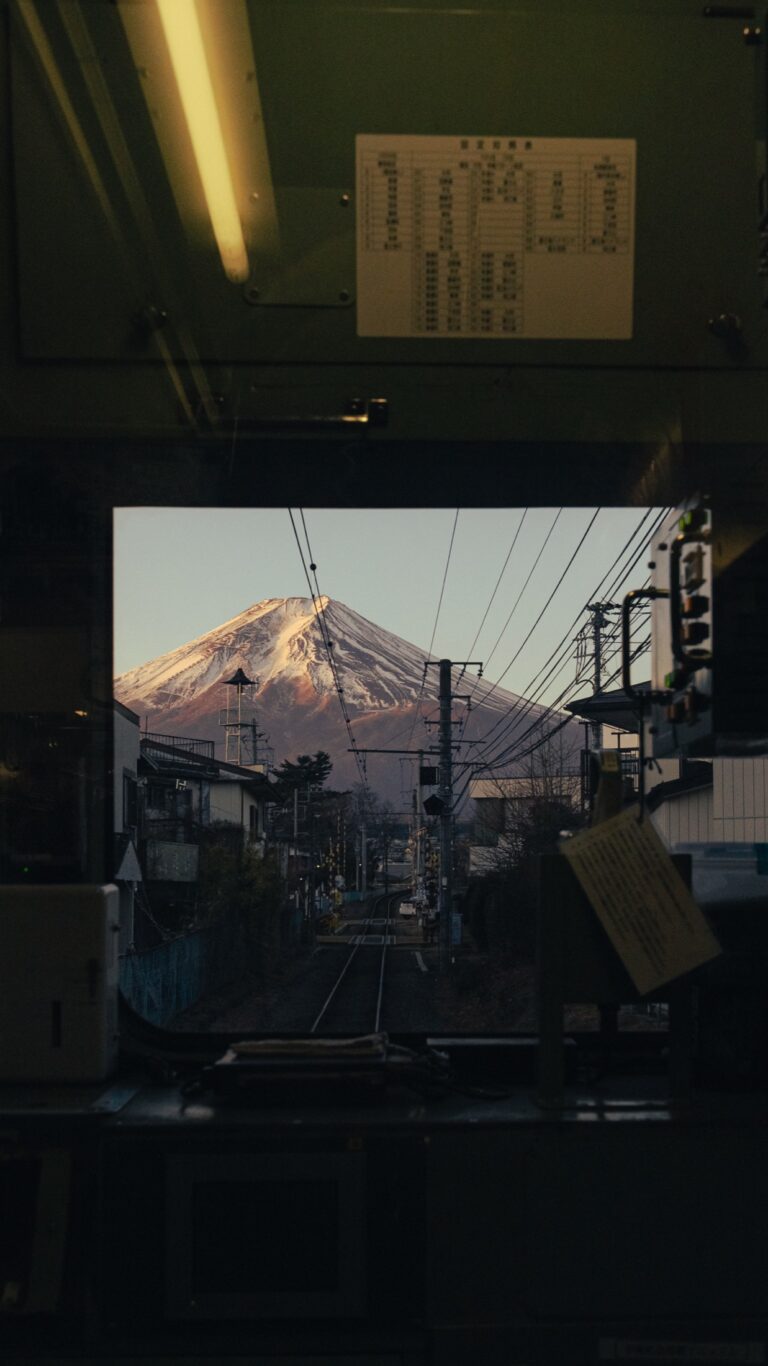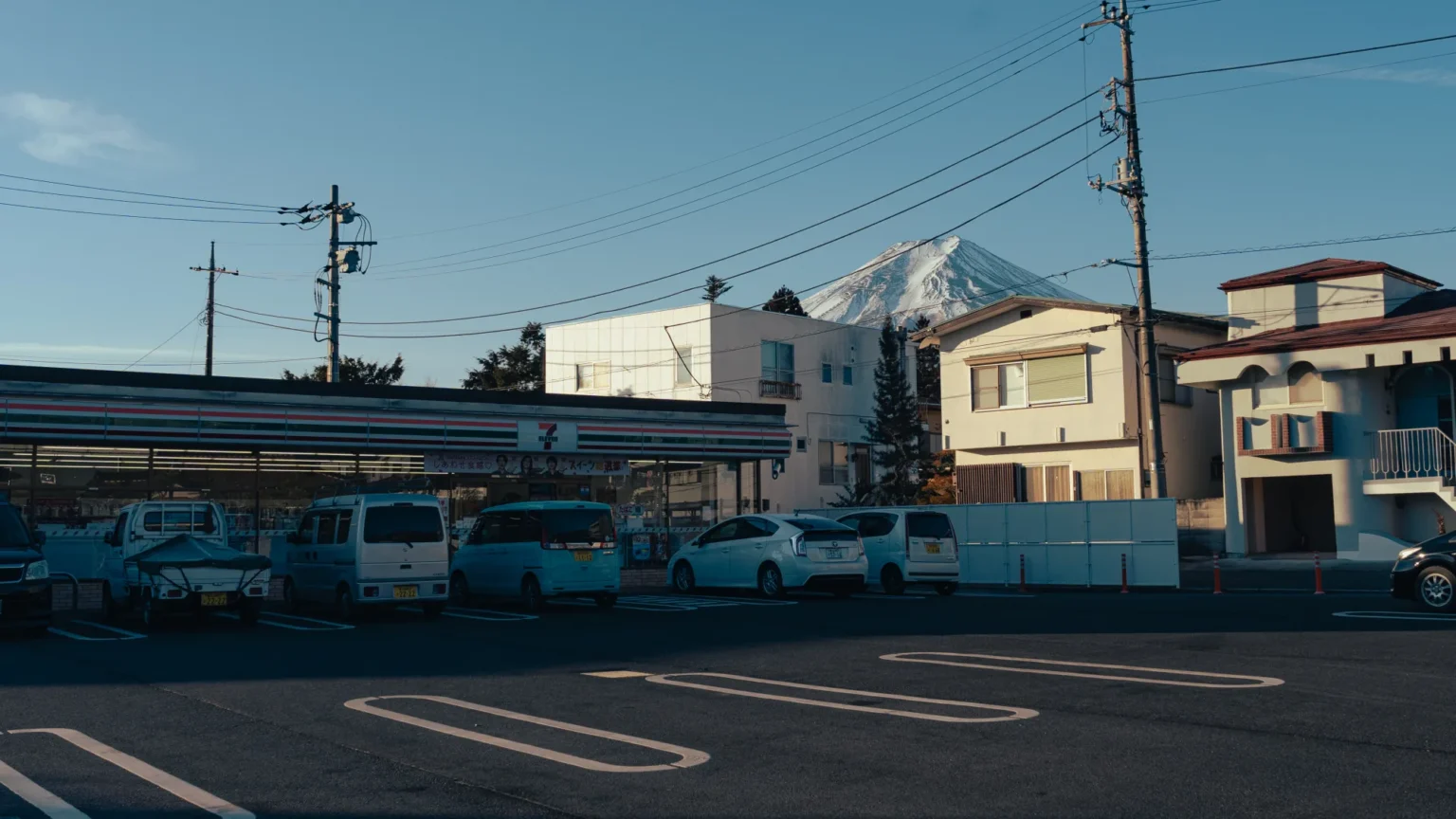

If you are trying to work out whether it is worth heading to Kawaguchiko tomorrow, the useful question is not just “will it rain near Mt Fuji” — it is “will I actually be able to see the mountain, and how should I dress.” Those are two different things, and a clear forecast does not always mean a clear Fuji. I live in Fujiyoshida, on the north side of the mountain, and I check Fuji by eye most mornings. This page pairs the local forecast with what the mountain actually looks like, so you can plan the day instead of guessing.
Forecast data tells you the weather. My eyes-on check — usually first thing in the morning, updated if the mountain changes through the day — tells you what Mt Fuji actually looked like from the north side in Fujiyoshida, though other sides of the mountain may differ. This page connects both: today’s conditions, the outlook for the days ahead, what to wear at each elevation, and what the weather means for your chance of seeing the summit.
Written and verified by Nobu, a long-time Fujiyoshida resident — hiddenjapan-gems.comOn this page
Mt Fuji weather at a glance
Mt Fuji has three very different weathers stacked on top of each other: mild base towns, a cold and windy 5th Station, and a summit that stays near or below freezing even in summer. Here is the quick version before the detail.
| Elevation | Typical summer | Typical winter | What it means for you |
|---|---|---|---|
| Base — Kawaguchiko / nearby Fujiyoshida (about 650–900 m) | Mild and humid; monthly mean about 18–23 °C, with warmer afternoons and frequent cloud | Cold mornings, often below freezing; some snow | Comfortable sightseeing, but haze and cloud can hide Fuji |
| 5th Station (Fuji Subaru Line / Yoshida side, about 2,300 m) | Cool to cold — roughly 9–14 °C, wind and fog common (estimate) | Road usually closed; sub-freezing | Bring a jacket even in August; it is not “Tokyo weather” |
| Summit (3,776 m) | Near freezing; August mean about 6.4 °C, dawn near 0 °C | Deep cold, roughly −15 to −18 °C, strong wind | A climbing-safety topic, not a sightseeing one |
Summit and base temperature figures are JMA 1991–2020 normals, using the Kawaguchiko station as the nearest official reference for the lake-town side; nearby Fujiyoshida is similar but not identical. Summit wind and fog figures are JMA reference values, based mostly on 1991–2004 data. The 5th Station range is an estimate from the official lapse rate of about 0.6 °C per 100 m, not a 30-year normal.
Mt Fuji weather today: local forecast and my morning view
The most useful comparison I can give you is what the mountain looked like from Fujiyoshida today, set next to the forecast — not a webcam still, but a person on the north side looking south toward Fuji. Once I have checked for the day, the card below shows that in-person check — usually first thing in the morning, sometimes updated later in the day. Until then, the card says so and labels any forecast it shows as a forecast, and days I miss are marked rather than hidden; the weather forecast sits separately so you can compare the two.
Mt. Fuji was only partly visible in Nobu's last verified check from Fujiyoshida on October 1, 2026 at 17:16 JST. Today's fresh check is pending.
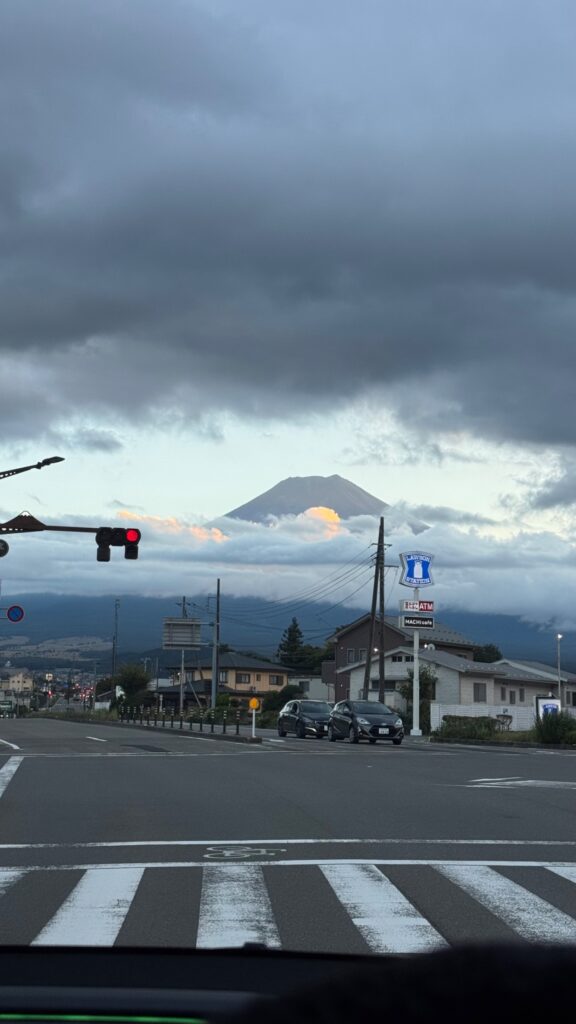
- Best viewpoint at that checkFujiyoshida
Updated each morning from Fujiyoshida by Nobu, a long-time resident. See how this compares to algorithmic forecasts ↓
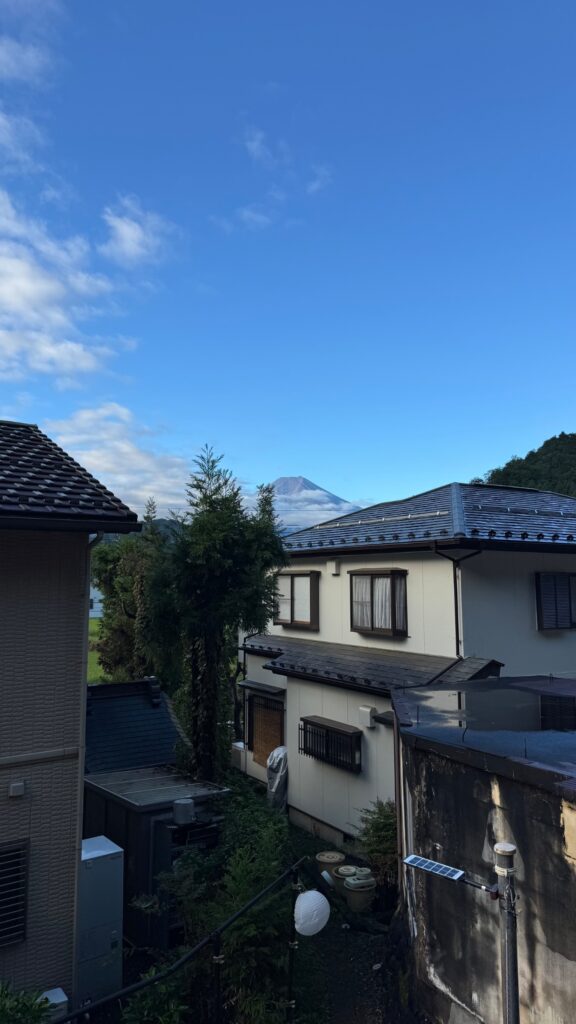
What this means for your plan today
If the note above says hidden, I would not spend the whole day chasing the same view — pick a plan that still works without Fuji and step outside again if the cloud lifts. If it says partly visible, stay nearby and re-check the timeline before committing to a distant viewpoint, unless the cloud is clearly lifting. If it says clear or mostly visible, go early: around Kawaguchiko and Fujiyoshida, mornings tend to beat afternoons before cloud builds. If you want sharp photos of a clear morning, a small travel tripod is the one piece of gear most day-trippers wish they had brought.
Some links are affiliate links — if you book or buy through them it supports this site at no extra cost. Always check cancellation terms before booking; no tour or hotel can guarantee clear weather.
For the deeper logic behind the call — cloud types, haze, time of day and viewpoint-by-viewpoint judgement — read my full Mt Fuji visibility guide, which is where I keep the observation archive and the forecast-vs-reality record.
Fuji Visibility Alert
Don’t miss a clear Mt. Fuji morning.
I check Mt. Fuji from Fujiyoshida and compare it with the JMA forecast. When a clear viewing window looks likely, I'll send you a short email so you can adjust your plans in time.
Mt Fuji weather tomorrow and the 7-day forecast
For planning, the most useful forecast is not tomorrow’s temperature but the best viewing window this week — the difference between morning clarity and afternoon cloud build-up. The snapshot below reads the JMA data for the Fuji Five Lakes area over the next few days; for the full 7-day weather forecast I use JMA and tenki.jp, both linked under trusted sources. Give extra weight to the morning windows, and still check whether the afternoon is set to improve or deteriorate.
Is Fuji Visible This Week?
Algorithmic forecast — Japan Meteorological Agency (気象庁) data for 富士五湖エリア
Today's algorithmic call
Oct 2 · 富士五湖エリア
Poor visibility chance
くもり 所により 朝 から 雨
Precip prob (rest of today, max): 30%
Next days
JMA forecast — algorithmic only, not human-verified
Tomorrow, Sun: from JMA's weekly forecast (published Oct 1, 17:00 JST), which covers Yamanashi Prefecture as a whole, not the Fuji Five Lakes area alone.
Source: Japan Meteorological Agency · Yamanashi forecast · published Oct 1, 17:00 JST · visibility score derived from JMA weather code + precip probability. For the latest verified photo check, see the status section on this page.
A few habits that help when you read any Fuji forecast:
- Weight the mornings. On the base side, a fine morning often clouds over by early afternoon in the warmer months, so a “sunny” day can still hide the summit by 2 p.m.
- Watch the day after rain. The morning after a rain system clears, or after wind has scoured the cloud away, Fuji can suddenly open up — some of my best mornings follow bad evenings.
- A city forecast is not a summit forecast. The lake-town snapshot above does not describe conditions on the mountain itself. Summit wind, temperature and lightning need a mountain-specific source (listed further down).
If the week looks uncertainIf the forecast keeps flip-flopping, avoid locking yourself into a non-refundable, view-dependent plan. A day tour with free-cancellation options can make sense when you want the transport arranged but still need room to move the day — check the specific terms, and don’t treat it as a weather guarantee.
Will Mt Fuji be visible? What the weather actually means for views
Sunny weather does not guarantee a view of Mt Fuji: local cloud bands, haze and a cloud cap around the summit can hide the mountain even when the sky over town looks bright. The short version is below; the full “how to judge it” logic lives on the visibility guide so this page stays about the weather.
- Clear sky over town ≠ clear Fuji. The mountain makes its own weather. A band of cloud can sit on the middle slopes or cap the summit while it is genuinely sunny where you are standing.
- Humidity and haze are the summer enemy. In the warm, damp months the air holds more water vapour, so even on a rain-free day Fuji can fade into a white haze — clear to the eye locally, but not “photo clear.”
- Mornings win more often than afternoons. The ground heats through the day and builds convective cloud, so the early window is usually your best odds on the base side.
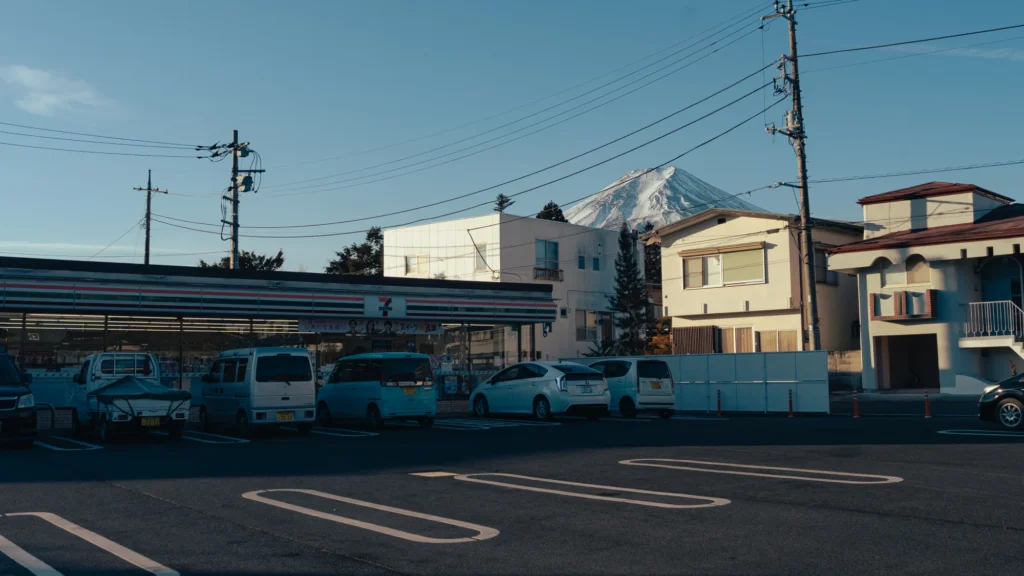
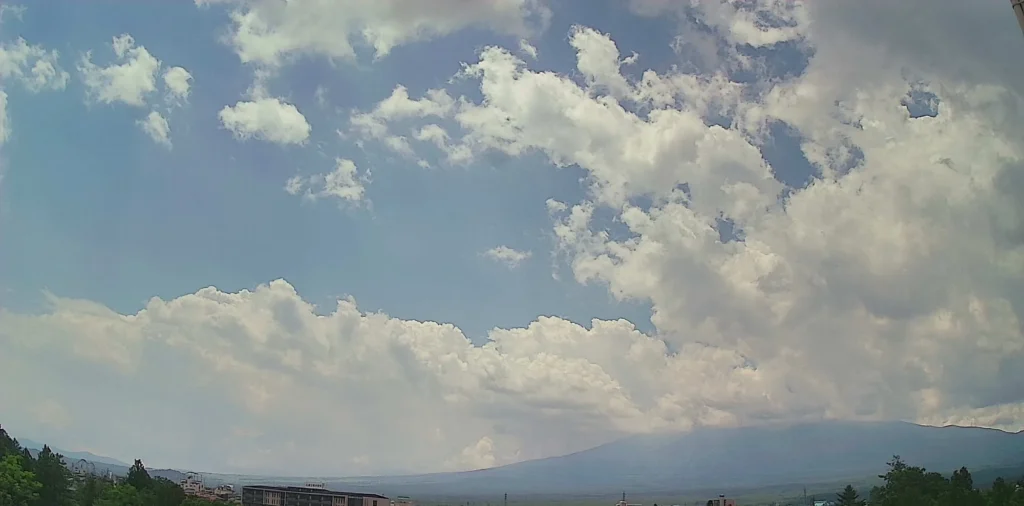
Clear sky over town is not the same thing as clear Fuji.
For the complete decision method — cloud types, the role of wind direction, time of day and which viewpoints hold up on a marginal day — see how to tell if Mt Fuji will be visible today. If you are visiting in one specific month, I also keep a worked example in how often Fuji is actually visible in August.
Mt Fuji weather by season: the best months for a clear view
If a clear view matters more than warm weather, the cold, dry months from late autumn to early spring give you the best odds, and the humid months from June to August give you the worst — especially after late morning. Here is how each season actually behaves — and if you are choosing travel dates around the view itself, the month-by-month visibility guide ranks the odds.
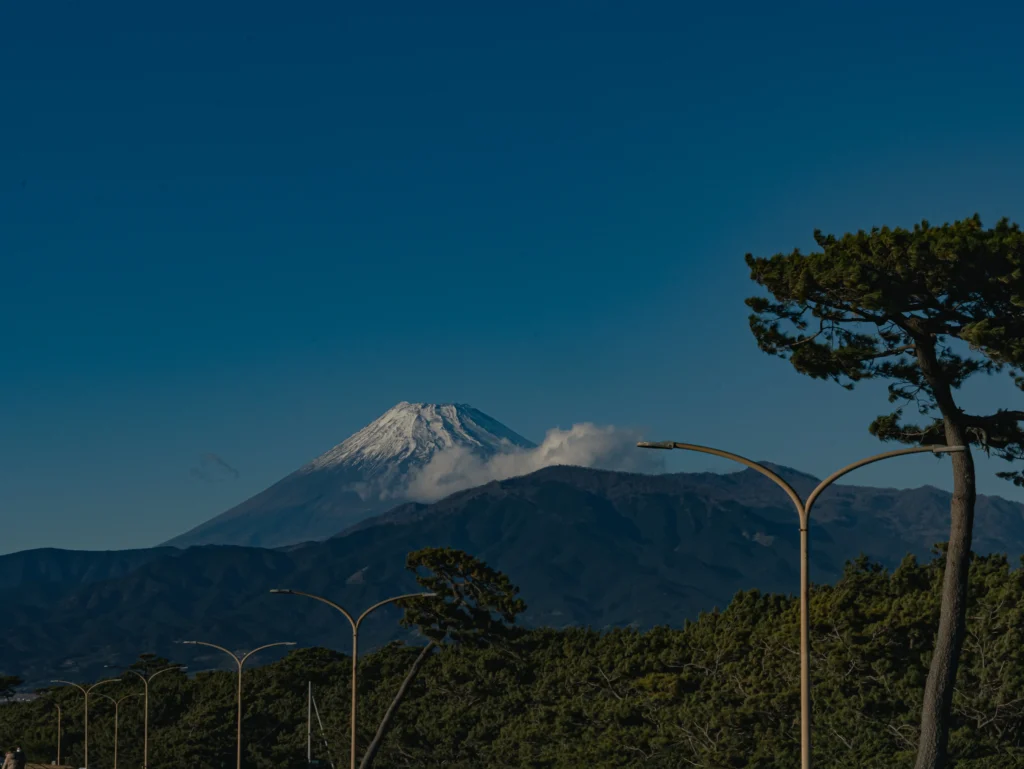
Winter (December–February): coldest, but usually clearest
Winter is the paradox that surprises most visitors: the harder it is to be outside, the easier it is to see Fuji. The Japan Meteorological Agency explains it simply — winter air is colder with weaker convection, so it holds less water vapour and dust and the sky is more transparent. Expect cold mornings at the base, often below freezing (Kawaguchiko’s winter normals run roughly −0.4 to 2.3 °C, with lows down near −5 °C and occasional snow), but the sharpest outlines of the year. It is also prime Diamond Fuji season from certain viewpoints, when the sun lines up with the summit on specific dates.
Spring (March–May): changeable, and often hazy
Spring warms up quickly but brings unsettled systems and spring haze, which can leave the mountain looking washed-out and pale in photos even when it is technically visible. Mornings still beat afternoons. Cherry-blossom-and-Fuji shots can be excellent when conditions line up, but they depend on a clear, low-haze morning — keep the plan flexible.
Summer (June–August): the hardest season to see it
This is the counter-intuitive one, and it catches out a lot of summer visitors. Kawaguchiko’s summer humidity sits around 80–81%, and the summit records roughly 20 foggy days a month from June to September, so the mountain is often wrapped in its own cloud by mid-morning. Ironically, this is also climbing season — you can be standing on Fuji while day-trippers below never see it. If you are travelling in summer, read how often Fuji is visible in August before you set expectations. The full summer numbers — 80 photographed mornings, month by month — are in my Mt Fuji summer visibility data report. before you set expectations.
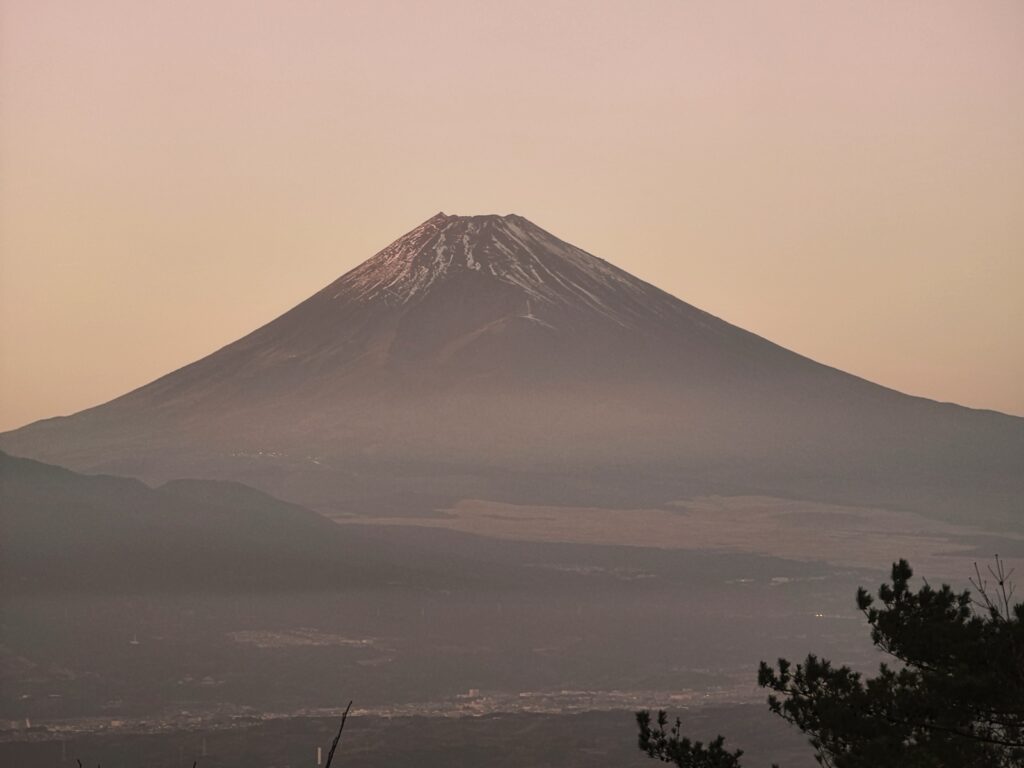
Autumn (September–November): recovering, and improving fast
September is still wet on the base side (Kawaguchiko’s September precipitation normal is 264.7 mm), but as the air dries into late October and November the odds climb back toward winter levels. Late autumn mornings are a genuinely good, and much less cold, window.
| Month (2025 record, 8 a.m.) | Days Fuji was fully or partly visible | Season verdict |
|---|---|---|
| January | 28 of 31 | Best odds |
| February | 26 of 28 | Best odds |
| June | 11 of 30 | Hardest |
| July | 9 of 31 | Hardest |
| August | 11 of 31 | Hardest |
| November | 28 of 30 | Best odds |
| December | 26 of 31 | Best odds |
Visibility counts above are from Fuji City’s official 2025 morning record, observed from the south side. I observe from the north side in Fujiyoshida, so my day-to-day calls can differ; the broad seasonal pattern is a useful reference, but local cloud can make the two sides disagree. Fuji City also found the mountain fully visible on 37.3% of mornings at 8 a.m., versus 26.3% at noon and 24.9% at 4 p.m. — good evidence that mornings matter.
My own north-side log adds a same-day Fujiyoshida check from a different angle. It is still a young record, starting in late May 2026, so I treat it as a practical daily log rather than a long-term climate statistic — gaps and all:
Our Mt. Fuji morning observation record — 127 mornings from Fujiyoshida
Observed, not forecast. A first-hand record of what Mt. Fuji actually looked like each morning from Fujiyoshida — checked in person by Nobu, with a photo. 127 mornings logged across the 129 days from May 26, 2026 to Oct 1, 2026 — 2 mornings missed and left out rather than guessed. The summit was clearly out on 44 (35%), at least partly out on 59 (46%), and fully hidden on 68 (54%). We compare this against Fuji City's long-run south-side record, kept since 1990 — a separate dataset measured differently.
Percentages are rounded independently and may not total exactly 100%.
Month-by-month — our observed record
| Month | Days observed | Visible | Partial | Hidden | Visible % |
|---|---|---|---|---|---|
| May 2026 | 6 | 5 | 0 | 1 | 83% |
| Jun 2026 | 30 | 6 | 3 | 21 | 20% |
| Jul 2026 | 30 | 15 | 1 | 14 | 50% |
| Aug 2026 | 30 | 11 | 6 | 13 | 37% |
| Sep 2026 | 30 | 6 | 5 | 19 | 20% |
| Oct 2026 | 1 | 1 | 0 | 0 | 100% |
Weather at the summit vs Fujiyoshida, Kawaguchiko and Tokyo — and what to wear
Weather at Mt Fuji’s summit can be far colder, windier and more dangerous than the weather in the base towns or Tokyo, so pack for the specific place you are actually going. Dress in layers, especially outside high summer.
The numbers make the gap concrete. At the summit, the JMA 1991–2020 normal mean temperature is about 5.3 °C in July and 6.4 °C in August, with pre-dawn readings near 0 °C; in winter the monthly mean drops to roughly −15 to −18 °C. Meanwhile Kawaguchiko in summer averages a mild 18–23 °C. That is a two-season difference over a single day trip if you go up to the 5th Station or higher.
Wind makes it worse than the thermometer suggests. The official climbing site’s rule of thumb is that apparent temperature drops about 1 °C for every 1 m/s of wind, and the summit’s summer wind averages around 8–10 m/s — so a “6 °C” morning can feel close to freezing in the open.
What to wear, by zone
- Base — Kawaguchiko / Fujiyoshida: In summer, a T-shirt is fine by day, but carry a light layer for cool mornings and evenings. From late autumn to early spring, dress for genuine cold: a warm coat, gloves and a hat, and expect sub-freezing mornings. My winter clothing guide for the Fuji lakes covers November to April.
- 5th Station sightseeing: Cool to cold year-round when it is open — think long sleeves, a fleece and a windproof or rain shell, even on a summer afternoon. Fog and wind can make it feel far colder than the car park in town.
- Anyone going higher: This crosses into climbing kit — moisture-wicking base layers, insulation, proper waterproofs, gloves and a warm hat. A folding umbrella is not a rain plan on Fuji.
Climbing weather on Mt Fuji: summit wind, lightning and when not to go
A good view from town is not proof of safe climbing weather — summit wind, cold, lightning risk and official route conditions have to be checked separately. Treat this section as a safety heads-up, not a go/no-go decision.
For 2026, the Yoshida and Subashiri trails were scheduled for July 1 to September 10, while the Fujinomiya and Gotemba trails and the summit crater loop were scheduled for roughly July 10 to September 10 — always subject to weather and snow. The 2026 season ended on September 10. Full details and the permit rules are in my Mt Fuji climbing permit and reservation guide.
Two hazards deserve special respect:
- Lightning. The official climbing authorities note that thunderstorms form readily on Fuji in summer, and that there is no lightning “warning” level — even a thunderstorm advisory is a reason to hold off. On an exposed ridge there is nowhere safe to shelter.
- Cold and wind together. With dawn temperatures near 0 °C and steady wind, hypothermia is a real risk in shorts-and-hoodie clothing, even in August.
ImportantDo not choose climbing plans from a sightseeing forecast. Before you book transport or a mountain hut, check official route information, permit status and a mountain-specific forecast. If you are new to the climb, start with what a night in a Mt Fuji mountain hut is actually like.
What to do if Mt Fuji is hidden or the weather turns bad
When Fuji is hidden, the best move is usually to keep the day flexible rather than drive between viewpoints hoping it clears. Stay close, pick indoor-friendly options, and leave a chance to step outside if the cloud lifts.
On a hidden-Fuji day around Kawaguchiko and Fujiyoshida, I would stay in the area rather than rush between distant lookouts. An onsen, a local museum, a lakeside café or a short indoor stop keeps the day worthwhile while still leaving the door open if the summit appears later in the afternoon.
If rain looks settled around Fuji for the whole day, Hakone is often a better bad-weather plan — not because Fuji is more visible there, but because the trip can revolve around onsen, museums and ryokan time instead of a single mountain view.
Salvage a grey day
Keep it low-effort and refundable. Area activities and onsen passes, or a flexible tour you can move, all beat staring at cloud. If you are shooting in drizzle anyway, a cheap camera rain cover saves a lot of stress. And if seeing Fuji really matters, staying a night near the lakes gives you a second and third morning to try — a mountain-view room helps, though no hotel can promise clear skies.
Affiliate links. Check cancellation and room details before booking — weather is never guaranteed.
Trusted Mt Fuji weather sources (and why I still look out the window)
No single site tells the whole story, so cross-check a base-town forecast with a mountain-specific one — and remember that none of them can see the cloud sitting on the middle slopes the way a person on the ground can. Here are the sources I actually use.
- JMA (Japan Meteorological Agency), English — the official base-area forecast for today, tomorrow and the week.
- tenki.jp Mt Fuji mountain page — temperature and wind by elevation, plus rain and lightning radar.
- Mountain-Forecast — a summit- and altitude-specific forecast written for climbers.
- Windy — good for comparing wind and cloud models; a supporting check, not an official forecast.
What these forecast sources do not reliably do is translate the weather into a north-side, human “can I see Fuji right now?” check. That is the gap I try to fill: the forecast tells you the weather, and my morning observation tells you what the mountain looked like from Fujiyoshida when I checked. Use both.
Mt Fuji weather FAQ
Does sunny weather mean Mt Fuji will be visible?
Why can Mt Fuji be hidden when the forecast says clear?
What is the best time of day to see Mt Fuji?
Is Mt Fuji weather the same as Tokyo weather?
Is the summit weather the same as at Kawaguchiko or Fujiyoshida?
Which months are best for seeing Mt Fuji?
Can I climb Mt Fuji if it looks clear from town?
What should I wear near Mt Fuji?
What should I do if Mt Fuji is hidden today?
Can a hotel guarantee a Mt Fuji view?
Join travelers discovering Japan's hidden side
Weekly dispatches from off-the-beaten-path Japan — spots and stories you won't find in guidebooks.
No spam. Unsubscribe anytime.
Welcome aboard!
You're in. See you in your inbox soon.