Climbing season status
The 2026 climbing season ended on 10 September 2026
The official trails to the summit and the mountain huts are closed. Climbing to the top is not something to attempt now — the route markers, the huts and the first-aid stations that operate only during the season are gone until next summer, and so is the entry reception.
Some 5th Stations may still be reachable for sightseeing, depending on road, weather, snow and bus conditions on the day. That is not the same as the climbing trails being open.
Dates and current conditions: the official Mt Fuji climbing site.
Season over: the 2026 climbing season ended on 10 September and the summit trails are closed until next summer; the 2027 rules and booking dates have not been announced yet. In 2026, on every trail you could not start up between 2:00 PM and 3:00 AM without a mountain hut reservation. The booking timeline below describes 2026.
Every Mt. Fuji climbing guide tells you to book a mountain hut. None of them show you what is actually inside. The communal sleeping platforms, the curtain-divided “private” rooms, the curry rice dinner with miso soup, the 1:00 AM wake-up call in pitch darkness — these details matter more than trail distances when you are deciding whether to book. I am Nobu from Hidden Japan Gems, and I have stayed in these huts and experienced both the tight quarters and the spectacular sunset above the clouds. This is an honest look at Mt. Fuji mountain huts in 2026, including what has changed, what to expect, and how to choose between them.
Part of my Calmcation in Japan guide to the country’s quietest escapes.
Part of the full Mt. Fuji travel guide.
Mt. Fuji hut reservations — 2026 season. Bookings opened in early May, and the popular 8th-station huts on the Yoshida Trail — Tomoekan, Taishikan and Ganso-muro — fill fast, with many August-weekend dates gone within days. Reserve directly on each hut’s official site (the English-friendly huts are flagged below); foreign credit cards often fail at the 3D-Secure step, so use the workaround in the booking section. Date already full? Check each hut early every morning for cancellations, switch a Saturday or Obon night to Monday–Thursday, or try the quieter Fujinomiya, Subashiri or Gotemba huts.
Quick Facts: Mt. Fuji Mountain Huts 2026
| Detail | Info |
| What | Overnight accommodation on Mt. Fuji during climbing season |
| Season | 2026: July 1 (Yoshida, Subashiri) or July 10 (Fujinomiya, Gotemba) to September 10 — now over |
| Cost | ¥10,000 – ¥17,600 per person (1 night, 2 meals included) |
| Booking Opens | Early May 2026 (varies by hut — see booking section) |
| Payment | Credit card required at booking (3D Secure mandatory) |
| Cancellation | 5% fee from time of booking; increases closer to date |
| Sleeping Style | Communal dormitory (~50-60 cm per person) or semi-private with curtain dividers |
| Meals | Dinner (curry rice) + breakfast (rice, miso, side dishes) |
| Facilities | Coin-operated toilets (¥100-200), limited charging (¥500-1,000), no showers |
| Key Rule (2026) | Mountain hut reservation required to pass Yoshida Trail gate after 2:00 PM |
Two ways to get a bunk on the mountain
New here? Most climbers need just three things:
Or skip straight to booking: All 42 huts & booking links →
When a Mountain Hut Is Required on the Yoshida Trail (2026 Rules)
Mountain huts on Mt. Fuji have always been the recommended way to climb overnight. In 2026, on the Yoshida Trail, a hut reservation was required to enter between 2:00 PM and 3:00 AM.
If you want the case for the hut night in human terms rather than rules: two serious incidents on Fuji in one July 2026 day showed exactly what the two-day pattern is protecting you from.
The Yoshida Trail gate system — introduced to combat dangerous “bullet climbing” — closes the trailhead gate from 2:00 PM to 3:00 AM. To pass through in those hours, you must show a confirmed mountain hut reservation; day climbers without one can start between 3:00 AM and 2:00 PM. A cap of 4,000 climbers a day applies to those day climbers (hut guests are not counted), and the fee is ¥4,000 per climber, with a few exemptions (payable in advance via the official reservation system).
If you want to see sunrise from the summit, you need to start climbing in the early afternoon, stay at a hut overnight, and push to the summit before dawn. Walk-in stays are no longer reliable — huts at popular stations sell out weeks in advance. For a complete breakdown of all four trails and the full cost structure, see our Mt. Fuji Climbing Guide 2026.
On the Shizuoka trails (Fujinomiya, Subashiri, Gotemba), the 2026 rules were similar: anyone starting up between 2:00 PM and 3:00 AM needed a mountain hut reservation, checked at the 5th Station, and huts were often fully booked in peak season. In 2026 they also required registration, a short safety course and the ¥4,000 entry fee (with a few exemptions), all of which could be done in advance on the FUJI NAVI app or on site at the 5th Station (about 30 minutes).
How to Book a Mt. Fuji Mountain Hut in 2026
Booking a hut is the most competitive part of planning your Mt. Fuji climb. Here is the current process.
When Reservations Open
Reservation opening dates vary by hut. Based on 2026 official announcements:
| Hut | Station | Opens | Time |
| Kamaiwakan (鎌岩館) | 7th | May 8, 2026 | 10:00 AM |
| Taishikan (太子館) | 8th | May 11–14, 2026 (staggered) | 9:00 AM |
| Tomoekan (トモエ館) | 7th & 8th | Early May 2026 | TBA |
Taishikan uses a staggered system: bookings for June 30–July 15 stays open on May 11; July 16–31 on May 12; August 1–15 on May 13; August 16–September 9 on May 14.
How to Book
1.Direct via hut websites — Most reliable. Each hut has its own booking page. Japanese language skills (or browser translation) are needed for most sites.
2.Yamatan — yamatan.net/en — English-friendly aggregator for mountain hut bookings.
3.Travel Road — travelroad.co.jp/fujisan-yamagoya — Japanese booking service with guided tour packages.
Payment: The 3D Secure Problem
Almost all huts now require online advance payment via credit card. Your credit card must support 3D Secure (3Dセキュア / personal authentication service). This is the single biggest booking obstacle for foreign climbers.
Many overseas credit cards do not support 3D Secure, or the authentication fails on Japanese payment systems. Before booking day, verify with your bank that your card supports 3D Secure. If it does not, set up a PayPay account (accepted at Kamaiwakan and Taishikan) or ask a Japan-based friend to book on your behalf.
Cancellation Policies
Cancellation policies are strict due to the short climbing season and a history of mass speculative bookings:
| Hut | At Booking | 7+ Days Before | Day Of / No-Show |
| Taishikan | 5% | 20–50% | 100% |
| Tomoekan | Free (10+ days) | 30% (9 days or less) | 100% |
| Kamaiwakan | Check website | Check website | 100% |
Always check the specific policy of your chosen hut before booking.
Pro tip: Set a calendar reminder for the exact booking opening date and time. Popular huts at the 8th station sell out within hours, not days. The most in-demand dates are Friday and Saturday nights in late July and during Obon (August 11–16).
Sleep in Fujiyoshida the night before
Most climbers underestimate the altitude shift from sea level to 2,300m at the 5th Station. Spending one night in Fujiyoshida (alt. 750m) cuts the headache risk significantly. Hotels here are also closest to the early-morning Subaru Line bus.
Mt. Fuji Huts Booking Checklist 2026
One-sheet PDF with the 42-hut directory, packing list, day-of timing, and the reservation phone script. Free for subscribers.
No spam. Unsubscribe anytime.
You're in. Here's your checklist:
Click the button below to open the printable checklist (use Cmd+P to save as PDF). A copy of the link is also on its way to your inbox.
Open the checklist →The Fast Track to Booking a Mt. Fuji Hut
Your date already sold out? Two fallbacks that actually work
Mt. Fuji 8th-station huts: booking the most-wanted by name
Most English-speaking climbers end up choosing between a handful of Yoshida Trail huts. Tap a name to jump to its row in the full directory below.
Tomoekan reservation 2026 (7th Station, English-friendly)
Tomoekan, on the 7th station, is the hut I point most first-time international climbers to: it is the most foreigner-friendly hut on the mountain, with English-speaking staff, and you book it directly on its own site (tomoekan.com), which is the smoothest to use in English. A 7th-station hut means a slightly longer pre-dawn push to the summit than an 8th-station one, but spaces are usually a little easier to get. See Tomoekan in the directory →
Original 8th Tomoe-kan 2026 (English support)
The Original 8th Tomoe-kan is the 8th-station sister hut to Tomoekan, also with English support, booked through the same site (tomoekan.com). It is the obvious English-language fallback if the 7th-station Tomoekan is sold out for your night. See Original 8th Tomoe-kan →
Taishikan reservation 2026 (8th Station)
Taishikan is a large-capacity 8th-station hut, sitting about halfway between the 5th station and the summit, which makes it a common 8th-station choice and a useful fallback when the Tomoekan huts fill. See Taishikan →
Ganso-muro reservation 2026 (highest 8th Station)
Ganso-muro is the highest 8th-station hut on the Yoshida Trail, which means the shortest remaining climb to the summit for sunrise — a real draw, so it books up. If the highest huts are gone for your date, drop to Taishikan or a 7th-station hut. See Ganso-muro →
Fujisan Hotel 2026 (Original 8th, premium)
Despite the name it is a mountain hut, not a hotel — but Fujisan Hotel is the premium, “hotel”-feel option at the Original 8th station, and it is often one of the first huts to book out. See Fujisan Hotel →
All 42 Mt. Fuji Mountain Huts: The Complete 2026 Booking Directory
Most English-language Mt. Fuji guides list two or three famous huts. The reality is that there are 42 mountain huts spread across the four trails, and the difference between which one you book affects everything from your wake-up time to the sunrise view, the breakfast timing, and whether you can bypass the gate cap. Below is every single hut on every trail, with the official booking URL and key details so you can compare apples to apples.
Find your hut — jump straight to it
Yoshida Mt. Fuji-Miharashi · Unjokaku · Komitake-chaya · Satogoya · Satomidaira Seikanso · Hana-goya · Hinode-kan · Tomoekan · Kamaiwa-kan · FUJI ICHIKAN · Torii-so · Toyo-kan Inn · Taishikan · HORAIKAN · Haku-un-so · Ganso-muro · Fujisan Hotel · Original 8th Tomoe-kan
Fujinomiya Unkai-so · Houei Lodge · The Sunrise Mountain Lodge (Goraikousansou) · Yamaguchi-sanso · Ikeda-kan · Mannennyuki-sanso · Munatsuki-sanso · Chojo Fujikan
Subashiri Kiku-ya · Higashifuji-sanso · Yoshino-ya · Osada-sanso · Setokan · Taiyo-kan · Miharashi-kan · Edoya (Shita-Edoya) · Munetsuki-Edoya (Ue-Edoya) · The Prince House (Goraikoukan) · Ougiya · Yamaguchi-ya
Gotemba Oishi-Chaya · Hanzobo · Waraji-kan · Sunabashirikan · Akaiwahachigo-kan
1. Yoshida Trail (Yamanashi side) — 17 huts
The busiest and most-booked trail. In 2026 the 5th Station gate closed at 2 PM to anyone without a hut reservation, and hut guests were not counted in the 4,000/day cap.
| Station | Hut Name | Notes | Booking |
|---|---|---|---|
| Fuji-Subaru 5th | Mt. Fuji-Miharashi | Day-trip base, observation deck | fujisan5.com → |
| Fuji-Subaru 5th | Unjokaku | Restaurant + souvenir + lodging | unjokaku.jp → |
| Fuji-Subaru 5th | Komitake-chaya | Tea house style, day-trip only | — |
| Yoshida 5th | Satogoya Year-round | Open year-round, unlike the huts higher up | mtfuji.satogoya.jp → |
| 6th | Satomidaira Seikanso | Steep climb begins here | seikanso.jp → |
| 7th | Hana-goya | First 7th station hut, smaller | hanagoya → |
| 7th | Hinode-kan EN via Yamatan | English booking via Yamatan platform | hinodekan-fujiyoshida.com → |
| 7th | Tomoekan EN | Most foreigner-friendly hut, English staff | tomoekan.com → |
| 7th | Kamaiwa-kan | Newest (2016 rebuild), modern facilities, PayPay accepted | kamaiwakan.jpn.org → |
| 7th | FUJI ICHIKAN | Mid 7th-station hut | fuji-ichikan.jp → |
| 7th | Torii-so | Named for the torii gate marker outside | toriiso.com → |
| 7th | Toyo-kan Inn | Highest 7th-station hut | fuji-toyokan.jp → |
| 8th | Taishikan | Halfway point between 5th and summit, large capacity | taisikan → |
| 8th | HORAIKAN | Mid 8th-station, sunrise views | horaikan.jp → |
| 8th | Haku-un-so | Quieter 8th-station option | fujisan-hakuun.com → |
| 8th | Ganso-muro | Highest 8th-station hut on Yoshida | ganso-muro.jp → |
| Original 8th | Fujisan Hotel | Premium “hotel”-feel option, often booked first | fujisanhotel.com → |
| Original 8th | Original 8th Tomoe-kan EN | Sister to 7th Tomoekan, English support | tomoekan.com → |
2. Fujinomiya Trail (Shizuoka side) — 8 huts
Shortest distance to summit (5 km), highest 5th-station start. No gate cap; FUJI NAVI app registration required.
| Station | Hut Name | Notes | Booking |
|---|---|---|---|
| 6th | Unkai-so | First hut on the trail, popular start point | unkaiso.com → |
| 6th | Houei Lodge | Below the Houei eruption crater, distinctive views | houeisansou.com → |
| New 7th | The Sunrise Mountain Lodge (Goraikousansou) | Named for the sunrise view from the deck | goraikousansou.com → |
| Old 7th | Yamaguchi-sanso | One of the oldest huts on the mountain | fujisan-ganso.jp → |
| 8th | Ikeda-kan EN via Yamatan | English booking through Yamatan platform | fuji8.com → |
| 9th | Mannennyuki-sanso | “Eternal snow” hut, closest 9th-station option | mannnennyuki → |
| 9th | Munatsuki-sanso | Just below the steep final push to summit | munatsuki.com → |
| Summit | Chojo Fujikan EN via Yamatan | Sleep at the summit, sunrise from your door | fujisanchou.com → |
3. Subashiri Trail (Shizuoka side) — 12 huts
The forested trail. Easier on the descent thanks to the sand-run section. FUJI NAVI registration required.
| Station | Hut Name | Notes | Booking |
|---|---|---|---|
| 5th | Kiku-ya EN via Yamatan | Trailhead hut, breakfast spot before climb | fujisan-kikuya.jp → |
| 5th | Higashifuji-sanso | Adjacent to Kikuya, similar role | higashifuji → |
| Sunaburi 5th | Yoshino-ya | Mid-route rest stop | sunaharaigogou → |
| 6th | Osada-sanso | Family-run, generations old | fujisan-osada.com → |
| 6th | Setokan | Upper 6th station, route splits here | fujisan-setokan.com → |
| 7th | Taiyo-kan | “Sun Hall” — named for sunrise view | fujisan3776.net → |
| 7th | Miharashi-kan | Hon-7th (upper 7th Station), view of Yamanaka and Kawaguchi lakes | fujisan-miharashikan.com → |
| 8th | Edoya (Shita-Edoya) | Where Subashiri merges with Yoshida trail | fujisan-edoya/edoya2 → |
| 8th | Munetsuki-Edoya (Ue-Edoya) EN via Yamatan | Upper 8th, English booking available | fujisan-edoya/edoya1 → |
| 9th | The Prince House (Goraikoukan) | Last hut before the summit push | goraikoukan.jp → |
| Summit | Ougiya | Summit-level hut, no website — phone only | Phone only |
| Summit | Yamaguchi-ya | Summit-level second option | fujisan-yamaguchiya → |
4. Gotemba Trail (Shizuoka side) — 5 huts
The longest and quietest trail. Only 5 huts on the entire route. For experienced climbers and solitude seekers.
| Station | Hut Name | Notes | Booking |
|---|---|---|---|
| New 5th | Oishi-Chaya | Trailhead, phone reservations only (090-8955-5076) | Phone only |
| New 6th | Hanzobo | Phone + email reservations | hanzobo.main.jp → |
| 7.4th | Waraji-kan | Mid-route, very quiet | warazikan.main.jp → |
| 7.5th | Sunabashirikan | Below the sand-run descent route | sunabashirikan.co.jp → |
| 8th | Akaiwahachigo-kan | Last hut before summit; nothing above this | fujisan-akaiwa8go.jp → |
Which Mt. Fuji Hut Should I Book? A Decision Tree
Forty-two huts is overwhelming. Use this short decision tree to narrow to 2-3 candidates, then check booking availability and personal preference.
- Q1. Do you speak Japanese or have a Japan-issued credit card? If no: prioritise huts marked EN in the tables above — Tomoekan (7th), Original 8th Tomoekan, Hinodekan, Ikedakan, Chojo Fujikan, Kikuya, Munetsuki-Edoya. These accept English booking via direct site or via Yamatan. Top pick for English speakers: Tomoekan (Yoshida 7th). Bilingual staff, takes overseas cards, has the most experience hosting foreign climbers.
- Q2. Do you want to summit for sunrise (gorai-ko)? If yes: you need to be at the 8th or 9th station the night before, then wake up at 1–2 AM for the 2-hour climb. Pick HORAIKAN, Taishikan, Haku-un-so, Ganso-muro (all Yoshida 8th) or Fujisan Hotel / Original 8th Tomoekan (Honhachigome). The closer to the summit you sleep, the less you climb in the dark. Top pick: Tomoekan Original 8th (3,400 m) — the highest English-friendly option, only 90 minutes to summit.
- Q3. Do you want privacy or are you okay with a dormitory? If privacy: pay the ¥2,000–5,000 upgrade for a curtain-divided room. Few huts offer truly private rooms — most are dormitory only. Premium options: Fujisan Hotel, Kamaiwakan. Privacy-friendly: Kamaiwakan (7th, 2016 rebuild) — cleanest facilities and newest layout.
- Q4. Are you climbing on a weekday or weekend? Weekend / Obon (August 11–16): book 8–12 weeks ahead. Popular huts (Tomoekan, Fujisan Hotel, Goraikoukan) sell out within hours of reservations opening in early May. Weekday (especially Mon-Thu in July): 2–4 weeks ahead is usually enough. Strategy: Set a calendar reminder for your hut’s exact opening date and time. Reservations open in early-mid May 2026, hut by hut.
- Q5. Is your goal the sunrise photo or just to complete the climb? If just complete: a 7th-station hut works fine. Cheaper (~¥10,000–12,000), less altitude effect, longer pre-dawn climb but still doable. Best 7th-station value: Toyo-kan (highest 7th) or Tomoekan 7th (best English service).
- Q6. Are you climbing Yoshida or Shizuoka side? Yoshida (Yamanashi): in 2026 the gate closed at 2 PM to anyone without a hut reservation, and day climbers were capped at 4,000 a day (hut guests excepted). Easiest access from Tokyo via Kawaguchiko. Shizuoka (Fujinomiya / Subashiri / Gotemba): no daily cap, but in 2026 you needed to register, take a short safety course and pay the ¥4,000 fee (on FUJI NAVI in advance or at the 5th Station), plus a hut reservation to start up between 2 PM and 3 AM. Smaller crowds, quieter huts. If you want solitude: Pick a Fujinomiya or Gotemba hut. Subashiri descent has the famous “suna-bashiri” sand-run that is genuinely fun.
Three Ways to Book a Mt. Fuji Hut
Mountain Hut Comparison: Which Station to Stay At
Where you stay significantly impacts your summit day.
| Station | Altitude | Time from 5th St. | Time to Summit | Pros | Cons |
| 7th Station | 2,700–2,800 m | 2–3 hours | 3.5–5 hours | Easier altitude, more hut options, lower price | Long pre-dawn push, may miss sunrise if slow |
| 8th Station | 3,040–3,400 m | 4–5 hours | 1.5–3 hours | Closest to summit, short pre-dawn climb, best views | Higher altitude sickness risk, higher price |
| Original 8th (本八合目) | 3,400 m | 5 hours | 1.5 hours | Closest to summit, Yoshida/Subashiri merge | Most expensive, most crowded |
For first-time climbers wanting sunrise, an 8th station hut is the best balance. The shorter summit push (1.5–3 hours) gives you more margin for error, and the views from the hut itself are spectacular. For those concerned about altitude sickness, a 7th station hut like Kamaiwakan allows more acclimatization time.
What a Mt. Fuji Mountain Hut Looks Like Inside
This is the part that no guide shows you. Here is the reality.
The Exterior
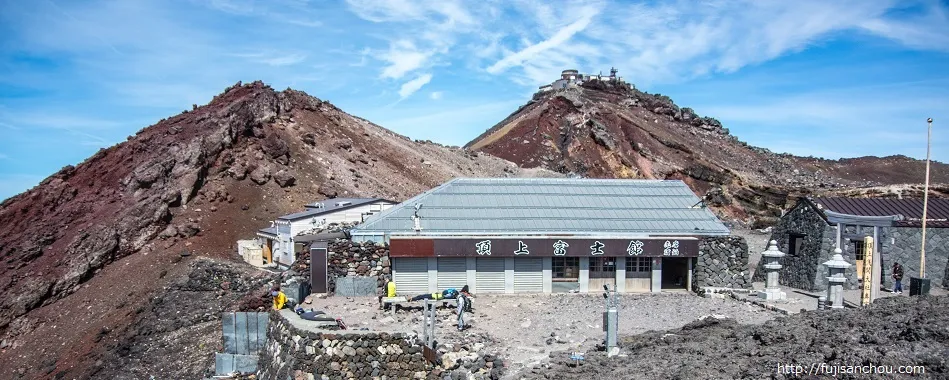
Mountain huts on Mt. Fuji are sturdy wooden and metal-framed structures anchored to the volcanic slope. They look industrial from the outside — corrugated metal roofing, reinforced walls designed to withstand typhoon-force winds. Do not expect alpine charm. These are functional shelters at extreme altitude.
Most huts cluster at the 7th station (2,700 m) and 8th station (3,040–3,400 m). The higher the station, the closer to the summit — and the more expensive the hut.
The Dormitory
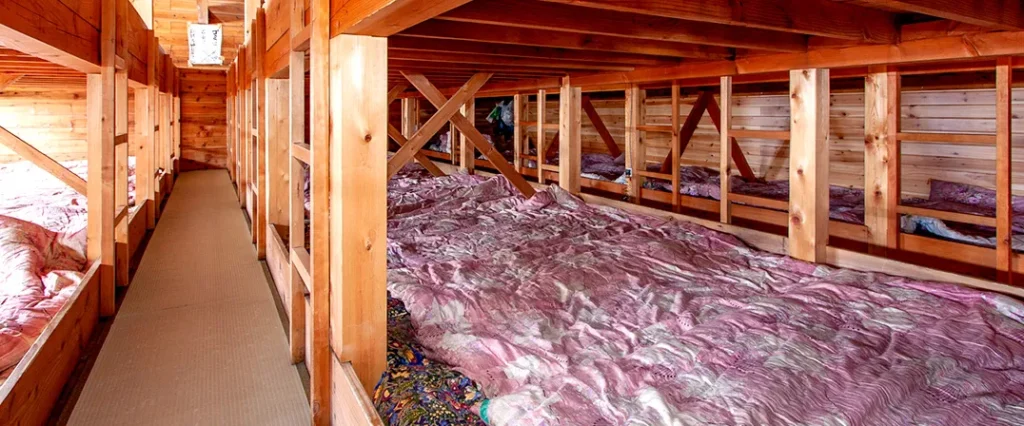
The traditional Mt. Fuji mountain hut sleeping arrangement is a communal dormitory. You sleep on a long wooden platform, shoulder to shoulder with other climbers, under shared blankets or sleeping bags.
The space per person is approximately 50–60 cm wide — enough to lie flat but not to roll over without bumping your neighbor. Ceiling height is low; in many huts, you cannot sit fully upright in the sleeping area. Bedding consists of a futon or sleeping bag plus a pillow. Noise is significant: snoring, gear rustling, phone alarms, and the general sounds of 50–100 people in a confined space. Earplugs are essential.
Is it comfortable? No. Is it functional? Yes. The purpose is not luxury — it is providing a warm, dry, wind-sheltered space to rest before the summit push. In that context, it works.
The Semi-Private Room
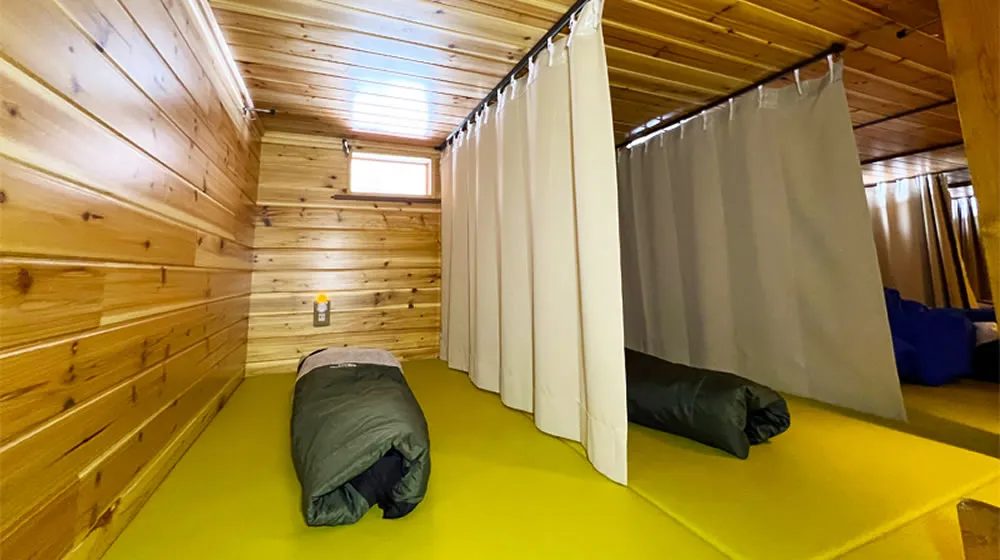
In recent years, several Mt. Fuji huts have introduced semi-private sleeping arrangements. These feature individual sleeping spaces separated by curtain dividers, slightly more width (70–80 cm), better quality sleeping mats, and a small shelf or hook for personal items. These rooms cost ¥2,000–5,000 more than standard dormitory beds.
Huts offering this option include Tomoekan (all rooms private in 2026), Kamaiwakan (dorm beds with antibacterial curtains plus private 2-person rooms, single rooms, and loft rooms), and several 8th station huts.
My honest take: if you are a light sleeper or value personal space, the premium for a semi-private room is absolutely worth it. The curtain does not block sound, but having your own defined space makes the night significantly more manageable.
The Common Area
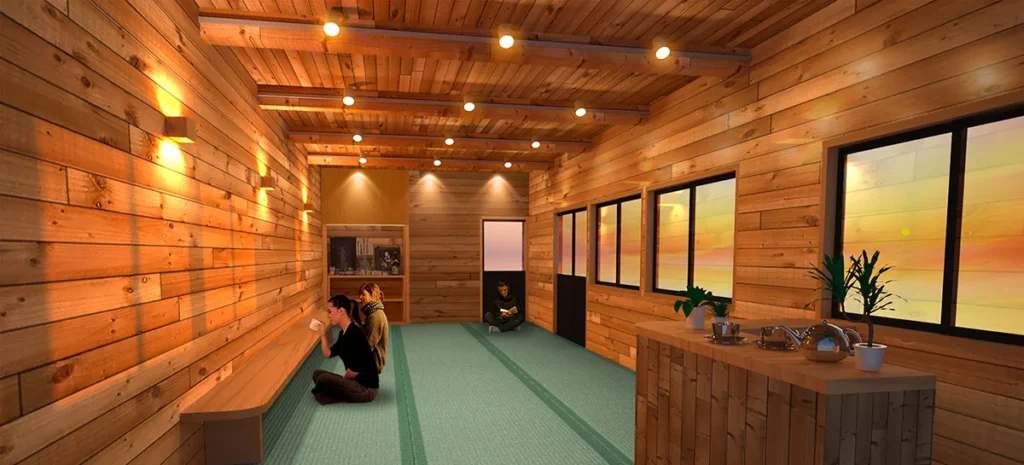
Most huts have a communal lounge or dining area separate from the sleeping quarters. This is where you eat meals, dry gear, and — most importantly — watch the sunset and sunrise through the windows.
The best huts have windows facing east (sunrise) or west (sunset). The warm wood interiors, the glow of the lights, and the view of clouds through the windows create a surprisingly cozy atmosphere that contrasts sharply with the harsh volcanic exterior.
The Meal Experience: Curry Rice at 3,400 Meters
Mountain hut meals are simple, high-calorie, and surprisingly satisfying after hours of climbing.
Dinner is served between 5:00 PM and 7:00 PM. The standard is Japanese curry rice with miso soup. Some huts offer Hamburg steak, hayashi rice, or nikujaga (meat and potato stew) as alternatives. Portions are adequate but not generous — bring supplemental snacks.
Breakfast is served between 4:30 AM and 5:30 AM. It typically consists of rice with miso soup, pickles, and a small side dish. Many huts offer a bento (packed lunch) option if you depart before breakfast is served — request this at check-in.
Water and drinks are expensive because everything above the 7th station is transported manually by porters or pack horses. A 500 ml bottle of water costs ¥500 (compared to ¥100 at a convenience store). Hot tea or coffee costs ¥300–500.
Dietary restrictions: Vegan, halal, and gluten-free options are generally not available at mountain huts. If you have dietary needs, bring your own supplemental food. For travelers from Southeast Asia, consider purchasing onigiri (rice balls) and snacks at a convenience store in Tokyo before heading to the mountain — 7-Eleven and Lawson both carry a selection of halal-friendly options.
The View from 3,400 Meters
This is what the guides do not emphasize enough: mountain huts on Mt. Fuji have some of the most spectacular views in Japan.
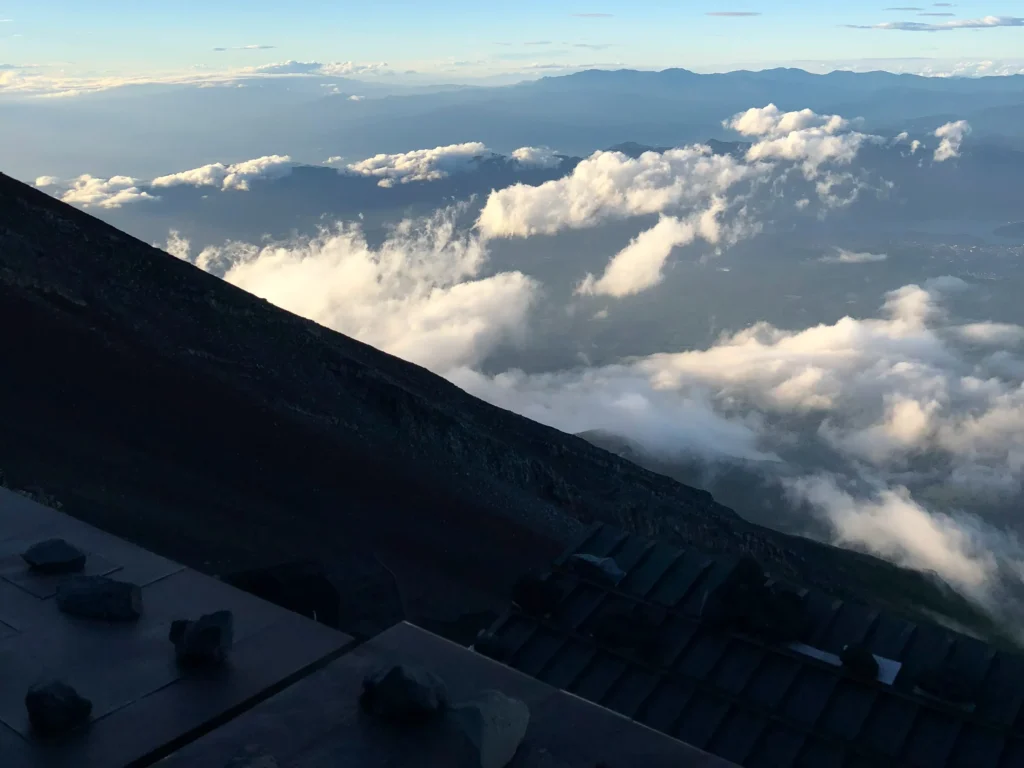
From an 8th station hut, you are above the cloud line on most summer days. The cloud sea (unkai) stretches to the horizon in every direction, with distant mountain peaks emerging like islands. The Southern Alps, Hakone, and sometimes the Izu Peninsula are visible.
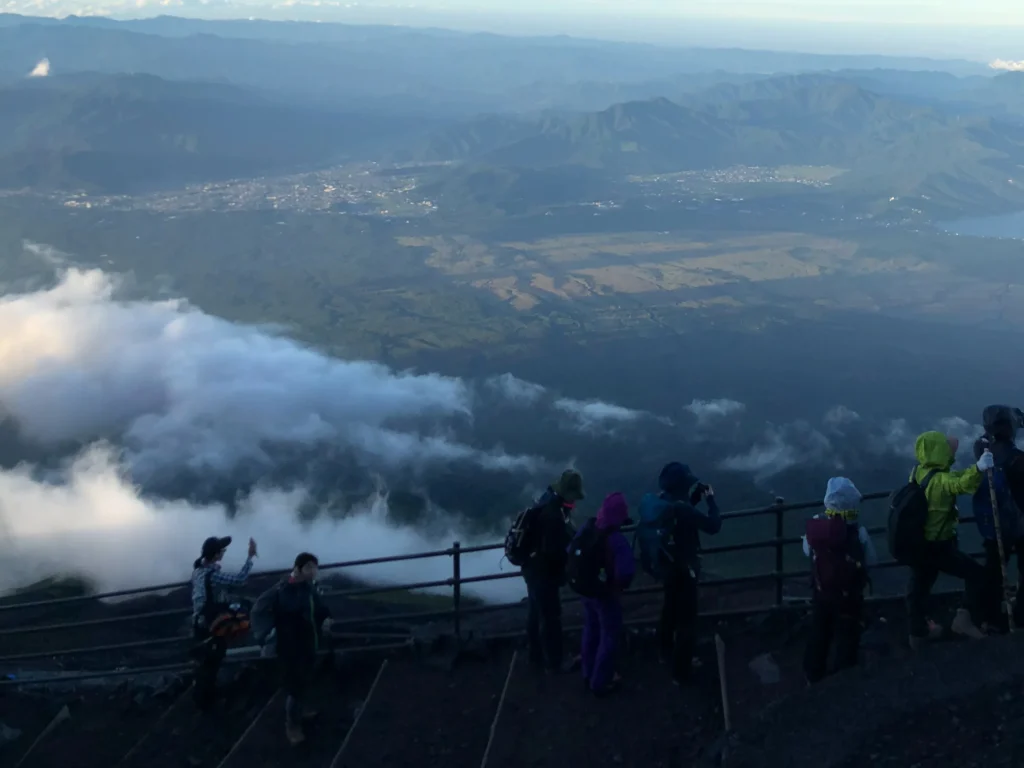
The sunset from a mountain hut terrace is one of the most beautiful and underrated moments of the entire climb. While everyone focuses on the sunrise, the sunset over the cloud sea — golden, pink, then deep orange — is equally striking and far less crowded. For a complete hour-by-hour breakdown of the sunrise experience, see our Mt. Fuji Sunrise Photography Guide.
What to Bring to the Mountain Hut
Beyond standard climbing gear (covered in our Mt. Fuji Climbing Guide 2026), these items specifically improve the mountain hut experience:
| Item | Why |
| Earplugs | Non-negotiable. Communal sleeping = communal snoring |
| Eye mask | Headlamps from early departures flash through the room |
| Sleeping bag liner | Adds warmth + personal hygiene layer over hut bedding |
| ¥100 coins (10+) | Toilets are coin-operated. No change available at 3:00 AM |
| Plastic bags | For wet gear, dirty clothes, trash (pack out everything) |
| Slippers or sandals | For moving around the hut without boots |
| Headlamp (red mode) | For navigating without blinding your bunkmates |
| Snacks | Energy bars, chocolate, dried fruit — hut meals are not generous |
| Portable charger | Limited charging at huts (¥500-1,000). Keep it warm inside your jacket |
| Body wipes | No showers on the mountain. Wipes are your only hygiene option |
Southeast Asia traveler tip: If you are coming from Singapore (average 30°C), Bangkok (35°C), or Jakarta (32°C), the temperature at 3,400 m drops to near 0°C at night. Buy disposable heat packs (kairo, カイロ) at any convenience store in Tokyo before heading to the mountain — they cost about ¥100 for a pack of two and last 12 hours. Use them in your pockets or on clothing as the packet directs, never against bare skin and not while you sleep, because they can cause low-temperature burns. Also bring thermal base layers; the unheated huts feel brutally cold if you are accustomed to tropical weather.
The list above is hut-comfort kit. This is the climb itself — the gear I actually carry up. It is all on Amazon Japan, so you can have it waiting at your Tokyo hotel before you head for the 5th Station — here is exactly how to get an Amazon Japan order delivered to your hotel, a convenience store or an airport locker. As an Amazon Associate, Hidden Japan Gems earns from qualifying purchases, at no extra cost to you.
Flying in from the US or Canada? A few of these are worth buying at home before you pack, rather than hunting for them here at the last minute — on amazon.com: headlamp, trekking poles, rain jacket & pants, power bank. Already in Japan? The Amazon Japan picks below can go straight to your hotel.
Should You Climb Mt Fuji — or Just See It?
The honest case for climbing vs simply seeing Fuji.
Portable oxygen can
For the altitude headache that hits a lot of first-timers above the 8th station. Light, cheap, reassuring.
Headlamp (USB-rechargeable)
The pre-dawn push to the summit is pitch dark and you want both hands free. Red mode keeps the peace in the hut.
Rain jacket & pants
Fuji weather turns fast and the wind above the tree line is cold. A poncho will not cut it.
Trekking poles
The descent on loose volcanic gravel is brutal on the knees. Poles save the day for most people.
Gloves
The upper trail has rocky, hands-on sections, and the summit is freezing while you wait for the sunrise.
Quick-dry hiking socks
Blisters end climbs. Cushioned, quick-dry socks are the cheap fix people forget to pack.
Daypack (20-30L)
Room for water, layers, oxygen and warmers — and it folds down into a suitcase.
Dry bag
Keeps your phone, passport and a spare layer dry when the rain comes in sideways.
Gaiters
Short gaiters keep the volcanic scree out of your shoes on the way down.
For the full route, timing and trail rules, see the Mt. Fuji Climbing Guide 2026.
Practical Tips and Mountain Hut Etiquette
Altitude and weather — know when to turn back. Above 3,000 m, watch for altitude sickness: a persistent headache, nausea, dizziness or breathlessness that rest does not ease. The only real fix is to go down — tell the hut staff and descend rather than pushing for the summit. Huts may also hold you back or send you down early in bad weather; on Fuji the biggest dangers are lightning and high wind, and cold rain on top of them can bring on hypothermia. Build a flexible buffer into your plan and treat the forecast, not your schedule, as the boss.
Check-in: Arrive by 5:00–6:00 PM. Staff need to assign sleeping spaces and serve dinner on schedule. Show your reservation confirmation (email or app screenshot) and entry fee receipt.
Boots: Remove all footwear at the entrance. Huts provide a shelf or cubby system. Mark your boots with a distinctive tag — dozens of identical trekking boots lined up is a recipe for mix-ups.
Quiet hours: Lights out by 8:00–9:00 PM. No talking, no phone calls, no alarms until the staff wake-up call (typically 1:00–2:00 AM). If you need to use the toilet during the night, use your headlamp on red mode.
Trash: Pack out all your trash. Mountain huts have no garbage collection system. Bring a dedicated trash bag.
Water conservation: No showers. No hand-washing facilities beyond basic sanitizer. Bring wet wipes for personal hygiene.
Photography: Ask before photographing other climbers in the sleeping quarters. It is a shared personal space.
Cash on the mountain: Bring ¥3,000–5,000 in small bills and coins for on-site purchases (water, snacks, charging, toilets). Credit cards and IC cards are not accepted for these purchases. If you are used to cashless payment in Singapore or Malaysia, this is an important adjustment — read our IC card guide for Japan for general cashless tips, but remember that the mountain is cash-only territory.
FAQ: Mt. Fuji Mountain Huts
Do I need to book a mountain hut in advance for 2026?
If you plan to start climbing after 2:00 PM, yes: in 2026, on the Yoshida Trail and on the three Shizuoka trails, you could not start up between 2:00 PM and 3:00 AM without a mountain hut reservation. Walk-ins in peak season are extremely unreliable anyway, so book as soon as your hut opens reservations for the season, often from May.
How much does a mountain hut cost on Mt. Fuji?
Prices range from ¥10,000 to ¥17,600 per person per night including dinner and breakfast. Semi-private rooms with curtain dividers cost an additional ¥2,000–5,000. Prices vary by station (higher = more expensive) and by date (weekends and Obon period are priciest).
Can I choose between dormitory and private room?
At some huts, yes. Tomoekan offers all-private rooms in 2026. Kamaiwakan has individual room options including single rooms, loft rooms, and scenic rooms. Most traditional huts only offer communal dormitory sleeping. Check the specific hut website when booking.
What if I cannot sleep at the mountain hut?
This is extremely common. Altitude, noise, tight space, and anticipation make deep sleep unlikely for most people. The goal is not a full night of rest — it is a few hours of physical recovery. Even lying down with eyes closed provides meaningful rest. Earplugs and an eye mask help significantly.
What food is served at Mt. Fuji mountain huts?
Dinner is typically Japanese curry rice with miso soup. Breakfast is rice with miso soup, pickles, and side dishes. Some huts offer packed bento boxes for early departures. Bring supplemental snacks for the pre-dawn climb.
Are there toilets at the mountain huts?
Yes, but they are coin-operated bio-toilets (¥100–200 per use). Bring at least ten ¥100 coins. Toilet paper is usually provided, but bringing pocket tissue is recommended as backup.
Can I stay at a mountain hut without climbing to the summit?
Absolutely. Many climbers — especially those with children or altitude concerns — stay at a 7th or 8th station hut, enjoy the sunset and sunrise from the hut terrace, and descend without attempting the summit. The views are spectacular in their own right.
How do I pay at a Mt. Fuji mountain hut?
Most payments are made online at the time of booking via credit card (3D Secure required). PayPay is accepted at some huts. On-site purchases (water, charging, snacks) are cash only. Bring ¥3,000–5,000 in small bills and coins.
What happens if I arrive late to the mountain hut?
Contact the hut by phone immediately. Most will hold your reservation but may not be able to serve dinner if you arrive past 7:00 PM. Arriving after dark is highly dangerous and strongly discouraged.
Lock in Your Climb
Mountain hut spots disappear by mid-June for the peak July-August season. Book the hut first, then the transport, then the optional guide.
Is a Mt. Fuji Hut Worth It?
Mt. Fuji mountain huts are not hotels. They are not glamping. They are functional shelters on the side of an active stratovolcano at an altitude where the air is 35% thinner than at sea level.
And they are part of what makes the experience real.
The tight sleeping quarters mean you hear the breathing of climbers from a dozen countries. The simple curry dinner tastes remarkable because you earned it with five hours of uphill effort. The 1:00 AM wake-up call in complete darkness, surrounded by the rustle of 50 people preparing for something difficult and beautiful — that is a shared human experience you cannot get from a hotel room.
Book early. Bring earplugs. Choose a semi-private room if you can. And when you step out onto the terrace at sunset, with the cloud sea glowing orange below you — that view is worth every yen.
For the complete climbing logistics, read our Mt. Fuji Climbing Guide 2026. For sunrise photography tips, see our Mt. Fuji Sunrise Photography Guide. And if you are planning your base before or after the climb, check our Lake Motosu guide for the iconic ¥1,000 bill view, or browse Kawaguchiko area hotels on Agoda for convenient pre-climb accommodation.
The Horse Riders of Mt. Fuji’s 5th Station
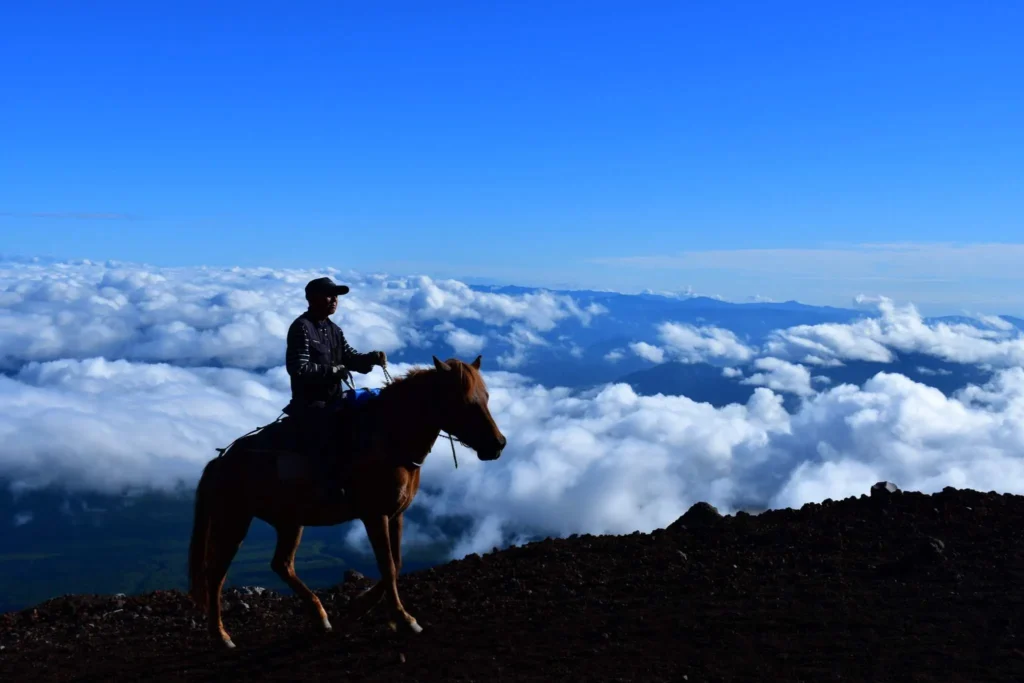
One of the most unexpected sights on Mt. Fuji: horses. Between the 5th Station and the 6th Station on the Yoshida Trail, you may encounter pack horses that have been used for centuries to transport supplies up the mountain.
These sturdy Japanese horses carry food, water, fuel, and building materials to the mountain huts above. In the past, climbers could also ride them partway up the mountain. Today, the horse-riding service operates on a limited basis between the 5th and 7th stations.
The silhouette of a horse and rider against the cloud sea, on the volcanic slopes of Japan’s highest mountain, is one of those images that reminds you this is not just a hike — it is a pilgrimage route with centuries of history. The high cost of water and food at the huts makes more sense when you realize that every bottle was carried up this way.
Convinced? Lock the whole climb in three moves
Related articles on Hidden Japan Gems
•Mt. Fuji Climbing Guide 2026: 4 Trails, New Rules & Costs
•Mt. Fuji Sunrise 2026: Hour-by-Hour Goraiko Guide
•Lake Motosu: Where to See the ¥1,000 Bill Mt. Fuji View
•Fuji Shibazakura Festival Guide
•Kawaguchiko Ohashi Bridge: Mt. Fuji View Guide
•Mt. Fuji & Cherry Blossoms 2026
•IC Card Guide: Suica & Pasmo in Japan
•Mt. Fuji Night Climb — What the Hut Night Turns Into
•Mt Fuji Weather & What to Wear — Even Summer Summits Feel Like Winter
•Can You See Mt Fuji Today? Live Visibility Forecast
•The Best Time to See Mt Fuji (Clearest Months)
Sources checked
fujisan-climb.jp, Tomoekan (tomoekan.com), Kamaiwakan (kamaiwakan.jpn.org), Taishikan (mfi.or.jp/~taisikan), Yamanashi Prefecture
If mountain-hut life appeals beyond Mt. Fuji, the same trekkers’-inn culture exists at Kamikochi — Tokusawa-en (2-hour walk in), Yokoo Sanso (3-hour walk in, gateway to Karasawa) and Myojinkan (1-hour walk in). We compare all of them in our Kamikochi accommodation guide 2026, alongside the bus-terminal hotels for travellers who’d rather not carry a pack 10 km.
Join travelers discovering Japan's hidden side
Weekly dispatches from off-the-beaten-path Japan — spots and stories you won't find in guidebooks.
No spam. Unsubscribe anytime.
Welcome aboard!
You're in. See you in your inbox soon.