
Culture · Autumn words · Lake Kawaguchi
Momiji (紅葉) means autumn foliage and can also mean a maple tree. The word grew out of an old verb, momitsu, later momizu, “to take on autumn colour”, so at its root it names a change rather than a plant. Kōyō is the Sino-Japanese reading of 紅葉; it means autumn colouring and the coloured leaves themselves. Near where I live, momiji also sits in two place names that are easy to confuse: Lake Kawaguchi’s Momiji Corridor (もみじ回廊) and its Momiji Tunnel (もみじトンネル) are about ten minutes apart by car, and they are not the same place.
What does momiji mean?
In everyday Japanese, momiji has two main meanings. It is the colouring of leaves in late autumn, along with the coloured leaves themselves, and it is another name for kaede, the maple. Daijisen lists the senses in that order; Nipponica explains the maple sense as growing out of the first. Nipponica notes that in the Nara period the word was said momichi, with a clear “chi”, as the noun form of momitsu, to turn colour. The later verb was momizu, and momiji is built from it.
Kōyō is the Sino-Japanese reading of 紅葉. It means autumn colouring and the coloured leaves themselves; momiji can also mean a maple tree. Daijisen adds that kōyō can take in yellow and brown leaves as well. On paper, 紅葉 can be either word; only the context, or the small reading guide printed beside the characters, tells you which.
紅葉 · momiji / kōyō
Momiji: autumn colour, the coloured leaves and the maple tree. Kōyō: autumn colouring and coloured leaves, sometimes including yellow and brown foliage.
黄葉 · kōyō
Leaves turning yellow, as ginkgo does. The Man’yōshū reads it as momichi.
楓 · kaede
The maple genus, Acer, with about 25 wild species in Japan. From kaerude, “frog’s hand”, for the shape of the leaf.
いろは紅葉 · iroha-momiji
Acer palmatum, named after the game of counting its lobes: i, ro, ha, ni, ho, he, to.
紅葉狩り · momijigari
Going out to look at autumn leaves. The same -gari covers mushroom gathering.
紅葉のような手 · momiji no yō na te
“Hands like maple leaves”: the small hands of a young child.
Momiji or kaede: which word is the maple?
Botanically, the maple is kaede. Britannica’s Japanese encyclopedia gives both names in one entry: the trees are called momiji because their leaves change colour, and kaede because the leaf looks like a frog’s hand, kaerude in older Japanese. Nihon Kokugo Daijiten counts about 25 wild maple species in Japan. Heibonsha’s encyclopedia adds that momiji is also another name for one species, iroha-kaede, better known as iroha-momiji, and that maples as a group are sometimes called momiji too. Iroha-momiji is Acer palmatum, also called takao-kaede after Takao in Kyoto.
The character 楓 has a botanical history of its own. Japanese dictionaries describe its use for kaede as a historical misapplication of a Chinese name for sweetgum, a different tree. Poets mostly left the word kaede alone. Nihon Kokugo Daijiten notes that kaede and kaerude are rare in poetry, probably because when old texts meant the maple they usually said momiji.
Momiji can even mean a green maple. Hotokuji, a temple in Kiryu whose polished hall floor reflects the trees outside, calls its April-to-May opening haru no yuka-momiji, “spring floor maples”, when the trees are in new leaf rather than autumn colour.
Why the Man’yōshū usually writes autumn leaves as yellow
In the Man’yōshū, Japan’s oldest surviving anthology of waka, compiled in the eighth century, autumn leaves are usually written 黄葉, “yellow leaves”. Nipponica finds only one or two poems that write 紅葉 or 赤葉, “red leaves”, instead, and explains the habit partly by the spelling in Chinese poetry of the Six Dynasties and early Tang, and partly by how many of the local trees turned yellow. From the Heian period, partly under the influence of the collected works of the Tang poet Bai Juyi, the red spelling took over. Heibonsha’s encyclopedia reads it as a change of taste: in the showier Heian age, when red plum blossom was prized, the red maple became the emblem of autumn.
Yellow foliage is also recorded separately in Japan’s seasonal observations. The Meteorological Agency keeps a record for ginkgo, its “yellowing day”, alongside the one for maples. Tokyo’s best-known yellow is the ginkgo avenue at Meiji Jingu Gaien; our Gaien ginkgo page follows its light-up and festival notices.
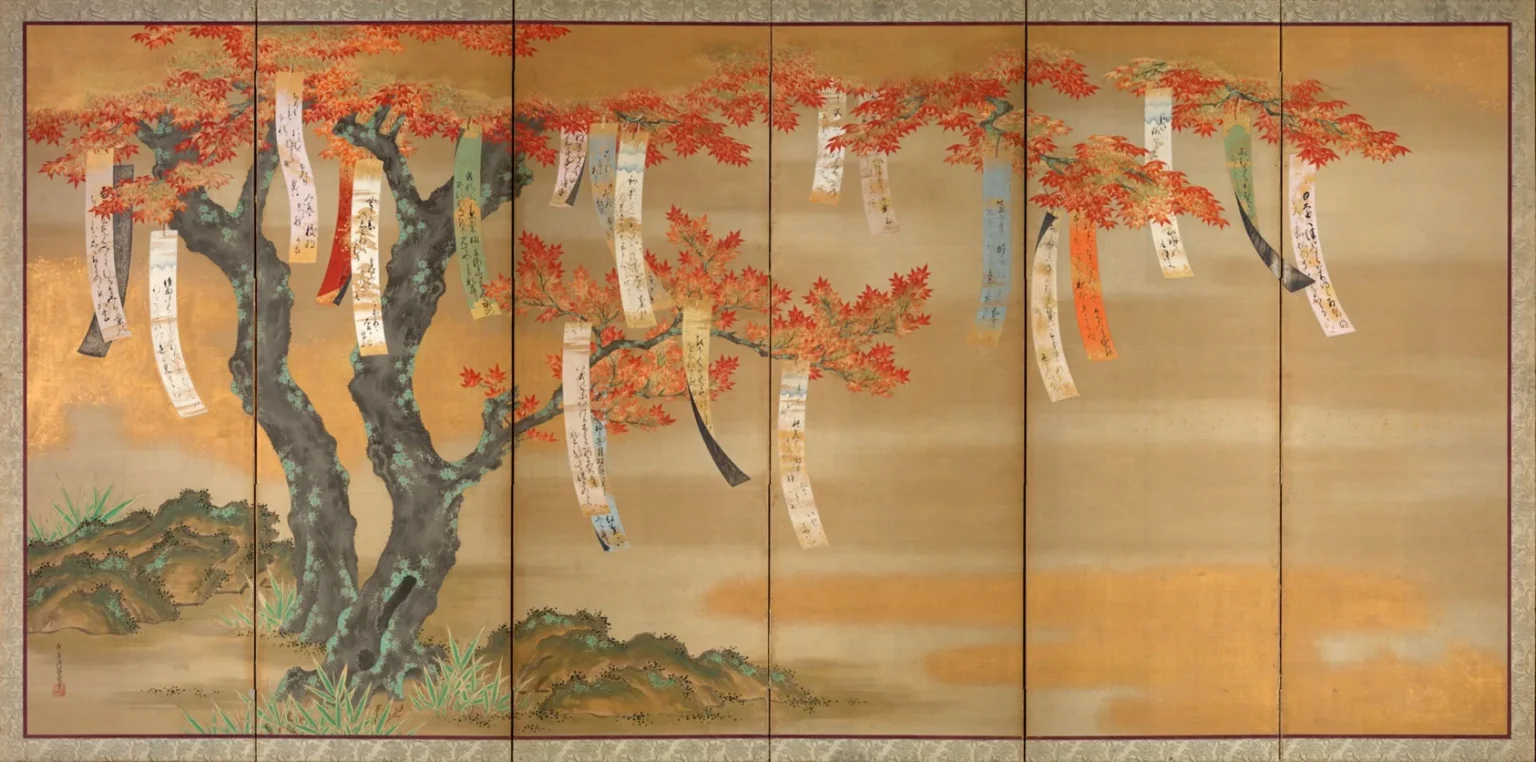
Momijigari: why Japanese go “hunting” for autumn leaves
Momijigari (紅葉狩り) means going out into the hills to enjoy autumn leaves. The -gari is the same 狩り as in hunting, but Daijisen also gives it a gentler sense: going out into the countryside to admire or gather plants. Its two examples are matsutake-gari, mushroom gathering, and momiji-gari.
Nipponica traces leaf viewing through the written record from the Man’yōshū on, and describes momijigari as an elegant pastime of the court and the aristocracy. In the Kokinshū, the court anthology compiled between 905 and 914, the second book of autumn is almost entirely maple poems, and in The Tale of Genji the chapter Momiji no Ga (紅葉賀) has Genji dancing the court piece Seigaiha. The Noh play Momijigari, by Kanze Nobumitsu, turns the outing into a demon story: a party of noblewomen enjoying the leaves on Mount Togakushi turns out to be demons.
Only in the Edo period did the outing spread to ordinary people. For Edo, the city that became Tokyo, Nipponica lists Ueno, the hill at Nezu Gongen, Shōtō-ji in Asakusa, and Kaian-ji and Tōkai-ji in Shinagawa as the famous maple spots. Tokyo autumn leaves in 2026 covers where people go now.
Autumn leaves in three Hyakunin Isshu poems
The Hyakunin Isshu is a set of a hundred poems by a hundred poets, said to have been chosen by Fujiwara no Teika at his villa on Mount Ogura in Kyoto, and from the Edo period on it spread as a card game. Five of the hundred use the word momiji. Here are three: two that use the word, and a river poem that evokes the crimson leaves without naming them. English translations by Nobu.
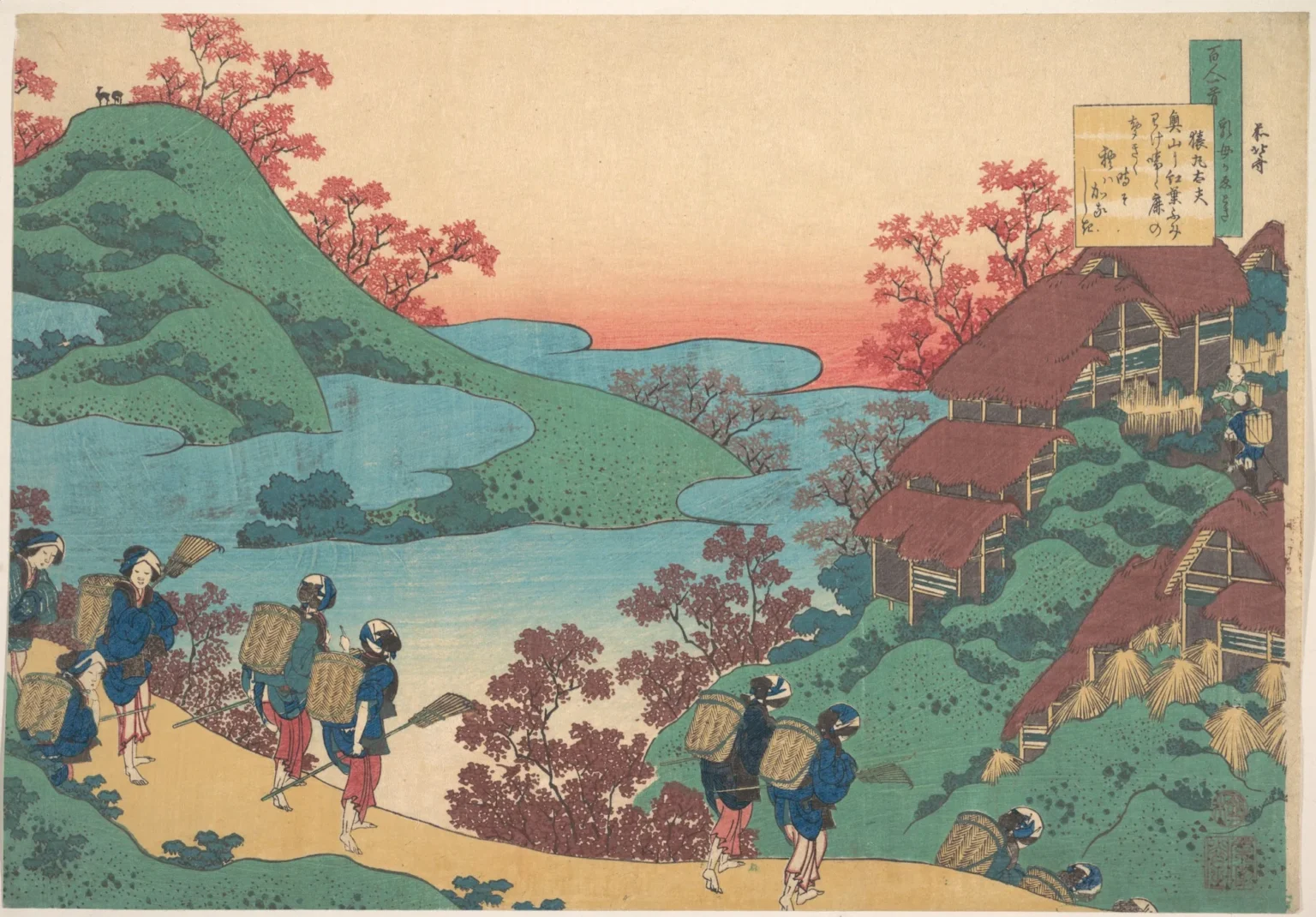
奥山に紅葉踏み分け鳴く鹿の 声聞く時ぞ秋は悲しき
Okuyama ni / momiji fumiwake / naku shika no / koe kiku toki zo / aki wa kanashiki
Deep in the hills, through drifts of maple leaves, a deer calls out; hearing that voice is when autumn is saddest.
Poem No. 5 is credited to Sarumaru Dayū, a poet so shadowy that Britannica’s Japanese encyclopedia says not one surviving poem can be securely called his. Deer and maples come back below, on a playing card and on a menu.
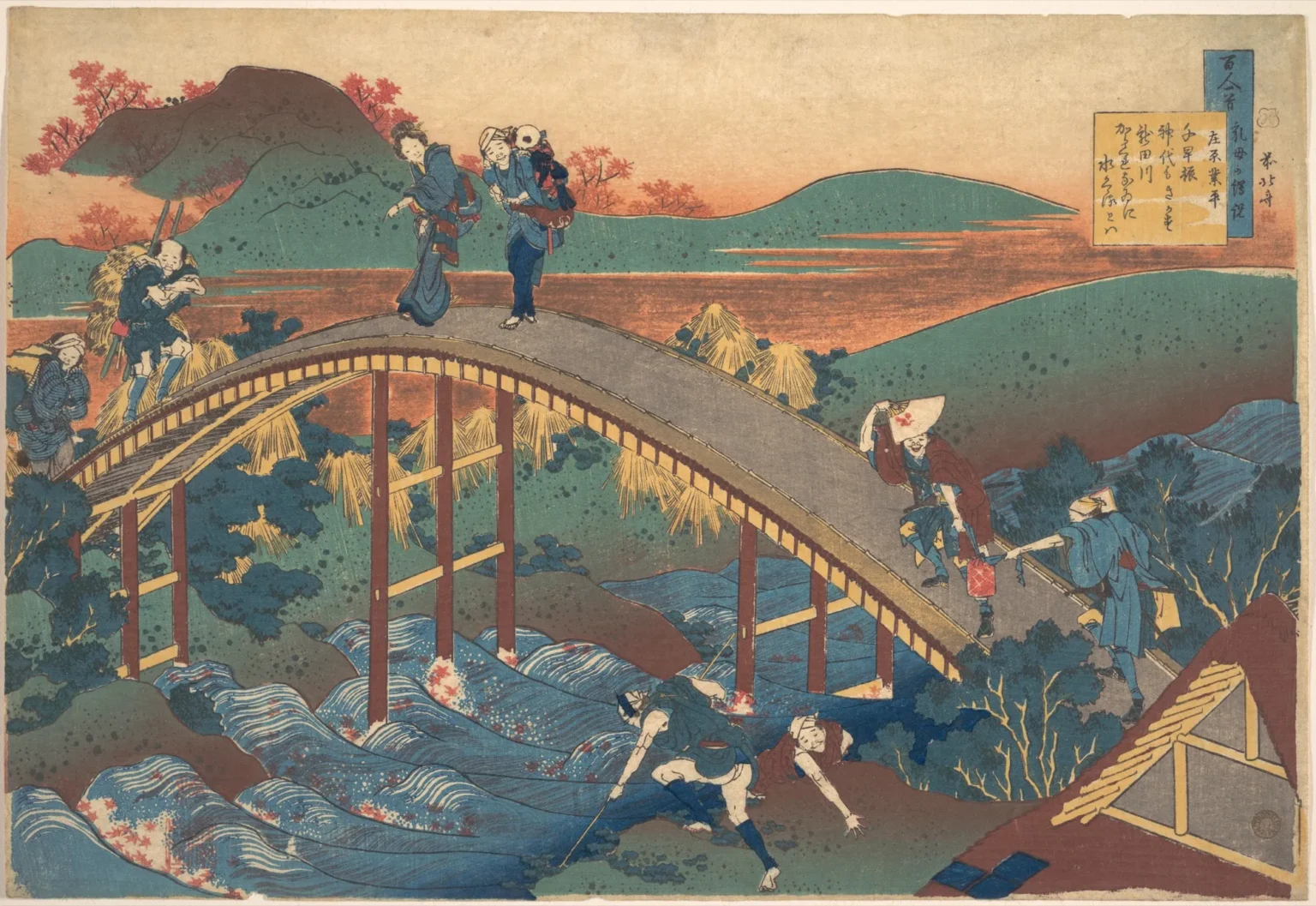
ちはやぶる神代も聞かず竜田川 からくれなゐに水くくるとは
Chihayaburu / kamiyo mo kikazu / Tatsutagawa / karakurenai ni / mizu kukuru to wa
Unheard of even in the age of the gods: the Tatsuta River, its water dyed deep Chinese crimson.
Poem No. 17, by Ariwara no Narihira, is also in the Kokinshū. It never says momiji. The Tatsuta River, in north-west Nara Prefecture, was the classic poetic place for maple leaves carried on the current, and the crimson comes from the leaves.
A third poem, No. 26 by Fujiwara no Tadahira, addresses the maples on Mount Ogura itself: 小倉山峰の紅葉葉心あらば いまひとたびのみゆき待たなむ, “maple leaves on Ogura’s peak, if you have a heart, wait for one more royal visit.” Mount Ogura faces Arashiyama across the river in western Kyoto, and Heibonsha’s encyclopedia notes that Enri-an, a hermitage at its eastern foot, is said to stand on the site of Teika’s villa. Arashiyama is one of the three places in our guide to Japan’s three great autumn foliage spots, and Kyoto in November explains when to book and when to go.
The maples of Arashiyama
Deer, hanafuda and the slang word shikato
The deer-and-maple pair from poem No. 5 turns up well beyond poetry.
The October card
Hanafuda, the 48-card flower deck, gives each month a plant and four cards; October’s plant is momiji. Its ten-point card shows a deer under the maples. Heibonsha’s encyclopedia notes that older picture-matching cards already paired maple with deer, pine with crane and plum with bush warbler.
Shikato
Shikato (シカト) is slang for ignoring someone. Daijisen and Nihon Kokugo Daijiten both explain it, with an “it is said”, by the October ten-point card: the deer has turned its head away. Daijisen dates the word to young people in the early 1960s.
Momiji on the menu
Momiji is an old name for venison. Daijisen gives the reason in one line: deer and maples go together. Nihon Kokugo Daijiten quotes an 1850 essay on boar and deer meat being called botan and momiji, peony and maple.
Momiji you can eat, and momiji on a temple floor
Momiji manjū · Miyajima
A maple-leaf-shaped cake: castella-like batter around sweet bean paste, baked in a leaf mould. One reference work records two origin stories, a request for a maple-shaped sweet at Momijidani Park, and Itō Hirobumi telling a teahouse girl her hands were like maple leaves. Our Miyajima guide covers the deep-fried version too.
Momiji tempura · Minoh
Maple leaves fried in batter, sold in Minoh, in the hills north of Osaka. Nipponica lists it among the maple-season attractions created for visitors. The shops and prices are in our Minoo Falls walking guide.
Yuka-momiji · Kiryu
“Floor maples”: the trees outside reflected in a dark, polished temple floor. Hotokuji’s autumn opening is 17 October to 30 November 2026, with evening light-ups from 14 November. See the Hotokuji guide.
Kusamomiji · Oze
Grasses colouring in autumn, as Daijisen defines it. In Oze, wetland plants take on autumn colours before the surrounding woodland. Our Oze kusamomiji guide explains the seasonal timing.
The momiji front: how autumn colour moves across Japan
Momiji zensen, the maple front, is the line on a map joining the dates when maples turn, and it moves south, the opposite direction to the cherry-blossom front in spring. The long-term pattern runs south from October into December, while higher elevations generally colour earlier. The dates come from the Japan Meteorological Agency. At each of its observatories a specimen tree is chosen, and the “maple colouring day” is the first day when, looking at the whole tree, most of its leaves have turned red. The agency uses iroha-kaede (iroha-momiji) where it grows, and yama-momiji, ō-momiji or itaya-kaede where it does not.
| Around this date (1991–2020 average) | The observatory maples have turned in |
|---|---|
| mid-October | Eastern Hokkaido, Pacific side: the front starts here |
| 10 November | Southern Hokkaido, Pacific side |
| 20 November | Tohoku and eastern Hokuriku |
| 30 November | Kanto, Hokuriku, Tokai, Chugoku, Shikoku and northern Kyushu |
| early to mid-December | The Pacific coasts of Kanto and Tokai, Kinki and southern Kyushu |
Those are dates for the trees at the observatories. Elevation shifts the dates: Yamanashi’s tourism organization lists Mt Fuji’s Fifth Station, at 2,305 metres, for late September to mid-October, and the Momiji Corridor, at 830 metres, for early to mid-November. Ginkgo has its own line, starting in late October in eastern Hokkaido and on Tohoku’s Pacific side.
The forecasts you read each autumn come from private forecasters such as the Japan Weather Association. The Japan Weather Association’s first 2026 forecast, published on 1 October, predicted normal to later-than-normal timing in eastern and western Japan, with delays especially in lowland areas. Our foliage forecast guide explains how to read these predictions; the koyo tracker follows the latest 2026 updates.
Momiji Corridor or Momiji Tunnel? Two places at Lake Kawaguchi
Two maple spots at Lake Kawaguchi have momiji in their names, and the official Japanese pages describe two different places. The Fujikawaguchiko Tourism Association has a page for the corridor; the tunnel is listed by the Yamanashi Tourism Organization, the prefecture’s official tourism site.
Momiji Corridor · もみじ回廊
What it is: maples along both banks of the Nashi River (梨川) on the north shore, in the Kawaguchi district. The association counts about 150 maples; the prefecture’s corridor page describes about 60 trees over about 150 metres of bank.
When: late October to mid-November, says the association. It is the main venue of the Fujikawaguchiko Autumn Leaves Festival, 7–29 November 2026, lit from sunset to 21:00 and free to enter.
Getting there: the Red-Line sightseeing bus from Kawaguchiko Station to the Kubota Itchiku Art Museum stop, about 20 minutes, then five minutes on foot.
Momiji Tunnel · もみじトンネル
What it is: a stretch of road in the Oishi district where the roadside maples turn red and arch over the road like a tunnel, with Mt Fuji and the lake in the same view.
When: early to mid-November, on the prefecture’s page.
Getting there: about ten minutes by car from the corridor, past Oishi Park. By bus, about 30 minutes from Kawaguchiko Station to the Kawaguchiko Shizen Seikatsukan (Natural Living Center) stop, then about 20 minutes on foot. The prefecture lists parking for ten cars.
Similar wording on the official pages. The prefecture’s own page for the corridor describes its canopy as “a crimson tunnel” overhead (真紅のトンネル), and its page for the tunnel mentions the corridor in the same paragraph. If a page promises illuminations at “the Momiji Tunnel”, check which place it means: the association’s 2026 festival notice puts the light-up in the corridor (紅葉回廊). One more thing to check: the prefecture’s corridor page, with information as of 28 September 2026, still gives the lights until 21:30, while the association’s 2026 notice says 21:00.
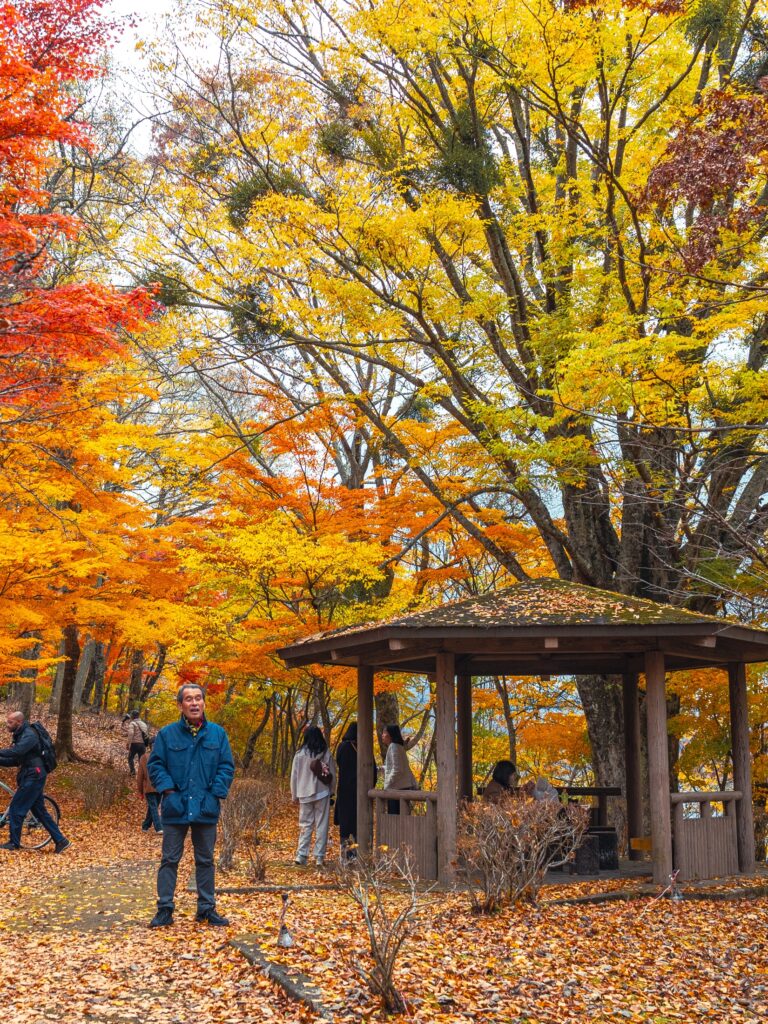
I went to the corridor on Wednesday 19 November 2025, in the early afternoon. The canopy over the footbridge still held orange and gold, the stream bed underneath was covered in leaves, and the bridge was full of people. The prefecture’s page has a phrase for that late stage, 紅葉の絨毯, a carpet of autumn leaves, and places it from mid-November.
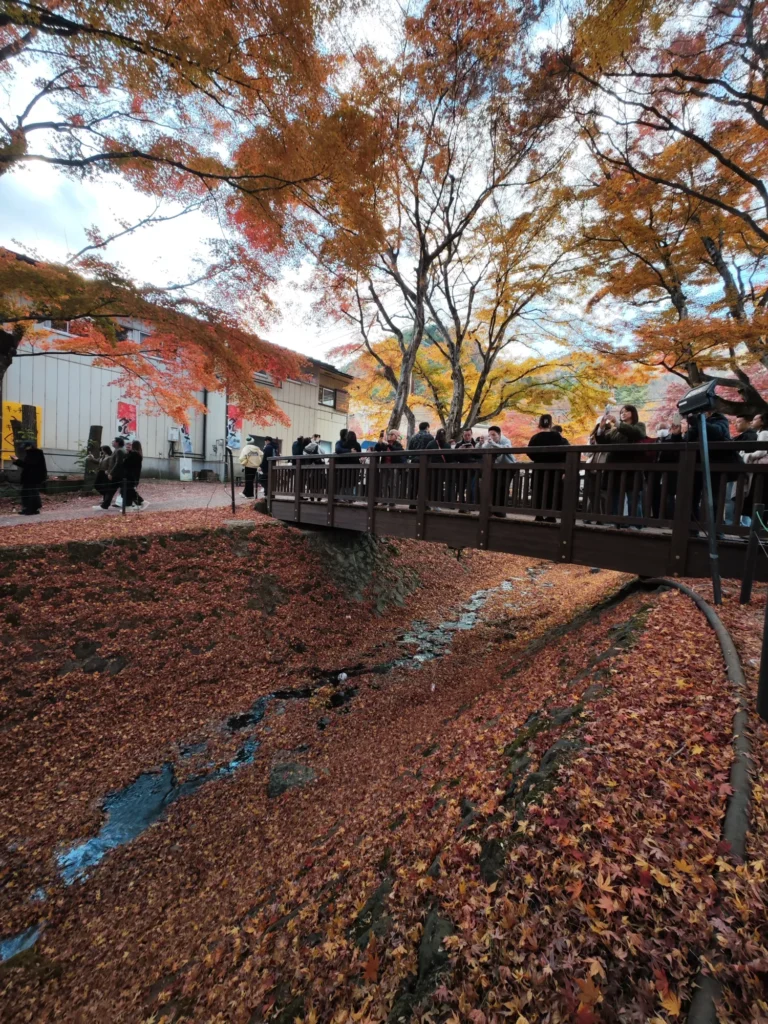
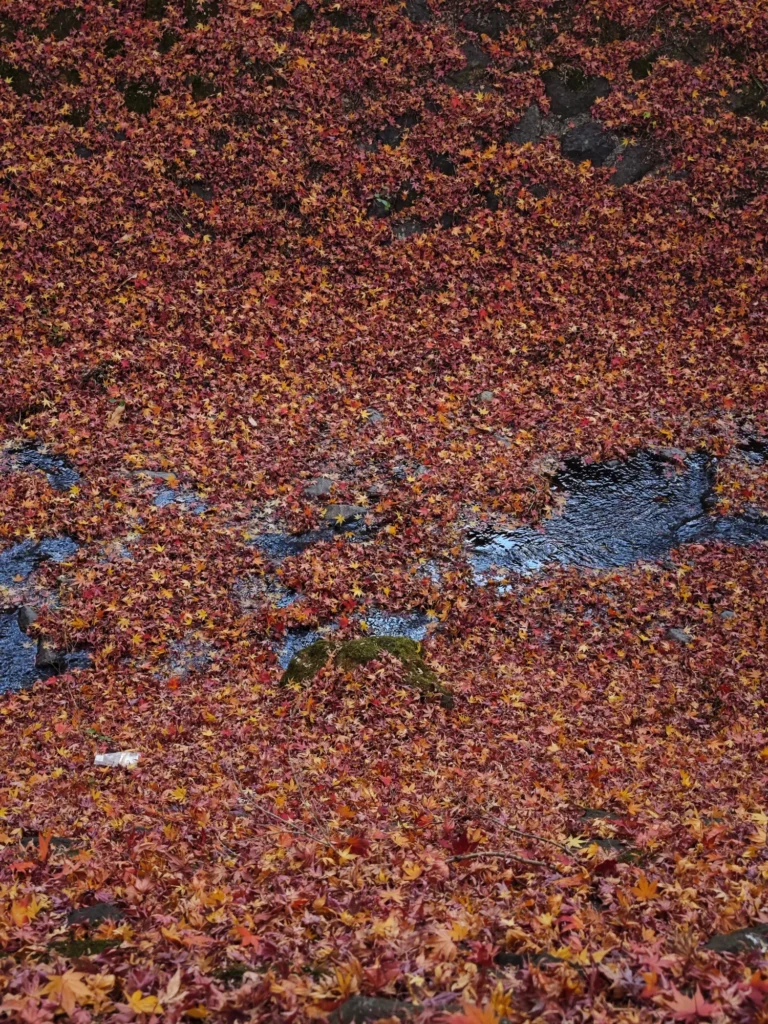
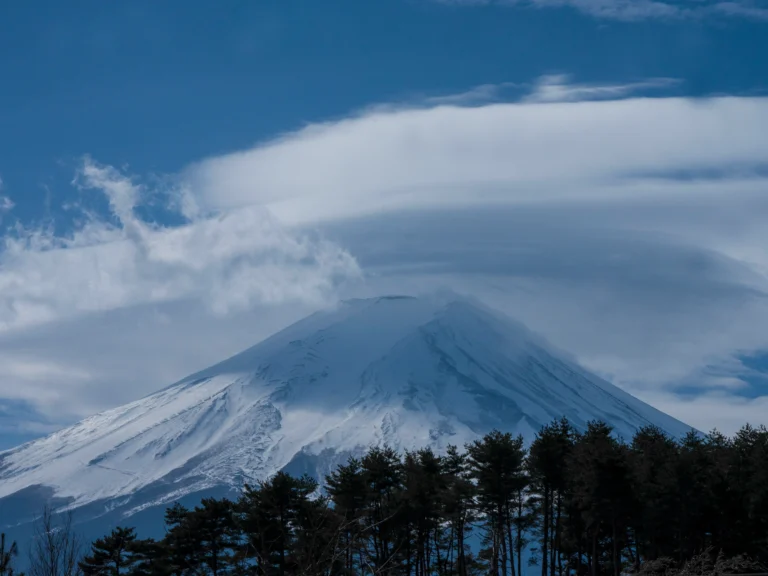
Around the corridor the roadside maples were redder than the ones over the stream, so the festival venue is not the only place to look. The shore a few minutes away was quieter, with Mt Fuji mostly behind cloud.
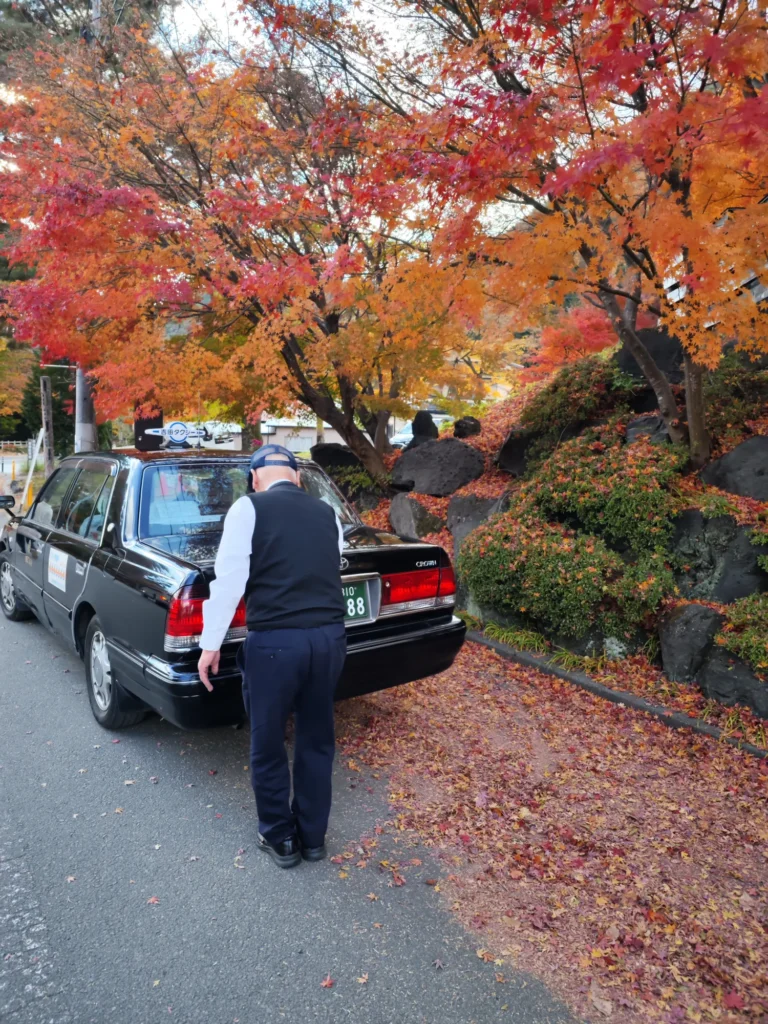
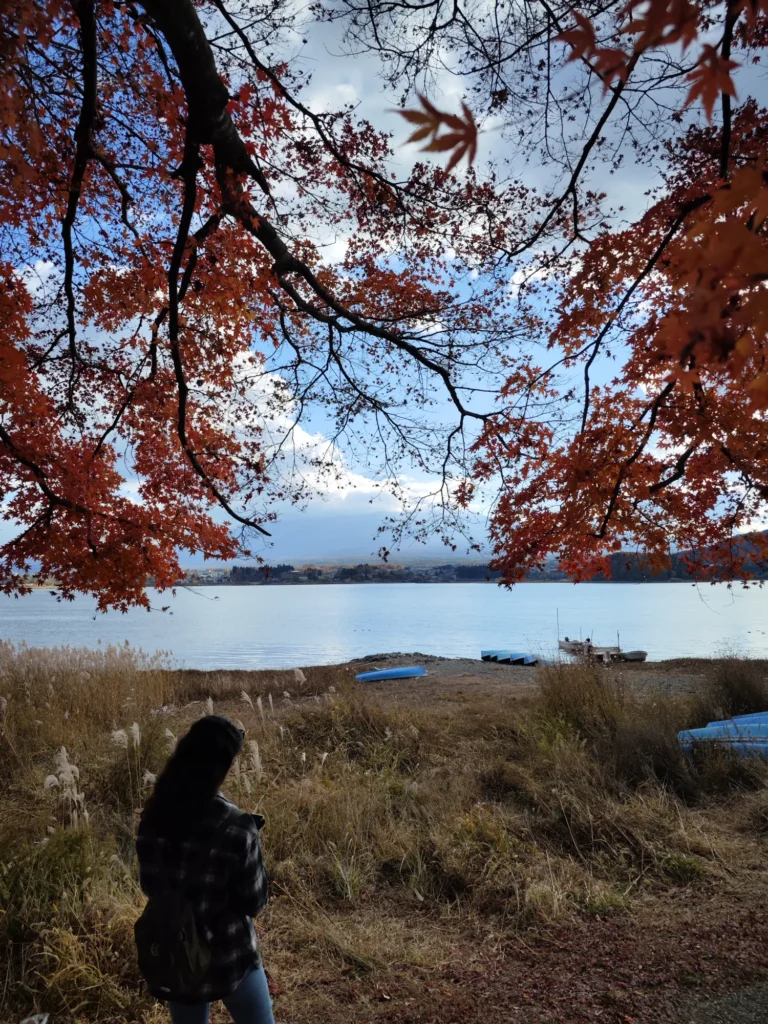
The 2026 festival details, including the proposed car park charge and the last sightseeing bus back from the corridor, which leaves well before the lights go off, are in our Kawaguchiko Autumn Leaves Festival guide. Nearby Lake Yamanaka holds its own autumn leaves festival earlier in the season.
Staying near the corridor
For a stay within walking distance of the illuminations, check hotels near the Momiji Corridor on the north shore and confirm the walking route before booking.
Momiji: short answers
What does momiji mean in Japanese?
Momiji (紅葉) means leaves turning red or yellow in autumn, the coloured leaves themselves, and, as another name, the maple tree. It comes from an old verb, momitsu (later momizu), meaning to take on autumn colour.
Is momiji the same as kaede?
Both refer to maples. Kaede (楓) is the name of the maple genus, from kaerude, “frog’s hand”, for the leaf shape. Momiji is the everyday and poetic name, and it also means autumn colour in general, including on trees that are not maples.
Is 紅葉 read momiji or kōyō?
Both. Kōyō is the Sino-Japanese reading of 紅葉. It means autumn colouring and the coloured leaves themselves; momiji can also mean a maple tree. Written down, 紅葉 can be either, and only the context or a printed reading guide tells you which.
What is momijigari?
Momijigari (紅葉狩り) is going out to look at autumn leaves. Nipponica describes it as an elegant pastime of the court and aristocracy that spread to ordinary people in the Edo period, when Ueno and Kaian-ji in Shinagawa were among Edo’s famous maple spots.
Why is venison called momiji?
Momiji is a traditional name for venison, reflecting the familiar pairing of deer and autumn leaves in poetry and art.
What does shikato have to do with maple leaves?
Shikato, slang for ignoring someone, is explained by Daijisen and Nihon Kokugo Daijiten as coming from the October hanafuda card worth ten points, where a deer under the maples has its head turned away. Both dictionaries introduce the explanation with “it is said”.
Are the Momiji Corridor and the Momiji Tunnel the same place?
No. The Momiji Corridor is a row of maples along the Nashi River in the Kawaguchi district, and it is where the Fujikawaguchiko Autumn Leaves Festival is lit up, 7–29 November 2026. The Momiji Tunnel is a stretch of maple-covered road in the Oishi district, about ten minutes away by car, past Oishi Park.
When do the maples turn in Japan?
On the Meteorological Agency’s 1991–2020 averages for its observatory trees, the front starts in eastern Hokkaido in mid-October, reaches Tohoku around 20 November and Kanto around 30 November, and reaches Kinki and southern Kyushu in early to mid-December; higher elevations generally colour earlier. For trip planning, see Japan in October 2026 and Japan in November 2026.
Sources
The dictionaries, observation guides and official pages behind this article, checked 5–6 October 2026
- Kotobank (Daijisen, Nihon Kokugo Daijiten, Nipponica, Heibonsha World Encyclopedia, Britannica Japan): 紅葉, もみじ, 楓, イロハモミジ, 黄葉, 紅葉狩, 狩, 草紅葉, 紅葉前線, 紅葉のような手
- Kotobank, poems and cards: 小倉百人一首 (poem texts), 猿丸大夫, 竜田川, 小倉山, 花札, しかと, もみじ饅頭
- Japan Meteorological Agency — phenological observation pages, with the observation guides for maples and ginkgo (PDFs, 1991–2020 averages)
- Japan Weather Association — first 2026 autumn colour forecast, 1 October 2026 (tenki.jp)
- Agency for Cultural Affairs, Cultural Heritage Online — Man’yōshū (Genryaku manuscript, book 2): the oldest anthology of waka, compiled in the later eighth century
- Fujikawaguchiko Tourism Association — Kawaguchiko Momiji Corridor and 2026 Fujikawaguchiko Autumn Leaves Festival notice (Japanese)
- Yamanashi Tourism Organization — Momiji Corridor (information as of 28 September 2026), Momiji Tunnel (as of 10 December 2025) and autumn leaves feature with elevations (Japanese)
- Hotokuji — 2026 event list (Japanese)
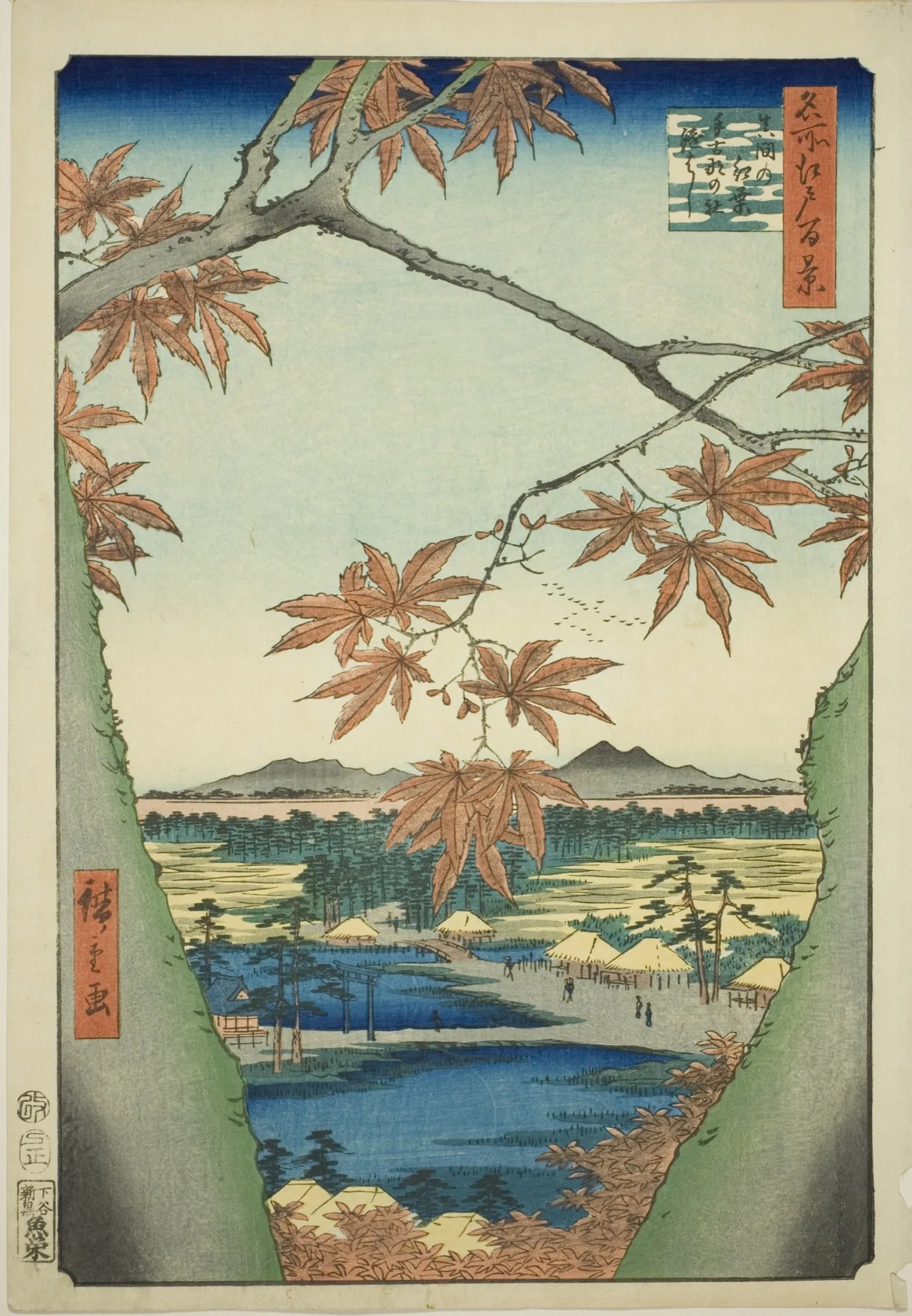
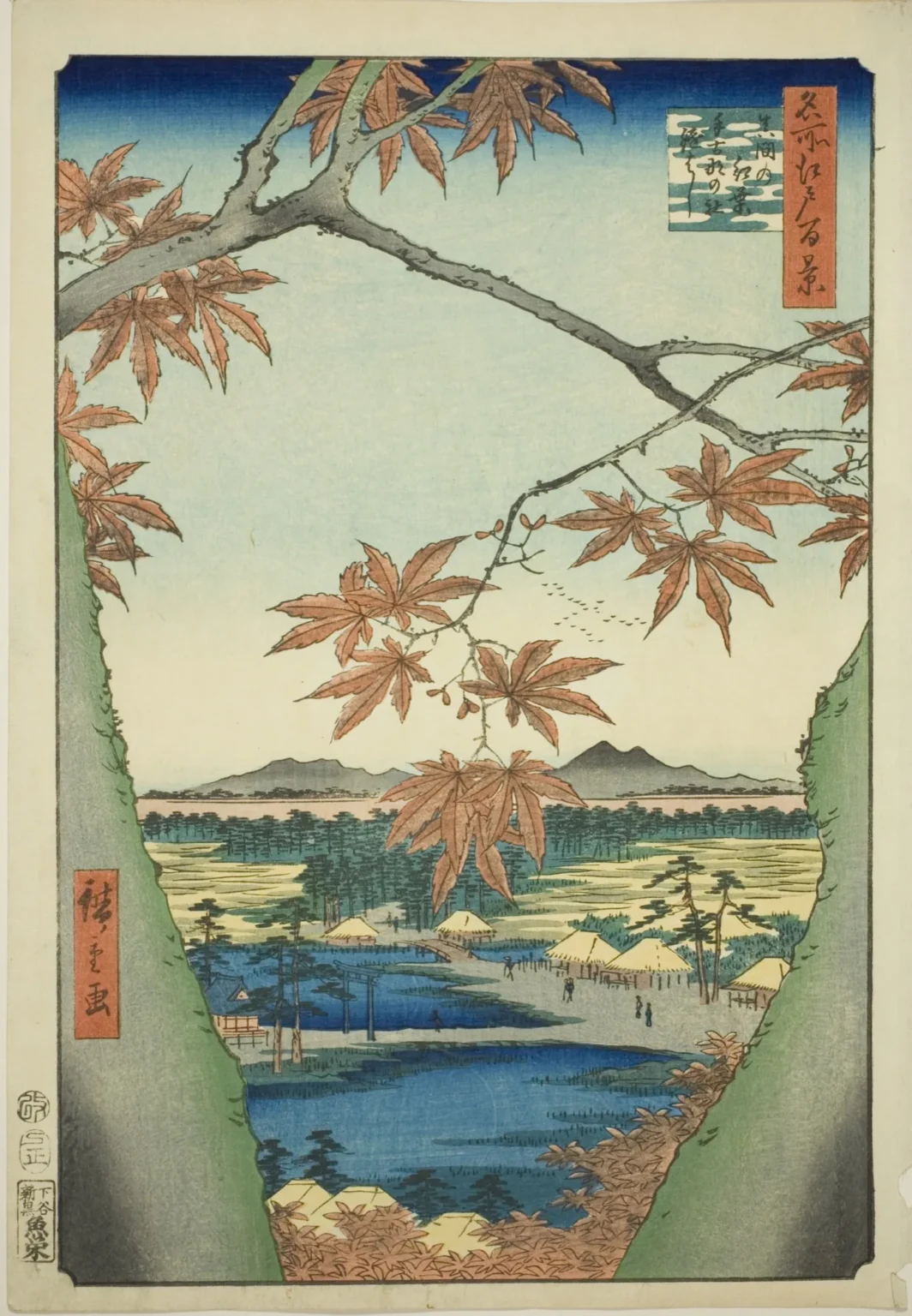
- Artworks — Art Institute of Chicago: Hiroshige, Maple Trees at Mama and Tosa Mitsuoki, Autumn Maples with Poem Slips; The Metropolitan Museum of Art: Hokusai, Poem by Sarumaru Dayū and Hokusai, Poem by Ariwara no Narihira (all public domain)
Join travelers discovering Japan's hidden side
Weekly dispatches from off-the-beaten-path Japan — spots and stories you won't find in guidebooks.
No spam. Unsubscribe anytime.
Welcome aboard!
You're in. See you in your inbox soon.