Climbing season status
The 2026 climbing season ended on 10 September 2026
The official trails to the summit and the mountain huts are closed. Climbing to the top is not something to attempt now — the route markers, the huts and the first-aid stations that operate only during the season are gone until next summer, and so is the entry reception.
Some 5th Stations may still be reachable for sightseeing, depending on road, weather, snow and bus conditions on the day. That is not the same as the climbing trails being open.
Dates and current conditions: the official Mt Fuji climbing site.
Yamanashi · Mt Fuji · Climbing
Climbing Mt Fuji’s Yoshida trail in 2026 meant paying a ¥4,000 toll per person — at the Fifth Station on the day, or in advance through the English-friendly online reservation on Asoview, the ticketing platform linked from the official fujisan-climb.jp site. To book ahead, you pick a day-trip or hut-holder ticket, agree to a set of safety pledges, pay by card or PayPay, and get a QR e-ticket to show at the Fifth-Station gate. Here’s the whole process, screen by screen, with the parts that trip people up.
Season over: the 2026 climbing season ended on 10 September, and the Yoshida trail from the Fifth Station to the summit is closed until next summer. There are no 2026 dates left to book, and the 2027 rules, fee and booking dates have not been announced yet. The steps below show how the 2026 system worked.
I’m Nobu. The paid-permit system confuses a lot of first-time Fuji climbers — where you actually pay, which ticket to choose, whether it books your hut (it doesn’t), and what you’re agreeing to. I went through the official English reservation flow and captured it so you know exactly what to expect before you climb. This covers the Yoshida trail on the Yamanashi side — the main route, and the one with this specific ¥4,000 gate.
Read this first: the permit is not a hut booking. The ¥4,000 covers passage through the Yoshida gate. If you plan to sleep in a mountain hut, you reserve and pay for that separately, and you should book the hut before you buy the hut-holder version of this ticket.
The 2026 rules you’re agreeing to
Buying the ticket means accepting the Yoshida trail rules, so it’s worth knowing them before you pay. Before you climb, also check the Mt Fuji summit weather and wind — a separate question from whether the mountain looks clear from town.
| 2026 Yoshida trail | Rule |
|---|---|
| Permit fee | ¥4,000 per person per climb, paid online in advance or at the Fifth Station |
| Season | 1 July – 10 September 2026 |
| Daily cap | 4,000 climbers/day (mountain-hut guests are exempt) |
| Gate hours | Closed 14:00–3:00 (hut guests may pass; others wait for 3:00) |
| Equipment check | Cold-weather clothing, separate rain gear, proper climbing footwear |
| Not allowed | Overnight “bullet” climbs without a hut, leaving the trail, taking rocks/plants, graffiti |
Before you start
Fix your climb date
You book for a specific date, which you can move until the day before. Cancelling is possible only until the day after you pay; after that there is no refund for personal reasons or bad weather — only if the Fuji Subaru Line is closed before you check in, or on-site climbing guidance stops the climb.
Book your hut first (if staying)
If you’ll sleep in a mountain hut, reserve the hut before buying the ticket, and choose the hut-holder version at checkout.
Have a card + your phone ready
Online payment is by card or PayPay, and the QR e-ticket lives on your phone. Bring a way to keep it charged for the gate.
Step by step: booking the permit
Step 1 · Start on the official site
Begin at the official Mt Fuji climbing site, fujisan-climb.jp (there’s an English version at /en/). It lays out the rules and links to the reservation system with a “Click here to purchase” button. That link goes to Asoview, the official ticketing partner — start there rather than a random third-party reseller.
Step 2 · Choose the right ticket (and switch to English)
On the Asoview ticket page, use the Language toggle (bottom-right) to switch to English. You’ll see two ¥4,000 tickets — pick the one that matches your plan.
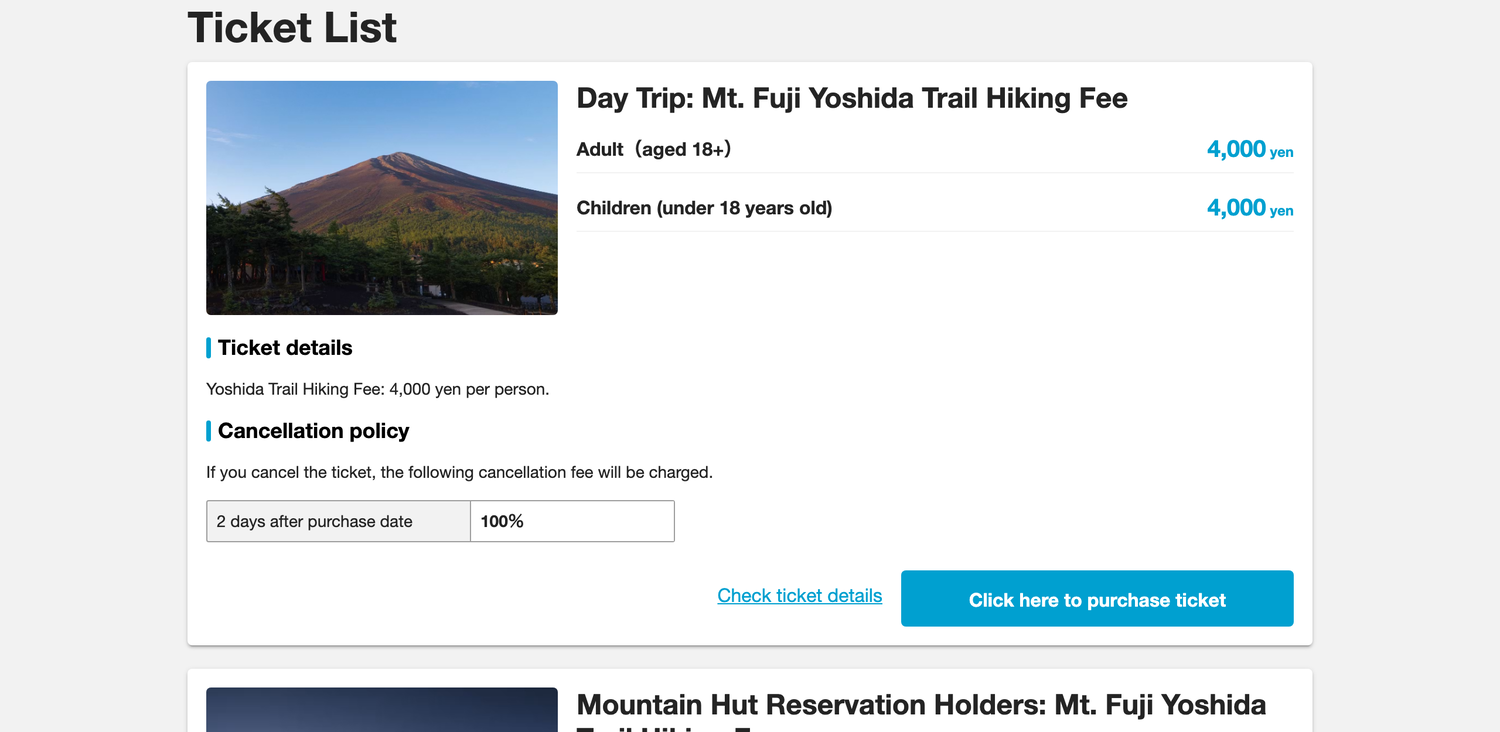
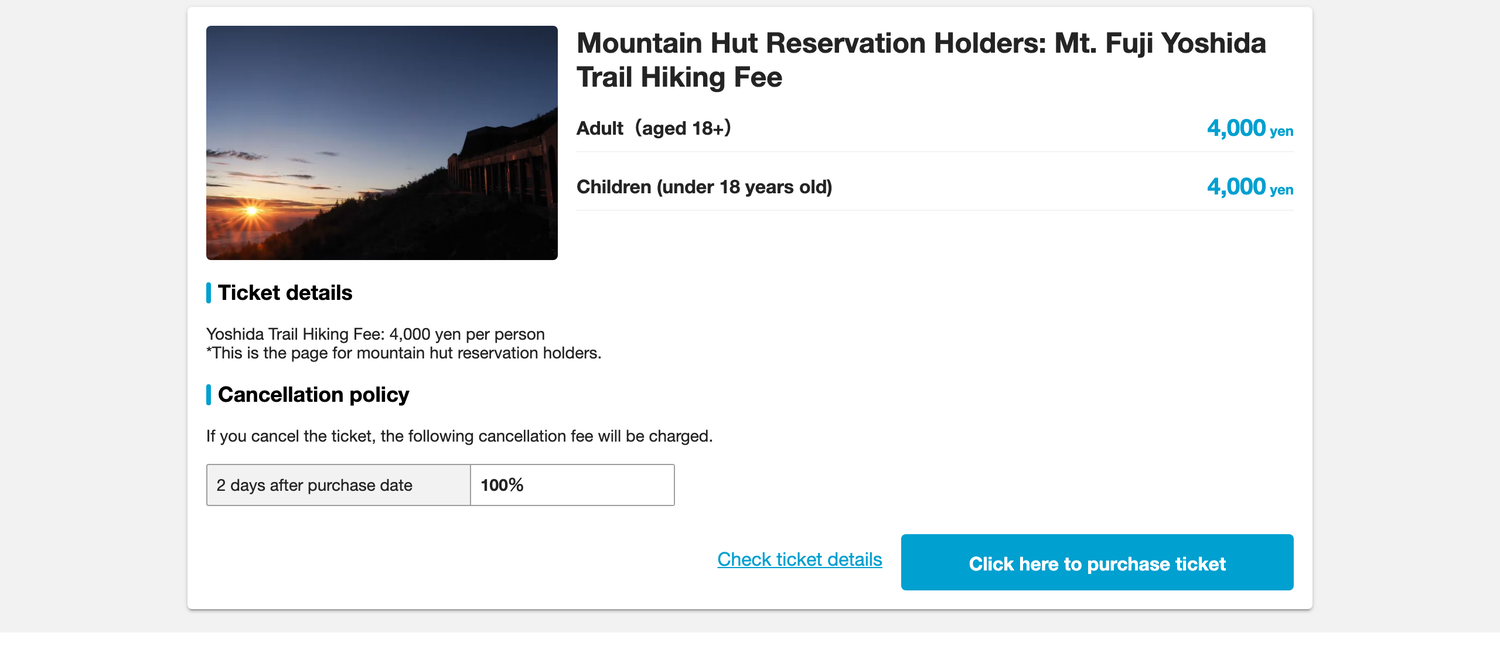
Day Trip ticket
For climbing up and down in a day with no hut. You’re bound by the 3:00 gate opening and the 4,000/day cap.
Mountain Hut Reservation Holders
For anyone with a hut booked. This ticket exempts you from the daily cap and lets you pass the gate outside 3:00–14:00 — but book the hut first.
Step 3 · Pick your date and number of people
Choose your climb date on the calendar, then the number of climbers — one ticket per person, adults and children alike at ¥4,000. A few groups pay nothing — people with a disability and their carers, school groups on a curricular educational activity, and anyone walking only between Umagaeshi and the Fifth Station — but they claim it at the on-site counter or with forms sent to Yamanashi Prefecture, not by buying a ticket. Watch for any “sold out / cap reached” note on busy summer dates.
Step 4 · Read and tick the safety pledges
Before payment you confirm a set of pledge checkboxes — proper gear, no bullet-climbing, staying on the trail, understanding the gate hours. Don’t tick them blindly; the equipment ones are enforced by a real check at the Fifth Station.
Step 5 · Log in or create an Asoview account
Asoview asks you to log in or make a quick account so your ticket and confirmation are tied to your account. Keep your login details handy.
Step 6 · Pay by card — and save your QR ticket
You pay the ¥4,000 in advance by card or PayPay — a booking cannot be held without paying. After payment, Asoview issues a QR-code e-ticket to your Asoview account. Keep it reachable on your phone even if signal drops at the trailhead, because you show that QR at the Fifth-Station gate.
A note on how I did this: I walked the flow in English and stopped at the payment step — I didn’t complete a purchase, so I’m describing the date, pledge, login and payment screens rather than showing a real ticket, order or card details. When you do it for real, the checkout screen is where you confirm your date, ticket type and total, and pay.
At the Fifth-Station gate
On climb day, have the QR e-ticket ready and be prepared for the equipment check — cold-weather layers, separate rain gear and real climbing shoes. Remember the gate is closed 14:00–3:00: without a hut booking you can’t start in that window, so a day-trip climb can start once the gate opens at 3:00. The permit is passage, not a guarantee — bad weather or an official closure can still stop the climb.
Cancellations & getting help
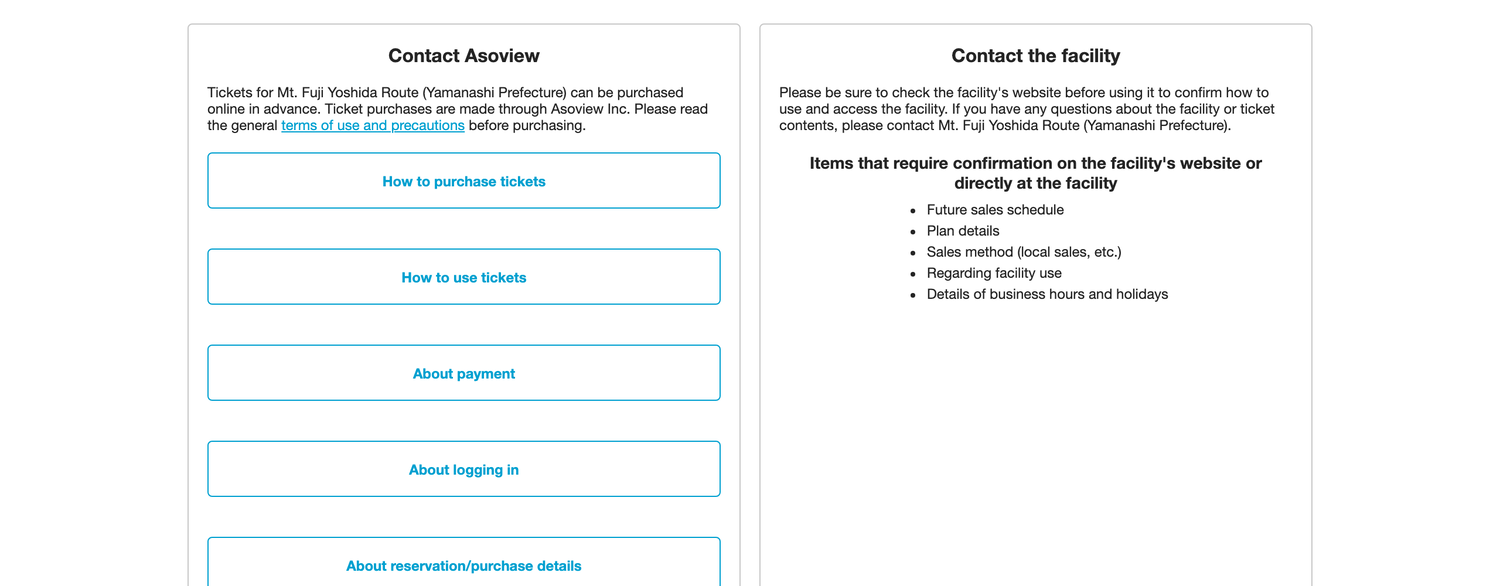
The cancellation terms are strict: you can cancel until the day after you pay, and from the second day after payment the fee is 100%. You can still move the booking to another date until the day before your climb, but not change the number of people. After that window there is no refund for personal changes of plan or bad weather on its own. If the Fuji Subaru Line (the road to the Fifth Station) is closed on your date, bookings that had not yet checked in at the gate are refunded automatically, with nothing to apply for. A climb stopped by on-site climbing guidance also qualifies for a refund. Asoview’s own help panel (in English) links out to guidance on purchasing, payment and login.
Plan the Rest of Your Fuji Climb
Common mistakes to avoid
Thinking it books a hut
It doesn’t. Hut nights are booked and paid separately — do that first if you’re staying over.
Buying the hut-holder ticket with no hut
Only choose that version once your hut is actually reserved.
Planning to start during gate-closed hours
No hut means no passage between 14:00 and 3:00 — build your day around the 3:00 opening.
Skimping on gear
The Fifth-Station check can turn you back. Rain gear, warm layers and proper footwear are non-negotiable.
Where to book: 2026 bookings were made on the official Mt Fuji Yoshida Trail reservation page (Asoview) — switch to English with the Language toggle. Booking for 2027 has not opened yet; check next season’s rules on fujisan-climb.jp before you pay.
Climbing Mt Fuji 2026
The full route, gear list, timing and how the day runs.
Mt Fuji mountain huts
What a hut stay is like — and why a hut changes your gate options.
Midnight bus to the 5th Station
Getting to the trailhead from Tokyo without a car (a summer-season bus).
Where do I actually pay the ¥4,000 Mt Fuji fee?
In 2026 you could pay at the Fifth Station on the day, or online in advance through Asoview, the official ticketing platform linked from the official fujisan-climb.jp site. Online, there’s an English version of the page (use the Language toggle), you pay by card or PayPay, and you receive a QR e-ticket to show at the Fifth-Station gate.
Does the permit include a mountain hut?
No. The ¥4,000 is a passage fee for the Yoshida trail only. Mountain-hut nights are booked and paid for separately, and you should reserve the hut before buying the “Mountain Hut Reservation Holders” version of the ticket.
Which ticket do I choose — Day Trip or Hut Holder?
Choose Day Trip if you’re climbing up and down without staying overnight. Choose Mountain Hut Reservation Holders only if you already have a hut booked — that version exempts you from the daily cap and the 14:00–3:00 gate closure.
Can I reserve on the day I climb?
Yes, during the season. Advance bookings were limited to 3,000 a day up to the day before; on the climb day, places opened up to the full 4,000-a-day cap (for day-trippers; hut guests are exempt), and you could also pay at the gate. Booking ahead is still the safer choice in peak summer.
Can I get a refund if the weather is bad?
Generally no. You can cancel only until the day after you pay; from the second day the fee is 100%. You can move to another date until the day before, though. After that window, refunds are made only if the Fuji Subaru Line is closed on your date (provided you had not checked in and received a wristband) or the climb is stopped by on-site climbing guidance — not for personal cancellations or bad weather on its own.
Is this the same for all Mt Fuji trails?
No — this ¥4,000 online permit and these rules are specific to the Yoshida trail on the Yamanashi side. The Shizuoka-side trails (Subashiri, Gotemba, Fujinomiya) have their own 2026 arrangements, so check separately if you’re climbing those.
Join travelers discovering Japan's hidden side
Weekly dispatches from off-the-beaten-path Japan — spots and stories you won't find in guidebooks.
No spam. Unsubscribe anytime.
Welcome aboard!
You're in. See you in your inbox soon.