Mt. Fuji · Diamond Fuji · 2026-27
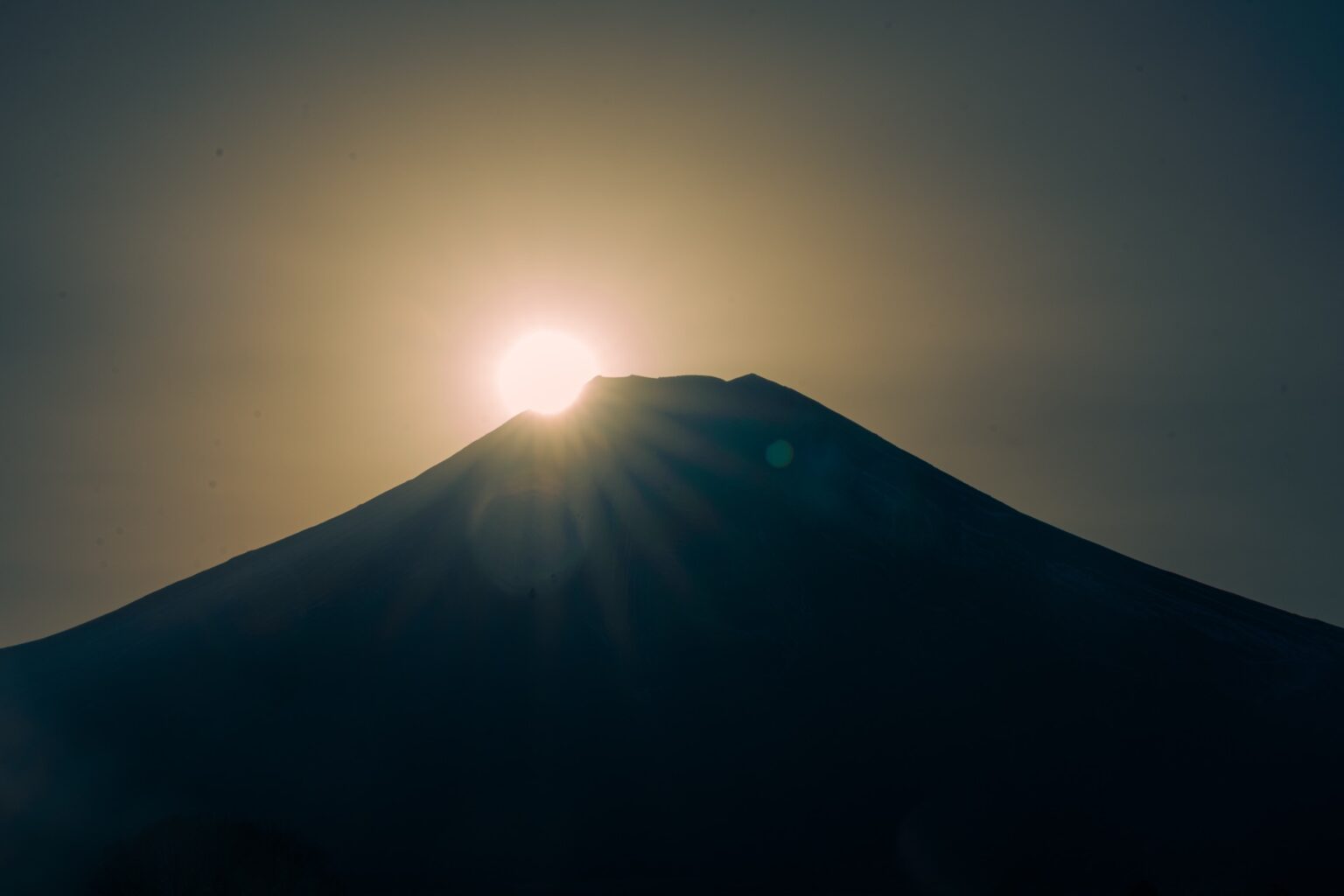
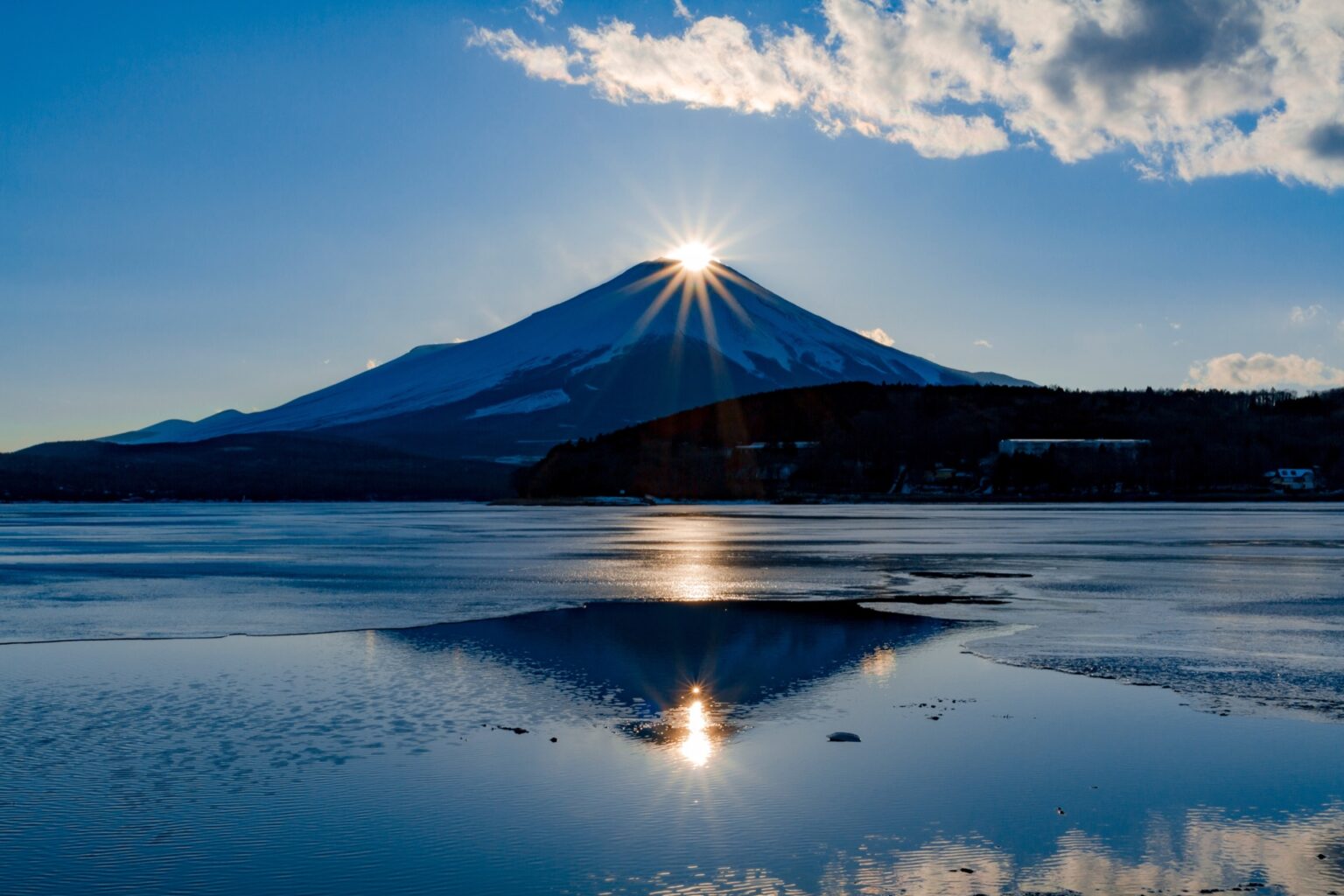
Diamond Fuji — the sun meeting the summit of Mt. Fuji — happens somewhere in the Fuji-viewing belt through most of the year, but every viewing point has its own narrow dates. For the 2026-27 season the calendar is filling in unevenly: Chiba City has already published official spot-by-spot dates for 14–23 October 2026, Sunshine 60 in Tokyo has announced sessions from 13 November 2026 and 25 January 2027, Lake Yamanaka’s nine spots run on official reference dates published without a year, and Mt. Takao’s 2026 window was still unannounced in mid-September. This guide sorts every major viewing area by what is actually known.
How the calendar actually works
The sun’s setting and rising points drift along the horizon through the year. Each viewing location sees Mt. Fuji’s summit in one fixed compass direction, so the alignment only lands there on a narrow set of dates — typically one pass in autumn and one in late winter for sunset spots east of the mountain, or spring and late summer for sunrise spots to the west and the far south. A few places break the two-date pattern honestly: sites with large grounds (Hana no Miyako Park at Yamanaka) or a whole stretch of riverbank can track the alignment for weeks as the ideal standing point migrates.
Three planning rules follow from the official caveats rather than from folklore. First, MLIT’s date lists warn that the calendar shifts one to two days between years — so undated reference lists are planning tools, not guarantees. Second, the exact date depends on the summit’s direction and apparent height from where you stand: high observation floors run on different dates from the ground below them, and MLIT notes its calculations do not account for viewing-floor elevation. Third, the moment is short — the brightest instant is a matter of seconds — and it happens well before flat-horizon sunset, so “I’ll arrive around sunset” is how people miss it.
Region by region, labelled by status
| Where | Season & status |
|---|---|
| Lake Yamanaka (Yamanashi) | Sunset side. Nine official spots relay the alignment mid-Oct → late Feb; yearless reference dates, 2026-27 calendar not yet published |
| Mt. Takao (Tokyo) | Sunset. 2025 official window was 17–28 Dec; 2026 TBA, forms around the 22 Dec solstice |
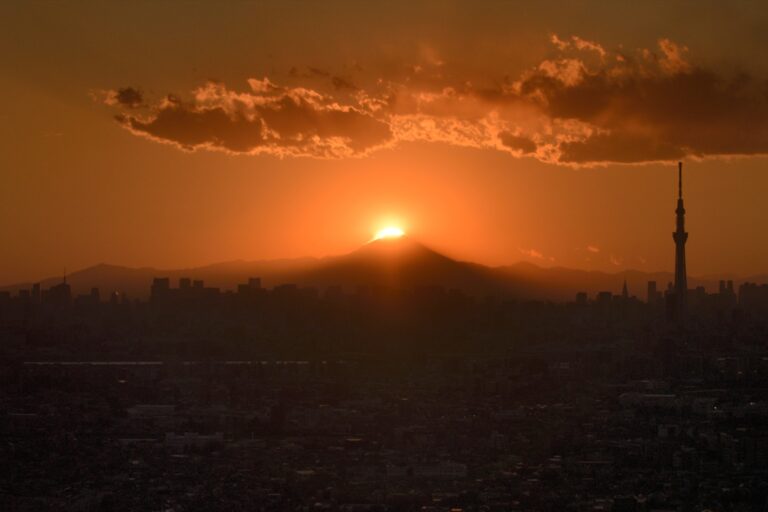
| Tokyo city venues | Sunshine 60 announced (13 Nov 2026 / 25 Jan 2027 starts); Skytree & Tokyo Tower ran official viewings last season, this season TBA; Arakawa banks have yearless MLIT references (Nov & Jan) |
| Chiba City bayfront | Sunset. Oct 2026 confirmed: 14–23 Oct citywide, spot by spot; Feb 2027 TBA (2026 ran 18–27 Feb) |
| Tanuki Lake (Shizuoka) | Sunrise + reflection (“double diamond”). About a week around 20 Apr and another around 20 Aug, per the city and the lakeside lodge; 2027 exact dates not published |
| Fujinomiya / Asagiri side | Sunrise belt west of the mountain; the city association describes viewing across roughly nine months of the year if you move between its spots |
| Mt. Ryugatake (Lake Motosu) | Sunrise, the New Year classic. Yamanashi’s list gives ~3 Dec–9 Jan as the season; a winter mountain hike — check current trail and car-park status before committing |
| Shonan coast (Enoshima area) | Sunset, typically early April and early September, varying by viewpoint along the beaches |
| Minami-Boso (Chiba) | The geometry flips seasons: late April to early June depending on the coastal point (Tateyama’s 2026 forecasts ran into early June); no 2027 list yet |
The calendar I actually check
For date-by-date planning I use the same tool I open at home: the Japanese-language Diamond Fuji & Pearl Fuji shooting calendar published by Oi (オイ), a Mt. Fuji photographer based here in Fujiyoshida. It lists each day’s rising and setting alignments with an approximate time and a named location, across more than 200 registered shooting points (as of writing), browsable month by month well into the season. His Fujitomo Map companion app draws the day’s Diamond Fuji viewing-position line on a map and shows the distance and direction to the summit from any point you tap.
Pearl Fuji — the moon, typically the full moon, rising or setting on the summit — is the lunar counterpart to Diamond Fuji, and the same calendar predicts it too; it is the rarer, stranger photograph of the two. One framing note the site itself insists on: its figures are calculated by its own method and carry margins of error, spots can be obstructed or inaccessible, and nothing there is an official event schedule. My workflow: shortlist candidate evenings there, then confirm against the official pages in this guide before committing a trip.
The five I would actually plan around
1 · Panorama-dai, Lake Yamanaka
The postcard composition, on reference dates around 16 October and 25 February. Parking is seven cars plus one accessible space — park at Mikuni Pass or Kirara and walk, per the association. February pairs with Diamond Fuji Weeks 2027, listed for 1–22 February in the annual plan.
2 · Chiba bayfront in October
The only fully confirmed 2026 dates as of writing: 14–23 October citywide, with the sun-on-summit “teppen” evenings listed per beach — Inage around the 18th, Kemigawa the 19th–20th, Makuhari the 21st–22nd, around 16:45–16:50. Fuji stands roughly 130 km away, so bring the long lens and hope for exceptional clarity.
3 · Mt. Takao in December
Tokyo’s classic, pending its 2026 notice: last season ran 17–28 December with 16:00–16:15 viewing and the cable car extended to 18:00, weather permitting. The Tokyo guide covers access, the summit wait and the city alternatives.
4 · Tanuki Lake in April or August
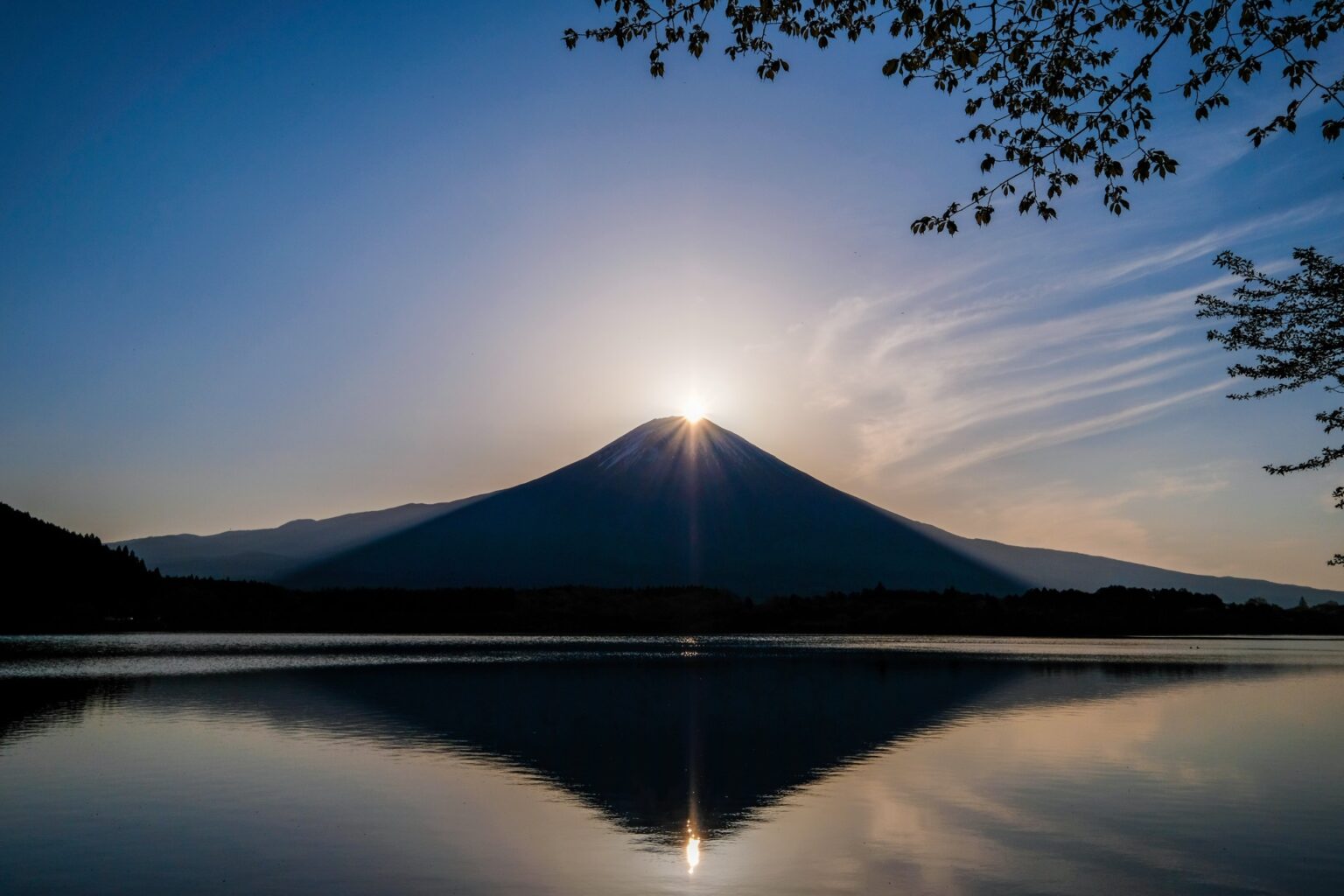
The sunrise mirror shot — double diamond over still water — in a window of about a week around 20 April and again around 20 August. A stay-overnight venue: the alignment comes at dawn, and lakeside positions go early.
5 · Sunshine 60, the city shortcut
Announced session starts of 13 November 2026 and 25 January 2027 make it the one Tokyo venue already on the season’s calendar — indoor warmth, skyline foreground, details still to be published.
Photographing it without hurting anything
The working kit is short: a travel tripod, because the light drops fast around the alignment; a spare battery kept warm in an inside pocket, because freezing waits eat charge; and touchscreen gloves, because bare fingers stop working right when the moment arrives. Longer glass rewards you here — 200mm and up isolates the summit — and the radial starburst in the photos comes from a stopped-down aperture, so it belongs to the lens, not the landscape.
Practical notes that survive fact-checking
Weather is the whole game: the sun must be visible at the exact minute it meets the summit, and no forecast fully promises that. Winter viewing spots run well below freezing by alignment time — dress for standing still. Arrive 30–60 minutes before the listed time for your spot; parking and positioning take longer than the event. And check the mountain itself before you commit an evening: my morning visibility report says whether Fuji is out from Fujiyoshida, the weather guide covers the forecast tools, and the seasonal guide explains why the cold months are the clear ones.
Base yourself where the dates are
One honesty note on tours: standard Fuji day tours run their own itineraries and do not promise Diamond Fuji timing or viewpoints — for the alignment itself, staying overnight near your chosen spot is the plan that works, which is why the Yamanaka and Kawaguchiko bases matter more than the bus.
Frequently asked questions
Which Diamond Fuji dates are actually confirmed for 2026-27?
As of 14 September 2026: Chiba City’s October window (14–23 October 2026, spot by spot) and Sunshine 60’s session start dates (13 November 2026 and 25 January 2027). Diamond Fuji Weeks 2027 at Lake Yamanaka is listed for 1–22 February in the association’s annual plan, marked subject to change. Everything else runs on yearless official references or last season’s records.
Is there one season for Diamond Fuji?
No single nationwide season. Sunset spots east of the mountain (Yamanaka through Tokyo to Chiba) concentrate from mid-October to late February; the sunrise belt west of Fuji runs on spring and late-summer windows (Tanuki Lake around 20 April and 20 August); Minami-Boso flips to late April–early June. Each location’s own dates are what count.
Can I use last year’s dates?
As a planning draft, yes; as a commitment, no. MLIT’s lists note a one-to-two-day drift between years, venues move their event dates, and high-floor venues set their own calendars. The workflow that works: draft with the references here, then confirm on the official page for your exact spot once your travel dates are fixed.
How long does the moment last?
The brightest instant — the “diamond” — is a matter of seconds, and the sun’s whole passage across the summit area varies by viewpoint. Be set up early; nobody refocuses in time after seeing it start.
Where is it easiest without a car?
Tokyo: Takao by train in season, or the announced Sunshine 60 sessions. Chiba’s October beaches are urban and station-walkable. Lake Yamanaka is richer but bus-based — the access guide covers routes, and the nine-spot guide covers where to stand.
What about Ryugatake’s New Year sunrise diamond?
The famous one — Yamanashi’s list gives roughly 3 December to 9 January for the area. It is a genuine winter hike: check current trail conditions and whether the trailhead car park is open before building plans around it, because neither is guaranteed year-round.
Sources
Official sources for every dated claim above, checked 14 September 2026
- Yamanakako Tourism Association — Diamond Fuji feature (nine yearless reference spots, parking rules) and annual events plan PDF (Weeks 2027)
- Chiba City Tourism Association — October 2026 spot-by-spot dates; Feb 2026 record via the city newsletter
- Takao Tozan Railway — Diamond Fuji page (2025 window; 2026 pending)
- Sunshine City — 2026 programme announcement
- Fujinomiya City — Tanuki Lake page and Kyukamura Fuji’s photo-season notes; Yamanashi Tourism — spot list incl. Ryugatake
- MLIT Kanto — viewing-date lists and calculation caveats (year drift; elevation)
- Fujisan to Tomoni (Mt. Fuji photographer Oi, Fujiyoshida) — shooting calendar and Fujitomo Map (independent calculated predictions; described with the site’s own caveats, predictions not reproduced here)
Join travelers discovering Japan's hidden side
Weekly dispatches from off-the-beaten-path Japan — spots and stories you won't find in guidebooks.
No spam. Unsubscribe anytime.
Welcome aboard!
You're in. See you in your inbox soon.