Fuji Five Lakes · Autumn field notes
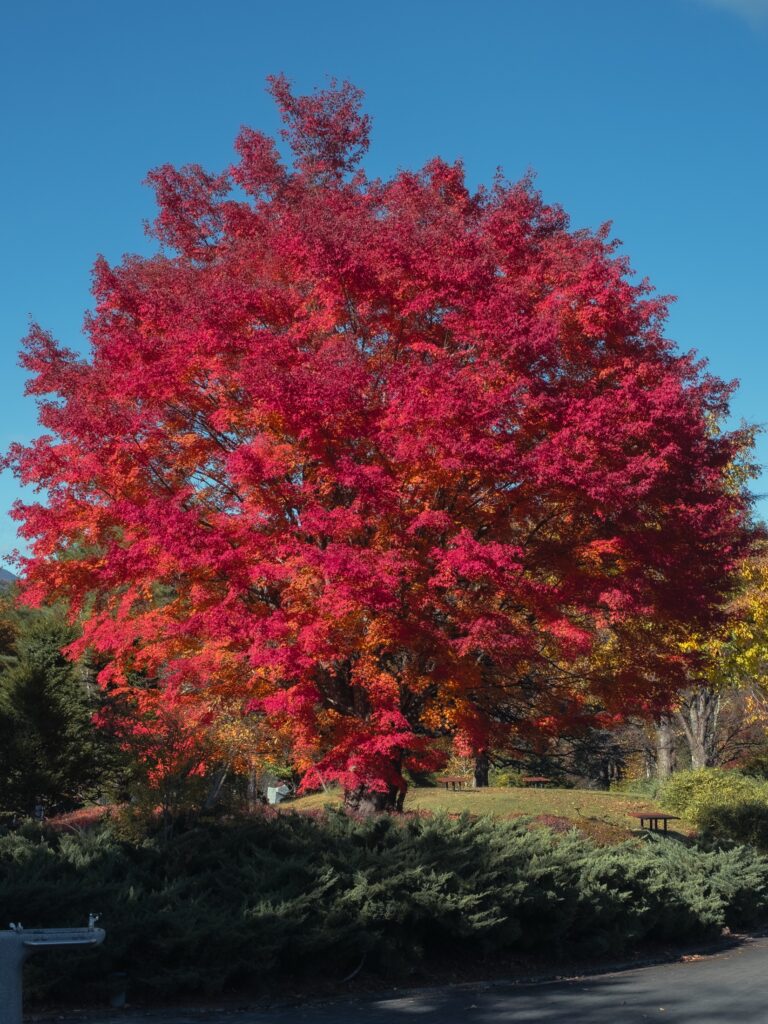
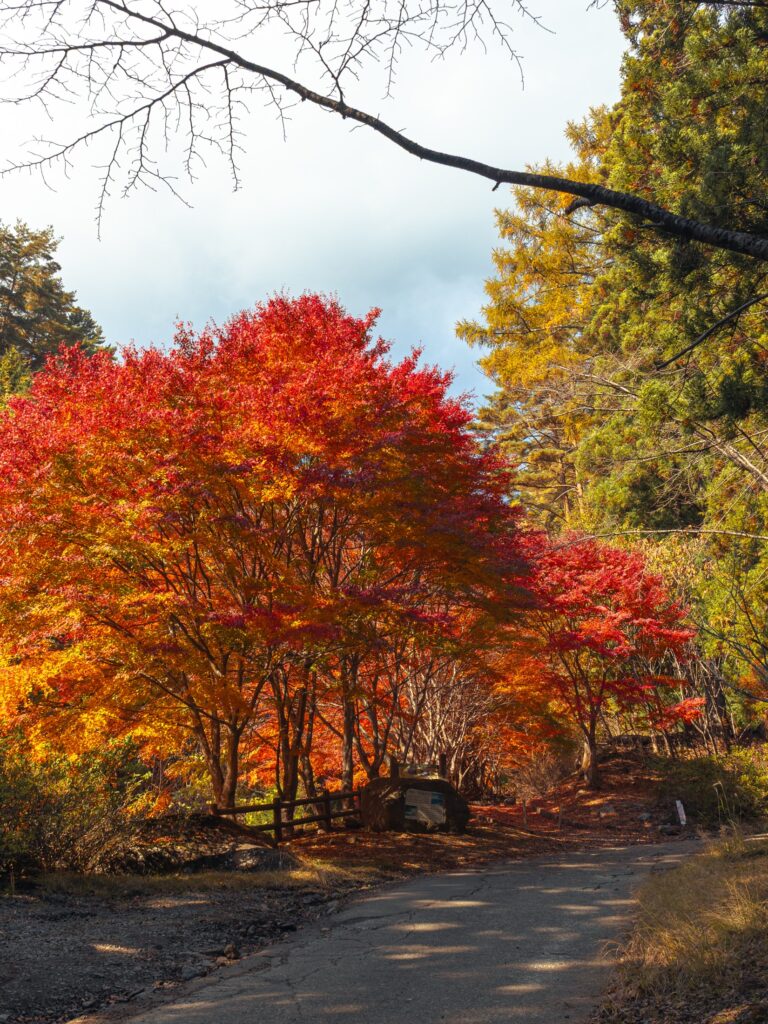
Autumn around Mt. Fuji is not one event — it is a slow slide downhill. In 2025 I photographed it three times in twenty-six days: golden larch high on the mountain’s flank on 2 November, maples at full burn around Kaneyama Falls in Fujiyoshida on 12 November, and the twin Taro and Jiro Falls in Tsuru still holding colour on 27 November. Same season, three altitudes, three different shows — and none felt crowded while I was there.
How the colour actually moves
The rule of thumb is altitude: higher generally turns earlier, though tree species and local weather matter just as much. On Fuji’s northern side the larch belt along the Subaru Line opens the season — the road operator’s own guide puts the roadside colour at roughly mid-October to early November, with the high Ochudo larch zone ahead of it — and the maples in the towns and low valleys follow.
My three dates are one year’s snapshots, not a forecast: they captured three stages of the season, not each site’s peak. What they do show is how long the window runs. A late-November trip can still be worth trying — I found full colour at Taro and Jiro Falls on 27 November.
| Stop | My 2025 date | What turns |
|---|---|---|
| Subaru Line, mid stations | 2 Nov | Larch (gold) |
| Kaneyama Falls, Fujiyoshida | 12 Nov | Maples (red) |
| Taro & Jiro Falls, Tsuru | 27 Nov | Mixed woodland |
Stop 1 — the golden larch belt of the Fuji Subaru Line
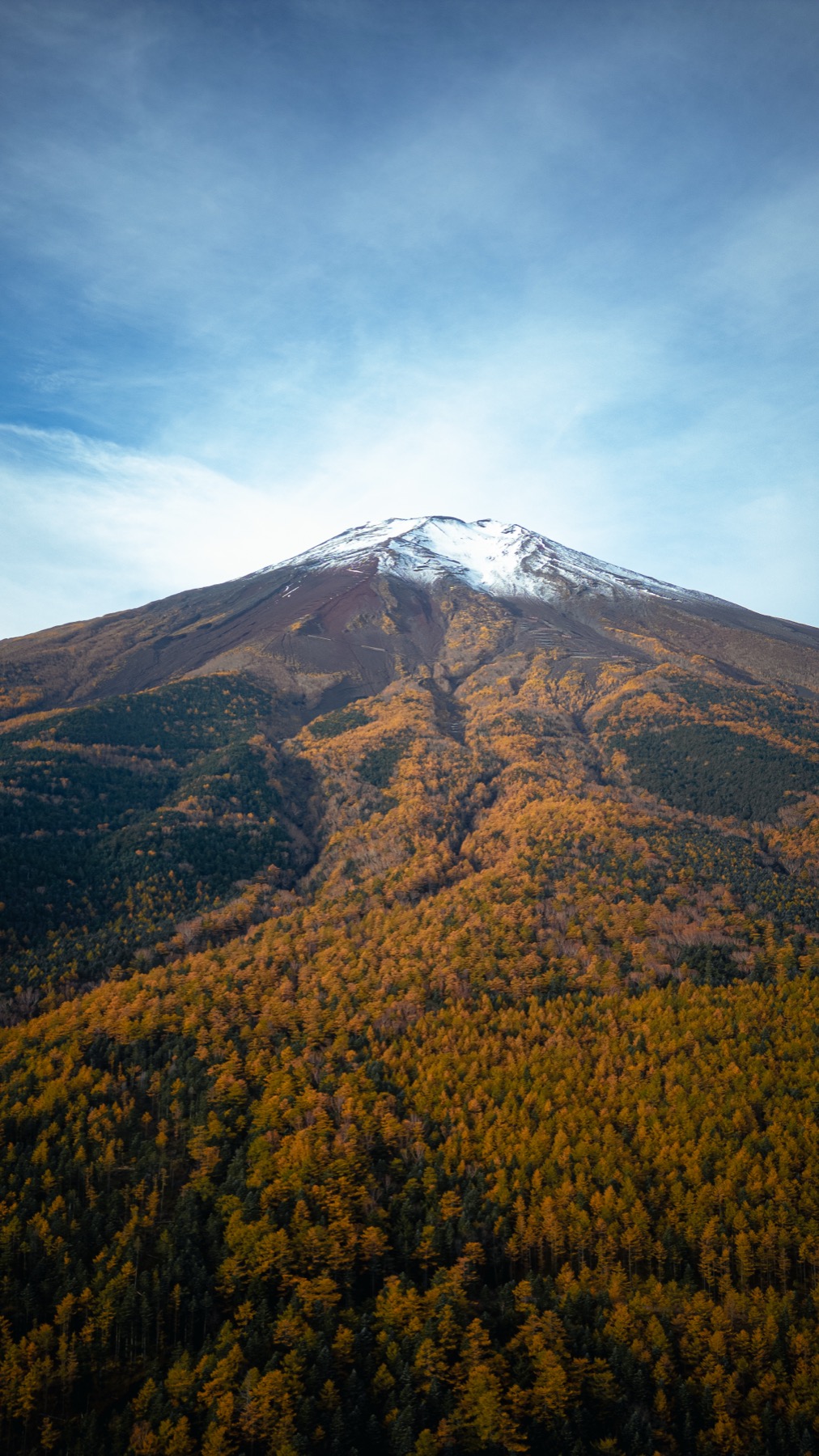
Most people drive the Subaru Line straight to the 5th Station. In autumn the middle of the road is the show: the toll road crosses a huge belt of karamatsu — Japanese larch, a deciduous conifer that turns gold and sheds its needles — and from above it looks like someone has drawn veins of gold through the dark evergreen forest, all the way up to the bare lava slopes.
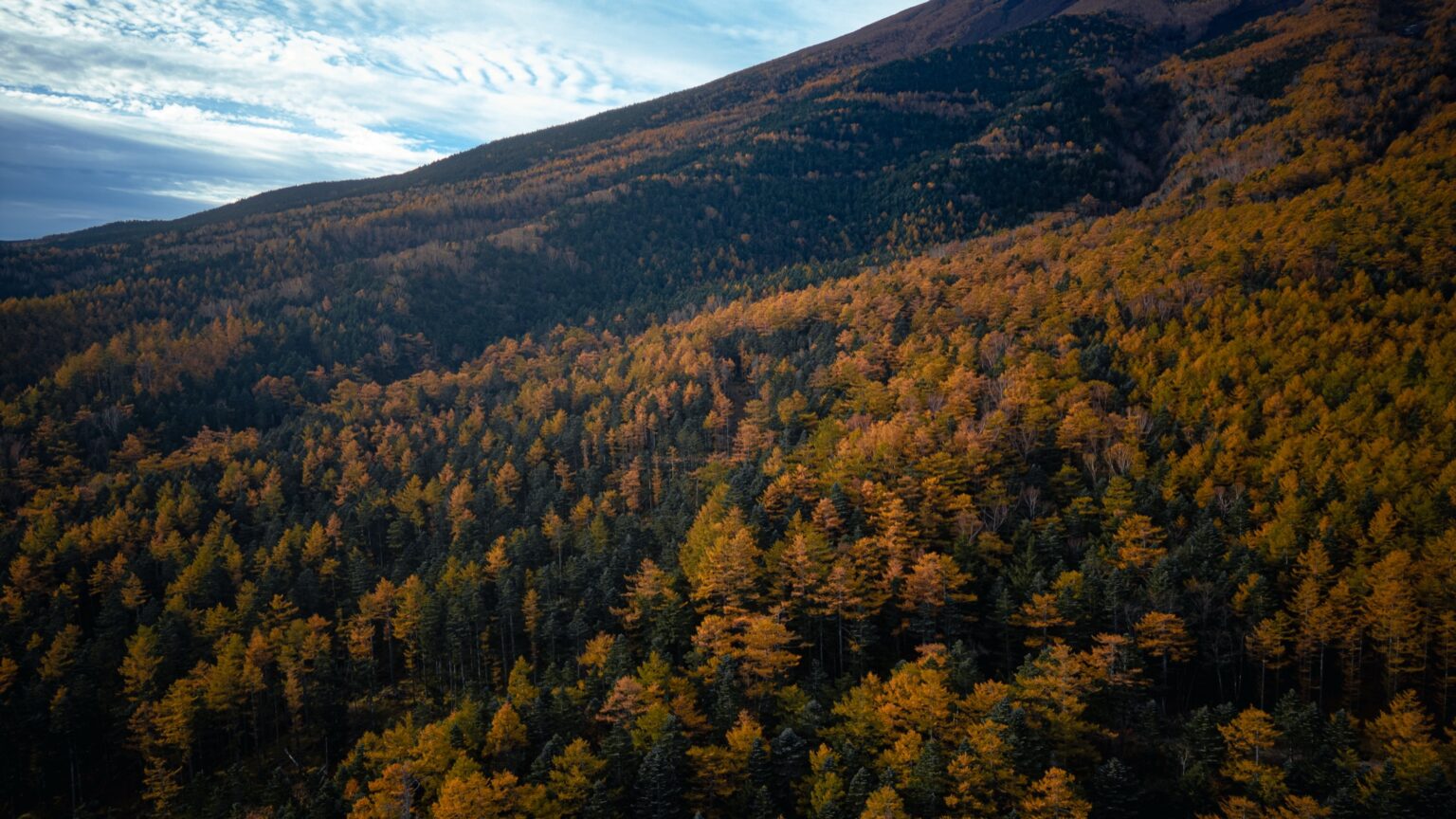
The road first: the Subaru Line is open to private cars outside the summer regulation season (the 2025 restriction ended 10 September), weather permitting — it closes temporarily in snow and high wind, which becomes more frequent from late autumn. Check the road corporation’s status page on the morning you go.
Timing: the road operator puts the roadside colour season at roughly mid-October to early November, the high Ochudo larch earlier. Years differ — on my 2 November 2025 flight the belt around the fourth station was still gold.
No car? Buses to the 5th Station depart from Fujisan Station and call at Kawaguchiko Station, Yongome Osawa Tenbodai (the Fourth Station Osawa viewpoint) and Oniwa (Okuniwa). The timetable effective 1 October 2026 lists five departures in each direction daily — a plan-around-the-timetable trip, not a turn-up-and-go one.
Stay nearby and take your time
Stop 2 — Kaneyama Falls, the town waterfall with a light-up
Ten days later the show had come down into Fujiyoshida itself. Kaneyama Falls is a roughly ten-metre waterfall that splits into two streams over a dark rock ledge, and it sits about two minutes’ walk from the Fujisan Museum — you park at a museum, cross a road, and there is a waterfall wrapped in maples. The viewing deck faces it straight on.
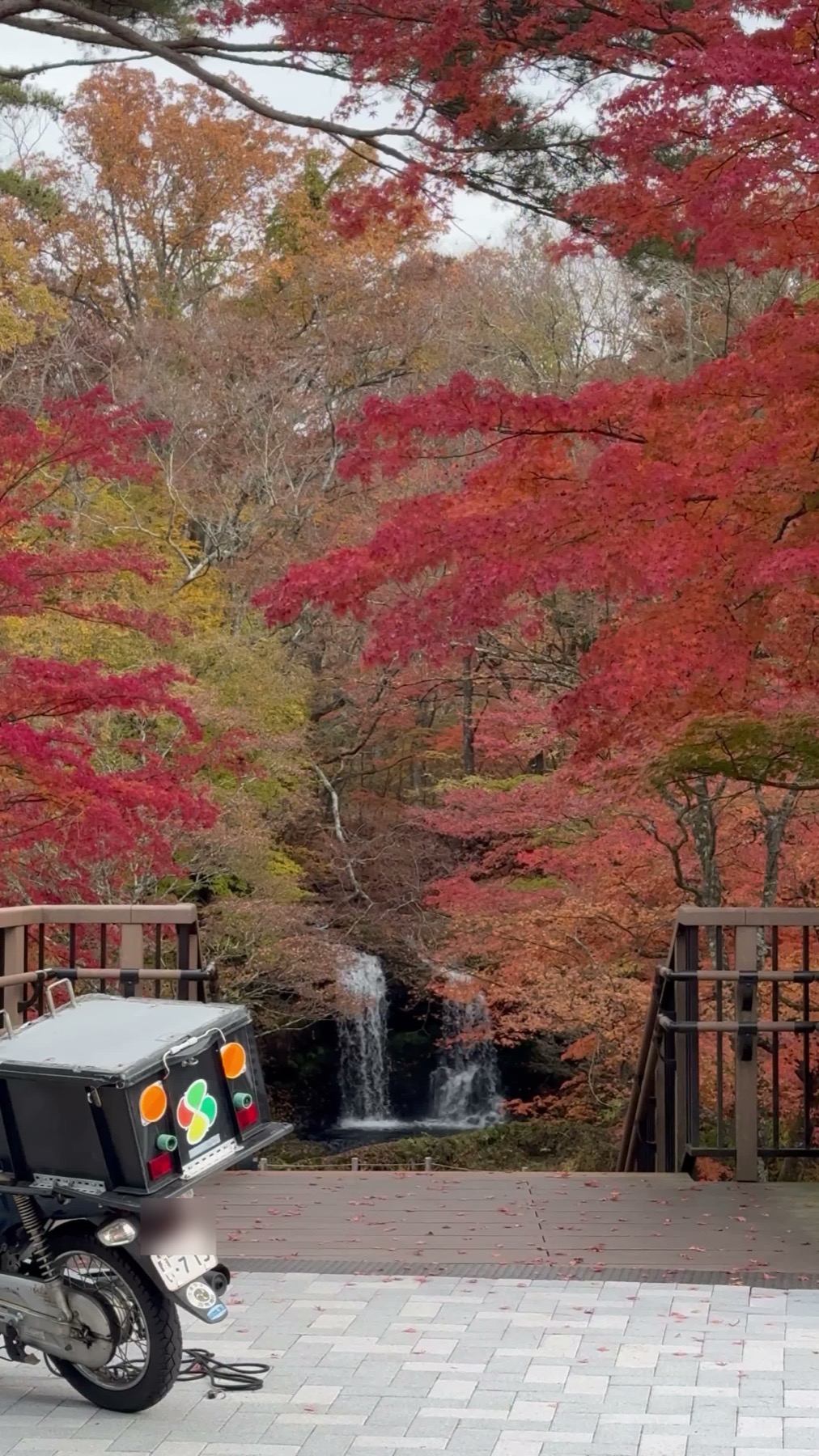
A waterfall at peak colour, two minutes from a museum car park — and on a Wednesday midday, one parked delivery bike for company.
The area around it is the Fujisan Museum Park, home ground of Fujiyoshida’s local leaf festival. In 2025 the festival ran 25 October–9 November — my photographs are from three days after it closed, and the colour was still at its best. Check the city’s event page for the current year’s dates before planning an evening around stalls.
The falls themselves are open around the clock and free, and the official visitor guide lists illumination from after sunset until 21:00. November sunset here comes before 17:00, so an early-evening visit is practical. I visited in daylight; the night shots you will see elsewhere are not mine.
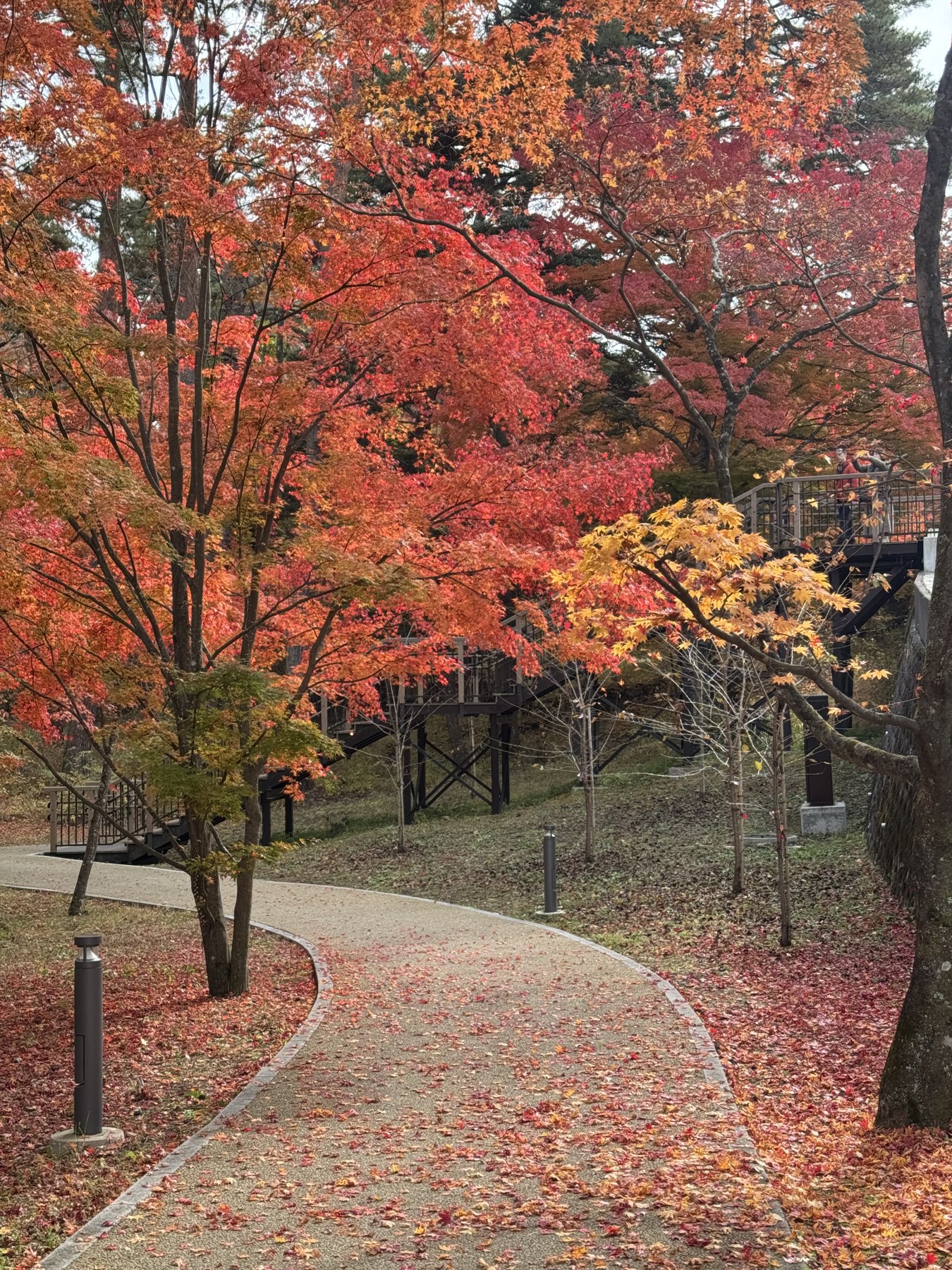
By bus, the Fujikko-go loop bus stops at Fujisan Museum Park Mae; by car the museum’s parking is right there. It pairs naturally with Chureito Pagoda in the same town — pagoda in the late afternoon, falls after sunset — allowing separately for the drive, parking and the climb up to the pagoda; the maple walls of Fuji Hokuroku Park sit up the hill from both.
Stop 3 — Taro & Jiro Falls, the valley finale in Tsuru
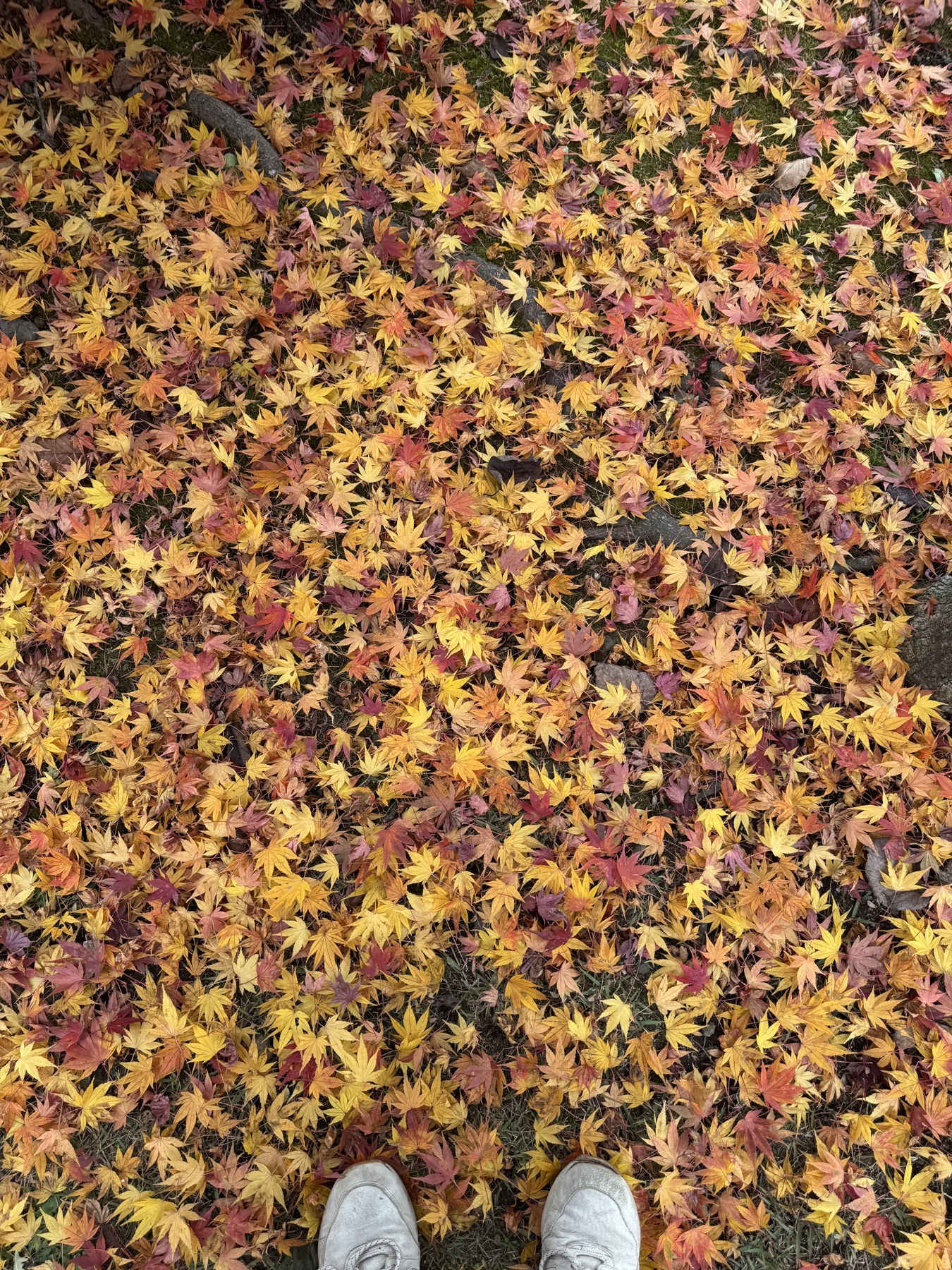
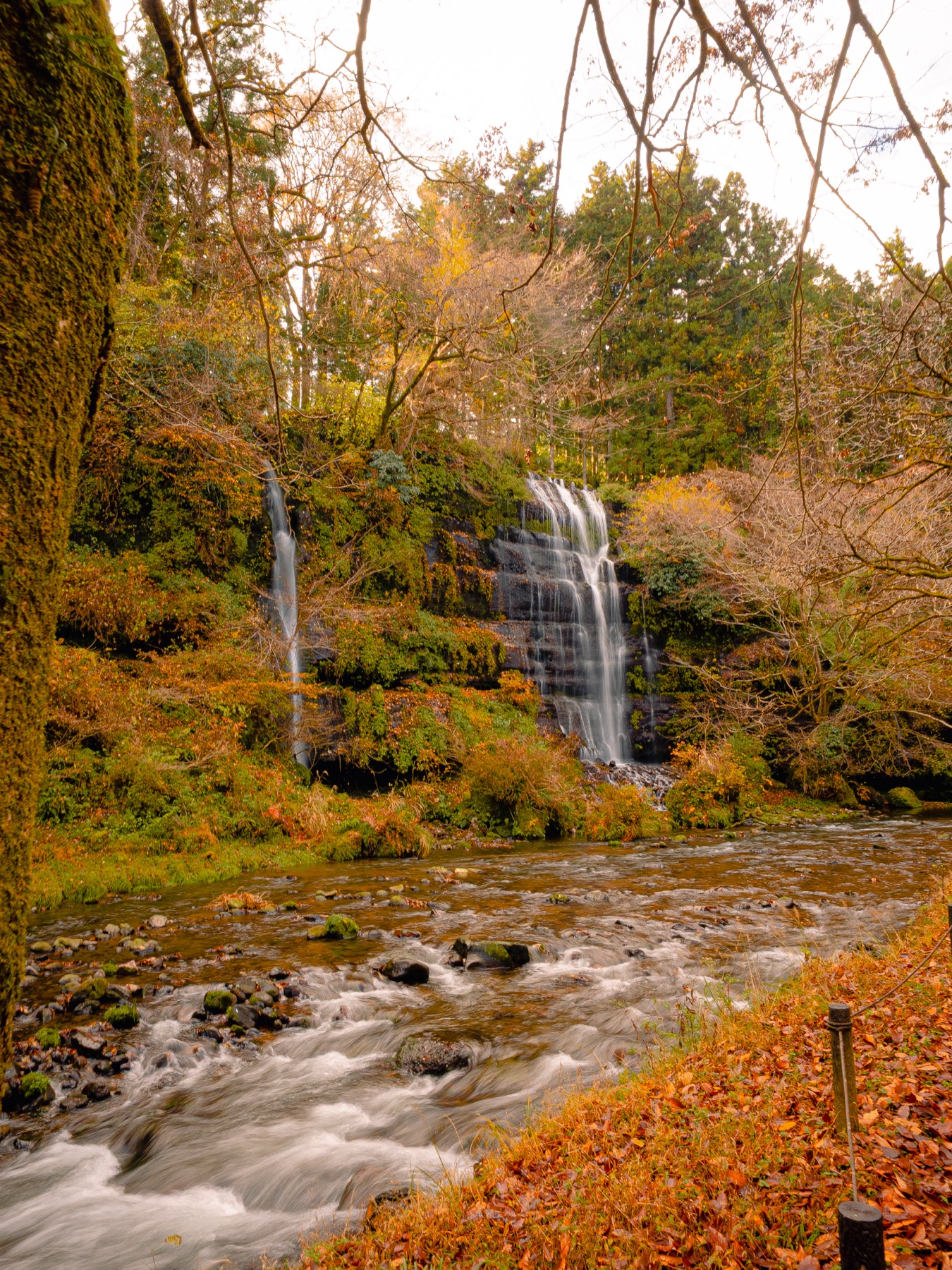
The season’s last act, for me, played out in the low river valleys east of Fuji. In Natsugari, a district of Tsuru, two waterfalls pour side by side over one mossy lava cliff — a thin straight ribbon and a wide tiered cascade. They are named Taro and Jiro, two brothers on one cliff; the city’s guide lists Taro as the fall set deeper in, Jiro the one nearer the path. On 27 November 2025 the woodland around them was still full of gold and rust.
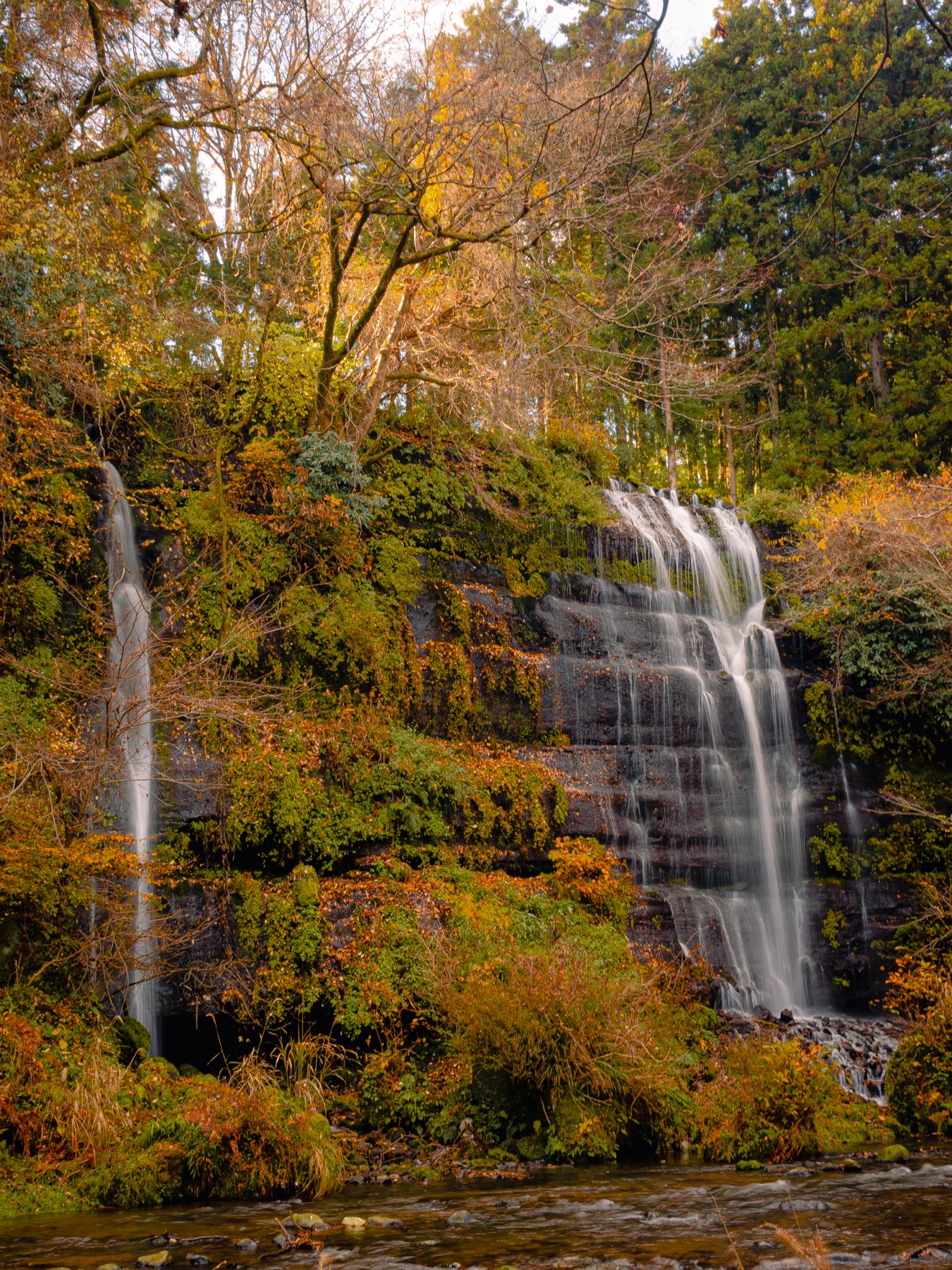
Getting there: the nearest station is Higashi-Katsura on the Fujikyu Railway line, about fifteen minutes’ walk, and the train is now the default — bus routes running entirely within Tsuru ended service on 31 March 2026 (routes connecting Tsuru with Otsuki and Doshi continue, but none of them helps here).
Driving, there is a small free lot in Natsugari with space for about five cars; check the city’s parking guidance before you commit to arriving by car. The path down to the falls is short but damp and mossy — the same spring water that feeds the falls keeps every stone slick.
Pick your stop — do not chain all three
The point of this trio is that one trip rarely catches all three at their best — my own dates were spread across almost four weeks. So build around when you are here, not around collecting all three.
Here in October
Go up. The Subaru Line larch belt is the show, and the Oishi Park kochia is burning red at lake level the same weeks. Base at Kawaguchiko.
Here 1–15 November
Town season. Kaneyama Falls (check that year’s festival dates — 2025’s ended 9 November), Chureito’s maples, the Mitsutoge trailhead walking path, and the two lake leaf festivals: Kawaguchiko and Yamanaka.
Here after 20 November
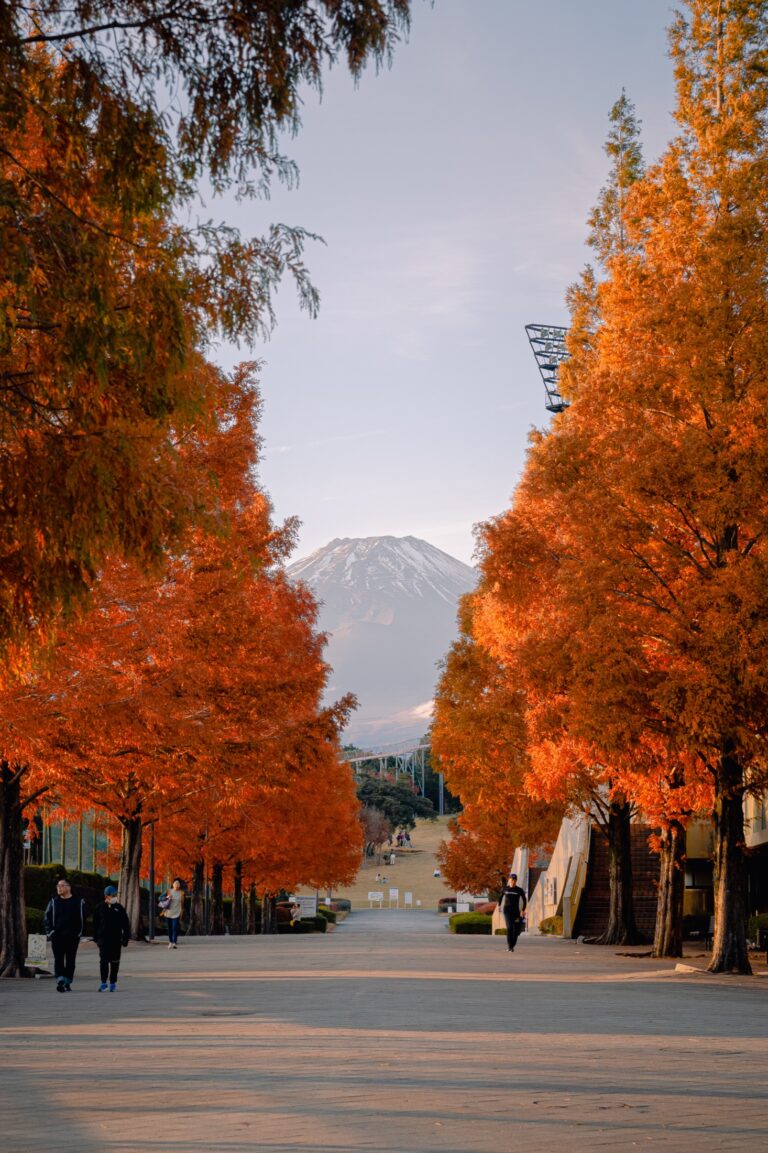
Valley season. Taro & Jiro Falls by train from the Fuji area — I found full late-season colour here on 27 November 2025, with the light low and gold. On the mountain’s other side, Susono’s metasequoia avenue runs just as late.
A stay of two nights or more buys you flexibility to pick your stop around the weather and the current foliage reports — a ryokan around Kawaguchiko or Fujiyoshida makes a practical base, with travel time depending on your stop and transport. If you are still choosing dates, our guide to how Japan’s autumn colour moves covers the country-wide picture.
Frequently asked questions
When do the larch trees on Mt Fuji turn gold?
The road operator’s guide puts the Subaru Line’s roadside colour at roughly mid-October to early November, with the high Ochudo larch zone turning first. Years differ: on 2 November 2025 the belt around the fourth station was still gold.
Can I see all three spots in one day?
You can drive between them in a morning, but it defeats the point — my own visits were spread across almost four weeks of the season. Pick the stop that matches your dates and pair it with nearby sights instead.
Is Kaneyama Falls really lit up at night?
The official visitor guide lists illumination from after sunset until 21:00, and the area itself is free and open 24 hours. November sunset comes before 17:00, so an early-evening visit is practical — but check the city’s page before building an evening around it.
How do I reach Taro and Jiro Falls without a car?
Take the Fujikyu Railway to Higashi-Katsura Station and walk about fifteen minutes. Bus routes running entirely within Tsuru ended in March 2026, so the train is the reliable option.
Do any of these spots charge admission?
No — all three are free. The only cost is transport: the Subaru Line is a toll road; at Kaneyama Falls you use the museum park’s lot, and Taro-Jiro has a small free lot in Natsugari.
Is the Subaru Line open in autumn?
Yes, in principle year-round once the summer private-car regulation ends (10 September in 2025), but it closes temporarily for snow and high winds — increasingly likely from late autumn. Check the road’s official status page on the morning you go.
Sources
Official sources for the transport, timing and light-up details above, checked 20 September 2026
- Yamanashi Prefectural Road Public Corporation — Fuji Subaru Line road status and seasonal guide (roadside foliage period)
- Fujikyu Bus — 5th Station route timetable (Yongome Osawa Tenbodai / Oniwa stops), Fujikko-go loop bus, and the Tsuru intra-city route discontinuation notice
- Yamanashi Tourism Organization — Ochudo larch foliage timing and the English guide to Taro & Jiro Falls
- Official Fujiyoshida Tourist Guide (fujiyoshida.net) — Kaneyama Falls (hours and illumination) and the Yoshida leaf festival page
- Tsuru City / Tsuru Tourism — Taro & Jiro Falls and walking and parking guidance
- All photographs: taken by the author on 2, 12 and 27 November 2025 at the three locations.
Join travelers discovering Japan's hidden side
Weekly dispatches from off-the-beaten-path Japan — spots and stories you won't find in guidebooks.
No spam. Unsubscribe anytime.
Welcome aboard!
You're in. See you in your inbox soon.