
Fujikawaguchiko · Mt Fuji viewpoint · Night to dawn
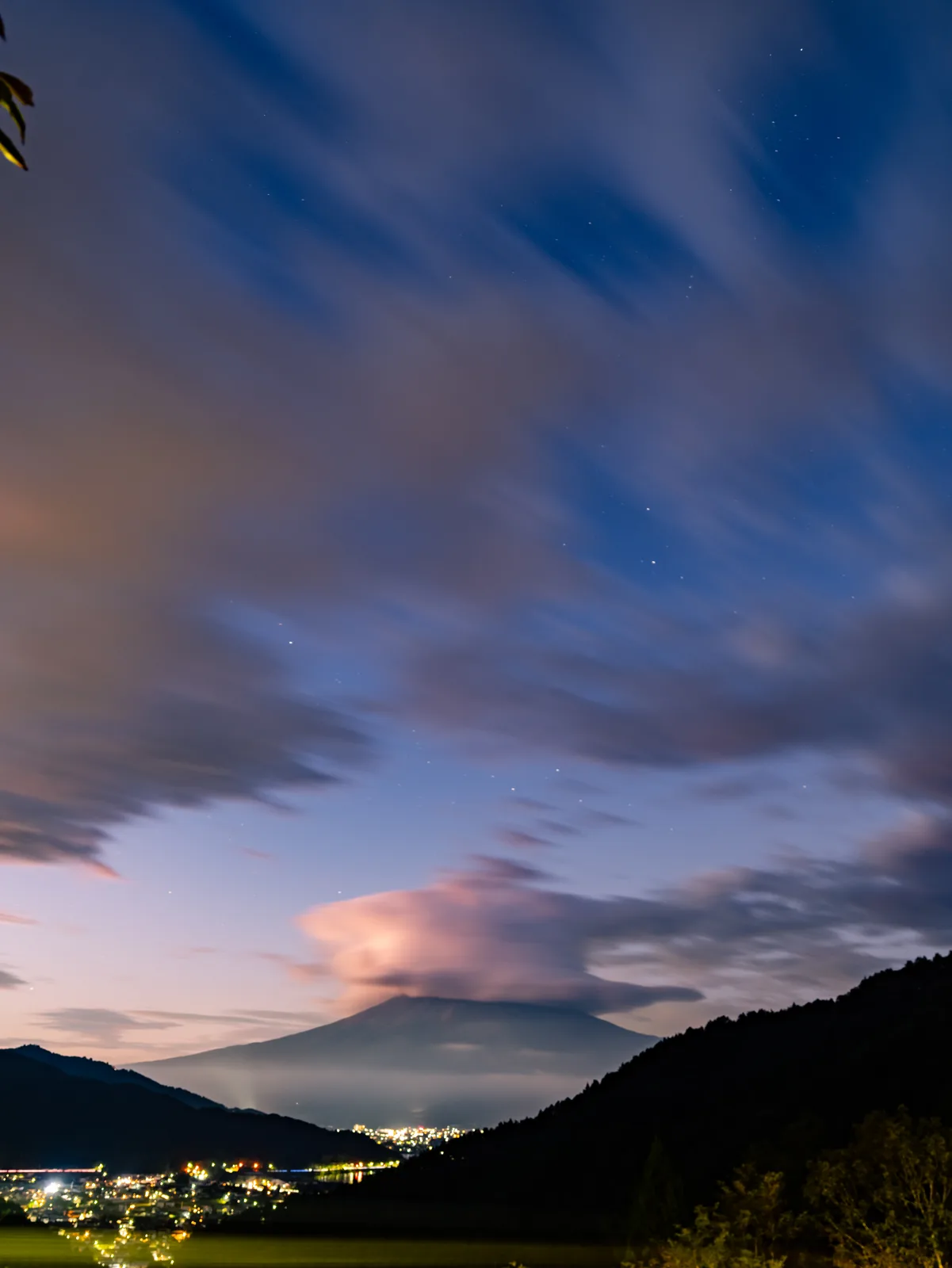
Fujimi-bashi Observation Deck (富士見橋展望台) is a small deck on a mountain pass road north of Lake Kawaguchiko, in the Kawaguchi area of Fujikawaguchiko town. I stood there with a camera from about 3:00 to 5:30 in the morning in mid-October, could see Mt Fuji and the cloud over its summit; my early frames show a lens-shaped cloud over the summit, and later frames a pink cloud there, and in all that time no one else turned up to photograph it.
I’m Nobu, and I live in Yamanakako village, one lake over from here. This page is the whole night as my camera saw it: 160 frames, a timeline of what changed and when, and the plain practical things you want to know before driving up a pass road at three in the morning. The photo times in this article come from my camera’s clock.
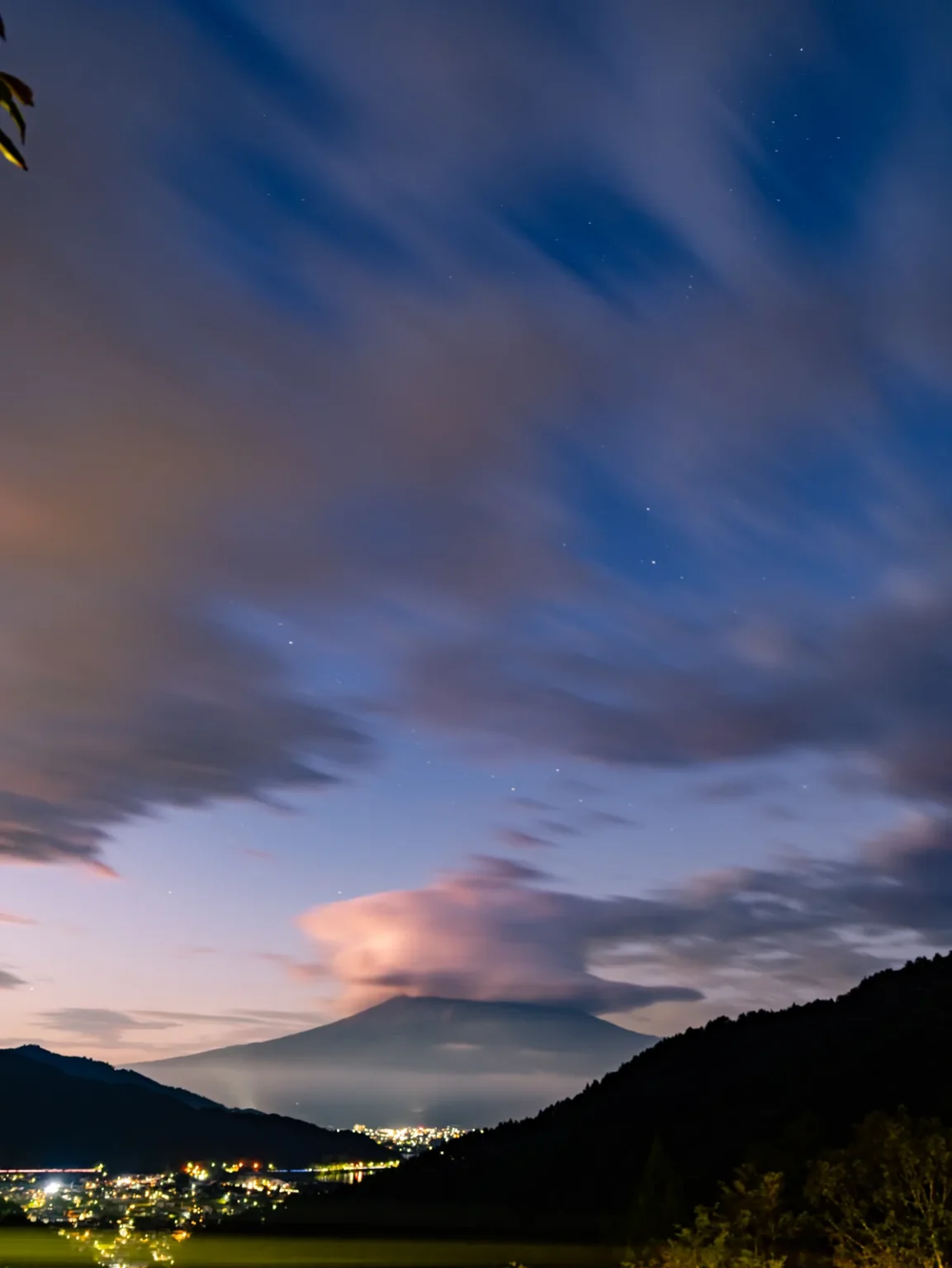
The night, frame by frame
I was at the deck from about 3:00 and stayed until about 5:30, and Mt Fuji was there for me to see. The first frame on my card is stamped 3:28 and the last 5:04. In between are 160 frames, mostly about 32 seconds apart, each one a 30-second exposure. That is why cloud looks like brushed paint in these pictures and why every passing car turns into a line of light.
| Camera clock | What my frames show |
|---|---|
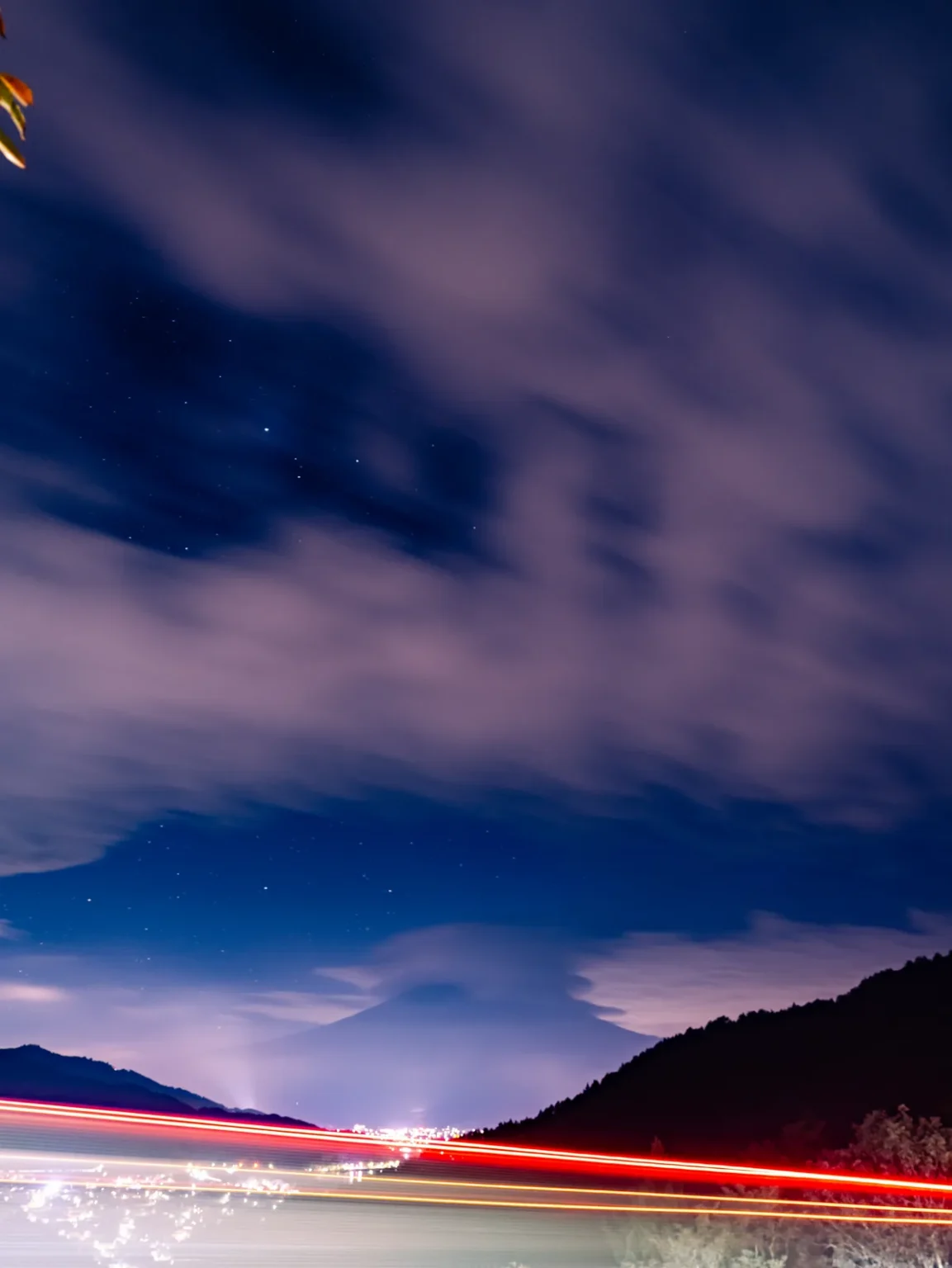
| 3:28 | First frame. A lens-shaped cloud sits over the summit, stars above, town lights in the valley below. |
| 3:30 | A car passes. Its headlights flood the road and the guardrail right in front of the camera. |
| 3:52 | Cloud gathers around the summit. The stars are still out. |
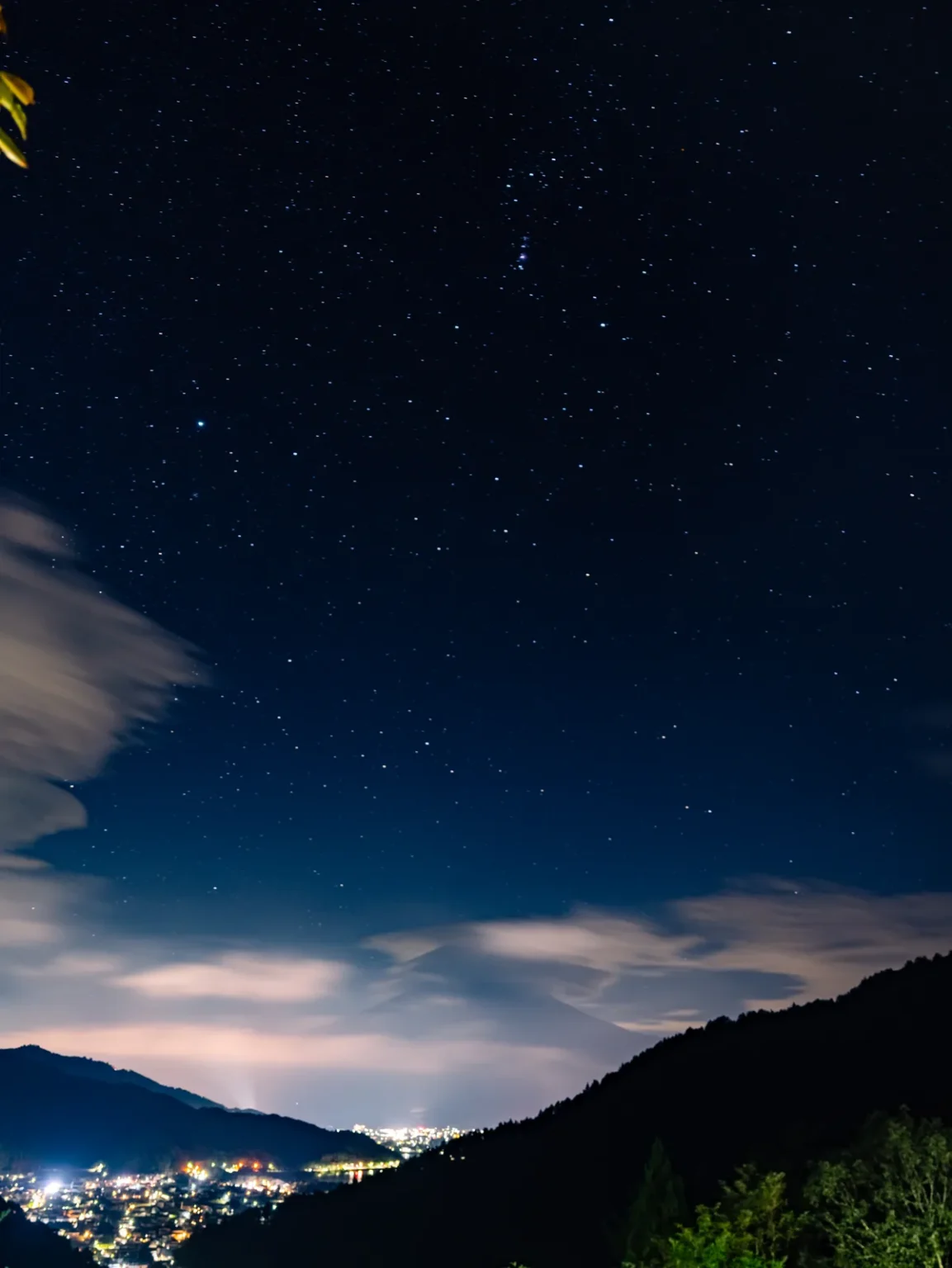
| about 4:10 | A band of low cloud lies across the mountain. The cone is only a faint shape behind it. |
| 4:15 | Stars and town lights, low cloud over the valley. |
| 4:30 | Red and white light trails along the road. |
| about 4:36–4:40 | Heavy, streaked cloud overhead; the sky turning from navy to blue. |
| about 4:43 | The sky in my frames has turned blue, and the cone is visible again with cloud sitting on top. |
| 4:53 | The cloud over the summit is pink. |
| 5:01 | First light, the pink cloud still there. |
| 5:04 | Last frame. |
Times are from my camera’s clock. One night only; the sky will be different every time.
All 160 frames were shot the same way: a Sony α7 IV with a 24–70mm lens at 24mm, f/2.8, ISO 800 and 30 seconds. For reference, the National Astronomical Observatory of Japan gives sunrise at Kofu on 14 October 2026 as 5:51; that figure assumes a flat horizon, so it is a guide for when to arrive, not when light reaches this deck.
Under the stars, 3:28 to 4:15
In the opening frames a smooth, lens-shaped cloud hovers over the summit like a lid, the town in the valley is a scatter of yellow and white lights, and the sky above is full of stars. Leaves from a branch show in the top-left corner of some of my frames. I could see the cloud on the summit with my own eyes too, not just in the long exposures.
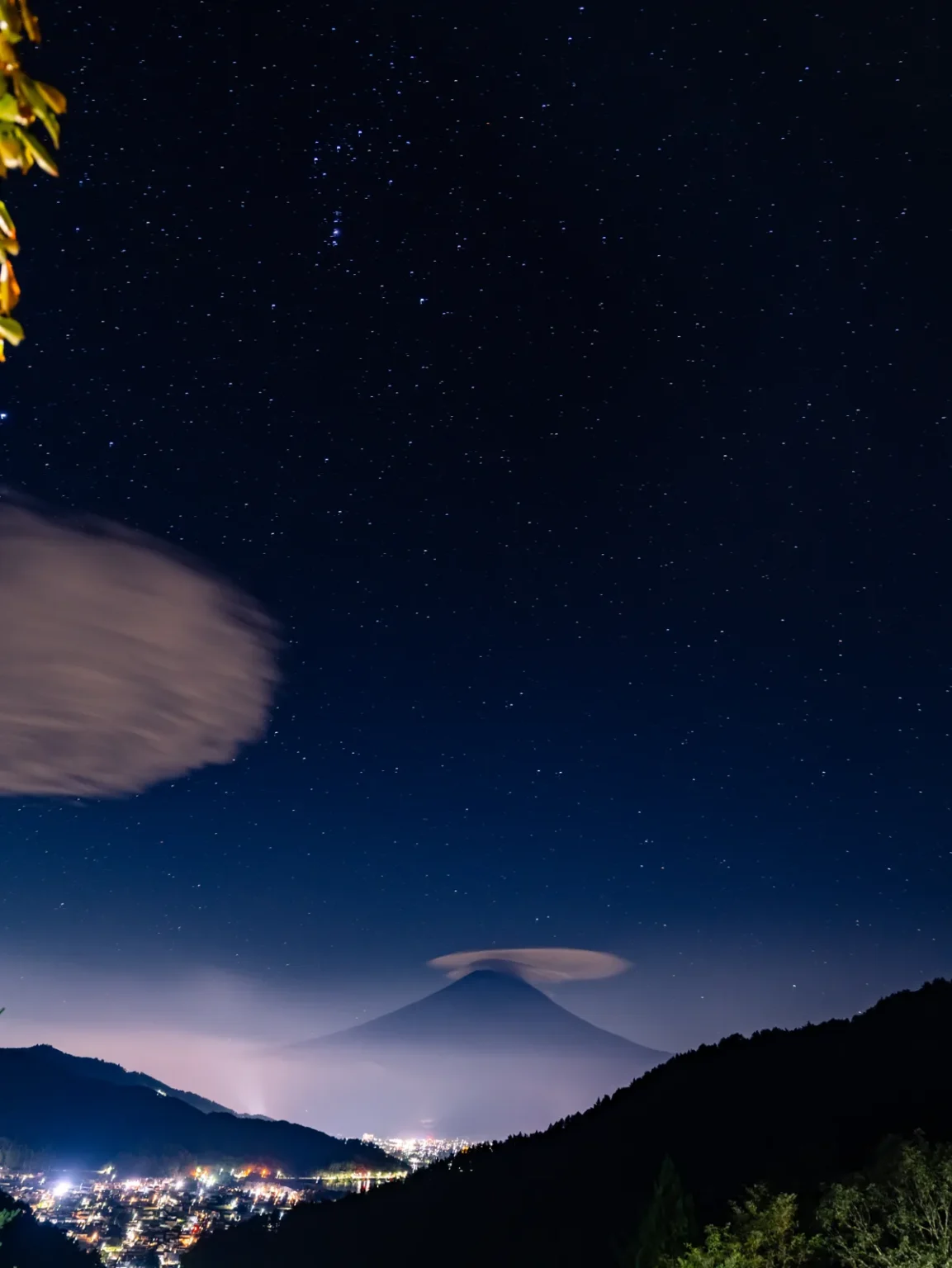
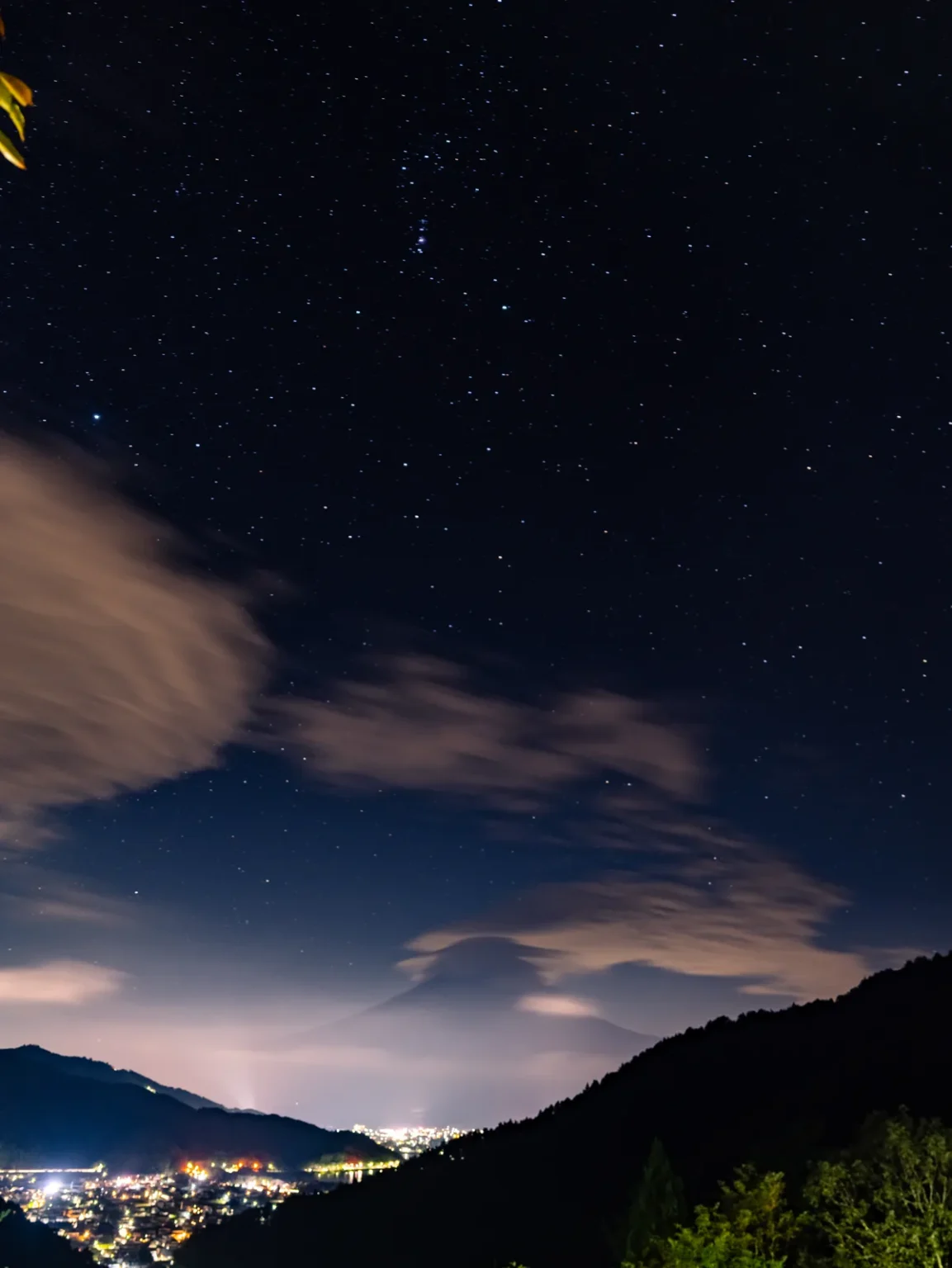
Within half an hour the cloud had thickened around the top of the mountain. For a stretch after four, a low band of it lay right across the cone, and in my frames Fuji is only a pale outline behind it. In my sequence the mountain came back.
Cars and light trails, around 4:30
The road runs right in front of where I set up, across the bottom of my view. With a 30-second shutter, every car that passes leaves red and white streaks through the foreground. At 3:30 one car lit up the road and the guardrail so brightly that the road surface and guardrail at the bottom of the frame were lit bright white. A passing car can cross the bottom of the picture during a 30-second exposure; one did in my sequence.
The pink cloud, 4:53 to 5:04
From around 4:40 the sky in my frames shifts from navy to blue, the stars fade, and the clouds overhead streak through my long exposures. Then the cloud sitting over the summit turns pink. It stays pink through the last frames, with the town lights still on below. That is the picture at the top of this page.
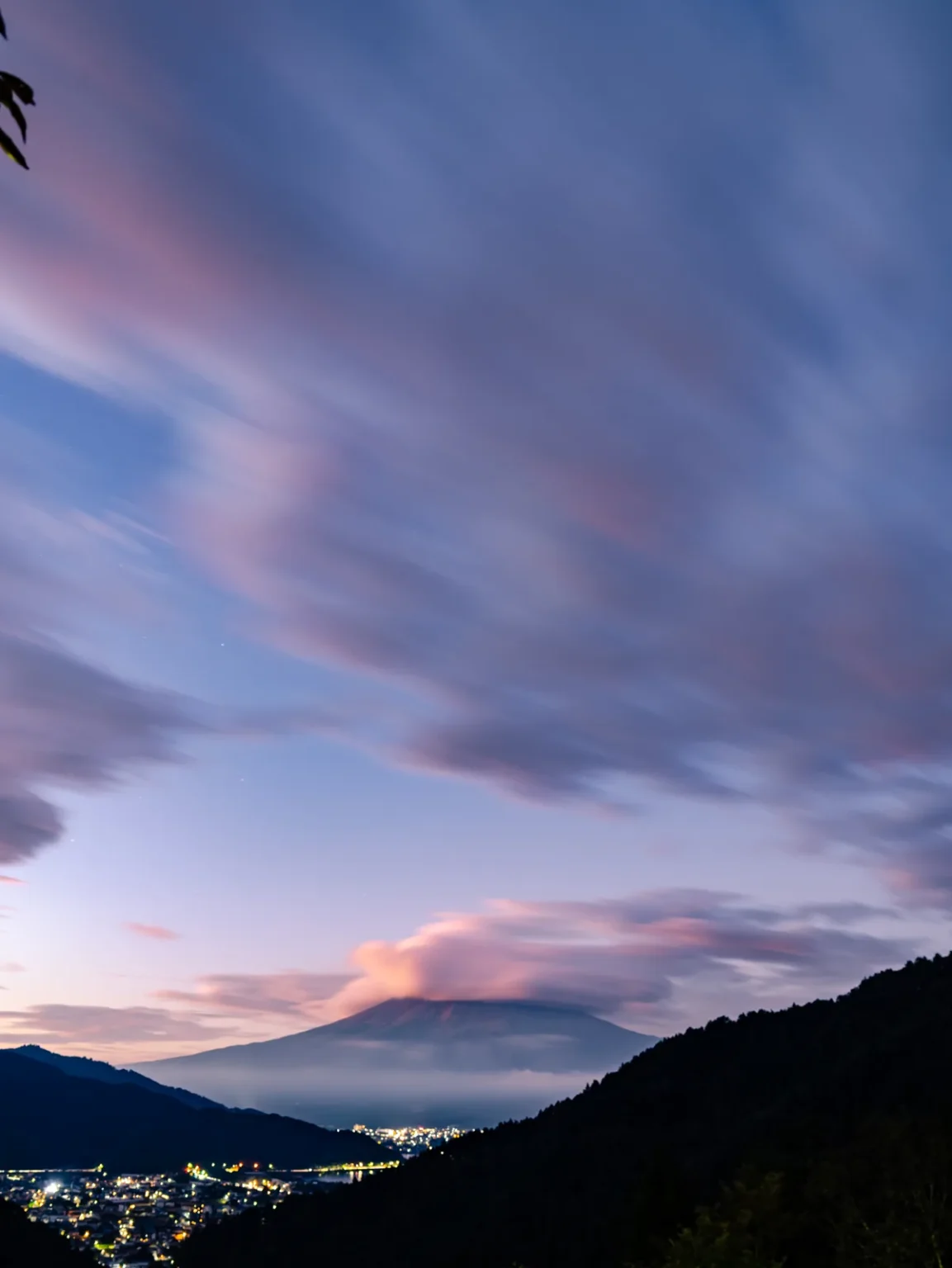
My last frame is stamped 5:04, and I stayed until about half past five.
My settings
Sony α7 IV, 24 mm, f/2.8, ISO 800, 30 seconds, all in portrait format. All 160 frames have the same recorded settings.
Frame for the road
With my framing, passing cars crossed the bottom of the picture, and one at 3:30 lit the road and guardrail white.
What changed in my sequence
Around 4:10 the cone was almost lost behind low cloud. By 4:43 it was visible again, and the pink came after that.
Before you drive up at night
I came by car, about ten minutes’ drive from Fujiyoshida. The deck sits beside the pass road that climbs north from Lake Kawaguchiko towards Misaka. Fujikyu’s published routes include a Kawaguchiko Station–Tenka-chaya bus, but I can’t give you a pre-dawn bus plan for the deck, so check the current timetable yourself. These are the things I would want to know if it were my first time.
Parking
You can park right beside the observation deck. Follow any signs on site.
Toilets and drinks
I found no toilets or vending machines nearby on my visit, so use one and buy what you need before you head up.
Cold and clothing
It did not feel cold to me that night. I shot from about 3:00 to 5:30 in a single long-sleeved T-shirt. For context, the Japan Meteorological Agency’s Kawaguchiko station recorded a low of 11.1°C that day; that was not a measurement at the deck. It is the only night I can speak for.
The road
It is a mountain pass road. In the dark, watch the curves and look out for small animals.
Bears
Fujikawaguchiko town’s bear map records a sighting in front of the deck at 21:30 on 11 April 2024, with others in the area. Check the town’s current bear-sighting map before you go.
Company
I was the only photographer there the whole time, from about 3:00 to 5:30.
Check the sky first: whether Mt Fuji shows at all depends on the weather, and so read the Mt Fuji visibility forecast guide before you set out.
I drove here myself. If you are coming to the lakes without a car, rental cars for the Fuji area can be compared here.
Compare rental cars on Discover CarsSearch Japanese rental companies on Rakuten TravelMisaka and its view of Fuji
This is an old view. The wider Misaka area has a long history as a Fuji viewpoint: Japan’s land ministry includes the Misaka side in its list of Mt Fuji views from the Kanto region, along the old Kamakura road (Kamakura Ōkan). Hokusai’s print “Koshu Misaka Suimen”, with Fuji reflected in Lake Kawaguchi, comes from this direction, and the writer Dazai Osamu stayed at the Tenka-chaya teahouse at the top of the pass, which now has a room about him. You can stop at Tenka-chaya on the way up or down in the daytime.
Where the deck is
The deck is in the Kawaguchi area of Fujikawaguchiko town, beside the pass road north of Lake Kawaguchiko. The pin below is at the coordinates I use for it.
If you are coming from Tokyo, the Tokyo to Kawaguchiko guide covers getting to the lake.
Where to sleep before a 3 a.m. start
The deck is north of Lake Kawaguchiko, so a bed by the lake is the obvious base. The Kawaguchiko vs Fujiyoshida guide compares the two bases.
If you want to be on the deck by three, look for a bed by Lake Kawaguchiko.
See Lake Kawaguchiko stays on Booking.comMore Mt Fuji viewpoints
For the daytime, there are other views of the mountain around the lake: Kawaguchiko Ohashi Bridge, the Mt Fuji Panoramic Ropeway and Oishi Park. Over in Fujiyoshida there is the Honmachi 2-chome street view. Further afield, see our guide to Mt Fuji at sunrise from the Izu Skyline. The two-day Fuji Five Lakes itinerary strings several together, and the rest are on the Mt Fuji hub.
Rather not drive at all? A guided day around Mt Fuji covers the daytime viewpoints.
Browse Mt Fuji tours on KlookWhere is Fujimi-bashi Observation Deck?
On a mountain pass road north of Lake Kawaguchiko, in the Kawaguchi area of Fujikawaguchiko town. The map above is pinned at the coordinates I use.
Is there parking at the deck?
Yes. You can park beside the deck.
Did you find toilets or vending machines?
No. I found no toilets or vending machines nearby on this visit, so plan for that before you go up.
Is it crowded before dawn?
Not on my night. Between about 3:00 and 5:30 a.m. on 14 October 2026 I was the only one there photographing.
How cold is it at night in October?
It did not feel cold to me in mid-October 2026. I wore one long-sleeved T-shirt from about 3:00 to 5:30. That is one night, so check the forecast for yours.
What camera settings did you use?
24 mm, f/2.8, ISO 800 and 30 seconds on a Sony α7 IV, unchanged from the first frame to the last.
Sources
- Location: coordinates confirmed by me; municipality (Fujikawaguchiko town, Kawaguchi) from the Geospatial Information Authority of Japan’s reverse geocoder (GSI result)
- Night, photos and practical notes: my own visit, 14 October 2026. Photo dates and times are from my camera’s clock. Camera settings are from my original files.
- Fujikawaguchiko town, bear sightings and map: town.fujikawaguchiko.yamanashi.jp
- Ministry of the Environment Kanto office, cap and hanging clouds: kanto.env.go.jp
- National Astronomical Observatory of Japan, sunrise October 2026: eco.mtk.nao.ac.jp; JMA Kawaguchiko daily data, October 2026: data.jma.go.jp
- MLIT, Mt Fuji views from Kanto (Misaka): ktr.mlit.go.jp; Tenka-chaya: fujisan.ne.jp
- Fujikyu bus routes (Kawaguchiko Station–Tenka-chaya): fujikyubus.co.jp
Conditions on this page are from one night in October 2026.
Some links above are affiliate links — they cost you nothing extra and help keep this site going.
Join travelers discovering Japan's hidden side
Weekly dispatches from off-the-beaten-path Japan — spots and stories you won't find in guidebooks.
No spam. Unsubscribe anytime.
Welcome aboard!
You're in. See you in your inbox soon.