Yamanashi · Fujiyoshida · Year-Round
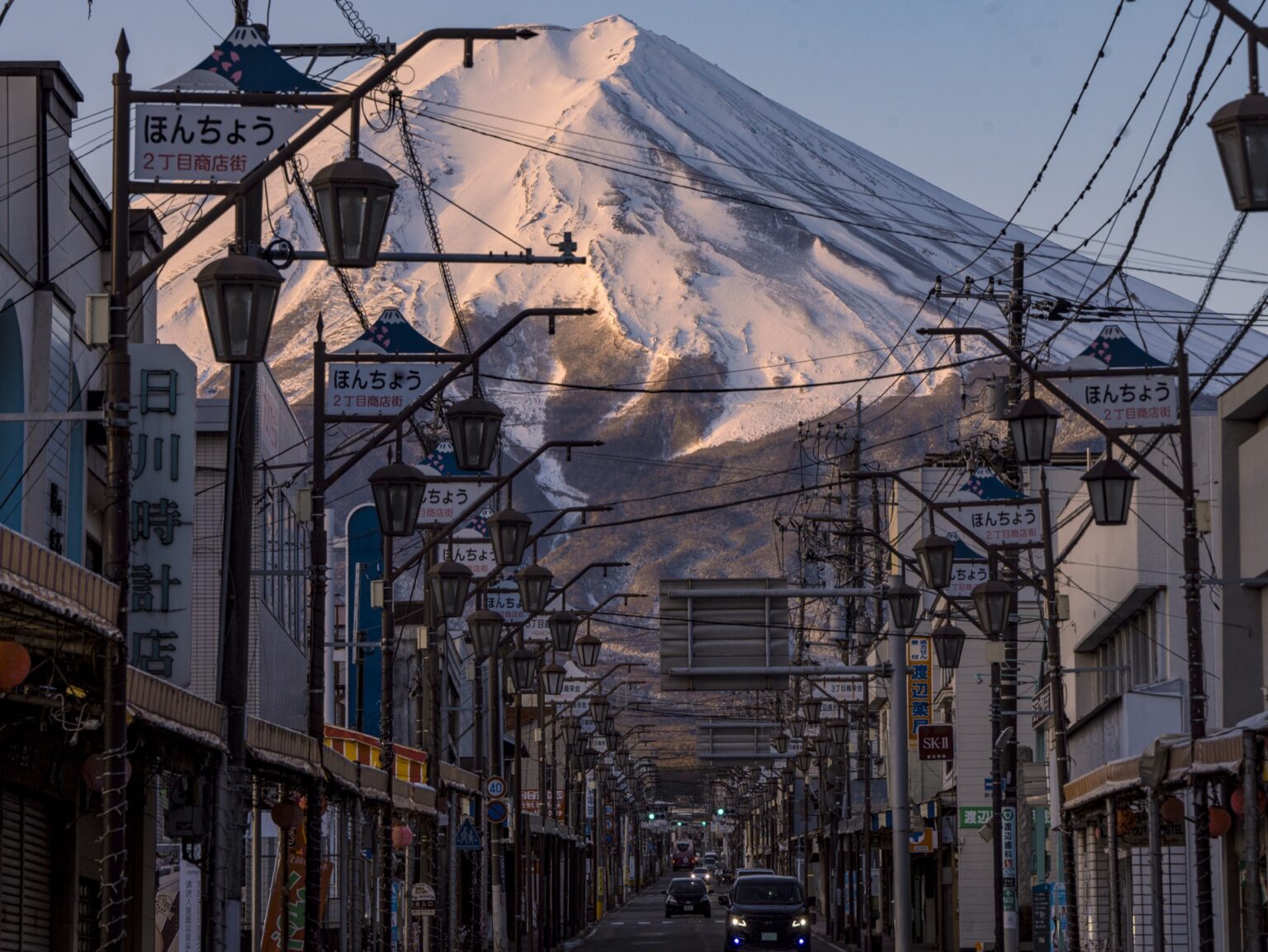
Honmachi 2-chōme Shōtengai is a north-south retro shopping street in Fujiyoshida that frames Mt. Fuji directly between Shōwa-era lampposts and overhead wires, made famous on Instagram by the camera-compression effect that makes the mountain appear three times its natural visual size — best shot late morning on a weekday from beside the city parking lot, ¥100 per hour, ten minutes’ walk from Shimoyoshida Station.
I had walked past this view three times before I understood it. The first two were on the way to dinner at one of the Showa diners in the Nishiura district — too dark to see Fuji, too late to care. The third time was a December afternoon at 14:30, no plan, on my way back to the station, and I turned a corner and the mountain was sitting at the end of the street looking, in the way a 200mm photograph would render it, twice as tall as the buildings. I stood there for forty minutes. The street had eleven other people in it across that window, three with cameras. This is the case for treating Honmachi 2-chōme not as a photo stop but as the central composition of any Fujiyoshida half-day.
30-second summary
What it is: A north-south retro shopping street in central Fujiyoshida where the south-to-north sight-line places Mt. Fuji directly at the vanishing point, framed by Shōwa-era lamp posts.
Why it works: Camera compression — long focal lengths (135mm+) collapse the apparent distance to Fuji, making the mountain dominate the frame even though it’s 18 km away.
Best window: 10:30 – 14:00 on a clear-air weekday. Morning = back-lit; sunset = street goes into shadow before the mountain does.
Part of the full Mt. Fuji travel guide.
Quick Facts
Location
Honmachi 2-chōme, Fujiyoshida, Yamanashi. The shot is taken from beside the city parking lot, looking north up the street.
Cost / Hours
Free to view, 24/7. Parking ¥100 / first hour + ¥50 / 30 min thereafter at Fujiyoshida City Honmachi-dōri lot.
Best Photo Window
Late morning to early afternoon (10:30 – 14:00) on clear, dry-air days. Best months: Nov – Feb (lower haze, snow on Fuji).
From Shimoyoshida Station
~10 min walk. Exit left, right at the next corner, past the Lawson, cross at “Shimoyoshida-eki-mae” signal, straight north.
Recommended Lens
135mm – 300mm equivalent (full-frame). 70-200mm zoom is the universal answer; a smartphone telephoto at 5× works too.
Etiquette
Residential / commercial street. Stay on the sidewalk, do not step onto the road, do not stand in front of shop doors, no flash, no drones.
Why This One Shot Became Famous: the Compression Effect
Mt. Fuji is 18.4 kilometres from the photo spot on Honmachi 2-chōme. In real-world perception, that distance makes the mountain look modest behind the buildings — visible, but not dominant. The reason the photograph looks the way it does is a piece of optical physics that camera people call “compression” and that physicists call “telephoto perspective.”
When you zoom in with a long lens, you’re not just magnifying — you’re also flattening the apparent depth between near and far objects. A 200mm photo from this spot makes the buildings 50 metres away and the mountain 18 kilometres away appear in roughly the same plane. The mountain therefore reads as enormous, towering over the street, because the lens has visually eliminated the depth between them.
This is why every photograph you’ve seen from Honmachi 2-chōme looks larger-than-life. Your eye doesn’t see this from the spot; only the lens does. Knowing this lets you pre-plan the shot:
24mm
Wide
Fuji disappears. Street dominates. Almost useless.
50mm
Normal
Roughly what the eye sees. Fuji is present but not dominant.
200mm
Tele · Sweet Spot
The canonical Instagram shot. Compression visible, mountain dominant.
400mm
Super tele
Fuji fills the frame. Street becomes secondary. Tighter, less storytelling.
If you only have a smartphone, use the 5× telephoto mode if your phone has one (iPhone 14 Pro and later, recent Samsung S/Pro models). The optical-only telephoto on a flagship phone produces a usable approximation; digital zoom past that point degrades the image.
For the broader landscape of Fuji photo spots, see our Best Time to See Mt Fuji 2026 and the Mt. Fuji Visibility Forecast for live conditions before you commit to a trip.
When to Shoot: Sun Position + Best Time of Day
The street runs north-south. Fuji sits at the north end. The sun rises and sets on a perpendicular axis to the sight-line. This produces predictable lighting behaviour throughout the day:
Honmachi 2-chōme · Sun position vs photo quality
The bracketed sweet spot is 10:30 – 14:00. In this window the sun is high enough to light both the street and the mountain face from the same general angle, the street isn’t fighting against deep shadow, and Fuji still has crisp contrast against the sky.
Sunrise shooters: don’t bother here. The sun rises behind Fuji from this angle in summer (May–Jul) and well to the east of Fuji in winter (Nov–Feb), but in both cases the street goes pitch black against the rising sky. If you want a sunrise Fuji shot, go to Lake Yamanaka or Diamond Fuji from Lake Kawaguchi instead.
Sunset shooters: the street faces north-south, so the western buildings cast shadow across the street from about 15:30 in winter (sun sets at ~16:40) and 17:30 in summer. By the time the sky has warm tone, your foreground is dead.
What to bring for this shot
It is a compression shot down a real street with traffic and a working convenience store — timing and a steady frame are everything. My full camera kit is here, and it is all on Amazon Japan, so you can have it sent to your hotel before you go.
Tatsumi Shokudo (Susono)
Hungry near Fuji? A Showa diner in nearby Susono.
Skip the Crowds in Japan (2026)
The compression shot without the Chureito crowds — and 11 more swaps.
Travel tripod
The compression look needs a long lens held dead still — handheld at dawn will not cut it.
Spare battery
You will wait for the light and a gap in the traffic. Keep a charged spare.
Fast SD card
Burst the moment the street clears, without filling the card.
Lens cleaning kit
A clean front element matters on a long lens at this distance. A quick wipe before the shot.
Where to Stand: The Exact Spot
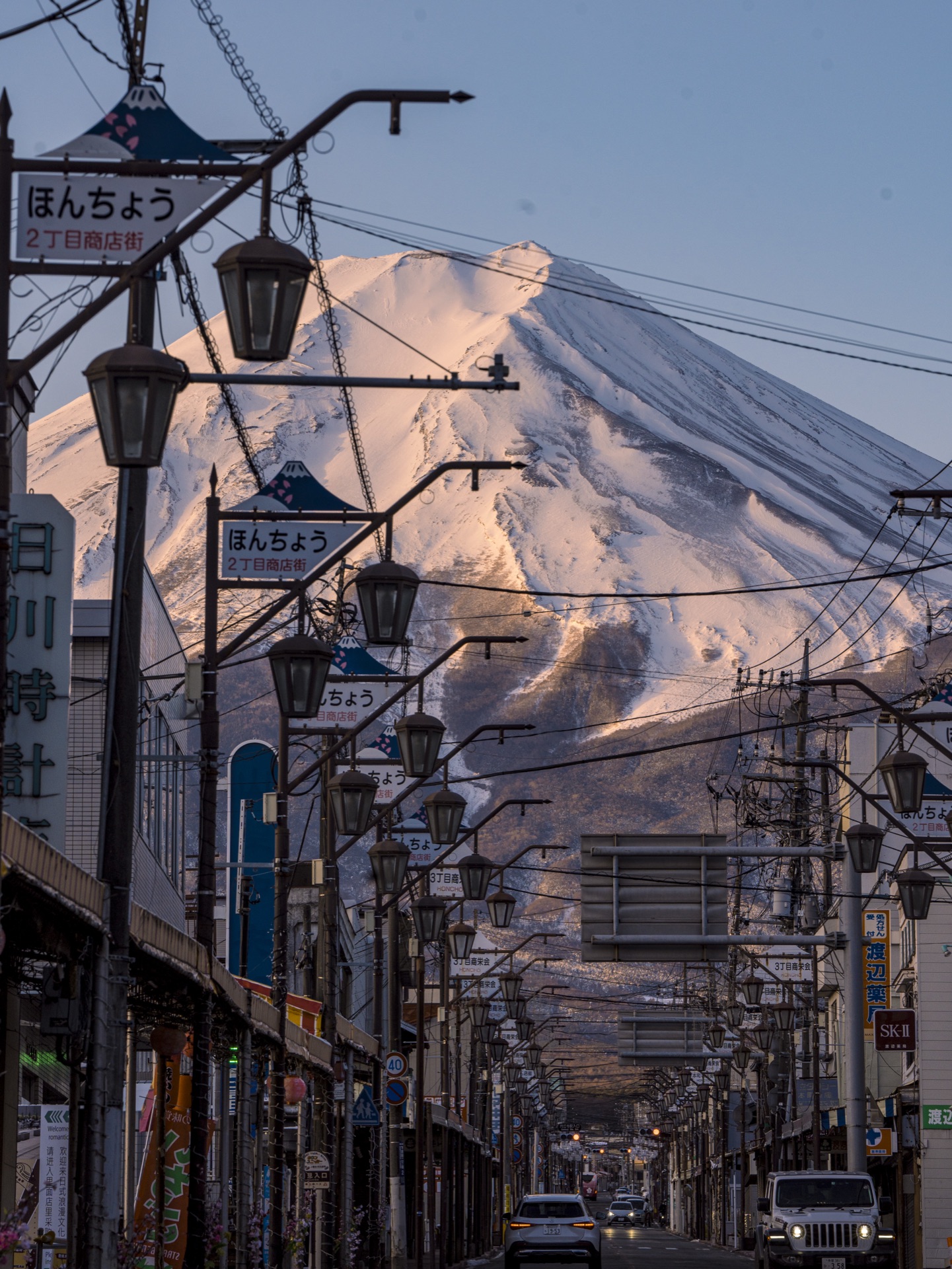
The canonical shot is taken from the south end of the street, with Fuji at the north end. The exact position is the sidewalk next to the Fujiyoshida City public parking lot — about 100 meters south of where the visible “ほんちょう 2丁目商店街” lanterns begin.
Three positional notes that matter in practice:
The sidewalk is the only legal shooting position. The road carries genuine traffic — both cars and the occasional Fujikyu Bus. Photographers who stand in the centre of the road for “the perfect symmetrical shot” are creating a safety hazard and have been formally asked by the chamber of commerce to stop. The sidewalk position is offset by maybe 1.5 metres from the centre line; in a 200mm framing, this offset is invisible.
The composition works equally well from either sidewalk. East sidewalk = “ほんちょう” lanterns on your right, hanging down into frame. West sidewalk = lanterns on your left. Choose by what side the morning light is hitting.
Don’t block the shop entrances. The eastern row in particular has a barber, a clock-repair shop (the visible “日川時計店” sign in many shots), and several small storefronts. The shopkeepers are tolerant of photographers but actively annoyed by tripods placed directly in front of their doors. Set up at the gap between buildings, not in front of one.
“Stay on the sidewalk. Long lens. Mid-morning. That’s the photograph.”
Etiquette: Don’t Be the Reason This Spot Gets Restricted
Honmachi 2-chōme is not a tourist attraction in the official sense — it’s a working shopping street that residents use daily, and the chamber of commerce has explicit safety and behavioural requests posted at the corner of the parking lot. This view exists because the neighbourhood tolerates photographers. Behaviour matters.
Stay off the road
Cars and the Fujikyu Bus use the street. Standing in the centre of the road has caused at least one near-miss incident and is the chamber’s #1 complaint. Sidewalk only.
Don’t block shop entrances
The barber, clock shop, and bakery on the eastern row are working businesses. Tripods directly in front of their doors are not OK. Pick the gaps between buildings.
Quiet voice
It’s a residential area. Voices, group conversations, and music carry. Treat the street the way you’d treat the inside of a temple.
No drones
The spot sits within the 300-metre radius of multiple residences. Drone flights are forbidden by Civil Aviation Bureau rules without specific permission, and the chamber actively asks photographers not to fly here.
Don’t bring large props
Pre-wedding shoots with assistants, reflectors, fans, and changing tents have become a problem on weekends. The chamber has not banned them, but they’re noticed.
Park properly
The ¥100/hour lot exists for a reason. Roadside parking in front of shops or in residential side streets is unwelcome.
How to Get There
Honmachi 2-chōme is in central Fujiyoshida, 10 minutes’ walk from Fujikyū Shimoyoshida Station. No special bus required, no expressway exit close enough to matter. The cleanest approaches:
| Method | Time | Notes |
|---|---|---|
| From Shimoyoshida Stn (foot) | ~10 min | The realistic option for train travellers. Step-by-step walking instructions below. |
| From Fujisan Stn (foot) | ~20 min | Slightly longer walk south. Stop at Chureito Pagoda on the way for a second Fuji composition. |
| From Kawaguchiko Stn (Fujikyū train) | ~25 min + 10 min walk | Most international visitors arrive via Kawaguchiko. Local Fujikyū train to Shimoyoshida, then walk. |
| Rental car (Tokyo) | ~90 min via Chūō Expressway | Exit at Kawaguchiko IC, 15 min on local roads. Park at Honmachi-dōri lot (¥100/hr). |
| Rental car (Kawaguchiko) | ~15 min | Local roads. Park at Honmachi-dōri lot. Combine with Chureito Pagoda 5-min drive away. |
Walking from Shimoyoshida Station, in five steps
- Exit Shimoyoshida Station, turn left (north-west) at the station front.
- Within 50 meters, turn right at the first signalled corner.
- Walk straight for about 200 meters, passing a Lawson convenience store on your left.
- At the “Shimoyoshida-eki-mae” signal, cross the major road and continue straight north.
- You will see the lantern signs of Honmachi 2-chōme on both sides of the street after ~150 meters. The Fujiyoshida City public parking lot is on the right; the canonical photo spot is the sidewalk beside it.
Pair the Visit: Half-Day Fujiyoshida Itinerary
Honmachi 2-chōme is a 30–60 minute stop. The trip out from Tokyo or Kawaguchiko deserves a fuller day. A realistic half-day plan, anchored on the 10:30 shooting window:
| Time | Activity | Why this order |
|---|---|---|
| 09:30 | Arrive Shimoyoshida Station from Kawaguchiko (or Tokyo earlier) | Train timing puts you on the street in the photo window. |
| 09:45 – 10:15 | Coffee at Tiger Shokudō or a local kissaten on the Nishiura side | Caffeine and a sit-down before the shoot. Lets the light come into position. |
| 10:30 – 12:00 | Honmachi 2-chōme photo shoot | Sweet spot lighting window. Allow 90 minutes for set-up + multiple frames + walk-around. |
| 12:00 – 13:30 | Lunch at Gensuke Showa diner (10-min walk) | The Nishiura retro district is a 2-minute walk west of Honmachi. |
| 13:30 – 14:30 | Walk through Nishiura Fujiyoshida retro Shōwa district | The texture-rich back-street counterpart to Honmachi’s clean sight-line. |
| 14:30 – 16:00 | Chureito Pagoda (taxi 5 min) for the second Fuji composition | Different angle, different sun. Pairs the two most-photographed Fujiyoshida views in one trip. |
| 16:30 | Return to Kawaguchiko or Tokyo | Catches the express trains/buses before the evening rush. |
For Tokyo-base visitors who want to stay overnight near Fuji rather than day-tripping back, our Where to Stay Near Mount Fuji Without a Car covers the realistic options near Kawaguchiko, Fujiyoshida, and Yamanakako.
Plan This Trip
Plan This Trip
For Southeast Asian Visitors
Fujiyoshida is one of the easiest Mt. Fuji entry points for travellers from Singapore, KL, Bangkok, Jakarta, and Manila — fewer transfers than the Fuji Five Lakes proper, no rental car required, and a station-walkable photo spot. The catch: the whole mountain shows on only about 134 mornings a year (Fuji City’s 35-year 8 a.m. record, taken from the south side; Fujiyoshida can differ), and about half of those fall between November and February, when average daytime highs at nearby Lake Kawaguchi run just 6–14°C. Pack a proper insulated jacket; a Singapore-tropical layer will not work here. Halal options are limited; the easiest meals are convenience store onigiri (clearly labelled) or the family-run kissatens that serve coffee and Western-style sandwich sets. Cash is more useful here than in central Tokyo — bring small notes for the parking lot meter and small shops. Mobile signal is full 5G across the city (Docomo, SoftBank, au all work).
FAQ
How is the famous photo even possible if Fuji is so far away?
Camera compression. Long focal lengths (135mm+) flatten the apparent depth between near and far objects, making Mt. Fuji — 18.4 km from the photo spot — appear in roughly the same visual plane as the shopping street’s buildings 50 meters away. The result is a mountain that looks two to three times the size your eye reports. This is real optical physics, not a trick of editing.
Can I take this photo with a smartphone?
Yes if your phone has an optical telephoto lens (iPhone Pro models from 14 onward have 3× or 5×; recent Samsung S Ultra models go to 5×–10×). Use the optical zoom setting, not digital zoom. The image won’t have the same depth-of-field as a dedicated camera, but the compression effect still works because it’s about angle of view, not sensor size. Budget phones with single-lens setups produce noticeably weaker results.
Are tripods allowed?
Yes, on the sidewalk. Not in the road. Not blocking shop entrances. Set up in the gap between two buildings, frame the shot, take it, move on. Long camera-equipment sessions of 30+ minutes are tolerated but please don’t make a scene. Pre-wedding photography set-ups with reflectors, fans, and changing tents are increasingly common and not appreciated by the residents.
What time of year has the best chance of clear weather?
November through February — the dry-air winter window. Fuji City’s 35-year 8 a.m. record (taken from the mountain’s south side) has the whole mountain visible on roughly 53–62% of mornings in those months, and at least partly visible on roughly 75–85%. March–May and September–October run at about 27–41% whole-mountain mornings; summer (June–August) is the worst at roughly 10–15%, as haze and cloud build on the mountain. The Mt. Fuji Visibility Forecast tool we maintain at this page updates daily.
Where else can I get good Fuji photos in Fujiyoshida?
Three spots, in order of fame: (1) Chureito Pagoda — Mt. Fuji with a five-storey pagoda from above; touristy but the view is real; 5 min drive from Honmachi 2-chōme. (2) Arakurayama Sengen Park — same general area, broader angle. (3) the Nishiura Fujiyoshida back streets — less famous, more atmospheric, smaller crowds. For non-Fujiyoshida alternatives: Lake Yamanaka for water reflection, Lake Kawaguchi for the diamond Fuji window, Oishi Park for seasonal flowers + Fuji.
Is there a small-shop fee or any restricted period?
No fee, no restricted period as of May 2026. The chamber of commerce has explicitly stated they want to keep the spot accessible — but they have hinted that if photographer behaviour deteriorates further (more cars stopped in the middle of the road, more pre-wedding set-ups blocking shops), they may petition the city for formal restrictions. The honest answer: this view is free because the community chooses to keep it free.
Is this view dangerous?
The road is. The view is not. The road carries genuine vehicle traffic including the Fujikyū Bus and delivery trucks. At least one near-miss incident involving a photographer standing in the centre of the road has been documented locally. Stay on the sidewalk; you’ll get the shot, and you won’t be the reason this spot makes the news.
Booking the Trip
Booking the Trip
Three doors into a Fujiyoshida photo morning. The Tokyo day-trip is the easiest; one night near the lake gives you the best chance of a clear-air shoot.
Related Reading
- Nishiura Fujiyoshida: A Journey Through Time in a Retro Showa District — The back-street complement to Honmachi 2-chōme’s clean sight-line. Pairs naturally.
- Gensuke Fujiyoshida: A Taste of Showa-Era Japan at a Beloved Local Diner — Lunch stop, 10-min walk from Honmachi.
- Tiger Shokudo Fujiyoshida: Local Diner with Mt. Fuji Views — Coffee or lunch before the shoot.
- Best Time to See Mt Fuji 2026 — Month-by-month visibility, 35-year data.
- Mt. Fuji Visibility Forecast — Live conditions and 7-day forecast.
- Where to Stay Near Mount Fuji Without a Car — Practical accommodation guide.
Join travelers discovering Japan's hidden side
Weekly dispatches from off-the-beaten-path Japan — spots and stories you won't find in guidebooks.
No spam. Unsubscribe anytime.
Welcome aboard!
You're in. See you in your inbox soon.