
Yamanashi · Fujikawaguchiko · Mt Fuji
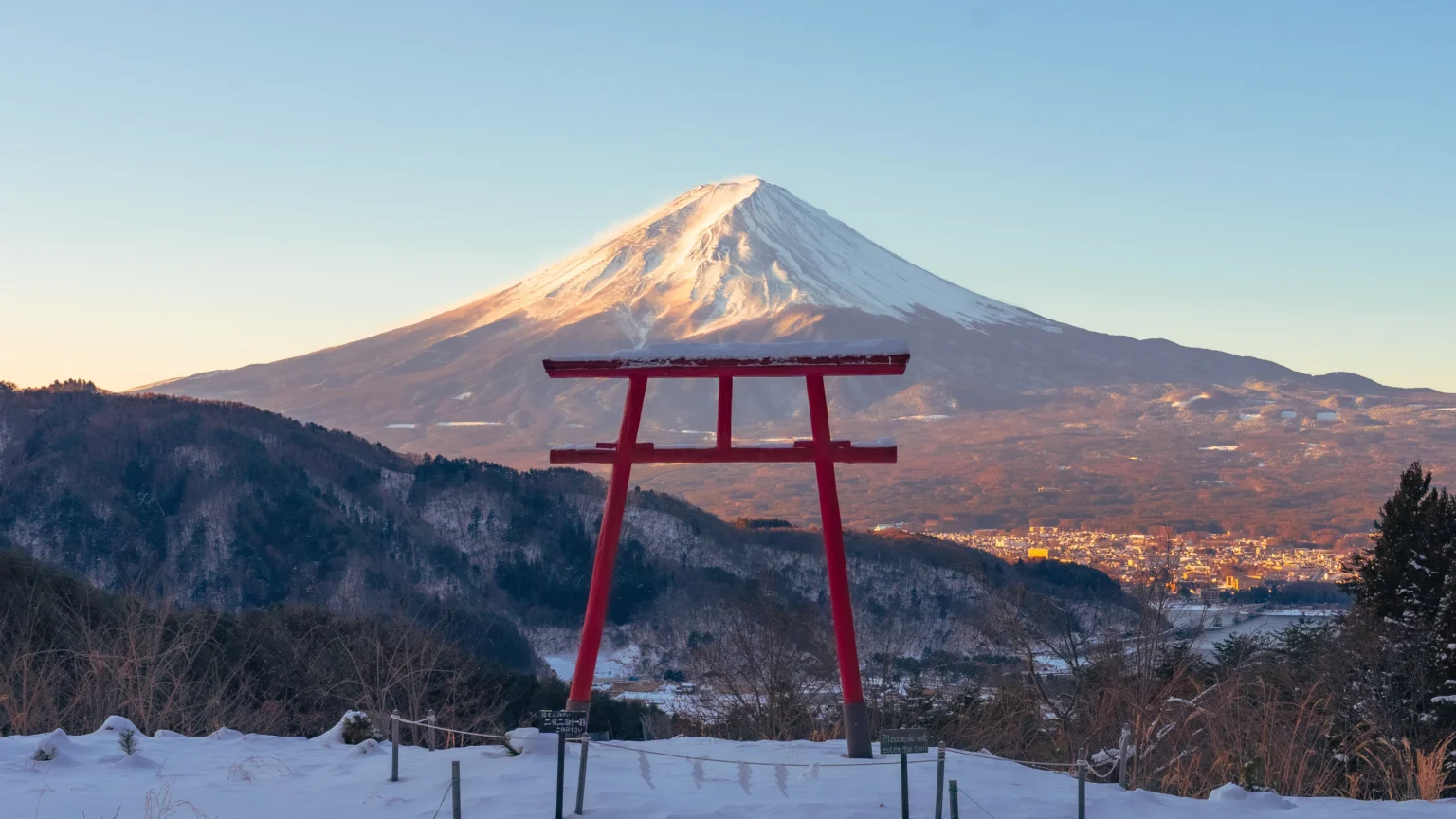
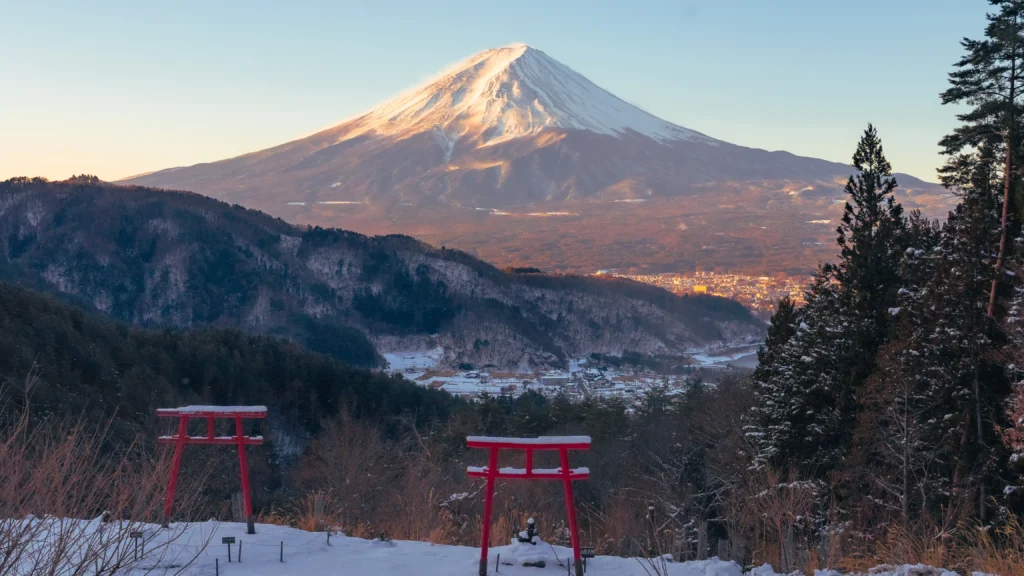
Tenku no Torii, also called the Fujisan Yohaijo, is a vermilion gate on a cleared hillside above Lake Kawaguchi at about 990 m above sea level — roughly 160 m above the lake — with Mt Fuji framed in its opening. It is privately owned and run, separately from Kawaguchi Asama Shrine below it. Visitors are asked for a single contribution of ¥200 for adults and ¥100 for children aged 6 to 17, with no extra charge for an ordinary visitor’s photograph. Since the earthquake of 26 June 2026, the mountain path above the torii has been closed by Yamanashi Prefecture.
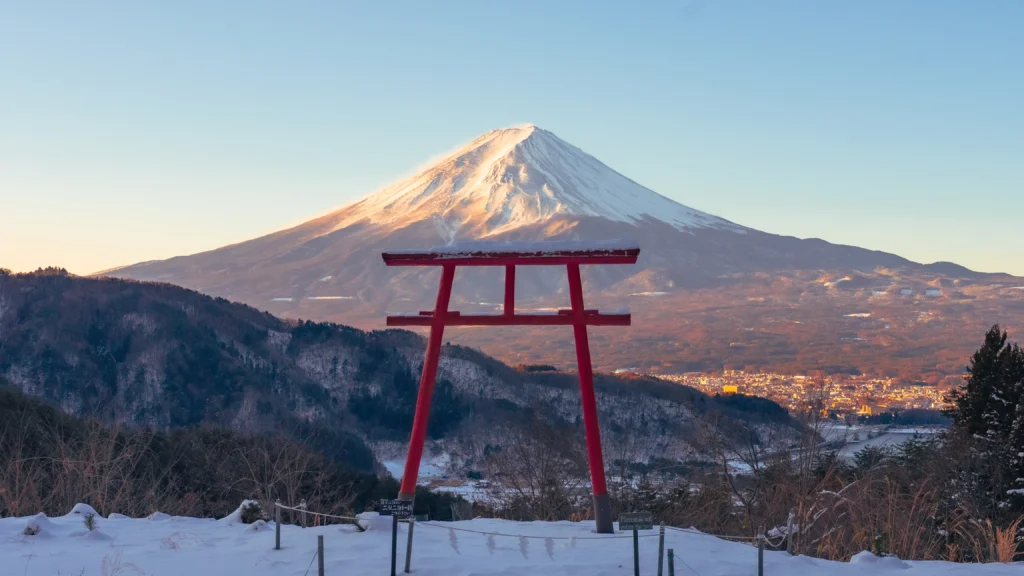
The gate faces the mountain squarely, so Fuji fills the opening without a telephoto lens and without hunting for an angle. That is deliberate: the site was built as a yohaijo, a place for worshipping Fuji from a distance, and everything on the slope is arranged around that sightline.
Who runs it, and why it gets confused with the shrine
The torii stands on the hillside behind Kawaguchi Asama Shrine, and most English pages describe it as the shrine’s. The town’s tourism association says otherwise on the shrine’s own listing: “the Tenku no Torii (Fujisan Yohaijo) is not a facility owned or operated by this shrine.”
It was built in March 2019 by Nakata Susumu on land he owns personally, and it is operated by a private company, Asamasha LLC, which maintains its own website and its own rules. Nakata is also the shrine’s chief priest, which is why the two keep getting merged — but they are separate organisations, and the shrine’s website carries no fee, hours or access information for the viewpoint.
What this means in practice. Anything needing clearance in advance — a wedding shoot, a commercial shoot, a film crew — goes to the viewpoint’s operator, not the shrine office. Questions about what the viewpoint costs go there too.
The contribution, and the ¥100 still in circulation
Visitors are asked for a contribution towards running the site: ¥200 for adults and ¥100 for children aged six to seventeen. The operator publishes no rate for children under six. For an ordinary visitor taking their own photographs, that is the whole cost — there is no photo ticket and no camera licence. Shoots that fall under the operator’s advance-application rules are charged separately; see below.
The ¥100 figure carried by many English pages is not invented, it is simply the old rate. The operator says the site was generally open free of charge from its establishment in 2019; a flat ¥100 per person was introduced in July 2022; and the current rates took effect on 1 December 2024. The reasons the operator gives are rising prices and the major repairs an ageing structure needs.
| Period | What visitors paid |
|---|---|
| 2019 – June 2022 | Generally free |
| July 2022 – November 2024 | ¥100 per person, flat — not a photography fee |
| From 1 December 2024 | ¥200 adult · ¥100 child (6–17) |
Several large travel sites still show ¥100, including a Japanese tourist-information portal run by a major agency. Bring the current amount in small change. The operator does not publish a payment method, and visitors consistently describe cash into a box at the entrance rather than a till, so do not count on a card or on anyone having change for a note.
On the “three-minute photo slot”. Older English pages pair ¥100 with a timed three-minute slot in front of the gate. The ¥200/¥100 contribution is not a photo slot, and nothing is bookable. Japanese visitors do describe being asked, when it is busy, to keep their turn at the gate short so the queue moves — that is a courtesy request on the day, not a purchase. Follow whatever the signage and staff ask for when you are there.
If you are bringing a photographer or shooting commercially
Tripods
Permitted only in designated places. Not banned outright, but not free use either.
Drones
Prohibited in principle by the operator, as this is private land.
Bringing a photographer
A shoot by a photographer needs advance application and carries a usage fee — and the operator’s wording explicitly includes friends and acquaintances acting in that role. Location shoots such as weddings are charged even when private.
Selling the images
No property release is issued, so photographs taken here cannot be sold through stock libraries.
Commercial applications must be submitted at least one month before the shoot, and the operator says a decision takes about a week. Both application forms linked from its page returned 404 errors when I checked, so ask the operator directly how to apply rather than relying on those downloads.
Opening hours and sunrise visits
The operator publishes no opening or closing time anywhere on its site. The only scheduled hours in circulation come from the Google listing, which shows 9:00–16:00 daily and is not an official source; other Japanese accounts describe access from early morning, or opening until sunset.
So: plan around 9:00–16:00, and do not build a trip around being there before dawn on the strength of an unpublished schedule. I was photographing at the gate at 07:13 on 9 February 2026, which tells you it was possible that morning and nothing more. If sunrise is the whole point of your visit, contact the operator first — and remember the approach is an unlit mountain path.
Getting there by bus
From Kawaguchiko Station, stop 5, take a Fujikyu bus bound for Kofu and get off at Kawaguchi-kyokumae (河口局前, “Kawaguchi Post Office”). It is 10 minutes and ¥350, and the shrine is a few minutes’ walk from the stop — it is the closest stop in the Fujikyu network to the shrine, and the cheapest.
Fujikyu’s sightseeing page and the town tourism association both route you differently: Red Line loop bus to the Itchiku Kubota Art Museum, then 20–25 minutes on foot, at ¥440. That is a real service and it may suit you if you are going round the lake anyway, but for a direct trip to the shrine the Kofu-line bus is cheaper and the walk is far shorter. If you hold a loop-bus pass, it covers the Kofu line as far as Kawaguchi-kyokumae, which is the last stop it is valid to; beyond that towards Kofu you are outside the pass.
| Departures from Kawaguchiko Station |
|---|
| 05:57 · 06:38 · 07:08 · 07:38 · 08:08 |
| 09:08 · 09:50 · 10:18 |
| 12:08 · 14:08 · 15:38 |
| 16:58 · 17:28 · 18:28 · 19:08 |
| Departures back from Kawaguchi-kyokumae |
|---|
| 07:03 · 07:49 · 08:20 · 08:53 · 09:23 |
| 10:03 · 10:32 · 10:43 |
| 11:53 · 12:53 · 14:50 |
| 16:13 · 17:13 · 18:23 · 19:23 · 20:23 |
Fifteen departures out and sixteen back, the first out at 05:57 and the last back at 20:23. Two caveats: the 09:50 out is the Tenkachaya working rather than a Kofu bus, and the 07:49 back runs on weekdays only. Note the shape of the day — roughly half-hourly until 08:08, then a gap of an hour and fifty minutes between 10:18 and 12:08, and a two-hour gap after that. Check your return before you start walking uphill.
Driving up: what the forest road allows
You can drive to the top, and the operator’s access page assumes you will. What it warns about is width. The road is a narrow forest road, single-track in places, and its instructions are worth reading literally.
Vehicles seating 11 or more are barred
Yamanashi Prefecture prohibits them on the prefectural forest road above the site, and the operator repeats the restriction. It rules out coaches and larger minibuses; smaller vehicles are not covered by it.
Winter: prepare for ice
The operator asks for studless tyres or other anti-slip equipment because the surface ices. As checked on 23 September 2026 the prefecture’s record for that road listed no closure of any kind, winter included — but conditions and restrictions change, so check after snow.
Parking is minimal, and the pages disagree
The operator’s access page mentions space for five standard cars; another of its pages says the Yohaijo has no dedicated parking. Visitors describe an unpaved lot below the entrance with a further uphill walk of several minutes. Either way, do not plan on parking at the gate.
No roadside parking
The operator asks you not to leave a car on the road, because emergency vehicles use it.
On weekends and holidays the operator’s own instruction is to park at Kawaguchi Asama Shrine at the bottom and walk up. Japanese reviewers keep making the same point in their own words: if you are not confident reversing on a single-track mountain lane to let another car past, leave the car at the shrine.
None of the official access pages I checked — the operator’s, the town’s, the tourism association’s or Fujikyu Bus’s — lists a shuttle or a share taxi to the viewpoint, and there is no stop for it in the Fujikyu network. One thing to watch for: Japan has a second, unrelated “Tenku no Torii” at Takaya Shrine in Kagawa, 600 km away, which does run a shuttle bus and does close its approach road to cars at weekends. If a page tells you to book a shuttle to the Kawaguchiko torii, it has confused the two.
Chartered sightseeing taxis do cover it. Fugaku Taxi sells a year-round three-hour course taking in Kawaguchi Asama Shrine, the Fujisan Yohaijo and Oishi Hanaterrace, from ¥24,000 for a sedan or minivan.
Making the early start work
The first bus of the day reaches the stop at about 06:07, so staying near the station is what makes a first-light visit workable without a car. One thing to budget for later: Fujikawaguchiko introduces a ¥200 per person per night lodging tax on 1 April 2027, as does neighbouring Fujiyoshida. It does not affect a 2026 trip, but it will appear on the bill after that.
The walk up
From the shrine car park at 844 m to the torii at about 990 m is a climb of roughly 150 m, and takes 20 to 30 minutes at an ordinary pace. Published estimates run from 15 to 40 minutes, which says more about who was walking than about the path.
It starts as a narrow paved lane past a check dam, then becomes an earth path with timber-edged steps and a few steep pitches. Ordinary trainers are enough in dry conditions; after rain, or in winter when the shaded sections ice over, you want grip. Many people walk up the path and come back down the paved forest road instead, which is longer but easier on the knees.
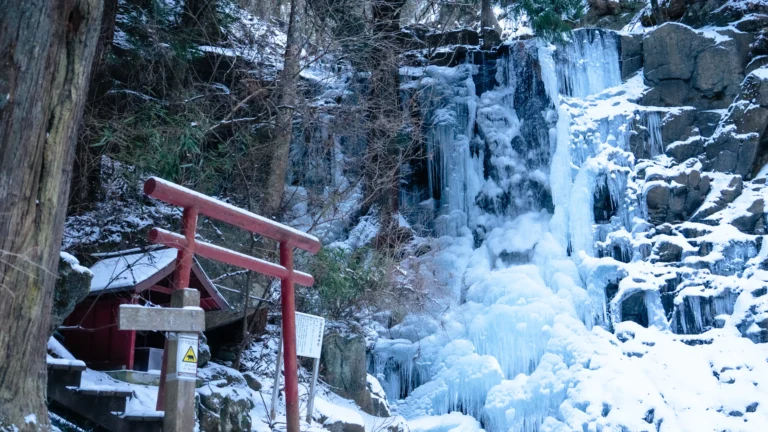
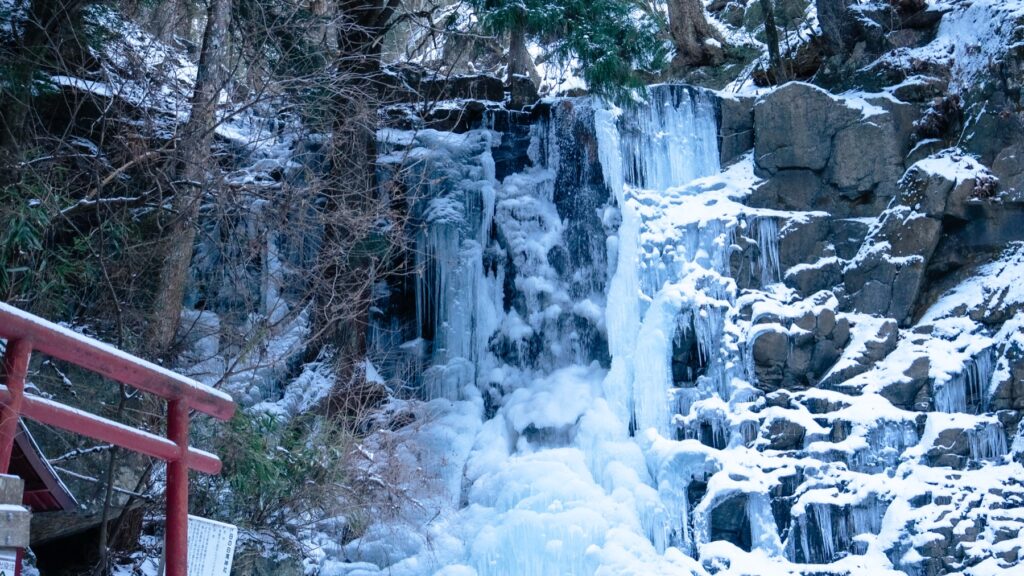
Before you plan to continue to the waterfall. Haha no Shirataki, 10 to 15 minutes further up at 1,006 m, is where Yamanashi Prefecture’s closed section begins — the closure runs from the waterfall up to the forest-road junction, about 1.8 km, and has been in force since 29 June 2026 until further notice. The waterfall’s own small shrine was damaged by a trail collapse in the same earthquake. The figures usually quoted for the full out-and-back — about 4.5 km, an hour and three-quarters, graded for beginners — describe the route as it was before June 2026. Do not plan the extension without confirming access first, and follow every closure sign on the ground.
What the June 2026 earthquake changed
Late on 26 June 2026 an earthquake centred on the eastern Fuji Five Lakes shook the area; the Japan Meteorological Agency put its magnitude at 5.6 and recorded a lower 6 on the Japanese intensity scale in Fujikawaguchiko. Here is what the official notices say, as of 23 September 2026.
Closed. Yamanashi Prefecture closed about 1.8 km of the Mitsutoge footpath — from Haha no Shirataki up to where the prefectural forest road meets the Shirataki forest road — from 17:00 on 29 June 2026, until further notice. No reopening date has been set.
Damaged. Kawaguchi Asama Shrine’s notice of 29 June reports that stone lanterns in its precinct were damaged, that those along the approach path are at risk of falling, and that visitors should keep away from them. The small shrine at Haha no Shirataki was damaged by a collapse of the trail; the one at Chichi no Shirataki could not be inspected because its approach had given way. The shrine states that the path above Haha no Shirataki is impassable.
Not named in any closure. The torii itself. It sits below the prefecture’s closed section, and neither the prefecture nor the operator has published a notice closing it or the path up to it. That is not the same as a statement that the hillside came through undamaged — the shrine below plainly did not — so treat signage and rope lines on the day as the last word.
Walking through to Mitsutoge by this route is not currently possible. If that was the plan, the other routes up the mountain are a separate matter.
Bear sightings and precautions
Fujikawaguchiko publishes a bear-sighting map, and this hillside is on it. For the current fiscal year, and current to 16 September 2026, the Kawaguchi district records four sightings — one of them three bears at the Haha no Shirataki point at two in the afternoon on 20 May 2026. Not dawn, not dusk: the middle of the day.
The town’s advice is to carry something that makes noise — a bell, a whistle or a radio — on the wooded approach, to walk well-used paths in daylight, and to check the sighting map before setting out. Yamanashi’s own bear page, as of 18 September 2026, carried no formal sighting alert for the prefecture, but notes that autumn bears are active ahead of hibernation.
A correction to earlier versions of this guide. This page previously said bear bells could be rented or bought at the shrine for ¥500–1,000. I can find no source for that, and the shrine’s list of what it offers contains no bells. Bring your own.
When to come, and how to check first
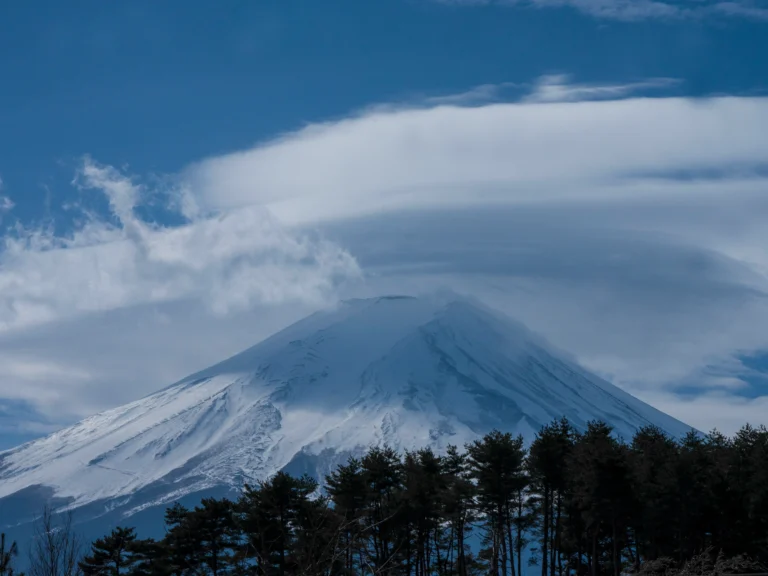
Fuji shows itself most reliably on clear, dry mornings from late autumn through winter, which is also when the sunrise light on its east flank is at its best. Summer is hazy and the mountain is often lost in cloud by mid-morning — go for the gate and the forest rather than the postcard.
There is a live camera at the site itself, run by Fujigoko TV and refreshing about once a minute, linked from the operator’s home page. It is the best pre-departure check there is when it is working; it was returning an error when I looked on 23 September 2026. Our own Mt Fuji visibility page pulls several other cameras if that one is down, and the month-by-month odds are worth reading before you fix a date.
Visiting Kawaguchi Asama Shrine
Most visitors treat the shrine as a car park. It is a constituent asset of the Mt Fuji World Heritage site, founded in 865 after the Jogan eruption of 864, and the oldest Asama shrine on Fuji’s northern flank.
Its seven cedars, the Shichihonsugi, have been a prefectural natural monument since 1958. All seven clear 40 m; the tallest is 47.5 m and even the slenderest measures 6.8 m round at chest height. They are individually named, and the names record what the trees were for — sacred infant robes were hung on one at the annual festival, another watched over childbirth, a third supplied wild silkworm cocoons that were spun and presented to the imperial court. The shrine’s Chigo no Mai, a children’s dance, has been a national important intangible folk cultural property since 2017. The office keeps 9:00–16:00, every day of the year.
The slope you walk up is also a project. Since 2019 the Asama–Shirataki Sakura Line has been planting cherry trees along the route from the shrine towards the waterfall, funded by sponsored trees, with a target of about a thousand — a target, not a count, which is worth saying because the line “over 1,000 cherry trees planted” has spread widely. Among them are scions of three of Japan’s most famous cherries — Miharu Takizakura, Yamataka Jindaizakura and Neodani Usuzumizakura — and two descendants of the Jindaizakura grown from seed flown in space.
What to bring
Small change
¥200 per adult and ¥100 per child aged 6–17, in coins. No payment method is published, and visitors describe cash into a box.
Shoes with grip
Earth steps and steep pitches, and shaded sections that ice in winter. The last stretch from the lower parking is uphill on loose ground.
Warm layers in winter
The slope is open and exposed, and a February sunrise up there is cold enough to end the visit early if you are underdressed.
A bell or whistle
For the whole wooded approach, not only the upper trail. See the sighting record above.
Use the toilet at the shrine
The operator states there are none at the Yohaijo. The free toilets at the shrine car park at the bottom are the nearest.
A wide lens
From where I stood, 24–35 mm equivalent took in both uprights and the whole mountain.
Frequently asked questions
How much does Tenku no Torii cost?
¥200 for adults and ¥100 for children aged six to seventeen, as a contribution towards running the site. For an ordinary visitor photographing with their own camera or phone, that is the whole cost: there is no photo ticket, no timed slot and no camera licence. No rate is published for children under six. The ¥100 still shown by several travel sites is the old flat rate, which applied from July 2022 until 30 November 2024.
Do I need permission for a photo shoot?
For an ordinary snapshot, no. The operator does require advance application, and charges a usage fee, for shoots by a photographer — its wording explicitly includes friends and acquaintances acting in that role — and for location shoots such as weddings, even when private. Commercial applications go in at least a month ahead, with about a week for a decision. It issues no property release, so images from the site cannot be sold through stock libraries, and it prohibits drones in principle.
What time does it open?
The operator publishes no opening or closing hours at all. The Google listing shows 9:00–16:00 daily, which is not an official source, and Japanese accounts variously describe early-morning access and opening until sunset. Plan around 9:00–16:00; if a sunrise visit is the point of your trip, ask the operator first rather than relying on an unpublished schedule.
Can I get there by public transport?
As far as the shrine, yes. Take the Kofu-bound Fujikyu bus from stop 5 at Kawaguchiko Station to Kawaguchi-kyokumae — 10 minutes, ¥350, fifteen departures a day — then walk a few minutes to the shrine and 20 to 30 minutes uphill. None of the official access pages lists a bus, shuttle or share taxi to the torii itself, and there is no stop for it in the Fujikyu network; vehicles seating 11 or more are in any case barred from the forest road above the site.
Can I drive to the top?
Yes. There is no gate or permit, but the forest road is narrow and single-track in places, parking at the top is minimal — the operator’s own pages are inconsistent about how much there is — and it asks you not to park on the road because emergency vehicles use it. On weekends and holidays it asks you to park at the shrine and walk up instead. In winter it asks for studless tyres or other anti-slip equipment, as the surface ices.
Is the site open after the 2026 earthquake?
No closure has been published for the torii, the shrine or the path between them. What is closed is the footpath from Haha no Shirataki upwards, shut by Yamanashi Prefecture since 29 June 2026 until further notice. The waterfall’s small shrine was damaged by a trail collapse, and stone lanterns on the shrine’s approach path are at risk of falling and should not be approached. Walking through to Mitsutoge by this route is not currently possible.
Are there toilets at the torii?
No — the operator states there are none on site. The nearest are the free toilets at the shrine car park at the bottom of the walk, 20 to 30 minutes back down.
Is it worth going if Fuji is hidden?
The whole composition depends on the mountain, so a clouded morning costs you the photograph. The walk, the cherry slope and the shrine’s cedars stand on their own, but if your trip is short, check a camera before you commit and keep the morning flexible.
Haha no Shirataki
The frozen waterfall further up the same trail — and what the earthquake did to it.
Why Mt Fuji is World Heritage
Kawaguchi Asama Shrine is one of the 25 constituent assets. This explains what that means.
Mount Mitsutoge
The summit this trail used to lead to, and the routes up it.
Chureito Pagoda
The other framed-Fuji shot, half an hour away — busier, and up 398 steps.
Oishi Park
Across the lake, and an easy pairing with the torii on the same morning.
Skip the crowds
Where to go when the obvious Fuji viewpoints are shoulder to shoulder.
The same town holds the Kai no Katsuyama yabusame every 29 April, a horseback-archery rite I watched from the rope line at Shikkogo Park; the September yabusame with the hoofprint divination is a separate rite, over in Fujiyoshida. Lake Yamanaka is the other lake worth a morning if you are basing yourself here.
Official sources, re-checked 23 September 2026
- Fujisan Yohaijo, the site’s operator (Asamasha LLC) — contribution rates and their history, access and parking, the vehicle-size and winter-tyre warnings, conduct rules, personal and commercial photography rules, and the live-camera link
- Kawaguchi Asama Shrine, notice of 29 June 2026 — earthquake damage to the stone lanterns and to the Haha no Shirataki and Chichi no Shirataki shrines, and the impassable path above the waterfall; plus the shrine’s own pages on the seven cedars and its hours
- Fujikawaguchiko Tourism Association — the statement that the Tenku no Torii is not owned or operated by the shrine, and the shrine’s hours and parking
- Yamanashi Prefecture — the Mitsutoge footpath closure of 29 June 2026 and its extent; the forest-road regulation record for the Nishikawa-Arakura prefectural forest road, including the 11-seat vehicle restriction and the absence of a listed winter closure; and the prefecture’s bear page
- Japan Meteorological Agency — magnitude and observed intensity for the earthquake of 26 June 2026
- Fujikyu Bus — the current fare table and timetable for the Kofu line, stop numbering at Kawaguchiko Station, and loop-bus pass coverage
- Fujikawaguchiko Town — the FY2026 bear sighting map, current to 16 September 2026, and the town’s bear advice
- Geospatial Information Authority of Japan — elevations at the torii, the shrine and the waterfall
- Photographs: taken by the author at the Yohaijo and Haha no Shirataki on 9 February 2026.
Join travelers discovering Japan's hidden side
Weekly dispatches from off-the-beaten-path Japan — spots and stories you won't find in guidebooks.
No spam. Unsubscribe anytime.
Welcome aboard!
You're in. See you in your inbox soon.