Kanto Highlands · Early Autumn
Kusamomiji means “grass autumn leaves” — colour that arrives not as a few red trees but as an entire wetland turning gold. At Ozegahara — Japan’s largest mountain wetland and Honshu’s largest high moor — the sedges and grasses usually start building colour from mid-September, with the best grass colour often around late September into early October, while the surrounding forests are still green. It comes weeks before the maple season, two prefectures from Tokyo, across flat wooden boardwalks reached by a maintained trail. What follows: what kusamomiji actually is, the 2026 access through Hatomachi Pass, and the day-trip-versus-hut-night decision.
What kusamomiji actually is
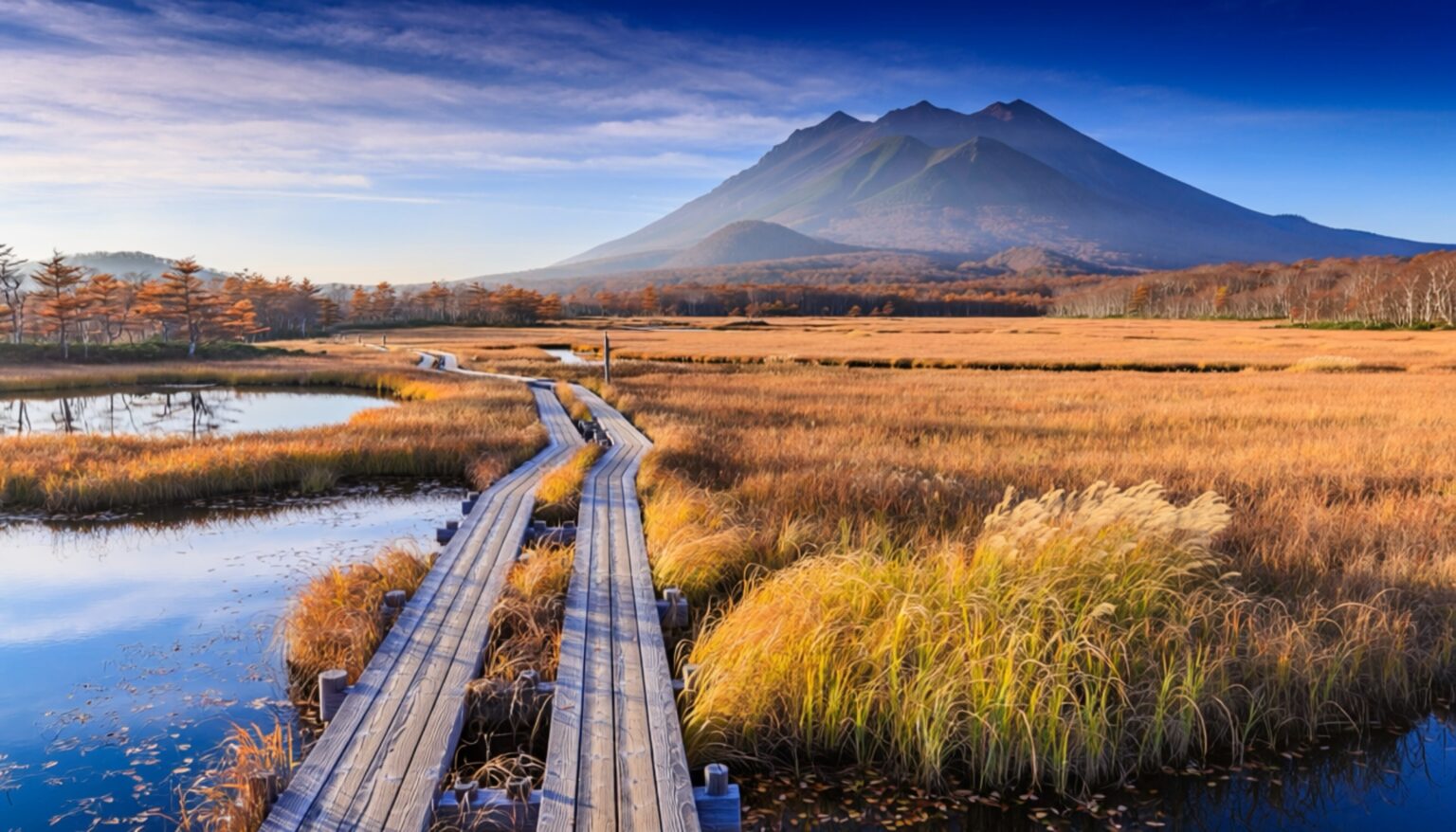
Japan’s famous autumn is tree foliage — maples and ginkgo from October onward. Kusamomiji is the wetland prelude: marsh grasses and sedges colouring weeks earlier, not in single leaves but as an entire landscape shifting through yellow and amber toward russet. The Oze Preservation Foundation’s own season notes put the change through September, with the strongest grass colour typically around late September into early October — weather-dependent, like everything in this list. The effect is different in kind from the maple season — a flat gold plain running to the foot of Mt. Hiuchigatake, at its best in low morning light — sometimes with mist over the marsh.
Getting in: how the 2026 access works
The classic entry for Ozegahara is Hatomachi Pass on the Gunma side, and it runs traffic controls most of the season: private cars are restricted from April 17 (10:00) to November 5 (14:00) in 2026, so you park at Tokura and ride up — shared buses and taxis shuttle the pass road from April 18 to November 3. From the pass, a maintained path descends about an hour to Yamanohana at the marsh’s edge, where the boardwalks begin. No technical gear is needed in September, but the pass path starts with a steep stone-paved descent and wet boardwalks are slippery — grippy trail shoes, rainwear and a warm layer are the sensible minimum. The marsh itself is flat.
| Step | What it is | Notes |
|---|---|---|
| Tokura (Katashina Village) | Park-and-ride base | Car parks + the bus/taxi shuttle up to Hatomachi Pass (runs Apr 18 – Nov 3) |
| Hatomachi Pass | Trailhead | Private cars restricted Apr 17 – Nov 5; the shuttle drops you here |
| Yamanohana | Marsh gateway, huts | ~1 hour down a maintained path; last toilets and hut cluster before the plain |
| Ozegahara boardwalks | The kusamomiji | Flat wooden planking across the gold; walk as far as your turnaround time allows |
The rules that keep Oze being Oze
Oze survives its visitors because everyone stays on the planks. The boardwalk rules are not suggestions: no stepping onto the marsh (even for a photo), no picking anything, carry every scrap of rubbish out, and keep right when passing oncoming walkers on the doubled sections. The wetland took thousands of years to build and regenerates at millimetres a decade — the reason the gold plain is still there to photograph is that nobody shortcuts it.
Day trip or hut night?
| Plan | How it runs | Choose it if |
|---|---|---|
| Long day trip from Tokyo | Earliest trains via Numata, or the early Oze-go bus; the daytime Shinjuku bus reaches Tokura late morning, which cuts marsh time to a few hours | Your schedule is tight and midday light is an acceptable trade |
| One hut night | Arrive afternoon, sunset and dawn on the boardwalks, walk out next morning | You want the early low-light hours the marsh is known for |
| Katashina-side inn + early shuttle | Sleep in Tokura/Katashina, first shuttle up | Huts are booked out but you still want early light |
Mountain huts around the marsh take reservations and fill on late-September weekends, so book as soon as your dates firm — and for the Katashina/Tokura side or a Numata-line base, compare Booking.com and Agoda; for a Tokyo overnight before an early start, Trip.com is useful around Ueno and Asakusa. Keep the rate refundable until the September weather picture firms.
Timing check before you commit: watch our live koyo tracker from early September. Kusamomiji is steadier than tree foliage — the grasses turn on schedule more reliably than maples — but a warm September can hold the gold back a week, and our September colour guide keeps the alternatives on one page.
FAQ
How is kusamomiji different from normal autumn leaves?
It is the grasses and sedges of wetlands changing colour, not trees — an entire plain turning gold and copper rather than canopies turning red. It happens weeks earlier than tree foliage (late September at Oze versus late October onward for the region’s maples) and reads as a landscape effect rather than individual spectacular trees.
Do I need hiking experience for Ozegahara?
No — but you need legs for the hour-long descent from Hatomachi Pass to the marsh (and the same climb back out). The marsh itself is flat boardwalk. Sturdy shoes, rain layer and water are enough in September; trekking poles help on the pass path if your knees complain on stairs.
Can I do Oze as a day trip from Tokyo in late September?
Yes, but the transport choice decides how much marsh you get: the earliest trains via Numata (or the early Oze-go bus runs) buy the most hours, while the daytime Shinjuku bus reaches Tokura late morning and leaves only a few hours on the boardwalks. Check the season’s current timetables. Either way, day-trip hours put you on the marsh in its flattest light.
When exactly does the kusamomiji peak?
Typically late September into early October, with the turn starting mid-September. Grass colour is more punctual than tree colour year to year, but a warm autumn still shifts it — check live reports from mid-September rather than fixing everything to one date.
Are there bears in Oze?
Yes — this is black-bear habitat, and the area runs sighting alerts with bells installed along some sections. Standard practice applies: make noise, don’t walk the quietest stretches alone at dawn or dusk, and check current advisories at the visitor centres before setting out.
Is autumn Oze crowded?
Late-September weekends are the season’s second rush after the June skunk-cabbage bloom — expect steady boardwalk traffic mid-morning to mid-afternoon. Weekdays and the first two hours after dawn are a different, much quieter marsh.
Sources
Oze Preservation Foundation season and conservation guidance (kusamomiji timing, boardwalk rules); Katashina Village 2026 Hatomachi Pass traffic-control and shuttle dates (cars restricted Apr 17–Nov 5; buses/taxis Apr 18–Nov 3); tenki.jp Oze spot pages for typical viewing windows. Live conditions in season: the foundation’s field updates and our koyo tracker.
Join travelers discovering Japan's hidden side
Weekly dispatches from off-the-beaten-path Japan — spots and stories you won't find in guidebooks.
No spam. Unsubscribe anytime.
Welcome aboard!
You're in. See you in your inbox soon.