
Narusawa · Road station · Crystal museum
Michi-no-Eki Narusawa is a roadside station in Narusawa village with a farm stand, a shop of local goods and a snack counter. Right beside it, the Narusawa Fujisan Museum is free to enter and has crystal displays: tall amethyst geodes, stones you are invited to touch, and panels on Yamanashi’s crystal history. I spent one Tuesday afternoon in September 2026 on the pair.
I’m Nobu, and I live in Yamanakako village. On 8 September 2026, at the road station, I used the snack counter, the farm stand and the car charger, then went into the museum. My road-station photos are from 1:10 to 1:58 p.m. and my museum photos from 2:00 to 2:42 p.m.
Lunch at the road station
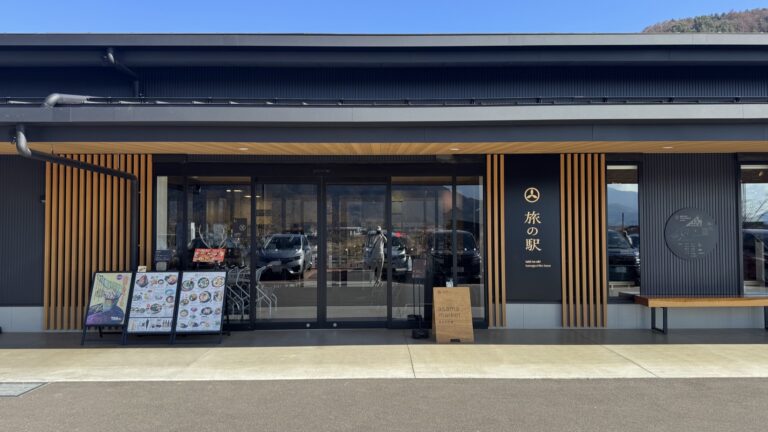
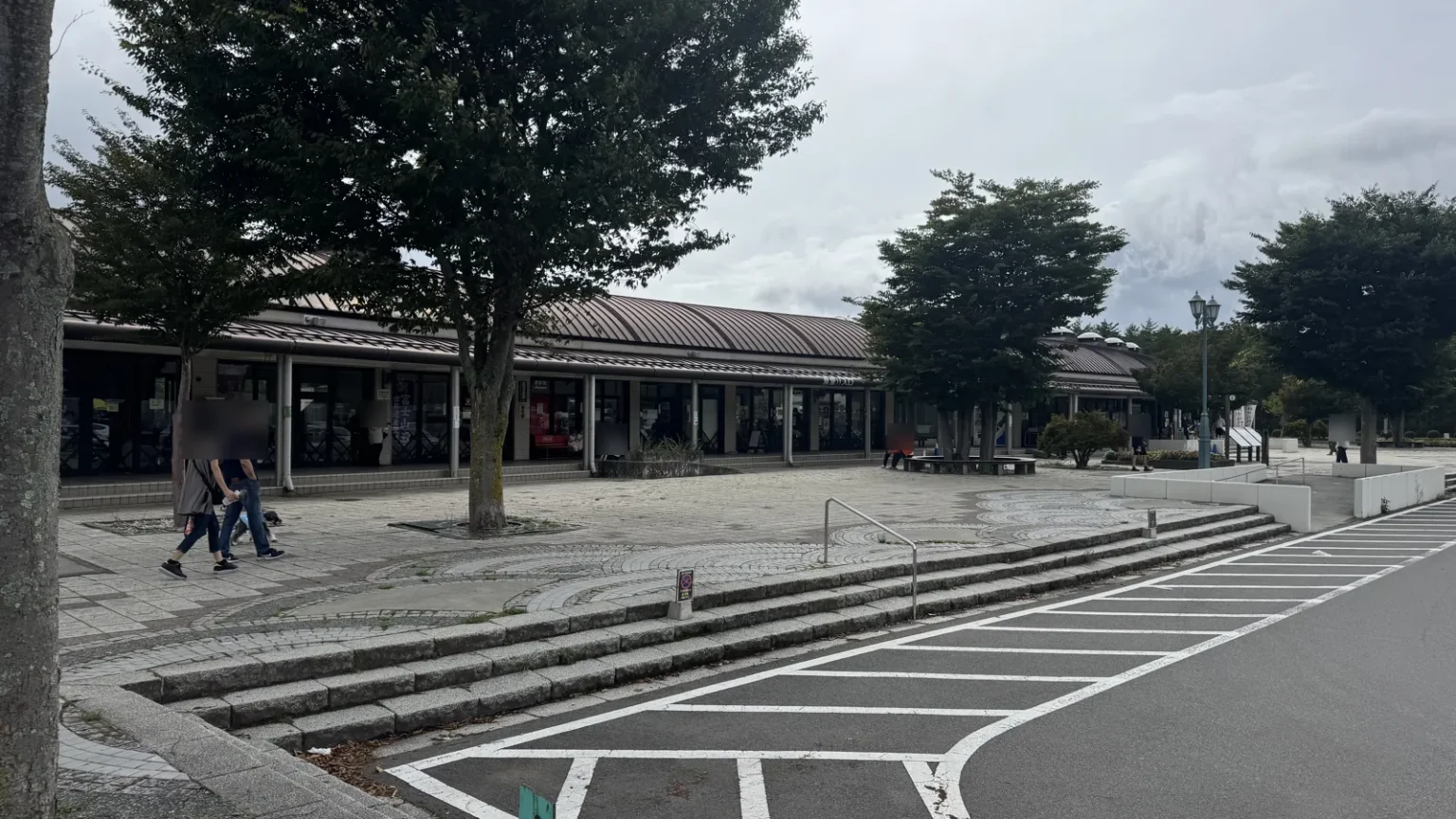
The road station is a long, low building with a curved roof, set back behind a paved plaza with a few trees and some wide steps. The sky was grey and cloudy when I took the photo below. The car park was not busy that Tuesday afternoon.
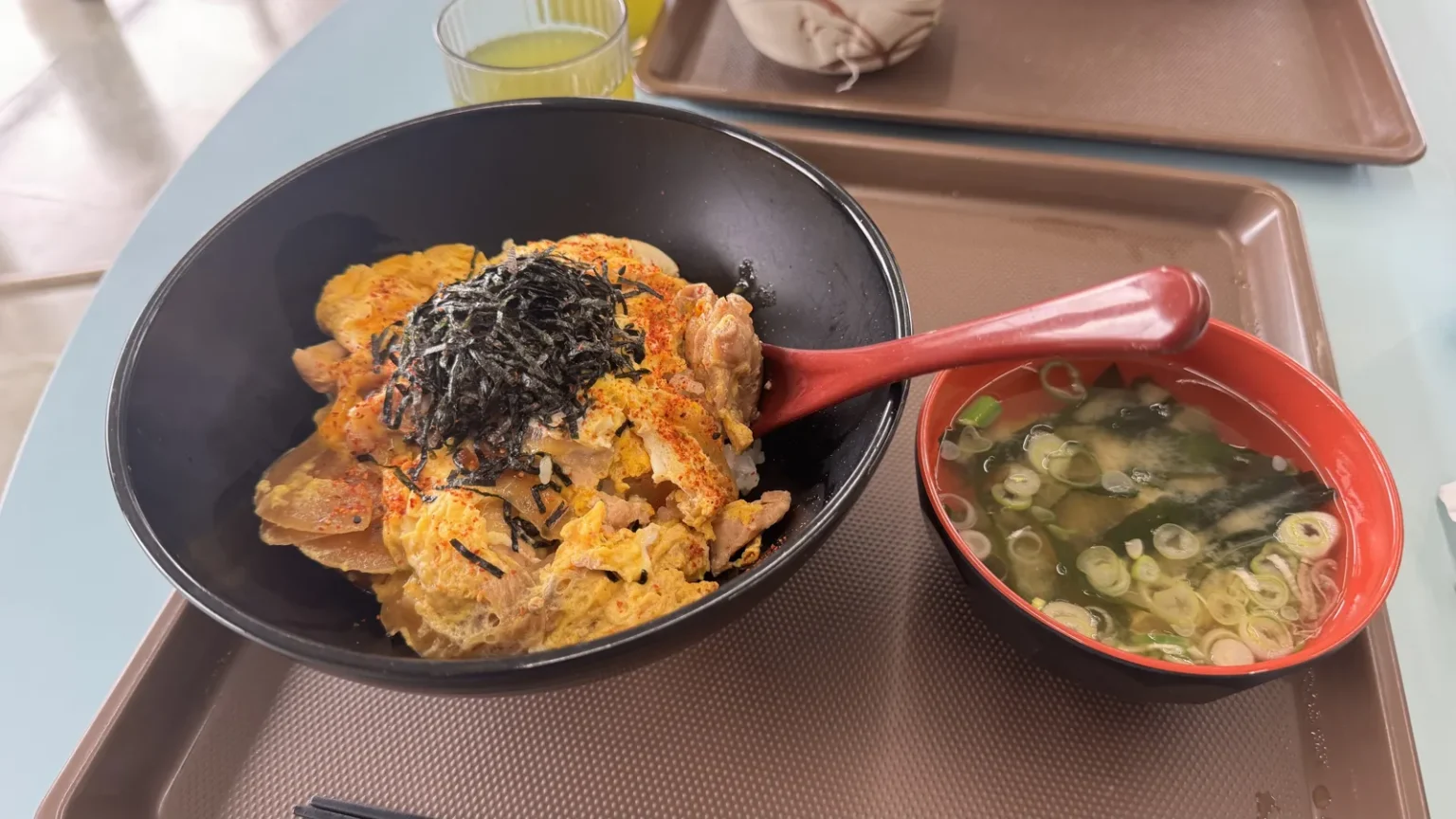
Lunch came from the snack counter: a rice bowl topped with egg, meat and shredded seaweed, with a bowl of miso soup, on a brown tray. The menu name is unconfirmed, so I won’t guess at it.
For what else is on offer, Narusawa’s tourism site lists local dishes at the snack counter such as sendo soba, rice mixed with Narusawa-na, biscuit tempura, a “Jiragonno” croquette and Fuji-zakura soft serve. According to the village, the road station also has an information desk, a rest room, a nature trail with a viewpoint, and toilets and parking open 24 hours, plus a quick charger for electric cars. It opened in 1995, and since April 2026 it has been run by the Fuefuki farmers’ co-operative.
If you eat gluten-free or halal, see three places around the Fuji Five Lakes.
What the farm stand had in early September
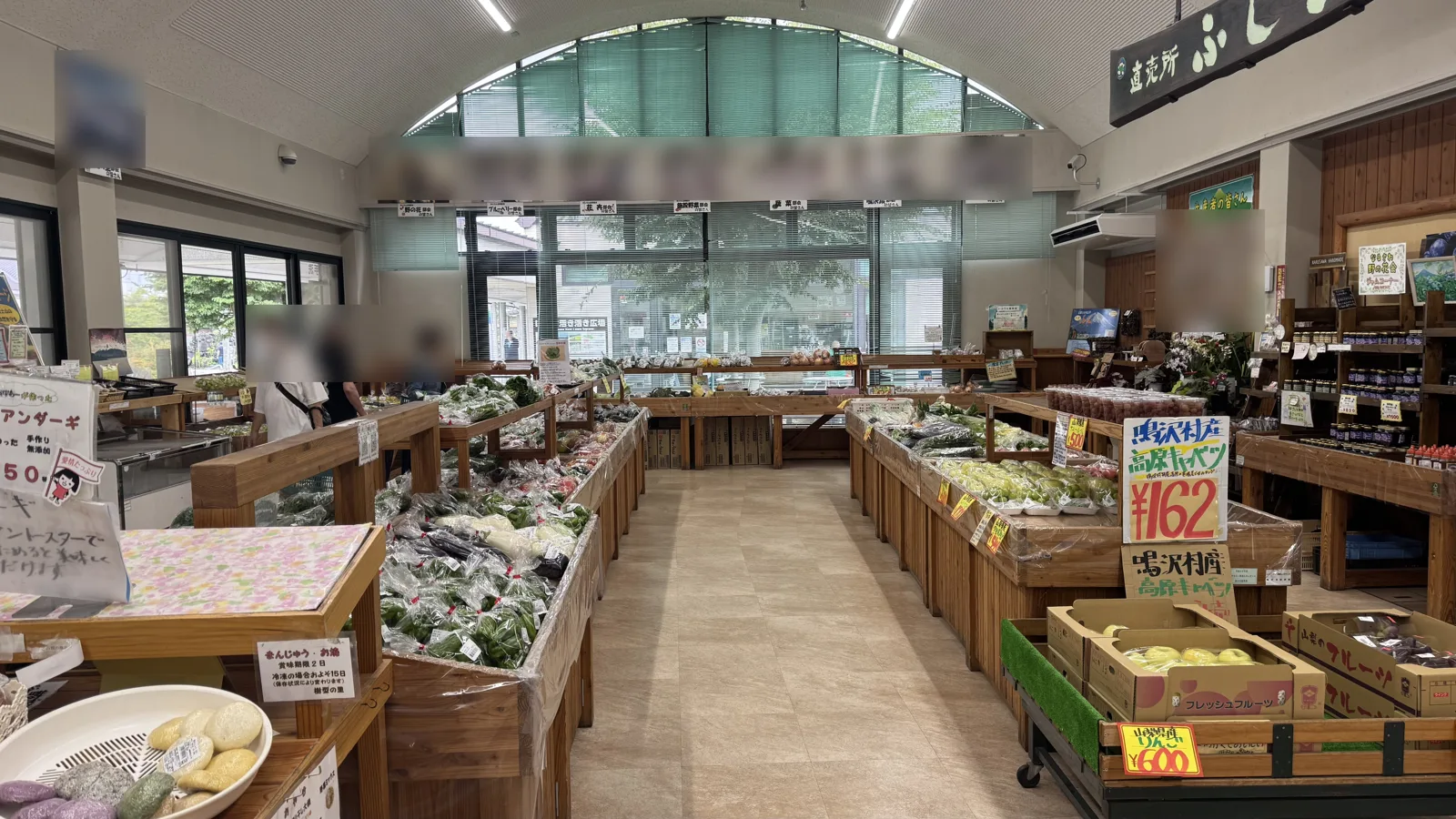
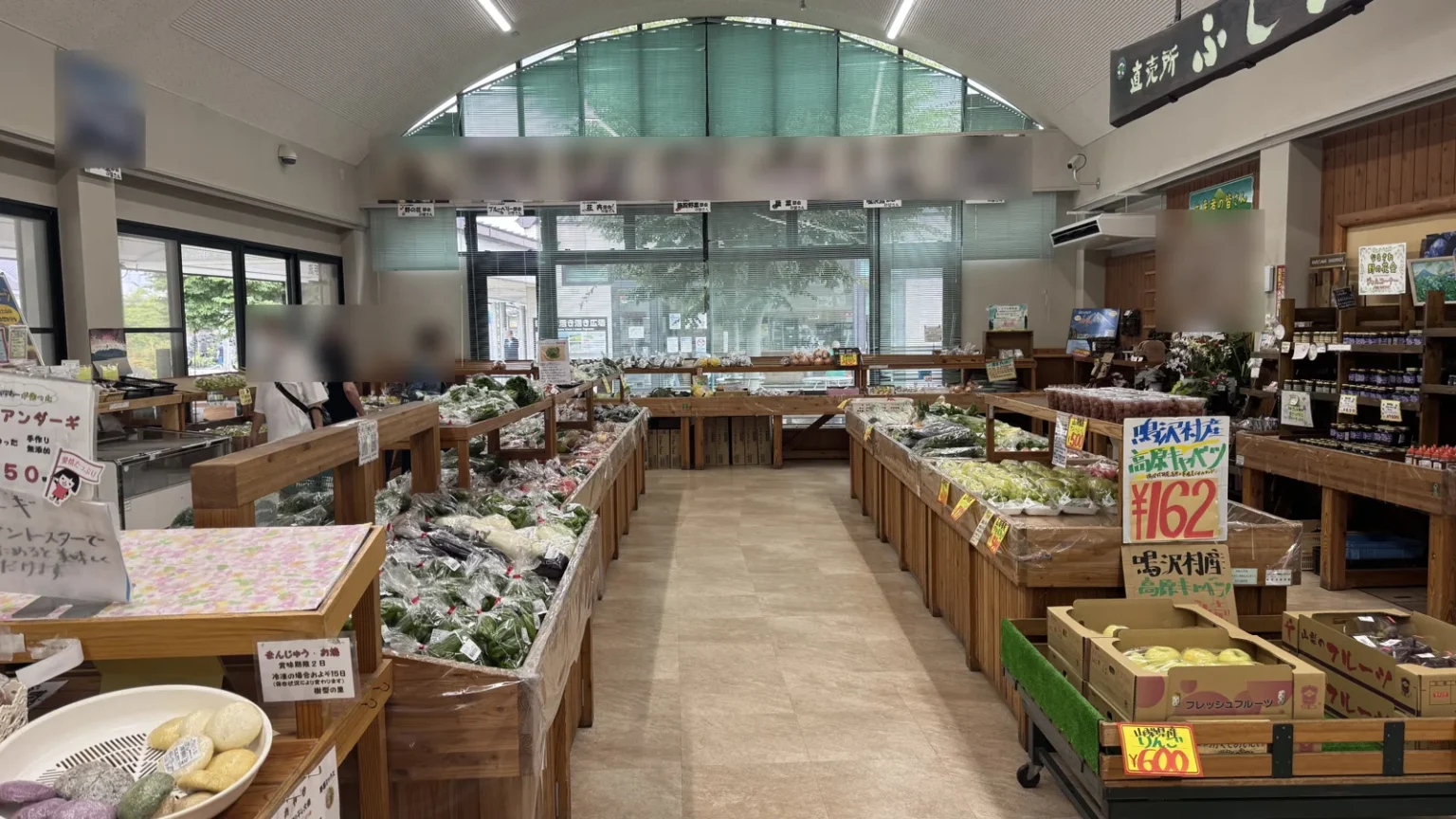
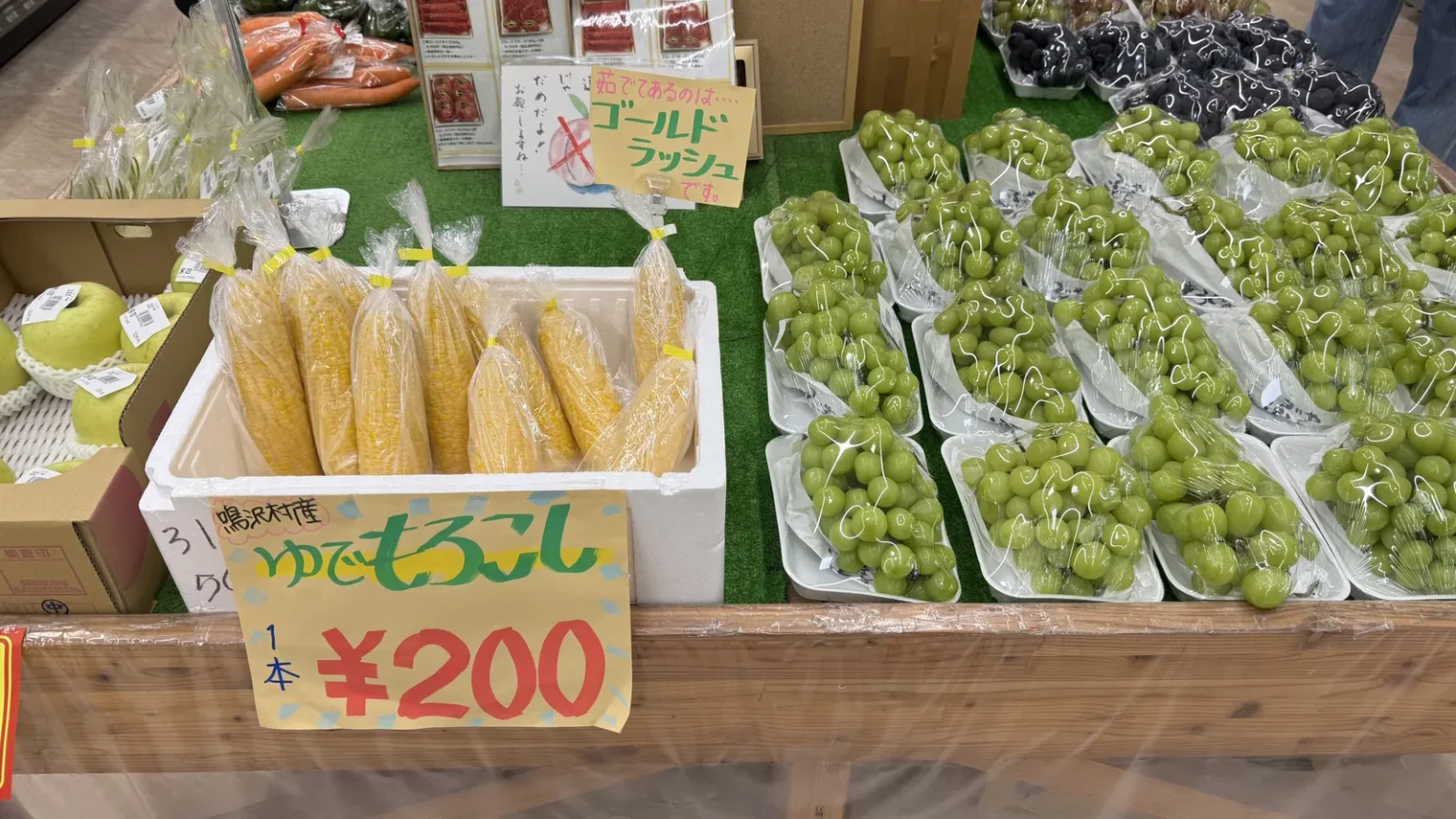
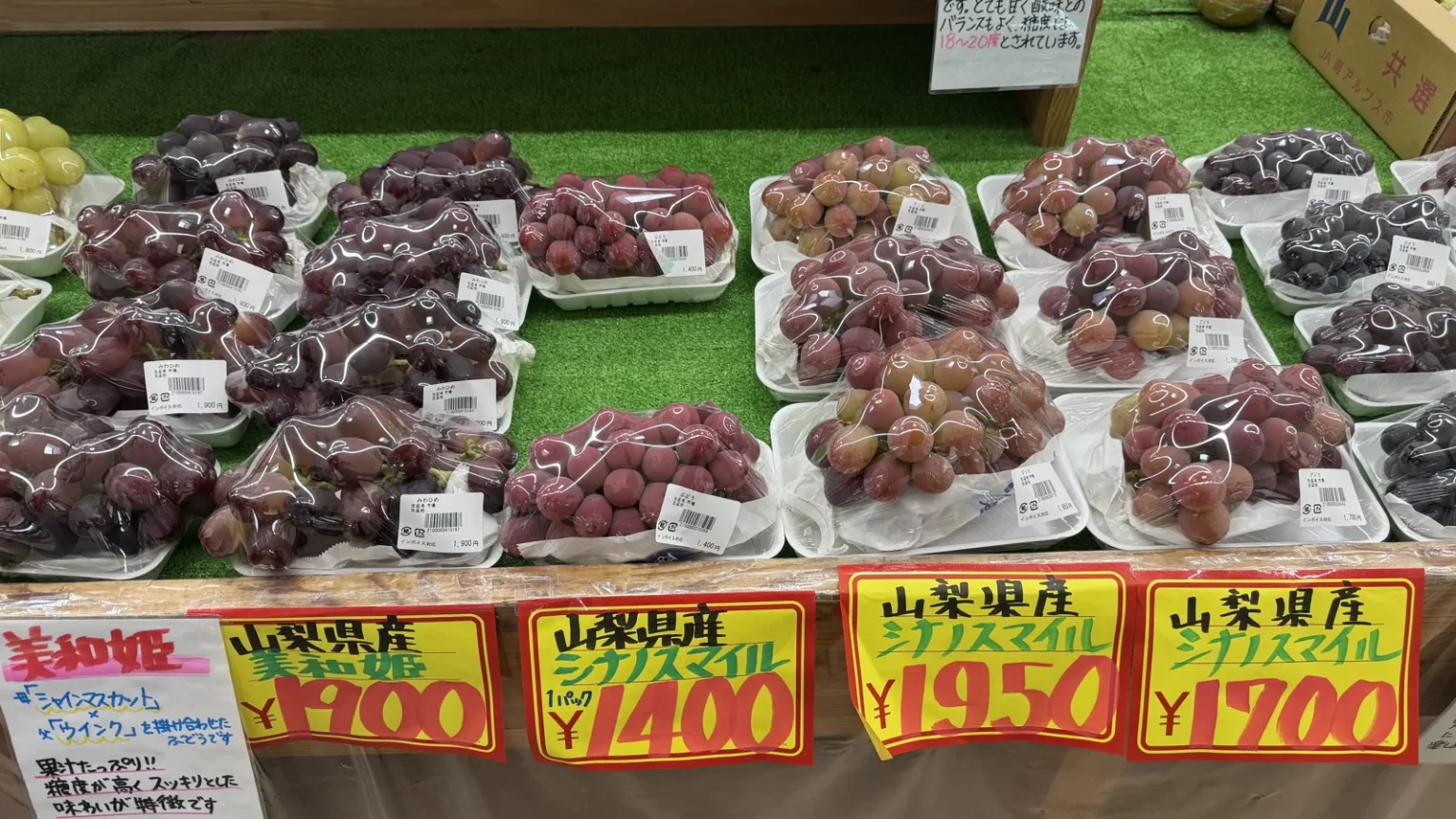
The farm stand sits under the same arched roof, with wooden bins of bagged vegetables and boxes of fruit. Grapes fill a good share of my photos from the stand, and the signs I photographed name either Narusawa village or Yamanashi Prefecture as the origin. These are the prices on those signs that day:
| Item (as signed) | Origin on the sign | Price on 8 Sep 2026 |
|---|---|---|
| Highland cabbage (高原キャベツ) | Narusawa village | ¥162 |
| Boiled corn (ゆでもろこし) | Narusawa village | ¥200 each |
| Apples (りんご) | Yamanashi | ¥600 |
| Shinano Smile grapes (シナノスマイル) | Yamanashi | ¥1,400 a pack; other signs ¥1,700 and ¥1,950 |
| Miwahime grapes (美和姫; Shine Muscat × Wink, per the sign) | Yamanashi | ¥1,900 |
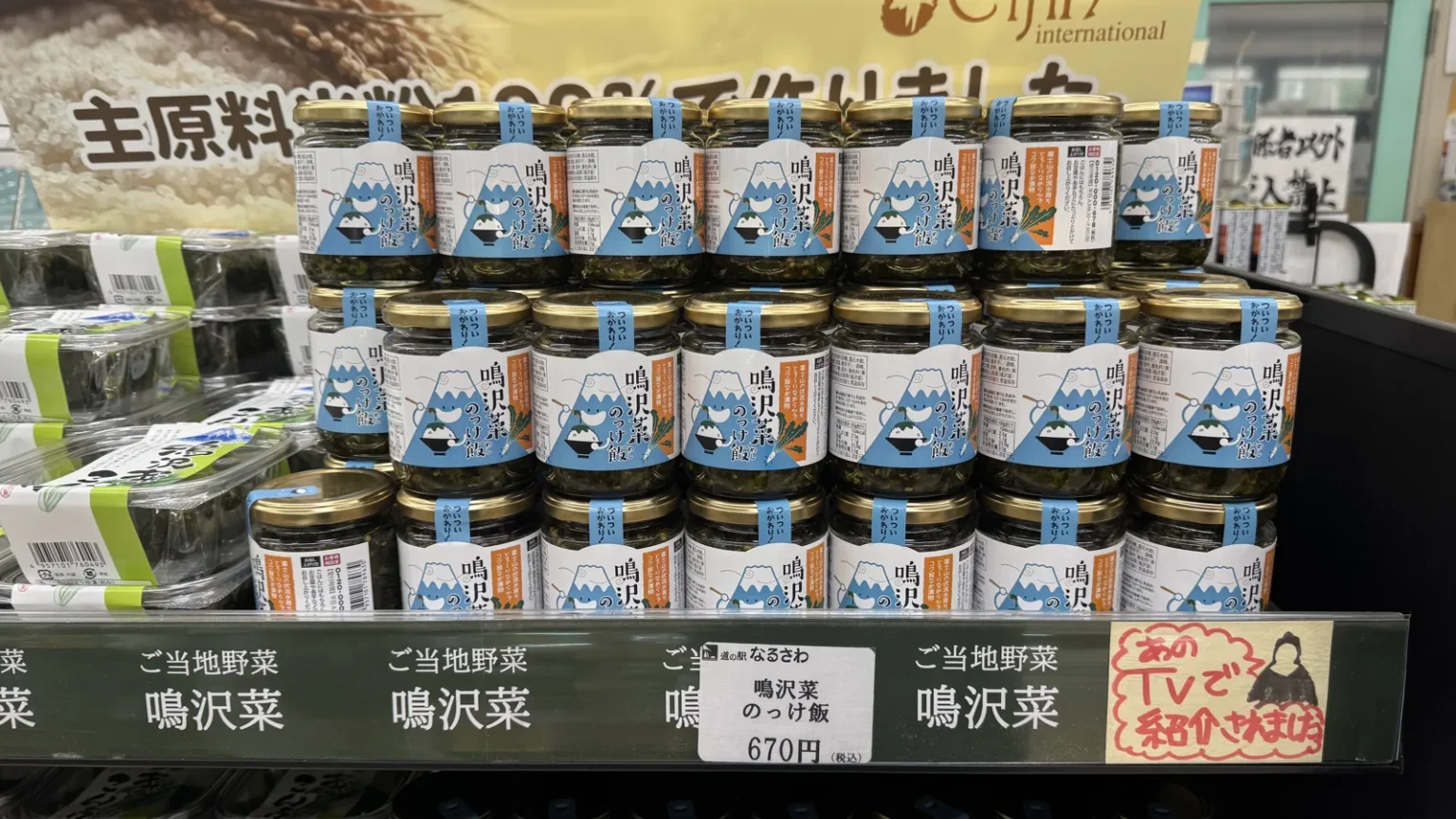
| Narusawa-na rice topping (鳴沢菜のっけ飯), in the shop | Road station’s own label | ¥670 incl. tax |
Prices are from the signs on one day and change with the season and the harvest.
Narusawa-na and the local-goods shop
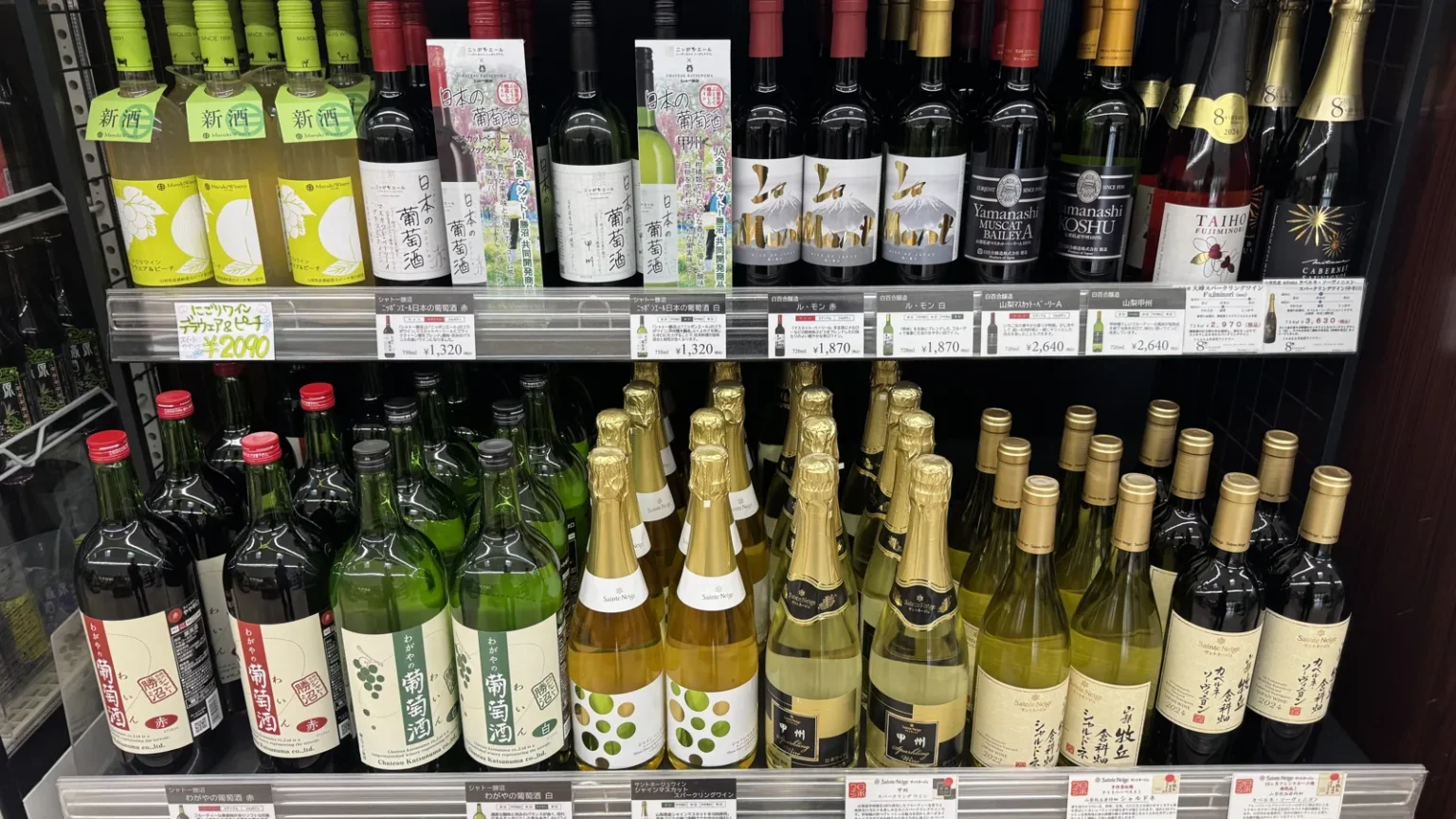
Inside the local-goods shop, under a sign reading なるさわ 物産館, one shelf was given over to Narusawa-na (鳴沢菜), signed as the area’s own local vegetable. The jars on it had Mt Fuji on the labels, and a tag for 鳴沢菜のっけ飯, something to put on rice, was marked ¥670 including tax and labelled as a road station product. There was also a shelf of bottled wine.
Narusawa-na is worth knowing about. Yamanashi Prefecture describes it as a traditional vegetable grown in Narusawa since the Edo period, a turnip green similar to nozawana; the tender stems are good lightly pickled, and the swollen root is eaten too. The prefecture puts its shipping season at late October to early November. Check availability if you’re coming for it.
Why here? Japan’s agriculture ministry, in its traditional-foods database, puts it down to Narusawa’s own conditions: the cool air of the Fuji foothills, Mt Fuji’s volcanic-ash soil and the groundwater that flows down from Fuji. In a village this cold, it adds, green vegetables were precious in winter and also a cash crop, and it was often pickled to keep. The ministry cites the provincial gazetteer Kai Kokushi, which in 1814 lists tsukena (菘) among Narusawa’s products, and says this indicates Narusawa-na was being grown in the early 19th century. It also notes that although it looks like nozawana, genetically it belongs to the line of Chozenji-na, a kind of turnip from Kyoto.
EV charging
I charged the car here on 8 September 2026. I can only vouch for that day, so check the current charger status before you count on it.
Labels are in Japanese
The price signs and product labels I photographed were in Japanese. The table above gives the readings; a translation app helps with the rest.
Opening hours
The road station’s hours differ between Narusawa village’s page and the national road-station site, so I’m not giving one here. Check before you plan a late stop.
Narusawa Fujisan Museum: putting a hand on the crystal
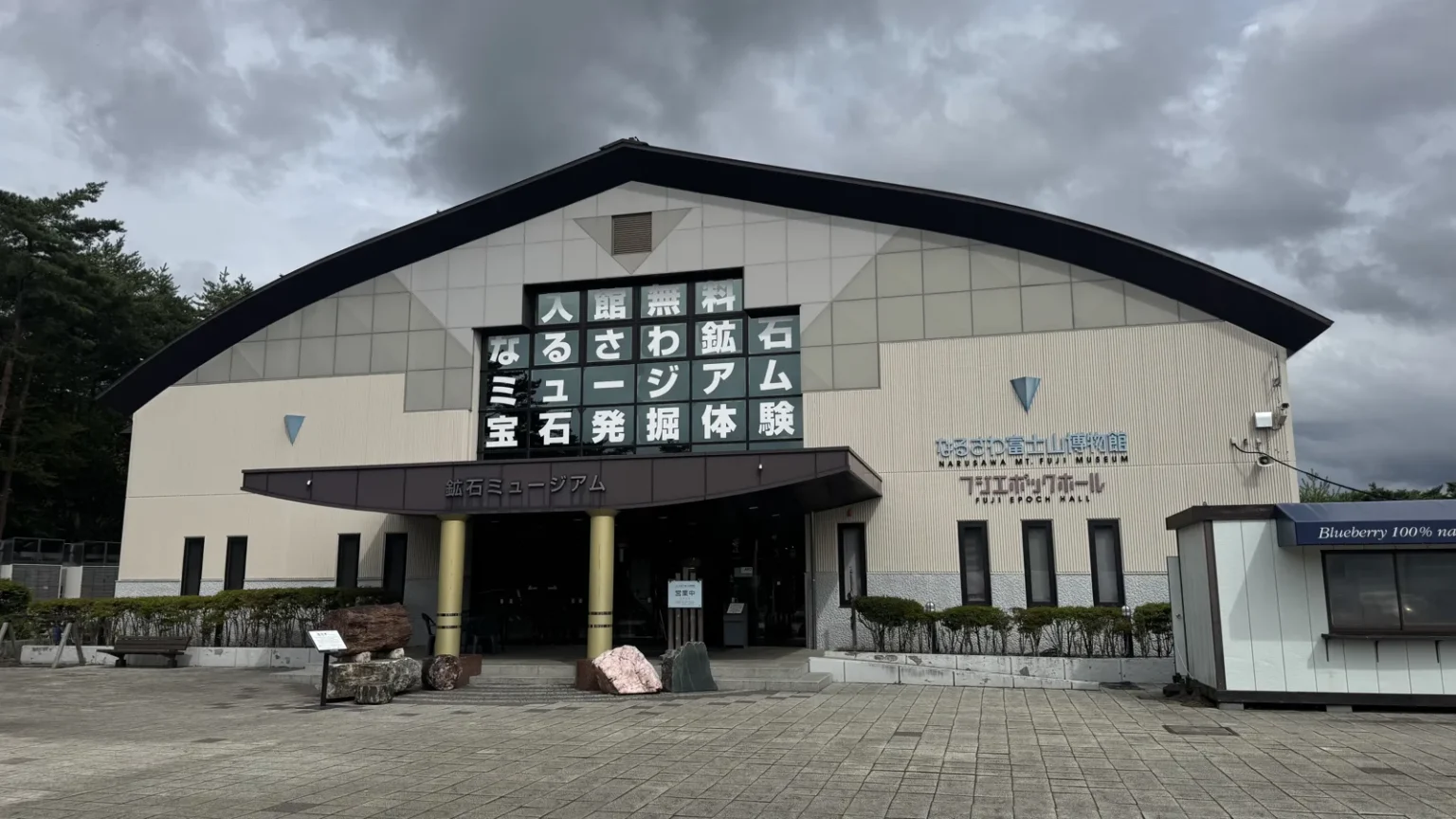
The museum stands next to the road station: a large building with a curved roof, and signs reading なるさわ鉱石ミュージアム (Narusawa mineral museum) and 宝石発掘体験 (gem-digging experience). Its official name is the Narusawa Fujisan Museum (なるさわ富士山博物館). The official site says entry is free and it is open every day. Yamanashi Prefecture’s tourism page says it was renovated in July 2008, when the mineral museum was added, and suggests it as a stop for anyone taking a break at the road station. That is exactly how I used it.
I went into the museum itself, not just the shop, and found it interesting. One sign asks 「アナタならどの石に触りますか?」 (“Which stone would you touch?”) and lists stones such as sodalite, rose quartz, amethyst, rock crystal and red jasper.
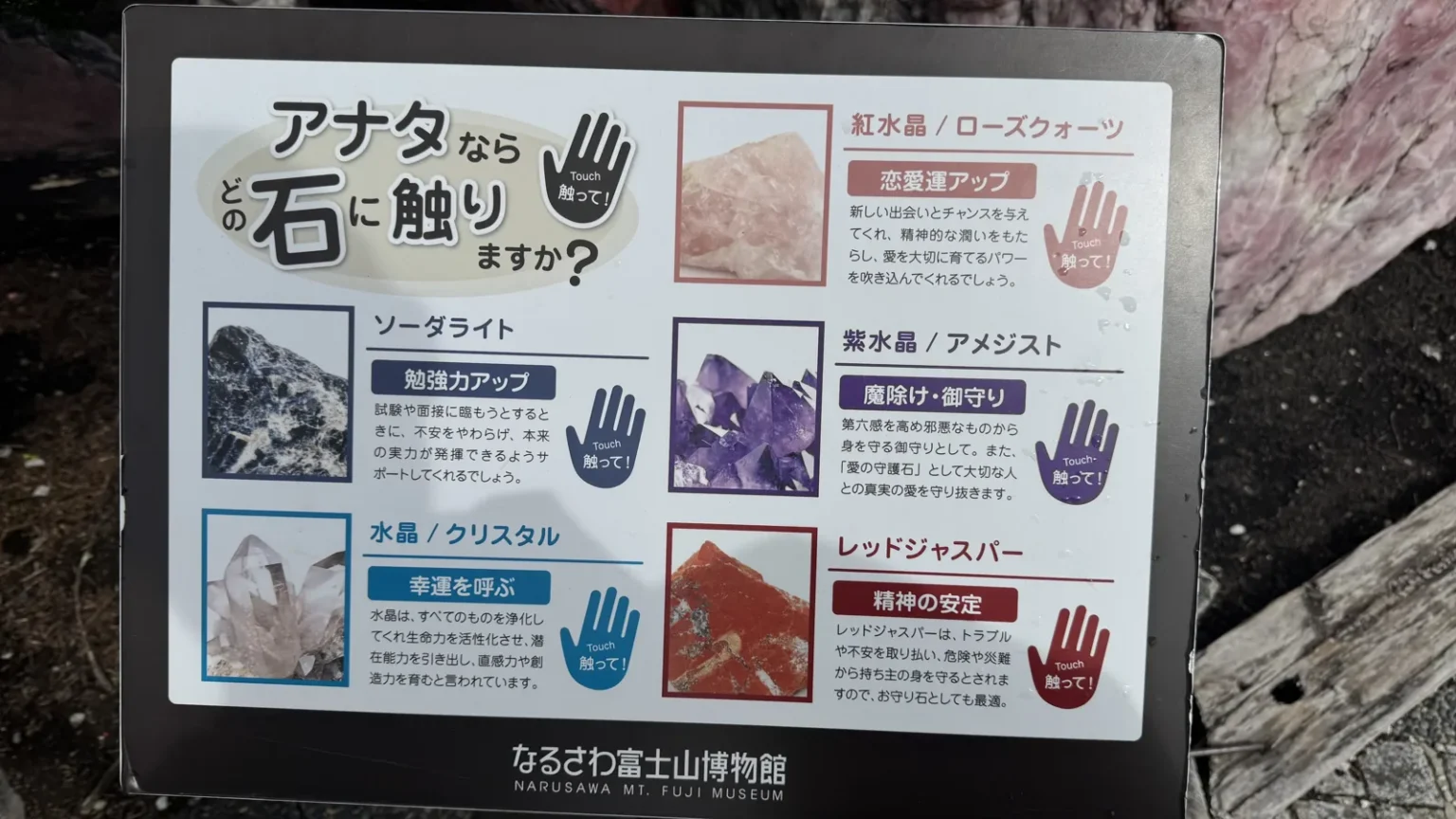
So I put my hand on the crystal. It felt cool, and beyond that, almost as if there were a flow of energy. I’m not making any claim about crystals here; that’s only how it felt to me, standing there with my hand on the stone.
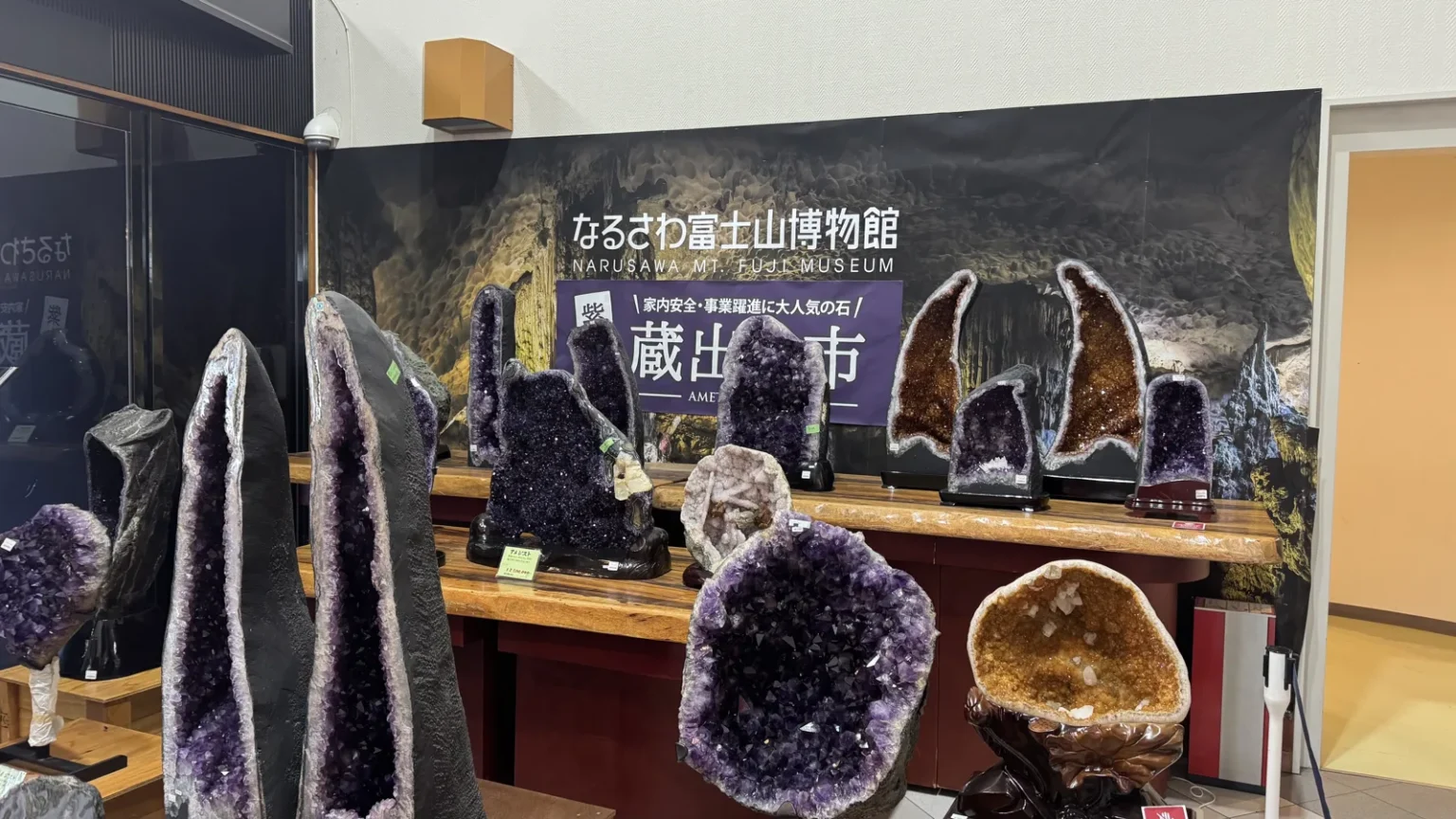
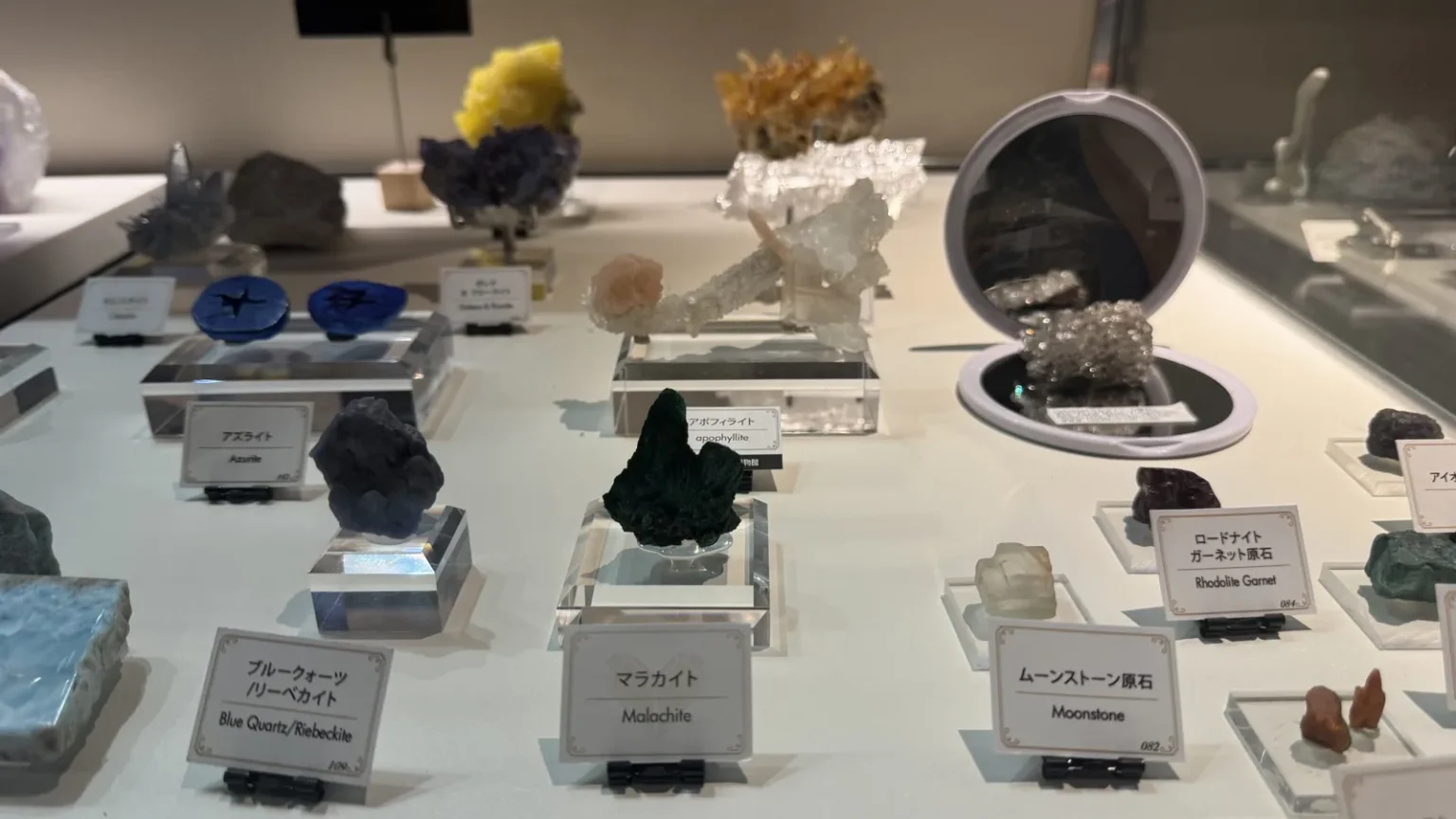
The amethyst geodes stand tall and split open, deep purple inside. Elsewhere, specimens sit on white displays, each with a small label.
Yamanashi’s crystal history
I also enjoyed the exhibit on the history of crystal in Yamanashi. It is a run of illustrated panels; the ones I photographed had Japanese text. Three that I photographed are titled 「武田信玄公と水晶 大念珠」 (Takeda Shingen and the great crystal rosary), 「武田信玄公の信仰心」 (Takeda Shingen’s faith) and 「聖地・昇仙峡」 (Shosenkyo, a sacred place). The text is dense Japanese, so a translation app helps.
If you would rather dig for stones than look at them, the Fujikawaguchiko Stone Museum in Funatsu runs gem hunting next to its free museum.
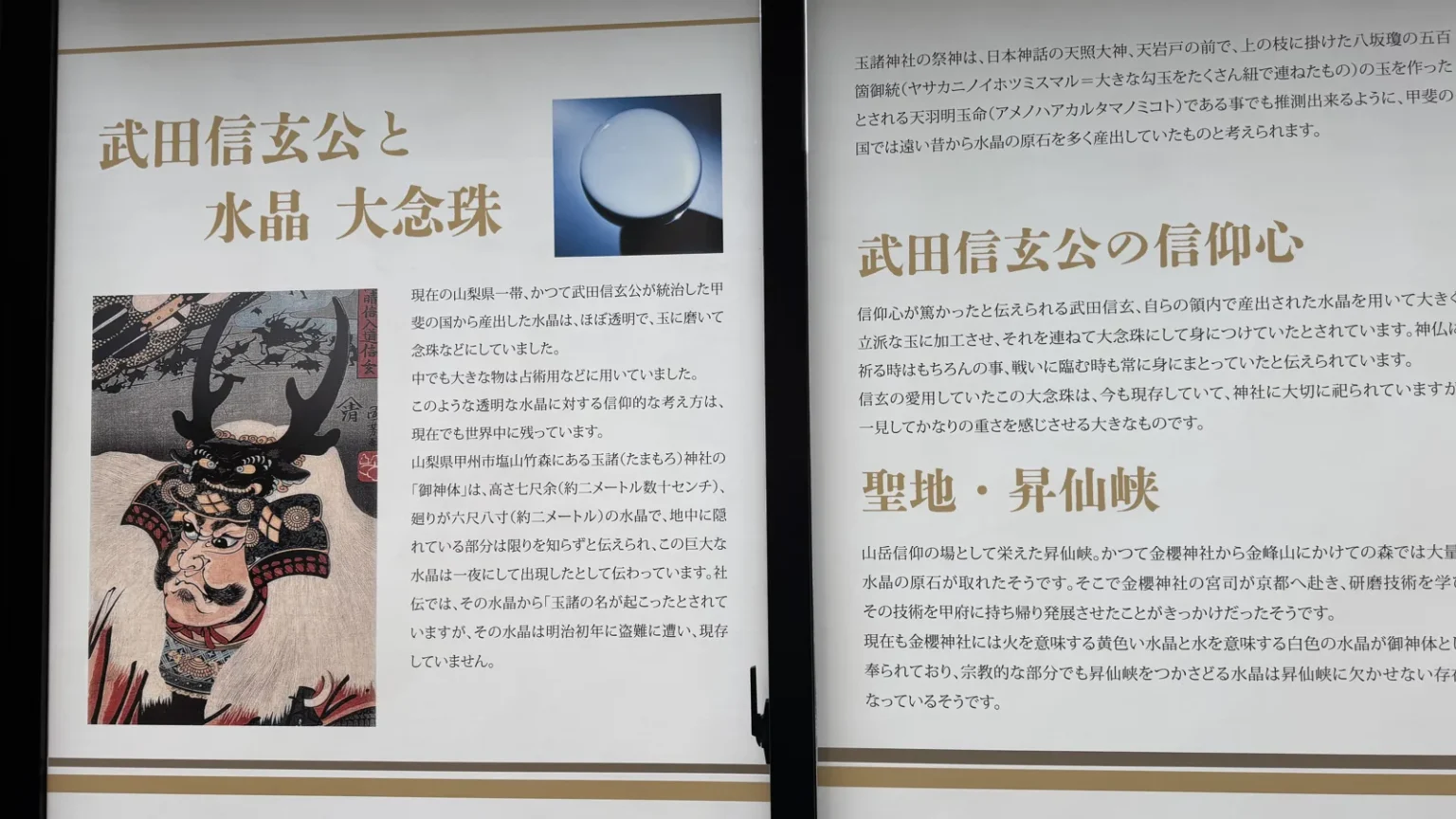
Why crystal is a Yamanashi craft
The museum’s own site ties its shop to Yamanashi’s local industry of polishing rock crystal. The prefecture explains where that industry came from. Rock crystal was once found around Mt Kinpu (金峰山), and Yamanashi’s jewellery museum says the craft is said to have started in the late Edo period, when gem-working craftsmen from Kyoto taught crystal working to the priests of Kanazakura Shrine (金桜神社). The prefecture’s industry history adds a story it gives only as tradition: around 1834, someone sent to Kai to buy crystal on the orders of Tamaya Ubei Nagatsune, the twelfth of that name in Kyoto, passed on polishing techniques over several visits.
Under the Meiji government’s policy of promoting industry, private individuals were allowed to mine minerals, and crystal mining became active in Yamanashi, where polishing was already under way. In 1876 a crystal workshop and training courses were set up at the industrial testing ground inside Kofu Castle, and in 1887 the polishing craft of Mitake moved to Kofu. From 1915 rough crystal was imported from Brazil, and output grew.
The museum shop
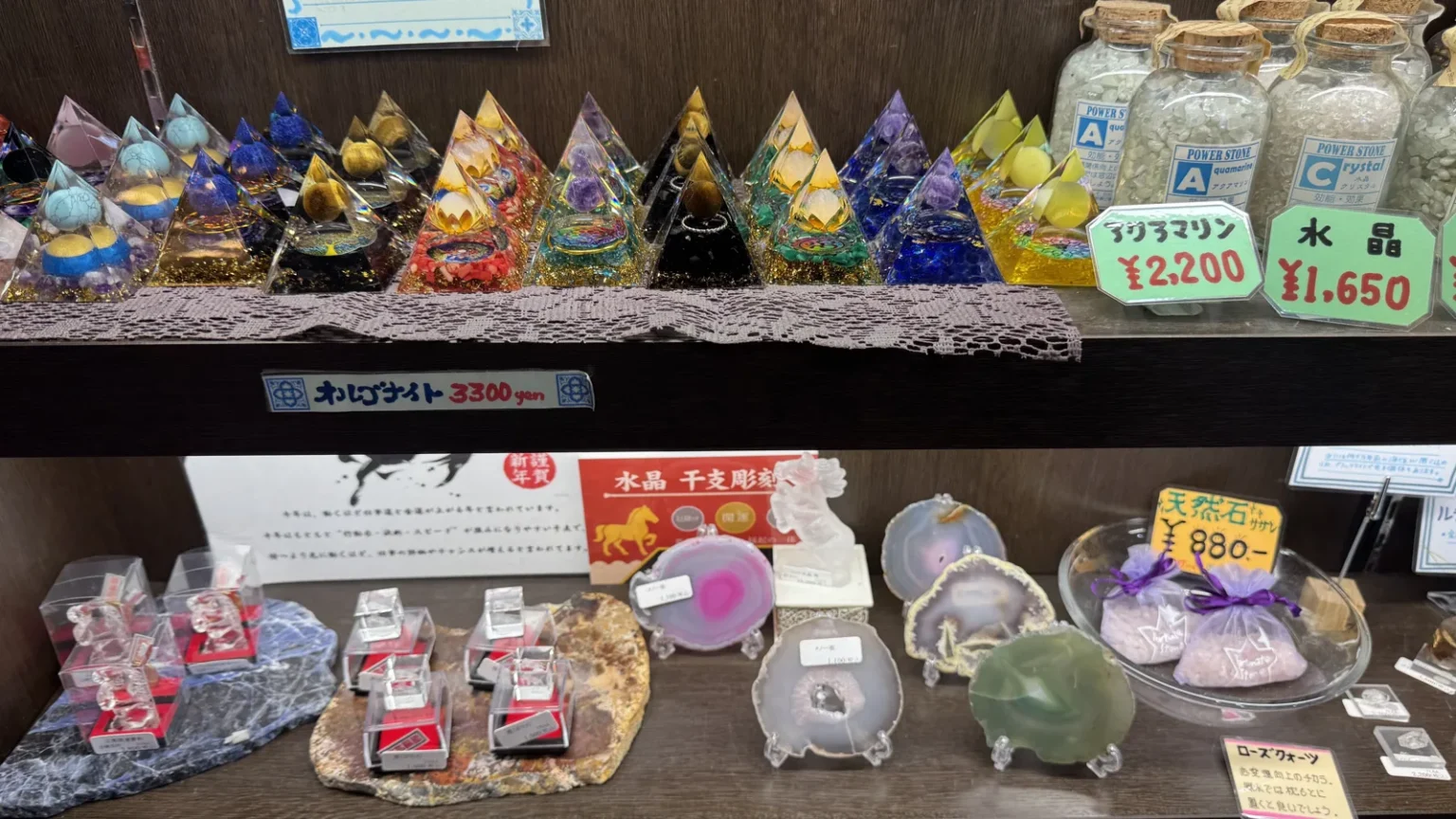
The official site describes the shop, also called 鉱石ミュージアム (Mineral Museum), as selling rough rock crystal, natural stones, power-stone bracelets and Yamanashi souvenirs. On my visit the shelves had resin orgonite pyramids under a sign reading 「オルゴナイト 3300yen」, bottles of crystal chips with price signs, and slices of agate.
Museum hours
| Season | Hours | Source |
|---|---|---|
| Most of the year | 9:00–18:00 (last entry 17:30) | Official site |
| Winter, mid-December to mid-March | 9:00–17:00 (last entry 16:30) | Official site |
| Winter, 21 December to 20 March | 9:00–17:00 | Prefecture’s tourism page |
Both pages read on 22 October 2026. The two give slightly different winter dates, so check the official site if you’re visiting around the switchover.
Getting there
I came by car and charged it at the road station. The museum is at 8532-64 Jiragonno, Narusawa village (〒401-0320 山梨県南都留郡鳴沢村字ジラゴンノ8532-64). Yamanashi Prefecture’s tourism page gives about 15 minutes by car from Kawaguchiko IC on the Chuo Expressway. Parking is free; official pages give different numbers of spaces, so I won’t quote one.
Without a car, Fujikyu’s Blue Line sightseeing bus (Narusawa, Lake Shoji and Lake Motosu loop) runs from Kawaguchiko Station to the 道の駅なるさわ stop in about 27 minutes. On the timetable as of 22 October 2026, buses left Kawaguchiko Station at 9:35, 10:35, 11:35, 13:35 and 15:35, and a one-day pass for the loop buses was ¥1,500 for adults. With so few buses, plan your return before you set off, and check the current timetable.
I didn’t go into the Narusawa Ice Cave or the Fugaku Wind Cave on this trip. They are on the same bus line, about 1 and 12 minutes beyond the road station by the timetable, and their operator lists adult entry at ¥350 each, with hours of 9:00–17:00 from 16 October to 15 November and 9:00–16:30 from 16 November to 15 February. For getting to the area from the city, see my Tokyo to Kawaguchiko guide; for another stop around the lakes, there’s the Mt Fuji Panoramic Ropeway guide. If you’re building a longer trip, the Fuji Five Lakes 2-day itinerary lays out two full days.
I came by car and charged it at the road station. If you don’t have one, a rental makes it easy to add this stop to a drive round the lakes.
Compare rental cars around Mt Fuji on Discover Cars Search Japanese rental car companies on Rakuten TravelNot driving? Guided Mt Fuji day tours are another option; check each itinerary, as they won’t necessarily stop at Narusawa.
Browse Mt Fuji tours on KlookWhere to stay
For a place to sleep nearby, my Kawaguchiko vs Fujiyoshida guide compares the two main bases. More guides for the area are on the Mt Fuji hub.
Looking for a base around the lakes? These are hotels by Lake Kawaguchi.
Compare Lake Kawaguchiko hotels on Booking.comIs the Narusawa Fujisan Museum free?
Yes. The official site says entry is free and the museum is open every day, 9:00 to 18:00 (last entry 17:30), or 9:00 to 17:00 (last entry 16:30) from mid-December to mid-March.
Is it worth going into the museum, or just the shop?
I’d go in. I found it interesting as an adult, especially putting my hand on the crystal and the exhibit on the history of crystal in Yamanashi. It costs nothing, and you can visit the shop too.
What can you buy at the Michi-no-Eki Narusawa farm stand?
On 8 September 2026 the signs showed Narusawa highland cabbage at ¥162, boiled Narusawa corn at ¥200 each, Yamanashi apples at ¥600 and Yamanashi grapes from ¥1,400 to ¥1,950. What’s there changes with the season.
Can I charge an electric car at Michi-no-Eki Narusawa?
I charged my car at the road station on 8 September 2026. I can’t speak for other days, so check current availability before relying on it.
Was it crowded?
Not when I went. The car park was not busy on a Tuesday afternoon in September 2026. I can’t say what weekends or holidays are like.
Sources
- Narusawa Fujisan Museum official site (address, free entry, hours, shop): narusawa-fuji.com
- Yamanashi Prefecture tourism page for the museum (2008 renovation, access, parking, winter dates): yamanashi-kankou.jp
- Lunch, farm-stand prices, the museum visit and all photos: my own visit on 8 September 2026. Pages read on 22 October 2026.
- Narusawa village, road station facilities and hours: vill.narusawa.yamanashi.jp; operator from April 2026: vill.narusawa.yamanashi.jp
- National road-station site (hours): michi-no-eki.jp; Narusawa tourism site (snack menu): narusawa-kanko.jp
- Yamanashi Prefecture, Narusawa-na: pref.yamanashi.jp (PDF)
- Why crystal and Narusawa-na are here: Yamanashi Prefecture, jewellery industry history and Yamanashi Jewellery Museum; Ministry of Agriculture, Forestry and Fisheries, Narusawa-na pickles. Checked 24 October 2026.
- Fujikyu Blue Line timetable and passes (read 22 October 2026): fujikyubus.co.jp; Ice Cave and Wind Cave: mtfuji-cave.com
Some links above are affiliate links — they cost you nothing extra and help keep this site going.
Join travelers discovering Japan's hidden side
Weekly dispatches from off-the-beaten-path Japan — spots and stories you won't find in guidebooks.
No spam. Unsubscribe anytime.
Welcome aboard!
You're in. See you in your inbox soon.