
Yamanashi · Fujiyoshida · Festival
The Yoshida Fire Festival (Yoshida no Himatsuri) runs August 26–27, 2026 in Fujiyoshida, Yamanashi. On the evening of the 26th, roughly 80 giant taimatsu towers burn along about 2 km of the town’s main street from around 18:30 to 22:00 — the city’s count passes 100 fires once the stacked pyres outside homes join in — a short walk from Fujisan Station. No tickets, no gates: the town simply closes its main road and sets it alight.
Three weeks after the torches, the same town holds its other big rite: the yabusame festival in Shimoyoshida (September 18–19), where a diviner reads the horses’ hoofprints.
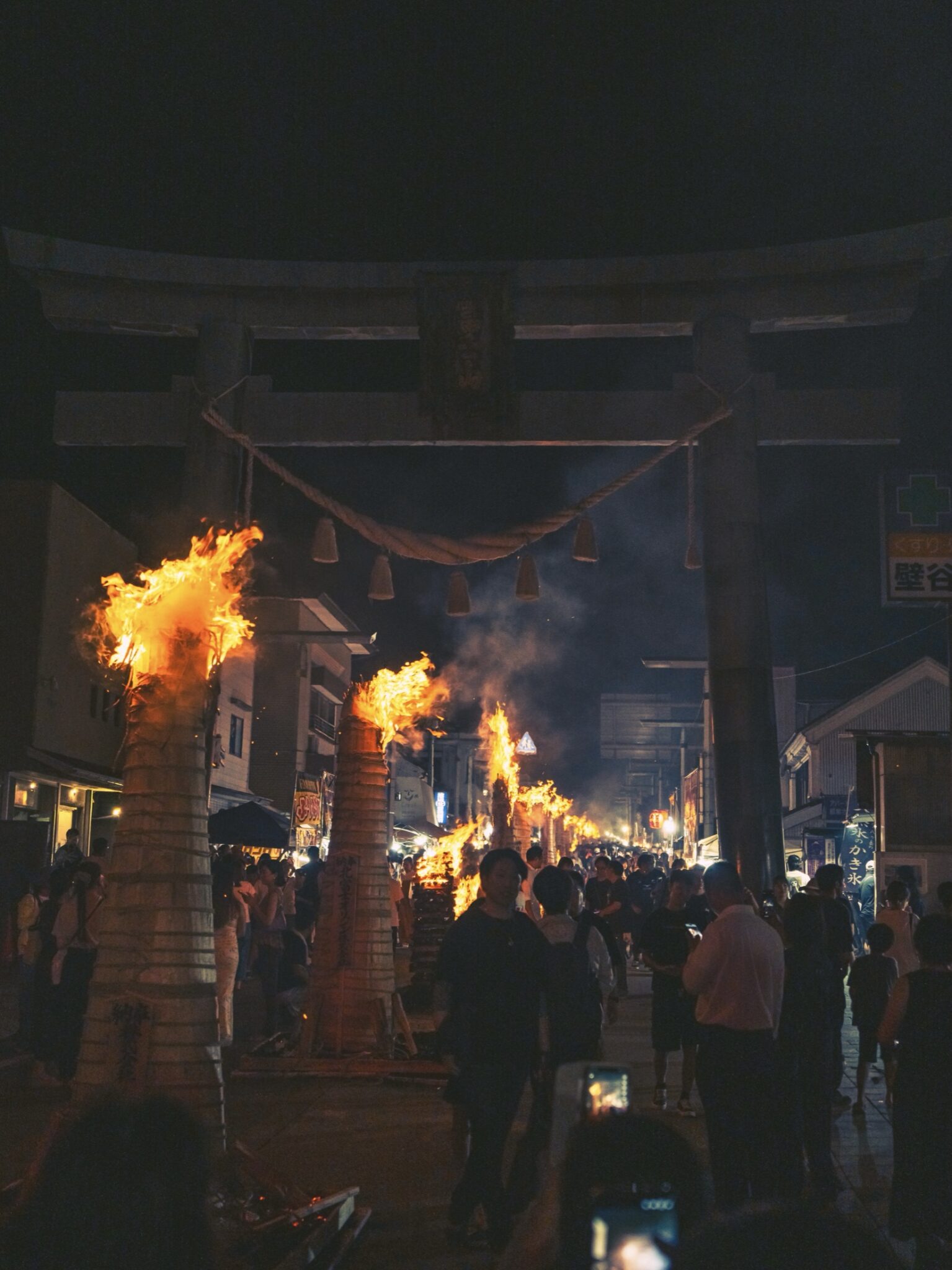
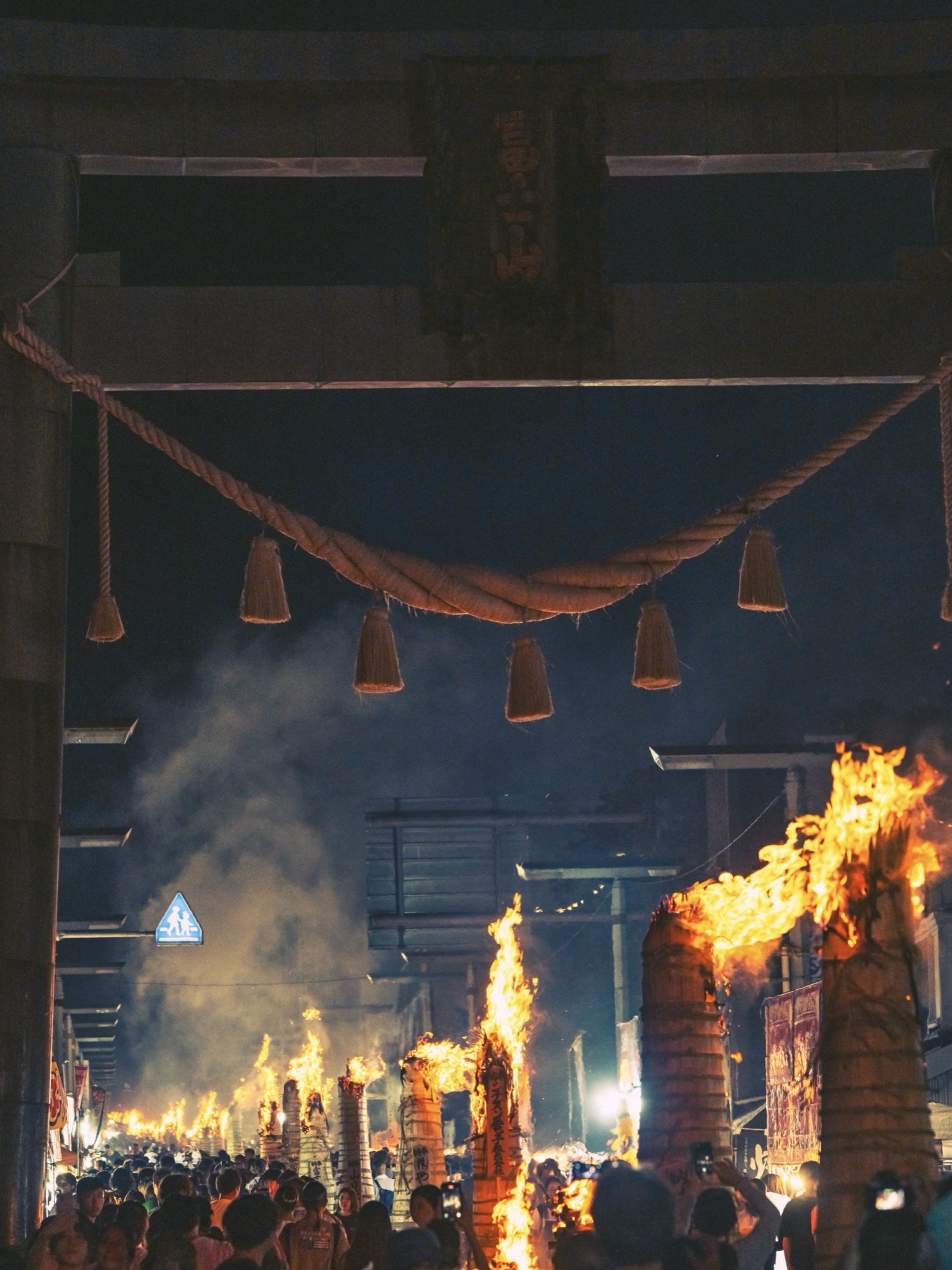
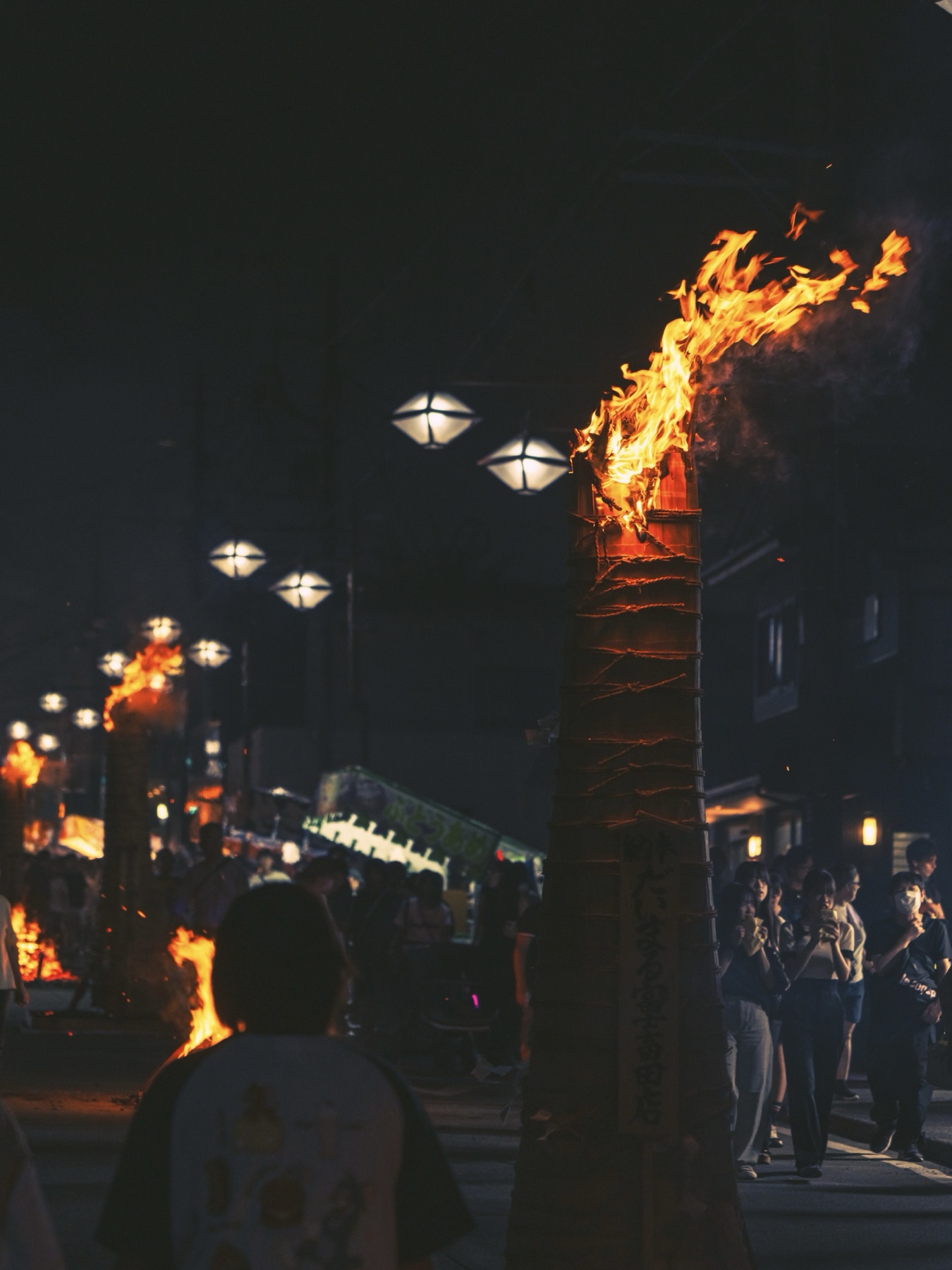
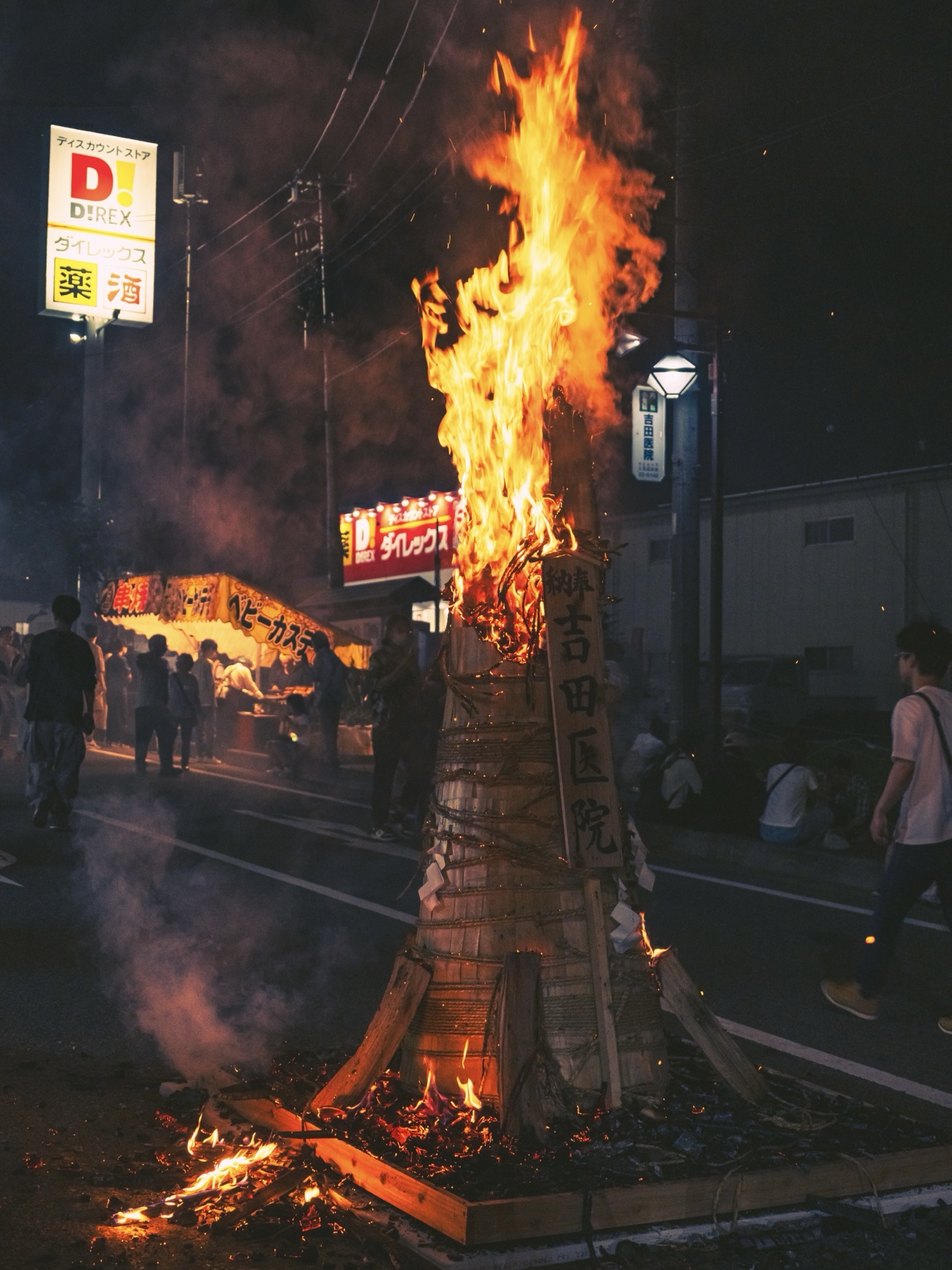
This one is personal. I live in Fujiyoshida, and the photos on this page are mine from the 2025 festival — shot walking the same street I walk to buy groceries, except lined with fire from end to end. It is the biggest night of my town’s year, it marks the traditional close of the Mt Fuji climbing season, and the 2026 festival ran Aug 26–27. The dates never move — the 2027 festival will burn on Aug 26–27 again, and everything below (times, access, closures, where to stand) holds year to year.
Which night do you want?
The two days feel very different, so decide first which one you are coming for.
August 26 — the fire
The night in these photos (mine are from 2025). Two mikoshi come down from the shrine, and once they settle at the resting place the taimatsu are lit one after another down the street. This is the night to come if you only have one.
August 27 — the Susuki Matsuri
The quieter procession day. No wall of street fire — the portable shrines, children’s mikoshi among them, tour the town through the afternoon, and the evening climax circles the sacred Takamagahara ground by the shrine. Parishioners carry pampas-grass wands and pray for safe childbirth and good health.
August 26, hour by hour
These times come from the city’s official 2026 event page and this year’s police-issued regulation map. One thing to burn into your plan: the torches are not lit at a fixed clock time. Lighting begins once the mikoshi reach the resting place, which is scheduled for 18:30 — treat everything after that as “from around”.
| Time | What happens | Where |
|---|---|---|
| 14:30 | Rites at both shrines | Kitaguchi Hongū Fuji Sengen Shrine & Suwa Shrine |
| 17:00 | The two mikoshi leave the shrine — they work down the route and pass the lower town later, so pick a spot and wait | Departs Kitaguchi Hongū |
| 18:30 | Mikoshi arrive at the resting place; torch lighting begins, tower by tower | Otabisho (Kamiyoshida Community Center) |
| ~18:30 – 22:00 | About 2 km of taimatsu burn, Kamijuku down to Nakasone | The main street |
| 22:00 | Torch removal begins; crowds thin fast | — |
August 27, the quieter timetable
| Time | What happens |
|---|---|
| 13:15 | Rites at the otabisho (Kamiyoshida Community Center) |
| 14:00 | The mikoshi set out again through the parish |
| 15:30 | Kanadorii rite, at the great torii |
| 18:00 | Okura-ishi rite |
| 19:00 | Closing rites back at Kitaguchi Hongū; in the evening the mikoshi circle the Takamagahara ground — the shrine calls this the festival’s climax |
The two mikoshi — and the one that gets dropped on purpose
Two portable shrines make the journey. The first, the Myōjin mikoshi, carries the enshrined deities and is borne with ceremony by older parishioners. The second is the one you will remember: O-yama-san, a bright red replica of Mt Fuji itself weighing about a tonne, carried hard by the younger bearers — and at points along the route it is deliberately dropped to the road. The shrine explains it plainly: the crash is meant to rouse the deity’s power and calm the raging mountain.
The festival’s formal name is Chinkasai — the fire-quelling rite. A town at the foot of a volcano, burning fire to ask the mountain not to.
Where to stand: a local’s picks
The Kanadorii
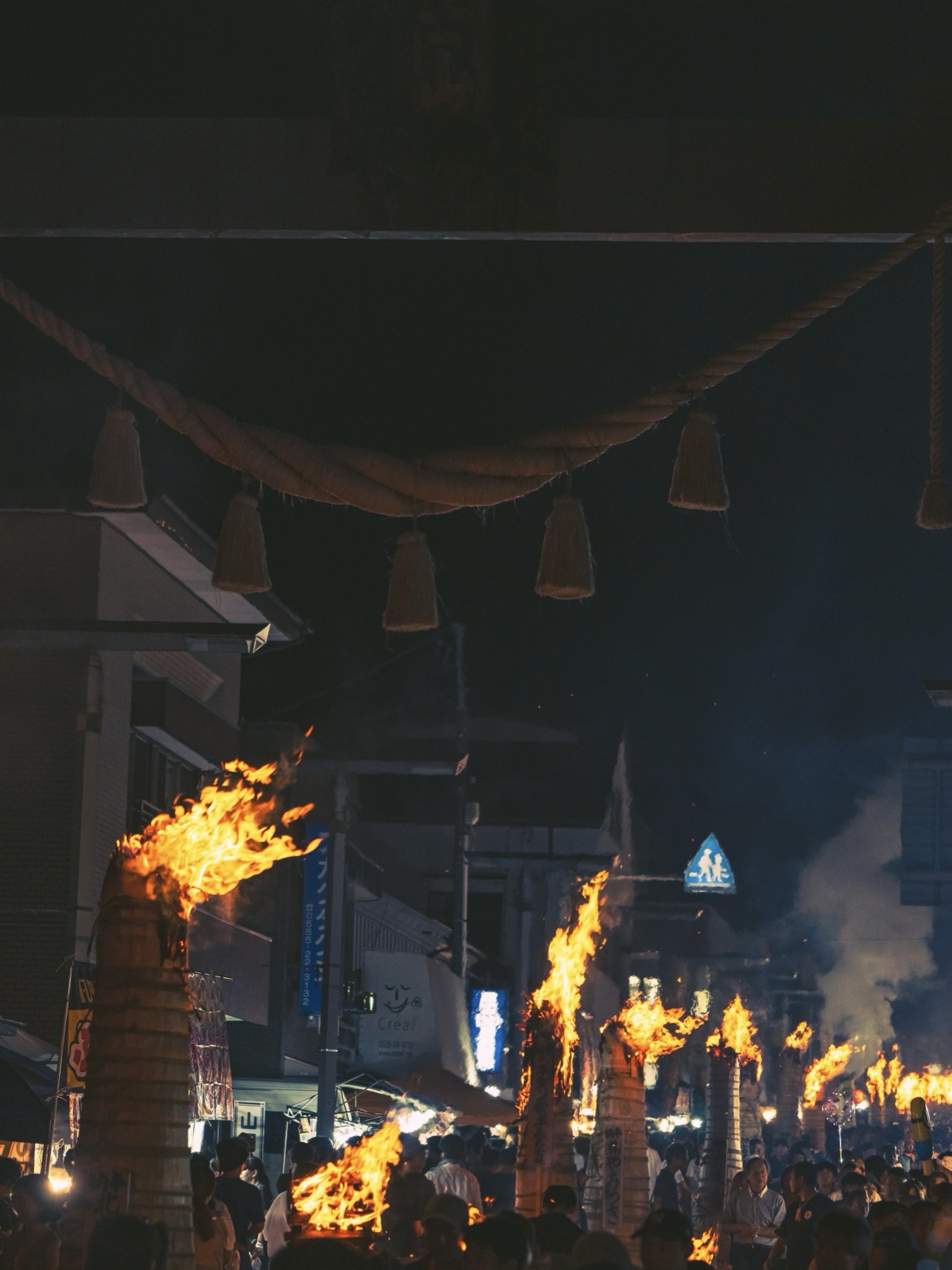
The great torii over the main street, a few minutes downhill from Fujisan Station. Shoot through the gate and the line of fires recedes toward the mountain — the classic frame, and where I shot several of these 2025 photos. It is also the most crowded spot; claim your angle before 18:30.
Mid-street, Kamijuku to Nakasone
The fires run about 2 km, and the crowds do not. In 2025 the pack thinned fast once I walked away from the torii — a few hundred metres out I stood between two burning towers with room to breathe, close enough to feel the heat swing when the wind shifted.
The otabisho
The resting place at the Kamiyoshida Community Center, where the two mikoshi sit for the night. Come here to see the red Fuji mikoshi up close between the fires.
The back streets
Off the main road, households and mountain huts burn their own stacked igeta pyres at their doors. Quieter, more intimate, and the part most visitors never see.
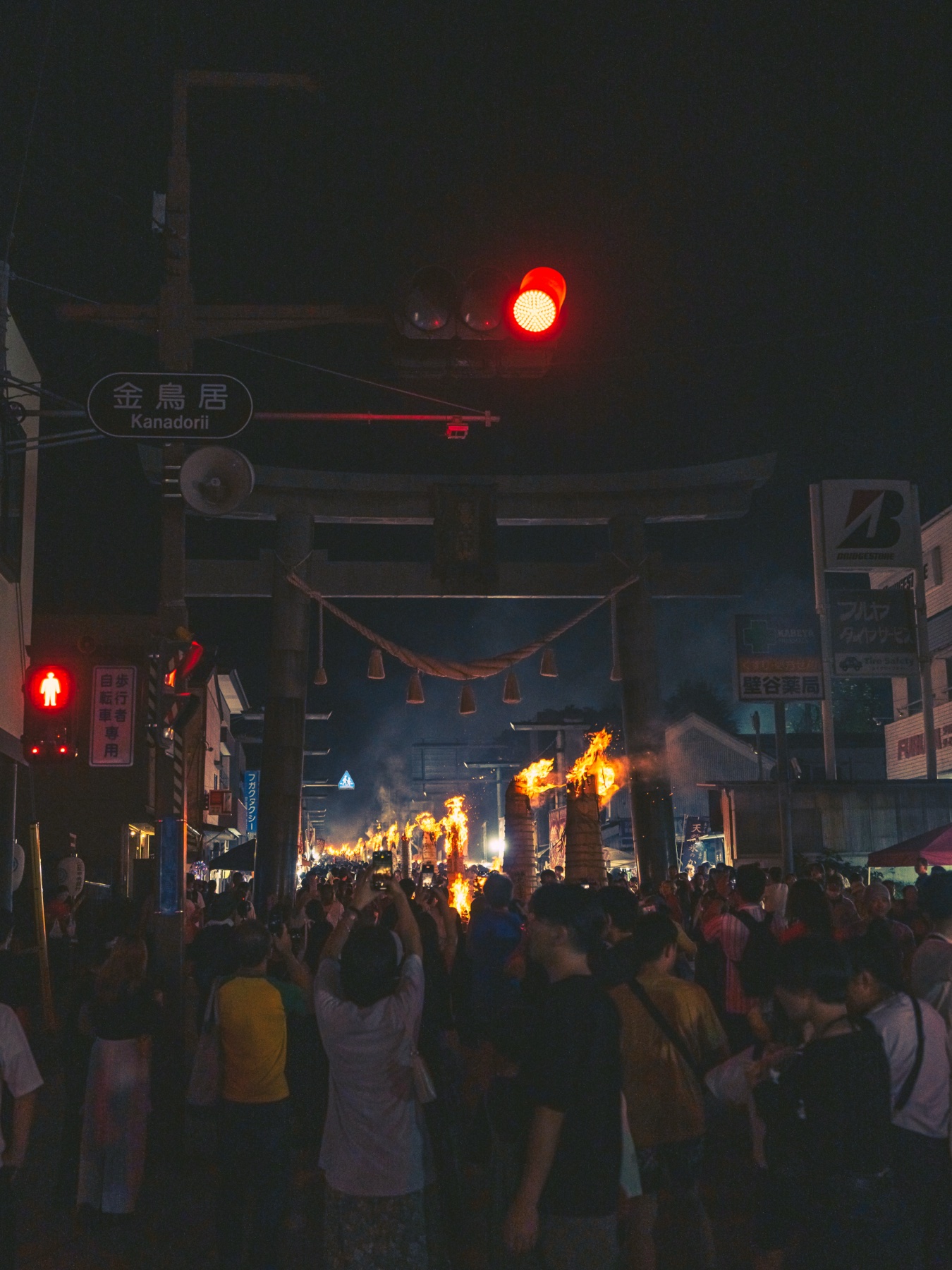
About the heat: these are open fires taller than you on a public street, with no barriers beyond common sense. Sparks drift when the wind gusts. Wear cotton rather than synthetics, keep children on your far side from the flames, keep the respectful distance the locals keep, and follow the police and staff when they wave you along. The street asphalt radiates heat for hours — it is part of the experience.
Getting there — and, more importantly, getting back
| From | Route | Notes for the 26th |
|---|---|---|
| Tokyo | Fuji Excursion limited express, Shinjuku → Fujisan Station (approx. 2 h); or highway bus to Fujisan Station | Book the return leg early — festival-night trains fill every year |
| Kawaguchiko | Fujikyu line, 2 stops to Fujisan Station | The easiest base; you ride home after the fires |
| On the night | 26 extra trains run on Aug 26 (13 each way per Fujikyu’s notice), including the “Yoshida no Himatsuri-gō” runs of the Fujisan View Express No. 13 and Fujisan Express No. 5, with a connecting service from JR Shinjuku | The last extras leave Kawaguchiko toward Ōtsuki at 21:24 and 22:28, calling at Fujisan Station minutes later — confirm the posted station times, and allow for the walk back from your viewing spot |
| By car | Chūō Expressway, Kawaguchiko IC or Fujiyoshida-Nishikatsura Smart IC | Park at the festival lots by mid-afternoon and walk — see the closures below |
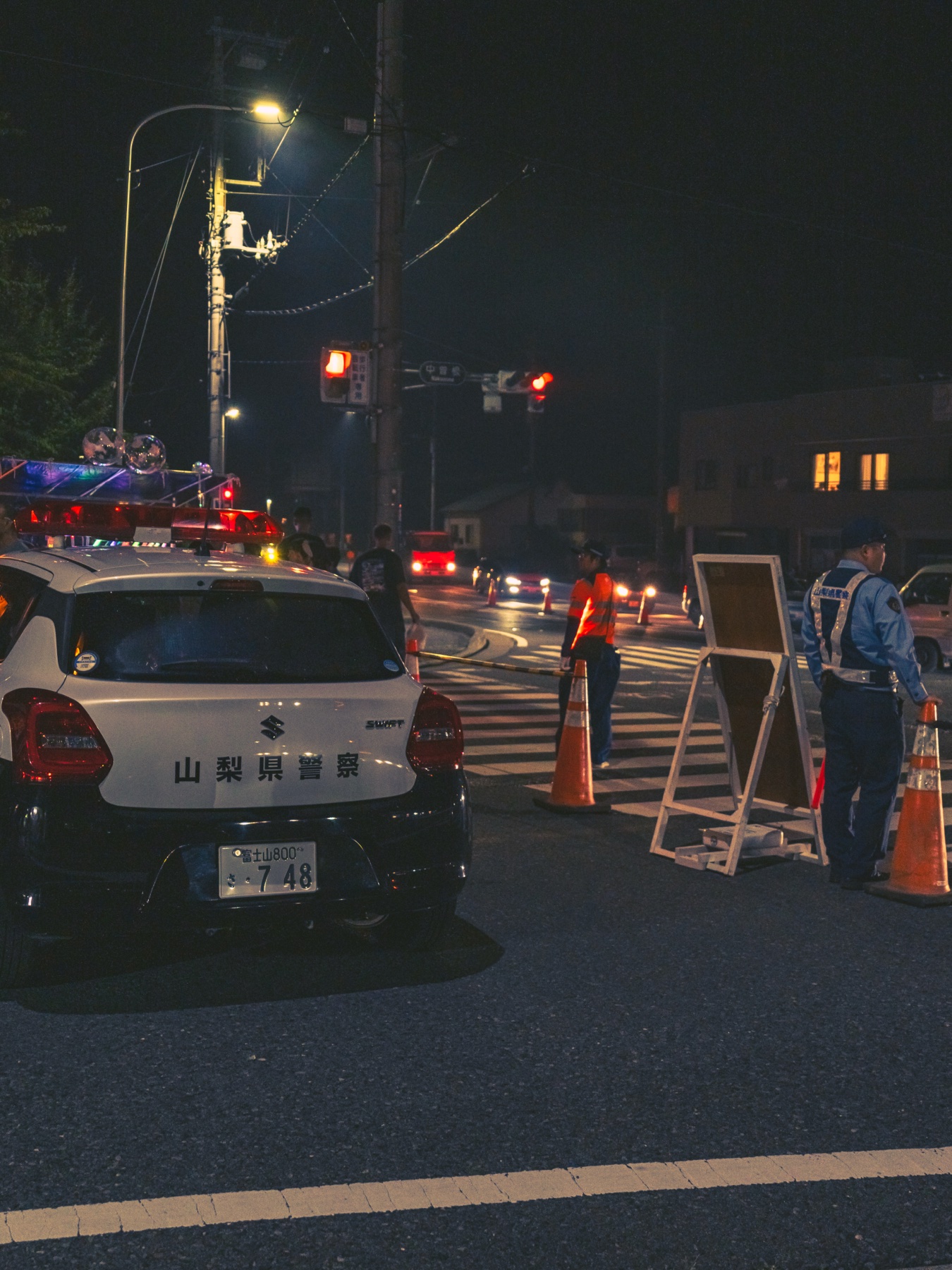
Road closures on Aug 26 (from the 2026 police and city regulation map): the main street from Kamijuku through the Kanadorii to Nakasone closes to all traffic 16:30–24:00, the Kamijuku stretch of Route 139 closes 16:30–23:30, and the surrounding blocks follow from 18:30. Festival parking opens at Yoshida Elementary (200 cars, 14:00–23:00), Yoshida-Nishi Elementary (200 cars, 14:00–23:00) and City Hall (about 200 cars, 18:00–23:00), all a walk from the street. On Aug 27 the closures are earlier and shorter — the main street shuts 14:00–18:30 for the mikoshi, with brief holds in front of Fujisan Station 15:30–16:30, and the map designates the shrine’s free lot beside Route 138. The maps list a festival security headquarters staffed on both days (080-8401-0223).
Plan the Fire Festival Trip
What this festival actually is
The official name is Chinkasai, the fire-quelling rite, held jointly by Kitaguchi Hongū Fuji Sengen Shrine — a component part of the Mt Fuji World Heritage inscription — and its auxiliary Suwa Shrine. Historically this was Suwa Shrine’s own festival; as Fuji worship grew, the Sengen shrine is said to have risen around the older shrine and taken it in as a sessha, and the Edo-period Kai-koku-shi already describes the town lit with bonfires for the Suwa deity. The fire carries a double meaning: it recalls the shrine’s goddess Konohanasakuya-hime, who gave birth safely amid fire, and it asks the volcano itself to stay quiet. The shrine itself, with its cedar-lined approach and the start of the Yoshida Trail, is the subject of a separate guide.
The festival was designated an Important Intangible Folk Cultural Property in March 2012, and it is often counted among Japan’s three most unusual festivals — a traditional grouping with no fixed official list, so I will leave the ranking to the izakaya arguments. What is beyond argument is the scale: one night, one small town, eighty-odd towers of fire down a single street and more burning at the doorsteps beyond.
Nagano has a winter fire festival of its own: the Dosojin Fire Festival in Nozawa Onsen on 15 January, also a nationally designated Important Intangible Folk Cultural Property. In 2026 the entry tickets for its festival ground went only to villagers and to guests staying in the village; the date, the 2026 timetable and how entry worked are in our Nozawa Fire Festival guide.
The “mountain-closing” nuance: the festival traditionally marks o-yama-jimai, the close of the Mt Fuji climbing season — but the actual Yoshida Trail stays open to September 10, 2026 (descents until noon on the 11th). You can watch the town bid the mountain goodnight on Wednesday and still climb it the following week. The two calendars are cousins, not twins. The shrine itself wrote in 2024 that the festival is sometimes taken for the mountain-closing rite, which it holds separately as the Heizansai on September 10 each year; the national designation still describes the fire festival as the o-yama-jimai.
Practical notes from a resident
Bring cash
Food stalls line the closed street and the side lanes on the 26th — yakisoba, kakigōri, the usual festival canon — and they are cash businesses. There are convenience stores on the street itself, but their queues on festival night are their own attraction.
Weather on the night
Late August in Fujiyoshida swings between clear festival evenings and sudden mountain rain — check the JMA forecast in the final week. The festival is a rite, not a fair — check the city’s page on the day rather than assuming a washout.
Arrive before the streets close
If you come by train, aim to be at Fujisan Station by 17:00: you catch the mikoshi procession first, then the lighting. Drivers should be parked before the 16:30 closures on the 26th — after that, the town centre is a walking town (note the City Hall lot only opens at 18:00).
Stay the night if you can
The fires burn to 22:00 and the last extra trains leave just after. But the better version of this trip is a bed in Fujiyoshida or Kawaguchiko and a clear morning look at Mt Fuji while the town sweeps up the ash.
Where to sleep on festival night
Fujiyoshida’s own guesthouses put you in walking distance of the fires but sell out first. Kawaguchiko, two stops up the line, has the depth: Booking carries the mainstream hotels, Rakuten Travel is consistently stronger for the small ryokan and lakeside onsen inns, and Agoda often prices the Fujiyoshida business hotels keenest. Whichever you use, book well before festival week — the close-in rooms go first every year.
An evening that works (Aug 26)
16:30 — Arrive
Off the train at Fujisan Station as the closures begin. Walk down to the Kanadorii, note your exits, buy a drink before the queues form.
17:00 — The mikoshi set out
They leave the shrine at 17:00 and work down the route, so pick your stretch of street and wait — you will hear O-yama-san’s young bearers before you see the red mountain coming.
18:30 — The lighting
Be at your chosen spot. The fires start near the otabisho as the mikoshi settle and spread down the street tower by tower.
19:30 – 22:00 — Walk the 2 km
Drift from the torii toward Nakasone as the crowds thin. Eat from the stalls. Find the household pyres in the side streets. Catch one of the late extras from Fujisan Station — or walk to your bed in town.
Yoshida Fire Festival 2026: FAQ
When is the Yoshida Fire Festival in 2026?
August 26 and 27, 2026 — the dates are fixed every year. The torch-burning night is the 26th, roughly 18:30 to 22:00; the 27th is the Susuki Matsuri, centred on the mikoshi processions and the evening rites at the shrine.
Does it cost anything?
No. There are no tickets or gates — the festival happens on the town’s public streets. Bring cash for the food stalls.
What time are the torches actually lit?
Lighting begins once the two mikoshi reach the resting place, scheduled for 18:30 — so “from around 18:30” is honest and “18:30 sharp” is not. The fires then burn until removal starts at 22:00.
How do I get there without a car?
Fuji Excursion limited express from Shinjuku to Fujisan Station (about 2 hours), then a few minutes on foot downhill to the Kanadorii. On August 26, Fujikyu runs 26 extra trains including late departures toward Ōtsuki at 21:24 and 22:28 from Kawaguchiko, plus the “Yoshida no Himatsuri-gō” special expresses.
Can I drive?
To the edge of town, yes — through it, no. The main street closes 16:30–24:00 on the 26th. Free festival lots open from 14:00 at Yoshida Elementary and Yoshida-Nishi Elementary (200 cars each) and from 18:00 at City Hall. On the 27th, closures run 14:00–18:30 and the shrine’s Route 138 lot is the designated parking.
Is it safe for children?
Local families bring children of every age — it is their festival. But the fires are open, taller than any adult and unfenced, and sparks travel on gusts. Keep small children on your far side from the torches, dress everyone in cotton, and use the quieter mid-street stretches rather than the packed Kanadorii crowd.
Does the festival mean the Mt Fuji climbing season is over?
By tradition and in the national designation, yes — it is described as the o-yama-jimai, the symbolic closing of the mountain, although the shrine holds its own mountain-closing rite separately on September 10. In practice the Yoshida Trail remains open through September 10, 2026, with descents until noon on the 11th, so you can see the festival and still climb afterwards.
Join travelers discovering Japan's hidden side
Weekly dispatches from off-the-beaten-path Japan — spots and stories you won't find in guidebooks.
No spam. Unsubscribe anytime.
Welcome aboard!
You're in. See you in your inbox soon.