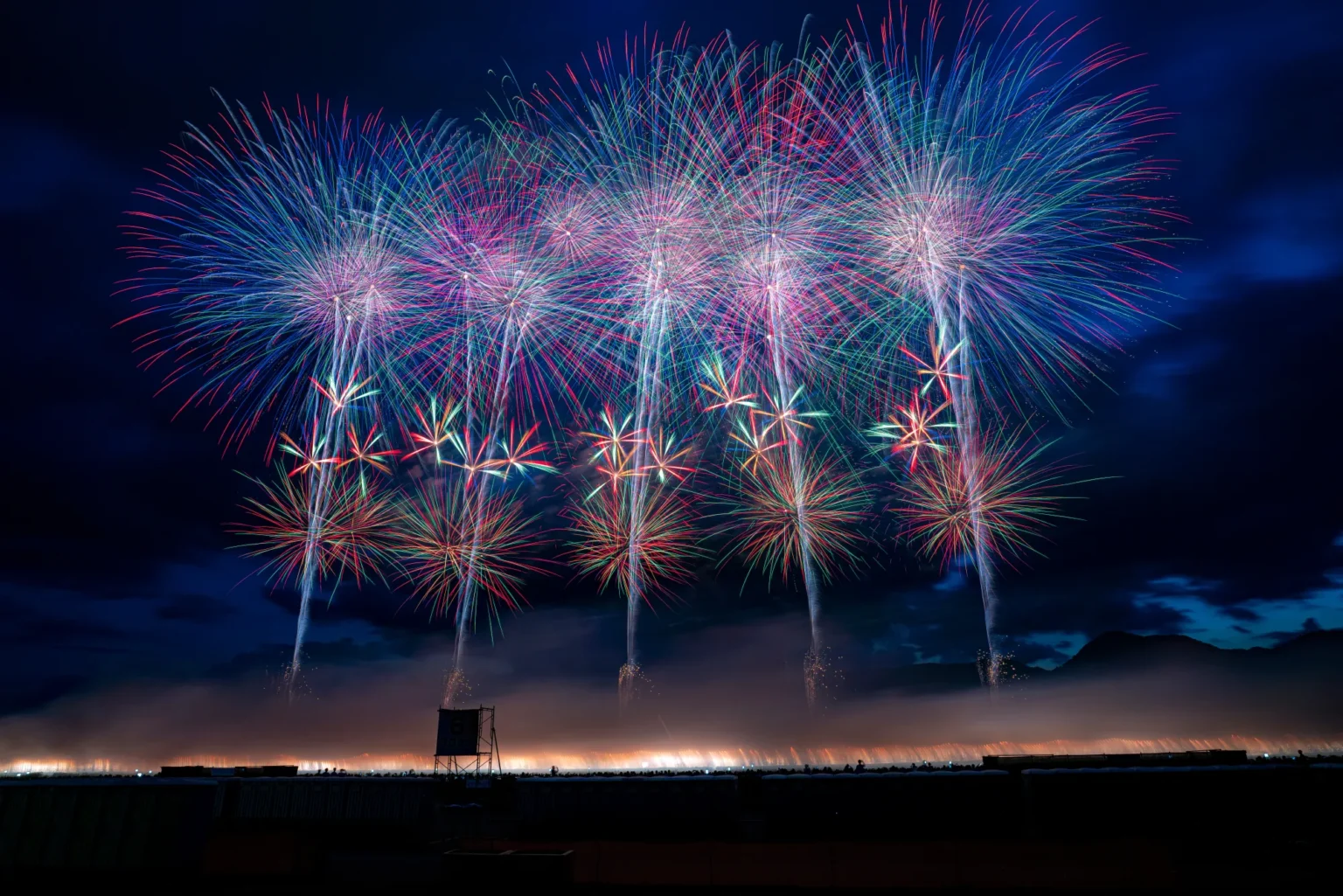
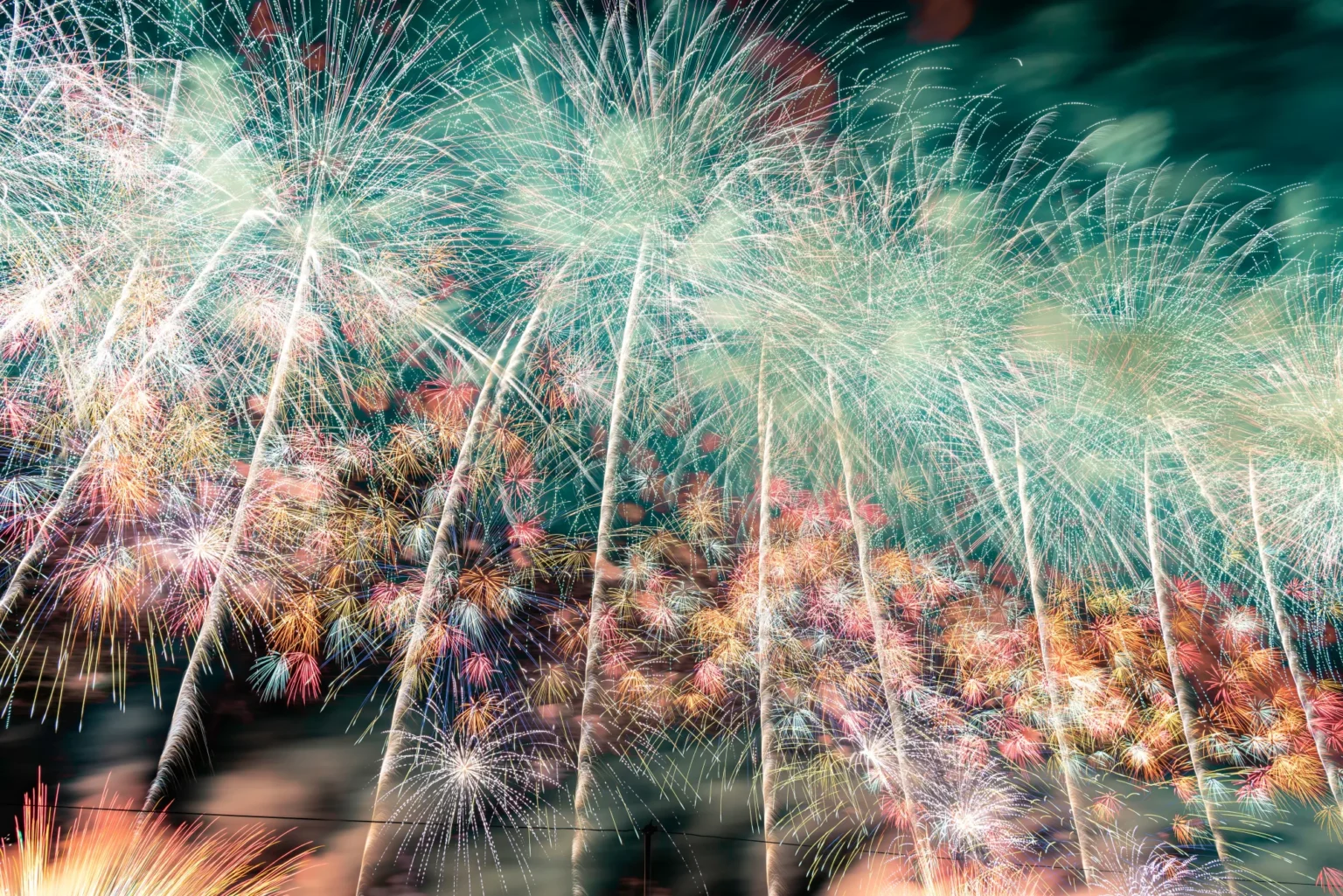
On Saturday evening, August 29, 2026, the 98th National Fireworks Competition — better known as Omagari no Hanabi — fired roughly 18,000 shells over the Omono River in Daisen, Akita, in front of a riverbank crowd of about 100,000 (the city’s venue figure, which the Akita Sakigake newspaper also reported). It is the event where Japan’s best pyrotechnic companies compete for the Prime Minister’s Prize, the highest award a Japanese fireworks maker can win. On Sunday the organizers published the verdict: the prize went to the hometown maker, Komatsu Enka Kogyo (小松煙火工業) of Daisen, which won three of the four divisions. The division-by-division table is in the results section below. Everything after that is the guide I verified the night before the show, kept as a record of how the day was set up — the program, the sold-out tickets, the 77 extra trains and last departures, the weather — and as the playbook for the 99th in August 2027.
Result: the 98th competition, August 29, 2026
Updated Sunday, August 30, from the organizers’ official awards list and the Akita Sakigake newspaper. The guide sections below were written on the evening of Friday, August 28 and are left as that night-before snapshot — where the text says “tomorrow,” it means Saturday, August 29, and “tonight” or “this week” means that Friday evening and the days before it.
- It went ahead as scheduled. Daytime section from 5:10 p.m., night competition 7:00–9:30 p.m., no rain, roughly 100,000 people on the riverbank, and — as the Sakigake’s headline put it — conditions rarely this good in recent years.
- Prime Minister’s Prize: Komatsu Enka Kogyo (小松煙火工業), Daisen. The hometown company won three of the four divisions outright — daytime fireworks, No. 10 core-shell and No. 10 free-style — and was runner-up in the fourth. It is Komatsu’s third Prime Minister’s Prize, after 2013 and 2024.
- Creative fireworks: Kita-Nihon Hanabi Kogyo (北日本花火興業), Daisen. A second Daisen company took the fourth division, so every division winner came from Daisen City.
- Last year’s champion, Nomura Hanabi Kogyo of Ibaraki, finished runner-up in the core-shell division.
- Next fireworks on this river: the Autumn Chapter on Saturday, October 3, 6:00–7:30 p.m. — the official advance-sale window runs September 7 to October 2 (details near the end).
01Why this one is different
Japan has hundreds of summer fireworks festivals. It has only about fifteen fireworks competitions, and Omagari sits at the top of that pyramid. This is not a show assembled by an event company — it is a contest in which 28 pyrotechnic companies, selected from across the country, are judged on shells they built themselves. The official site makes a point of it: at Omagari, the people pressing the buttons are the craftsmen who made the shells.
The stakes are real. Since 2000, the overall winner has received the Prime Minister’s Prize — and only two fireworks events in Japan award it: Omagari and Tsuchiura in Ibaraki. (Both cities’ official pages say so; each names the other.) Winning here is described, in the organizers’ own words, as the highest honor a Japanese fireworks maker can earn. That’s why you’ll often see Omagari counted among “Japan’s Three Great Fireworks Festivals” alongside Nagaoka and Tsuchiura — a popular title rather than an official one, but one the travel industry uses constantly. I compared all three in my Three Great Fireworks Festivals guide; the short version is that Nagaoka is the spectacle, Tsuchiura is the connoisseur’s autumn contest, and Omagari is the one whose competitive lineage runs back to 1910.
Those roots go back to 1910, when fireworks were staged as a side entertainment for the Suwa Shrine festival — the “Ouu Six-Prefecture Fireworks Fair,” as Daisen City records it. By 1915 it had gone national in name and scale; it restarted in 1946, the year after the war ended, explicitly to give people something to look up at. And in 1964 Omagari invented the category that now defines Japanese competitive fireworks: sozo hanabi, “creative fireworks,” a themed piece of up to 2 minutes 30 seconds judged on color, sound, rhythm and dimensionality — the first competition in Japan to make it an official event.
The only daytime fireworks competition in Japan
Here is the part first-timers don’t expect: the competition starts at 5:10 p.m., in daylight. Daytime fireworks (hiru hanabi) don’t paint with light — they paint with colored smoke, in five colors, dragged across the sky as “smoke dragons” and “smoke chrysanthemums.” Each company fires five No. 5 shells and is judged on smoke artistry. The official site states flatly that this is the only daytime fireworks competition left in Japan. If you hold a ticket, do not stroll in at 6:30 thinking you’re early — you’d have missed an art form that essentially survives nowhere else.
02The program, hour by hour — and how the 98th was decided
From the official program for the 98th competition:
- 15:00Gates planned to open. Ticket checks happen at gates 1–8 outside the viewing area; without a seat ticket you cannot enter.
- 17:10Daytime fireworks competition — 28 companies, five No. 5 shells each, judged on colored smoke. A daytime starmine follows.
- 18:00Daytime section ends. Roughly an hour’s pause — this is when to eat and queue for toilets, but don’t wander far: a sponsor drone show (about 15 minutes, announced by security firm Norton) runs somewhere in this interval this year.
- 19:00Night competition opens (with a Niagara-attached special starmine from the sponsors). Each company fires two No. 10 shells — about 30 cm across — one in the strict multi-ring shin-iri warimono category (triple core or more), one free-style, plus its creative fireworks piece.
- 20:50Around now: the taikai teikyo — the organizers’ own non-competitive grand show, this year titled “Eiko e no Sanka” (Hymn to Glory). For many regulars this is the single biggest moment of the night.
- 21:30Closing volley. Then tens of thousands of spectators head for the station and the parking lots at roughly the same time — more on that below.
One program note worth knowing: the night section includes a special program called “Kōen” (光炎) by Nomura Hanabi Kogyo of Ibaraki — the company that won the Prime Minister’s Prize at last year’s 97th competition. Nomura took the top prize in 2025 with a quintuple-core chrysanthemum shell, while the local Daisen company, Komatsu Enka Kogyo, swept both the daytime division and the creative division. That was the storyline going in: the Ibaraki champion returning, and the hometown maker the one the local crowd would be watching most closely. It went the hometown’s way, and not narrowly.
The results: a Daisen sweep
The organizers posted the official awards list on Sunday, August 30, the same day the ceremony was held at the Omagari Empire Hotel. The Prime Minister’s Prize went to Komatsu Enka Kogyo of Daisen. The company won the daytime division, the No. 10 core-shell division and the No. 10 free-style division outright, and finished runner-up in the one division it didn’t win, creative fireworks, which went to another Daisen maker, Kita-Nihon Hanabi Kogyo — so all four division titles stayed in Daisen City. For Komatsu it is a third Prime Minister’s Prize: 2013, 2024 and now 2026, all listed in the organizers’ results archive. Nomura Hanabi Kogyo (野村花火工業) of Ibaraki, the 2025 champion, was runner-up in the core-shell division, with merit awards in the other two night divisions.
| Division | Winner | Runner-up | Merit awards (優秀賞) | Placed (入賞) |
|---|---|---|---|---|
| Daytime fireworks | Komatsu Enka Kogyo (Akita) | Taiyodo Tamura Enkaten (Nagano) | Abe Enka Kogyo (Niigata); Isogai Enkaten (Aichi) | Shinohara Enkaten (Nagano); Saiki Enka Honten (Yamanashi); Haga Kako (Miyagi) |
| No. 10 shell, core-shell (shin-iri warimono) | Komatsu Enka Kogyo (Akita) | Nomura Hanabi Kogyo (Ibaraki) | Ina Kako Horiuchi Enkaten (Nagano); Yamazaki Enka Seizosho (Ibaraki) | Takata Hanabi Kogyo (Fukuoka); Kita-Nihon Hanabi Kogyo (Akita); Beniya Aoki Enkaten (Nagano) |
| No. 10 shell, free-style | Komatsu Enka Kogyo (Akita) | Kita-Nihon Hanabi Kogyo (Akita) | Nomura Hanabi Kogyo (Ibaraki); Haga Kako (Miyagi) | Shinshu Enka Kogyo (Nagano); Ina Kako Horiuchi Enkaten (Nagano); Kikuya Obata Hanabiten (Gunma) |
| Creative fireworks | Kita-Nihon Hanabi Kogyo (Akita) | Komatsu Enka Kogyo (Akita) | Nomura Hanabi Kogyo (Ibaraki); Taiyodo Tamura Enkaten (Nagano) | Kikuya Obata Hanabiten (Gunma); Marutamaya Kokatsu Enkaten (Tokyo); Shinshu Enka Kogyo (Nagano) |
The special prizes: in the daytime division, the Japan Chamber of Commerce and Industry chairman’s prize (日本商工会議所会頭賞) went to Taiyodo Tamura Enkaten (太陽堂田村煙火店) of Nagano; in the core-shell division, the Daisen mayor’s prize (大仙市長賞) to Nomura; in the free-style division, the Japan Tourism Agency commissioner’s prize (観光庁長官賞) to Haga Kako (芳賀火工) of Miyagi; and in the creative division, the Sato Isao Prize (佐藤勲賞) to Kikuya Obata Hanabiten (菊屋小幡花火店) of Gunma. Two prizes span all four divisions: the Japan Pyrotechnics Association chairman’s prize (日本煙火協会会長賞) went to Isogai Enkaten (磯谷煙火店) of Aichi, and the judges’ art prize (審査委員芸術賞) to Kita-Nihon Hanabi Kogyo. Prefectures are as listed on the organizers’ results pages. The awards sheet doesn’t carry the titles of the winning shells; the official results archive lists titles for every past competition, so expect them there once the 98th page goes up — check omagari-hanabi.com’s results archive if you want the names.
03Tickets: the honest situation
If you don’t already hold a ticket, tomorrow is not your night — and I’d rather say that plainly than have you ride four hours to a closed gate. The official notices this week are unambiguous: sold out, no same-day sales, and the venue contains no free viewing area at all. The organizers also list “place-holding” among prohibited nuisance behaviors, and their FAQ confirms same-day tickets basically never exist for the August competition in any year. Resale is banned outright; the official line is that entry may be refused on tickets bought outside official channels, so please don’t hand money to a scalper site tonight.
For planning 2027 (the 99th), here is what the full 2026 price sheet looked like — useful because the structure has stayed stable from year to year — though 2027’s details are official only when the organizers publish them — and it shows what “all paid seating” means in practice. Prices are per unit, tax included — one multi-person block for the group categories (same price regardless of headcount, within capacity), one seat for the single-person categories:
| Seat type | Capacity | 2026 price | Notes |
|---|---|---|---|
| Platinum pair seat | 2 | ¥70,000 | Raised ~1 m stage, private toilet, 180×45 cm table |
| Deluxe table seat | 4 | ¥50,000 | 230×230 cm space, 90 cm round table |
| Table seat | 4 | ¥38,000 | 170×140 cm space, 120×60 cm table |
| Embankment BOX seat | 4 | ¥30,000 | Two bench rows on the levee slope |
| Photographer seat A / B / C | 1 | ¥25,000 / ¥18,000 / ¥13,000 | Upper / middle / lower tier; tripods allowed here only; Lawson Ticket exclusive |
| Leisure sheet seat | 4 | ¥15,000 | 180×180 cm ground sheet; own chairs allowed |
| Pair bench seat | 2 | ¥13,000 | 180×30 cm bench |
| Chair seat | 1 | ¥8,000 | The entry point |
Sales for 2026 ran online-first through Lawson Ticket and e+ from June 12, with a cash-only in-person day on July 5 and a second online window in late July for whatever remained. Wheelchair-accessible blocks (¥28,000, with accessible toilets nearby) sold out by May 27. The pattern for 2027 is therefore simple: watch omagari-hanabi.com from late spring, be ready the morning sales open in June, and buy immediately. Travel agencies also buy seat blocks for tour packages — that channel closed back in spring too, though it’s the reason fireworks bus tours come with seats included. If you’re weighing whether paid fireworks seating is ever worth it in Japan, I ran the numbers across the whole industry in my paid seats deep-dive — Omagari is one of the clearest cases for paying, because there is no free alternative inside the official venue.
The “secret spot” question, answered honestly
Every year, Japanese blogs pass around lists of free vantage points for Omagari, and every year the ground truth shrinks. Read the 2026 regulation map before trusting any of them: the levee roads on both banks of the Omono River between Omagari-Hanabi Bridge and Himegami Bridge are closed even to pedestrians, the launch-side riverbed has been a no-entry zone since Friday evening, the west-bank farm lanes sit inside all-day vehicle and parking bans, and the expressway crossing the area is a motor-vehicles-only road you cannot legally stand on. The map even prints, next to the west-bank parking cluster: “fireworks are not visible from the parking lots around here.” Posts describing a free riverbank area date from an abolished system — as late as 2017 there was a free zone with a ¥1,000 cooperation fee; in 2026 there is nothing.
What survives, per locally maintained 2026 guides, is modest — and the honest ones say so. The Marukogawa green space and levee area northeast of the venue (roughly 1–1.4 km out, on foot only, since the surrounding streets close to cars in the evening) catches the high No. 10 bursts above the levee line; a 2025 account from that spot confirms the tall shells read fine but the low-built creative-fireworks compositions, the music and the announcements are mostly lost. Himegami Park, the hilltop across the river at about 2.5 km, is the classic distant-panorama photo spot — but its parking appears on the official map only as reservation-only paid lot #93, so don’t drive up expecting to park. Neither is sanctioned, and police direction on the night overrides everything.
My honest advice: Omagari’s whole point is composition — 2-minute-30-second creative pieces judged on color, rhythm and dimensionality. That is exactly what off-site viewing loses. Without a ticket, the NHK broadcast (below) shows you more of the actual competition than any levee 1.4 km away, and the Machinaka Fes downtown (also below) gives you the festival without the walk.
04Getting in — and the much harder problem of getting out
Omagari is a district of Daisen City reached by the Akita Shinkansen: about 3.5 hours from Tokyo, 2 hours from Sendai, 35–55 minutes from Akita City, and roughly 45–75 minutes from Morioka depending on the train. For tomorrow, JR East is running 77 extra trains across August 29–30. (You may see “80 trains” in July news reports — three Kitakami Line extras were cancelled on August 5 after heavy-rain damage to the track, so 77 is the current number.)
Inbound is the easy half. Extra Komachi runs include Tokyo 8:52 → Omagari 12:45, Sendai 11:13 → 13:13, and Tokyo 13:44 → 17:08 — though note that last one arrives two minutes before the daytime competition starts, so it only works for the night program. To see the daytime section, aim to reach Omagari by early afternoon, ideally around the 15:00 gate opening. There are also five extra Komachi from Akita and locals from every direction — the Tazawako Line extras are literally named “Niagara,” the Ou Main Line ones “Hanabi” (fireworks) and “Starmine.” From the station it’s about a 30-minute, 2 km walk to the heart of the venue (about 22 minutes to the nearer gates), along pedestrian routes named after fruit — you follow the Apple Road or Banana Road signs. The official map warns the walk can take more than double that in tomorrow’s crowds.
The escape problem
Now the part every foreign visitor needs to hear: you cannot get back to Tokyo tomorrow night. The last direct Tokyo-bound Komachi leaves Omagari at 7:43 p.m. — while the night competition is still mid-air. The farthest the rails will carry you toward Tokyo is Sendai, on the 10:19 p.m. extra Komachi arriving 11:59 p.m. — and treat that one with respect: it leaves 49 minutes after the closing volley, against a 2 km walk the organizers warn can take double the usual time, plus the station queue. If you hold that seat, start walking before the finale ends. This is not a planning failure you can cleverly route around; it’s how the geography works, and it’s why the whole region’s hotel market revolves around this one night.
| Direction after the finale | Last practical departures from Omagari | Good for |
|---|---|---|
| Sendai | 22:19 extra Komachi (arrives 23:59) | The only same-night option toward Tokyo — tight after the 21:30 finish; leave the venue early |
| Morioka | Extra Komachi until 1:18 a.m. (arrives 2:12); all-stations “Niagara” locals until 0:40 a.m. (arrives 2:27) | Deepest hotel inventory within reach |
| Akita City | Extra Komachi and “Hanabi” locals past midnight (last toward Akita around 0:37 a.m.) | Prefecture capital, ~50 min away |
| Yokote / Yuzawa (south) | Ou Line locals until 23:45 | Yokote is 17 minutes and ¥350 from Omagari — the easiest cheap base |
| Kakunodate / Lake Tazawa | All-stations “Niagara” locals toward Morioka serve this line late — confirmed Kakunodate stops to 23:39, with a final local at 0:40 a.m.; one 21:43 extra terminates at Tazawako Station | Samurai-town ryokan night |
Three fine-print traps in the extra-train system, straight from JR East’s own release. First, several of the late-night extra Komachi cannot be booked on Ekinet at all — they’re sold only at station ticket windows and reserved-seat machines, so buy your return seat on paper before the show, not from your phone at 10 p.m. Second, a few others can be reserved online but not used as e-tickets — you must collect a physical ticket first. Third, all extra Komachi are fully reserved seating, and I could not verify remaining availability tonight; rail commentators describe them as selling out early every year, so treat a reserved return seat as something you already have or probably won’t get. Note also that Omagari sits outside the Suica tap-in area according to rail guides, so local-line rides need paper tickets regardless — and for the Shinkansen extras, the booking rules above mean a station window is often unavoidable anyway. Buy both directions on paper, in advance. After the finale, the streets around the station close to cars from 8:30 p.m. and staff marshal separate outdoor queues for Shinkansen and local-line passengers; budget serious standing time.
Luggage: don’t gamble on station coin lockers. The organizers announced (July 27) two official baggage counters for the day, both open 10:00 a.m.–11:00 p.m. and both ¥1,000 per item, tax included, any size: Sagawa Express at the station West Exit, next to the police box (cash only; advance booking via the link on the official notice), and Yamato Transport at the Omagari Chamber of Commerce, a few minutes’ walk from the station along the venue route — look for the black-cat tent. The trap is the 11 p.m. closing: if your train leaves after the finale, collect your bag before joining the station queue, not after. Better still, leave suitcases in Akita, Morioka or at your hotel and come with a small daypack — luggage trolleys are banned from the venue anyway. Local station guides report the station’s own small locker bank (about two dozen doors) is taken out of service entirely on fireworks day, so the counters are the plan, not the backup. Based in Akita City? The tourist office inside Akita Station will deliver your bag to a participating city hotel for ¥650 if you drop it by 11:00 a.m.
The crowd playbook
Going in: local advice is to reach Omagari by around noon; by 3 p.m. the station and its streets are already thick — the 2025 park-and-ride fill times above tell the same story. Don’t plan to provision locally: the station’s own kiosk shut for the day in 2024, and a 2025 first-hand account describes convenience-store queues out the door by mid-afternoon. Buy food and drinks in Akita, Morioka or Sendai before boarding.
Getting out is a three-way choice. Leave around 20:15 — before the 20:50 grand show, a real sacrifice — and you walk out clean and catch the 20:52–21:27 first wave of trains, ahead of the crowd-control lines that form at the station from 20:30. Leave right after the grand show, and local advice says budget up to two hours of queueing. Or stay to the 21:30 closing volley — my vote; it’s what you came for — and expect one to two hours from seat to seat, going on 2024–2025 first-hand accounts (one 2024 visitor queued about an hour in the non-reserved lane, then stood the whole way to Morioka). Two mitigations: reserved-seat holders are marshalled ahead of non-reserved at the station, and Daisen City itself states train capacity is sufficient — the queue, not the seats, is the bottleneck.
Assume the network chokes. The three biggest mobile carriers all list official congestion countermeasures for tomorrow’s event — docomo is sending 5G base-station trucks — and the notice posted at Omagari Station this week (as shared by locals) still warns the internet may be hard to connect around the station, specifically telling digital-ticket holders to sort their return tickets in advance. Before leaving your hotel: screenshot your seat block and gate, the venue map, your return train and your hotel address (in Japanese too), agree on a physical meeting point with your group, and carry a power bank and cash — don’t count on card readers at stalls. (Relying on hotel Wi-Fi alone? A Japan eSIM set up the night before at least puts you on the carriers’ reinforced networks.)
Driving? The organizers themselves try to talk you out of it. Their access page says congestion builds from 3 p.m. and lasts until 2–3 a.m., some venue-area lots physically can’t release cars until midnight, and the committee’s 897 reserved parking spaces (¥6,000) sold via advance booking. Traffic restrictions started tonight (August 28) and widen in stages tomorrow — around the venue from 9 a.m., the town-center streets from 6 p.m., the station frontage from 8:30 p.m., all until midnight. If you must drive, the official recommendation is park-and-ride: four free lots at outlying stations (Jinguji, Kariwano, Ugo-Sakai, Ugo-Nagano — about 560 spaces total per the city’s park-and-ride page, each about 5 minutes’ walk to a station with trains into Omagari). They fill early: at the 2025 competition the Jinguji lot was full by 1 p.m. and Ugo-Nagano by 3:30 p.m., by the city’s own record. And the Nishisenboku Smart IC stays open until 2 a.m. for ETC-equipped cars because the Omagari IC jams solid. And don’t pencil in a taxi as plan B: the GO ride-hailing app lists no coverage anywhere in Akita Prefecture as of this week, taxi reservations reportedly dry up from mid-afternoon, and the exit roads stay jammed until 2–3 a.m. — the trains are the plan; there is no plan B. Live parking and congestion updates run all day on the safety committee’s X account @HanabiOmagari and on local radio FM Hanabi 87.3.
If the logistics of Japanese trains are new to you, my JR Pass honest-math guide covers when a pass beats point-to-point tickets — for a Tohoku fireworks trip like this one, a regional JR EAST Pass covering the Akita Shinkansen is usually the smarter shape (check current pricing on the JR East English site before you commit), and slow-travel fans should see the JR sightseeing trains guide for what else runs through these valleys.
05The night-before forecasts, and the mud
How it turned out: no rain fell during the show — the JMA’s Omagari station logged 0.0 mm in every ten-minute reading from 3 p.m. to midnight, with the evening breeze at 0.4–2.7 m/s and the temperature sliding from 25.7°C at 3 p.m. to about 21°C by the finale — and the Akita Sakigake’s report ran under a headline calling the conditions rarely this good in recent years. Here is what the forecasts said the night before — four of them, all issued Friday, August 28, all pointing the same general way:
| Source (Aug 28 issue) | Sky for Sat 29 | Rain chance | Temperatures |
|---|---|---|---|
| JMA (inland Akita) | Cloudy, rain in places at night | 10% by day, 20% for 6 p.m.–midnight | Yokote reference point: 19–29°C |
| tenki.jp (Daisen) | Cloudy with sunny spells; hourly forecast keeps the show dry | 20–30% | 26°C high; ~24°C at 5 p.m. falling to ~21°C at 9 p.m. |
| Weathernews (Daisen) | Cloudy, brief passing showers possible | 40% | 27°C / 18°C |
| Weathermap (via Yahoo News) | No rain expected during the event itself | — | Around 24°C during the show, humidity 60–70% |
So: bring a compact rain layer — umbrellas are hopeless in a crowd this dense — and note that no forecast flagged thunder. The risk the Weathermap forecaster actually highlighted is stranger — almost no wind. The evening breeze is forecast at about 1 m/s, and with air that still, smoke from earlier bursts can hang over the river and soften the view of later ones. Nothing you can do about it except know that if the sky looks hazy by 8 p.m., that’s physics, not your eyes. The show itself goes on in ordinary rain; severe weather or river conditions can force a postponement — decided case by case, with the new date set after checking the venue — in which case tickets stay valid.
The ground is the real comfort issue. The Omono River flooded in early August and dumped mud across the viewing grounds; the committee cleared it with heavy machinery and washed the walkways, but posted on August 24 that restoration isn’t complete and rain will bring back muddy patches — their explicit advice is to bring rubber boots. Friday’s go-ahead notice repeated it: sturdy shoes, watch your footing. Combine that with three other field facts and you have tomorrow’s packing list: the portable toilets at the summer competition stock no toilet paper (the official guide and the city’s FAQ both say bring your own), the organizers recommend hat-drink-fan heat measures for the daytime hours, and temperatures keep sliding toward the forecast overnight low of 18–19°C while you queue after the show — so a light extra layer earns its place. Banned at the venue, per the official guide: pets, handcarts and luggage trolleys, bicycles, drones, tents, parasols, camp stoves and any open flame, chairs and tables beyond what your seat type explicitly allows, and tripods outside the photographer seats. (Wheelchairs are of course fine — the venue sells dedicated wheelchair blocks.)
06On the ground: food, families, small print
Eating there
There are official food stalls inside the venue, and more stalls line the walking route from the station — eating and drinking at your seat is explicitly allowed. Two details worth knowing: the banned-items list does not mention alcohol or cooler boxes (chairs and tables beyond your seat allowance are the ban), and the 18:00–19:00 interval is when every stall and toilet queue peaks at once — buy your night-half supplies during the daytime section, not after it ends.
Downtown, the Machinaka Fes — the chamber of commerce’s street festival — runs Saturday 10:00–17:00 around the Nakadori park and the Hanabi-dori shopping street, minutes from the station: an Akita local-food fair (Yokote yakisoba, Noshiro negi-yaki, a sake-and-umeshu bar, draft beer, shaved ice) with live stages. If you arrive at noon as advised, this is where the early afternoon goes. And a marker of what this night has become: a one-night-only restaurant operates in the middle of the viewing grounds this year — 30 tables at ¥200,000–250,000 per table including seats and a paired Akita-ingredient course dinner. Not a recommendation; just a measure of how seriously this town takes its one evening.
Families and wheelchairs
The official venue map is the document to study before dark. The event headquarters, police box, fire post and central medical aid station cluster mid-venue — nearest Gate 5, the Banana Road gate — with four more first-aid posts spread along the grounds. There is no dedicated lost-child center; the official instruction is to go to the police, so that central police box is your point. The best meeting-point trick is built into the signage: each gate’s approach road carries a fruit or card-suit symbol — spade (Gate 1), melon (2), pineapple (3), orange (4), banana (5), apple (6), diamond (8) — so agree on “if we get separated, the banana sign” before dark, because you cannot rely on phones.
Terrain: the levee-top walkway is the step-free tier — accessible toilets (starred on the map) sit at each numbered entrance and in the wheelchair-seating area, along with water taps and the aid posts. The riverbed seating blocks below are reached by nine flights of stairs, so wheelchair users and stroller-pushing parents effectively live on the levee level; there is no wheelchair rental, and staff won’t store equipment. Strollers aren’t on the banned list — handcarts are — but between the mud and the density of the exit queues, a baby carrier is the better tool tomorrow. Two child-specific notes: fireworks at this range are loud enough that ear-defender muffs for small children are standard audiology advice (the organizers publish none of their own), and the official program carries a chigger (tsutsugamushi) warning for this riverbed — insect repellent going in, a bath that night, and a doctor if fever or unusual blisters appear within a week or ten days.
One tool tip: the official Omagari Hanabi app added English support this week and carries digital tickets, the program and a seat map — worth installing tonight, though the facility locations (aid stations, toilets) live on the PDF map, not the app.
07No ticket? Watch it properly from wherever you are
You lose less than you’d think by watching remotely. NHK broadcasts the entire night live — “Akita Omagari National Fireworks Competition 2026” on NHK BS and BS Premium 4K from 6:50 p.m. to just before 10 p.m., a three-hour live program NHK has run on satellite for decades. If you’re in Japan, many hotel-room TVs carry NHK BS — check the channel list — and you can watch the Prime Minister’s Prize contested in real time with commentary.
Outside Japan, or without a TV: an independent YouTube channel, Japan Explorers, has a free 4K HDR live stream scheduled under the title “Omagari Fireworks Festival 2026.” It’s unofficial — the organizers don’t run their own stream — so it could be cancelled or geo-limited at the streamer’s discretion, but it existed and was scheduled as of Friday night. Local community radio FM Hanabi airs all-day live coverage if you want the ambient-sound version. And for what it’s worth, the whole town is having a moment this year: this summer’s Crayon Shin-chan movie — the 33rd — is set around the Omagari fireworks (Shin-chan’s father Hiroshi canonically hails from here), and Daisen ran station displays and tie-up merchandise all month. Japanese media treated it as a genuine pop-culture moment for the festival.
08Where people actually sleep
Omagari itself has roughly 14 lodging facilities — small business hotels and ryokan for a town whose fireworks night draws crowds reported at 600,000-plus. The official FAQ says what you’d expect: most local rooms fill months out. Nobody should feel bad about not staying in Omagari; almost nobody does. The official access page itself points visitors down the rail lines, and that’s exactly how to think about it:
| Base | From Omagari | Why |
|---|---|---|
| Yokote | 17 min, ¥350 | Closest cheap base with business hotels; locals run until 23:45 on fireworks night |
| Akita City | ~50 min local (¥1,040) / ~35 min Komachi | Biggest hotel stock in the prefecture; extras run past midnight |
| Kakunodate | 20 min, ¥350 | Samurai-district ryokan; Morioka-bound locals stop here until after midnight |
| Morioka | 45–75 min | Deep city inventory; the only direction with trains past 1 a.m. |
| Sendai | ~2 h (last dep. 22:19) | If you must be closer to Tokyo by morning |
One genuinely weird trap I want on the record: if you search “Omagari” on Booking.com, its Hotels near Ōmagari city page actually resolves to a same-named district in Abashiri, Hokkaido — 700 km away. Search “Daisen,” the hotel’s own name (e.g. “Hotel Route-Inn Omagari Ekimae”), or just base yourself in the cities above where English inventory runs deep:
Akita City hotels on Booking.com Morioka hotels on Booking.com Search Yokote business hotels on Rakuten Travel
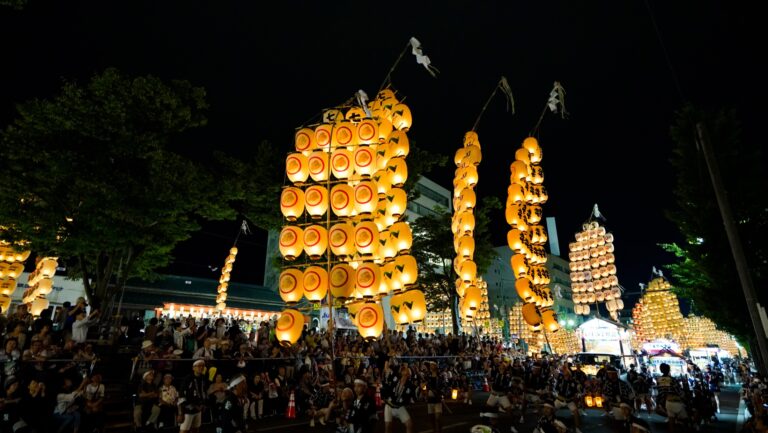
For 2027, when you can plan properly: reserve the night of the last Saturday of August in Akita, Morioka or Kakunodate the moment your dates firm up — think spring, not summer — and treat the seat ticket (June) and the hotel as two separate races you must win. Trip.com is handy here because it books regular JR trains and hotels in English in one place (the fireworks-night extras are JR-window territory, as covered above), and if you’re building a wider Tohoku itinerary around the fireworks, a JR East regional pass (temporary visitors only — check eligibility and current pricing) usually pays for itself on the Tokyo–Akita round trip alone. And if the trip stretches into a longer Tohoku summer, Akita City’s own Kanto Festival — hundreds of lantern-laden bamboo poles balanced on palms and foreheads — lands earlier in August, a different art from the same prefecture.
The morning after: don’t just leave
The 30th is a Sunday, and you’ll wake up two stops from two of Tohoku’s best half-days. Kakunodate — 20 minutes from Omagari, ¥350 — is the Edo-period samurai district often called the “Little Kyoto of Michinoku,” all dark wooden mansions and weeping cherries. Lake Tazawa, the next Komachi stop up the line, is Japan’s deepest lake at 423.4 m, ringed by a 20 km shore road with the gold Tatsuko statue; the lakeshore bus takes about 15 minutes from the station. Both are covered in Semboku City’s decent English tourism site, and both fold naturally into the autumn-planning ideas in my September and October guides.
09Missed it? The town fires again on October 3
Omagari now stages fireworks as an annual three-chapter series — a spring “New Fireworks Collection” (held April 25 this year), the August competition, and an Autumn Chapter on Saturday, October 3, 2026: about 8,000 shells, 6:00–7:30 p.m., themed around experimental and avant-garde creative fireworks, closing with a 100-shell volley of No. 10 shells. The official advance-sale window runs from September 7 to 11:59 p.m. on October 2, while seats last — through convenience-store terminals in Japan (Lawson, Ministop, FamilyMart and 7-Eleven) or as a QR-code digital ticket via the official site and app — at ¥7,000 for a single chair seat and ¥30,000 for a four-person table (camera seats, ¥10,000, are Lawson/Ministop only). If chair or table seats are left, they are sold at the entrances from 3 p.m. on the day, cash only, at ¥8,000 and ¥32,000. Children under primary-school age enter free with a guardian, and if the weather forces a postponement, the show moves to October 4 or October 10 with tickets still valid. It’s a fraction of the summer crowd with the same launch site and the same craftsmanship-first DNA. October in Tohoku is also simply a better travel month for most people — cooler, clearer, and the start of the foliage run I map in the Japan in October guide. Fireworks chasers who can’t reach Akita at all should look at the Naniwa Yodogawa fireworks in Osaka on October 17 — 2026 is an unusually good autumn for hanabi — or, next summer, at the more accessible lakeside Kojosai at Kawaguchiko near my home turf.
10Quick answers
Who won the Omagari fireworks competition in 2026?
Komatsu Enka Kogyo of Daisen City, Akita — the hometown company — won the Prime Minister’s Prize at the 98th competition on August 29, 2026, taking three of the four divisions: daytime fireworks, the No. 10 core-shell division and the No. 10 free-style division. The creative-fireworks division went to Kita-Nihon Hanabi Kogyo, also of Daisen. Nomura Hanabi Kogyo of Ibaraki, the 2025 winner, was runner-up in the core-shell division. The organizers published the official awards list on August 30, 2026.
Can I buy a ticket at the venue on August 29, 2026?
No. The organizers announced on August 27 that all spectator seats are sold out and no same-day tickets will be sold. Their FAQ states as standing policy that same-day tickets are basically never sold for the August competition — advance purchase (sales opened June 12 in 2026) is effectively mandatory.
Is there a free viewing area at the Omagari fireworks?
Not inside the venue — the official guide states every spot in the spectator grounds is paid seating, and place-holding is listed as a prohibited behavior. The organizers don’t endorse any off-site free spots, the levee roads between the two bridges are closed even to foot traffic in 2026, and the surviving unofficial spots are distant and lose the creative-fireworks compositions that make Omagari special (the ticket section above covers them honestly). Without a ticket, plan on the NHK BS live broadcast from 6:50 p.m. or an online stream instead.
What happens if it rains at the Omagari fireworks?
The show goes ahead in ordinary rain. Only severe weather or river conditions trigger a postponement, and there’s no fixed rain date — a new date is set after checking the riverside venue’s condition. If it’s postponed, tickets remain valid; refunds happen only on outright cancellation. In 2026 the August 28 forecasts gave a 20–40% chance of showers, and the night stayed dry.
Can I get back to Tokyo after the fireworks end?
No. The last direct Tokyo-bound train leaves Omagari at 7:43 p.m., mid-show. After the 9:30 p.m. finale, the farthest you can travel toward Tokyo is Sendai (10:19 p.m. extra Komachi, arriving 11:59 p.m.). Plan to sleep in Sendai, Morioka, Akita, Yokote or along the local lines, and note some late-night extras are sold only at station windows, not online.
How do I watch the Omagari fireworks live from overseas?
NHK’s three-hour live broadcast (NHK BS / BS Premium 4K from 6:50 p.m. JST) is the professional feed, but NHK’s streaming is generally Japan-only. An unofficial free 4K YouTube live stream by the channel Japan Explorers was scheduled as of August 28 — search the title “Omagari Fireworks Festival 2026,” and treat it as best-effort since it isn’t organizer-run.
What should I bring to the venue on the day?
The 2026-specific list: rubber boots or shoes you can ruin (official mud advisories on August 24 and 28), your own toilet paper (the summer competition’s portable toilets stock none), hat and drinks for the daytime hours, insect repellent (the official program carries a chigger warning for this riverbed), a light layer for the 18–19°C late evening, cash, a power bank, ear-defender muffs if you’re bringing small children, and paper train tickets for both directions bought in advance. Leave behind: tripods (outside photographer seats), tents, parasols, stoves, drones, luggage trolleys and pets — all banned.
When should I start planning for the 99th competition in 2027?
Hotels first: rooms in Akita, Morioka, Yokote and Kakunodate for the last Saturday of August fill months ahead, so book by spring. Seat tickets went on sale June 12 in 2026 via Lawson Ticket and e+ and sold out well before the event — watch omagari-hanabi.com from May and buy the morning sales open.
Sources: the official competition site (omagari-hanabi.com — overview, program PDF, ticket pages, the August 24/27/28 notices, and the August 30 results notice with the 98th competition awards-list PDF), the Akita Sakigake Shimpo reports of August 29–30, 2026 (crowd, conditions, awards ceremony), Daisen City’s fireworks portal and traffic-regulation map (2026 second edition), JR East Akita’s extra-train press release of July 17, 2026 (as updated August 5), the Japan Meteorological Agency (the August 28 forecast and its AMeDAS observations for Omagari on August 29), tenki.jp, Weathernews and Weathermap forecasts issued August 28, NHK program listings, the official program PDF and venue map, the Machinaka Fes official site, and the carriers’ own congestion-countermeasure pages. First-hand crowd accounts and locally maintained spot guides are attributed as such in the text. Attendance and economic figures beyond the city’s ~100,000 venue count are reported estimates and labeled as such. Booking.com, Rakuten Travel, Trip.com and the JR pass and eSIM links are affiliate links — they cost you nothing and keep this site independent. Statuses in the guide sections are as of the evening of Friday, August 28, 2026 (JST); the results were added on August 30, 2026, and the Autumn Chapter details (sale window, seat prices, postponement dates) were rechecked against the official site on September 27, 2026.
Join travelers discovering Japan's hidden side
Weekly dispatches from off-the-beaten-path Japan — spots and stories you won't find in guidebooks.
No spam. Unsubscribe anytime.
Welcome aboard!
You're in. See you in your inbox soon.