Japanese Food Culture · Akita
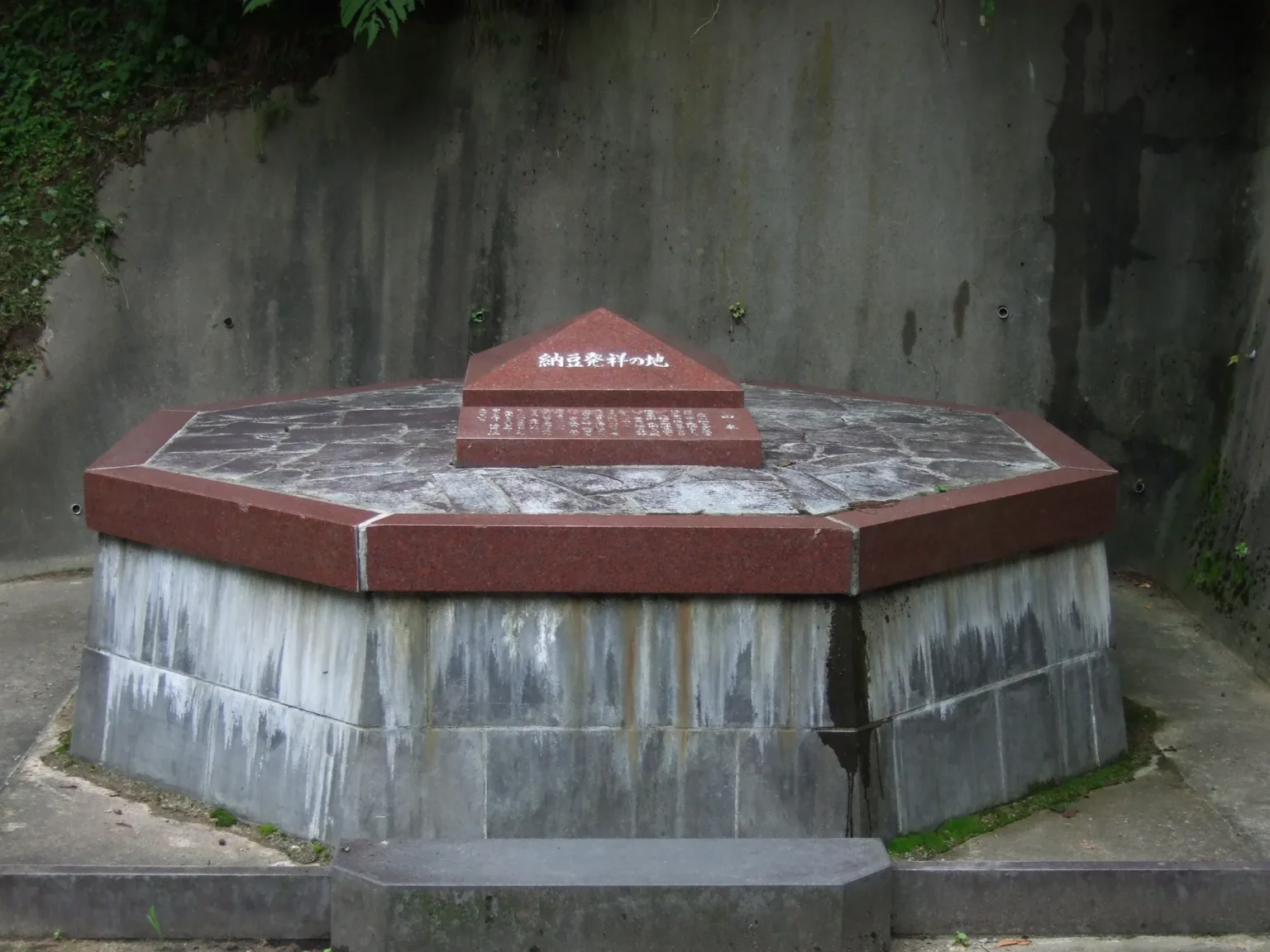
Yokote, a snow-country city in southern Akita, has its own “birthplace of natto” stone (納豆発祥の地). It stands in Kanazawa Park, on the hill held to be the stockade where the Later Three Years’ War ended in 1087, and its story stars the same samurai as Mito’s: Minamoto no Yoshiie. Farmers ordered to hand over boiled soybeans packed them into straw bales in a hurry, and a few days later the beans smelled and pulled into threads. Both towns tell this as a legend, and so will I. The reasons to make the long trip are around the stone: natto-jiru, the natto miso soup that people in this part of Akita look forward to every winter, and the kamakura snow-hut festival, which falls on 12–13 February in 2027. One warning before you plan February around the monument: Yokote City lists Kanazawa Park as closed in winter.
What Yokote claims, in its own words
The Later Three Years’ War (後三年の役, 1083–1087) was fought across the Yokote Basin. Yoshiie, then governor of Mutsu, took sides in a feud inside the Kiyohara clan and in 1087 starved out Kiyohara Iehira and Takehira at the Kanazawa stockade. Yokote City’s heritage pages date the fall of the stockade to the 14th day of the 11th month of that year. The winner on Yoshiie’s side, Kiyohara (later Fujiwara) no Kiyohira, went on to found the Fujiwara dynasty of Hiraizumi, which is why the city calls Yokote “the roots of Hiraizumi culture”.
The natto story is set during that campaign. The Yokote City Tourism Association tells it like this: Yoshiie had the farmers hand over boiled soybeans; they had no containers ready in time, so they packed the beans into straw bales; a few days later the beans gave off an aroma and drew threads; someone tasted them, found them surprisingly good, and the farmers began making natto themselves and passed it down. The stone in Kanazawa Park carries the same story, and the Agriculture Ministry’s regional food database repeats it, adding that Yoshiie’s side was struggling for supplies.
Read the endings. The tourism association closes with to iimasu, “it is said”. The inscription closes with to iu, which means the same. Yokote’s tourism promotion body says natto is “also said to have originated” in the city. No one in Yokote is claiming proof.
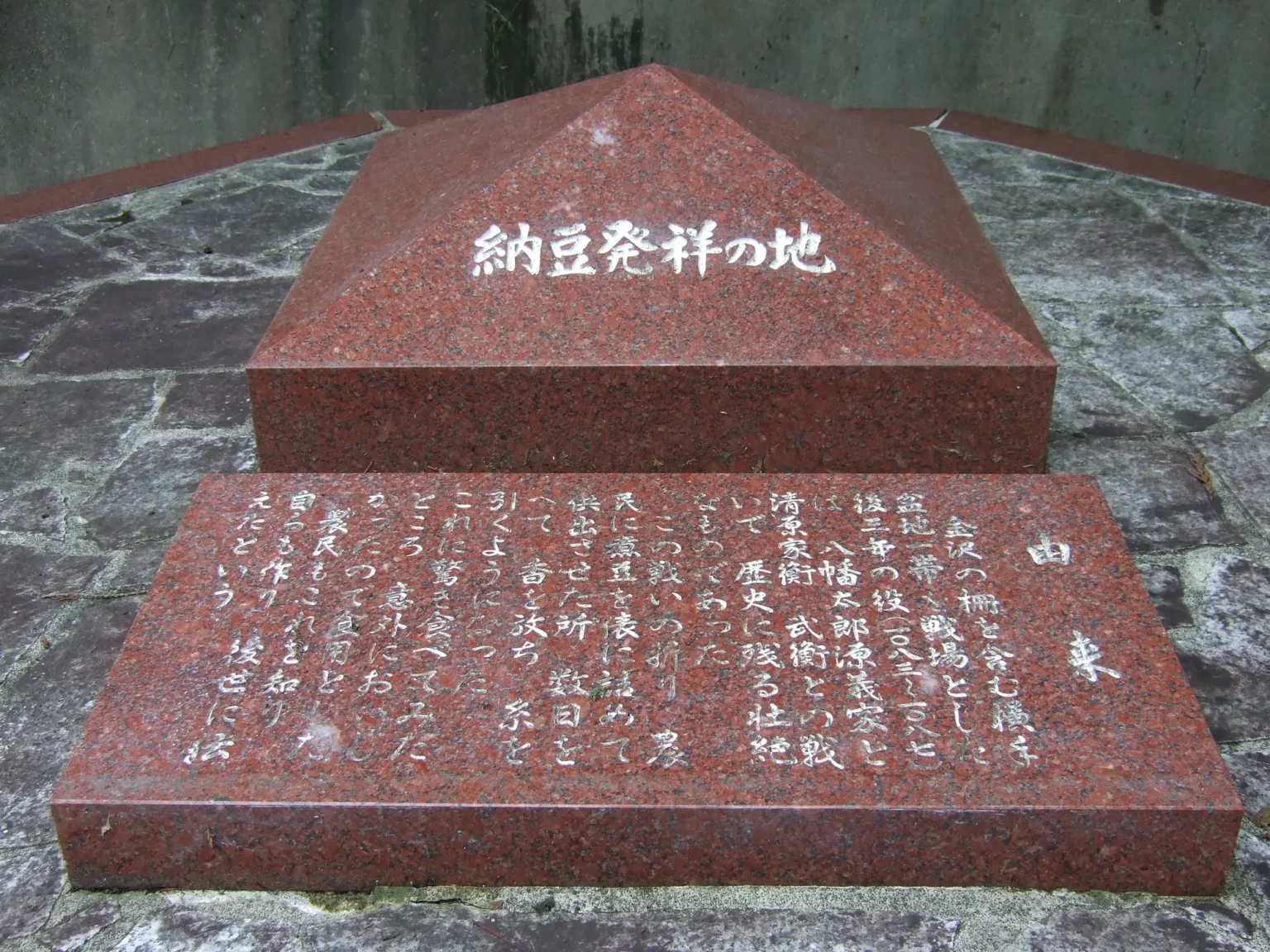
“[…] During this war, the farmers were made to hand over boiled beans packed in straw bales. After some days the beans gave off an aroma and began to draw threads. Surprised, they tried eating them, found them unexpectedly good, and took them as food. The farmers, too, learned of this, made it themselves and passed it on to later generations, it is said.”
From the inscription on the stone in Kanazawa Park, translated by Nobu
Yokote has three versions, not one
Yokote City’s own “natto legend course” lists three, each tied to a different place in the modern city.
Kanazawa
Farmers pack boiled soybeans into straw bales for Yoshiie’s army; days later the beans have turned to natto. This is the version on the stone, and the stone stands here.
Oya
On his way to the Numa stockade, Yoshiie is held up by heavy snow near Oya. Boiled beans carried on the horses’ backs ferment in their straw from the horses’ sweat; with nothing else to eat, Yoshiie tries them, then his men. The city calls this the start of “Oya natto”.
Numadate
Besieging the Numa stockade in a hungry winter, Yoshiie’s men find the beans on their horses have gone stringy overnight from damp snow and body heat. Natto is still sold on the approach to Numadate Hachiman Shrine at its eve-of-festival night, on the second Saturday of September.
Two birthplaces: Mito and Yokote side by side
Mito in Ibaraki is the town most people connect with natto, and our Mito natto day trip covers it stop by stop. Its legend and Yokote’s are two scenes from the same campaign. In Mito’s version Yoshiie is marching north to the war in 1083. In Yokote’s he is at the battlefields.
| Mito, Ibaraki | Yokote, Akita |
|---|---|
| The story | |
| 1083: Yoshiie stops in Watari on the march north; boiled beans for his horses, wrapped in straw, ferment | During the war: farmers told to supply boiled soybeans pack them into straw bales in a hurry, and days later the beans are stringy |
| Where it is set | |
| Mito’s Watari district, on the road north | The Kanazawa stockade, where the war ended in 1087, plus versions in the Oya and Numadate districts |
| What marks it | |
| A giant straw-wrapped natto at Mito Station’s south exit, honouring the station natto trade | The “birthplace of natto” stone in Kanazawa Park, put up by Yamada Foods for the war’s 900th anniversary |
| How the town words it | |
| City hall files it under “various theories” | The city’s tourism association and the stone both end with “it is said” |
| What is on record | |
| From 1889, straw-wrapped natto sold to railway passengers (Tengu Natto) | Hikiwari natto made in Akita, Aomori and Iwate since before the Edo period; Yamada Foods founded in the old town of Kanazawa in 1954 |
| Natto spending per household, 2023–25 average | |
| 4th of the cities surveyed, ¥6,797 a year | Yokote is not surveyed; Akita City is 3rd, ¥6,875 |
| From Tokyo | |
| About 70 minutes by limited express | About 3 hours 40 minutes, changing at Omagari |
How to see the monument in Kanazawa Park
Kanazawa here is a district of Yokote, not the city of Kanazawa in Ishikawa; you will also see it written Kanezawa, as in the name of its shrine, Kanezawa Hachimangu. Yokote City puts the district about 7 km north of its main city hall. The park sits on the hill most likely to have been the Kanazawa stockade; the city’s excavations found medieval castle remains rather than proof of the 11th-century stockade, and the hilltop, as Dewa Kanazawa Castle ruins, was made a National Historic Site in February 2026. The Agriculture Ministry and the city both place the natto stone inside the park.
| Option | What the official pages say |
|---|---|
| Bus | Ugo Kotsu’s Yokote–Omagari line from Yokote Bus Terminal. The printed timetable times the stop at Kanazawa Honchō (金沢本町), about 23 minutes out. The museum’s page says to get off at Kanazawa Kōen-mae (金沢公園前), three minutes’ walk from the museum. I could not confirm whether these are the same stop, so show the driver 金沢公園前. |
| Weekend buses | On Saturdays, Sundays and holidays the timetable revised on 1 April 2026 has six departures from Yokote Bus Terminal (8:26, 9:20, 12:00, 13:30, 15:50, 18:00) and six from Kanazawa Honchō back to Yokote (7:32, 8:12, 11:02, 12:32, 14:32, 17:12). Weekdays have more. |
| Taxi | About 20 minutes from Yokote Station. |
| Car | About 15 minutes from Yokote-kita Smart IC (ETC only) and 15–20 minutes from Yokote IC; the museum has 10 free spaces. |
Near the park is the Gosannen War Kanazawa Museum (後三年合戦金沢資料館), the one indoor stop in the area. It shows a copy of the painted Gosannen Kassen Ekotoba scroll made by Ebisuya Nanzan, a local man of letters, finds from the stockade sites, and armour and treasures deposited by Kanezawa Hachimangu. It opens 9:00–17:00 (last entry 16:30) and closes on Mondays (the next day when Monday is a holiday), on the day after any national holiday, and from 29 December to 3 January. Entry is the ¥100 four-venue ticket described in the kamakura section below.
The stone is further on. On the city’s natto-legend map, the route drawn from the museum to its Kanazawa Park marker is about 1.5 km of road, and the park’s own page describes a winding slope up to the top.
Kanezawa Hachimangu
On the second bailey of the castle ruins. By tradition founded in 1093, when Yoshiie had Kiyohira bring in the deity of Iwashimizu Hachimangu. The Satake lords of Akita were its patrons, and it has been rebuilt many times since 1604.
Kagemasa’s mound
The mound the park was laid out around. Legend says 16-year-old Kamakura Gongorō Kagemasa buried the enemy dead here on Yoshiie’s orders and planted a cedar; fire left only the trunk.
Heian no Kaze Wataru Park
A 1991 park at the pond where, in the legend, a broken line of wild geese warned Yoshiie of an ambush. Bronze statues and battle reliefs. Get off at Sankanzeki, the stop before Kanazawa Honchō, 17 minutes from Yokote Bus Terminal by the timetable. Also closed in winter.
Fitting it into the 2027 kamakura weekend
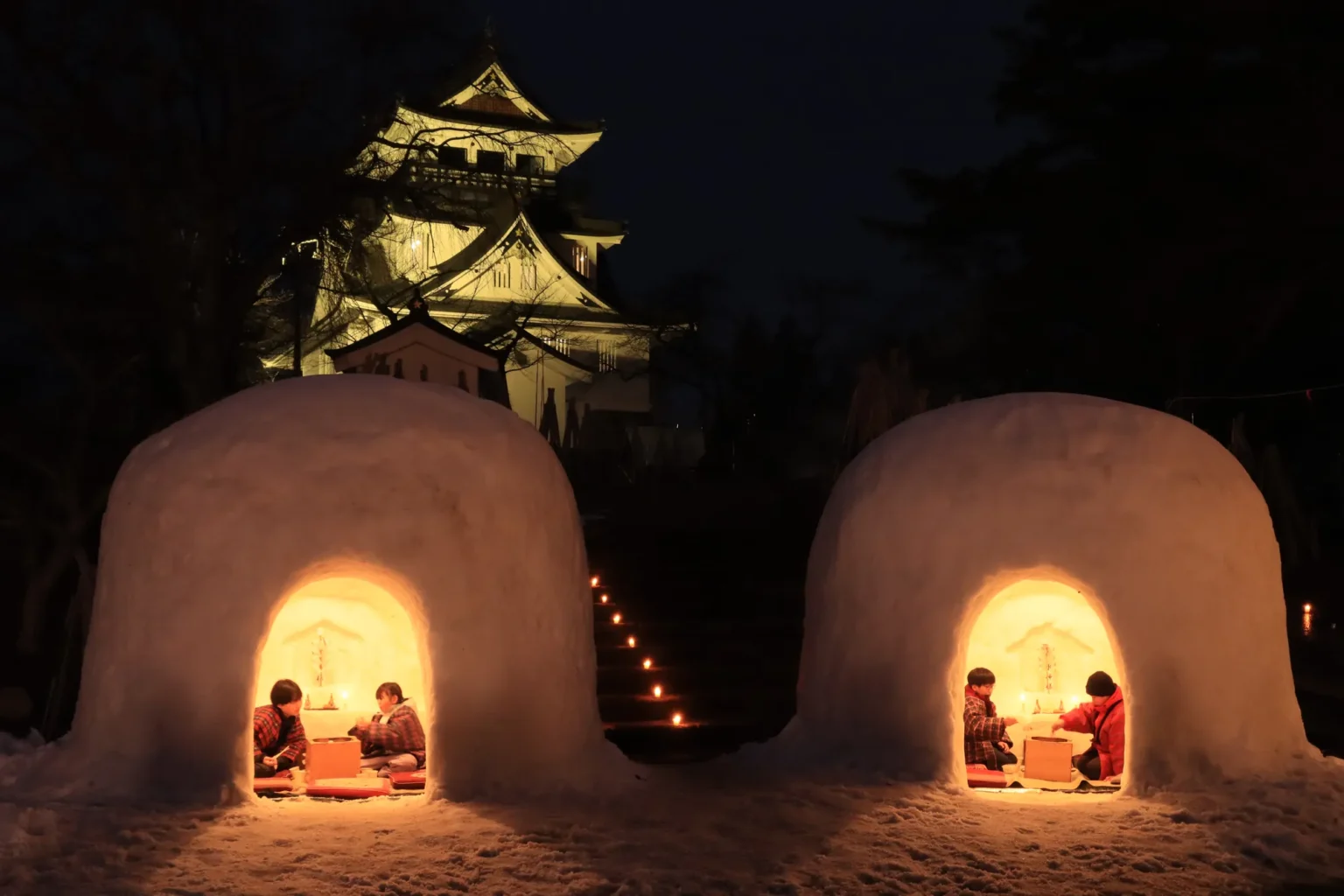
The kamakura are snow huts, about three metres high, with an altar to the water god inside. Children sit in them and invite passers-by in with “haitte tanse” (please come in) and “ogande tanse” (please pray to the water god), offering amaeko, a sweet rice drink, and mochi. The city says the custom is about 450 years old.
| Event | 2027 |
|---|---|
| Kamakura (snow huts) | Friday 12 and Saturday 13 February. The tourism association’s page gives the usual hours as 18:00–21:00 and the sites as the front of the city hall main building, Yokote Park, Futaba-chō and other spots around the city, with about 60 kamakura; that page still shows the 2026 dates. |
| Bonten (decorated poles) | Kept on its fixed dates, 16 and 17 February, as a Shinto rite, which in 2027 means Tuesday and Wednesday: the bonten contest on the 16th and the dedication at Asahiokayama Shrine on the 17th. |
| Why the change | From 2026 the kamakura moved off the fixed 15–16 February to the Friday and Saturday before bonten, as a trial; through 2029 that means the second Friday and Saturday of February. The city gives 11–12 February for 2028. |
Older English pages still give the old dates. The English text on Yokote City’s own site, written by the Japan Tourism Agency and last updated in 2022, still says 15, 16 and 17 February. The city’s Japanese page, updated in February 2026, gives 12–13 February for 2027.
A ¥100 ticket for four venues
Kamakura-kan, ten minutes’ walk from Yokote Station, keeps real kamakura made by kamakura builders in a room at about minus 10°C all year (9:00–17:00, closed 29 December–3 January). The building is free; the kamakura room costs ¥100, and that ticket, valid on the day of issue, also covers the Kanazawa war museum, the Yokote Castle observatory and the Ishizaka Yōjirō literary museum. Junior high pupils and younger go free.
The museum closes on Friday 12th
11 February 2027 is National Foundation Day, a Thursday, and the Kanazawa museum closes on the day after a national holiday. Saturday 13th is the day: on the weekend timetable revised in April 2026, the 9:20 bus from Yokote Bus Terminal reaches Kanazawa Honchō at 9:43, and the 12:32 from Kanazawa Honchō is back at Yokote Station’s east exit at 12:54.
The castle opens for the festival
The Yokote Castle observatory, a 1965 keep-style tower on the castle site, opens from 1 April to 30 November and again during the February kamakura. Hours change on event days, so check on the day.
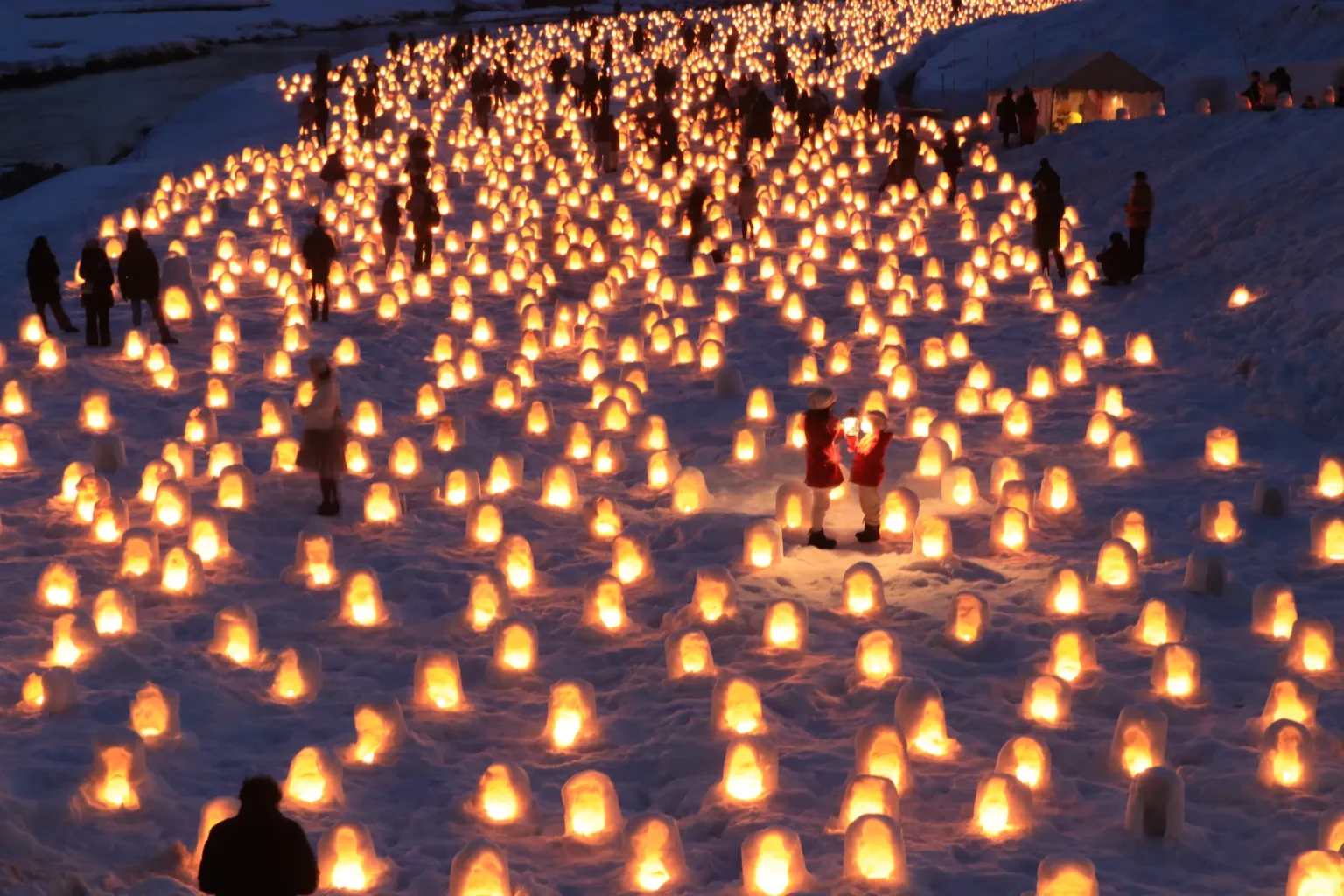
For a two-day visit, arrive on Friday afternoon, see Kamakura-kan, and walk the kamakura sites in the evening. On Saturday morning take the bus to the Kanazawa museum and, if you booked it, have natto-jiru at Asagiku, the restaurant in the next section. In past years the riverbed below Janosaki Bridge has been covered in mini kamakura on festival nights (the city’s 2022 English page describes it, and the photo above is from 2025), but the association’s current venue list does not mention it, so check locally that it is lit on the 13th before you plan Saturday evening around it.
Stay in central Yokote. Kamakura-kan and the city hall festival site are about ten minutes’ walk from the station, the WARP airport shuttle stops at the station’s west exit, and the Kanazawa buses leave from Yokote Bus Terminal. On festival nights you will be walking back after 21:00 in the snow, so a hotel near the station makes sense.
Staying in central Yokote
Search for Yokote rather than Akita: Akita City is about 1 h 20 min away by train. Book early for the kamakura weekend and check the walking distance to the station.
Natto-jiru: the soup that goes with the legend
Natto-jiru (納豆汁) is miso soup with natto ground into it. The Agriculture Ministry’s regional food database lists it as a dish of inland southern Akita, which is Yokote’s area, and of the Nakanone district of Yurihonjō. The recipe it reproduces, from a cookbook by Akita’s rural life research groups, simmers taro and fried tofu in niboshi stock, adds salted warabi bracken and saku (a wild herb) soaked out, rehydrated dried zenmai, mushrooms and tofu, seasons with miso, then stirs in natto that has been ground smooth in a suribachi mortar, without letting the pot boil again. Spring onion and salted mustard greens go on top. The ministry says the ground natto gives the soup body and a rounder taste.
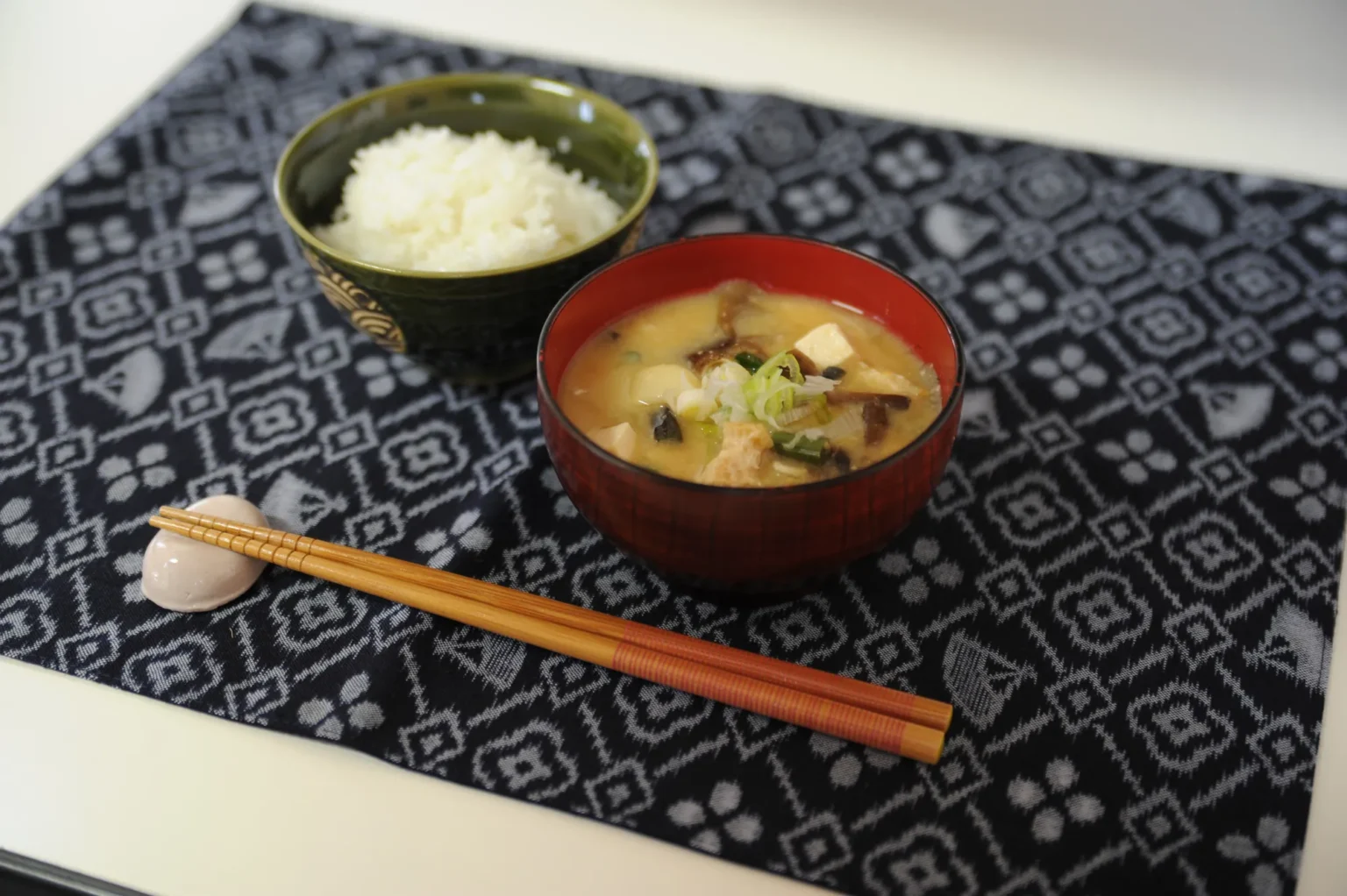
Three details from the ministry explain why it is a winter food. Much of the filling is mushrooms and mountain vegetables picked in spring and autumn, salted, and soaked out when the soup is made; because that takes work, it became a dish for weddings, funerals and other special days. Inland southern Akita eats natto-jiru at New Year where most of Japan eats zōni, cooking a big pot and reheating it over the first three days. And in winter, supermarkets set up corners selling natto-jiru ingredients. In Japanese dictionaries natto-jiru is a winter season word for haiku, and the oldest example Nihon Kokugo Daijiten quotes is a letter from 1440.
Where to taste it, or buy local natto
I can point you to one place in Yokote with a live official listing. Asagiku (朝菊), a Yokote yakisoba restaurant at 9-12 Tanaka-machi, lists natto-jiru with imo-no-ko-jiru (taro soup) and shio-kujira (salted whale) as country dishes, by reservation. The tourism association’s listing, last updated in 2021, gives 11:30–14:00 and 17:30–22:00, irregular closing days and phone 0182-33-4131. Ring ahead, in Japanese or through your hotel. Omagari, where the Komachi route changes trains, has gone further: the ministry says the Omagari Chamber of Commerce began promoting natto-jiru as the town’s dish in 2008 and more than ten restaurants now serve it as certified shops. I could not open a current list of those shops, so I am not naming any.
For natto itself, the local name is Yamada Foods, which sells under the Ohayo Natto brand. It started in 1954 as the Kanazawa Natto factory in the former town of Kanazawa, Senboku district, a town later divided between Yokote and Misato, so wider than today’s Kanazawa district of Yokote; its head office is now in neighbouring Misato, and its Yūshin-an factory is in Yokote’s Hiraka district. Its pages present Yūshin-an as a factory with access details, and I found no visitor hours or tours there, so buy the packs in a shop instead. One of its lines is kizami natto, chopped even finer than hikiwari. Fresh natto needs a fridge; for the flight home, dried natto travels better, as the natto guide explains, and Yamada Foods also makes freeze-dried natto. Kyoto’s temple natto is another thing again: dried, salty and string-less — see Daitokuji and Ikkyuji temple natto.
Getting to Yokote from Tokyo
| Route | Time and notes |
|---|---|
| Akita Shinkansen + Ou Line | The Komachi trains I checked on the October 2026 timetable take 3 h 11 min to 3 h 18 min from Tokyo to Omagari; all seats are reserved. The Ou Line local from Omagari to Yokote takes about 18 minutes, roughly hourly with gaps. Yokote City gives about 3 h 40 min as the shortest time including the change. |
| Tohoku Shinkansen + Kitakami Line + bus | Tohoku Shinkansen to Kitakami, the Kitakami Line to Hotto Yuda, then a JR replacement bus to Yokote. Trains have not run between Hotto Yuda and Yokote since the heavy rain of 2 August 2026, and there is no date for them to return. JR East has run replacement buses on that section every day since 12 September: 8 runs a day on weekends and holidays and 9 on weekdays, counting both directions, according to Akita Sakigake Shimpo on 5 September. JR East’s own replacement-bus timetable (from 12 September, until further notice) has buses leaving Hotto Yuda for Yokote at 7:20, 11:10, 17:50 and 20:40, plus 6:00 on weekdays, taking about 52 minutes, and JR East says reopening the line will take a considerable time. When trains ran, Yokote City gave about 4 hours from Tokyo this way. |
| Fly to Akita + Yokote WARP | Haneda to Akita is about 1 h 10 min. The city’s shared shuttle runs from Akita Airport at 10:05 and 18:10 to Yokote Station’s west exit (about 70 minutes), ¥500. It is for air passengers only and must be booked 60 to 4 days ahead, through the city’s online reservation system or by phone in Japanese. |
On the Komachi route you change at Omagari, the fireworks town; our Omagari fireworks guide covers it. The Komachi and the Ou Line are both JR, so a rail pass covers the train legs but not the bus to Kanazawa. A national pass only pays off if Yokote is one stop on a longer route, and my JR Pass vs individual tickets comparison does the maths. For a February trip, leave slack for snow delays; my heavy-snow travel guide covers delays, footwear and buffer time.
Yokote in other seasons
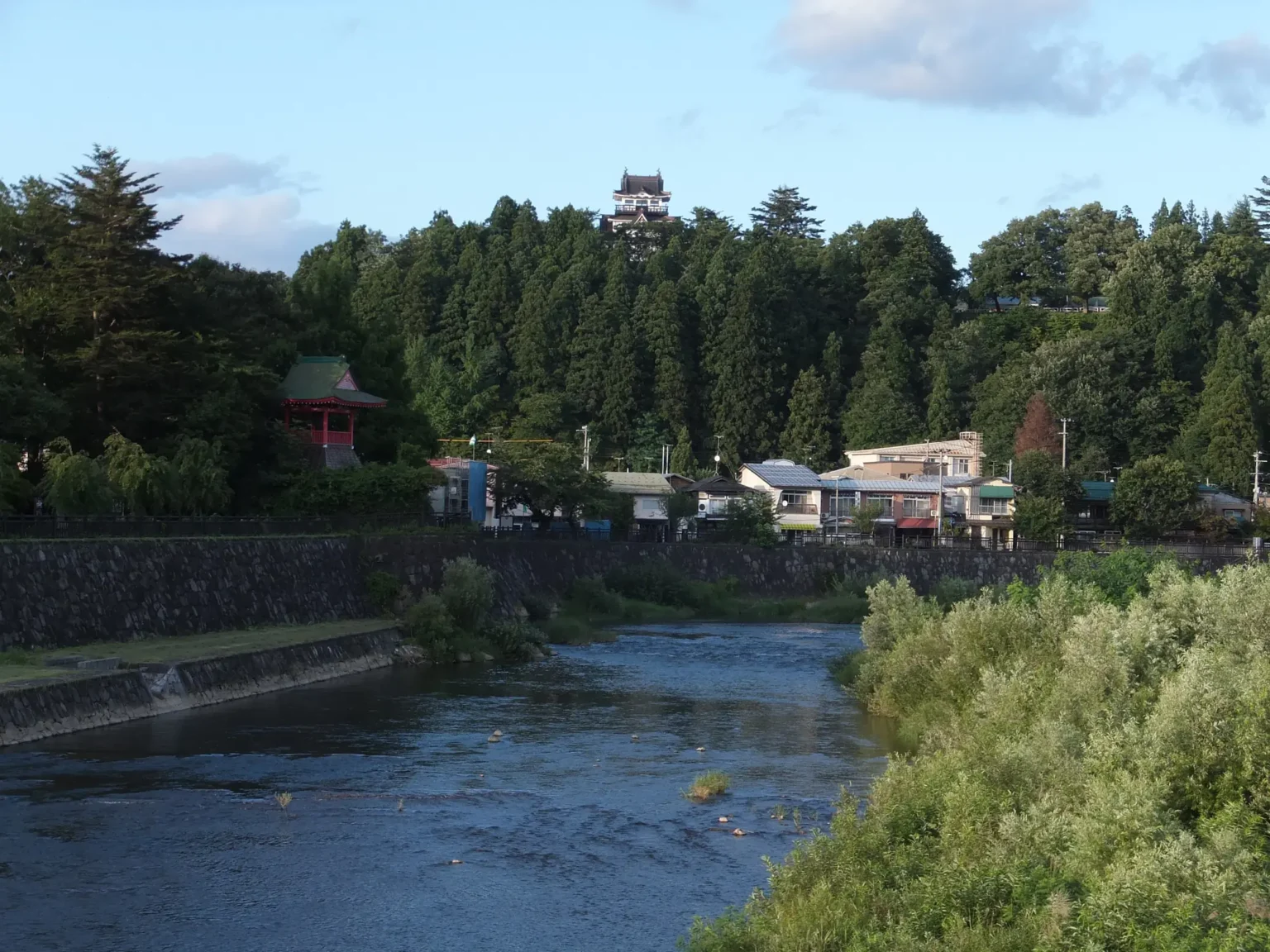
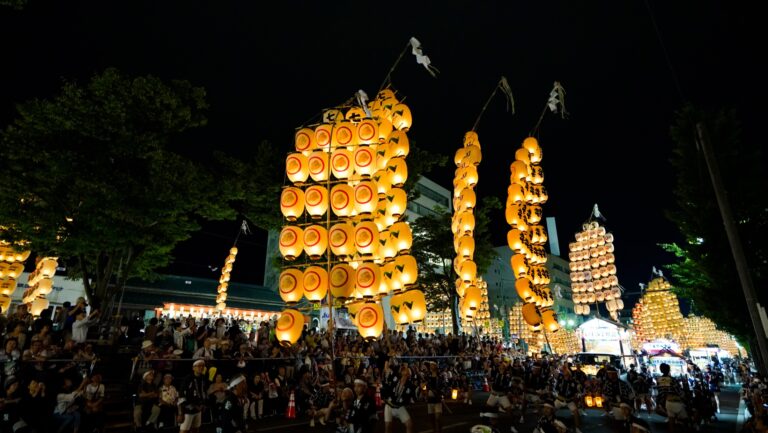
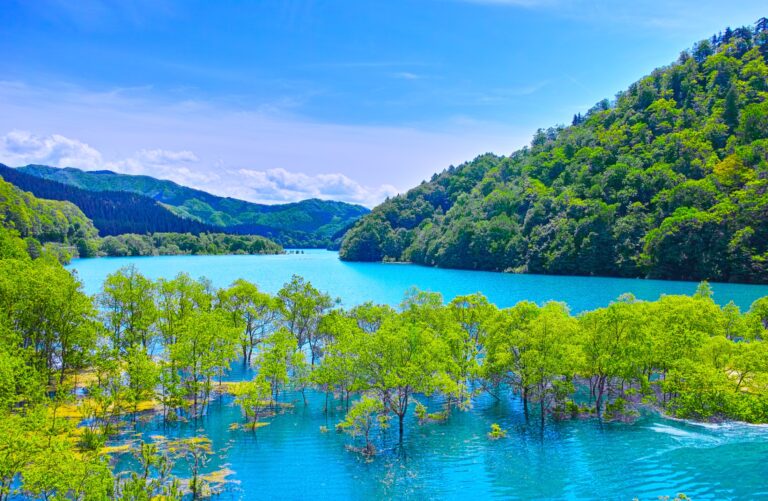
Outside the winter closure you can walk up to the natto stone, and Kanazawa Park is known for its cherry blossoms and azaleas. Akita has other things to plan around too: spring at the Lake Shusenko submerged forest and early August at the Akita Kantō Festival in Akita City. If Yokote is one stop on a longer rail trip around Tohoku, that is when a pass starts to pay for itself.
Before the long ride north
Yokote natto: short answers
Is Yokote really the birthplace of natto?
It is one of several places with a natto origin legend, and nobody can prove any of them. Yokote’s story says farmers packed boiled soybeans into straw bales for Minamoto no Yoshiie’s army during the Later Three Years’ War (1083–1087) and the beans fermented. The city and the monument both tell it as “it is said”. The national natto federation says only that boiled beans meeting rice straw was the likely start.
Where is the “birthplace of natto” monument?
In Kanazawa Park (金沢公園, also written Kanezawa) in Yokote’s Kanazawa district, about 7 km north of the city hall, on the hill thought to be the Kanazawa stockade. Take Ugo Kotsu’s Yokote–Omagari bus from Yokote Bus Terminal; the timetable times the Kanazawa Honchō stop at about 23 minutes, and the museum’s page says to get off at Kanazawa Kōen-mae. A taxi from Yokote Station takes about 20 minutes. On the city’s map the stone is about 1.5 km by road beyond the museum. Yokote City says the local maker Yamada Foods put it up for the war’s 900th anniversary.
Can I see the monument during the kamakura festival?
Probably not. Yokote City lists Kanazawa Park as closed in winter, without dates, and the festival is in mid-February. The Gosannen War Kanazawa Museum near the park stays open (9:00–17:00, closed Mondays and the day after national holidays), but in 2027 that means it is closed on Friday 12 February, the day after National Foundation Day. Go on Saturday 13th.
What is natto-jiru and where can I try it in Yokote?
It is miso soup with ground natto, taro, fried tofu, mushrooms and salted wild vegetables, eaten through the winter and at New Year in inland southern Akita. In Yokote, Asagiku in Tanaka-machi lists natto-jiru by reservation (phone 0182-33-4131). In Omagari, the Komachi route’s transfer town, the Agriculture Ministry says more than ten restaurants serve it as certified shops.
When is the Yokote Kamakura Festival in 2027?
Friday 12 and Saturday 13 February 2027; the tourism association gives the usual hours as 18:00–21:00. Since 2026 it has been held on the second Friday and Saturday of February, a trial that runs until 2029, instead of the fixed 15–16 February. The bonten events stay on 16 and 17 February.
How do I get from Tokyo to Yokote?
There are two rail routes. The simpler one is the Akita Shinkansen Komachi to Omagari (about 3 h 15 min, all seats reserved), then the Ou Line local to Yokote (about 18 minutes). The other is the Tohoku Shinkansen to Kitakami and the Kitakami Line to Hotto Yuda, then a JR replacement bus to Yokote: trains on that last section have been suspended since heavy rain on 2 August 2026, and the buses have run daily since 12 September (8 runs a day on weekends and holidays, 9 on weekdays, both directions combined). Check the bus times with JR East first. Flying to Akita and taking the city’s ¥500 WARP shuttle also works, if you book it 60 to 4 days ahead.
Is Yokote’s natto legend the same as Mito’s?
Both stories star Yoshiie in the same war, but in different places. Mito’s puts him in its Watari district in 1083, on the march north, with fermented horse feed. Yokote’s puts him at the battlefields of the Yokote Basin, with beans the farmers packed in straw. Mito’s documented claim to fame is the railway natto trade from 1889; see our Mito day trip.
Can I visit a natto factory in Yokote?
Not that I could confirm. Yamada Foods, which began in the old town of Kanazawa in 1954 and sells as Ohayo Natto, has a factory in Yokote’s Hiraka district, but its pages give no visitor hours or tours. If you want to watch natto being made, Takanofoods’ free viewing hall near Mito is the one I know of, covered in the Mito day trip.
Yokote is a long way to go for a stone in a park, and in February you may not even reach it. It is still a good place to understand the natto story, which is set in a winter siege with a hungry army and straw bales of beans, in a valley that still makes natto-jiru at New Year. In February the kamakura and the soup are the reasons to go; the monument is a trip for the green season.
New to natto? What it tastes like, how to stir it, and which pack to buy first.
Read the natto guideSources
The official pages behind every date, timetable and quotation above, checked 6 October 2026
- Yokote City (Japanese): natto legend course (three legends; the monument and who built it; the linked map of the course), Yokote kamakura (2027 and 2028 dates, history), Kanazawa Park (winter closure, access), Gosannen War Kanazawa Museum, Dewa Kanazawa Castle ruins, the Later Three Years’ War, Heian no Kaze Wataru Park, Kamakura-kan, Yokote Castle observatory, access to Yokote, Yokote WARP airport shuttle; English: Yokote’s Winter Festival (Japan Tourism Agency text, 2022)
- Yokote City Tourism Association (Japanese): Later Three Years’ War legends, sights at Kanazawa, kamakura, 2026 schedule change notice, Asagiku; Yokote City Tourism Promotion Organization: natto
- Ministry of Agriculture, Forestry and Fisheries, Uchi no Kyōdo Ryōri: natto-jiru, Akita (Japanese)
- Japan Natto Cooperative Society Federation: When did natto begin? and types of sticky natto (Japanese)
- Kotobank: 後三年の役, 金沢柵, 納豆汁
- Statistics Bureau of Japan, Family Income and Expenditure Survey: rankings by item, 2023–2025 average (natto, two-or-more-person households)
- JR East service information for the Kitakami Line, with the replacement-bus timetable from 12 September 2026: traininfo.jreast.co.jp (checked 6 October 2026)
- JR East timetables (October 2026): Yokote, Omagari, Kitakami; Akita Sakigake Shimpo, Kitakami Line suspension, 5 August 2026, and daily replacement buses from 12 September, 5 September 2026
- Ugo Kotsu: Yokote–Omagari line timetable, revised 1 April 2026 (PDF)
- Yamada Foods: company history, factories, kizami natto (Japanese)
- Akita Prefecture official tourism site Akita Fun: Yokote kamakura and Kamakura-kan (Japanese)
- Photographs: Wikimedia Commons (MWE, CC BY-SA 3.0; Rarisan, CC0; 掬茶, CC BY-SA 3.0) and the Agriculture Ministry’s natto-jiru page (Yokote City photograph, MAFF terms of use)
Join travelers discovering Japan's hidden side
Weekly dispatches from off-the-beaten-path Japan — spots and stories you won't find in guidebooks.
No spam. Unsubscribe anytime.
Welcome aboard!
You're in. See you in your inbox soon.