
Fireworks · The Big Three
Japan’s “Three Great Fireworks Festivals” all land in the second half of 2026: Nagaoka over the Shinano River on 2–3 August (19:20–21:25 both nights), the 98th Omagari National Fireworks Competition in Akita on 29 August (daytime section 17:10, night 19:00–21:30), and the 95th Tsuchiura competition in Ibaraki on 7 November from 17:30. Here is what the listicles skip: in 2026 there are no free seats at Nagaoka or Omagari at all — and Nagaoka’s general ticket lottery has already sold out, with the official page for overseas visitors showing the same. This is a guide to what each night actually is, and a realistic plan for seeing one.
What “Big Three” actually means
First, an honesty note. There is no governing body that defines the “Big Three.” In travel usage it almost always means Nagaoka, Omagari and Tsuchiura — the trio Nagaoka’s own tourism bureau names. A separate grouping, the “three great competition festivals,” covers Omagari, Tsuchiura and the Ise Jingu dedication fireworks, and the two lists get mixed up constantly. The practical difference matters more than the branding: Omagari and Tsuchiura are competitions, where Japan’s licensed pyrotechnic houses fire against each other for national titles; Nagaoka is not a contest at all — it is a memorial, and knowing that changes how you watch it.
Nagaoka (2–3 August) — the memorial
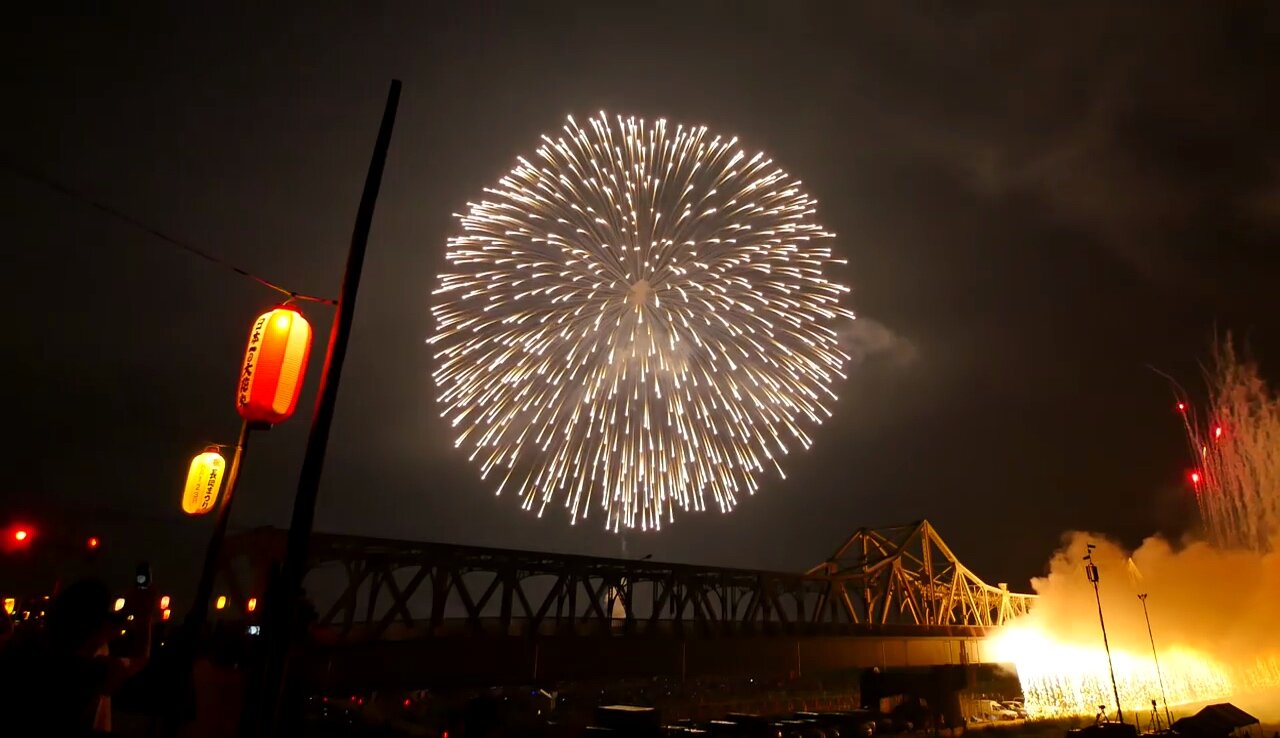
On the night of 1 August 1945, an air raid burned eight tenths of Nagaoka’s old city and killed 1,489 people. Nagaoka’s fireworks tradition is older than the war, but the festival in its modern form is built around that night. Every year on 1 August at 22:30 — the hour the bombs began falling — three pure-white shells called Shiragiku, “white chrysanthemum,” are launched in remembrance of the dead. The big shows on 2 and 3 August open with the same white flowers before any colour is allowed into the sky. The official programme spells the sequence out: the 90-centimetre sanjakudama go up at 20:30 and 21:00, and the Phoenix — a recovery-prayer barrage added after the 2004 Chuetsu earthquake, so wide you turn your head to follow it — fires at 20:45 both nights.
That context is why I’d call Nagaoka the one worth building a trip around — and why getting in has become the hard part. In 2026 every seat in the viewing areas is ticketed; the organisers state plainly that no free seating exists. Prices run ¥2,000 to ¥48,000 depending on the block. The residents’ pre-sale and the general lottery are both done, the lottery sold out, and no second lottery is planned; official resale is limited to residents of Japan. If you are reading this in late July 2026 hoping to walk in next week — that plan is over. Put it in the calendar instead and watch the official ticket site from spring 2027 — the sales cycle runs months ahead of August.
If you are aiming for Nagaoka in 2027, sort the rail side once you have seats: compare JR Pass options.
Omagari (29 August) — the national championship
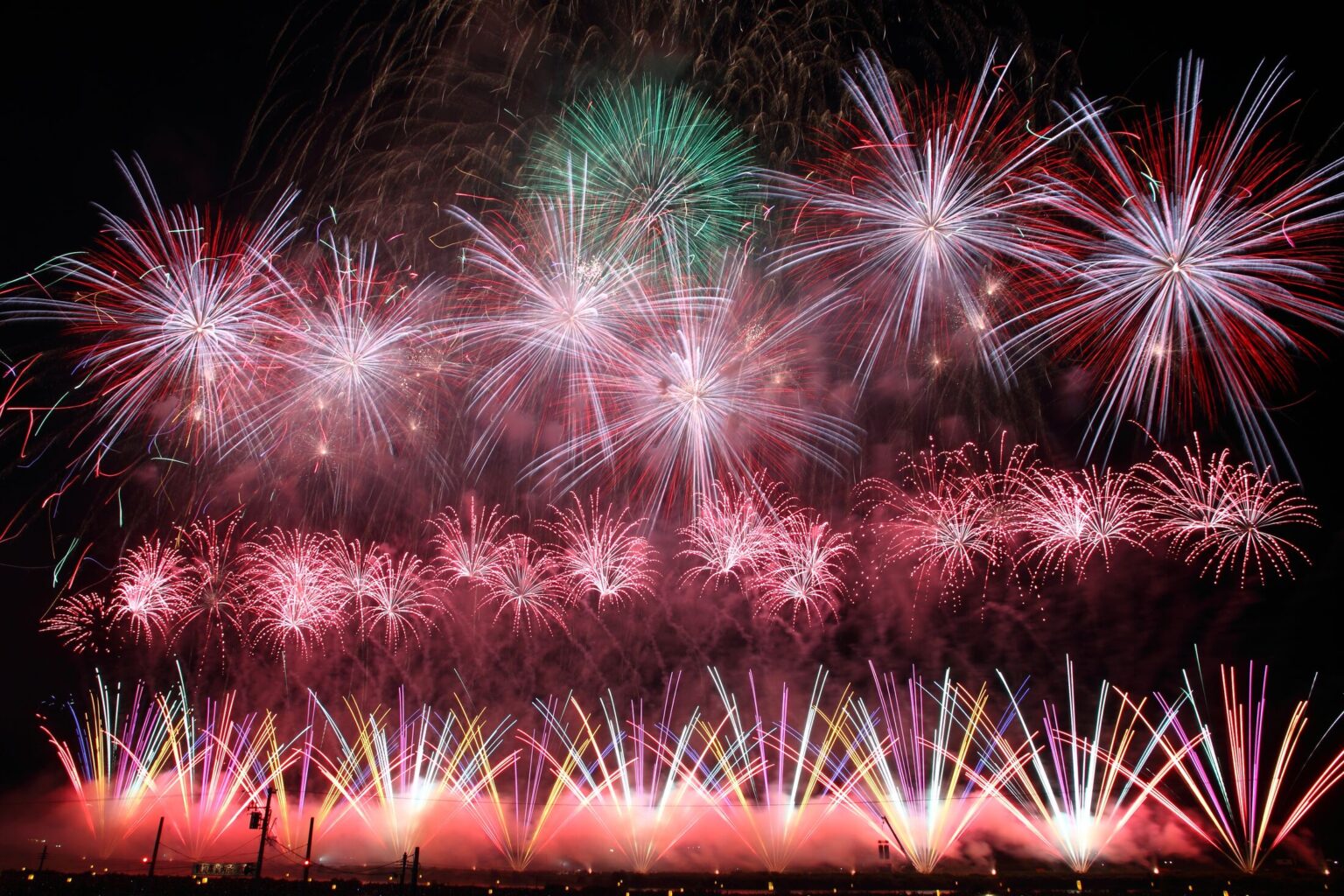
Omagari, a river district of Daisen City in Akita, hosts the 98th National Fireworks Competition on Saturday 29 August 2026 — the event where 28 fireworks companies compete for the Prime Minister’s Award, one of the highest honours in the craft. Three things make it unlike anywhere else. It starts in daylight: a dedicated daytime section runs 17:10–18:00, judged on coloured smoke against a bright sky — a discipline that survives almost nowhere else. Each entrant fires No. 10 shells (10-gō, roughly 30 cm across — one traditional patterned burst, one free-style) plus a creative-fireworks programme capped at 2 minutes 30 seconds, a format that rewards choreography over volume. Night competition runs 19:00–21:30.
Tickets: like Nagaoka, the venue is entirely paid seating — from ¥8,000 chair seats to ¥70,000 platinum pair seats (leisure-sheet spots run ¥15,000). Unlike Nagaoka, you may still have a shot: the second online sale window runs to 31 July 2026, first-come rather than lottery. The venue is a 30-minute, roughly two-kilometre walk from Omagari Station, extra trains are planned, and the organisers themselves warn that nearby hotels fill immediately — most visitors base in Akita City or Morioka and ride the Shinkansen in.
Update, 28 August: it sold out — the organisers confirmed on 27 August that all seats are gone and no same-day tickets will be sold. I published a dedicated night-before deep-dive covering the full programme, the 77 extra trains (including the ones sold only at station windows), the muddy-venue advisories and where to sleep: Omagari Fireworks 2026 — the complete guide.
Result, 30 August: the 98th competition went ahead as scheduled on 29 August in front of a riverbank crowd of about 100,000, and the Prime Minister’s Award went to the hometown company, Komatsu Enka Kogyo of Daisen, which won three of the four divisions (daytime, No. 10 core-shell and No. 10 free-style); another Daisen maker, Kita-Nihon Hanabi Kogyo, took the creative-fireworks division. Last year’s winner, Nomura Hanabi Kogyo of Ibaraki, was runner-up in the core-shell division. The division-by-division table is in the Omagari guide.
For a 2027 Omagari trip, Akita City is a common base: search Akita city hotels or compare on Trip.com.
Tsuchiura (7 November) — the autumn competition
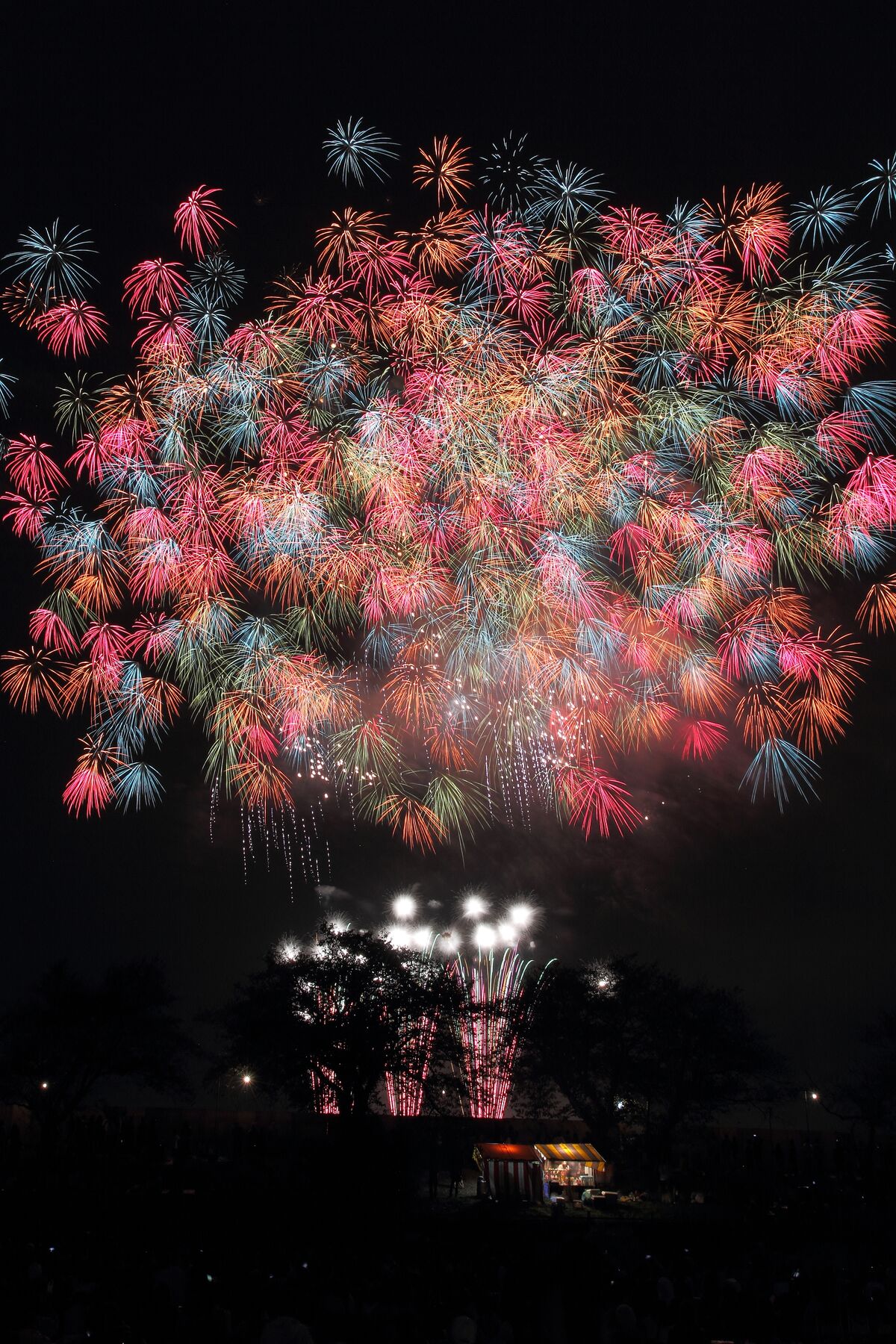
The third leg is the odd one out on the calendar, and that is its charm. Tsuchiura, an hour-ish northeast of Tokyo in Ibaraki, holds its 95th competition on Saturday 7 November 2026, from 17:30 — deep autumn, when the air is at its clearest and the rest of Japan’s fireworks calendar has gone quiet. The tradition started in 1925, when the head priest of Jinryuji temple organised fireworks to console the spirits of members of the Kasumigaura Naval Air Corps who had died in service, and to help revive a local economy struggling after the 1923 earthquake.
Competitively it is best known for its starmine division — shells fired in rapid, programmed sequence — alongside No. 10 shell and creative divisions. For travellers it is also the most accessible of the three to attempt in 2026: seat sales notices went out in mid-July, and demand is already visible: the group viewing squares (¥22,000 per four-person square, sold five squares and up, on raised platforms behind the main stands) hit a cancellation waitlist within days. Check the official ticket page for what remains — availability checked 25 July 2026 — and it is close enough to Tokyo to do without repacking your suitcase. November evenings by the Sakura River are cold in a way August never is; bring the layer you think is one too many.
Since Tsuchiura works as a day out from the capital, the simple plan is to compare Tokyo stays and ride in for the evening.
The three, side by side
| Nagaoka | Omagari | Tsuchiura | |
|---|---|---|---|
| 2026 date | Sun 2 & Mon 3 Aug | Sat 29 Aug | Sat 7 Nov |
| Hours | 19:20–21:25 | 17:10–18:00 + 19:00–21:30 | from 17:30 |
| Character | War memorial · sanjakudama · Phoenix | National competition · daytime section | Renowned starmine division · autumn air |
| Official seating | All paid · none free | All paid · none free | Paid · group squares waitlisted |
| Ticket range | ¥2,000–48,000 per seat/block · sold out | ¥8,000–70,000 per seat/pair · sold out | ¥22,000 per group square (waitlist) |
| Nearest station | Nagaoka (walk ~30 min) | Omagari (walk ~30 min) | Tsuchiura |
If the ticket walls here make your shoulders drop, I wrote a separate piece on why Japanese fireworks went paid, and when a paid seat is actually worth it — including data on what these seats cost nationwide, and the free-riverbank playbook that still works at hundreds of smaller festivals like Sakai’s Tone River show in September.
And if your trip leans urban rather than rural, the counterpoint to all three is the Naniwa Yodogawa Fireworks in Osaka — a 60-minute, five-scene city show on October 17, 2026, with its own advance-only seat system.
Questions I’d actually ask
Can I still get into any of the Big Three in 2026?
Nagaoka: realistically no — the lottery sold out and official resale is Japan-residents only. Omagari: no — every seat sold out, and the organisers confirmed on 27 August there will be no same-day sales (details). Tsuchiura: the best odds simply because sales are still in motion for the 7 November date — but the group squares are already waitlisted, so move quickly.
Is there anywhere free to stand?
Not inside the official viewing areas. Nagaoka and Omagari both state plainly that all venue seating is ticketed; Tsuchiura’s official viewing is likewise sold as paid seating (check its venue map for details). Inside the official grounds, the old walk-in riverbank plan is over — the nationwide shift I documented in the paid-seats piece.
Which one should a first-timer aim for?
If you want meaning with your spectacle, Nagaoka — plan for 2027 and enter the spring lottery. If you want pure craft, Omagari. If you want the most bookable 2026 option that fits a Tokyo itinerary, Tsuchiura on 7 November.
What is a sanjakudama?
A 90-centimetre-diameter shell — among the largest fired anywhere in the world at a regular festival. Nagaoka fires them at fixed times (20:30 and 21:00 on both 2026 nights), so you can be ready rather than surprised.
Why does Omagari fire fireworks in daylight?
The daytime section (17:10–18:00) is a competition discipline of its own, judged on coloured smoke and shape against a bright sky. Daytime competitive fireworks are now rare in Japan, which makes Omagari’s first 50 minutes as distinctive as anything after dark.
Do the shows run in rain?
Light rain generally doesn’t stop these events; severe weather decisions are made per-festival (Omagari states postponement depends on venue recovery, decided case by case). Check each official site on the day rather than assuming.
Join travelers discovering Japan's hidden side
Weekly dispatches from off-the-beaten-path Japan — spots and stories you won't find in guidebooks.
No spam. Unsubscribe anytime.
Welcome aboard!
You're in. See you in your inbox soon.