Hydrangea Season · June 2026
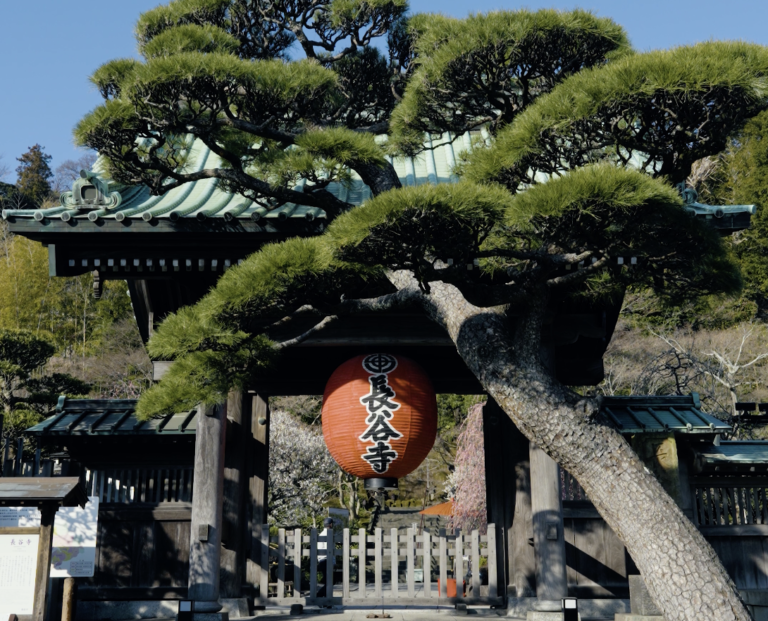
Japan has two temples named Hasedera (長谷寺) — one in Kamakura with about 2,500 hydrangea plants peaking early to mid-June, and one in Nara with about 3,000 plants peaking late June through early July, both founded in the 8th century from the same legend of a single sacred tree. Same name, same origin, two completely different ajisai experiences two-and-a-half hours apart on the Tokaido Shinkansen.
I have stood at the railing of both temples in hydrangea season — once in Kamakura with 1,800 other people queueing for a ¥500 numbered ticket, and once in Nara with maybe twenty visitors on a Wednesday afternoon, watching a single elderly volunteer rearranging the potted plants on the stone stairs. The two temples carry the same name, draw their lineage from the same 8th-century moment, and yet the rooms they place you in have nothing in common. This guide is the case for visiting both — and, if you only have time for one, the basis for choosing which.
30-second summary
If you have one June weekend: Kamakura first weekend of June — peak bloom on the coast, plus the only ocean-view ajisai temple in Japan. Reserve the ¥500 Ajisai Path ticket online (open Thursdays 10:00 for the following week).
If you have one late-June or early-July weekend: Nara Hasedera — about three weeks behind Kamakura, no separate ticket, no queue, and the 399-step covered staircase lined with about 300 potted hydrangeas. Less famous, equally photogenic.
If you have ten days in Japan in June: Hit Kamakura early (June 5–10), Nara late (June 26–July 3). The ajisai season effectively doubles.
Quick Facts: Both Temples Side by Side
Kamakura Hasedera
~2,500 plants, 40+ varieties, on the Ajisai Path (観音山あじさい路) on the hill behind the main hall, with Sagami Bay views.
Nara Hasedera
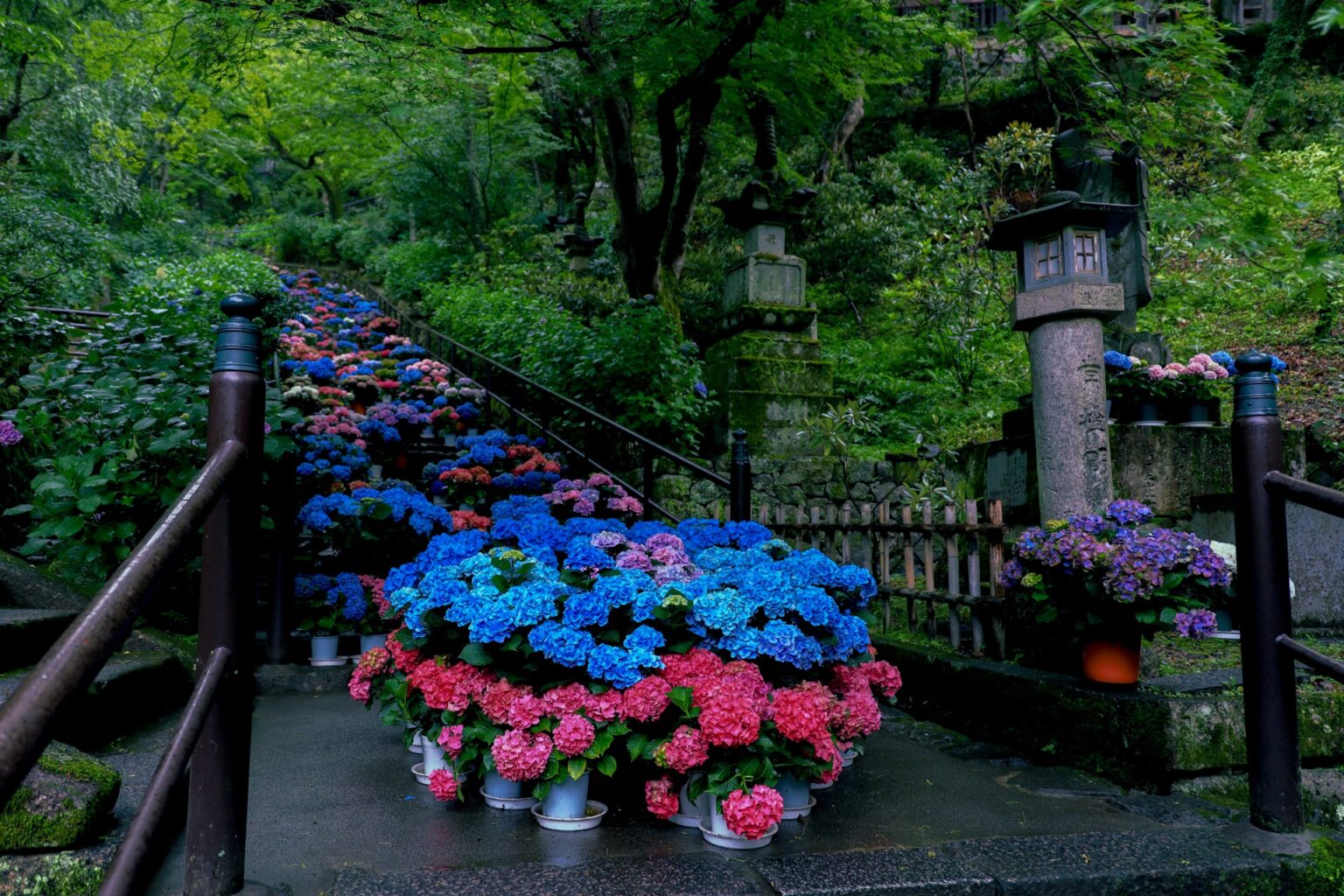
~3,000 plants, 10 varieties in the grounds plus ~300 potted plants on the 399-step covered staircase (登廊).
Peak Bloom 2026
Kamakura: early to mid June. Nara: late June to early July. About a 2.5-week gap.
Admission
Kamakura: ¥400 temple + ¥500 Ajisai Path ticket (separate). Nara: ¥500 total, no separate ajisai fee.
Queue Reality
Kamakura: peak weekends 2–3 hour wait, numbered ticket system. Nara: walk in.
Access
Kamakura: Enoden Hase Station, 5-min walk. Nara: Kintetsu Hasedera Station, 15-min walk.
The 721 Legend: Why These Two Temples Share a Name
The two temples are not coincidentally named the same. In 721, a single giant kusu (camphor) tree near Hatsuse in present-day Sakurai, Nara, was carved into two Eleven-headed Kannon statues — same wood, same hands. One stayed at the Nara temple that became today’s Sōhonzan Hasedera, the head temple of the Buzan branch of Shingon Buddhism. The other was set adrift on the Pacific with a prayer that it reach somewhere it was needed.
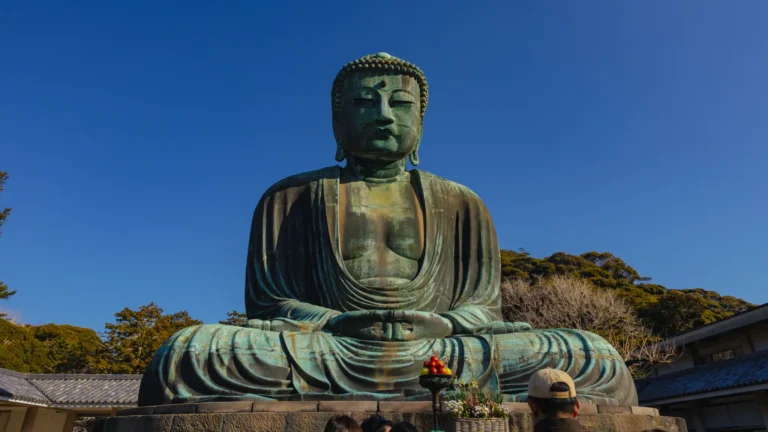
Fifteen years later, in 736, the second statue washed up on Nagai Beach south of Kamakura. The temple built around it on the wooded hillside above Yuigahama became today’s Kaikōzan Hasedera in Kamakura. The Kannon statue inside the main hall — still 9.18 meters of carved and gilded wood — is the older twin, found by sea, of the one you can stand in front of in the Nara hondō.
Two temples, one tree. The fact that both eventually became “flower temples” — Nara explicitly self-titled as the hana no mitera (花の御寺), Kamakura more reluctantly so — is the kind of coincidence that stops feeling like coincidence the longer you spend in both places.
Two Peaks, Two Weeks: Why the Timing Gap Matters
The single most useful fact in this guide: Kamakura’s hydrangea peak is roughly 2.5 weeks ahead of Nara’s. Kamakura sits at 35.3°N on the Pacific coast, and the rainy front (tsuyu) arrives there around June 7. Nara sits at 34.5°N but in the inland Yamato basin at a slightly higher elevation, and its hydrangeas — including the potted plants on the staircase — are timed by the temple to peak with the local front and the mountain humidity, which lag by two to three weeks.
Bloom windows (2026 forecast based on 2024–2025 observation)
What this means for a single trip: if you arrive in Tokyo on June 5 and fly out from KIX on June 28, you can hit both peaks. The Tōkaidō Shinkansen between Tokyo and Kyoto runs every 10 minutes and takes 2h15. From Kyoto, the Kintetsu express to Hasedera Station is another 70 minutes. It is one of the most rewarding flower itineraries in Japan, and almost no English-language guide explains that the gap exists.
“Two temples, one tree, two-and-a-half weeks apart. Plan the trip across both peaks if you have time.”
Kamakura Hasedera: The Crowded Twin
Kamakura Hasedera’s Ajisai Path is a single hillside loop with about 2,500 hydrangea plants in more than 40 varieties, accessed by a separate ¥500 numbered ticket on top of the ¥400 temple admission. The two-ticket system is new, the queueing system has changed every season since 2019, and the 2026 rules below were confirmed against the temple’s posted notice from May 6, 2026.
The 2026 ticket system, in plain language
Two separate tickets are required during ajisai season. The temple itself costs ¥400 (adults). The Ajisai-ken (あじさい券) for the Ajisai Path costs another ¥500. The Ajisai-ken is what gates access to the hillside loop where the actual flowers are. You can visit the temple grounds, the main hall, and the lower garden without it — but not the path.
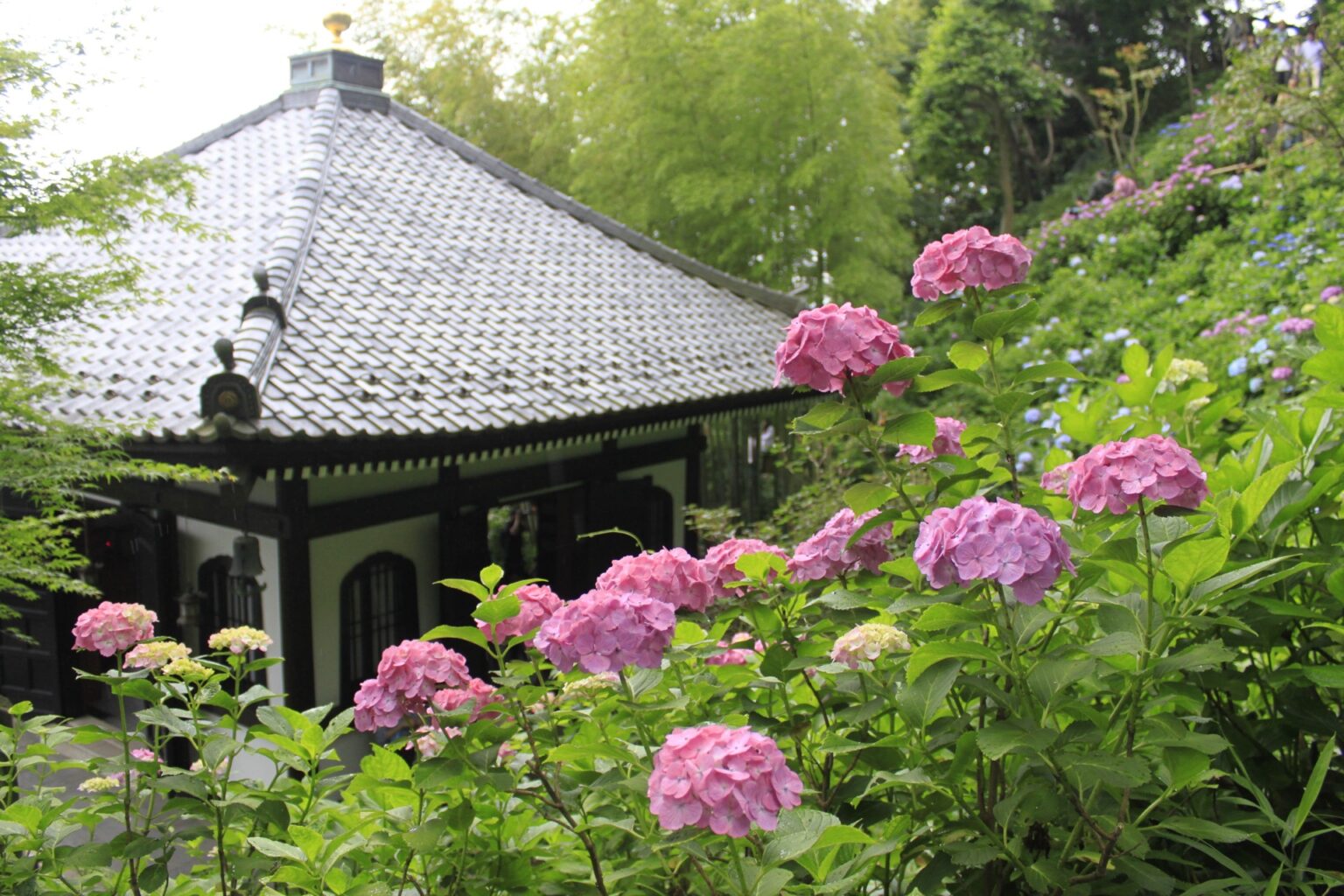
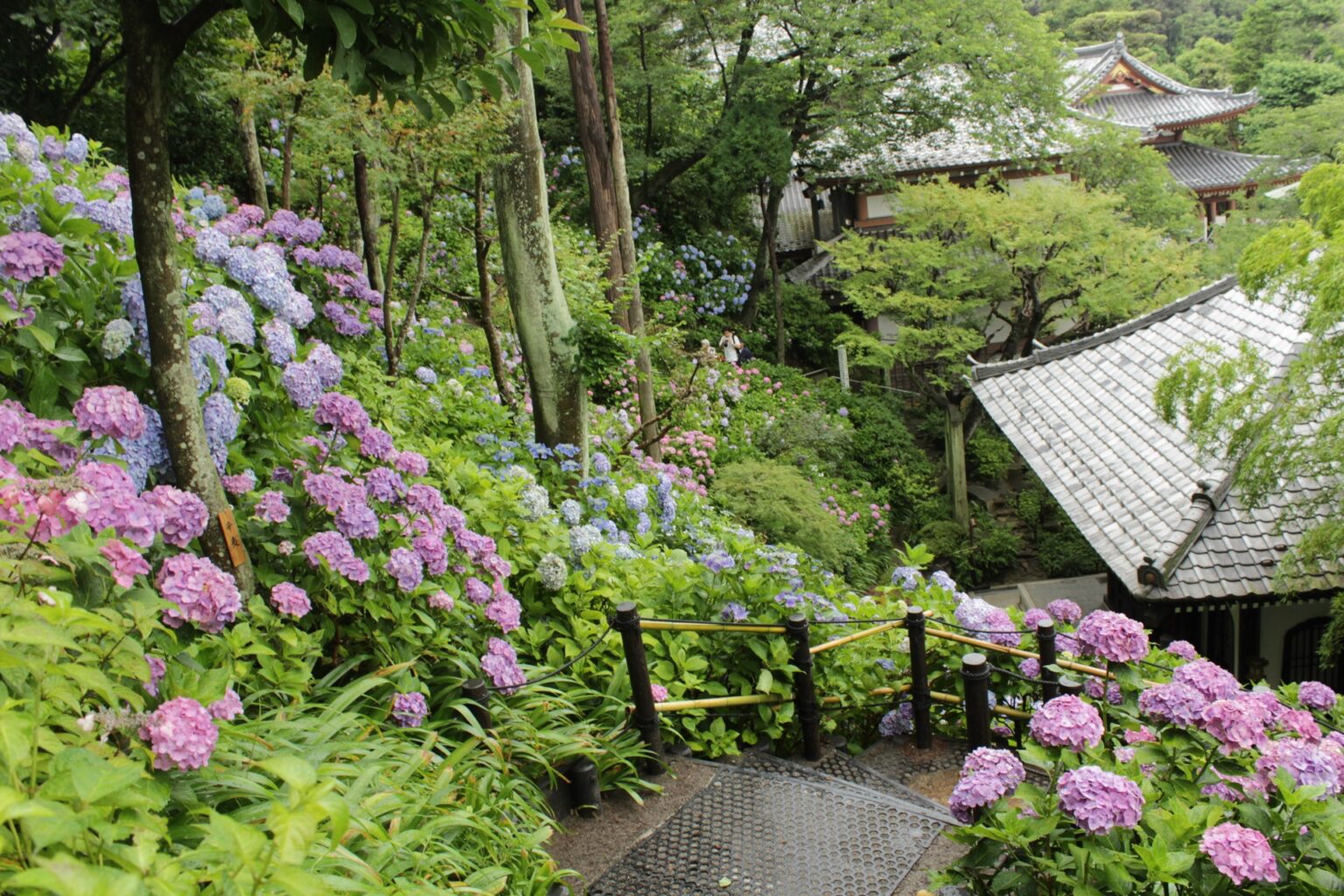
Online reservation opens every Thursday at 10:00 JST for the following week, on the temple’s official website. If you reserve, you get a specific 30-minute entry window with no queue. If you walk up without a reservation, you take a printed numbered ticket at the entrance and watch a screen near the gate. When your number is called, you go up. On a peak Saturday in June, that wait runs two to three hours — long enough that the temple lets you leave the grounds and come back as long as you keep your ticket.
What to actually do, in Nobu order
The first time I did Hasedera in ajisai season was 2022, without a reservation, on a Saturday at 11:00, and I waited two hours twenty minutes for a numbered ticket. The second time was 2024, on a Tuesday at 8:30 with a Wednesday-Thursday online reservation made the previous week. I walked straight up. The path takes maybe 25 minutes if you don’t stop, an hour if you do, and the loop ends at the upper viewpoint (kenchō-dai), the one Kannon-zan corner that gives you Sagami Bay directly behind the hydrangeas. Meigetsu-in does not have a view. Goryō Shrine does not have a view. Hasedera is the only Kamakura ajisai temple that puts the Pacific into the same frame as the flowers.
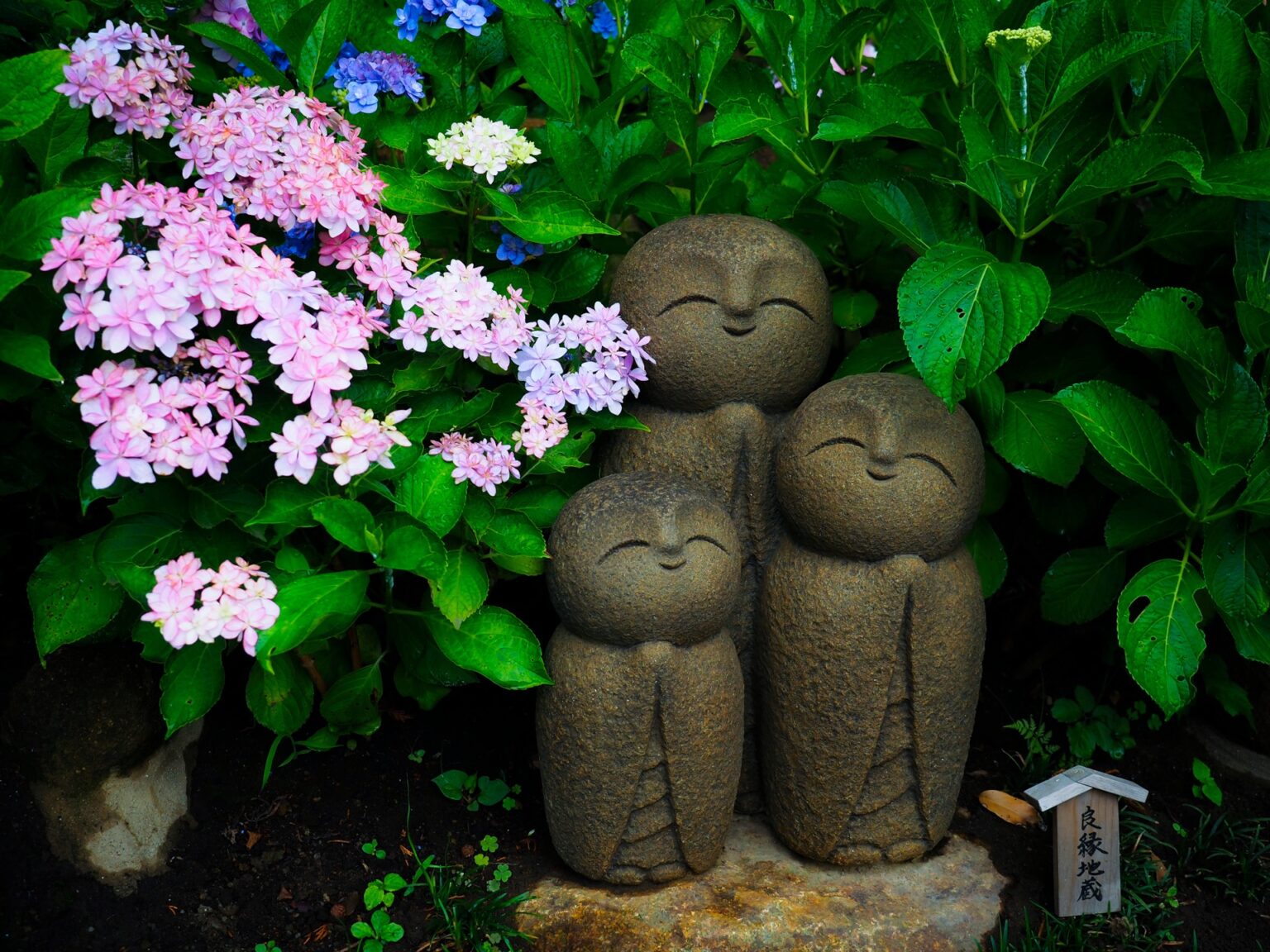
Combine the visit with the Benten-kutsu cave at the entrance (low-ceilinged, candlelit, dedicated to Benzaiten), the three smiling Nagomi Jizō statues on the lower garden, and a lunch of shirasu-don (whitebait rice bowl) at any of the Hase-mae cafés before catching the Enoden back. If you want the full year-round breakdown of the temple, including the February plum visit, see our Hasedera Temple Kamakura guide.
Best arrival time, in three lines
Best: 7:30–9:30 weekday morning with online reservation. Walk straight up.
Acceptable: 8:00 weekday morning without reservation, take a numbered ticket, wait 30–60 minutes.
Avoid: 11:00–15:00 weekend without reservation. You will spend more time on the queue screen than in front of flowers.
Nara Hasedera: The Quiet Twin
Nara Hasedera’s hydrangea display centres on the 399-step covered staircase (登廊, noborirō) that runs 200 meters uphill from the Niō gate to the main hall, supplemented by about 300 potted hydrangeas the temple stages along the steps during the bloom window. There is no separate ticket, no queue system, and no public bus past the station — you walk in from Kintetsu Hasedera Station for 15 minutes through a sleepy temple-town street and arrive to a temple roughly 5% as crowded as its Kamakura twin.
The 登廊 and the あじさい階段
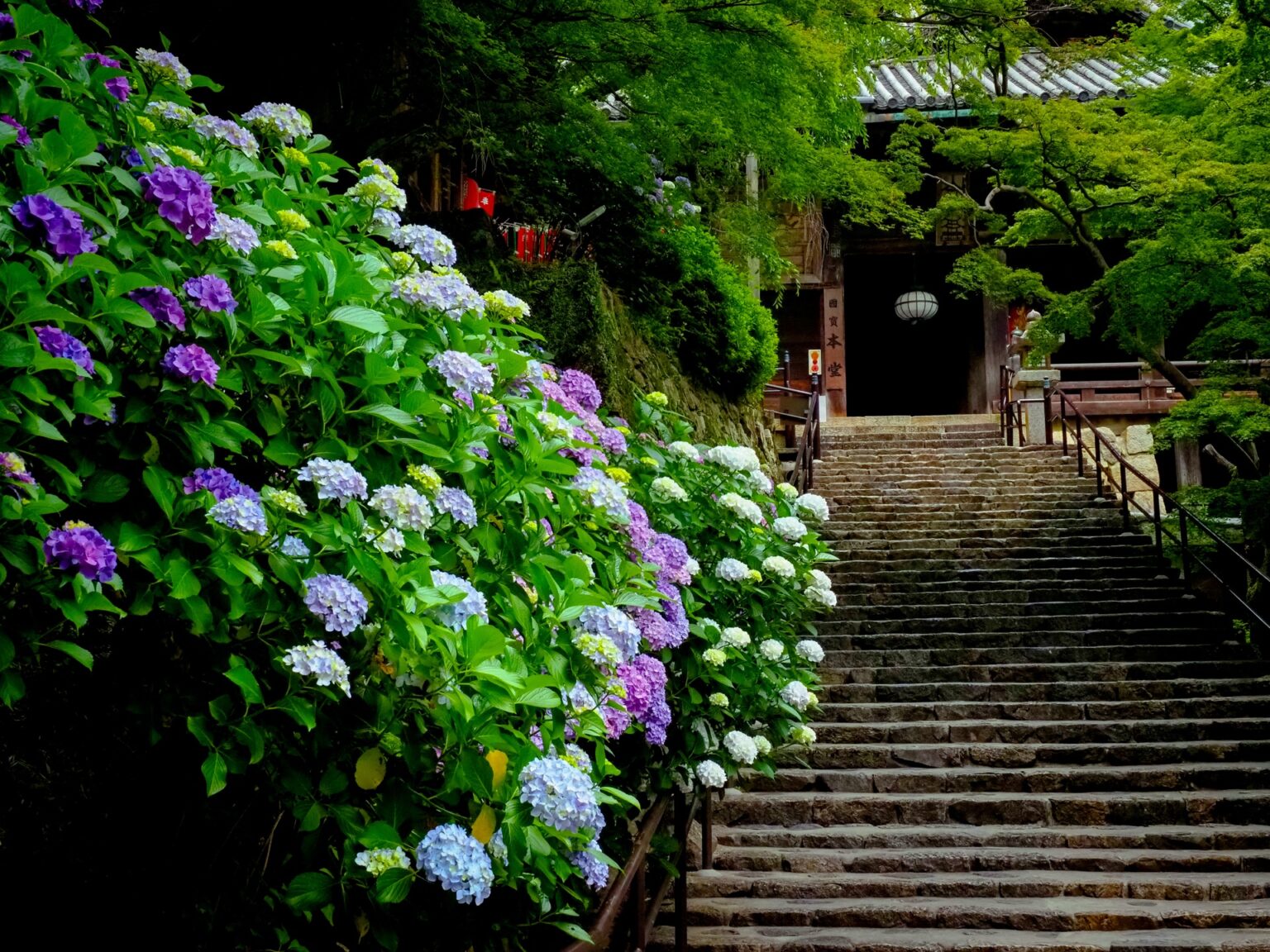
The noborirō is the architectural artifact that makes Nara Hasedera different from every other hydrangea temple in Japan. It is a covered wooden staircase corridor built in 1039, in three sections, with 399 stone steps under a slatted roof. The first time I climbed it in ajisai season I genuinely could not see the top — the potted hydrangeas in cobalt, magenta, and white were stacked alternately on the steps in such a way that I had to stop counting them at around 180 and just walk. They are rearranged twice a week by temple volunteers. The flowers in the ground beside the staircase peak about ten days earlier; the potted display is the temple’s deliberate extension of the season.
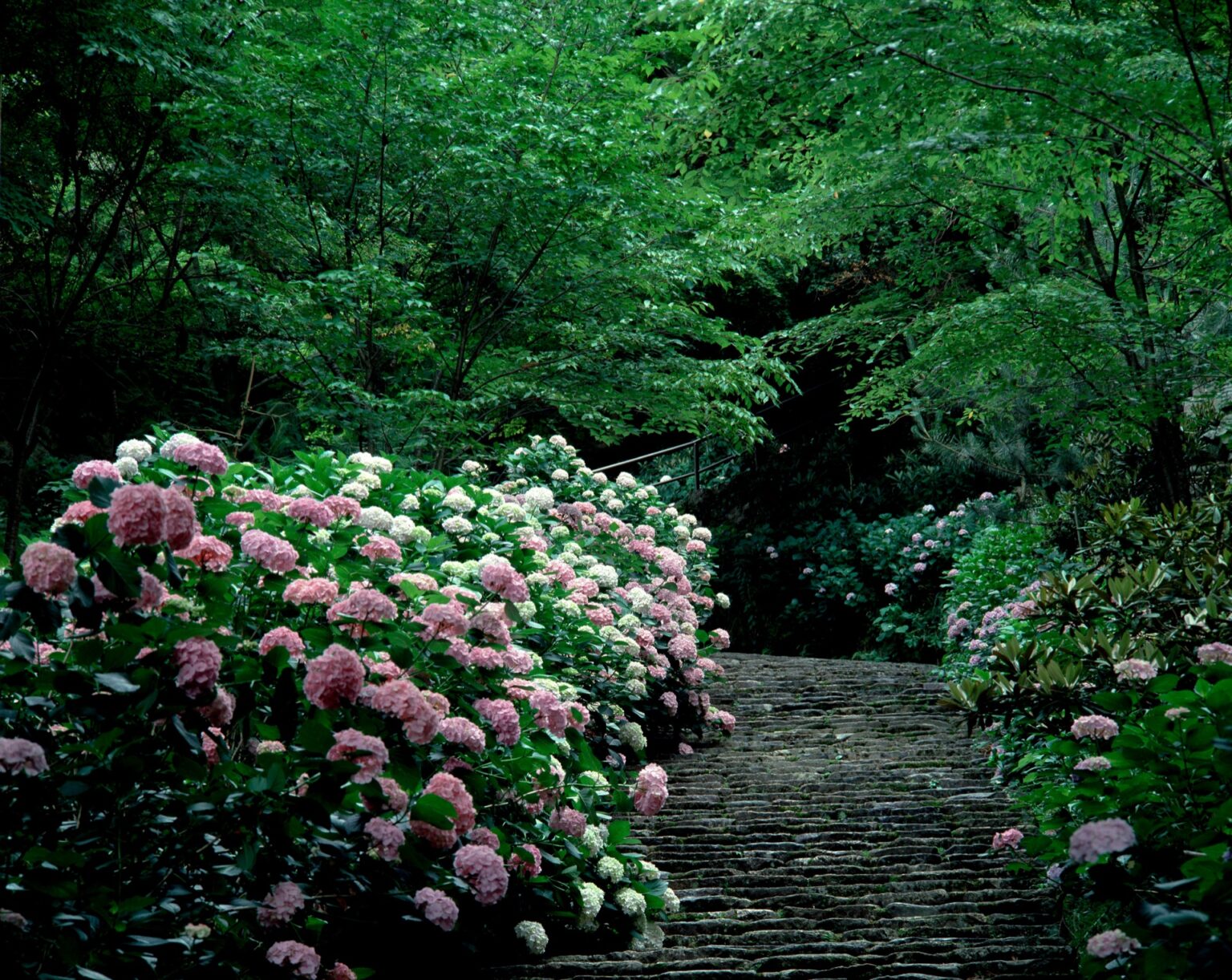
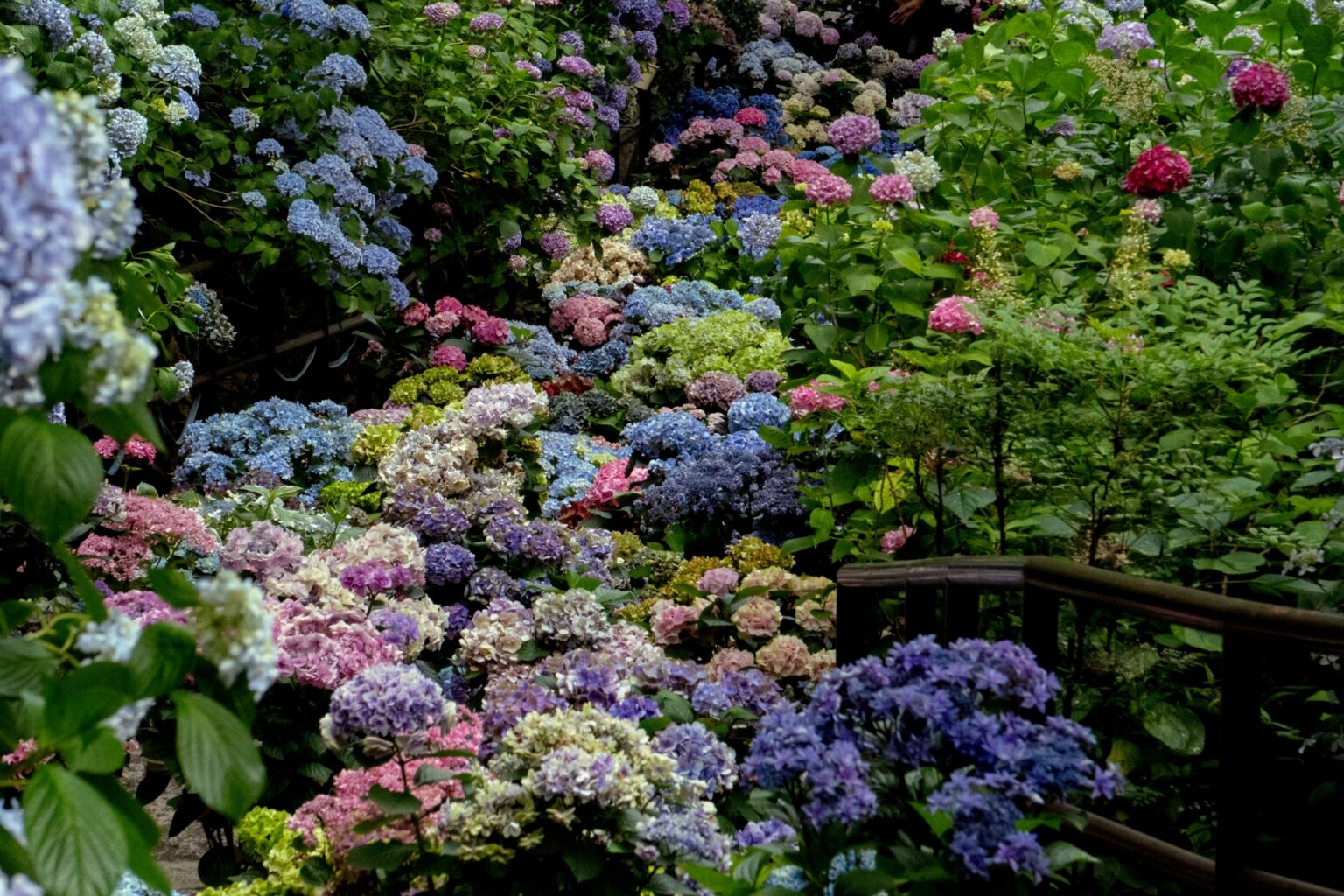
Yamato Kannon Ajisai Corridor (大和観音あじさい回廊)
Here is the secret nobody tells English-language visitors: Nara Hasedera coordinates an annual 4-temple ajisai pilgrimage with three nearby Buzan-branch temples — Oka-dera in Asuka, Tsubosaka-dera in Takatori, and Murō-ji in Uda. The corridor runs from late May through early July, the period during which at least one of the four temples is in peak bloom. A single stamped pilgrimage book (¥1,000) covers all four. Each temple peaks at a slightly different week because of elevation differences across the Yamato basin. If you commit two full days to Nara prefecture in June, you can sit in front of full-bloom hydrangeas at four different temples and never queue.
The most underrated of the four is Murō-ji, which the Japan Tsuyu 2026 guide covers as a Kanto-crowd alternative — same access logic for Nara visitors.
The 399 steps, honest version
The staircase is genuinely a climb. The roof keeps the rain off and the heat down, but the ascent itself takes 10–15 minutes at a normal pace, and there is no elevator. The reward is a stage-like wooden veranda at the top with a view back across the Hatsuse Valley — the same view Bashō wrote a haiku about in 1689. If you cannot manage the steps, the temple operates a free shuttle van to the main hall on request for visitors with mobility issues; ask at the ticket window.
Side-by-Side Comparison
Compared on the dimensions that affect a single-day visit decision. None of these numbers are estimates — they are taken from the two temples’ 2026 official notices, cross-referenced against my own visits.
| Dimension | Kamakura Hasedera | Nara Hasedera |
|---|---|---|
| Plant count | ~2,500 | ~3,000 in ground + ~300 potted |
| Variety count | 40+ (deliberate gradient) | 10 (with potted variety swap) |
| Peak bloom (2026) | Jun 5 – Jun 18 | Jun 24 – Jul 5 |
| Admission | ¥400 temple + ¥500 Ajisai-ken | ¥500 total |
| Queue system | Numbered ticket + online reservation (Thu 10:00 for following week) | None — walk in |
| Peak weekend wait | 2–3 hours without reservation | 0–10 minutes |
| Opening hours (Apr–Jun) | 8:00 – 17:30 (last entry 17:00) | 8:30 – 17:00 |
| Access | Enoden Hase Station, 5-min walk from Tokyo via JR Yokosuka | Kintetsu Hasedera Station, 15-min walk from Kyoto/Osaka via Kintetsu |
| Distance from Tokyo | ~1 hour (JR Yokosuka or Shōnan-Shinjuku) | ~3.5 hours (Tōkaidō Shinkansen + Kintetsu) |
| Special view | Sagami Bay from the upper Ajisai Path | Hatsuse Valley from the main hall veranda |
| Architectural draw | 9.18m Eleven-headed Kannon (sea-found) | 10.18m Eleven-headed Kannon (wood twin, 1538 reconstruction) |
| Signature flower setting | Hillside loop with ocean horizon | 399-step covered staircase with potted display |
| Temple title | Kaikōzan Hasedera | Sōhonzan Hasedera (head temple, Buzan Shingon) |
| Sect today | Jōdo (Pure Land) | Buzan Shingon |
| Crowd profile | International + domestic, photographer-heavy | Mostly older Japanese pilgrims and locals |
If You Only Have Time for One: Pick by Trip Type
Most international travellers asking this question are already in Tokyo. The honest answer is that the right temple depends less on which one is “better” — they are different temples — and more on what shape your trip has.
Go to Kamakura
You are already there. Hasedera + Meigetsu-in + Goryō Shrine is a complete ajisai day from Tokyo for under ¥3,000 in rail. Reserve the Ajisai-ken online ahead of your departure date.
Go to Nara Hasedera
If you have already been to Kamakura, or your itinerary already includes Kyoto/Nara, Sōhonzan Hasedera is the experience Kamakura no longer is — quiet, walkable, and 2.5 weeks behind Kamakura’s calendar.
Build for both peaks
The Kamakura ocean-and-flowers frame and the Nara potted-staircase frame are non-substitutable. Spend one June for Kamakura, one for Nara. Or hit both in a 10–14 day trip with timing built around them.
Pick Nara, always
Kamakura in peak weekend ajisai season is, in 2026, one of the most crowded outdoor sights in greater Tokyo. Nara on the same day is a half-empty mountain temple. If your trip cannot absorb crowds, the choice makes itself.
Either, but lean Nara
Both are dramatic in rain — that’s the point of tsuyu-season flowers. Nara’s covered noborirō gives you a 200m roofed corridor of full-bloom hydrangeas regardless of the weather. Kamakura’s path is open-air.
Lean Kamakura (with caveats)
Kamakura’s lower grounds are flat. The Ajisai Path itself has stairs but is shorter overall. Nara’s 399-step noborirō is unavoidable as the main route — the free shuttle van helps, but call ahead at the ticket window.
Plan This Trip
Plan This Trip
For Southeast Asian Visitors
If you are flying from Singapore, KL, Bangkok, Jakarta or Manila, June is the cheapest direct-flight month of the year to Japan — typhoon season has not started, sakura is over, and summer break has not begun. The trade-off is heat: Tokyo in mid-June averages 24°C with 75% humidity, which is more humid than Singapore but cooler. Both Hasedera temples are partially shaded and have water fountains on the grounds; bring an umbrella that doubles for sun. Pocket Wi-Fi or eSIM signal is reliable at both — Kamakura is in the SoftBank/Docomo backbone, Nara Hasedera is the rural edge but still 5G LTE. The Kintetsu line from Osaka to Hasedera does not accept some foreign cards at the gates; buy a paper ticket at Kintetsu-Nara or Osaka-Namba to avoid the fare-adjustment line at the small Hasedera station.
FAQ
Do I need to reserve the Kamakura Ajisai-ken in advance?
Strongly recommended for peak weekends. Reservation opens every Thursday at 10:00 JST on the temple’s official website for the following week. If you cannot reserve, arrive 7:30–8:30 weekday morning for the shortest walk-in queue. Without either, expect a 2–3 hour wait on a peak Saturday or Sunday in early to mid June.
Are both Hasedera temples worth visiting in the same trip?
If your trip spans the bloom-window gap (any trip covering the second week of June through the first week of July), yes — the two temples deliver fundamentally different experiences, and the timing gap means you don’t have to choose. Kamakura is the famous, crowded, ocean-view twin; Nara is the quiet, walkable, head-temple twin with the covered staircase.
Is the connection between the two temples real history, or legend?
The 721 carved-from-one-tree founding story is temple legend, recorded in medieval Japanese sources but not externally verifiable as historical fact. What is documented: Nara Hasedera was founded in 686 (older than the legend itself) and is today the head temple of the Buzan branch of Shingon Buddhism. Kamakura Hasedera was founded in 736 and today belongs to the Jōdo (Pure Land) sect — a different school from Nara, regardless of any 8th-century connection. The shared Eleven-headed Kannon iconography and shared name are real; whether the wood came from one tree is a question of faith.
Can I see hydrangeas in Kamakura without paying the ¥500 Ajisai-ken?
Partially. The temple’s lower garden — including the Nagomi Jizō trio with hydrangeas behind them — is accessible with only the ¥400 temple admission. The Ajisai-ken is required only for the hillside Ajisai Path itself. If you have already seen ajisai elsewhere in Kamakura that day (Meigetsu-in, Goryō Shrine), you can comfortably skip the path ticket.
How does Nara Hasedera compare to Mimuroto-ji in Uji, the other famous Kansai ajisai temple?
Mimuroto-ji is larger by plant count (about 10,000 plants vs Hasedera’s 3,000) and flatter to walk. Nara Hasedera is architecturally more dramatic — the 1039 noborirō has no equivalent at Mimuroto-ji, and the potted staircase is a Hasedera-specific tradition. Mimuroto-ji is the better choice for variety overload; Hasedera is the better choice for a single iconic frame.
What is the best month to visit each temple if I don’t care about hydrangeas?
Kamakura Hasedera: late November to early December for the maple-foliage upper grounds, or late February for the plum garden (which our Kamakura Hasedera year-round guide covers in detail). Nara Hasedera: late April to mid-May for the famous peony display — the temple’s most photographed week of the entire year, ahead of even the hydrangeas. Both are worth the visit outside ajisai season; the names flower temple and 花の御寺 are earned twelve months a year.
Can I do both temples in a one-day trip from Tokyo?
Technically yes, but it would be a brutal day. Tokyo to Kamakura Hasedera door-to-door is about 75 minutes. Kamakura to Nara Hasedera door-to-door is about 4.5 hours each way via Tōkaidō Shinkansen and Kintetsu. You would have 30 minutes at Nara before having to turn around for the last realistic return train. Plan two days minimum if visiting both — one night in Kyoto or Osaka between them.
Booking the Trip
Booking the Trip
Three doors into a two-Hasedera June. Reserve the Kamakura ticket the same day you book the hotel.
Related Reading
- Japan Tsuyu 2026: Regional Calendar + 4 Tested Hydrangea Spots — The rainy-season cluster article. Includes Meigetsu-in, Goryō Shrine, Murō-ji, and Shimoda Park.
- Hasedera Temple Kamakura: Year-Round Guide — The plum, the Kannon, the cave, and the year outside of ajisai season.
- Japan in June 2026: Hydrangeas, Fireflies and the Cheapest Week of the Year — The month-wide hub for June planning.
- Okadera in Asuka: Japan’s First Yakuyoke Temple & Its Flowers — Another Yamato Kannon “Ajisai Corridor” temple, famous for its hydrangea-and-dahlia flower basins.
Join travelers discovering Japan's hidden side
Weekly dispatches from off-the-beaten-path Japan — spots and stories you won't find in guidebooks.
No spam. Unsubscribe anytime.
Welcome aboard!
You're in. See you in your inbox soon.