
Culture · Travel tips · Reading Japan
You do not need to read Japanese to get around, but a few dozen signs do most of the work: exits, ticket gates, toilets, prices, food dates and warnings. Here they are by situation, each with its reading and what to do. Two pairs matter more than the rest: 賞味期限 and 消費期限 on food, and 避難場所 and 避難所 in an emergency.
How to read a sign fast
Learn the shapes of these four characters and you can often tell what kind of sign you are looking at before you translate it. The meanings are the standard dictionary ones (Daijisen).
口 = an opening
Literally “mouth”, and by extension a place where people or things go in and out. 出口 exit, 入口 entrance, 改札口 ticket gate, 非常口 emergency exit, 南口 south exit.
中 = in progress
Added to a noun, it means the activity is happening now. 営業中 open (business in progress), 準備中 not open yet (preparation in progress), 工事中 construction under way.
禁 = forbidden
Stops an action. 禁止 prohibited, 禁煙 no smoking, 立入禁止 no entry, 撮影禁止 no photography.
止 = stop
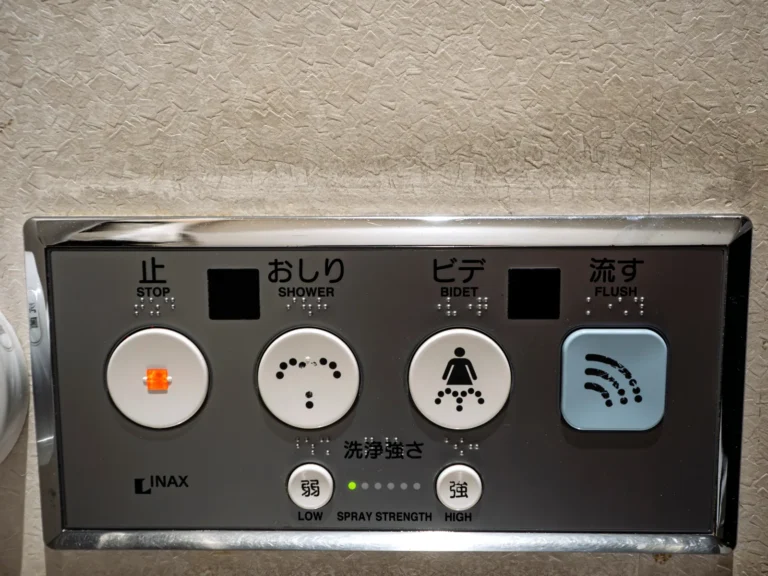
Stop, or cease. On its own it is often the stop button on a panel; it also sits inside 禁止 (prohibited), 停止 (stop) and 中止 (cancelled).
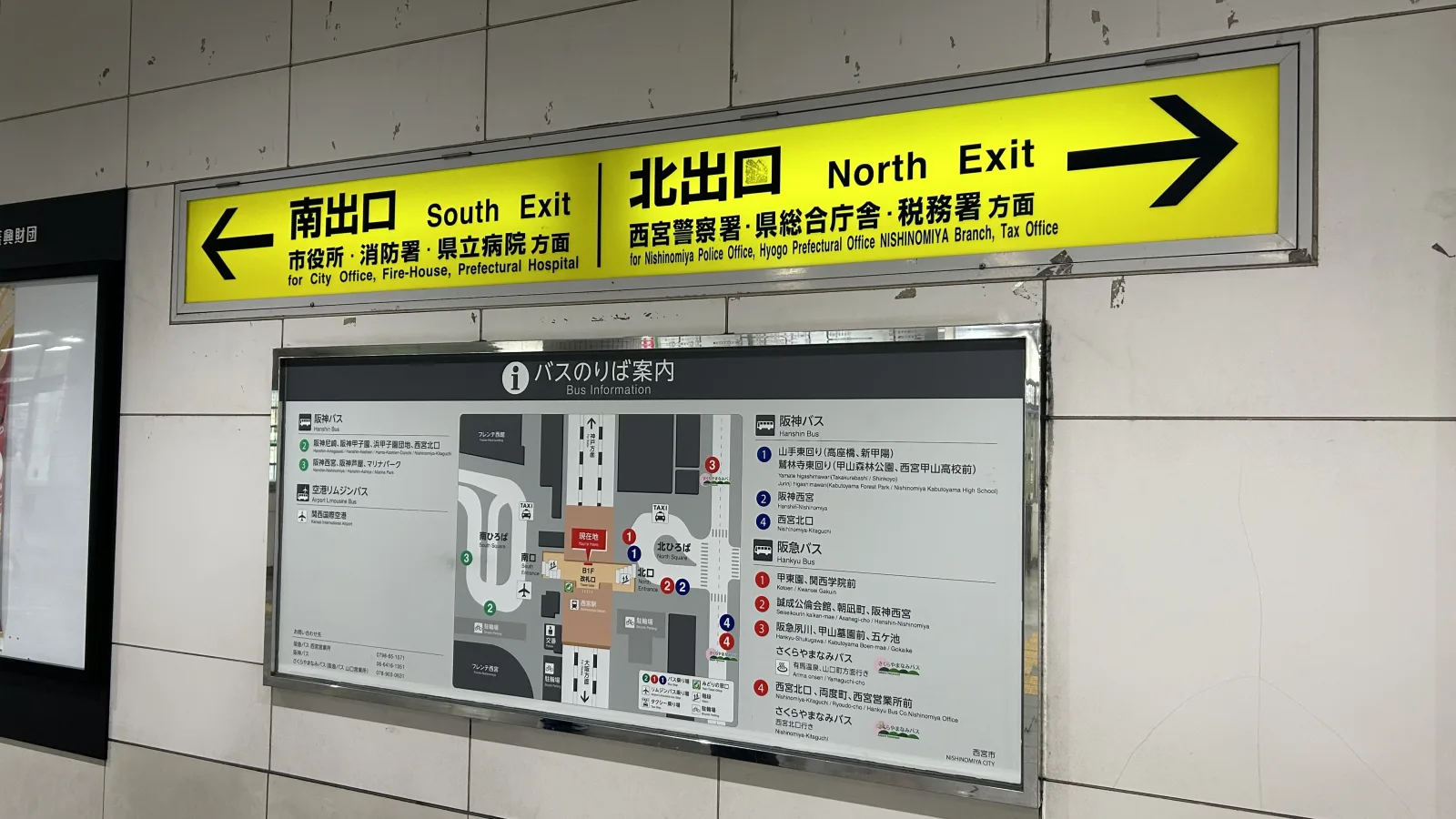
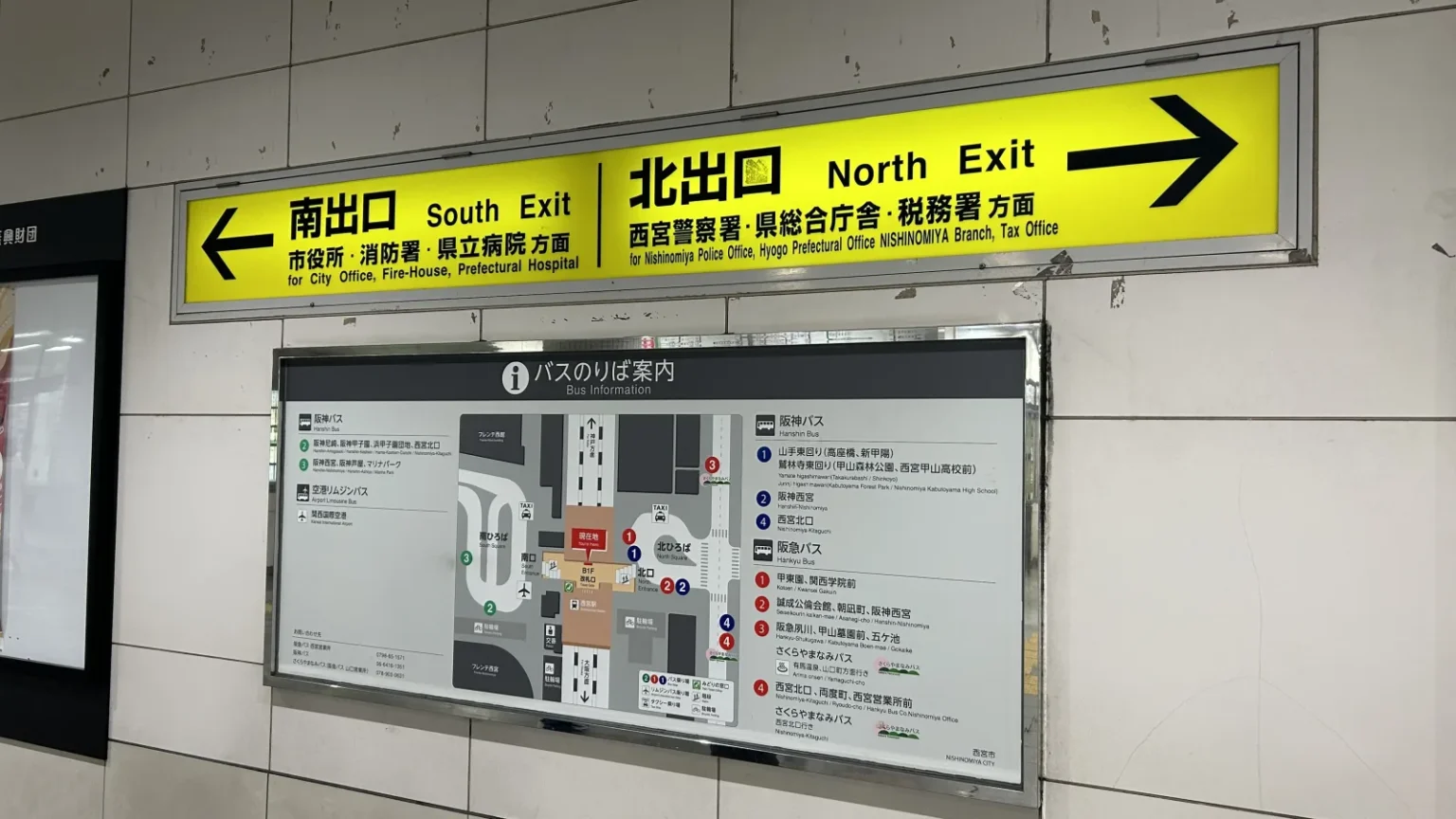
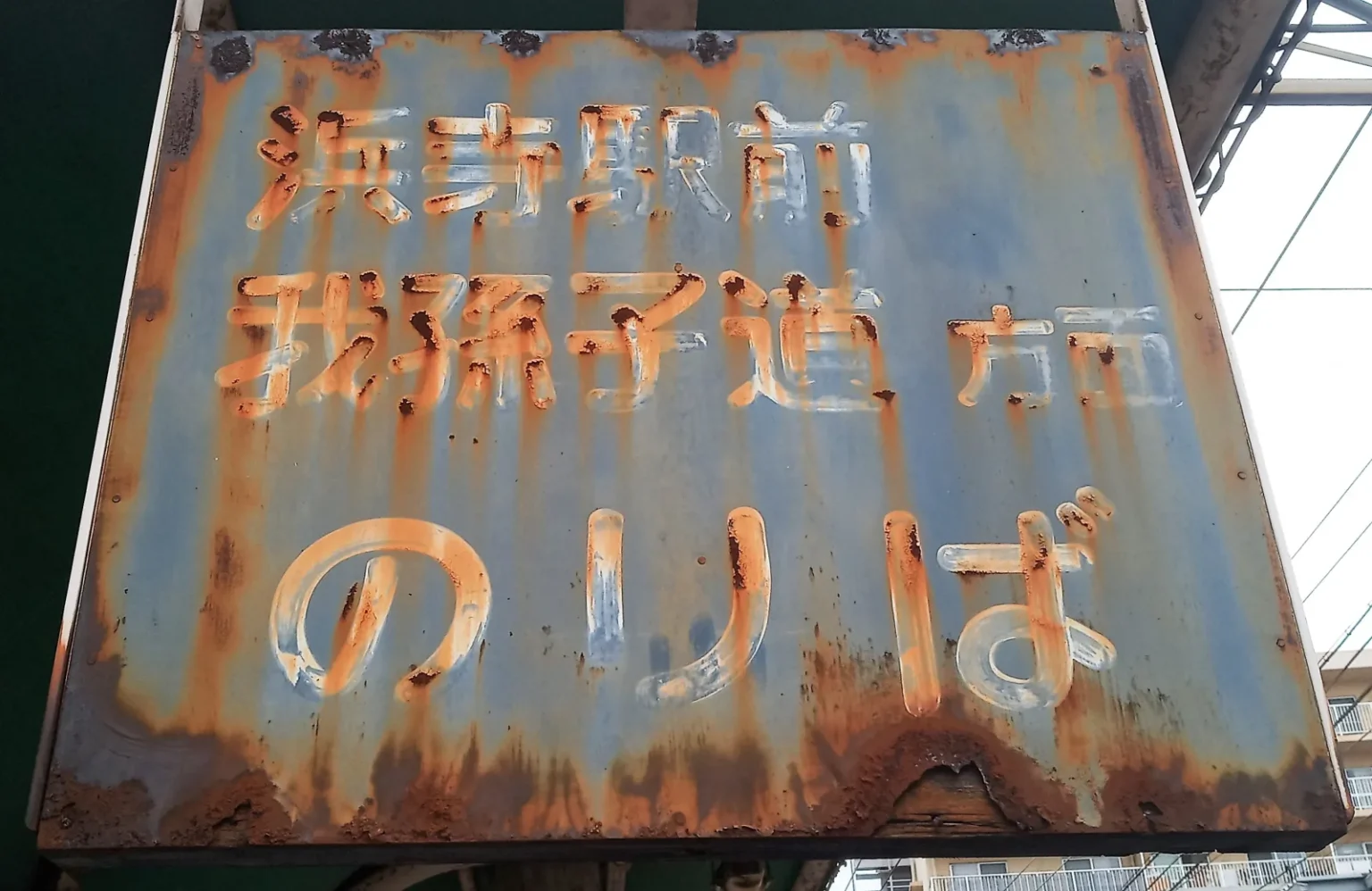
The sign in the photo above carries English as well. Not every sign does: the older のりば sign further down is in Japanese only.
In the tables, the first column gives the sign, then its reading in romaji and kana. Other ways of writing the same word are in the meaning column.
Doors, shops and buildings
| Sign | Meaning and what to do |
|---|---|
| 入口 iriguchi · いりぐち | Entrance |
| 出口 deguchi · でぐち | Exit. In a station, follow it with the exit name or number you need |
| 押 the 押 of 押す (osu · おす) | Push (on a door) |
| 引 the 引 of 引く (hiku · ひく) | Pull |
| 営業中 eigyōchū · えいぎょうちゅう | Open now |
| 準備中 junbichū · じゅんびちゅう | Not open: preparing. Check the hours on the door and come back |
| 定休日 teikyūbi · ていきゅうび | Regular closing day |
| 本日休業 honjitsu kyūgyō · ほんじつきゅうぎょう | Closed today |
| 関係者以外立入禁止 kankeisha igai tachiiri kinshi · かんけいしゃいがいたちいりきんし | Staff only: no entry for anyone not involved |
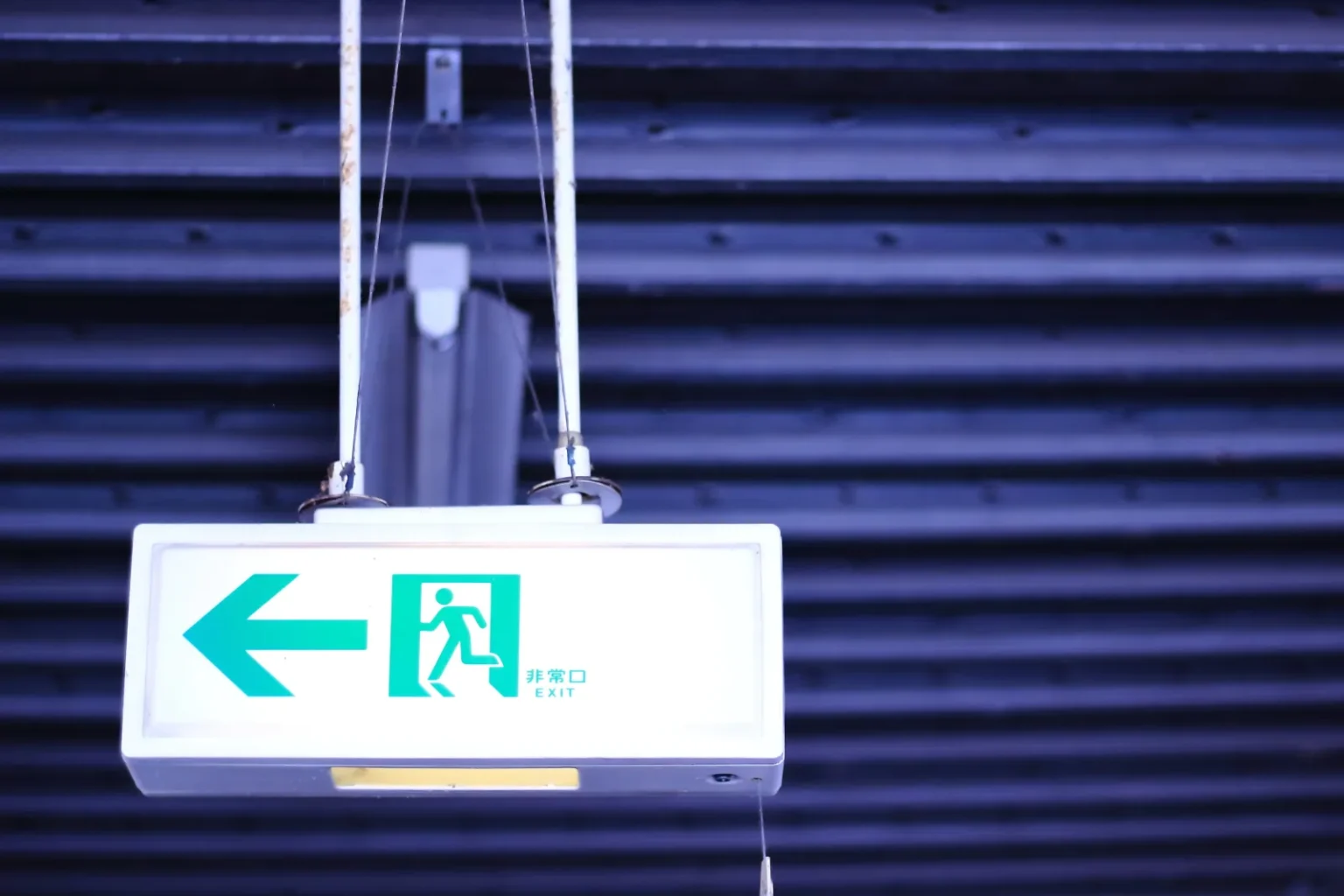
| 非常口 hijōguchi · ひじょうぐち | Emergency exit. Find the nearest one when you check in |
Stations and trains
Paying for the ride is in my guides to IC cards and JR tickets; this table is for reading the station.
| Sign | Meaning and what to do |
|---|---|
| 改札 kaisatsu · かいさつ | Ticket gates. 改札口 is the gate area; 改札内 / 改札外 mean inside or outside them |
| のりば noriba · のりば | Boarding place: a platform, a bus stop or a taxi rank. Read the line or destination above it. Also written 乗り場 |
| 番線 bansen · ばんせん | Track number: 3番線 is track 3 |
| 乗換 norikae · のりかえ | Transfer to another line. Also written 乗り換え or のりかえ |
| 指定席 shiteiseki · していせき | Reserved seats: you need a seat reservation for that car |
| 自由席 jiyūseki · じゆうせき | Non-reserved seats: sit in any free seat in these cars |
| グリーン車 gurīnsha · グリーンしゃ | The Green Car, JR’s first-class car. JR Kyushu, for example, requires a Green Car ticket on top of the fare and express ticket on its shinkansen and limited expresses |
| 女性専用車 josei sen’yōsha · じょせいせんようしゃ | Women-only car, at set times on some lines. Who else may ride is set by each railway (see below) |
| 優先席 yūsenseki · ゆうせんせき | Priority seats. Give them up to people who need them (see below) |
| 各駅停車 kakueki teisha · かくえきていしゃ | Local: stops at every station. Also shown as 各停 (kakutei) or 普通 (futsū) |
| 快速 kaisoku · かいそく | Rapid: skips some stations. Check which (see below) |
| 急行 kyūkō · きゅうこう | Express: skips some stations. Check which (see below) |
| 特急 tokkyū · とっきゅう | Limited express. On JR Kyushu, for example, it needs an express ticket on top of the fare |
| 終電 shūden · しゅうでん | The last train of the night |
| 運転見合わせ unten miawase · うんてんみあわせ | Service temporarily suspended on the affected line or section. Check the operator’s latest updates and other routes; a restart time may not be given yet |
| 遅延 chien · ちえん | Delay |
Women-only cars. Seibu Railway is one example: on its Ikebukuro line it runs them on weekday mornings, on 10-car trains due at Ikebukuro between 7:20 and 9:30. Seibu also lets these passengers ride: men with disabilities, men helping a passenger with a disability, boys of primary school age or under travelling alone, and male guardians travelling with a child of that age. Other railways set their own hours and rules; on Seibu, stickers on the platform and the car windows mark the car.
Priority seats. Seibu asks passengers to give up 優先席 to older people, people with disabilities, people with internal disabilities, people with babies or small children, and pregnant women. Seibu also asks passengers to turn off their phones near priority seats when the train is crowded.
For reference: that “off when crowded” wording replaced “always off” on 1 October 2015 at 37 railway operators in the Tohoku, Kanto and Koshinetsu regions, according to Tokyu Railway’s announcement at the time. Other regions and operators may word it differently.
方面 (hōmen, “towards”) after a place name tells you the direction of travel; the exit signs in the first photo use it too. If your bag is large, check the shinkansen luggage rules before you reach the gates. To plan routes before you reach the station, see my transit app guide.
Toilets and baths
| Sign | Meaning and what to do |
|---|---|
| お手洗い otearai · おてあらい | Toilets. Also written トイレ (toire) or 化粧室 (keshōshitsu) |
| 男 / 女 otoko / onna · おとこ / おんな | Men / women |
| 殿方 / 婦人 tonogata / fujin · とのがた / ふじん | A polite “gentlemen” / “ladies” you may see on older signs and at baths |
| 多目的トイレ tamokuteki toire · たもくてきトイレ | Accessible toilet. Also 多機能トイレ or バリアフリートイレ. Use it only if you need its equipment (see below) |
| 和式 / 洋式 washiki / yōshiki · わしき / ようしき | Japanese-style (squat) / Western-style (seated) |
| 流す nagasu · ながす | Flush. 大 (dai) is the full flush, 小 (shō) the small one |
| おしり oshiri · おしり | Rear wash on a heated-seat panel |
| ビデ bide · ビデ | Bidet: front wash |
| 止 the 止 of 止める (tomeru · とめる) | Stop the wash. Press it before you stand up. Some panels say 停止 (teishi · ていし), which also means stop |
| 男湯 / 女湯 otokoyu / onnayu · おとこゆ / おんなゆ | Men’s / women’s bath |
What each button does, and what you can flush, is in my guide to toilets in Japan.
Why the accessible toilet has three names. A 2021 report by the Ministry of Land, Infrastructure, Transport and Tourism (MLIT) found that names such as 多機能トイレ (multi-function) and 多目的トイレ (multi-purpose) suggest anyone can use them, and recommended signs that make clear they are for people who need the equipment. It calls them バリアフリートイレ and leaves the naming to each facility, so you will meet all three. Bath rules are in my onsen etiquette guide and sento guide.
Shops, prices and food labels
| Sign | Meaning and what to do |
|---|---|
| 税込 zeikomi · ぜいこみ | Tax included in the displayed price |
| 税抜 zeinuki · ぜいぬき | Before tax. The National Tax Agency accepts a label like “10,000円(税込価格11,000円)”, so the number in large print can be the pre-tax one: look for 税込 |
| 割引 waribiki · わりびき | Discount. 割 is a tenth: 2割引 is 20% off, 3割引 30% off |
| 半額 hangaku · はんがく | Half price |
| 現金のみ genkin nomi · げんきんのみ | Cash only. Where else you may still need cash: my cash vs card guide |
| 賞味期限 shōmi kigen · しょうみきげん | Best before (see the box below) |
| 消費期限 shōhi kigen · しょうひきげん | Use by (see the box below) |
| 原材料名 genzairyō mei · げんざいりょうめい | Ingredients |
| 要冷蔵 yō reizō · ようれいぞう | Keep refrigerated. The date on the pack assumes you did |
| 温め atatame · あたため | Heating up. At a convenience store till, 温めますか? (atatamemasu ka) means “shall I heat it?”: “hai” or “iie” |
Allergens. For packaged processed foods, the Consumer Affairs Agency specifies nine allergens that must be declared when the food contains them. One caveat: cashew was added on 1 April 2026, and food made, processed or imported up to 31 March 2028 may still lack the cashew line, and can stay on sale after that date. Each allergen is usually shown in brackets after the ingredient that contains it, as in (卵を含む), “contains egg”, or gathered at the end of the list as (一部に…を含む), “contains in part”. With the first style, when the ingredient’s own name already shows it, such as 玉子, バター, チーズ, 牛乳 or エビ, the bracket can be left out, so the allergen word itself may not appear next to it; the end-of-list style still has to name it. The nine:
| On the label | Allergen |
|---|---|
| 小麦 komugi · こむぎ | Wheat |
| 卵 tamago · たまご | Egg. Also written 玉子 or たまご |
| 乳成分 nyūseibun · にゅうせいぶん | Milk. Labels may say 乳成分を含む; where each allergen follows its ingredient, they may just name the ingredient (牛乳, バター, チーズ) |
| 落花生 rakkasei · らっかせい | Peanut. Also written ピーナッツ |
| そば soba · そば | Buckwheat. Also written ソバ |
| えび / かに ebi / kani · えび / かに | Shrimp / crab. Also written エビ, 海老 / カニ, 蟹 |
| くるみ kurumi · くるみ | Walnut. Also written クルミ |
| カシューナッツ kashū nattsu · カシューナッツ | Cashew. Added on 1 April 2026; food made before 1 April 2028 may lack it and can stay on sale after that date |
A further 20 items, such as soy (大豆) and sesame (ごま), are recommended but voluntary. A line such as 本品製造工場では…を含む製品を生産しています (“this factory also makes products containing …”) is a voluntary cross-contact warning, so its absence proves nothing either. Food made and served on the spot, in restaurants or sold loose at a counter, has no labelling duty, Sakai City’s food hygiene page notes. If an allergy is serious, do not judge safety from the label alone: ask about the ingredients and cross-contact, and do not eat it if you cannot confirm. The Consumer Affairs Agency’s allergy labelling page (Japanese) has the full rules. For eating out with a diet, see Japan’s restaurant rules and, near Mt Fuji, gluten-free and halal food around the Fuji Five Lakes.
Warnings and emergencies
| Sign | Meaning and what to do |
|---|---|
| 危険 kiken · きけん | Danger. Work out what the hazard is and follow any instructions with it |
| 注意 chūi · ちゅうい | Caution. 足元注意 is “watch your step”, 頭上注意 “mind your head” |
| 禁止 kinshi · きんし | Prohibited. The word before it says what |
| 撮影禁止 satsuei kinshi · さつえいきんし | No photography |
| 禁煙 kin’en · きんえん | No smoking. 喫煙所 (kitsuenjo) is the smoking area |
| 立入禁止 tachiiri kinshi · たちいりきんし | No entry |
| 避難場所 hinan basho · ひなんばしょ | Evacuation site, designated to protect lives from particular hazards (see the box below) |
| 避難所 hinanjo · ひなんじょ | Evacuation shelter, a facility for staying in (see the box below) |
| 地震 jishin · じしん | Earthquake |
| 津波 tsunami · つなみ | Tsunami. 津波避難ビル is a tsunami evacuation building |
| 火災 kasai · かさい | Fire |
| AED ē-ī-dī · エーイーディー | Automated external defibrillator. Call 119 and follow the device’s prompts |
Numbers. Call 119 for fire, or for an ambulance when someone is seriously ill or injured; call 110 for the police (JNTO). The Fire and Disaster Management Agency reported that, on 1 January 2025, 673 of Japan’s 720 fire departments (93.5%) had a three-way telephone interpreting service for 119 calls, all of them covering English, Chinese and Korean. JNTO’s Japan Visitor Hotline, 050-3816-2787, answers 24 hours a day in English, Chinese and Korean; JNTO says it supports visitors in emergencies such as illness or disasters, and with general travel information. It does not replace 119 or 110. Seibu Railway says it has an AED at every station and that the device guides chest compressions and rescue breaths by voice. What to do when the ground shakes is in my earthquake guide.
The pictures carry the same meaning
The hot-spring symbol and romaji spellings
The hot-spring mark ♨. Before the Tokyo 2020 Games, the Ministry of Economy, Trade and Industry (METI) set out to align many JIS pictograms with ISO’s, and ♨ was a candidate, J-CAST News reported on 6 October 2016. The report gave examples of answers from visitors from abroad who took the mark for a tea or coffee shop, a yakiniku restaurant or ramen. In Annaka, Gunma, home of Isobe Onsen, which promotes itself as the birthplace of the mark, the city, its tourism association and the local hot-spring and inn associations posted a request to METI on 29 September 2016 not to change it; J-CAST said many onsen areas seemed reluctant. In the JIS revision officially notified on 20 July 2017, both symbols are listed and whoever puts up the sign chooses one, METI’s summary says.
Romaji. A Cabinet notice of 22 December 2025 replaced Japan’s 1954 romanisation rules. The Agency for Cultural Affairs’ Q&A (February 2026) says it uses one table, close to the Hepburn spellings already common in daily life. Long vowels take a macron (Ōno, Yūki, Tōhoku); without one, the vowels are written out as in kana spelling (Oono, Yuuki, Touhoku). Without either, the Q&A notes, Ōno and Ono both come out as Ono. The “h” style, as in Oh, was not made a general rule, though names of people and places may keep it. The Q&A says the notice does not call for existing spellings to be changed immediately. The readings in the tables above use macrons.
Road signs are a separate system; they are in my guide to Japanese road signs.
Translation apps: what helps
- Camera translation. Several apps translate text through your phone camera. Where an app offers a Japanese offline pack, download it before you land, so it still works where signal is weak.
- Check the result against the kanji. A literal translation can miss the point: 準備中 is “in preparation”, which on a shop door means “not open”. The tables above give the meaning a traveller needs.
- For an allergy, use the app to ask, not to decide. A photo or translation of the label helps you ask staff. Do not judge a food safe by matching it against the nine words above: confirm the ingredients and any cross-contact with staff, and do not eat it if you cannot.
More apps worth installing are in my Japan essential tips.
No offline pack downloaded? Camera translation then needs data.
Get a Japan eSIMFAQ
What is the difference between 賞味期限 and 消費期限?
消費期限 (use by) is the safety date on food that spoils quickly, such as bento and deli dishes. 賞味期限 (best before) is the quality date on other food; Japan’s Food Labelling Standard says quality may still hold after it. Both apply to the pack unopened and stored as directed; after opening, do not rely on the printed date.
Do signs in Japan have English?
Some do and some do not. The station sign in this guide’s first photo is bilingual; the older のりば sign is Japanese only. Where a sign has a JIS Z 8210 pictogram, the picture carries the meaning without English.
Is 快速 faster than 急行?
There is no nationwide ranking: each railway ranks its own train types. Check the destination, the stops and the scheduled arrival time of the train in front of you.
What is the difference between 避難場所 and 避難所?
A designated evacuation site (避難場所) is a place designated to protect lives from particular hazards; a designated evacuation shelter (避難所) is a facility where people stay for a period. One place can be both. On signs that follow JIS Z 9098, a ○ next to a disaster symbol means the site suits that disaster. If there is a tsunami warning, or after strong shaking near the coast, go at once to high ground or a tsunami evacuation building and follow local instructions.
What number do I call in an emergency in Japan?
119 for fire or an ambulance, 110 for the police. Most fire departments can bring in a telephone interpreter for English, Chinese or Korean. JNTO’s Japan Visitor Hotline, 050-3816-2787, answers 24 hours a day and supports visitors in emergencies such as illness or disasters, but it does not replace 119 or 110.
Can men ride in a women-only car?
Some can, depending on the railway. Seibu, for example, allows men with disabilities, men helping a passenger with a disability, boys of primary school age or under travelling alone, and male guardians with a child of that age.
Sources (checked 12 October 2026)
- e-Gov: Food Labelling Standard (art. 2 definitions; table 14 allergens; supplementary provisions of the April 2026 amendment); Disaster Countermeasures Basic Act (arts. 49-4, 49-7)
- Consumer Affairs Agency: food allergy labelling; allergy labelling summary, April 2026 (PDF); allergy labelling handbook, April 2026 (PDF)
- Gunma Prefecture: food labelling leaflet vol. 21 on expiry dates (PDF)
- Sakai City: allergen labelling and the cashew transition
- National Tax Agency: No. 6902, total price display
- Cabinet Office (disaster management): evacuation sites; site and shelter: the difference (PDF); standardising evacuation-site symbols; JIS Z 9098 sign guidebook, Japan Safety Appliances Association (PDF)
- Japanese Standards Association: JIS Z 8210:2022 preview (PDF)
- Japan Restroom Industry Association: toilet control pictograms in JIS, January 2019 (PDF)
- MLIT: report on public toilets, March 2021; summary (PDF)
- JNTO: emergency numbers and Japan Visitor Hotline
- Fire and Disaster Management Agency: 119 interpreting, status at 1 January 2025 (PDF)
- Seibu Railway: women-only cars; priority seats and AEDs
- Tokyu Railway: phones near priority seats, 1 October 2015
- JR Kyushu: ticket types
- Hankai Tramway: route map and stops
- Norimono News: is 急行 always faster than 快速?, October 2016
- Kotobank (Daijisen): word meanings for 口, 中, 禁, 止, 殿方, 和式, 消費期限
- J-CAST News: the proposed change to the hot-spring mark, 6 October 2016 (Japanese)
- METI, published by the Tokyo Metropolitan Government’s multilingual council: JIS Z 8210 revision of 20 July 2017 (PDF, Japanese)
- Agency for Cultural Affairs: Q&A on “ローマ字のつづり方” (Cabinet notice No. 4 of 2025), February 2026 (PDF, Japanese). MEXT: textbook standards, 24 March 2026, giving the notice date (PDF, Japanese)
Join travelers discovering Japan's hidden side
Weekly dispatches from off-the-beaten-path Japan — spots and stories you won't find in guidebooks.
No spam. Unsubscribe anytime.
Welcome aboard!
You're in. See you in your inbox soon.