
Food · Etiquette · Eating out
Displayed menu prices in Japan are generally tax-inclusive, but the bill can still be higher: an izakaya may add an otoshi or seat charge, and some hotel restaurants a service charge. Eating in is taxed at 10%; eligible takeaway food and non-alcoholic drinks at 8%. Some places sell meal tickets from a machine. Indoor smoking is banned in principle, and tipping is not expected.
Before you sit down: a quick checklist
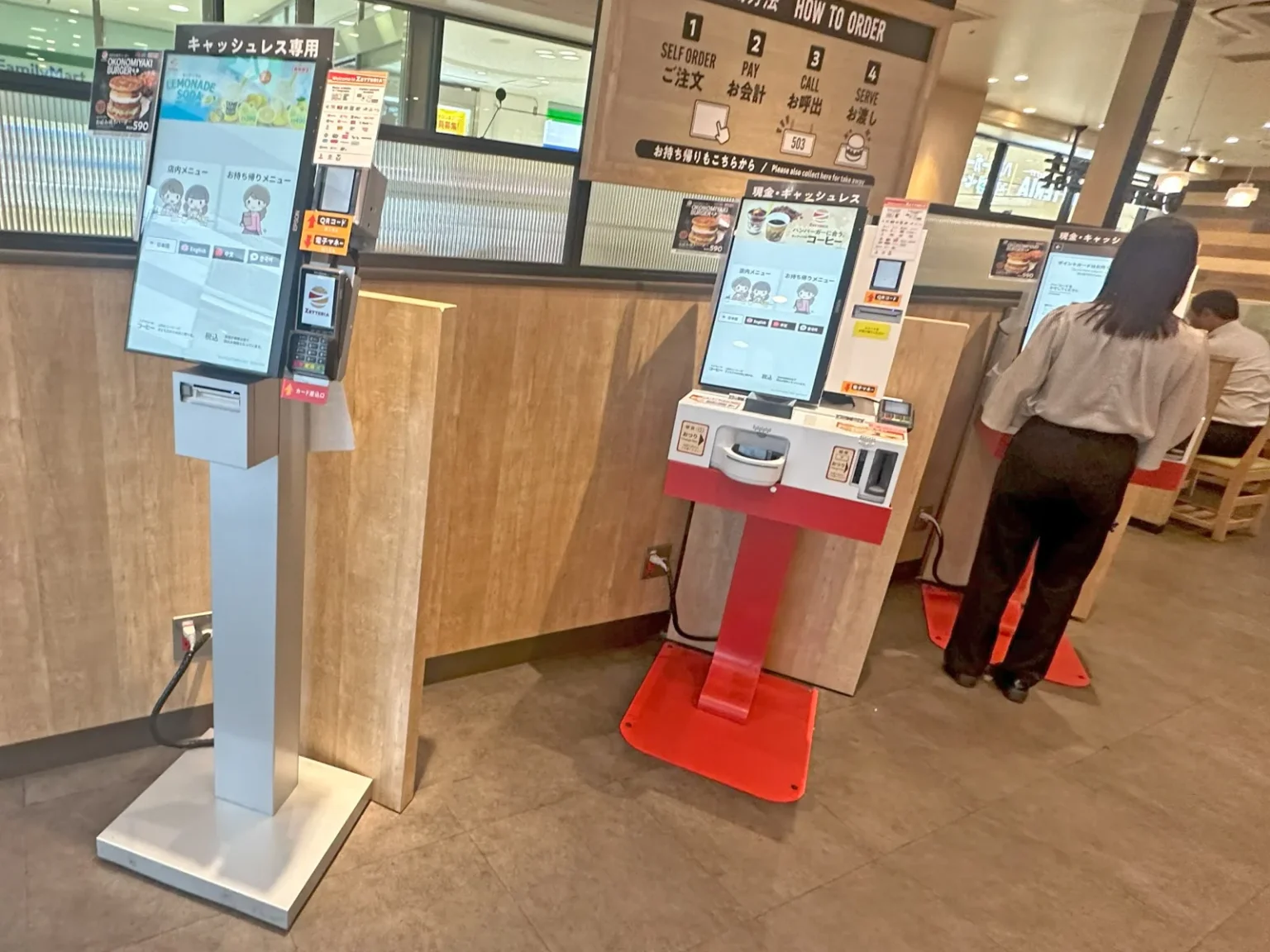
- Ticket machine or kiosk by the door? Order and pay there before you sit, following its screen or signs, or staff.
- Izakaya or bar? Ask about an otoshi or seat charge, and the price, before ordering.
- Hotel restaurant? Check the menu, or ask, whether service is included or added.
- Eating in or taking away? Say so: the tax rate depends on it.
- Smoking sign at the entrance? Under-20s may not enter a smoking area, or the shop at all if the whole shop is one.
- Allergy or diet? Have it written in Japanese (phrases below).
- Cash or card? Look for card, IC-card or QR logos, or a cash-only sign, before you eat.
Check first: smoking, allergies, charges, payment
Smoking
Under the revised Health Promotion Act, in full force since 1 April 2020, smoking is banned indoors in principle at restaurants. Smoking is allowed only in areas that meet the Ministry of Health, Labour and Welfare’s standards, and any place that has one must post the ministry’s sign. Judge the place by the sign at its entrance. “Smoking” on the signs includes heated tobacco.
| Sign (Japanese / English on the sign) | What it means · no under-20s in any smoking area |
|---|---|
| 喫煙専用室あり Designated smoking room available | There is a smoking room; no eating or drinking inside it |
| 加熱式たばこ専用喫煙室あり Designated heated tobacco smoking room available | A room for heated tobacco only, where you may eat and drink (a transitional measure) |
| 喫煙可能室あり Smoking room available | Part of a small restaurant that existed on 1 April 2020 (seating area 100 m² or less, capital ¥50 million or less) allows smoking |
| 喫煙可能店 Smoking area | The whole of such a shop allows smoking, so under-20s cannot go in at all |
| 喫煙目的室あり Smoking room available | Part of a bar or similar place whose purpose is smoking; no staple meals such as rice or noodles |
| 喫煙目的店 Smoking area | The whole of such a bar is a smoking area, so under-20s cannot go in at all |
Allergies, vegetarian and halal
Japan’s allergen labelling duty covers packaged processed foods and additives. The Consumer Affairs Agency requires them to show nine allergens: shrimp, crab, walnut, wheat, buckwheat (soba), egg, milk, peanut, and cashew, added on 1 April 2026. Sakai City notes a transition for cashew until 31 March 2028, so packaging may not yet show it. For restaurants and counters selling unpackaged food, Sakai City’s food-hygiene page says that, apart from packaged products, “there is no labelling duty”, though some businesses give the information voluntarily. A missing label is not proof an ingredient is absent: ask.
With a serious allergy, ask about ingredients and about cross-contact, such as shared oil or utensils. If the shop cannot confirm, don’t eat it.
For vegetarian and vegan diets, JNTO’s guide warns that even stocks and sauces usually contain some meat or fish. It advises being specific: no meat, seafood or animal products “including dashi or stocks”; make clear that “no meat” includes chicken, pork and fish; carry a written card in Japanese; and mention your diet when you book. It lists HappyCow, Vegewel and Japan VegeMap, and calls halal awareness “still far from optimal”, though some restaurants are halal-certified.
Near Mt Fuji, our guide to gluten-free and halal food around the Fuji Five Lakes covers three places from a visit; in Fukuoka, the Fukuoka food guide explains how the yatai stalls work.
The phrases below are conversation starters, not a guarantee of safety or of halal status.
| Japanese (romaji) | Meaning |
|---|---|
| __アレルギーです ___ arerugī desu | I am allergic to ___ |
| __が食べられません ___ ga taberaremasen | I can’t eat ___ |
| __は入っていますか? ___ wa haitte imasu ka? | Does this contain ___? |
| 同じ油や調理器具を使っていますか? onaji abura ya chōri kigu wo tsukatte imasu ka? | Do you use the same oil or utensils? |
| 肉も魚も、だしも食べられません niku mo sakana mo, dashi mo taberaremasen | I can’t eat meat, fish or dashi stock |
| 豚肉、お酒、みりんが入っていない料理はありますか? butaniku, osake, mirin ga haitte inai ryōri wa arimasu ka? | Is there a dish with no pork, alcohol or mirin? |
| えび・かに・くるみ・小麦・そば ebi, kani, kurumi, komugi, soba | Shrimp, crab, walnut, wheat, buckwheat |
| 卵・乳・落花生・カシューナッツ tamago, nyū, rakkasei, kashū nattsu | Egg, milk, peanut, cashew |
The charges
| Charge | What it is · source |
|---|---|
| Consumption tax | In the displayed price, under the total-price rule. 10% eating in; 8% on eligible takeaway food and non-alcoholic drinks; alcohol 10% · NTA, government PR office |
| Otoshi / tsukidashi | A small dish served at the start, billed per person, at izakaya, bars and some restaurants · Tokyo centre’s sample wording; 2023 trade survey |
| Seat or cover charge | A fixed amount per person for the table · same sources |
| Service charge | A percentage some hotel restaurants add; others include it in the price. Check the menu or ask · hotel menus, Ministry of Finance example |
| Cancellation fee | May be charged for a no-show under a policy shown when you booked · 2018 No-show report |
| Tip | Not expected · JNTO |
Prices on the menu include tax. A taxable business that shows prices to consumers in advance must show the price including consumption tax (sōgaku hyōji, total-price display). That covers menus, signs and websites. The rule dates from April 2004; from October 2013 to March 2021 shops could show prices such as “¥9,800 + tax”, and since 1 April 2021 the rule applies again. A menu may still show the pre-tax price next to the tax-inclusive one, so read for 税込 (zeikomi, tax included).
Why takeaway can cost less. Eligible food and non-alcoholic drinks bought to take away are taxed at the reduced 8% rate; alcohol stays at 10%. Restaurant meals, defined as food served where the business provides somewhere to eat it, are taxed at 10%. Where a shop does both, it decides at the time of sale, for example by asking you. A dish priced at ¥1,000 before tax is ¥1,100 eaten in and ¥1,080 taken away. How that shows on the menu is up to the shop: the government’s PR office lists both prices shown, only one shown, or one price for both.
Otoshi and seat charges. An otoshi (also called tsukidashi) is a small dish brought before your first order, at izakaya, bars and some restaurants, and billed per person. The Tokyo Metropolitan Sanitation Business Guidance Center’s sample English for restaurants reads: “It is customary in Japan to serve appetizers called otoshi … Each customer will be billed ●●● yen.” The same manual tells restaurants to explain their charges before taking the order, because disputes tend to happen at the till.
In a survey by Inshokuten.com (Synchro Food) in August 2023, 272 operators of restaurants, izakaya, bars and similar places, where such charges arise, were asked what they bill. 38.2% billed otoshi, 28.7% a seat charge and 15.1% a service charge; 29.4% billed none of these. Among the 104 shops serving otoshi, the most common price was ¥300–¥399 (40.4%); of those shops, 22.1% let customers skip it, and 16.3% did not serve it to foreign customers. More than half the respondents were in Tokyo. (Survey: Inshokuten.com (Synchro Food) research.)
Service charge. Two hotel examples, checked on 12 October 2026:
- Nadaman’s Japanese Dining San Applause, inside the Imperial Hotel Tokyo, listed by the Japan Hotel Association: “Prices are inclusive of consumption tax and service charge.”
- A Prince Hotels dinner menu for 1 October–25 November 2026: “Price includes consumption tax. A 13% service charge will be added to your final bill.”
The Ministry of Finance’s example of the second kind: a ¥3,300 dinner (tax included) plus a 10% service charge of ¥330 comes to ¥3,630.
Tipping. JNTO, the national tourism organisation: “In Japan, it’s not common to tip for services such as those provided in bars, cafes, restaurants, taxis, and hotels.” It adds that a private guide or interpreter may accept a tip, discreetly and in an envelope.
Reservations, no-shows and cancellation fees
In November 2018 a study group of restaurant-industry and reservation-service representatives, a consumer advisers’ association, lawyers and a law professor, with the Ministry of Economy, Trade and Industry (METI), the farm ministry and the Consumer Affairs Agency as observers, published a No-show report. It is guidance, not a fee set by law. Its view: a restaurant can claim damages for a no-show if it set a cancellation policy and showed it to you when you booked, phone bookings included. The amount must be reasonably calculated: for a set course it can reach the full price, minus food and staff costs the restaurant can save or reuse; for a table-only booking, a share of the average spend per customer. The restaurant must be able to explain the fee; an excessive fee with no basis, the report says, is legally problematic. Cancelling in advance can also cost you, depending on the case.
When you book, check the cancellation deadline and fee; if you cannot make it, tell the restaurant as early as you can. The METI release URL we checked on 12 October 2026 returned a missing-page error; we read the report in a copy hosted by the Aichi restaurant trade association.
How you will pay
Check before you eat whether the shop takes cards or IC cards; the Tokyo centre’s manual reminds shops to tell customers that cash means Japanese yen only. Our cash vs card guide covers where cards work, and the IC card guide covers Suica-type cards. If you carry coins, a small coin case (Amazon Japan) keeps the change apart from your notes.
Walking in
You will probably hear irasshaimase (“welcome”); you do not need to answer. Then comes nan-mei sama desu ka?, “how many people?”, and fingers held up are enough of an answer. Both lines are on the Tokyo Metropolitan Sanitation Business Guidance Center’s conversation sheets for restaurants.
If you would rather try your first izakaya with a guide, compare Tokyo food tours on MagicalTrip and check what each one includes.
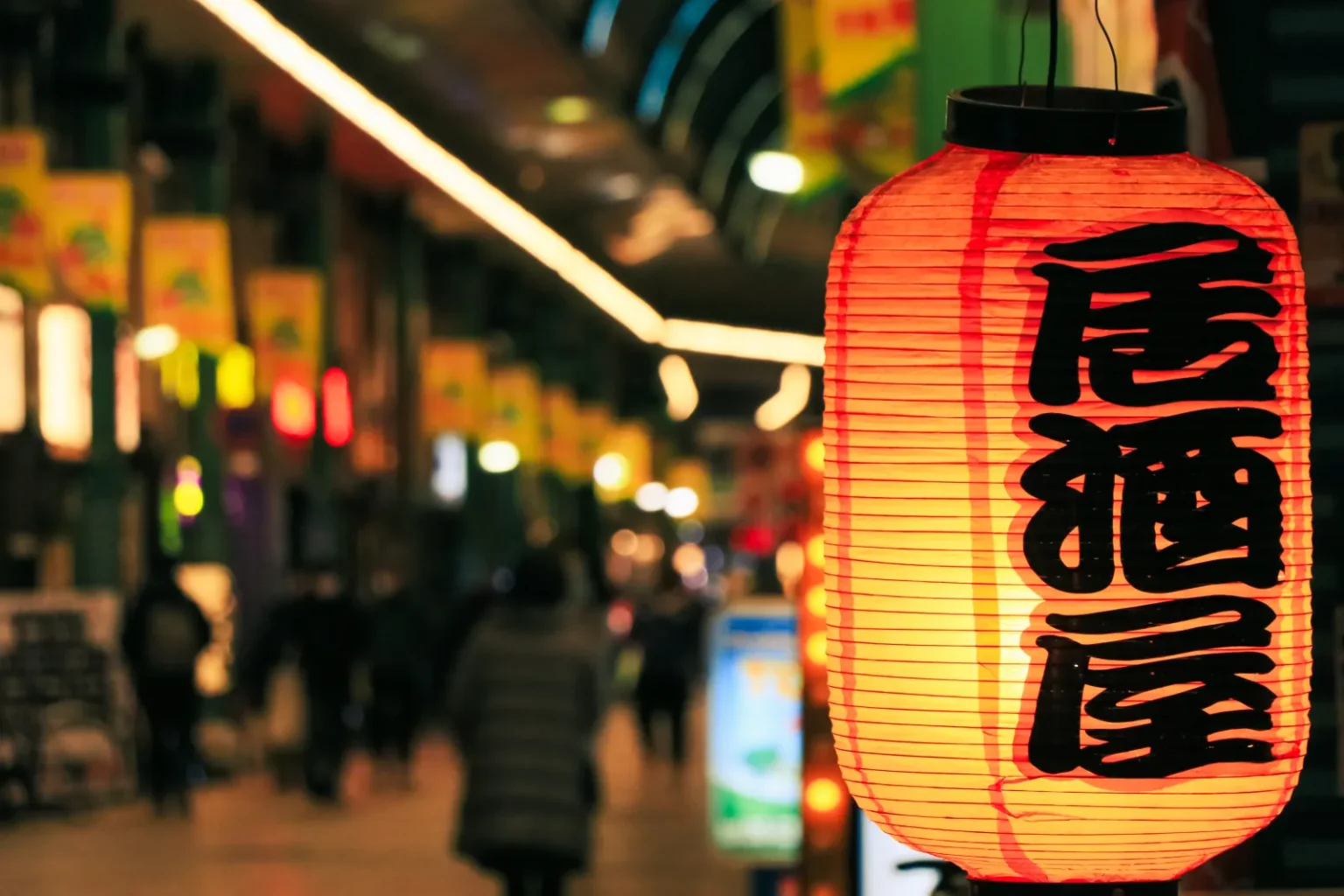
The same sheets cover the rest of the door. Kutsu wo nuide oagari kudasai means take your shoes off: the seating is on tatami (zashiki). You may be offered chairs or tatami, or pointed to a ticket machine first (“First, please buy a meal ticket”). If there is a sheet at the door for names and party size, write yours on it and wait to be called; otherwise join the end of the line. For a queue worth planning around, see Imakin Shokudo.
Ordering: ticket machines, tablets and calling staff
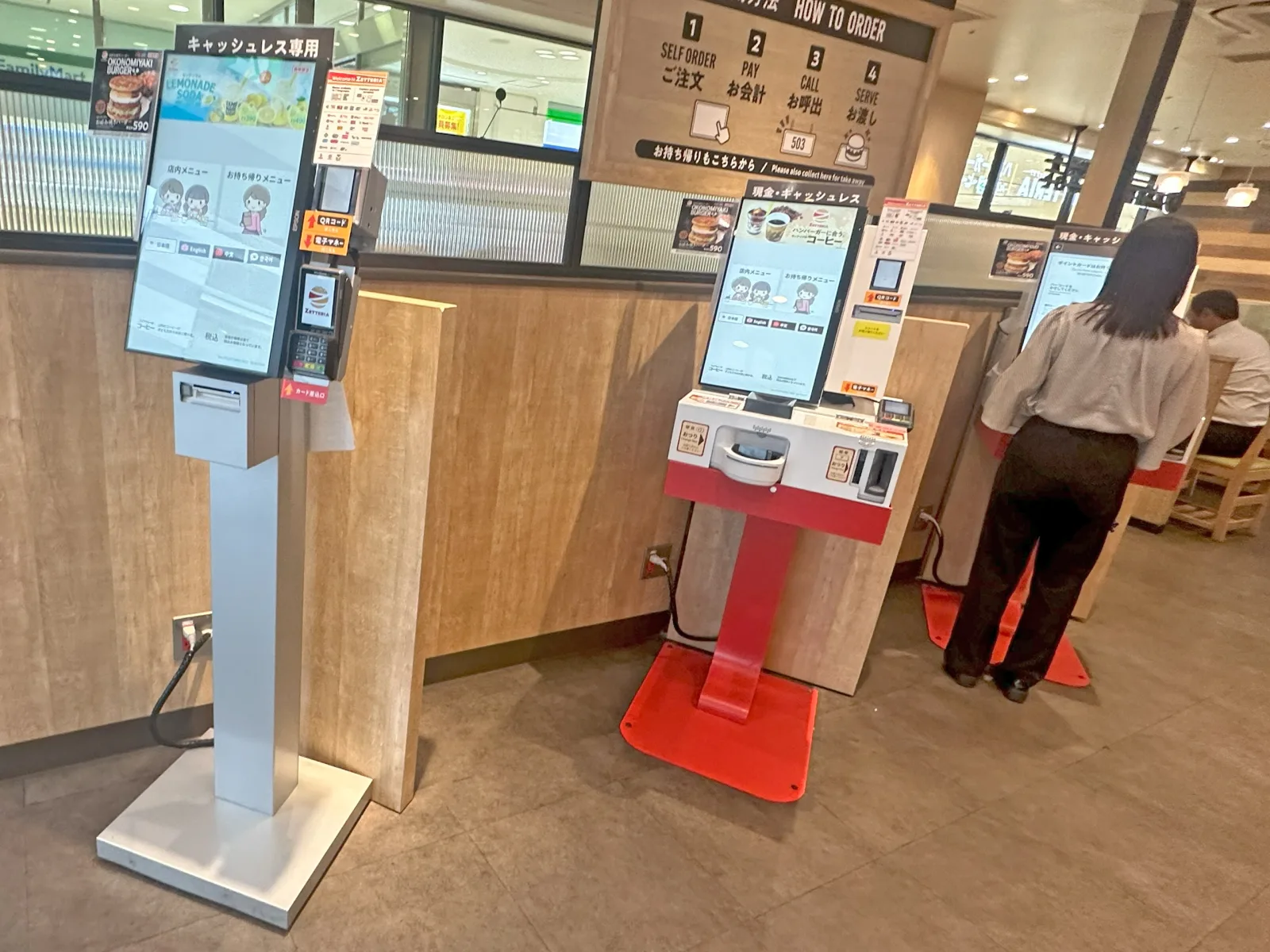
A meal-ticket machine (shokkenki) or kiosk means you order and pay before you eat. They work in different ways, so read the one in front of you.
1. Read the screen or sign
Follow the order it shows. The board in the photo at the top reads self order, pay, call, serve. The kiosks in that photo have a language button and ask if you are eating in or taking away. Check how it takes payment: a sign such as キャッシュレス専用 means cashless only; 現金のみ means cash only.
2. Button machines: cash may come first
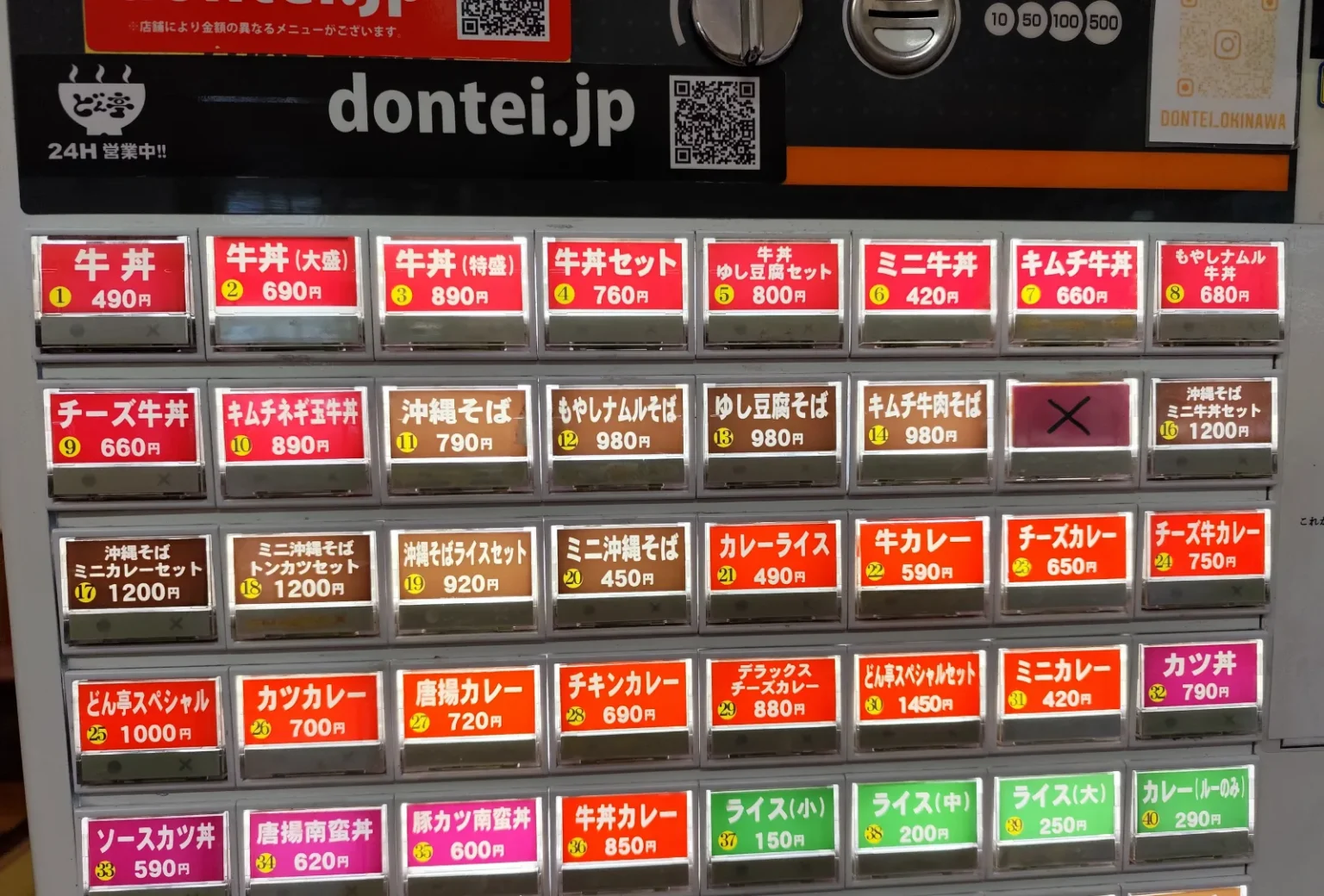
Some button machines need money in before you press. If nothing happens when you press, insert money and press again. On the machine below, small, medium and large rice each have their own button.
3. See what comes out
It may be a paper ticket, a number or a receipt, and your change. Keep whichever it is.
4. Follow the staff
Hand over the ticket, or sit and wait, or wait for your number to be called and collect your food, as staff or signs direct.
Tablets and QR codes. Some restaurants have a tablet on the table, or a QR code you scan to order on your own phone. Look for a language button, and for a “check” or お会計 (okaikei) option at the end; some tablets close the order there, others send you to the register.
A camera translation app reads a menu or a ticket machine’s buttons; a data connection is useful if you haven’t downloaded its offline languages. JNTO also suggests a translation app for explaining a diet.
See Japan eSIM plansCalling staff. Say sumimasen (“excuse me”) and raise a hand. Where there is a call button on the table, press that instead.
Self-service. At shops such as Minatoan in Yokohama, you order and pay at the counter and carry your tray to a seat.
Last order. The Tokyo centre’s sheet includes “Orders will be accepted until ●●”. The last order (rasuto ōdā) can be well before closing: the Japan Hotel Association’s listing for San Applause (Nadaman, in the Imperial Hotel Tokyo) shows dinner 5–9 p.m. with last order at 7:30.
Conveyor-belt sushi: don’t put a plate back
Kura Sushi’s press office told ITmedia Business Online (5 March 2023) that putting a plate you have taken back on the belt is, in principle, a breach of manners. ITmedia noted that less malicious cases can also be expected, such as taking the wrong plate by mistake and returning it at once; Kura said its system can tell whether an act is malicious, and that in the end staff ask the customer before deciding. If you take a plate by mistake, don’t put it back on the belt yourself: ask staff.
The same report covered videos of misconduct at restaurant chains that had spread on social media, among them one of a customer at Sushiro licking a soy-sauce bottle and a teacup on the table. Sushiro’s operator said it would respond firmly through both criminal and civil channels. As of March 2023, some chains, Sushiro among them, had switched to sending only ordered dishes along the belt. Kura Sushi kept free-flowing plates and added AI cameras that detect suspicious movements of the plate covers on the belt, for example when a customer puts a plate they have eaten from back on the belt; the head-office system then alerts the shop with the time and table. Kura said the AI detects plates on the belt, not the behaviour of customers away from it.
These arrangements were reported in March 2023 and may have changed. Follow the instructions at your table.
Paying
When you pay depends on the shop. The Tokyo centre’s manual lists three systems: in advance by meal ticket, at the table, or at the register. Its phrase sheets have both “Please pay the bill at the payment counter” and “Please pay the bill here at your table”. If the shop asks you to pay at the register, take the bill slip there; to ask for the bill, say okaikei onegaishimasu. If the register has a small tray, put your cash or card in it.
- Splitting the bill. Ask before you order, or at the register: betsubetsu de onegaishimasu (“separately, please”). Whether a shop splits bills is up to the shop.
- Receipts. Ryōshūsho is a formal receipt; say ryōshūsho onegaishimasu if you need one for expenses.
- On the way out. Gochisōsama deshita (“thank you for the meal”); Time Out Tokyo’s noodle piece suggests it as the way to show thanks.
Small customs
Oshibori
The damp towel you may be handed is for your hands. The Tokyo centre’s sushi guide for visitors starts with wiping your hands on it.
Water and tea
It depends on the shop. Some bring a glass; some have a dispenser (the Tokyo centre’s sheet has “Please help yourself to water from the dispenser”).
Slurping noodles
Time Out Tokyo (2023): slurping noodles loudly “is not considered bad table manners” in Japan, though loud eating may be frowned on in other kinds of restaurant. You do not have to slurp.
Photos
Shop rules vary; if there is a no-photo sign, follow it, and keep other diners out of the frame. See our photography etiquette guide.
Chopstick taboos, from the farm ministry’s magazine aff (May 2016, with the Japan Chopsticks Culture Association), which calls them kirai-bashi, chopstick habits to avoid:
| Don’t | Why (MAFF) |
|---|---|
| Stand chopsticks upright in rice | Tsukitate-bashi: a Buddhist offering of food to the dead |
| Pass food chopstick to chopstick | Hiroi-bashi: recalls picking up bones after a cremation |
| Rest them across your bowl mid-meal | Watashi-bashi: use the chopstick rest instead |
| Spear food | Sashi-bashi |
| Point with them, or hover over dishes | Yubisashi-bashi, mayoi-bashi |
| Pull a dish towards you with them | Yose-bashi |
More: ryokan meals, natto, daily food costs.
FAQ
Do prices on Japanese menus include tax?
If a business covered by the total-price rule displays a price in advance, it must include tax; the rule applies again since 1 April 2021. Look for 税込 (tax included). Prices told to you aloud, “market price”, and tax-exempt small businesses are not covered.
What is the otoshi charge, and can I refuse it?
A small starter billed per person, at izakaya, bars and some restaurants. In our 12 October 2026 search we found no official guidance on refusing it. Ask the price and terms before you order.
Why is takeaway cheaper than eating in?
Eligible takeaway food and non-alcoholic drinks are taxed at 8%; eating in is 10%, and alcohol is 10% either way (National Tax Agency). Some shops show both prices, some only one, and some charge the same for both.
Should I tip at restaurants in Japan?
No. JNTO says tipping is not common in restaurants, bars, cafes, taxis or hotels. Some hotel restaurants add a service charge and others include it; check the menu or ask.
Can I smoke in Japanese restaurants?
Not indoors, in principle, since 1 April 2020; only in areas marked with the Ministry of Health’s signs. Under-20s may not enter a smoking area, and cannot enter at all where the whole shop is one.
Do Japanese restaurants have to label allergens?
No. The duty covers packaged processed foods and additives; some restaurants give the information voluntarily. A missing label is not proof an ingredient is absent: ask, and with a serious allergy, don’t eat what the shop cannot confirm.
Will I be charged if I miss a reservation?
You may be. The 2018 No-show report (guidance, not a fee set by law) says a restaurant can claim for a no-show if it showed you its policy when you booked, with the amount reasonably calculated and costs it saves or reuses taken into account. Check the deadline and fee when you book, and tell them early if you cannot come.
Sources (checked 12 October 2026)
- National Tax Agency: No.6902 total-price display; No.6102 reduced tax rate; reduced-rate Q&A, eat-in or takeaway (PDF); planned food tax cut and leaflet (PDF); Q&A, incl. who the total-price rule covers (PDF)
- Cabinet Secretariat: food consumption tax cut, outline and bill; bills submitted to the 222nd Diet
- Ministry of Finance: price display from 1 April 2021; total-price display Q&A (service charge example)
- Government PR Online: total-price display from April 2021, takeaway column
- Tokyo Metropolitan Sanitation Business Guidance Center: foreign-visitor tools manual, March 2018 (PDF); earlier manual (PDF)
- Synchro Food: otoshi and service-charge survey, August 2023 (Inshokuten.com (Synchro Food) survey)
- Japan Hotel Association: Japanese Dining San Applause (Nadaman), Imperial Hotel Tokyo; Nadaman: San Applause; Prince Hotels: dinner menu, autumn 2026 (PDF)
- JNTO: Tipping in Japan; Vegetarian and vegan guide
- No-show report, 1 November 2018 (study group; METI, MAFF and Consumer Affairs Agency as observers): copy hosted by the Aichi restaurant trade association (PDF)
- Ministry of Health, Labour and Welfare: passive smoking measures; key points of the revised act; list of signs
- Consumer Affairs Agency: food allergy labelling; allergies when eating out
- National Consumer Affairs Center: Consumer Hotline for Tourists
- Sakai City: allergy labelling for businesses
- Ministry of Agriculture, Forestry and Fisheries: aff, May 2016, chopsticks; chopstick manners
- Time Out Tokyo: on slurping noodles, July 2023
- ITmedia Business Online: Kura Sushi’s AI cameras, 5 March 2023, page 1; page 2 (Japanese)
Join travelers discovering Japan's hidden side
Weekly dispatches from off-the-beaten-path Japan — spots and stories you won't find in guidebooks.
No spam. Unsubscribe anytime.
Welcome aboard!
You're in. See you in your inbox soon.