
Culture · Seasonal · New Year 2026–27
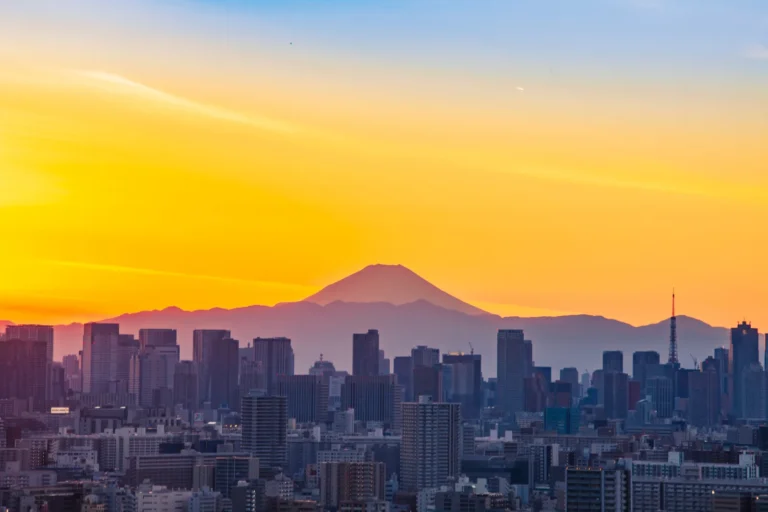
Japanese New Year, oshogatsu, begins with preparations around 13 December, peaks from 31 December to 3 January, and winds down through regional customs on 7 and 15 January, later in places. Much of it happens at home. Visitors can experience parts of it: temple bells around the turn of the year, Yasaka Shrine’s Okera fire in Kyoto, the Oji fox parade in Tokyo, the year’s first sunrise (6:50 a.m. in Tokyo on 1 January 2027), shrine visits and New Year food. Below: what is confirmed for 2026–27, and what is last season’s example.
The 2026–27 New Year calendar at a glance
Weekdays are calculated and checked against the Cabinet Office’s 2027 holidays. Labels, as of 12 October 2026, with some notices rechecked on 20 November 2026: 2026–27 notice (this season’s date is posted), annual listing (an official page gives the same date every year), customary date (a custom, per the source named) or not yet posted (only last season’s details were online).
| Date | What happens and its label |
|---|---|
| Around Sun 13 Dec 2026 | Preparations. Jinja Honcho says the soot-sweeping is still often held on 13 December customary date. Sensoji shows its stand-in Kannon at 2 p.m. that day annual listing. Gion’s koto-hajime 2026–27 notice: Kyoto City’s tourism site lists Sun 13 Dec 2026 |
| Thu 17 – Sat 19 Dec | Hagoita-ichi at Sensoji, stalls of decorated battledores annual listing |
| 26–28 and 30 Dec | Decorations go up, avoiding the 29th and 31st customary date |
| Thu 31 Dec Omisoka | New Year’s Eve. Toshikoshi soba. Yasaka Shrine’s Okera fire 2026–27 notice: Kyoto City’s tourism site. Oji fox parade 2026–27 notice: planned, per its organisers; no timetable yet. Temple bells 2026–27 notice: Zojoji from 9:45 p.m., Chion-in from about 10:20 p.m. |
| Fri 1 Jan 2027 Ganjitsu | New Year’s Day, national holiday 2026–27 notice: Cabinet Office. First sunrise (times below), first shrine visit, osechi and ozoni |
| Sat 2 Jan | Imperial Palace New Year greeting. No 2027 details on the Imperial Household Agency’s greeting page not yet posted |
| Early Jan | First sales (hatsuuri): department stores choose their own day. Nihombashi Takashimaya’s was Sat 3 Jan in 2026. For 2027, Takashimaya has posted in-store lottery applications for its “experience” lucky bags on 3 and 4 January 2026–27 notice; the whole store’s opening schedule not yet posted |
| Wed 6 Jan | Tokyo Fire Department’s New Year review 2027 notice: the ceremony at Tokyo Rinkai Disaster Prevention Park is for selected applicants only, and applications have closed. The exhibition at Ariake Garden, 10 a.m. to 3 p.m., is open to anyone without registration |
| Thu 7 Jan | Nanakusa-gayu, seven-herb porridge, and the usual end of decorations in Kanto customary date. Dazaifu Tenmangu’s bullfinch exchange and fire festival annual listing |
| Sat 9 – Mon 11 Jan | Toka Ebisu at Imamiya Ebisu, Osaka: three days, 9 January being Yoi-Ebisu 2027 notice: the shrine’s 2027 page |
| Mon 11 Jan | Coming of Age Day, national holiday 2026–27 notice: Cabinet Office. Kagami-biraki in many regions, often on the 11th customary date; local dates vary |
| Fri 15 Jan | Koshogatsu, “little New Year”, and the usual end of matsunouchi in Kansai. Jinja Honcho says many shrines burn decorations and old charms between 31 December and 15 January customary date |
| Wed 20 Jan | Hatsuka shogatsu. Weathernews says parts of Kansai close New Year on the 20th, with kagami-biraki that day customary date |
What you can join as a visitor
Event prices, times and entry rules are in these cards (sunrise and trains have their own sections). Each card says whether it is this season’s notice (2026–27 notice), a temple’s or shrine’s standing information, or a past-year example (2025–26 example or 2026 example): what to expect, not a promise.
Ring the bell yourself: Zojoji, Tokyo
2026–27 notice: Zojoji has moved its bell ringing earlier. The service starts at 9:30 p.m. on 31 December and the ringing at 9:45 p.m., expected to finish at about 11 p.m.; before the change, ringing began at midnight. The head priest rings the first of the 108 strokes; participants then ring in groups of four, each ticket letting one person ring. Tickets cost ¥2,000 including a gift and are due to be given out from 9 a.m. on 1 December at the temple office on the 2nd floor of the hall (kaikan), in limited numbers. Checked on 20 November 2026.
Watch 17 monks ring it: Chion-in, Kyoto
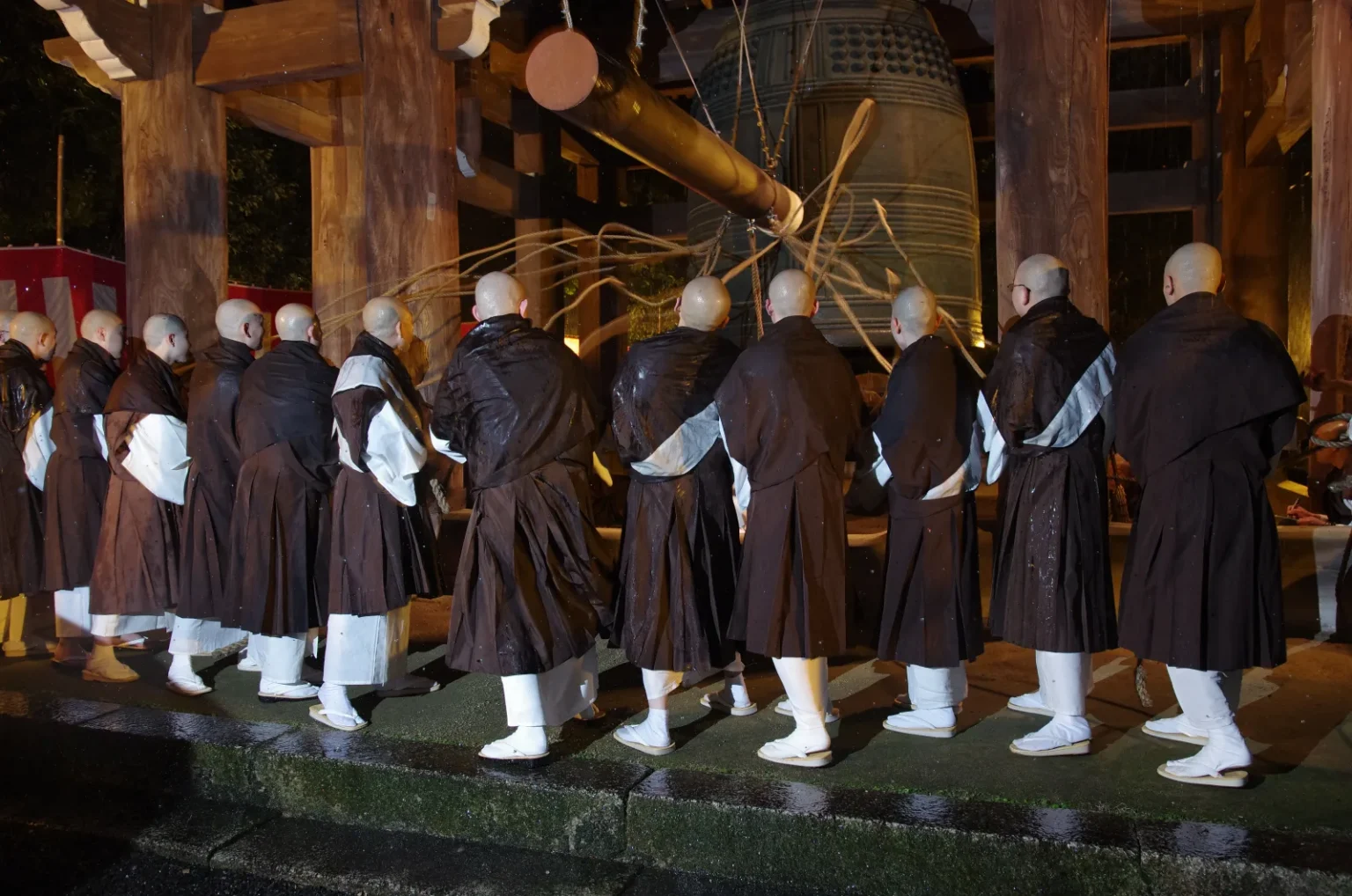
2026–27 notice: the bell, about 70 tonnes, is struck by 17 monks, one on the main rope and sixteen on the smaller ropes, to shouts of “ee-i hitotsu” and “sore”, from about 10:20 p.m. on 31 December 2026. Viewing only. ¥3,000 (primary-school age and under free), by online application from 2 p.m. on 1 December to 4:59 p.m. on 24 December (four groups of 500, card payment) or counter tickets at the Yuzen-en reception from 7 to 24 December, 9 a.m. to 4 p.m. (four groups of 100, cash only). The practice ringing on 27 December starts at 2 p.m. and needs no booking; entry may be limited when crowded. Online places are first come, first served (credit card only), and counter tickets end when sold out. For the New Year’s Eve viewing there are no applications on the day, about 30 minutes per group, and no re-entry once you leave; open flames are strictly prohibited on the grounds; using tripods, selfie sticks or drones is prohibited, and visitors are asked not to drink there or come after drinking. Checked on 20 November 2026.
Listen in the crowd: Sensoji, Asakusa
Sensoji’s page says that at midnight the bell on Bentenyama is struck to announce the New Year, followed by three strokes that are not counted, then 108 strokes by members of the temple’s Hyakuhachi-kai, which take about 40 minutes. The page, checked on 20 November 2026, did not mention visitors ringing or any fee.
See the Okera fire: Yasaka Shrine, Kyoto
Confirmed for 2026: Kyoto City’s tourism site lists purification at 3 p.m. and the Joya-sai at 7 p.m. on 31 December; afterwards the sacred fire burns in lanterns through the night. Anyone can go and see it; bus 206 to Gion. Carrying it is a local custom: worshippers light a rope (kichonawa) from the fire and spin it on the walk home to keep it smouldering. The shrine’s own page says the fire was once used to cook the New Year ozoni or light the household altar, and that today the extinguished rope can be hung in the kitchen as a charm against fire. It is a household practice, not something to take onto transport or into a hotel. Chion-in, nearby, strictly prohibits open flames on its grounds in its 2026 notice, so do not take a smouldering rope there. The shrine lists a kake-hinawa rope charm, sold for Okera-mairi only, at ¥1,000 (checked 20 November 2026). More in my Yasaka Shrine guide.
Watch the Oji fox parade, Tokyo
The organisers’ site says the 34th parade is planned for New Year’s Eve 2026. 2025–26 example: the published timetable had people dressed as foxes lining up after an 11 p.m. ceremony at Shozoku Inari, leaving after the midnight countdown and arriving at Oji Inari at about 1:30 a.m.; from the line-up, the public could not enter some areas. Walking in it took advance application (100 places, ¥2,000 per adult), Japanese dress, and a fox mask or Oji-style fox make-up. On 20 November 2026 the 34th parade’s timetable and rules were not yet posted.
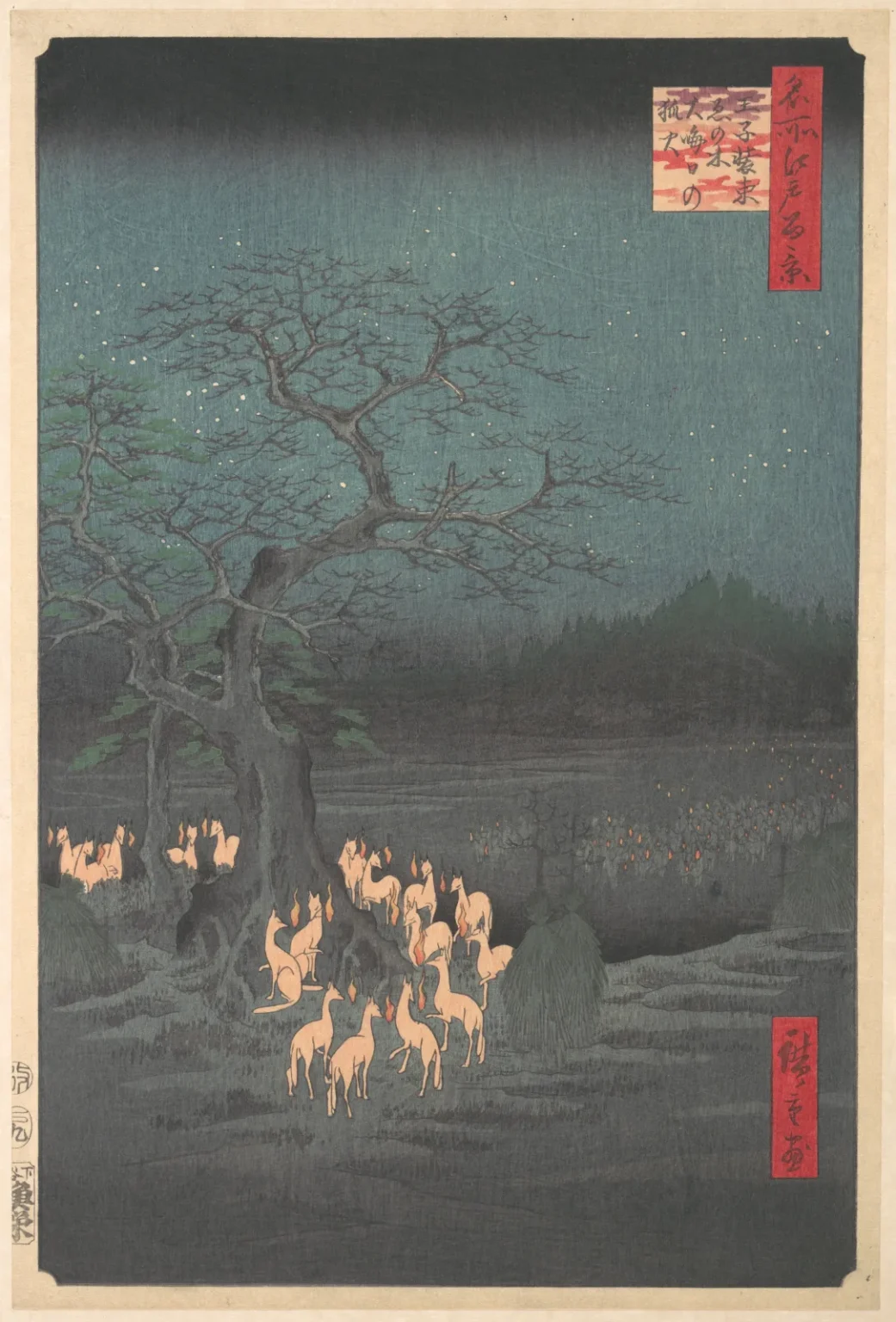
The parade re-enacts this print. The legend, as Kita City’s Asukayama Museum tells it: on New Year’s Eve the Inari god’s fox messengers gathered under the Shozoku enoki (hackberry) at Oji, dressed up and went on to Oji Inari, and people read the year’s harvest from the number of fox-fires. The parade began on New Year’s Eve 1993.
The Imperial Palace greeting, 2 January
2026 example: the gate opened 9:30 a.m.–2:10 p.m. and the Imperial family was scheduled to appear on the balcony about five times from 10:10 a.m.; 60,140 people came. The 2026 page (checked 12 October 2026) named no ticket or fee. In 2026 there were bag checks, and visitors were asked to keep bags to a minimum and leave suitcases and large bags in coin lockers or similar. Anyone carrying bulky luggage that might obstruct others could be refused entry, and tripods and selfie sticks could not be used inside. People were asked not to queue from the evening of 1 January or before dawn on the 2nd, and the 2026 notice warned that the event might be cancelled because of snow, severe weather or similar conditions. Check the Imperial Household Agency’s 2027 notice.
Lucky bags and first sales
2025–26 example: Nihombashi Takashimaya was closed on 1 and 2 January and opened the whole store for its first sale on 3 January at 10 a.m., and sold its special “experience” lucky bags by lottery. 2027 notice: Takashimaya has posted in-store lottery applications for its 2027 “experience” lucky bags on 3 and 4 January only, at its stores including Nihombashi. I found no 2027 opening schedule for the whole store when I checked on 20 November 2026. Others set their own days.
Swap a bullfinch: Dazaifu, 7 January
Dazaifu Tenmangu’s standing page (checked 12 October 2026): the usokae starts at 6 p.m.; you take a wooden bullfinch (¥2,000 on that page, handed out from the evening) and swap it with strangers to “exchange the year’s lies for truth”, and some birds win a gold one. The onisube fire festival follows (processions from 7 p.m., the fire around 9 p.m.), and the shrine says anyone can watch from the grounds or the route. See my Dazaifu guide.
The first shrine visit is covered in my hatsumode guide; I wrote about my New Year’s Day in a visit to Ookunitama Shrine. For a Kanagawa shrine known for happo-yoke prayers, see my Samukawa Shrine guide.
Kyoto City’s 2026 listing says the Okera fire burns through the night, and the Chion-in bell is due to start at about 10:20 p.m. on 31 December 2026. A room within walking distance of Gion means no late journey back.
See Kyoto hotels on AgodaIn Tokyo, Zojoji’s bell ringing now starts at 9:45 p.m. and is expected to finish at about 11 p.m. The Oji parade is planned again for this New Year’s Eve, but its timetable was not yet posted on 20 November 2026; last season’s timetable had it leaving at midnight and finishing at Oji Inari at about 1:30 a.m., with some areas closed to the public. Before booking a room within walking distance, check this year’s route and where spectators can leave.
See Tokyo hotels on AgodaWords you will see on signs and menus
| Word | What it is |
|---|---|
| Oshogatsu 正月 | The New Year period; its end date varies by region |
| Omisoka 大晦日 | 31 December, New Year’s Eve |
| Ganjitsu 元日 | New Year’s Day, 1 January |
| Joya no kane 除夜の鐘 | The 108 bell strokes rung at temples around midnight |
| Hatsumode 初詣 | The first shrine or temple visit of the year |
| Hatsuhinode 初日の出 | The first sunrise of the year |
| Toshikoshi soba 年越しそば | “Year-crossing” buckwheat noodles, eaten on New Year’s Eve |
| Osechi おせち | The New Year feast of symbolic dishes |
| Ozoni お雑煮 | Soup with mochi, eaten in the first days of the year |
| Matsunouchi 松の内 | “Within the pines”: the days the decorations stay up |
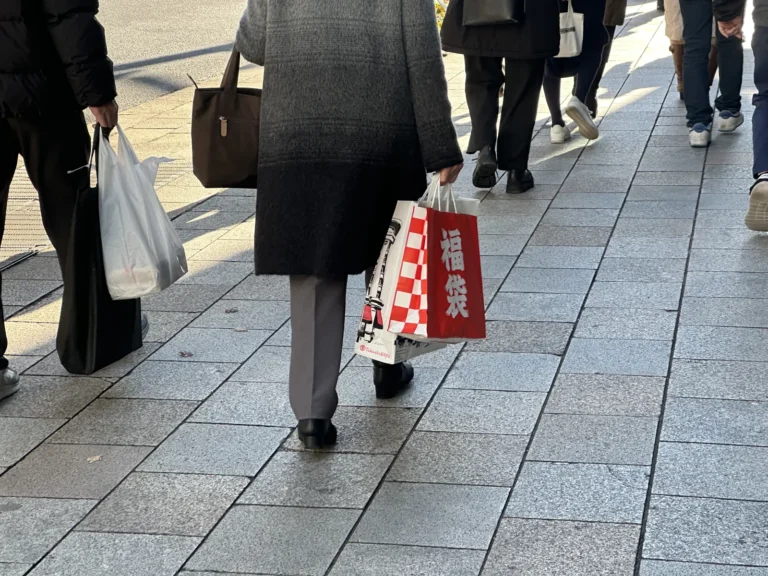
| Fukubukuro 福袋 | “Lucky bag”: goods sold as one bundle at New Year sales |
Nengajo: New Year cards, printed in smaller numbers
Nengajo 年賀状 are postcards for New Year greetings, sold at post offices from November. Japan Post’s initial print run for 2027 is 555.93 million cards, which it put at about 74.3% of the previous year’s initial run of roughly 750 million (31 August 2026). Kyodo News reported the same day that the initial print run had fallen for the 16th year in a row, by 25.7%. In a 2018 report, nippon.com put the peak at 4.46 billion lottery New Year cards, for 2004.
Japan Post’s own release says New Year greetings by social media have become ordinary, and that cards take time and cost money. It also addresses people thinking about nengajo-jimai 年賀状じまい, giving up New Year cards, and encourages them to reach out to someone important this year as well.
For 2027, Japan Post says cards are on sale from 2 November 2026 to 15 January 2027 (previously until about 10 January). Its posting-by guideline for delivery on New Year’s Day 2027 is 27 December 2026 (previously 25 December).
First sunrise on 1 January 2027: times by city

These are the National Astronomical Observatory of Japan’s times for each city’s reference point, from its January 2027 tables. NAOJ counts sunrise as the moment the top edge of the sun touches the horizon, at 0 m elevation. Hills, buildings or cloud on the horizon make it later.
| City | Sunrise, Fri 1 Jan 2027 and direction (0° = north) |
|---|---|
| Sapporo | 7:06 a.m. · 121.5° |
| Sendai | 6:53 a.m. · 119.1° |
| Tokyo | 6:50 a.m. · 118.1° |
| Kofu (nearest NAOJ point to the Fuji Five Lakes) | 6:55 a.m. · 118.1° |
| Nagoya | 7:01 a.m. · 117.9° |
| Kyoto | 7:05 a.m. · 117.9° |
| Osaka | 7:05 a.m. · 117.8° |
| Hiroshima | 7:16 a.m. · 117.7° |
| Fukuoka | 7:23 a.m. · 117.4° |
| Naha, Okinawa | 7:17 a.m. · 115.4° |
All are roughly east-south-east, between 115° and 122° clockwise from north: you need a clear horizon in that direction. Around Mt Fuji the mountains hide the true horizon; my Beni-Fuji post (written for the 2026 season) covers winter sunrise timing near Fujiyoshida.
Cold: the Japan Meteorological Agency’s 1991–2020 averages put the January daily low at 1.2°C in Tokyo, 1.5°C in Kyoto and −6.4°C in Sapporo, before wind. The Oji organisers tell walkers to wear a thin sweater under the kimono.
Bell queues and dawn waits mean hours near freezing; disposable warmers fit pockets and gloves.
See hand warmers on AmazonOsechi, ozoni and toshikoshi soba
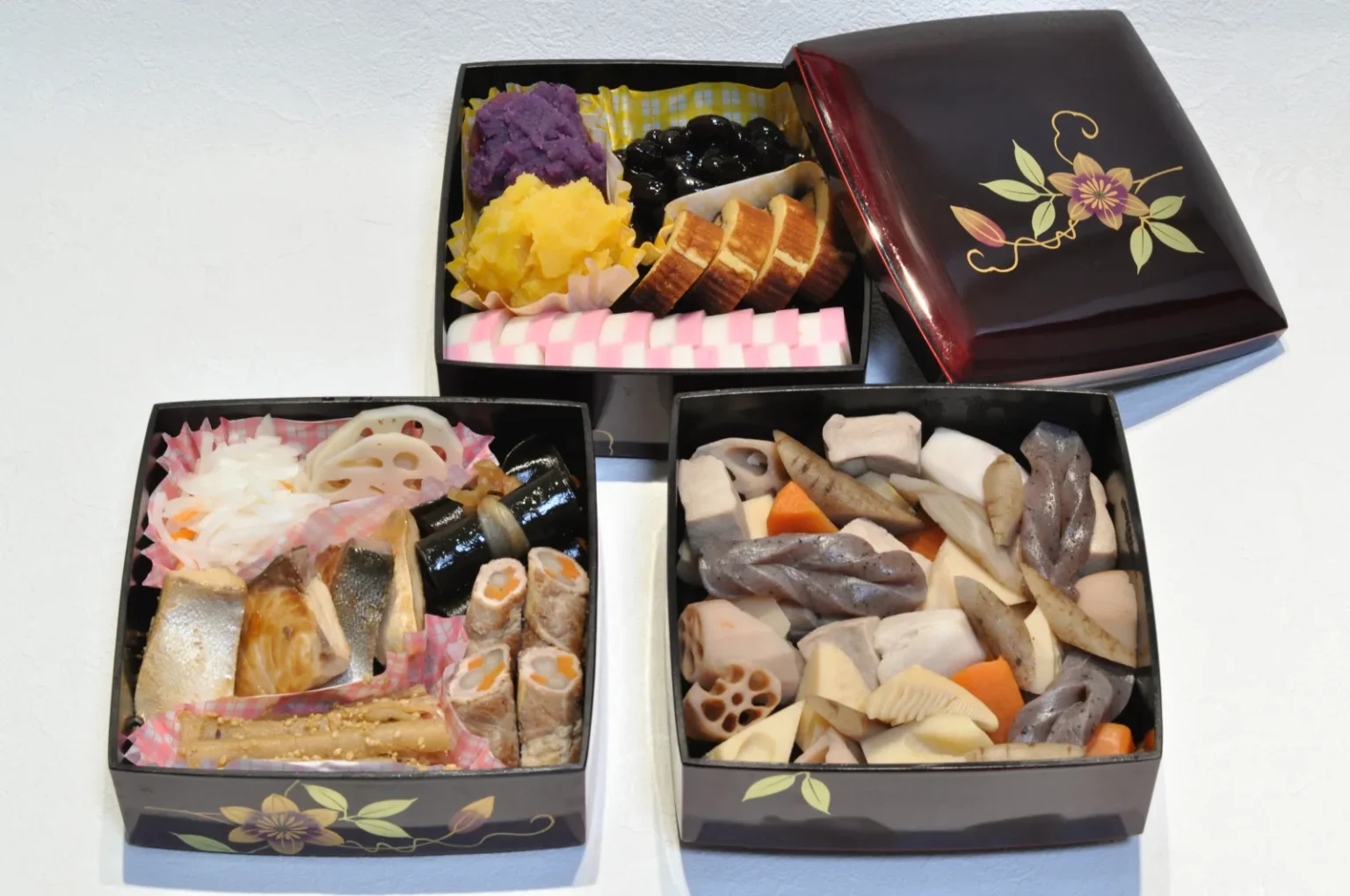
MAFF says the New Year osechi took shape at the end of the Edo period, and that most dishes carry a wish, often a pun. These are MAFF’s meanings: what each dish is traditionally said to stand for.
| Dish | Traditionally said to wish for |
|---|---|
| Kuromame 黒豆 (sweet black beans) | Working diligently (mame) through the year |
| Tazukuri 田作り (candied baby sardines) | A good harvest; the sardines were once used as field fertiliser |
| Kazunoko 数の子 (herring roe) | Many descendants, from the number of eggs |
| Kuri kinton 栗きんとん (chestnut and sweet potato) | Money: the name means “gold dumpling” and it is golden |
| Datemaki 伊達巻 (rolled sweet omelette) | Never lacking clothes; the roll looked like a kimono pattern |
| Kobumaki 昆布巻き (kelp rolls) | Joy, a pun on yorokobu |
| Ebi 海老 (prawn) | Living until your back bends like the prawn’s |
| Renkon れんこん (lotus root) | A clear view ahead, through the holes |
| Satoimo 里芋 (taro) | Many descendants: many small tubers grow on one plant |
| Buri ブリ (yellowtail) | Promotion at work: the fish changes its name as it grows |
Ozoni: square or round, clear or white
MAFF’s magazine puts the line near Sekigahara in Gifu: east of it, square mochi; west, round. In Gifu, Ishikawa, Fukui, Mie and Wakayama both are used in places, and there are exceptions on each side. Okinawa, it says, did not traditionally eat zoni. Examples from the same feature:
| Where | The bowl |
|---|---|
| Tokyo (“Edo zoni”) | Clear bonito and kombu broth with soy and mirin, grilled square mochi, chicken, shiitake, komatsuna and mitsuba; similar bowls across Kanto |
| Nagoya | Square mochi boiled, not grilled (grilling was said to mean “the castle burns”), with mochina greens |
| Kyoto | White miso, boiled round mochi, taro and carrot, all cut round to wish for harmony |
| Kagawa | Mochi filled with sweet bean paste, in white miso |
| Fukuoka (Hakata) | Round mochi in flying-fish broth with yellowtail and katsuona greens |
Toshikoshi soba. A food-culture researcher quoted by Weathernews lists several explanations: long thin noodles for a long life, and noodles that break easily, so you cut off the year’s hardships and debts. In a Weathernews survey from December 2020, 92% of respondents ate it, and 70% of all respondents boiled it at home.
To try them, ask a ryokan or hotel when booking whether it serves a New Year meal (ryokan guide).
Kadomatsu, shimekazari and kagami mochi: up and down
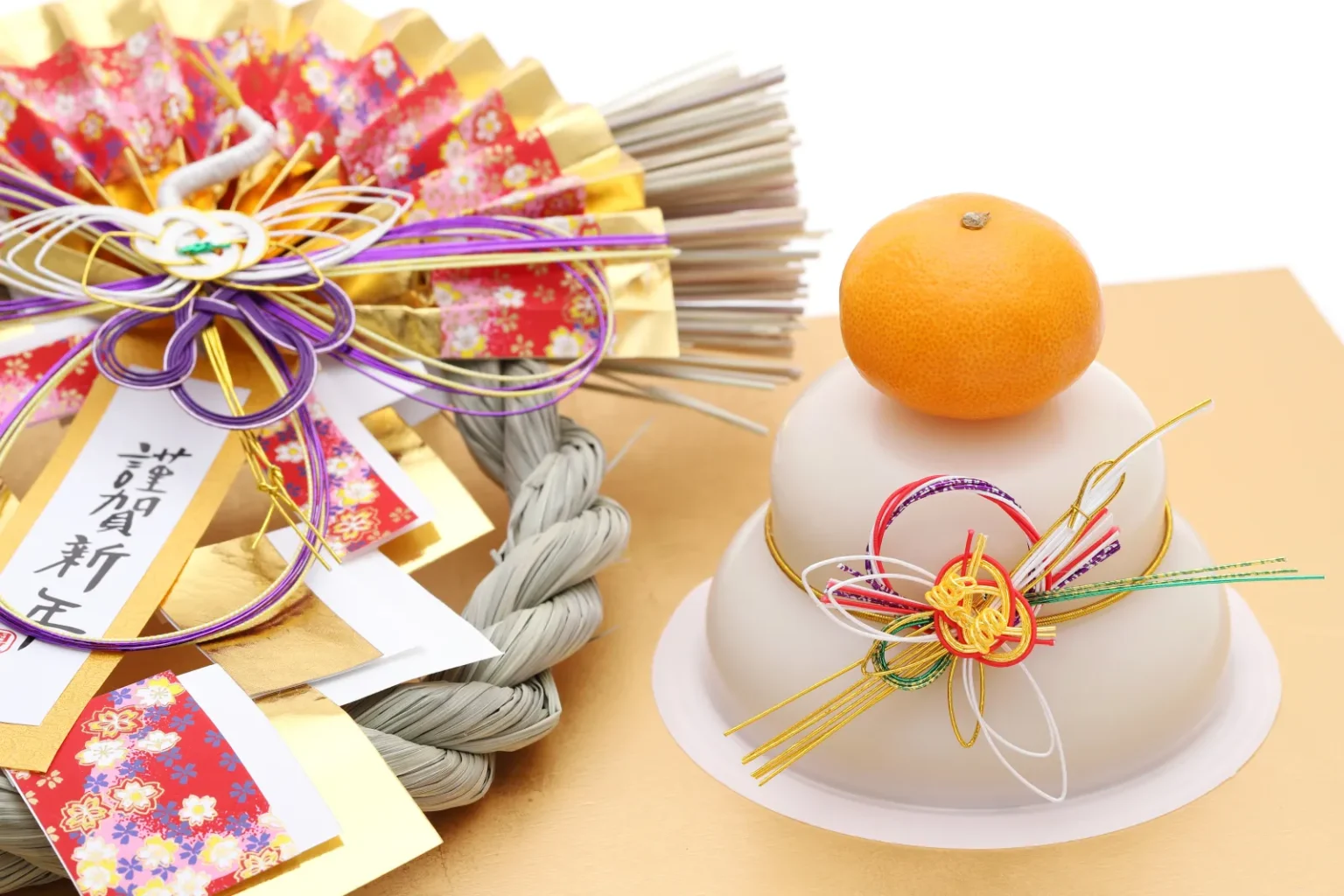
The decorations are aimed at the year god (toshigami). A maker quoted by Weathernews names 26, 27, 28 or 30 December to put them up: the 29th can be read as “double suffering”, and a one-night display on the 31st is thought disrespectful.
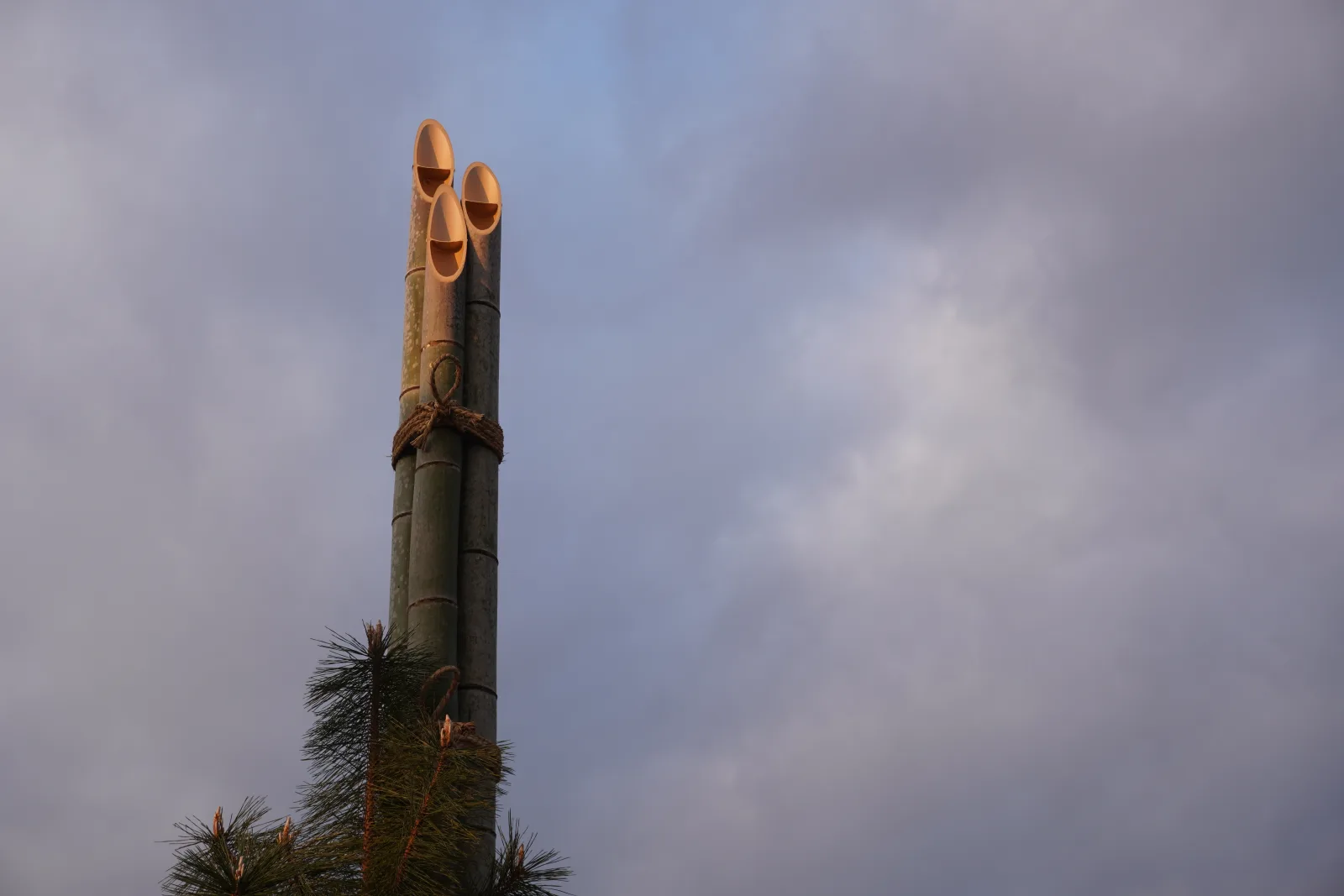
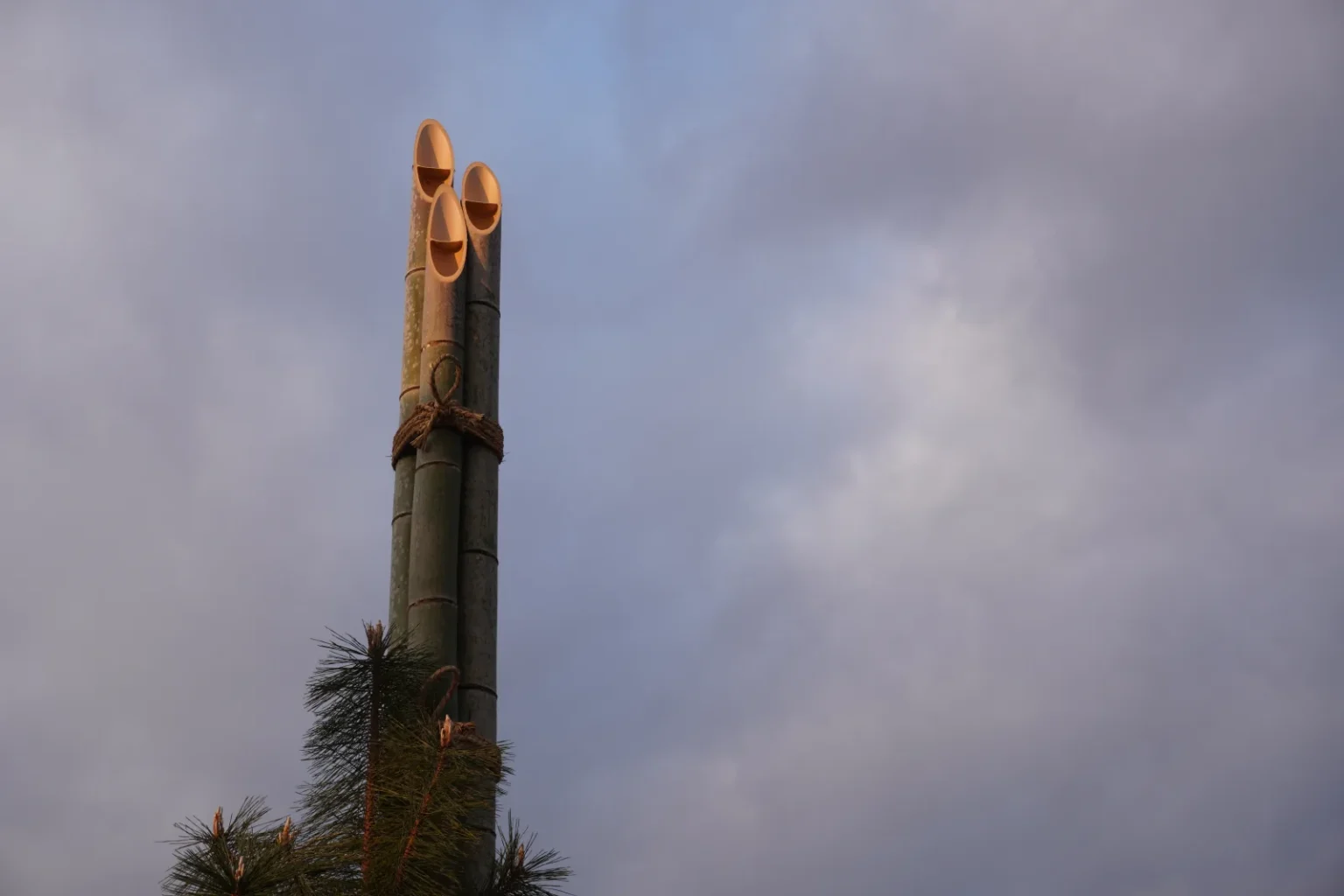
Kadomatsu 門松
Pine and slant-cut bamboo, in pairs either side of an entrance.
Shimekazari しめ飾り
A straw rope (shimenawa) dressed with ornaments over the front door. Shinmeido says it clears away the old year’s impurity and welcomes the god; the paper streamers mark a pure place, the bitter orange (daidai) stands for the family continuing, the fern (urajiro) for long life.
Kagami mochi 鏡餅
Two round rice cakes, which MAFF says represent the sun and the moon, topped with a daidai; the custom is said to date from the Muromachi period.
When they come down. Weathernews says matsunouchi usually ends on 7 January in Kanto and 15 January in Kansai. MAFF gives 11 January for kagami-biraki “in many regions”: the mochi is broken with a mallet, not cut, and the word used is “open”, not “break”. Many shrines burn old decorations and charms between 31 December and 15 January (Jinja Honcho).
Traps: closures, trains, queues, cold
Joining in politely
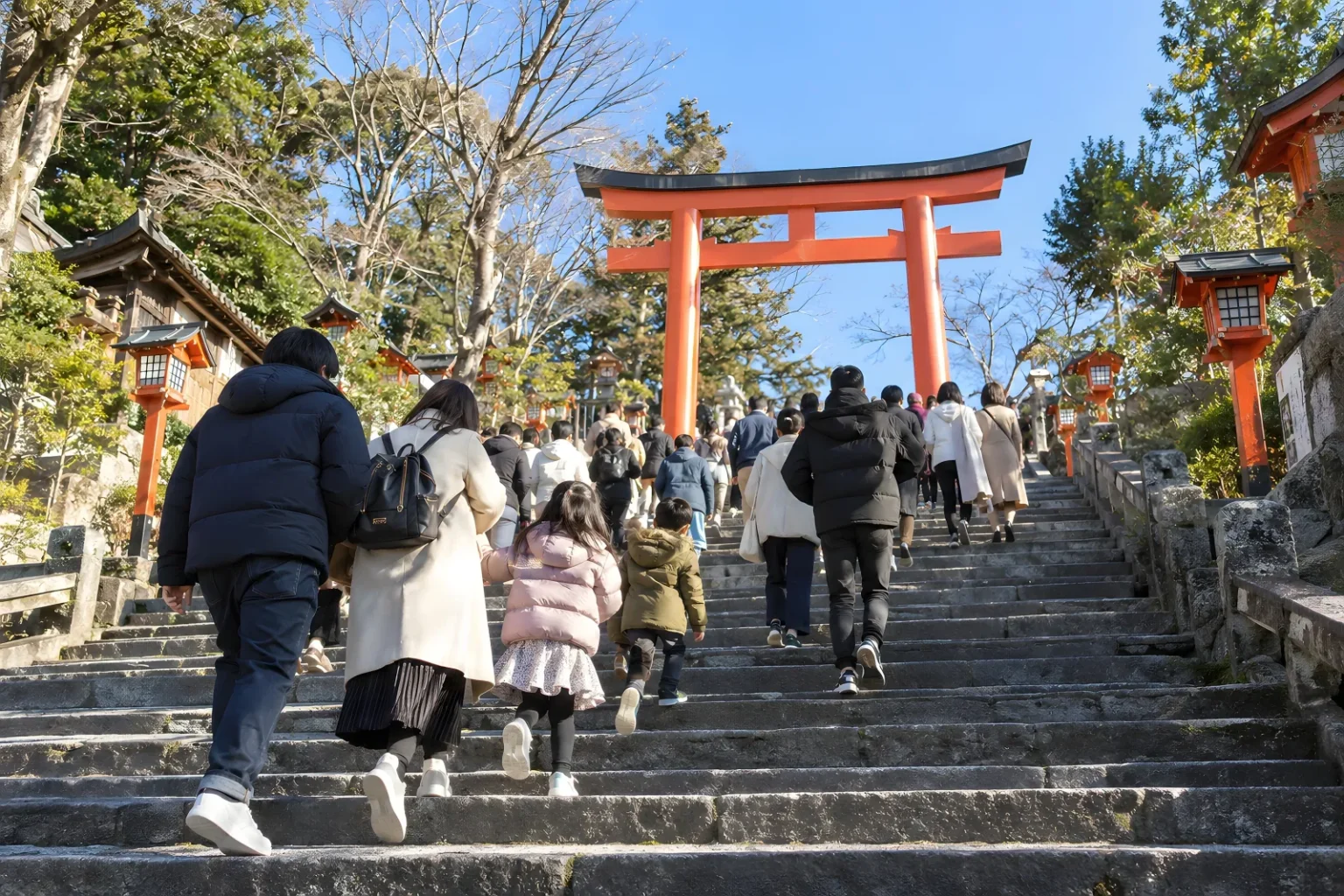
- At the bell. Follow the staff. At Chion-in (2026 notice) you can leave the bell tower but not come back in, and the ringing is live-streamed, so you may appear on camera.
- Omikuji. Sensoji asks you to put the numbered stick back in its box and to tie a bad fortune at the place provided. My omikuji guide explains how to read one.
- Old charms. Jinja Honcho: return them to the shrine they came from, or ask a nearby one.
- The fox parade. The organisers’ 2025–26 rules asked walkers not to wear fox-ear headbands or tails: it is a procession to a shrine, not a costume event. The 34th parade’s rules were not yet posted on 20 November 2026.
- Photos. These are religious services; see my photography etiquette guide. Chion-in’s 2026 notice prohibits using tripods and selfie sticks, and the Imperial Palace prohibited them at its 2026 greeting.
Temple notices, train plans and bad-weather cancellations are posted online, and several of the pages this guide relies on are in Japanese. A data connection lets you check and translate them on the night.
Get a Japan eSIMCheck these notices before you go
On 20 November 2026 Zojoji, Chion-in, SHIBUYA SKY, JR East, the Tokyo Fire Department and Imamiya Ebisu had posted this season’s details; Oji’s timetable, the Imperial Palace’s 2027 greeting and Keihan’s New Year trains were not yet posted. Check before you travel:
- Bells: Zojoji New Year page; Chion-in joya no kane
- Oji: fox parade organisers
- 2 January: Imperial Household Agency greeting page
- Sunrise: SHIBUYA SKY sunrise page
- Trains: JR East winter extra trains; Keihan
- Kyoto: Okera-mairi listing (already for 2026)
- Dazaifu: usokae and onisube page (standing page; check the 2027 price and times)
For other events around the New Year, see Christmas in Japan 2026 and my fukubukuro guide.
FAQ
What do Japanese people do on New Year’s Eve?
It centres on the home: toshikoshi soba, and in Hokkaido, MAFF’s office there says, many eat the New Year feast that night. Some go out to the temple bells or a shrine.
Can tourists ring the New Year’s bell in Japan?
At some temples. For 2026–27, Zojoji in Tokyo plans to sell a limited number of ¥2,000 ringing tickets from 9 a.m. on 1 December 2026; at Chion-in in Kyoto visitors watch, with tickets for viewing only. The current details are in the cards above.
What time is the first sunrise on 1 January 2027?
6:50 a.m. in Tokyo, 7:05 a.m. in Kyoto and Osaka, 7:06 a.m. in Sapporo and 7:23 a.m. in Fukuoka, according to the National Astronomical Observatory of Japan, for a sea-level horizon.
Do trains run all night on New Year’s Eve?
Some do. JR East has announced extra trains after the last regular trains on six lines around Tokyo for 2026–27, including the Yamanote Line. Keihan ran its main lines all night in 2025–26, but its 2026–27 timetable was not yet posted on 20 November 2026, so check its current page before you rely on a night train.
When do New Year decorations come down in Japan?
Usually on 7 January in Kanto and 15 January in Kansai, according to Weathernews; households vary. Kagami mochi is broken and eaten in many regions, often on 11 January, and many shrines burn old decorations between 31 December and 15 January (Jinja Honcho).
Is 2027 the Year of the Sheep?
Yes. Japan Post’s 2027 New Year card materials call it the year of the sheep (hitsuji).
Sources (checked 12 October 2026; some rechecked 20 November 2026)
- National Astronomical Observatory of Japan: sunrise and sunset by city, January 2027 pages for Tokyo, Kyoto, Sapporo, Fukuoka and the others; 2027 almanac
- Cabinet Office: national holidays 2026 and 2027
- Japan Post: 2027 New Year cards (PDF); 2027 New Year’s postcards: issuance overview (PDF)
- Jinja Honcho: susuharai; ofuda and sagicho
- MAFF: osechi; kagami mochi; aff January 2020: seasons and mochi, mochi shapes by region, zoni around Japan (PDF); Kyoto white-miso zoni; Hokkaido office: year-end and New Year customs
- Weathernews: how long New Year lasts (9 January 2025); New Year decorations (26 December 2025); toshikoshi soba (December 2025)
- Zojoji: New Year services and joya no kane; change of bell-ringing times (1 November 2026)
- Chion-in: joya no kane; 31 December 2026; practice ringing
- Sensoji: annual events, joya no kane, Hagoita-ichi, soot-sweeping, New Year services, FAQ (omikuji)
- Kyoto City official tourism site (Kyoto Navi): Okera-mairi, 31 December 2026; koto-hajime. Yasaka Shrine: New Year rites and Okera-mairi; yearly events (archived copy, April 2026)
- Kita City: Asukayama Museum on the Hiroshige print; Oji fox parade. Oji fox parade committee: official site, 2025–26 timetable, participation rules
- Imperial Household Agency: New Year greeting, 2 January 2026; visitor numbers
- SHIBUYA SKY: New Year sunrise event, 1 January 2027
- Takashimaya: Nihombashi first sale, January 2026 (PDF); 2027 experience lucky bags (PDF, November 2026)
- Tokyo Fire Department: 2027 New Year review
- Dazaifu Tenmangu: usokae and onisube. Imamiya Ebisu: Toka Ebisu; 2027 Toka Ebisu notices, 2027 dates (9 to 11 January)
- JR East: winter extra trains 2026–27, including New Year’s Eve (22 October 2026) (PDF, New Year’s Eve times on page 8). Keihan: New Year trains 2025–26 (PDF)
- Japan Meteorological Agency: climate normals 1991–2020 for Tokyo, Kyoto and Sapporo
- Kyodo News via Kumamoto Nichinichi Shimbun: New Year card print run falls for the 16th year, 31 August 2026 (Japanese)
- nippon.com: New Year card numbers, 8 November 2018 (Japanese)
Join travelers discovering Japan's hidden side
Weekly dispatches from off-the-beaten-path Japan — spots and stories you won't find in guidebooks.
No spam. Unsubscribe anytime.
Welcome aboard!
You're in. See you in your inbox soon.