Kyushu · Oita & Fukuoka · Late autumn
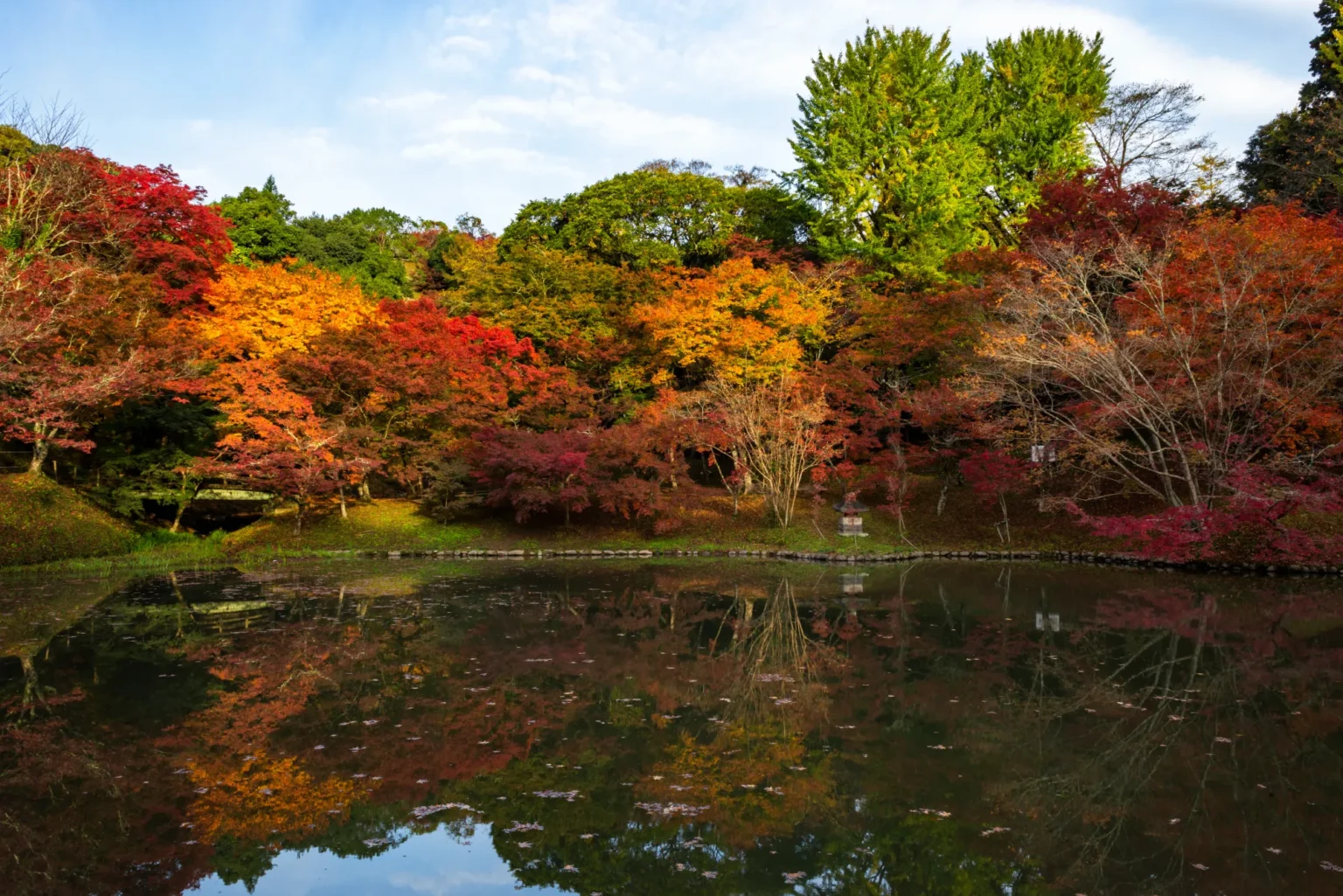
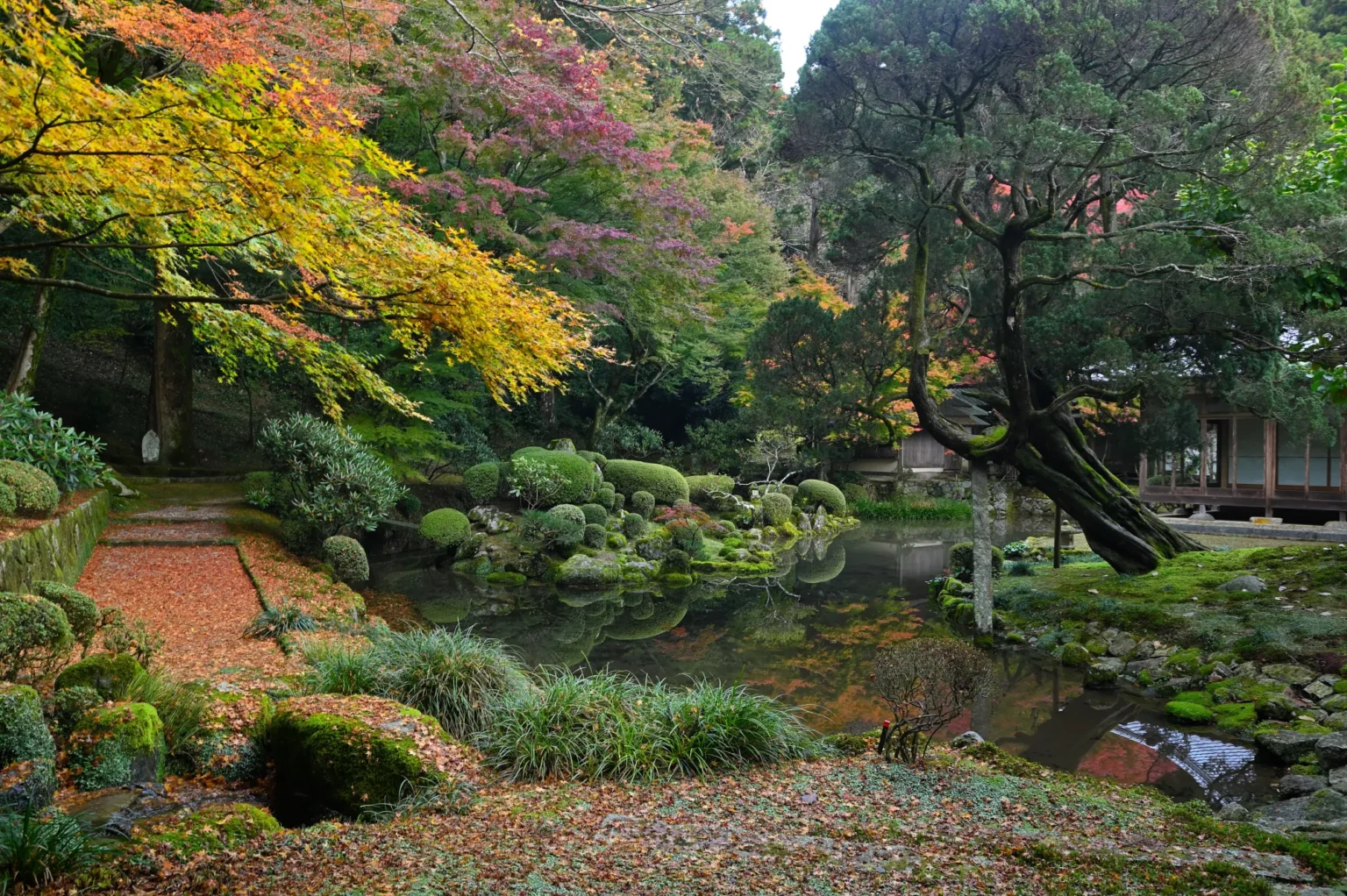
Yujaku Park in Oita — a former daimyo retainer’s villa garden with around 500 maples around its ponds — gets little attention in English: there is nothing on japan-guide or JNTO, and the one official English mention I found is an entry in a downloadable walking guide from Oita’s tourism organisation. Raizan Sennyoji in Fukuoka has the opposite problem. It is covered in English, but the details are wrong in ways that matter: its admission went up on 1 September 2025 and round-ups still quote the old figures, and its famous maple is a prefecturally designated natural monument, not the municipal one VISIT FUKUOKA’s English page describes.
Two different windows, a week or so apart
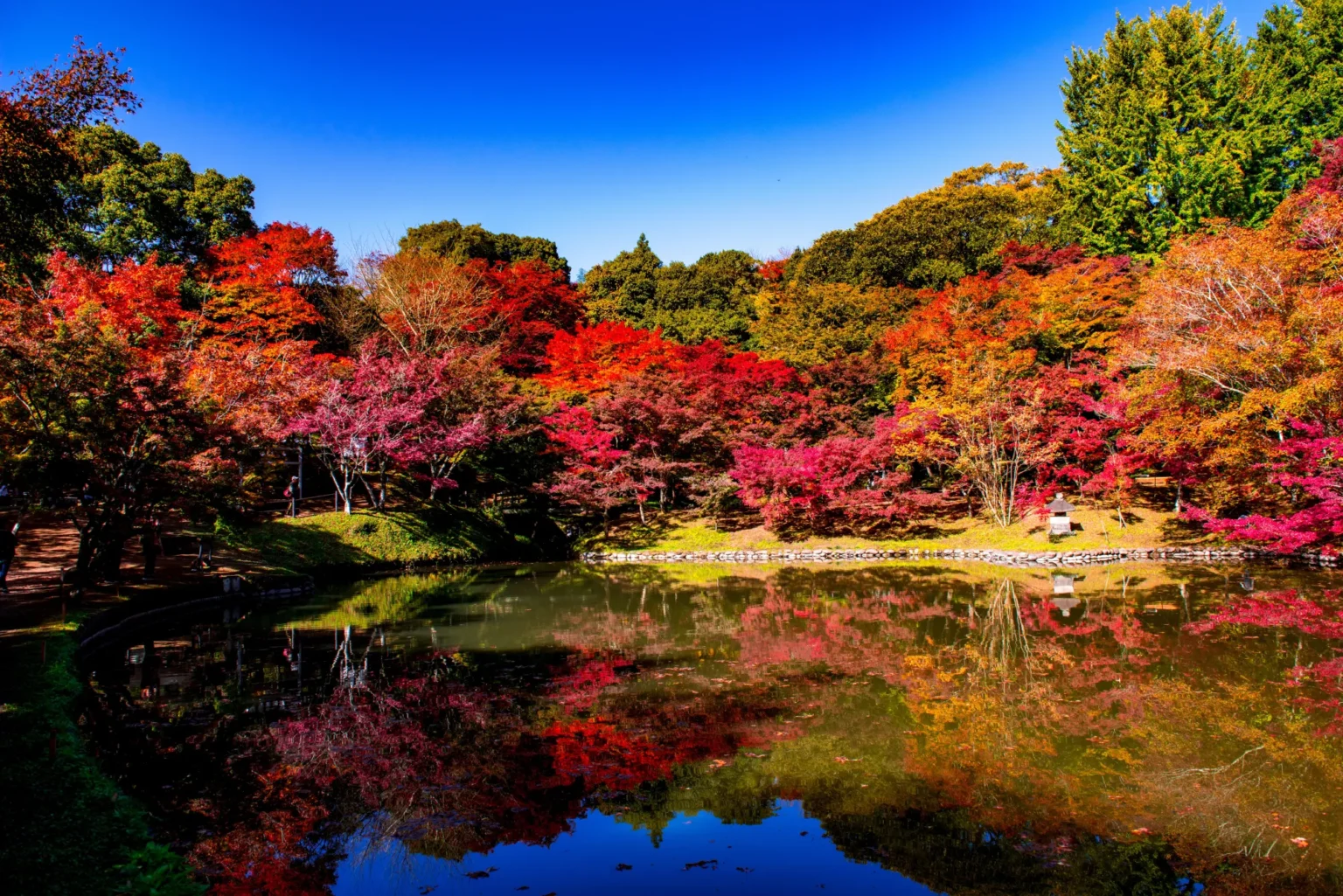
These two cover different halves of November rather than arriving together. Sennyoji’s own FAQ puts the great maple at “roughly early to mid November,” with the temple’s blog naming around 10 November as the usual peak, and says the two hundred or so maples across the grounds hold colour “through the end of November.” Bungo-ono City Tourism gives Yujaku Park’s window as “from mid to late November.”
What makes Yujaku unusually well documented is that the tourism association posts dated progress reports from the park itself. In 2025: colour starting around the ponds on 7 November; “about 60 per cent overall, and the ring around Shinji Pond looks like it peaks this week” on 17 November; 70 per cent on 20 November; “just past peak around the pond” on 25 November; leaves down by 9 December. That is a more useful record than any forecast, and it is the kind of thing our koyo tracker follows through the season. For where the front sits nationally in the same weeks, see our November guide.
Yujaku Park: a retainer’s garden nobody writes about in English
The land was granted by the lord of Oka Domain to his senior retainer Nakagawa Heiemon Naganobu as a villa estate. It sat on the domain’s sankin-kotai route to Edo, and Oita’s prefectural tourism body records that the Nakagawa lords stopped here on those journeys, and that literary figures including Tanomura Chikuden and Rai San’yo visited — the place functioned as the domain’s front door and reception house. In 1880 it passed to the Kira family. Every current festival notice routes enquiries through the Bungo-ono City Asaji Branch Office.
The maple count depends which official page you read: Bungo-ono City Tourism says “about 500” maple trees, Oita Prefecture says “more than 500.” Both are official. I have not found a count anyone has actually verified, so treat 500 as the order of magnitude rather than a number.
The festival, and the part that catches people out
The Yujaku Autumn Maple Festival has run 3–24 November for the last two editions. Illumination is the draw, and this is the thing to get right: it does not run every night. In 2025 it ran on seven specific dates — 7, 8, 14, 16, 21, 22 and 23 November — from sunset to 21:00. In 2024 it ran on six. Turning up on an unlit evening in the middle of the festival period is an easy mistake to make.
The 2026 edition, the 45th, runs 3–23 November. Bungo-ono City announced it on 13 October and its tourism association on 16 October, with illumination on five nights only — 7, 13, 20, 21 and 22 November — from sunset to 21:00. Entry is free.
Free entry and parking
The tourism association’s 2026 festival notice lists entry as free and parking as available at no charge, apart from the restrictions on the night-kagura date below.
Bring a light for the illumination
The association’s own report from 7 November 2025 says it plainly: the reflections are lovely at night, but parts of the path are dark underfoot and they recommend carrying a torch.
Night kagura, one date
In 2026 the Mizukagami night kagura is on 14 November from 15:45 beside Shinji Pond, whose surface reflects the dance, moving to the next day if it rains. From 14:00 that day parking at and around the site closes, and a shuttle runs from Asaji Community Centre between 15:00 and 21:00 for a ¥300 contribution.
Access was restricted for most of 2025
Construction-related access restrictions ran from January 2025 until 31 July and were lifted on 1 August. Nothing suggests a repeat, but it is worth checking current notices before making a long detour.
Getting to Yujaku Park
The nearest station is Asaji on the JR Hohi Line. From Oita it is a 1 hour 10 minute run on a local train, no change, ¥1,300 — that fare is the ticket alone, because no limited express is involved. From Bungo-taketa it is six minutes and ¥270. From Kumamoto, the realistic option is the Kyushu Odan limited express with one change at Bungo-taketa: about 2 hours 36 minutes, ¥3,620 unreserved.
Asaji is an unstaffed station — JR Kyushu’s own page for it says under ticket sales, “there is no sales window.” Thirty-four trains call there across a day, seventeen in each direction.
Raizan Sennyoji Daihioin: one maple, three official ages
Both ends of this need wheels
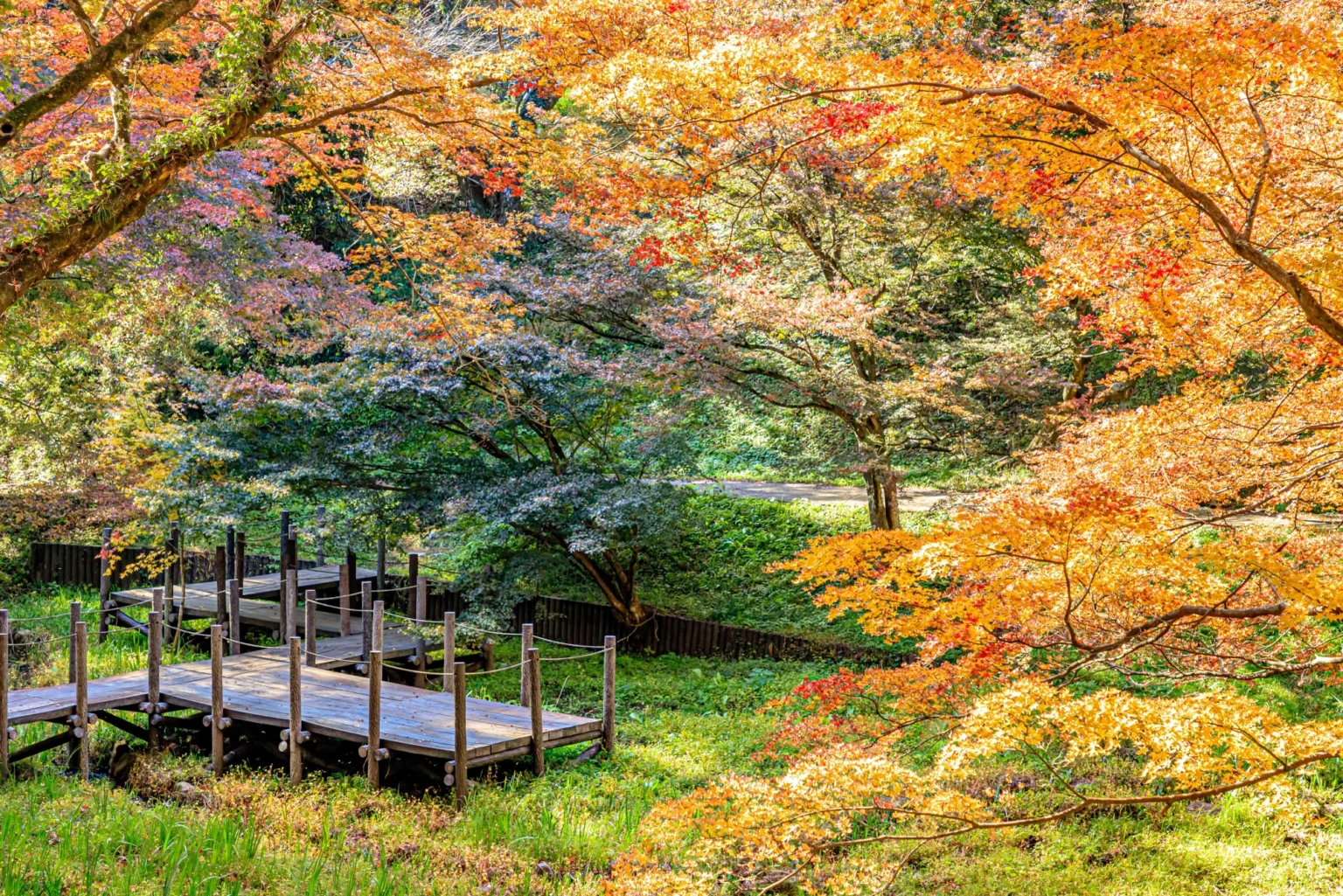
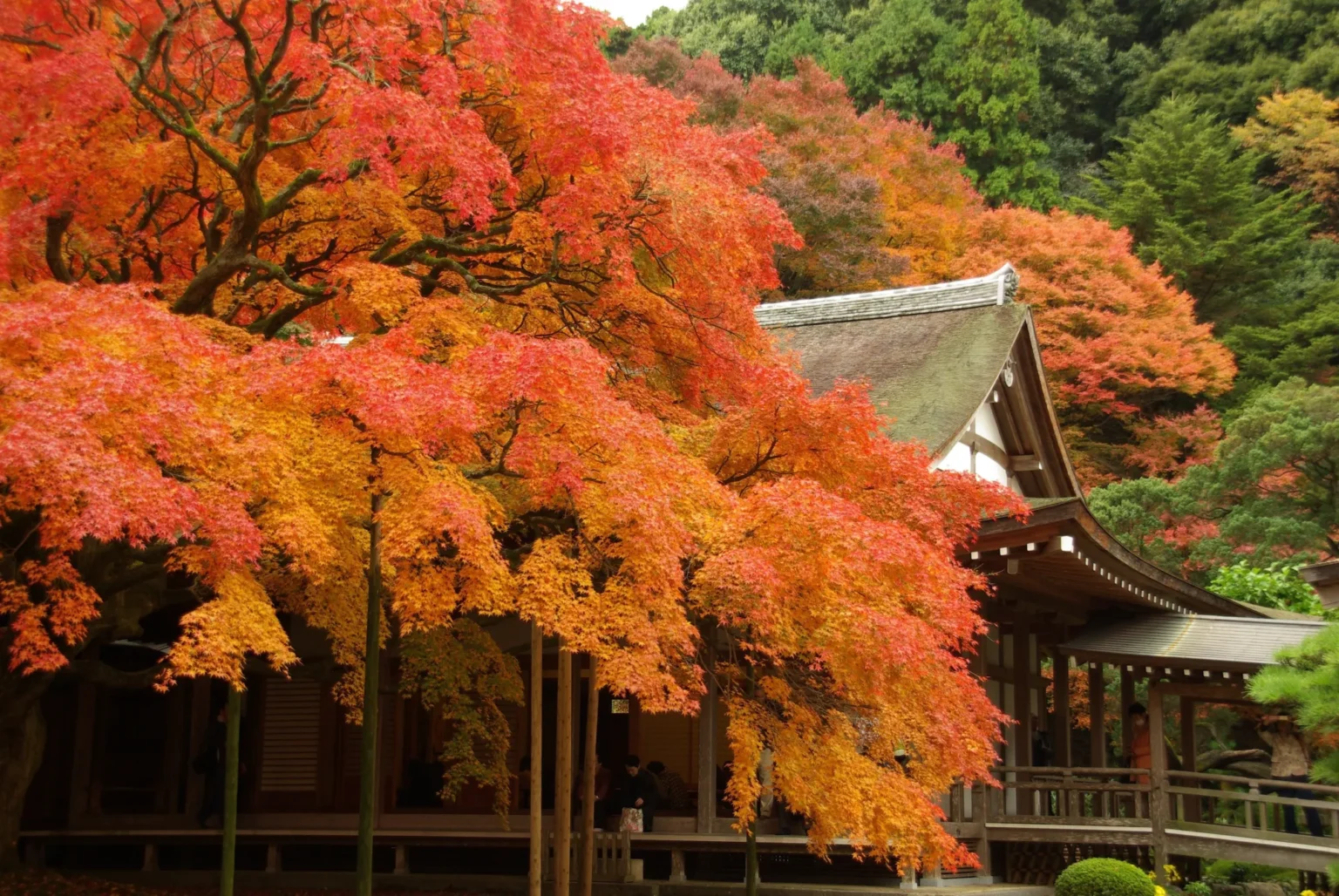
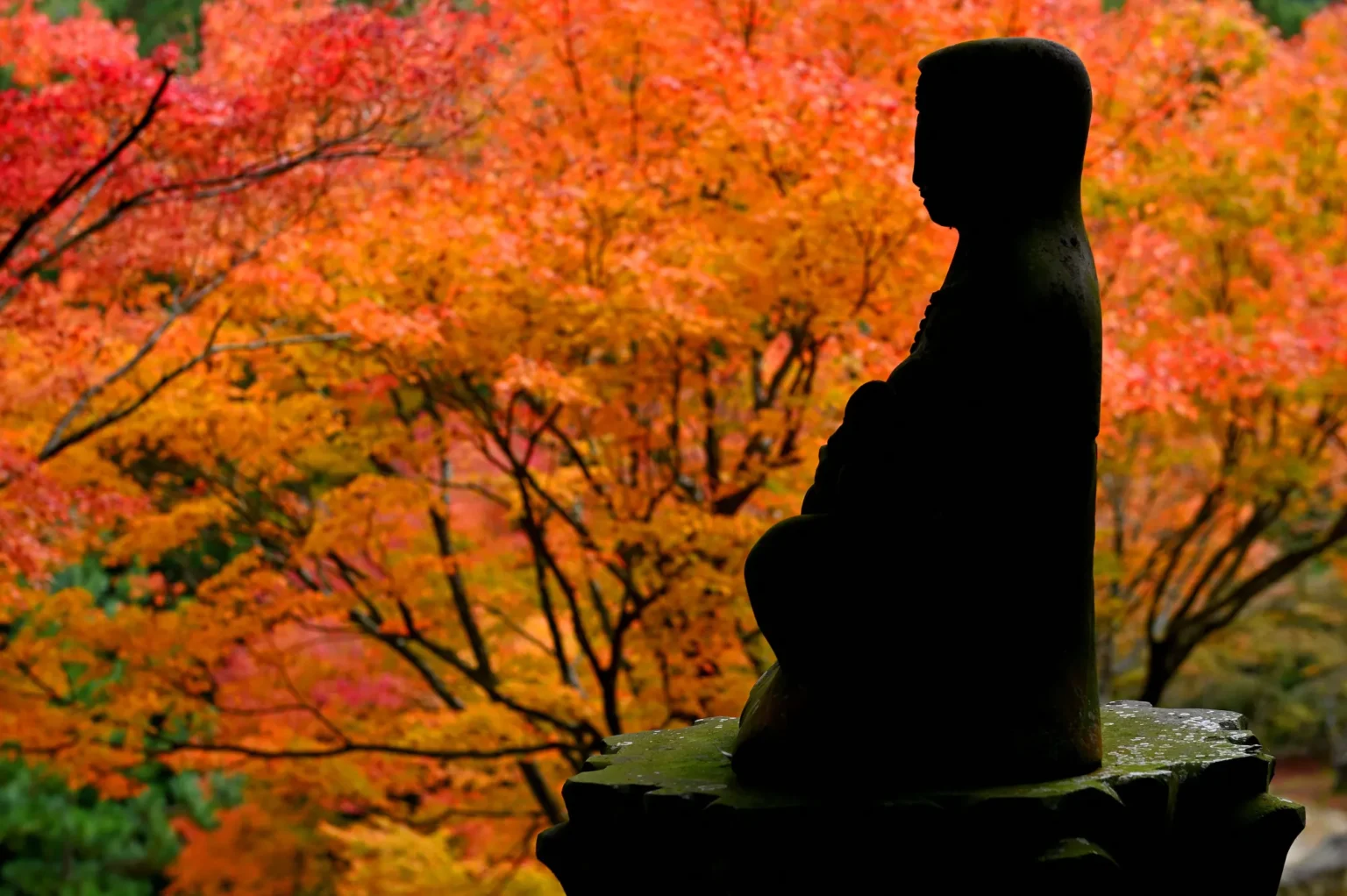
Daihioin was founded in 1753 by Kuroda Tsugutaka, lord of Fukuoka Domain. The great maple in the front garden is said to have been planted to mark that founding — which is where the arithmetic gets interesting, because Itoshima City’s own heritage page describes the tree as more than 350 years old, and its 2026 register of designated cultural properties gives about 300 years. Fukuoka Prefecture’s English page says 400. The temple itself does not state an age at all.
What is not in dispute is the designation and the measurements. The prefecture listed “the maples of Daihioin” as a natural monument on 14 January 1961 — three trees, all with a girth over 2.3 m at chest height. Itoshima City’s detail page describes the largest, in the front garden, as about 8 m tall with a girth of about 2.3 m and a root spread of about 13 m, its trunk dividing into three at 1.7 m above the ground and fanning out from there. Two more stand in the inner garden.
What you pay, and the November arrangement nobody explains
English sources describe this as a temple that changes its price in November. That is not quite it. The standard admission is ¥500 for adults, ¥400 for groups of twenty or more, free for junior high school age and under, and that does not change. What November adds is a separate, cheaper option: from 1 to 30 November, visitors who only want to see the outer garden and the great maple pay a ¥200 grounds fee instead. There is no group discount on that one.
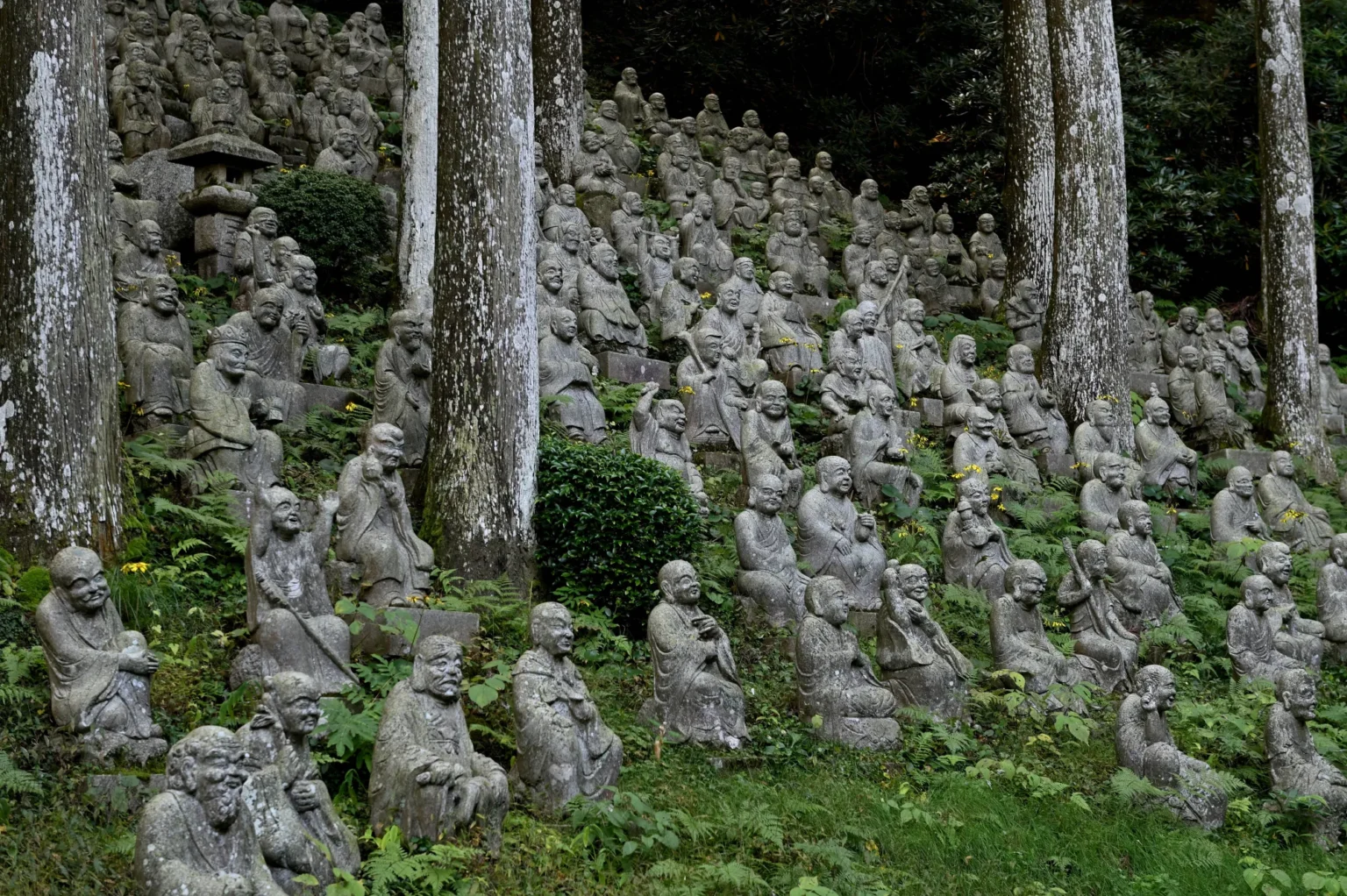
Both figures date from 1 September 2025, when the temple raised prices citing maintenance costs. The ¥500 admission includes entry to the halls, where the temple says a priest gives a fifteen-to-twenty-minute explanation to every visitor, individual or group alike. Inside is the principal image, a standing eleven-headed thousand-armed Kannon 4.63 m tall and designated an Important Cultural Property, along with the five hundred rakan.
| Yujaku Park | Raizan Sennyoji | |
|---|---|---|
| Prefecture | Oita (Bungo-ono) | Fukuoka (Itoshima) |
| Peak | Mid to late November | Great maple around 10 Nov; grounds to end of November |
| Admission | Free during the festival (2026 notice) | ¥500, or ¥200 grounds-only in November |
| Hours | Festival 3–23 November 2026; illumination sunset–21:00 on 7, 13, 20, 21 and 22 November only | Reception 09:00–16:30; gates close 17:00 in November |
| Tripods | No rule published | Banned, indoors and out; must be left at reception in November |
| Nearest station | Asaji (unstaffed) | Chikuzen-Maebaru |
| Last mile | 1.8 km waymarked walk from the station | Weekends and holidays: bus to Raizan Kannon-mae, then 7 min on foot. Weekdays: no regular bus reaches the temple |
The rules at Sennyoji are stricter than most
The temple’s FAQ is direct: personal photography is permitted, but tripods and monopods of any kind are banned both inside the halls and outdoors, along with drones and elaborate costume photography. In November the blog adds that tripods may not even be brought in — leave them at reception — that eating and drinking are prohibited throughout, that pets are not admitted, that the grounds are non-smoking, and that photography inside the halls is not permitted.
There is one more line worth knowing if you are planning a shoot rather than a visit: location photography, including pre-wedding shoots, is allowed at Sennyoji except during November and from 31 December to 17 January, and requires an application. In other words the temple stops accepting organised shoots for exactly the month everybody wants to photograph it.
Getting to Sennyoji, and why the day of the week decides everything
Chikuzen-Maebaru is easy: 42 minutes from Hakata and ¥640, or 47 minutes from Fukuoka Airport and ¥680, on the through service between the Fukuoka subway airport line and the JR Chikuhi Line. Note that the subway–JR transfer discount does not apply on this route.
The last five kilometres are where it gets awkward, and I have not seen this explained in English anywhere.
In 2025 the operators added a direct shuttle for the maple season, and unusually it ran on weekdays only — precisely to fill the gap above. It ran 17 to 28 November, three round trips a day, 22 minutes each way, ¥500 one way. Whether it runs again in 2026 had not been announced when I checked again on 20 October: Showa Bus’s 2025 notice has been deleted and nothing has replaced it. Past announcements have gone up in early to mid November, so check then rather than now.
The temple’s access page gives no parking details, but a 2023 post on its official blog mentions three car parks and about 120 spaces. VISIT FUKUOKA says 119, and its page for the same temple’s juniper says 50, which tells you how much weight to put on either number.
Doing both, and what else is nearby
Further into Kyushu, and worth a detour if you are heading for Aso: Nabegataki Falls in Oguni, where you can walk behind the water — 25 minutes from Kurokawa Onsen, and cheaper and less booked-up than most people expect.
They are not a practical same-day pairing: Itoshima is west of Fukuoka, Bungo-ono is deep in inland Oita, and their usual peaks are roughly a week to ten days apart. Treat them as two ends of a Kyushu autumn fortnight — Sennyoji in the first half of November, Yujaku in the third week.
If you are already building the fortnight, Oita holds a third date most English itineraries miss. Yabakei’s Hitome-Hakkei is one of the three places that share the unofficial title of Japan’s great autumn foliage, and Weathernews puts its 2026 peak from about 15 November — between Sennyoji and Yujaku, in the same prefecture as Yujaku.
Both ends assume wheels: Yujaku sits five to six minutes by car from an unstaffed rural station, and Sennyoji’s weekday buses are effectively unusable. TOCOO compares Oita pickups across Japan’s rental companies (coupon IJMEMZ takes ¥1,000 off a base rental of ¥10,000 or more, options excluded — check it shows before payment), and DiscoverCars covers the international brands for a Fukuoka Airport start.
Around Sennyoji, Itoshima is well covered in English for its coast, oyster huts and cafés. For a second temple with maples that most visitors miss, we have written about Nomiyama Kannon-ji in Sasaguri, on the other side of Fukuoka. Around Yujaku, the Kyushu Olle course continues to Oka Castle and the town of Bungo-taketa, which is the natural second stop. If you are circling the whole island rather than staying in Oita, the Saga pottery towns are a separate leg — see getting to Imari and Arita. If you are building a wider autumn route, our October highland gems covers what turns before Kyushu does, and the Aigi Tunnels near Nagoya are the late-November counterpart on the way back east. For the month either side, see Japan in October.
On where to stay: Itoshima works as a day trip from the city, so Fukuoka hotels are the practical base, though staying in Itoshima itself shortens the taxi ride and makes the on-demand minibus easier to arrange — it does not, on its own, solve the weekday bus gap. For Yujaku, Bungo-ono has little accommodation and most people base in Oita city or at Bungo-taketa; Rakuten Travel lists the small Japanese inns around there that the international sites tend to miss. Both of these run on notices that change late and locally — illumination nights, a shuttle that may or may not return — so having data on the day to check for cancellations matters more here than at a big-name site. If you are not arriving with a Japanese number, an eSIM covers it.
Questions worth answering first
Are the 2026 Yujaku festival and the Sennyoji shuttle confirmed?
The Yujaku festival is: 3–23 November 2026, lit on 7, 13, 20, 21 and 22 November. The Sennyoji shuttle had not been announced as of 20 October 2026. Sennyoji’s November admission arrangement is standing and needs no announcement, but the weekday shuttle bus is a separate seasonal service run by the bus operator, and past notices have appeared in early to mid November. Check both before you fix a date.
When should I visit each one?
Sennyoji’s great maple is usually best in the first half of November, with the temple’s own estimate around the 10th, and the two hundred or so other maples in the compound hold to the end of the month. Yujaku Park is generally best from the middle of November into the third week. Yujaku ran illumination on selected nights in 2024 and 2025; I found no illumination programme published for Sennyoji.
Can I get to Sennyoji without a car on a weekday?
Not on an ordinary bus. Between 08:30 and 17:00 on weekdays the only public option is the on-demand minibus, which needs membership arranged in advance. In the maple season a weekday-only direct shuttle fills the gap, but it is confirmed each year only in November. A taxi from Chikuzen-Maebaru is about twenty minutes.
What does ¥200 at Sennyoji actually get me?
The outer garden and the great maple, from 1 to 30 November only. It does not include the halls. If you want the thousand-armed Kannon, the rakan and the priest’s explanation, that is the ¥500 admission, which is charged all year.
Is there an entry fee at Yujaku Park?
No. The 2026 festival notice lists entry as free and parking as free. The one charge documented is a ¥300 shuttle contribution on the night-kagura date, 14 November in 2026.
Can I use a tripod?
Not at Sennyoji. Tripods and monopods are banned indoors and outdoors year-round, and in November they may not be brought onto the grounds at all. Yujaku Park publishes no photography rule; the general Bungo-ono city park ordinance requires permission for photography as a business, but I could not confirm that Yujaku is a designated city park under it.
Sources
The primary sources behind every figure above
- Sennyoji hours, fees, rules, maple: Sennyoji Daihioin official site — admission page, FAQ, priest’s message, and the temple blog.
- Maple designation and measurements: Itoshima City cultural property page and the city’s register of designated properties current to 1 April 2026.
- Yujaku Park, festival and illumination dates: Bungo-ono City Tourism Association, including its dated 2025 progress reports; Tourism Oita.
- Trains: JR Kyushu timetable and fare search, and the Asaji station page; Fukuoka City Transportation Bureau fare search for the subway through service.
- Buses: Showa Bus Raizan line timetable; Itoshima City’s community transport booklet, April 2026 edition; Bungo-ono City community bus timetable, April 2026 revision.
- Walking route: Kyushu Olle official course notes for the Oku-Bungo course.
- Yujaku Park English coverage, checked 3 September 2026: japan-guide.com, JapanTravel, Time Out, Tokyo Cheapo, Voyapon, MATCHA, JNTO, Visit Oita and Bungo-ono City — no dedicated page found on any of the nine.
- Sennyoji English coverage and its errors: VISIT FUKUOKA’s spot page (hours, ¥500, parking, bus) and MATCHA’s Kyushu and Fukuoka autumn round-ups, which carry the pre-September-2025 prices.
Join travelers discovering Japan's hidden side
Weekly dispatches from off-the-beaten-path Japan — spots and stories you won't find in guidebooks.
No spam. Unsubscribe anytime.
Welcome aboard!
You're in. See you in your inbox soon.