
Climbing season status
The 2026 climbing season ended on 10 September 2026
The official trails to the summit and the mountain huts are closed. Climbing to the top is not something to attempt now — the route markers, the huts and the first-aid stations that operate only during the season are gone until next summer, and so is the entry reception.
Some 5th Stations may still be reachable for sightseeing, depending on road, weather, snow and bus conditions on the day. That is not the same as the climbing trails being open.
Dates and current conditions: the official Mt Fuji climbing site.
Mt. Fuji Night Climb 2026: Dusk-to-Dawn Visual Guide [With Photos]
Most Mt. Fuji guides tell you what to pack and which trail to take. This one shows you what the mountain actually looks and feels like — hour by hour, from the moment the sun drops behind the cloud sea at 6 PM to the moment it rises in front of you at 4:30 AM. I am Nobu from Hidden Japan Gems. I climbed Mt. Fuji overnight, and the hours between dusk and dawn were nothing like what I expected. Here is the visual story, with practical notes for planning your own overnight climb.
Table of Contents
Part of the full Mt. Fuji travel guide.
Quick Facts
| Detail | Info |
| What | Overnight Mt. Fuji climb with mountain hut stay |
| Duration | About 22 hours for the suggested itinerary (5th Station departure to 5th Station return) |
| Climbing season | 2026: July 1 (Yoshida, Subashiri) or July 10 (Fujinomiya, Gotemba) to September 10 — now over |
| Entry fee | ¥4,000 mandatory (all trails) |
| Gate closure (Yoshida) | 2:00 PM – 3:00 AM (hut reservation holders exempt) |
| Mountain hut cost | Varies by hut, room and night — e.g. Horaikan (Yoshida 8th station), 2026: ¥15,000–¥17,000 in a dormitory bunk, ¥16,000–¥18,000 per person in a small room (1 night, 2 meals) |
| Summit sunrise | 4:21 AM (July 1) → 5:13 AM (September 10), official planning figures |
| Night temperature | Near freezing at the summit before dawn (JMA’s August normal daily low is about 4°C); below zero is possible |
| Trail | Yoshida Trail recommended (most huts, best infrastructure) |
| Key moments | Sunset cloud sea → night city lights → pre-dawn blue hour → goraiko → Shadow Fuji |
1. Why Should You Climb Mt. Fuji Overnight?
There are two ways to climb Mt. Fuji: a daytime ascent and an overnight ascent. The overnight version — arriving at a mountain hut by late afternoon, sleeping a few hours, then pushing to the summit for sunrise — gives you a rest stop before the pre-dawn push.
The practical reason: In 2026 the Yoshida Trail gate was closed from 2:00 PM to 3:00 AM to climbers without a mountain hut reservation, and the Shizuoka trails had the same hours rule. A 3:00 AM start is too late for the summit sunrise, so an overnight hut stay was effectively required for anyone aiming to see it from the top.
The experiential reason: Mt. Fuji transforms completely between dusk and dawn. The mountain you climb in afternoon sunlight becomes an entirely different place at night — the city lights below, the silence of the volcanic slopes, the headlamp chain winding upward, the slow explosion of color at dawn. You pass through nine distinct visual phases between afternoon and morning.
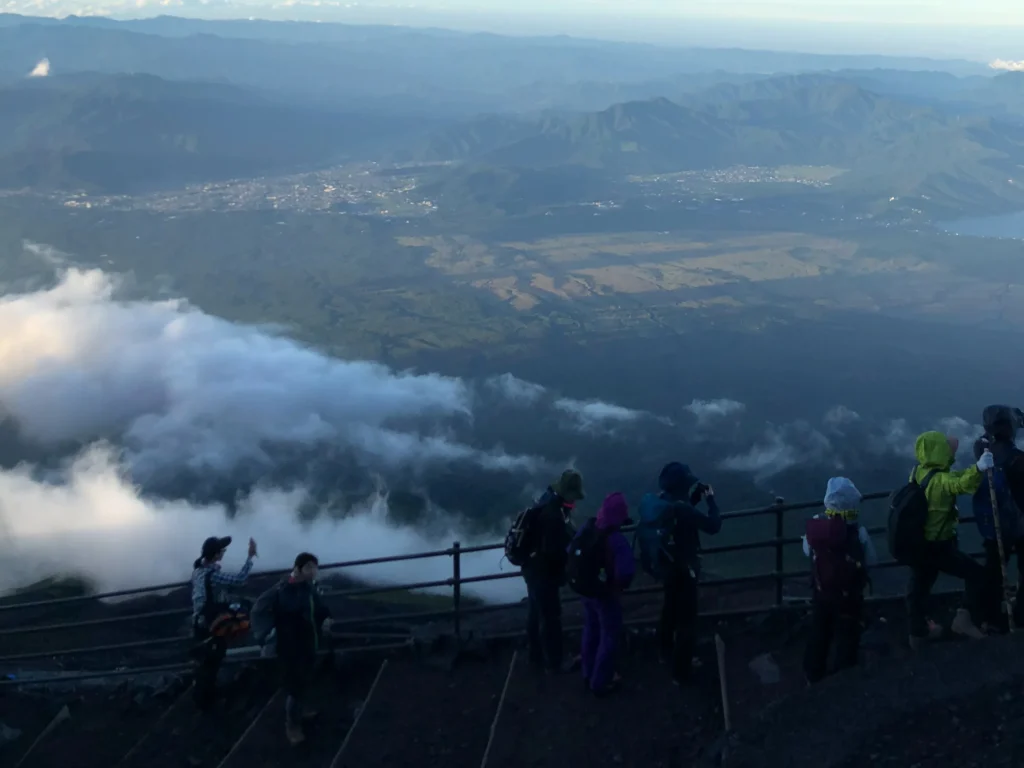
2. What Does the Dusk to Dawn Timeline Look Like?
This is the core of the experience — what you will actually see during each phase of the overnight climb.
Phase 1: The Ascent (1:00 PM – 5:00 PM)
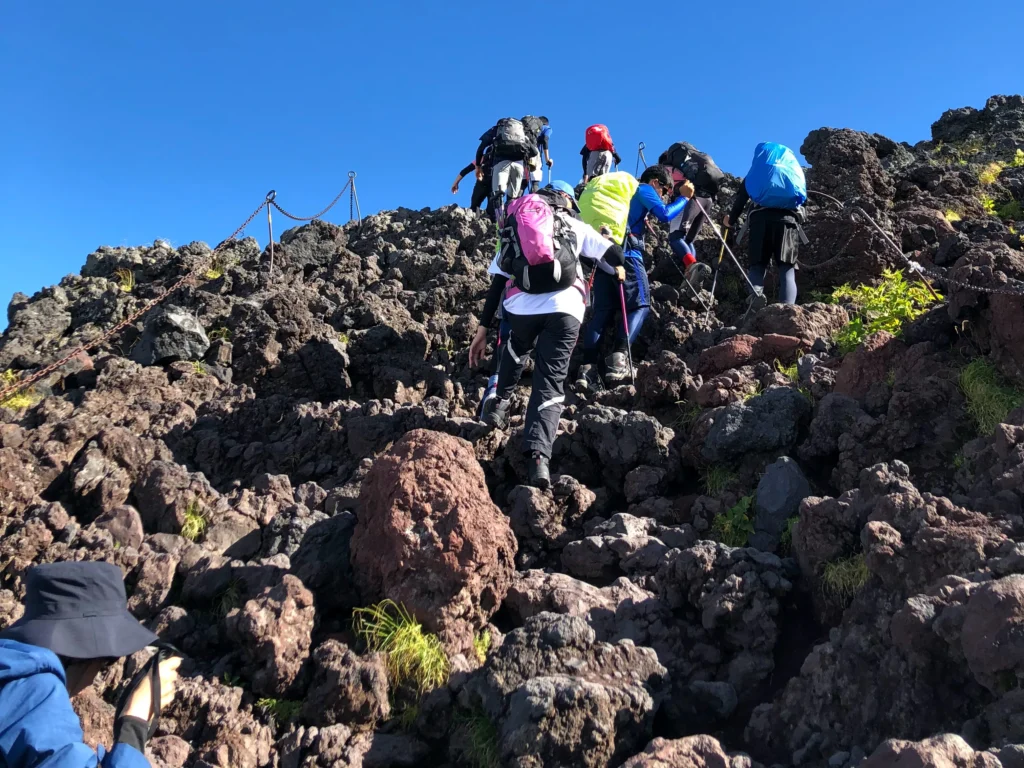
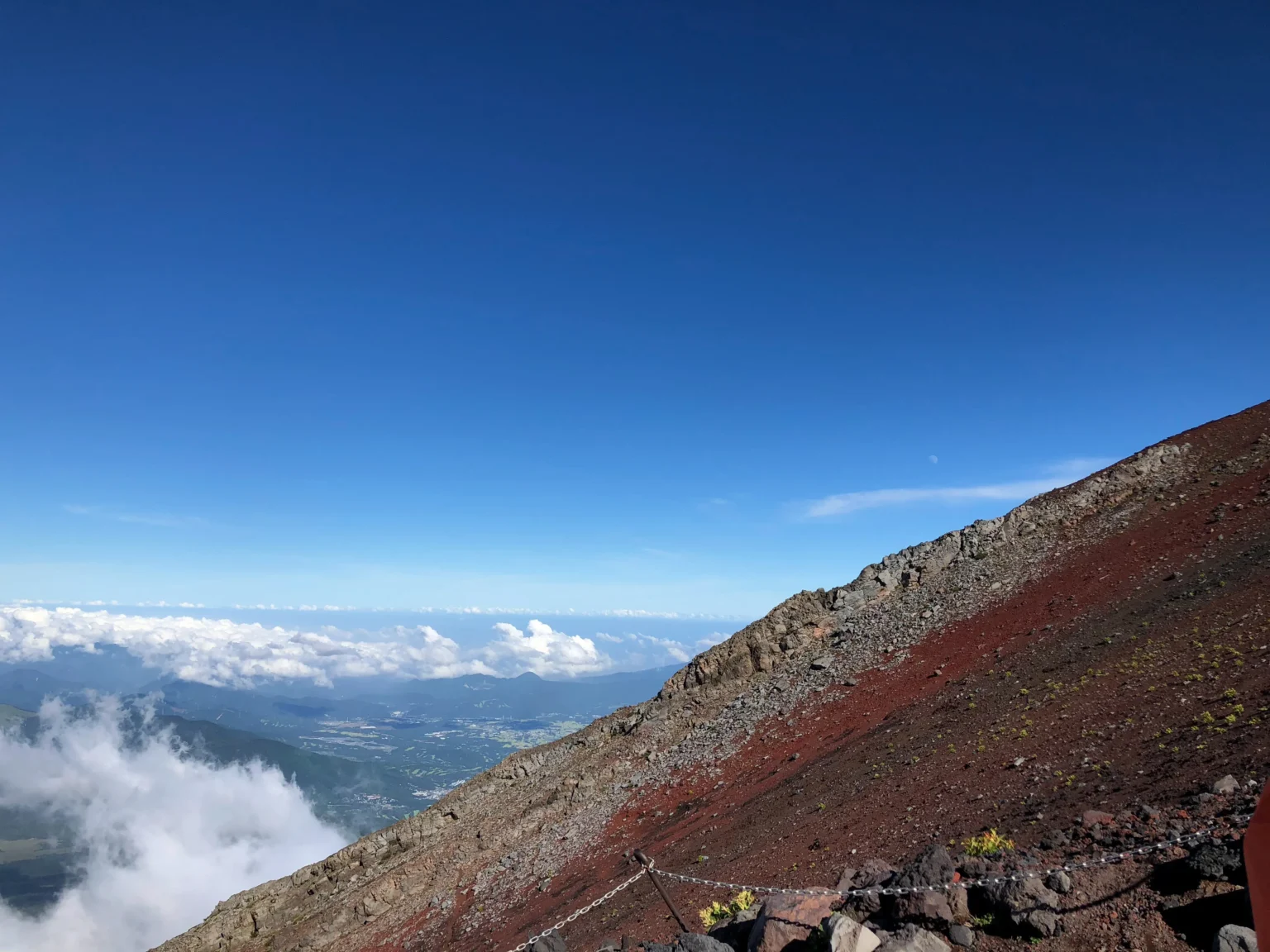
The afternoon climb from 5th Station to an 8th-station hut takes roughly 4–6 hours, depending on how high the hut is — Tomoekan at the upper 8th station quotes 5–6 hours. The landscape shifts from sparse forest at 2,300m to bare volcanic rock by 3,000m. Above the 7th station, it is all black basalt, red oxidized volcanic rock, and loose gravel. The colors are Mars-like — deep reds and blacks under harsh afternoon sun.
Phase 2: The Red Earth (3:00 PM – 5:00 PM)
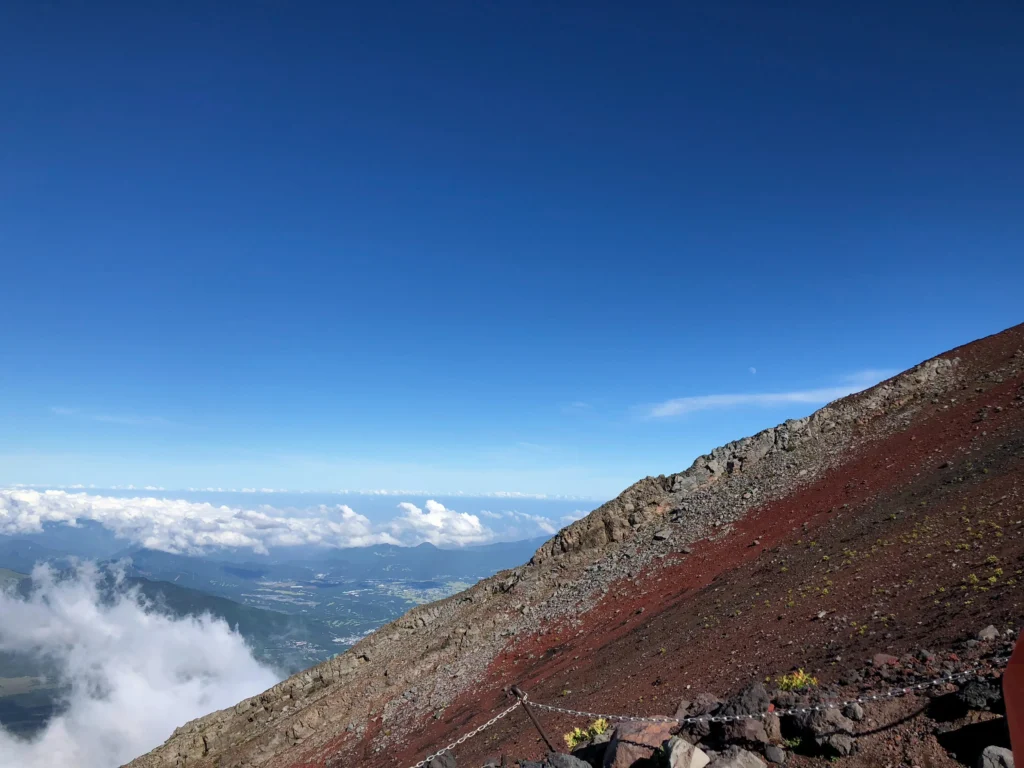
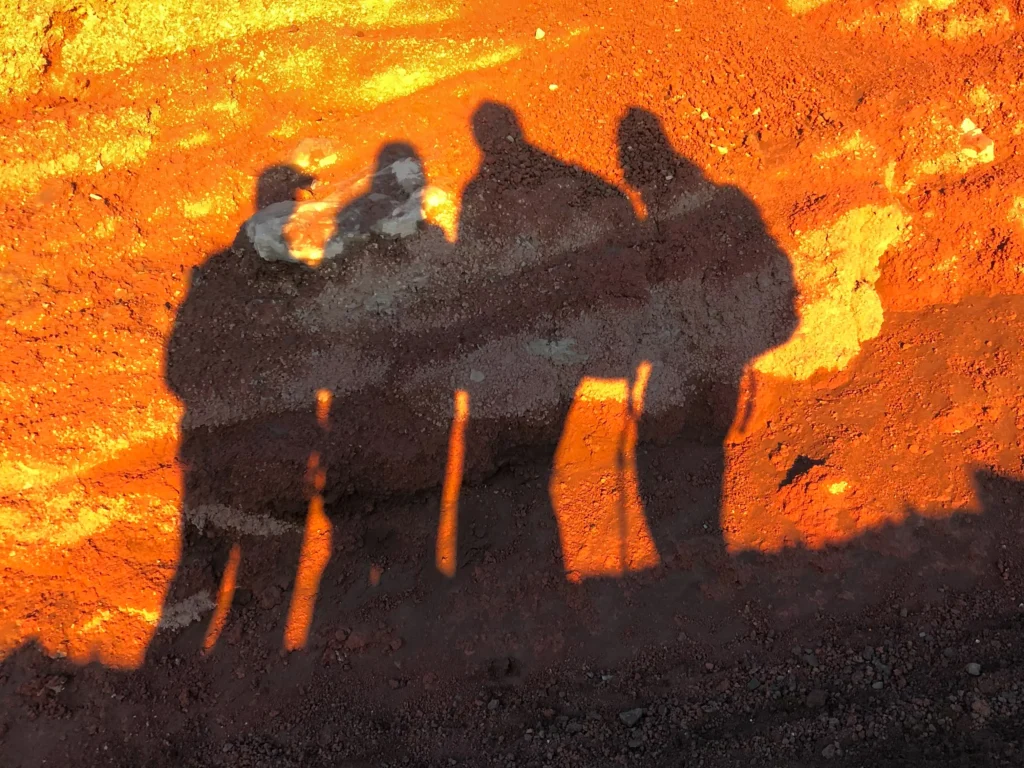
Between the 7th and 8th stations, the ground turns a striking rust-red. Combined with the white cloud sea below and the deep blue sky above, the color palette is surreal.
Phase 3: Sunset Above the Clouds (5:30 PM – 7:00 PM)
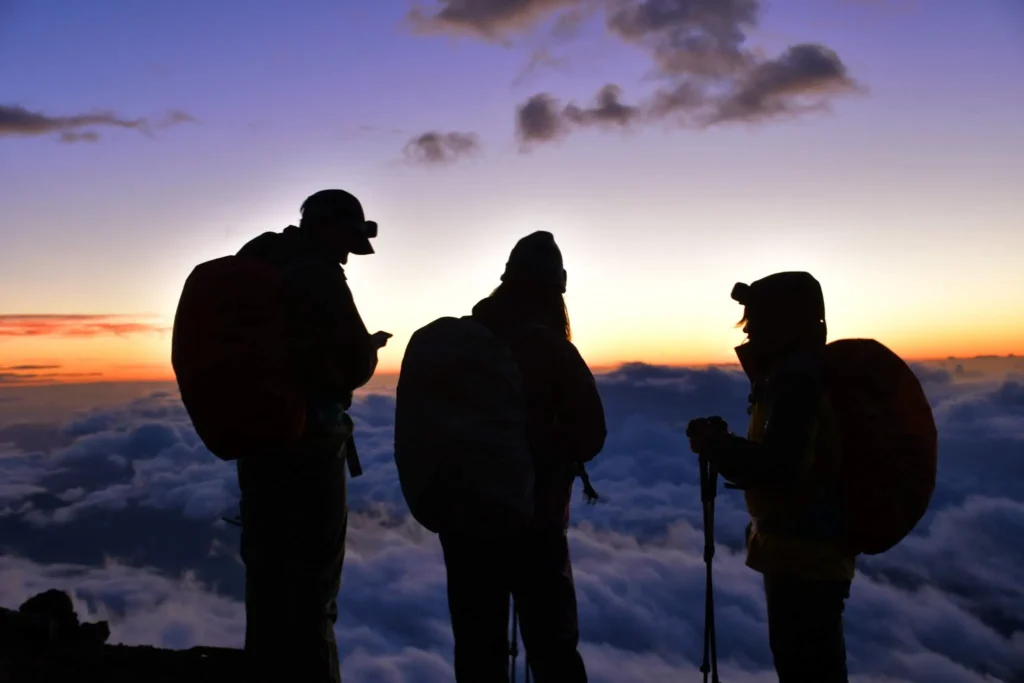
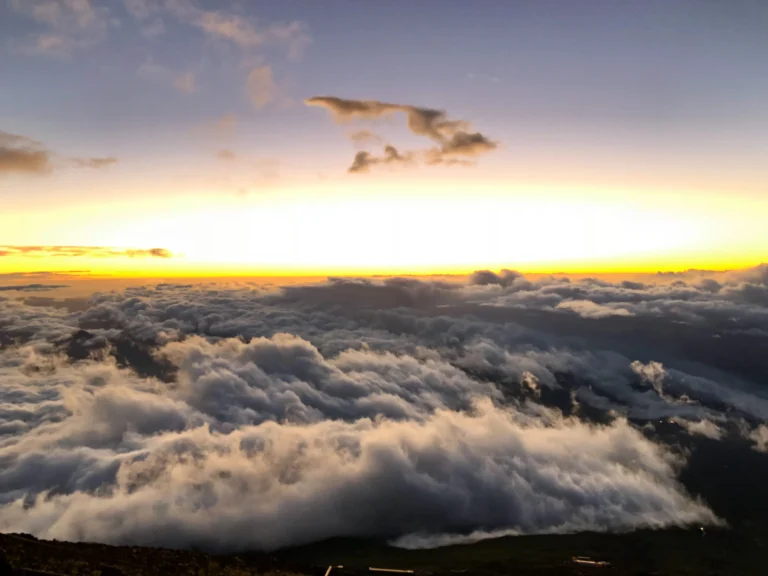
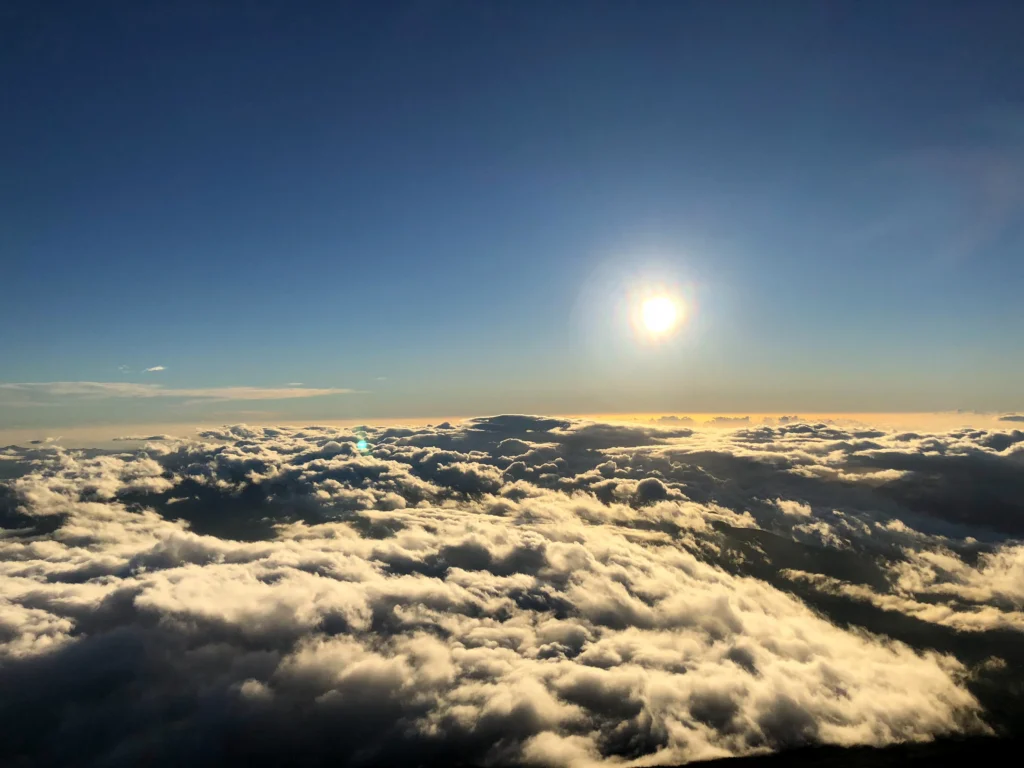
If you time your arrival at the mountain hut right, you will catch the sunset from above the cloud sea. The sun drops toward the western horizon, painting the cloud sea in layers of gold, pink, and eventually deep orange.
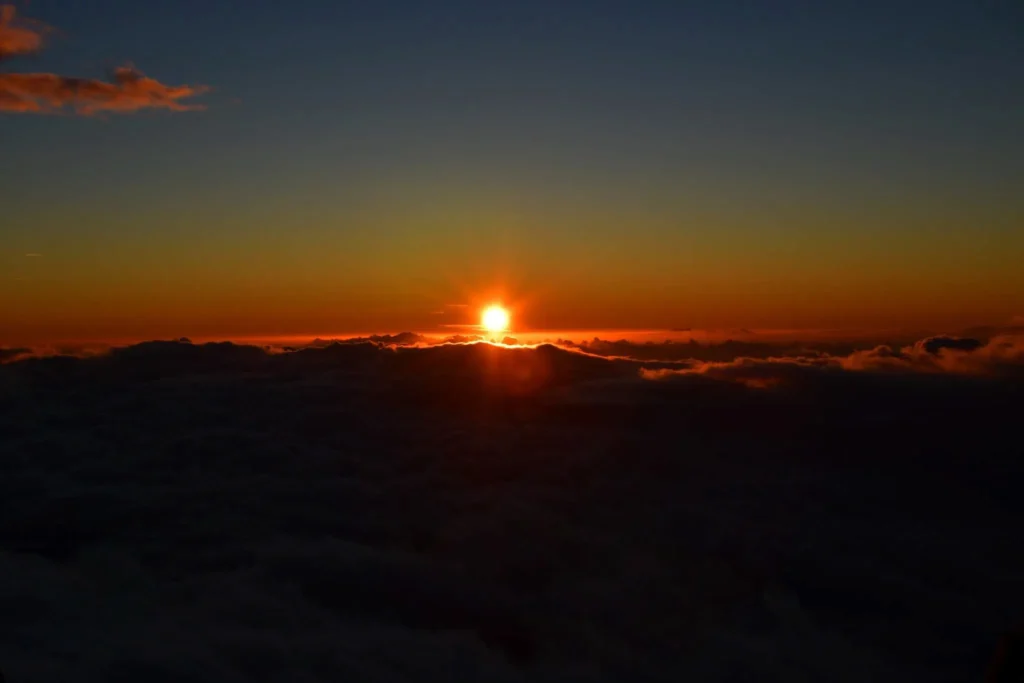
Phase 4: The Night City Lights (8:00 PM – 2:00 AM)
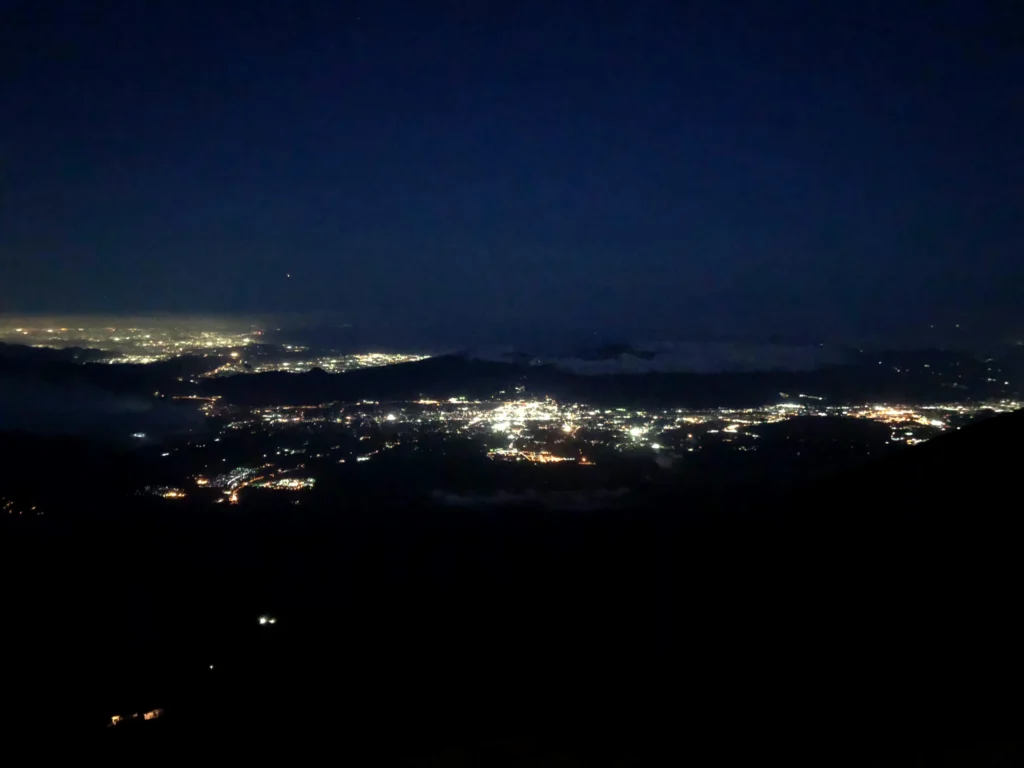
After sunset, the mountain goes dark. From the Yoshida Trail’s 8th station huts, you can see the lights of Fujiyoshida, Gotemba, and the Fuji Five Lakes towns.
Phase 5: The Pre-Dawn Push (1:30 AM – 4:00 AM)
You step outside into air that bites your lungs. The temperature has dropped to 0–3°C. A chain of headlamp lights stretches above you, winding up the mountainside in a slow-moving river of light.
Phase 6: First Light (3:30 AM – 4:15 AM)
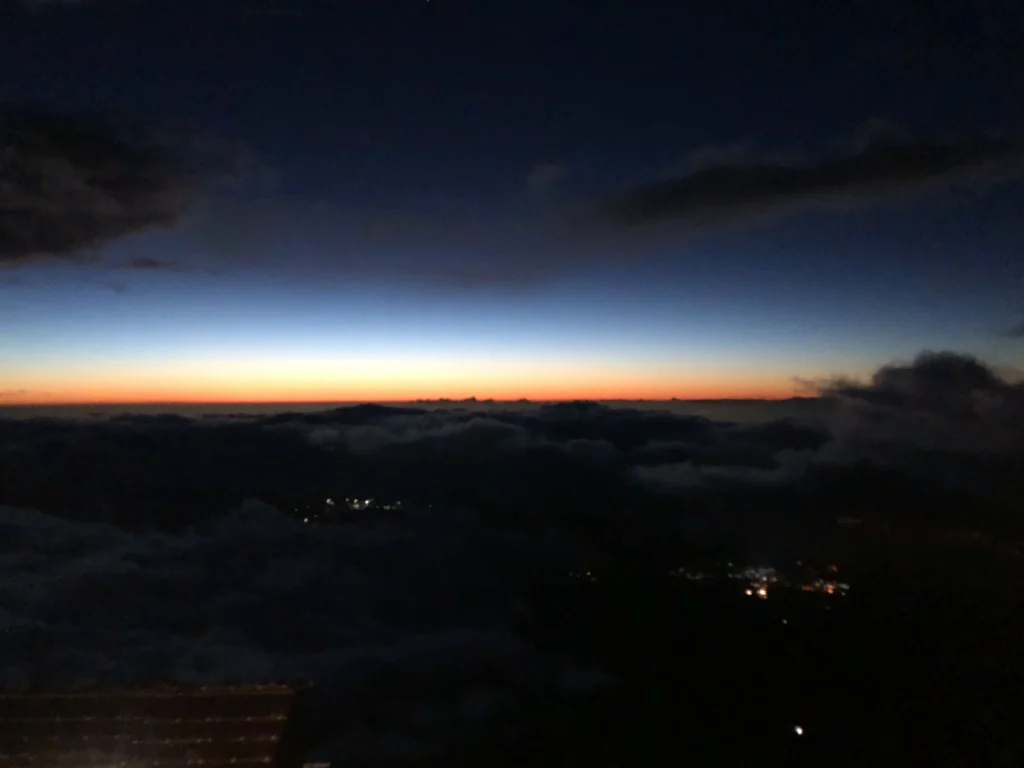
The first sign of dawn is not light — it is color. Around 3:30 AM, a thin band of warm orange appears on the eastern horizon. Over the next 45 minutes, that band widens and intensifies into the blue hour.
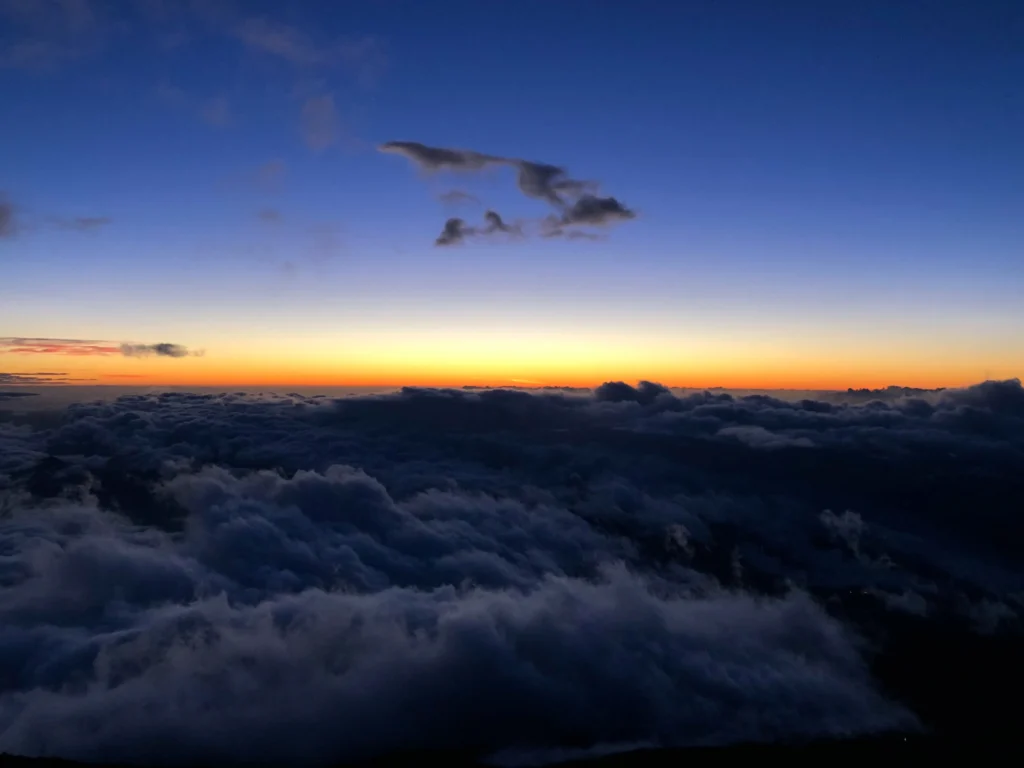
Phase 7: Goraiko — The Sunrise (4:30 AM – 5:00 AM)
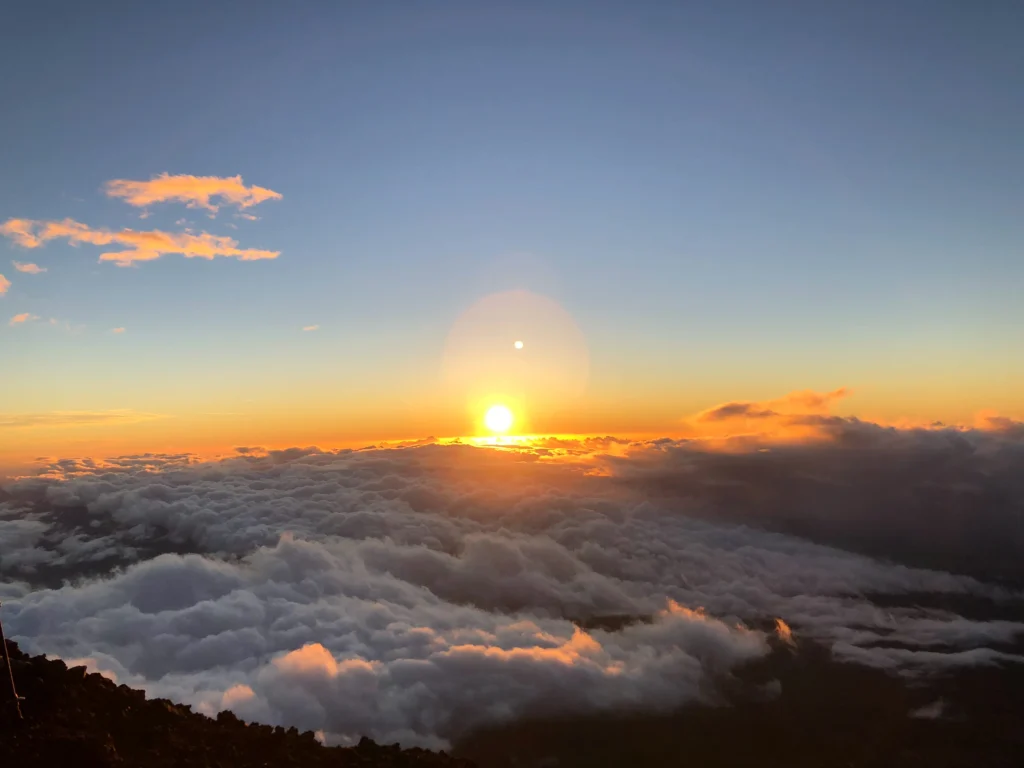
The sun rises from within the cloud sea. You are watching it emerge from a white ocean that stretches to the horizon in every direction.
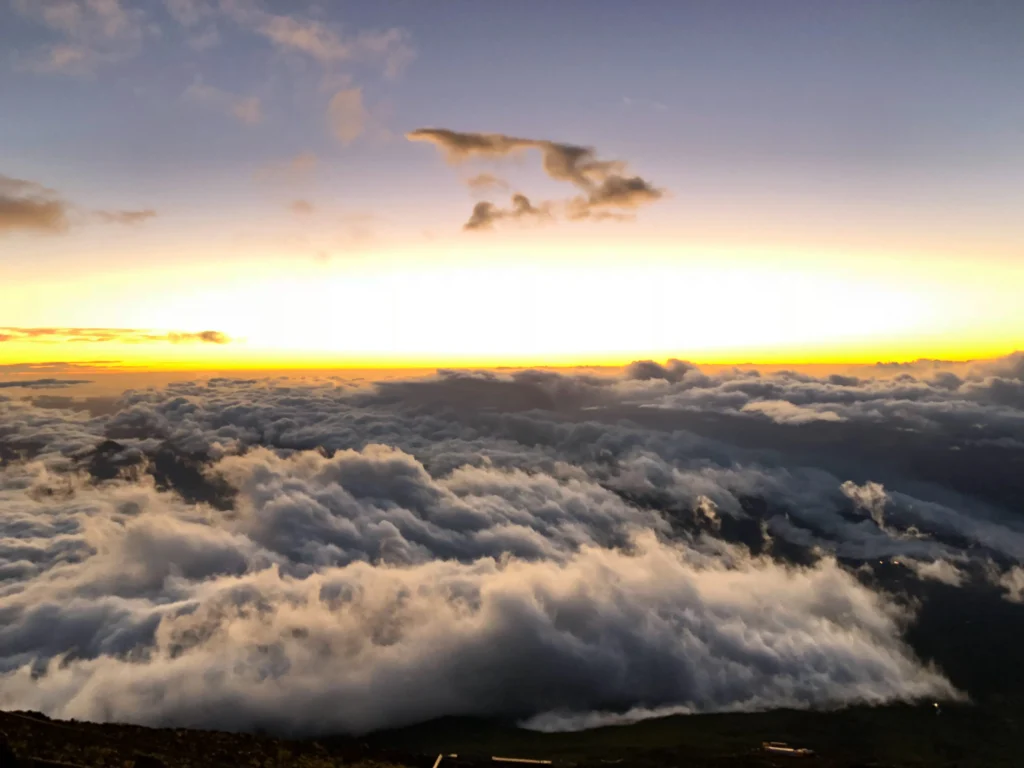
Phase 8: Shadow Fuji & Morning Light (5:00 AM – 6:00 AM)
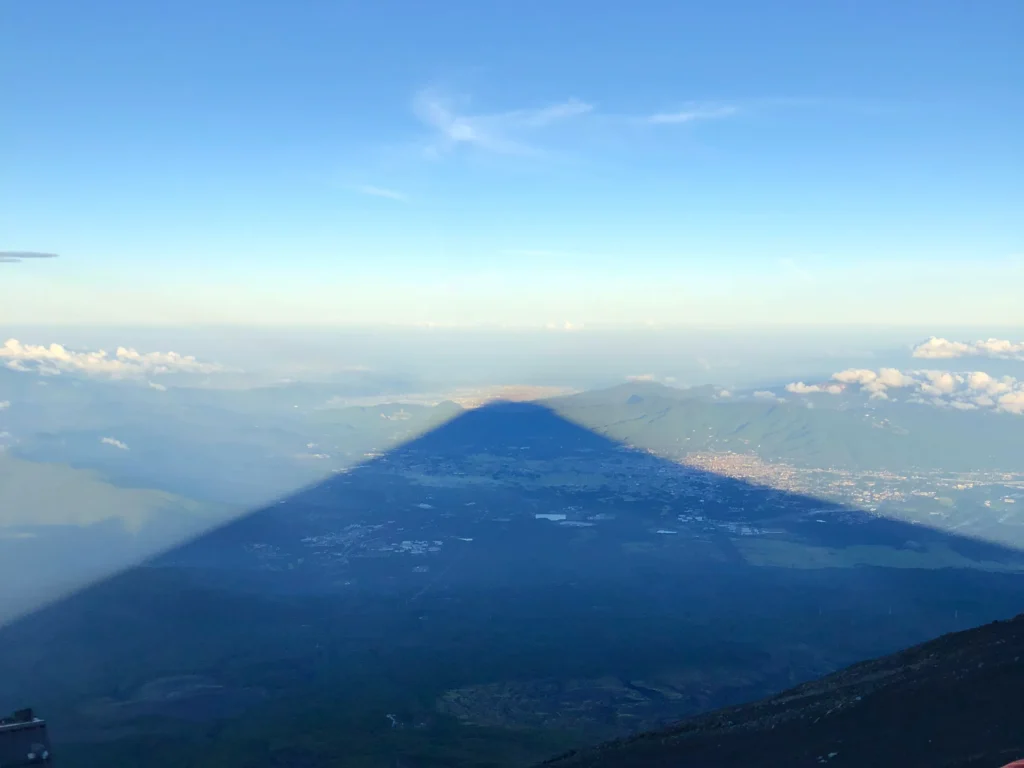
While everyone faces east, turn west. Mt. Fuji’s own shadow — a perfect dark triangle — stretches across the landscape below. This is Kage-Fuji (Shadow Fuji).
Phase 9: The Summit in Daylight (6:00 AM – 7:00 AM)
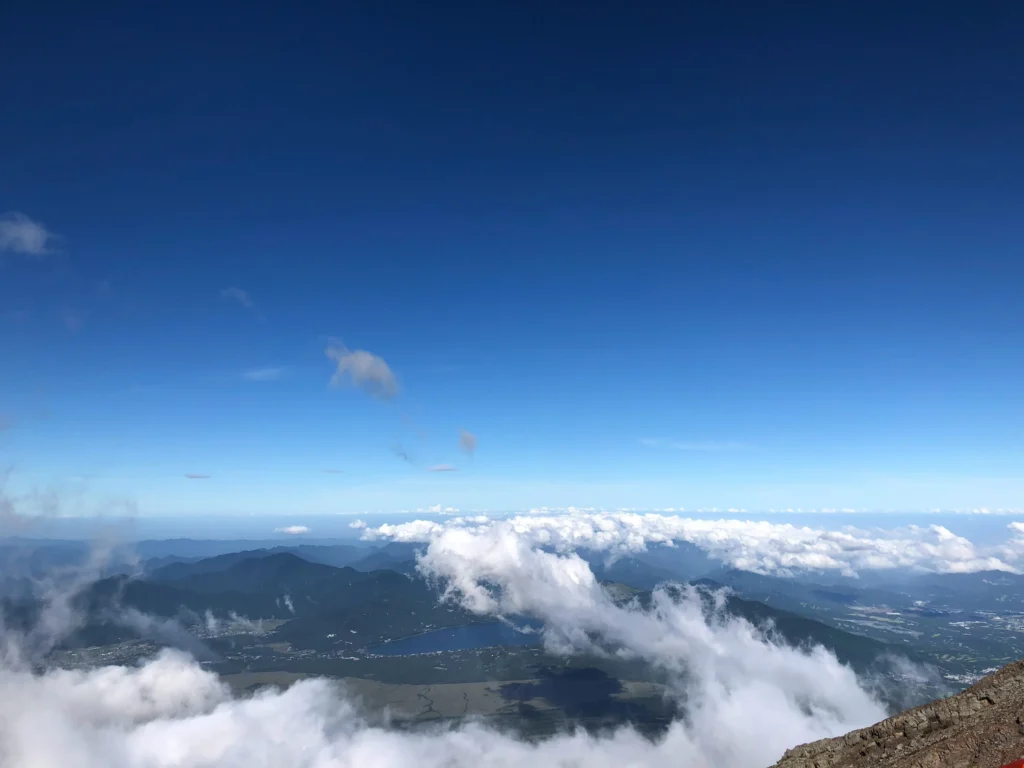
With the sun up, you can finally see where you are. The panoramic view on a clear morning extends over 100 kilometers.
3. What Happens in the Mountain Hut Between 6 PM and 1 AM?
The mountain hut experience is the part most climbers are least prepared for.
•Arrival (5:00–6:00 PM): Check in by showing your reservation confirmation. In most huts you sleep in shared bunks close to other climbers; some also offer curtained beds or small private rooms.
•Dinner (5:30–7:00 PM): Typically curry rice with miso soup.
•Sunset viewing (6:00–7:00 PM): Prime time for photography on the outdoor terrace.
•Lights out (8:00–9:00 PM): The hut goes quiet. Earplugs and an eye mask are essential.
•Wake-up (1:00–2:00 AM): Get dressed quickly, fill your water bottle, and head out.
4. How Does the 2026 Gate System Affect Night Climbing?
In 2026, these rules shaped how night climbing worked on Mt. Fuji (Yamanashi first introduced the 2:00 PM gate and the ¥4,000 fee in 2025).
Yoshida Trail:
•Trailhead gate closed at 2:00 PM and reopened at 3:00 AM.
•Climbers with mountain hut reservations were exempt.
•Without a hut stay you could not start up overnight, and climbers pledged not to attempt a non-stop overnight “bullet climb”.
Shizuoka Trails (Fujinomiya, Subashiri, Gotemba):
•Registration, the safety e-learning and the ¥4,000 fee were required — done in advance on FUJI NAVI, or on site at the 5th Station (allow about 30 minutes).
•Between 2:00 PM and 3:00 AM you could start up only with a mountain hut reservation, checked at the 5th Station.
For an overnight climb to the summit sunrise, book a mountain hut. A climb starting at or after 3:00 AM did not need one.
5. What Gear Do You Need for an Overnight Climb?
The overnight climb has different gear needs than a daytime hike.
Lighting:
•Headlamp with fresh/charged batteries.
Warmth (the #1 underestimated need):
•Base layer, mid layer (fleece), and a waterproof jacket with separate rain trousers — warm clothing, two-piece rainwear and proper climbing footwear were all checked at the Yoshida gate in 2026.
•Down jacket for the summit wait (near freezing).
•Gloves and beanie.
Sleep:
•Earplugs and eye mask.
Sustenance:
•1.5–2 liters of water.
•High-energy snacks (onigiri, chocolate).
Other essentials:
•¥100 coins for pay toilets.
•Portable phone charger (keep it inside your jacket for warmth).
I wouldn’t turn this into a huge shopping list. These are the few pieces that directly affect safety, warmth, and whether the night feels manageable — all on Amazon Japan, deliverable to your Tokyo hotel before you go.
Headlamp
The one non-negotiable — the trail has no lighting and your hands need to stay free.
Thermal base layer
The drop between Tokyo and the 1:30 AM summit push shocks most first-timers.
Windproof shell
What stops the cold cutting through your layers above the tree line.
Gloves
The upper trail is rocky and hands-on, and the summit wait is freezing.
Power bank
Hut charging is limited and cold kills batteries — keep it inside your jacket.
Oxygen can
Not a cure, but reassuring if the altitude headache starts above the 8th station.
Daypack (20–30L)
Carries water, spare layers, oxygen and a power bank on the overnight climb, then folds down into a suitcase.
Trekking poles
The long descent on loose volcanic gravel is brutal on tired legs — poles spare your knees.
6. Practical Tips for Southeast Asian Travelers & More
•Flights & Access: Travelers from Southeast Asia can fly into Tokyo (HND/NRT) via direct flights. From Shinjuku, take a highway bus directly to the Fuji Subaru Line 5th Station.
•Weather & Clothing: In August, Mt. Fuji’s summit averages about 6°C, with an average daily low near 4°C (39°F) in JMA’s normals, and before dawn it can drop below freezing — a massive contrast to the 30°C+ temperatures in Tokyo or Southeast Asia. Bring proper winter jackets and layer your clothing.
•Cash vs. Card: It varies. Many huts take bookings with advance card payment (Tomoekan and Horaikan, for example), while toilets mostly ask for coins — the Fujinomiya-side summit toilet also took PayPay in 2026. Bring plenty of ¥100 coins and some ¥1,000 bills.
•Altitude Acclimatization: The official health advice is to rest about 1–2 hours near 5th Station height before starting (the official model plan allows one hour). Walk around and hydrate to reduce altitude sickness risk.
7. Suggested Overnight Itinerary
For the Yoshida Trail in summer 2026, targeting an August 10 sunrise (4:49 AM, the official planning figure) from a hut at about 3,000 m — after midnight the times follow the official model plan:
| Time | Activity |
| 9:05 AM | Depart Busta Shinjuku by highway bus (2026 summer timetable) |
| 11:40 AM | Arrive Fuji Subaru Line 5th Station (2,305m). Rest about an hour to acclimatize |
| 12:40 PM | Begin ascent; pass the gate before 2:00 PM (officials ask hut guests to do so too) |
| 3:00 PM | 7th Station (2,700m). Rocky switchbacks begin |
| 5:00 PM | Check into an 8th-station hut at about 3,000 m |
| 5:30 PM | Dinner at hut |
| 6:00–7:00 PM | Sunset above cloud sea from hut terrace |
| 8:00 PM | Sleep (earplugs in) |
| 12:10 AM | Wake up, gear up |
| 12:40 AM | Depart hut |
| 1:00–3:00 AM | Climbing in darkness. City lights below |
| Around 3:30 AM | Upper trail, often in slow queues. First glow on horizon |
| 4:40 AM | Arrive at the summit (Kusushi Shrine). Find a position facing east |
| 4:49 AM | Goraiko (sunrise) |
| Just after sunrise | Look west for Shadow Fuji if the sun is out |
| 7:10 AM | Begin descent via the bulldozer route (after an optional walk to Kengamine) |
| About 11:00 AM | Arrive 5th Station. Bus to Kawaguchiko or Shinjuku |
8. FAQ
Is bullet climbing on Mt. Fuji still possible in 2026?
The 2026 rules barred climbers without a hut reservation from starting between 2:00 PM and 3:00 AM on all trails, and a 3:00 AM start is too late for the summit sunrise. Yamanashi also required a pledge against overnight bullet climbing without a hut stay.
Can I climb Mt. Fuji at night without a mountain hut reservation?
Yes, outside the restricted hours. In 2026, without a hut reservation you could not start up between 2:00 PM and 3:00 AM — at the gate on the Yoshida Trail, and with a check at the 5th Station on the Shizuoka trails — and a 3:00 AM start is generally too late to reach the summit for sunrise.
Will I sleep at all in a Mt. Fuji mountain hut?
Sleep can be short and broken. The combination of altitude, tight quarters, noise, and anticipation makes deep sleep unlikely. Earplugs and an eye mask make a significant difference.
How dark is the Mt. Fuji trail at night?
Very dark. There is no trail lighting. Your headlamp is your only light source. The chain of other climbers’ headlamps provides a visual guide for the route.
What happens if weather turns bad during the night climb?
Check the forecast and ask hut staff about conditions before you set out. If conditions turn dangerous while you are on the trail, head for the nearest hut.
How crowded is the pre-dawn Mt. Fuji summit trail?
On the Yoshida Trail during peak season, very crowded. Congestion near the summit before sunrise is particularly likely on weekends, holidays and during Obon. The Yoshida Trail’s 2026 limit of 4,000 climbers a day did not apply to hut guests. Weekdays are significantly less crowded.
Can I charge my phone at a Mt. Fuji mountain hut?
Charging arrangements vary by hut; Tomoekan, for example, gives guests free use of its outlets. Bring a portable battery pack and keep it inside your jacket — cold temperatures drain lithium batteries rapidly.
Is the overnight Mt. Fuji climb safe for beginners?
Yes, with proper preparation. The Yoshida Trail is well-maintained and staffed. Main risks are altitude sickness, hypothermia, and exhaustion — all mitigated by slow pace, proper clothing, and the hut rest period.
Before you obsess over the photos, line up the rest of the climb:
Mt Fuji Climbing 2026
The 2026 gate rules, fees and trail facts that shape every overnight plan.
Mountain huts & booking
What the hut night actually looks like, plus how to book one.
Sunrise timing
Time your push so you reach the top for goraiko, not after it.
What to wear
Clothing is the main safety gap — layer for a summit that feels like winter.
Live visibility
Check the weather read before committing a whole night to the climb.
Stay near the 5th Station base
Sleep near Fuji the night before so you start calm, fed and on time.
Guided overnight climb
If the gate rules and night navigation feel like too much.
9. Final Thoughts
Climbing Mt. Fuji at night is not about endurance. It is about watching the world transform.
Between dusk and dawn, you see the sun set behind a cloud sea, city lights emerge from darkness, stars appear overhead, the first crack of dawn paint the horizon orange, the sun rise from within the clouds, and the mountain’s own shadow stretch across the sleeping land below.
No other experience in Japan compresses that much visual drama into a single night. The moment the sun rises, none of the cold or exhaustion matters.
Sources checked
fujisan-climb.jp (official), mountain hut operator websites, Japan Meteorological Agency, Yamanashi Prefecture climbing regulations. Re-checked October 2026: fujisan-climb.jp (2026 season dates, FAQ, health advice, Yoshida model plan and sunrise figures), Yamanashi’s toll page, Shizuoka Prefecture’s 2026 rules, Fujikyu’s 2026 summer bus timetable, JMA’s summit normals (1991–2020), and the Horaikan, Tomoekan and Kamaiwakan hut sites.
Join travelers discovering Japan's hidden side
Weekly dispatches from off-the-beaten-path Japan — spots and stories you won't find in guidebooks.
No spam. Unsubscribe anytime.
Welcome aboard!
You're in. See you in your inbox soon.