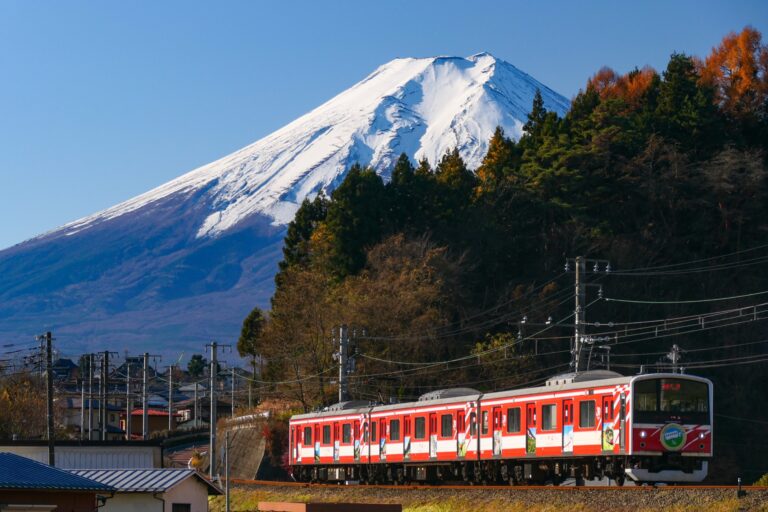
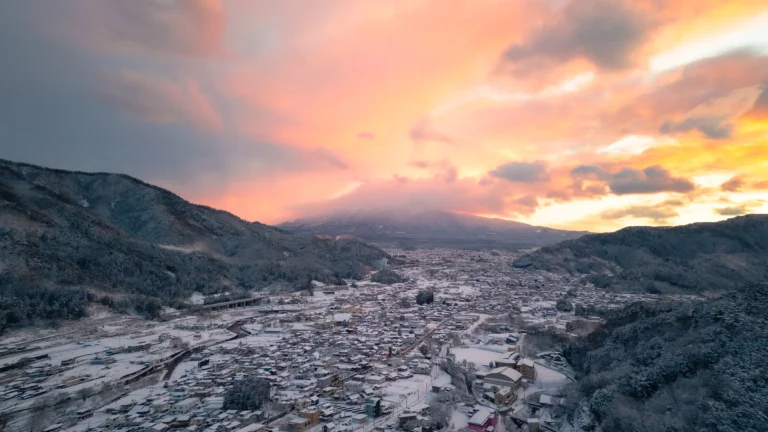
The first Fujikyu Railway train leaves Mt. Fuji Station at 05:57 heading toward Otsuki. Between November and February, that train (and the next three) runs in the window before sunrise — which is when Mt. Fuji’s snow cap glows pink in the alpenglow Japanese photographers call Beni-Fuji (紅富士). I rode the 06:48 local on February 6, 2026, eight minutes after sunrise. Here is the month-by-month table of which Fujikyu train catches the alpenglow, when the timing works, and when it doesn’t.
Quick facts
- What
- Beni-Fuji (紅富士) — the snow-covered peak glowing pink at dawn — viewed from the early Fujikyu Railway local trains
- Best season
- November to February (when sunrise is late enough for early trains to run before it)
- First train
- 05:57 普通 Mt. Fuji Station → Otsuki (the actual 始発)
- My ride
- 06:48 普通 (Thomas Land wrap that day), February 6, 2026
- Sunrise that day
- 06:35 JST
- Fare
- Mt. Fuji Station → Otsuki: ¥1,040 (one way, paper ticket, 2026)
- Where to sit
- Front car, west-facing window (right side travelling toward Otsuki)
- Cost
- Free to view from the platform; one short fare to ride
Part of the full Mt. Fuji travel guide.
What I saw at 06:48 on February 6
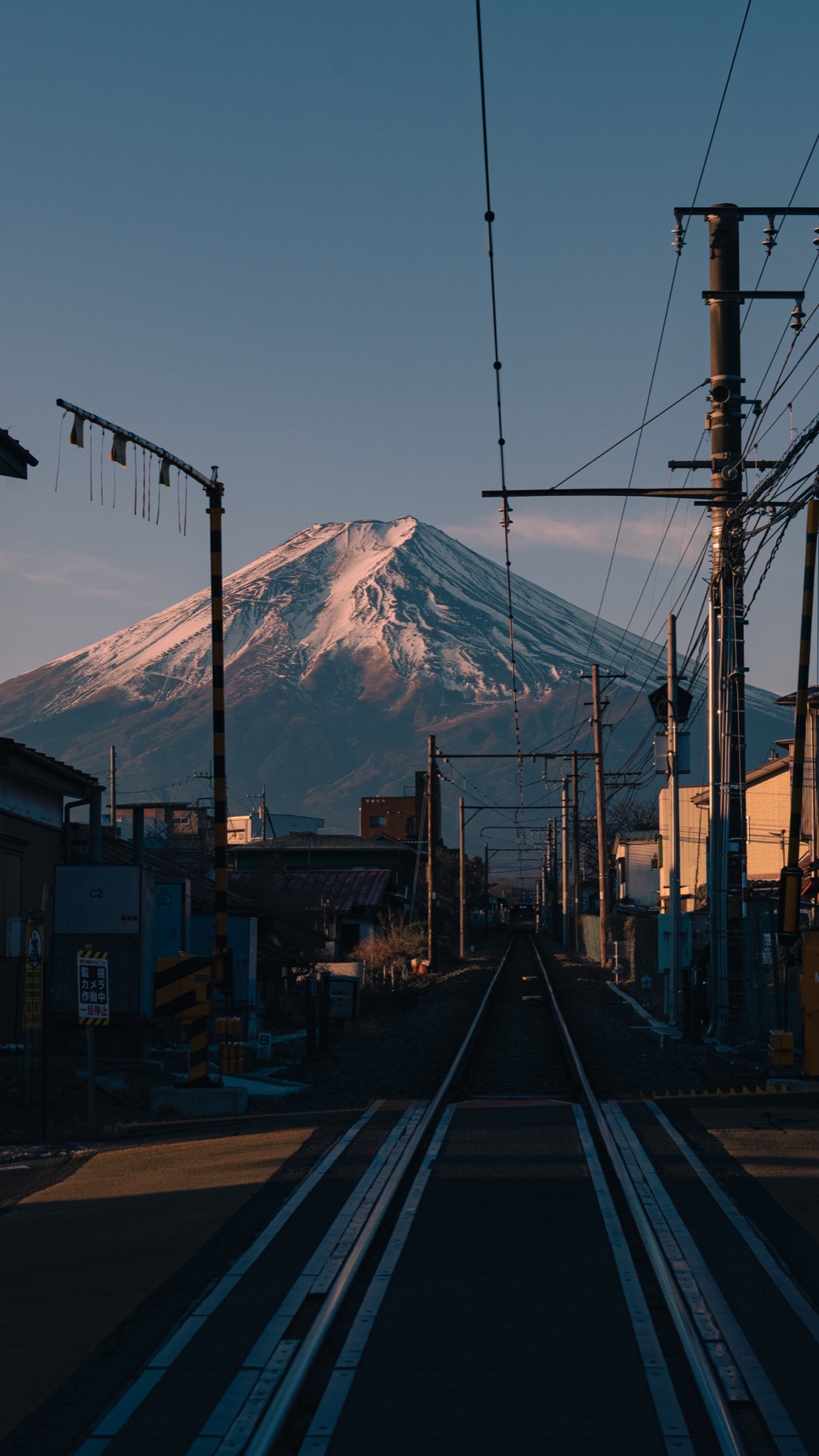
I left the house before 06:30. The snow on the roofs around Shimoyoshida was still blue. The mountain was a dark silhouette as I walked to the platform, and the first hint of light along the eastern ridge was orange, not yet pink.
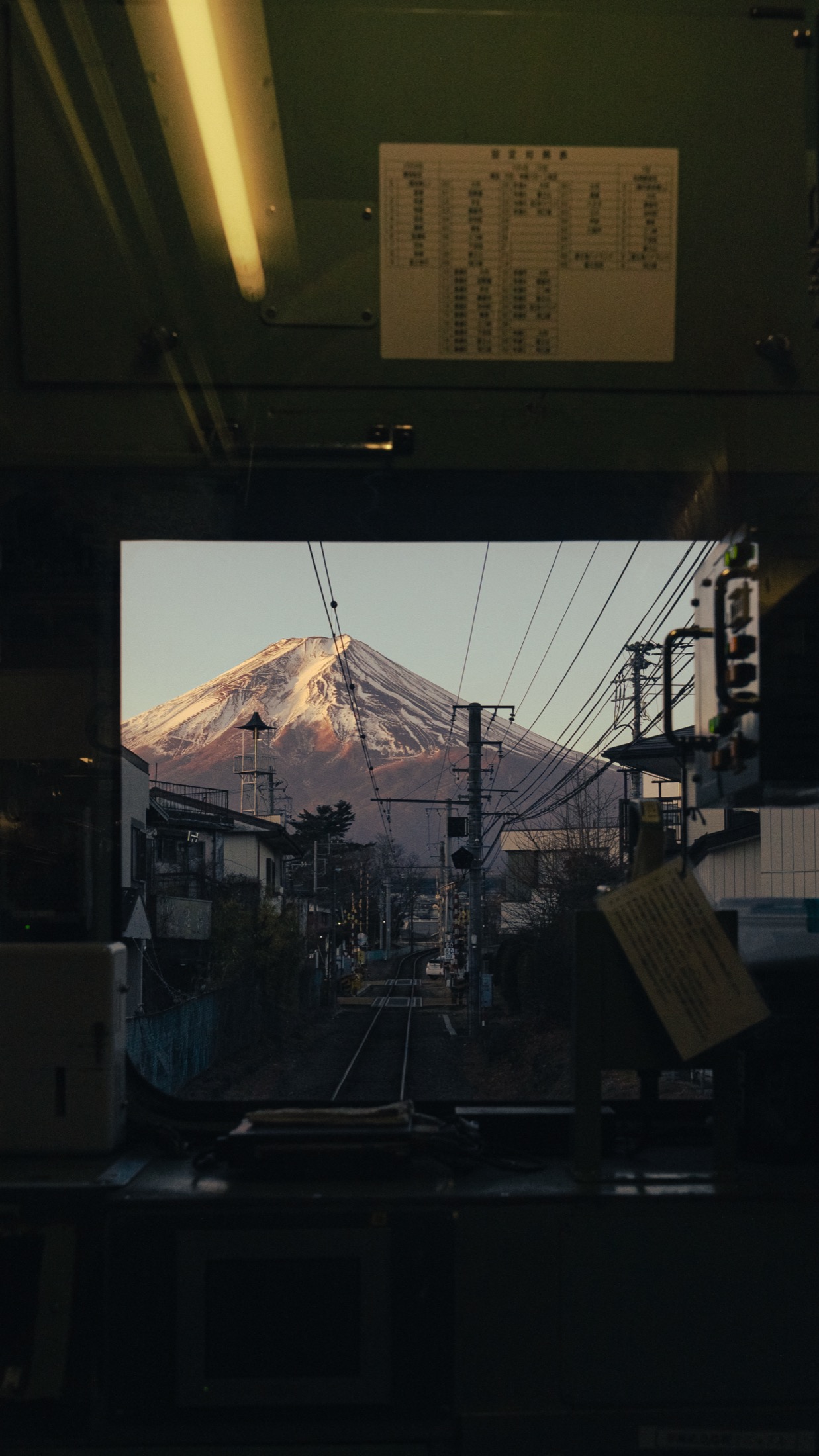
By the time I boarded the 06:48 — a two-car Thomas Land wrap that morning, running as a regular local — sunrise had hit at 06:35 and the cap had just turned. From the train window, the peak was the colour of unripe peach. By the time we pulled out and crossed the Shimoyoshida bridge, the snow was full pink. Three minutes later, as we descended toward Mt. Fuji Hyland, the pink was already softening to gold. By Tsuru-Bunkadaigaku-mae station, it was over.
The whole window was about ten to twelve minutes. Most travellers staying at a Kawaguchiko hotel sleep through it.
Why Beni-Fuji needs a winter morning
Beni-Fuji (紅富士) and Aka-Fuji (赤富士) are two different phenomena often confused in English.
Beni-Fuji vs Aka-Fuji — the distinction
Snow-covered Mt. Fuji glowing crimson in the alpenglow at dawn. Occurs December through February, briefly in November and March. The pink is light reflecting off the snow cap during the few minutes around sunrise.
Bare summer Mt. Fuji glowing red-brown at dawn — the snowless slopes reflecting low-angle morning light. Occurs late July through early September. Hokusai’s Akafuji woodblock print is the cultural reference, and seeing it is considered lucky. For the Yamanashi places named in Hokusai’s and Hiroshige’s Mt. Fuji print titles, see Hokusai and Hiroshige’s Mt. Fuji prints and their Yamanashi places.
This article is about Beni-Fuji specifically — the winter version, on the Fujikyu line. For the summer Aka-Fuji you need a different season, much earlier wake-up, and usually a lakeside position rather than a train.
The month-by-month Fujikyu × sunrise table
The Fujikyu Railway’s first six trains leave Mt. Fuji Station for Otsuki at 05:57, 06:08, 06:23, 06:40, 06:48, and 07:11 (per the 2026 March timetable). Sunrise in Fujikawaguchiko changes by more than two and a half hours over the year. Whether a given train runs before, at, or after sunrise decides whether the Beni-Fuji window is open.
| Month (15th) | Sunrise | 05:57 普通 | 06:23 普通 | 06:40 普通 | 06:48 普通 | 07:11 普通 |
|---|---|---|---|---|---|---|
| January | 06:48 | −51 min, dark | −25 min, building | −8 min, peak | 0 min, peak | +23 min, fading |
| February | 06:26 | −29 min, twilight | −3 min, peak | +14 min, fading | +22 min, gold | +45 min, over |
| March | 05:51 | +6 min, tail | +32 min, over | +49 min, over | +57 min, over | +80 min, over |
| April | 05:08 | +49 min, over | +75 min | +92 min | +100 min | +123 min |
| May | 04:35 | +82 min, over | +108 min | +125 min | +133 min | +156 min |
| June | 04:23 | +94 min, over | +120 min | +137 min | +145 min | +168 min |
| July | 04:35 | +82 min, over | +108 min | +125 min | +133 min | +156 min |
| August | 04:58 | +59 min, over | +85 min | +102 min | +110 min | +133 min |
| September | 05:22 | +35 min, over | +61 min | +78 min | +86 min | +109 min |
| October | 05:45 | +12 min, tail | +38 min, over | +55 min, over | +63 min, over | +86 min, over |
| November | 06:14 | −17 min, building | +9 min, peak fading | +26 min, gold | +34 min, over | +57 min, over |
| December | 06:40 | −43 min, dark | −17 min, building | 0 min, peak | +8 min, peak | +31 min, fading |
Reading the table: 0 min means the train leaves Mt. Fuji Station exactly at sunrise — usually the brightest pink. “−” minutes mean the train runs before sunrise (alpenglow is still building, pre-sun pink already visible on the cap). “+” minutes mean after sunrise; the alpenglow fades roughly 15 minutes after the sun is up. Sunrise times via the National Astronomical Observatory of Japan, for Fujikawaguchiko, 15th of each month.
The four months that actually work
December
- 06:40 local → catches sunrise exactly
- 06:48 local → 8 min after, peak pink still holding
- 06:23 local for the pre-sun build-up
- Snow cap is usually deep and crisp this month
January
- 06:48 local → 0 minutes after sunrise, peak window
- 06:40 local → 8 min before sunrise, pre-pink visible
- 06:23 local for the long alpenglow build-up
- Coldest mornings of the year — bring layers (what to wear near Fuji in winter)
February
- 06:23 local → exactly at sunrise, peak pink
- 06:08 local → 18 min before, alpenglow already on the cap
- 06:48 (the one I took) → 22 min after, gold transition
- Snow cap usually intact through this month
November
- 06:08 local → 6 min before sunrise, peak build-up
- 05:57 first train → 17 min before, alpenglow visible
- 06:23 local → 9 min after, tail of the window
- Snow cap may be incomplete early in November
Where to sit, where to alight
Five practical things from this morning
- Front car, west-facing window. The 大月 direction puts the mountain on your right. The conductor’s cabin window is the cleanest shot if you can stand behind it.
- Stations with the best views from the platform itself. Mt. Fuji Station, Shimoyoshida, and Tsuru-Bunkadaigaku-mae are the three with an uninterrupted line-of-sight to the summit while the train is stopped.
- Don’t take the express. The Fujisan Tokkyu (フジサン特急, 07:31) is faster but its windows are tinted and the cabin lighting reflects. The 普通 locals have clear glass and operable windows.
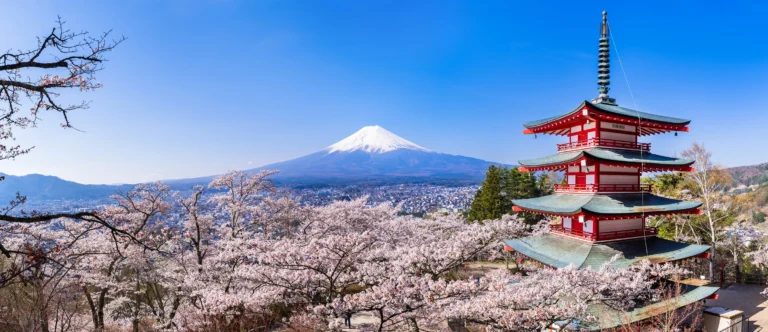
- Alight at Mt. Fuji Hyland. The platform here gives the Chureito-Pagoda-side angle without the 30-minute climb. Five-minute walk back to the road if you want the wider shot.
- Plan the return. The next train back toward Kawaguchiko after the alpenglow is usually 25 to 40 minutes out. Bring a coffee plan or a hot can drink from the platform vending machine.
If you can’t catch the train
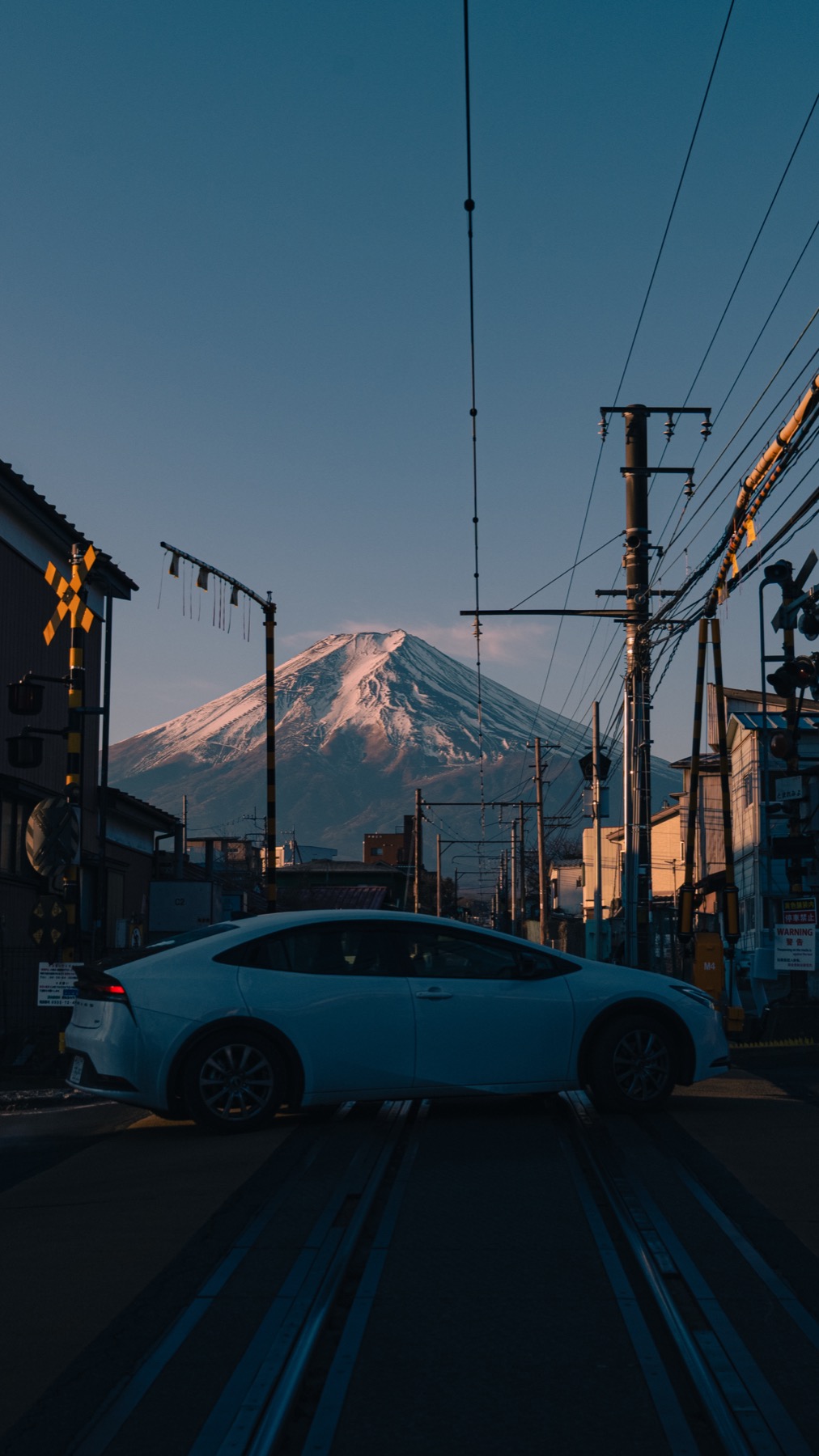
The same Beni-Fuji is visible from the level crossing two minutes south of Mt. Fuji Station, and from the Shimoyoshida pedestrian bridge eight minutes north. Both are walkable from the station within ten minutes. The crossing in particular gives you the iconic powerlines-and-Fuji frame that the train window also catches — and you can stand there longer than the 10-minute alpenglow window, recomposing.
The downsides: you lose the train-window framing, you give up the moving viewpoint, and you have to deal with the morning traffic. The upside: no ticket, no schedule.
Best base for catching the first train
To make the 06:23 or 06:08 trains (the February and December peak windows respectively), you really need to be sleeping within a 10-minute walk of Mt. Fuji Station or Shimoyoshida. That is a small set of properties:
- Ooike Hotel (Kawaguchiko Station area) — a 15-minute Fujikyu ride east means you can leave the room at 05:30 and board the 06:08 local at Fujisan Station. Honest review on the link.
- Fujiyoshida machiya guesthouses in the Honmachi 2-chome area — these put you a 5-minute walk from Mt. Fuji Station. Limited inventory, books through Rakuten Travel and Booking.
- Anything in Kawaguchiko proper (around the lake) — workable but you lose 15 minutes each direction on the Fujikyu transfer.
FAQ
Is Beni-Fuji visible every winter morning?
No. You need clear sky to the east at sunrise so light reaches the cap, AND clear sky around the summit so the cap is visible. Per the City of Fuji’s 35-year 8 a.m. record, the whole mountain is visible on about 62% of December and 60% of January mornings (85% and 82% counting partial views) — roughly three mornings in five. That record is taken from the south side at 8 a.m., not at sunrise, so treat it as a guide to the season, not a count of Beni-Fuji mornings. Cloud cover collapses the alpenglow regardless of season.
How long does the Beni-Fuji window last?
The intense pink is visible for roughly five minutes either side of sunrise — a ten- to twelve-minute window. The full alpenglow sequence (deep pink → soft pink → gold → white) takes about twenty minutes. After that the snow looks white in the regular morning sun.
Can I ride the same train and see Aka-Fuji in summer?
No — Aka-Fuji needs the bare summer mountain (snowless slopes), and Yamanashi sunrise in July is 04:35, well before the first Fujikyu train at 05:57. Aka-Fuji is a lakeside phenomenon — Lake Yamanaka, Lake Kawaguchi north shore, Lake Saiko around 04:30–05:00 in late July and August.
What’s the difference between this and the Fujisan Tokkyu (the express)?
The 富士山特急 is the same line but with reserved seating, tinted windows, and a 07:31 first run. By 07:31, even in January, the alpenglow is finished. For Beni-Fuji you want the regular 普通 (local), not the special-train. Save the Tokkyu for the afternoon return.
How do I know if tomorrow’s morning will be clear enough?
Three checks: (1) the verified morning verdict at the top of our Mt. Fuji visibility page, (2) the JMA Kawaguchiko forecast for cloud cover under 30%, (3) the wind direction — north or west wind is usually clear, east or south often brings cloud onto the cap. If two of three say “clear”, it’s worth the early wake-up.
Is the first Fujikyu train crowded?
05:57 and 06:08 are usually near-empty — local commuters dominate the 06:23 onward. The Thomas Land wrap on the 06:48 occasionally has family travellers because Thomas Land park opens later in the day. Even on a “crowded” winter morning, you can almost always sit by a window facing the mountain.
Sources used for this article
- Fujikyu Railway official timetable, Mt. Fuji Station (大月方面), valid from March 14, 2026 — fujikyu-railway.jp
- Sunrise and sunset times for Fujikawaguchiko-machi, 2026 — calculated from solar position formulas via hinode-hinoiri.com
- City of Fuji official Mt. Fuji visibility observation record (1990–2025) — City of Fuji
- Beni-Fuji vs Aka-Fuji distinction — Fujisan-Net; eFujisan
- Personal observation, Fujikyu 06:48 local, February 6, 2026 (photographs in this article)
Plan a Beni-Fuji morning — where to base yourself
To catch the 06:23 or 06:08 trains in peak season you need to sleep close. Three booking paths:
Join travelers discovering Japan's hidden side
Weekly dispatches from off-the-beaten-path Japan — spots and stories you won't find in guidebooks.
No spam. Unsubscribe anytime.
Welcome aboard!
You're in. See you in your inbox soon.