Mt Fuji · Culture · Woodblock prints
Hokusai’s Thirty-six Views of Mount Fuji, made around 1830–32, is really 46 prints, and five of them are titled after Kai Province (Kōshū), today’s Yamanashi, the side of the mountain where I live. Hiroshige’s own Thirty-six Views of Mount Fuji of 1858 has three more Kai titles. Between them the titles name Misaka, Mishima-goe, Inume, Ōtsuki, Isawa and Kajikazawa, and you can still visit every place they name. Misaka is the pass above Lake Kawaguchi; Hokusai’s “Mishima Pass” is thought to be Kagosaka Pass by Lake Yamanaka; Isawa is written 石和 today; Inume, Ōtsuki and Kajikazawa keep their old names.
UNESCO listed the mountain in 2013 as “Fujisan, sacred place and source of artistic inspiration”, and these prints are a large part of the second half of that name. The background is in why Mt Fuji is a cultural World Heritage Site. This article is the practical side: which prints show real places, where those places are now, and where in Japan you can see the prints themselves.
What is Hokusai’s Thirty-six Views of Mount Fuji?
Fugaku sanjūrokkei (冨嶽三十六景) is a series of landscape prints that Katsushika Hokusai began around 1830, when he was about seventy. Despite the title it runs to 46 sheets: the Art Institute of Chicago’s catalogue notes that ten scenes were added to the first thirty-six. Each is a horizontal ōban print, about 25 by 37.5 centimetres, and the Edo-Tokyo Museum records the publisher as Nishimuraya Yohachi of Edo. Museums date the set slightly differently: c. 1830–32 at the Metropolitan Museum and the Tokyo Fuji Art Museum, 1831–34 at the Edo-Tokyo Museum.
Two things made it new. Hokusai used a great deal of Berlin blue, also called Prussian blue, a pigment that had just become affordable, for skies and water. And the series sold so well that, in the Sumida Hokusai Museum’s words, it established landscape as a genre of ukiyo-e. Fuji is in every picture, sometimes filling the sky, sometimes a small triangle behind people at work.
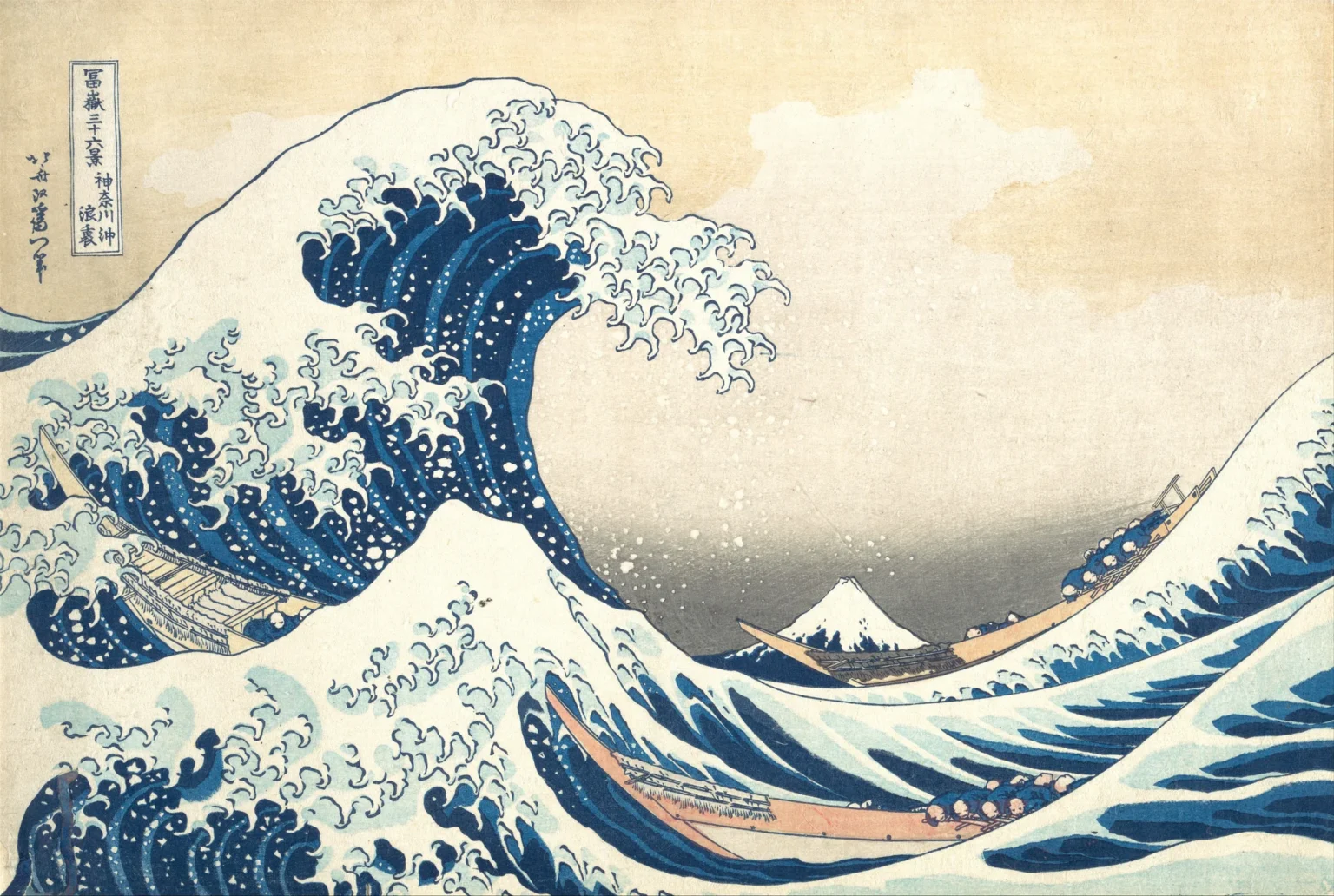
The Great Wave is the one everyone knows, and it is on the back of the current ¥1,000 note. It is a view from among the waves rather than from a spot on land, although the Tokyo Fuji Art Museum mentions one theory that Hokusai composed it looking across Edo Bay from the Kisarazu side. The prints this article follows are different: their titles name real passes, rivers and post towns in Kai Province, and you can still get to them.
Hiroshige’s Fuji prints
Utagawa Hiroshige (1797–1858) made two sets that are also called Thirty-six Views of Mount Fuji. The first, from 1852, is horizontal and in the smaller chūban size. The second is vertical ōban, published by Tsutaya Kichizō, and its censor’s seals read “Horse, 4th month”, the fourth month of 1858. Hiroshige died later that year, and the set is usually said to have gone on sale in 1859. Three of its 36 titles name Kai: Misaka Pass, the Ōtsuki Plain and Inume Pass. The 1852 set has Kai titles of its own, including another Inume Pass and a view of the back of Fuji from Yumeyama; those are not in this article.
Fuji turns up across his road series as well. In The Fifty-three Stations of the Tōkaidō (c. 1833–35), the print for Hara is subtitled “Mount Fuji in the Morning” and the one for Yoshiwara “Mount Fuji on the Left”.
Hiroshige knew the Kai road himself. By the usual account, in 1841 he travelled the Kōshū Kaidō to Kōfu to paint festival curtains, and kept a diary on the way, the Kōshū nikki. The Yamanashi Prefectural Museum published a research report on that diary and Kōfu’s Dōsojin festival in 2008.
Which prints show places around Fuji Five Lakes and Yamanashi?
Kai Province (甲斐) is the old name for what is now Yamanashi Prefecture; Hokusai’s titles use its other name, Kōshū (甲州). Hokusai gave five prints a Kōshū title, and Hiroshige’s 1858 set has three Kai titles. The table matches them to where you would stand today, alongside Hokusai’s Red Fuji, which is also thought to show this side of the mountain. The identifications follow museum catalogue entries; where a museum says “thought to be”, so does this table. One more Hokusai print, The Back of Fuji from the Minobu River, takes its name from Minobu, also in Yamanashi and home to Minobusan Kuon-ji, but its title doesn’t name the province, so it isn’t counted here.
| Where to stand today | |
|---|---|
| Hokusai, Reflection in Lake at Misaka | Lake Kawaguchi. The title names Misaka, the pass on the north side of the lake. |
| Hiroshige, Misaka Pass in Kai Province | The same pass road, looking down on Lake Kawaguchi. |
| Hokusai, South Wind, Clear Sky (Red Fuji) | No agreed spot. One museum suggests the north side, near Lake Kawaguchi. |
| Hokusai, Mishima Pass in Kai Province (the road over to Mishima) | Thought to be Kagosaka Pass, on Route 138 between Lake Yamanaka and Shizuoka. |
| Hokusai, Inume Pass in Kai Province | Inume, Uenohara City, on the old Kōshū Kaidō. |
| Hiroshige, Inume Pass in Kai Province | The same pass. |
| Hiroshige, Ōtsuki Plain in Kai Province | Ōtsuki, where the Fujikyu line to Kawaguchiko begins. |
| Hokusai, Dawn at Isawa in Kai Province | Isawa (written 石和 today), Fuefuki City, in the Kōfu basin. |
| Hokusai, Kajikazawa in Kai Province | Thought to be near Kajikazawa, now part of Fujikawa Town, where two rivers join to form the Fuji River. |
Lake Kawaguchi is easy by train and bus, and there is more on it below. The passes are a different matter. The old Misaka road and Kagosaka Pass, the likely Mishima Pass, are easiest by car, and Isawa and Kajikazawa are on the Kōfu side of the mountains, so a rental car lets you link two or three print sites in a day. Inume and Ōtsuki sit on the way in from Tokyo; my guide to getting to Kawaguchiko from Haneda or Narita covers the buses and the train route through Ōtsuki.
Linking the print sites
Print by print: what to look for
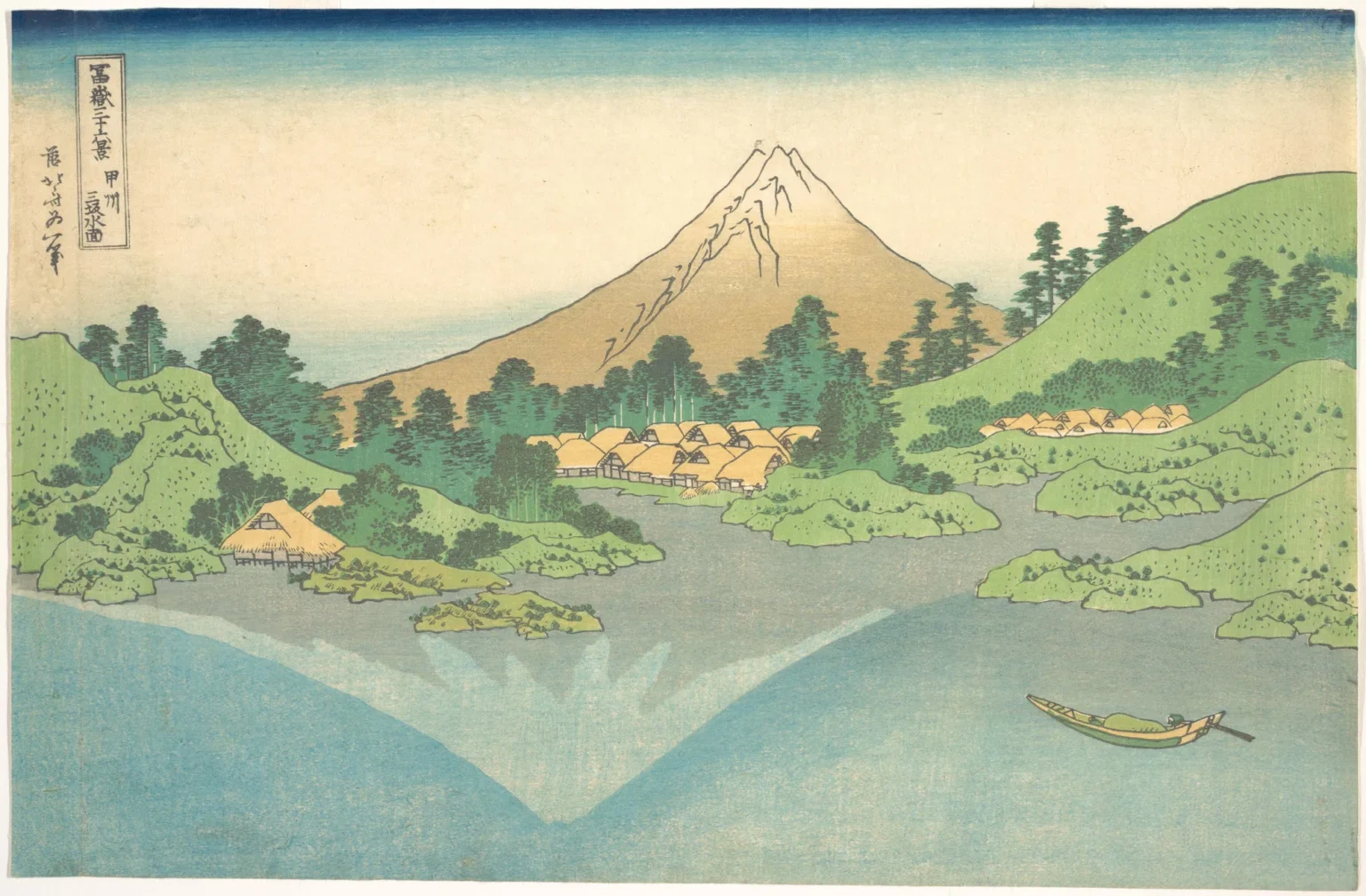
“What the lake reflects is a snow-covered winter Fuji: a landscape that could not exist in reality.”
The Tokyo Fuji Art Museum’s collection database entry on Hokusai’s Misaka print (translated by Nobu)
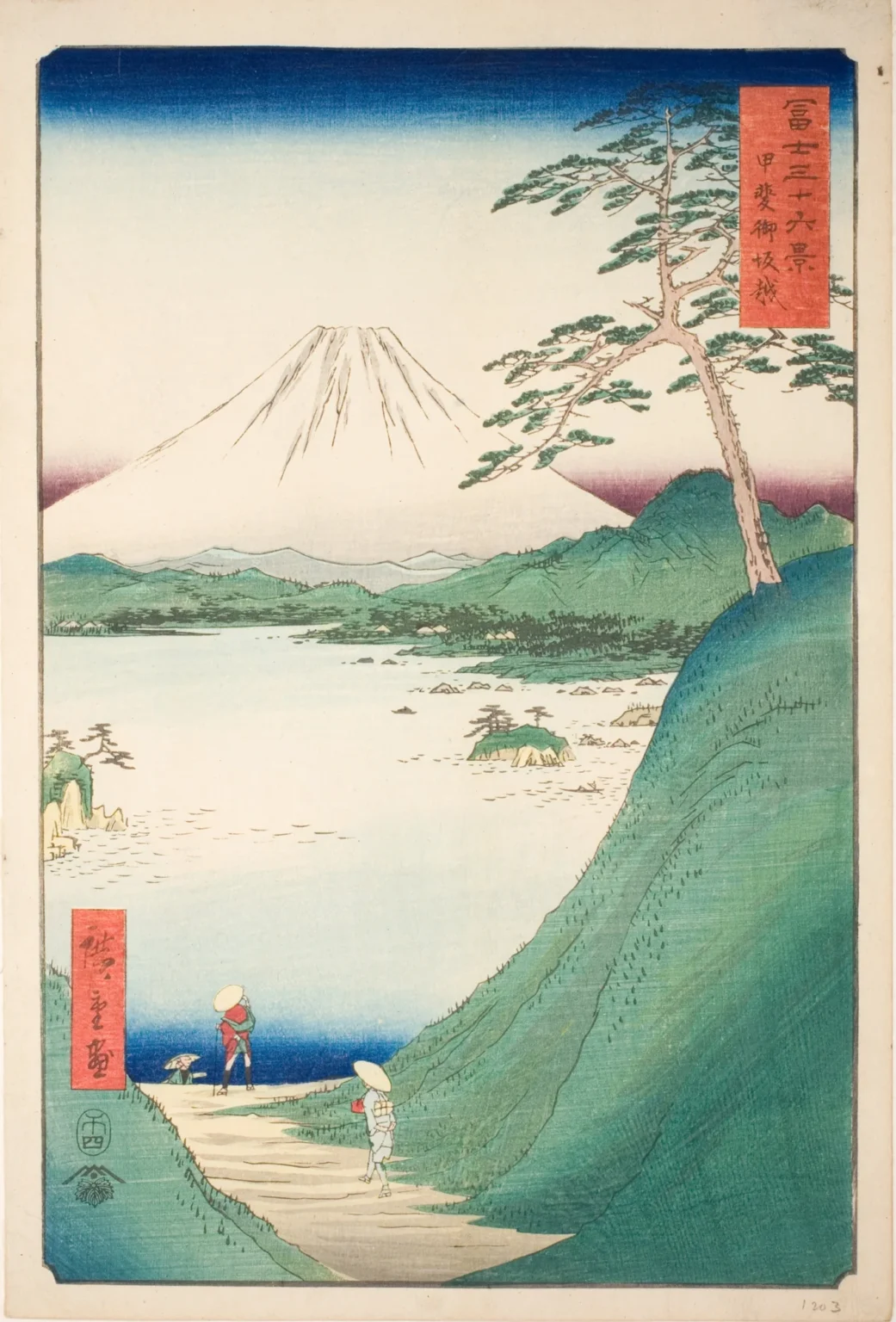
Lake Kawaguchi from Misaka · Hokusai and Hiroshige
Where it is: Lake Kawaguchi. Both titles name Misaka (御坂, also written 三坂), the pass on the old Kamakura Ōkan road between the Kōfu basin and the lake. The Tokyo Fuji Art Museum describes Hokusai’s print as Lake Kawaguchi and Fuji seen from Misaka, now part of Fuefuki City.
What to notice: In Hokusai’s version, the print at the top of this page, the mountain is in summer, its slopes bare and red-brown. The Fuji in the water wears a full winter snow cap. Look at where the reflection sits, too: its tip is well to the left of the peak above it. Hiroshige stands on the pass road itself, with travellers on a sandy path, a pine on the ridge, small islands in the lake and a white Fuji beyond. His version has no reflection.
Today: the teahouse Tenka Chaya stands by the Kawaguchiko end of the old pass tunnel. The novelist Dazai Osamu stayed there in the autumn of 1938, the stay behind his story Fugaku Hyakkei (One Hundred Views of Mt Fuji).
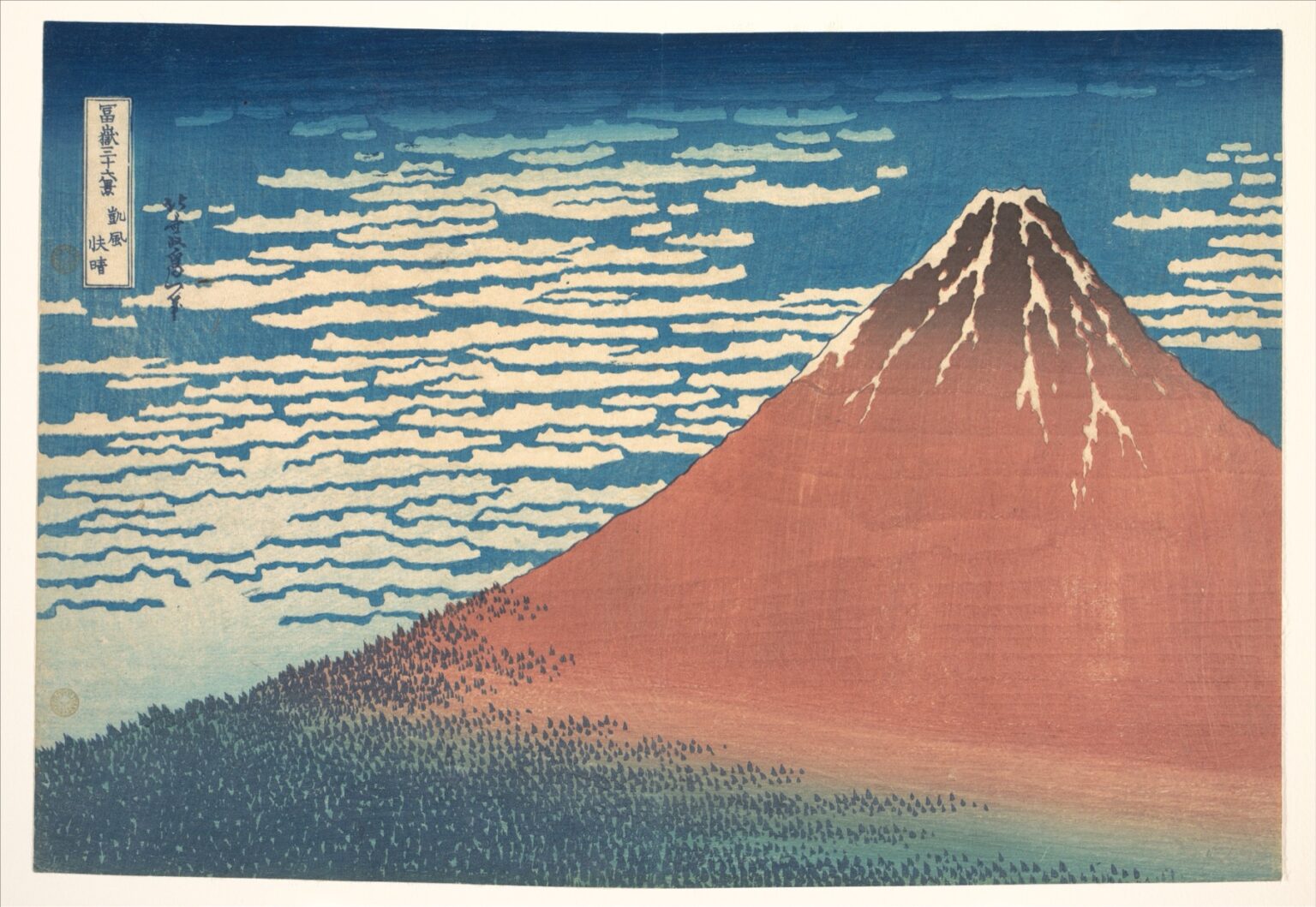
South Wind, Clear Sky (Red Fuji) · Hokusai
Where it is: nobody knows for certain. The Tokyo Fuji Art Museum says theories differ, but notes that the mountain is pushed to the right as if lit from the left, the east, and thinks this is the north face, seen from somewhere near Lake Kawaguchi.
What to notice: gaifū means a south wind. The small clouds are iwashi-gumo, “sardine clouds”, a sign of autumn coming. The museum adds that a red Fuji like this is said to appear only on early mornings between summer and autumn. People around here still call it aka-Fuji.
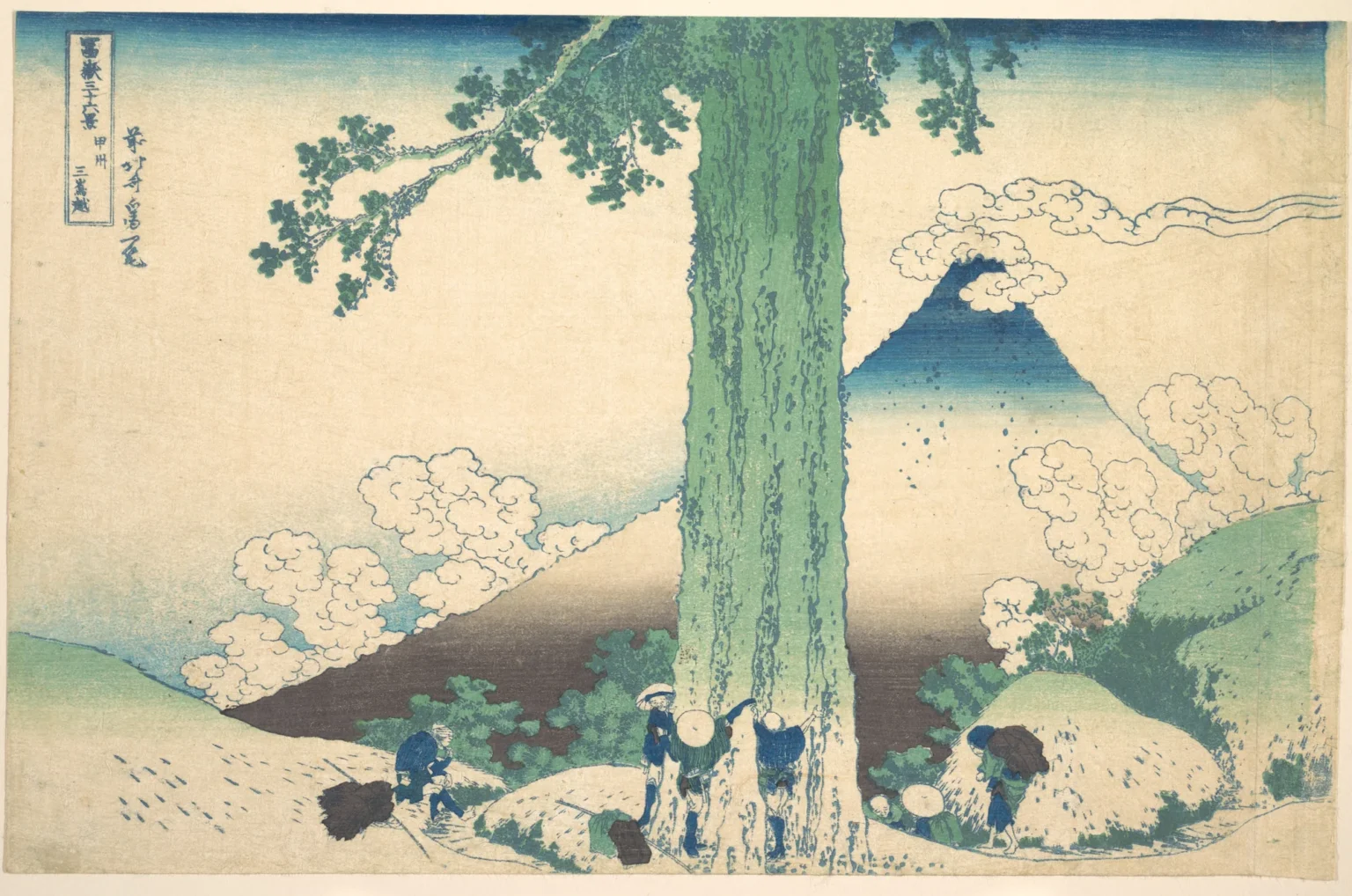
Mishima Pass in Kai Province · Hokusai
Where it is: thought to be Kagosaka Pass, on the border between Yamanakako village in Yamanashi and Oyama town in Shizuoka. Mishima-goe, the crossing towards Mishima, was the name for the old road from the Kōfu basin past the foot of Fuji towards Suruga and Sagami. The prefectural library’s note on the print suggests it meant the road from Yoshida, my town, over Kagosaka Pass and through Gotemba to Mishima. Route 138 crosses the pass today.
What to notice: three travellers have joined hands to measure the trunk of a giant tree. Clouds curl around Fuji, whose upper slopes are deep blue, unlike the summer brown of the Misaka print.
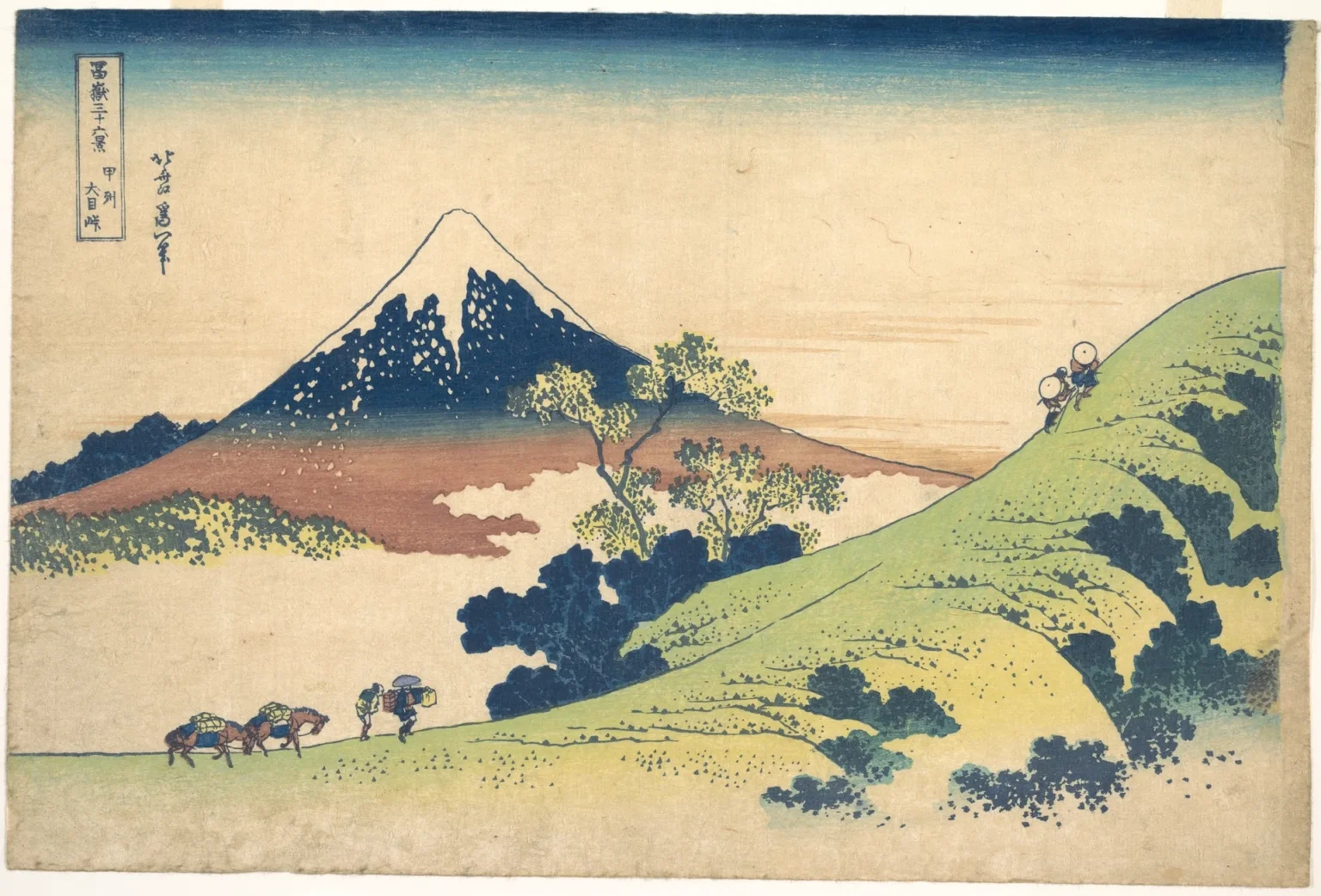
Inume Pass in Kai Province · Hokusai
Where it is: Inume, in Uenohara City. Inume-juku was a post town on the old Kōshū Kaidō out of Edo, and the Tokyo Fuji Art Museum notes that the pass was known for its view of Fuji.
What to notice: the mountain is printed in three bands, white, indigo and red-brown, to show how its colour changes with height, and a sea of pale cloud lies in front of it. Two groups of travellers make their way along the green slope, and the museum reads them as pausing at the view.
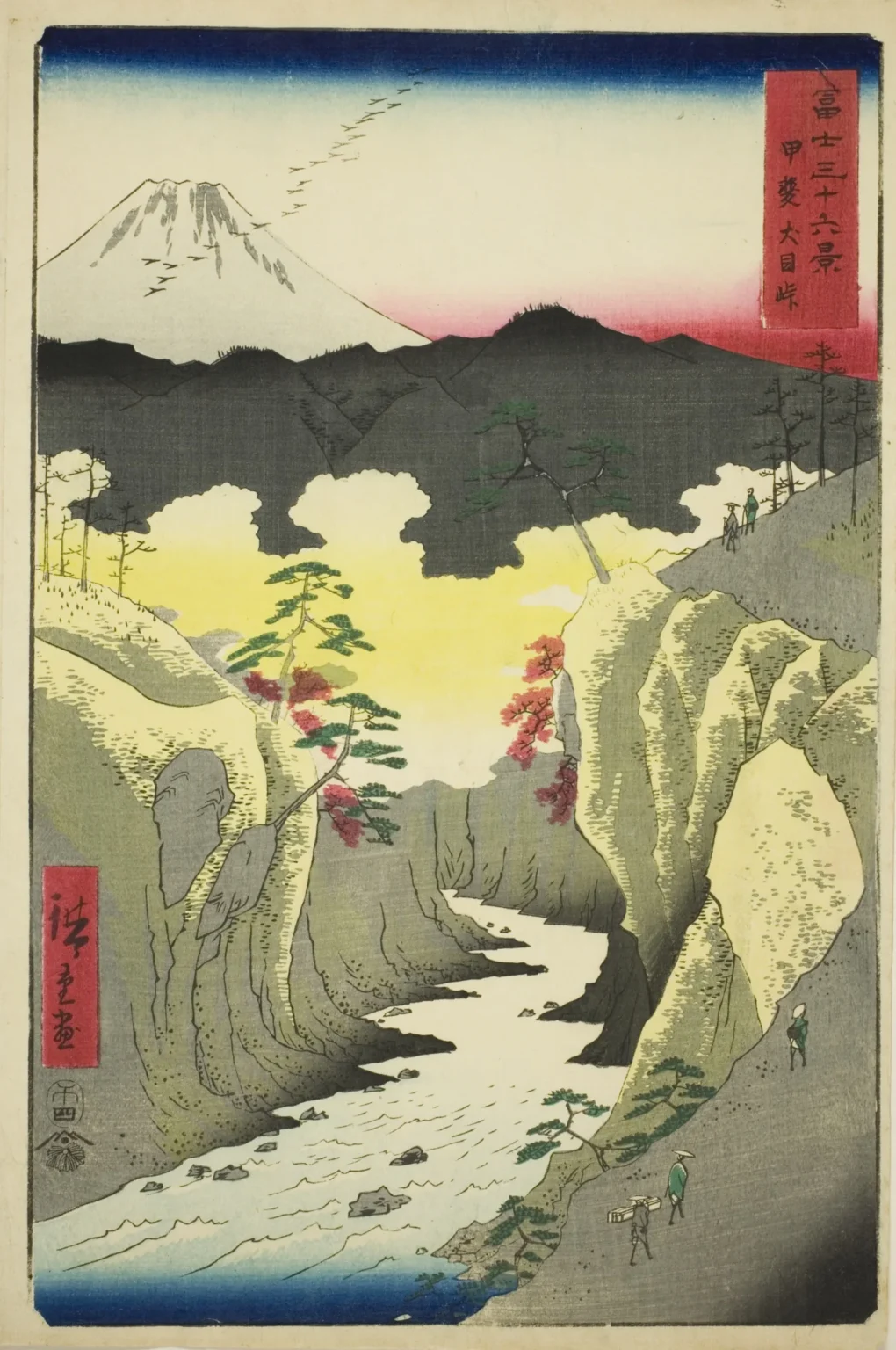
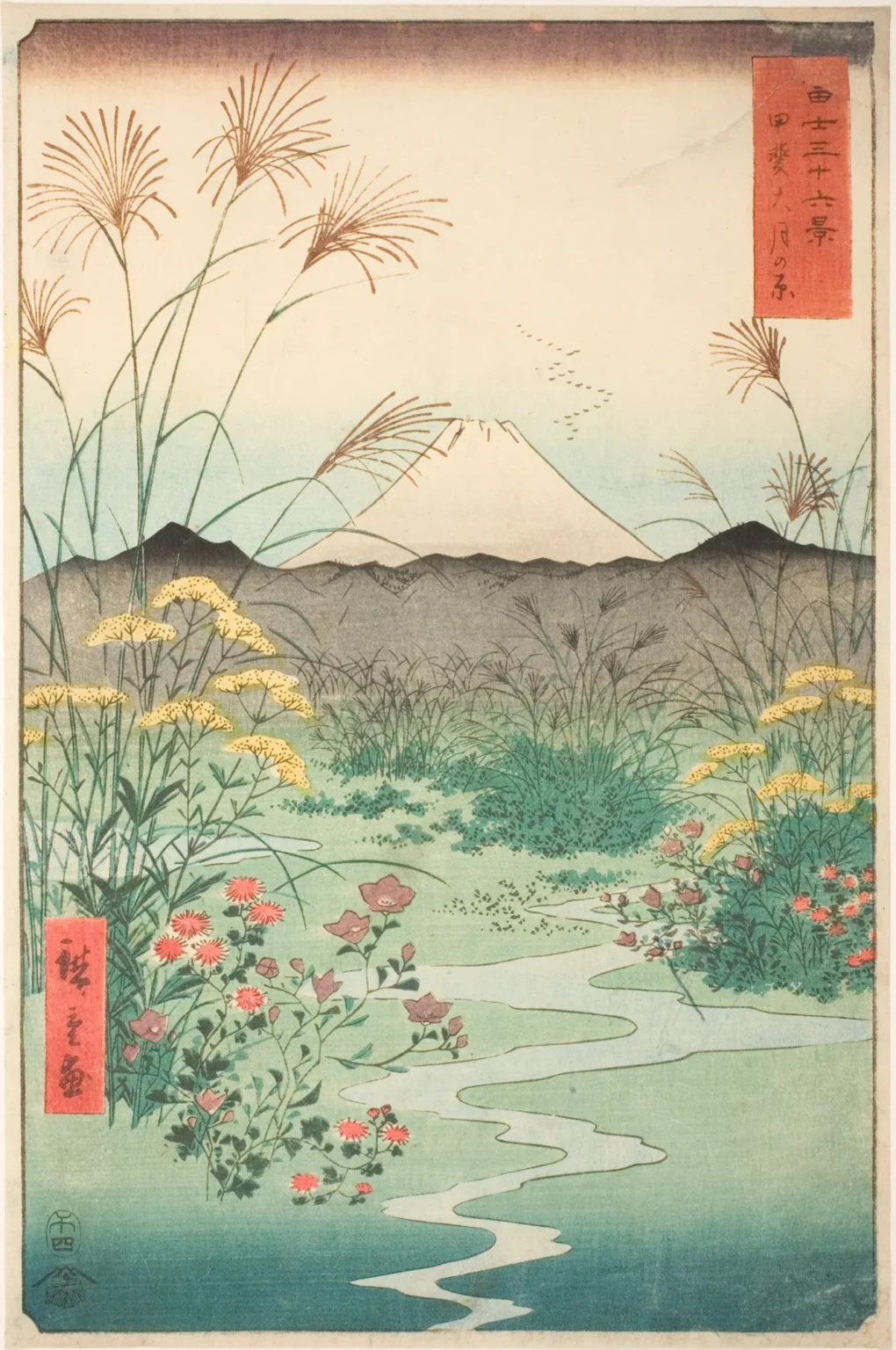
Inume Pass and the Ōtsuki Plain · Hiroshige
Where they are: Inume, as above, and Ōtsuki, further west towards Kōfu. Ōtsuki is where the Fujikyu line to Kawaguchiko begins, so every rail route from Tokyo to the lake passes through it.
What to notice: at Inume, Hiroshige puts a river gorge with pale cliffs in front and lifts Fuji above a dark ridge. At Ōtsuki the mountain sits behind grasses and autumn flowers. On each print, look for the small round censor’s seal near the signature: it dates the design to the 4th month of the Horse year, 1858.
Dawn at Isawa in Kai Province · Hokusai
Where it is: Isawa (written 石和 today), now in Fuefuki City in the Kōfu basin.
What to notice: it is just before sunrise. A post town fills the front of the picture, the Fuefuki River runs behind it, and Fuji appears beyond a band of morning mist while travellers and horses set off early.
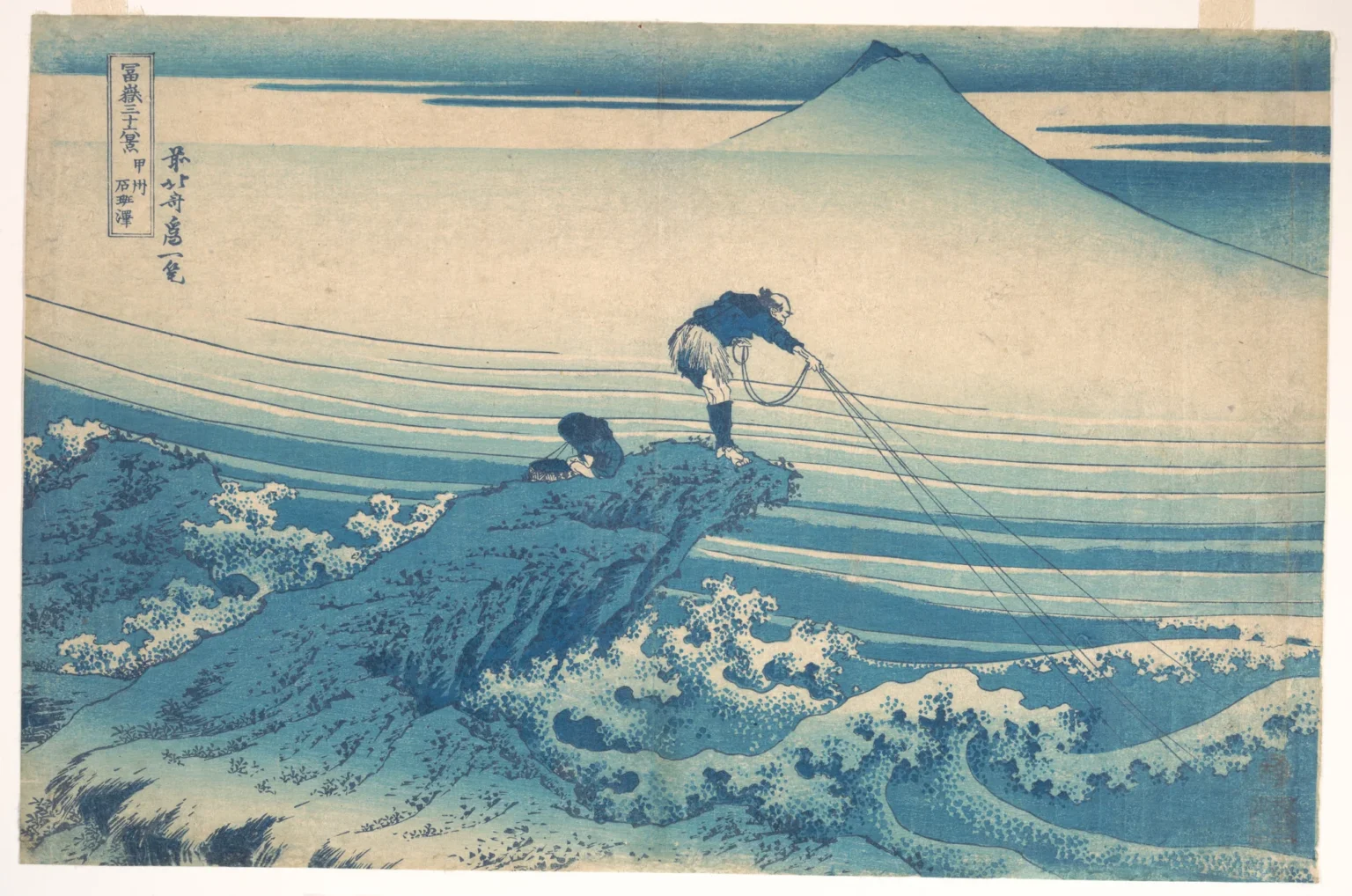
Kajikazawa in Kai Province · Hokusai
Where it is: thought to be near Kajikazawa, now part of Fujikawa Town, close to the point where the Fuefuki and Kamanashi rivers join and become the Fuji River. About 400 years ago a boat route was opened from here down the Fuji River to Iwabuchi, now in Fuji City, Shizuoka, and the boats covered roughly 72 kilometres in half a day. The town’s Shio no Hana history museum tells that story; the nearest station is Kajikazawaguchi on the JR Minobu Line, about 4 kilometres away.
What to notice: a father fishes from a rock while his son looks into the basket. The Tokyo Fuji Art Museum points out the repeated triangles: the mountain, the rock with the fisherman on it, and the lines of the net he has cast.
Getting to the print sites from Lake Kawaguchi
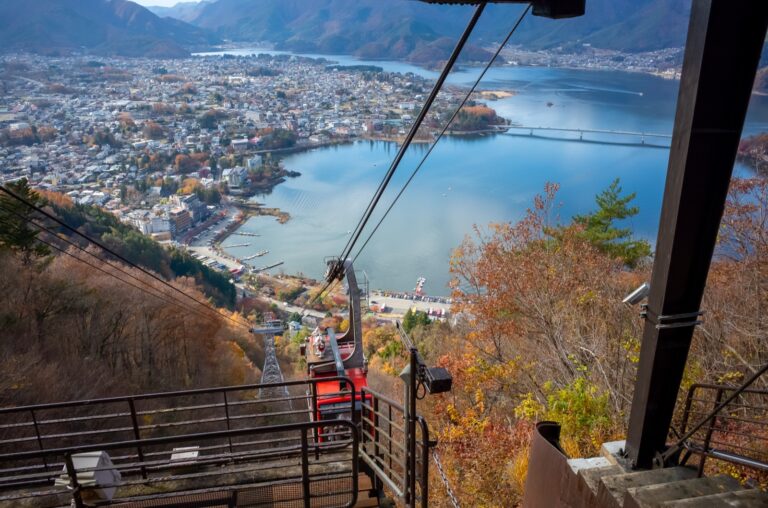
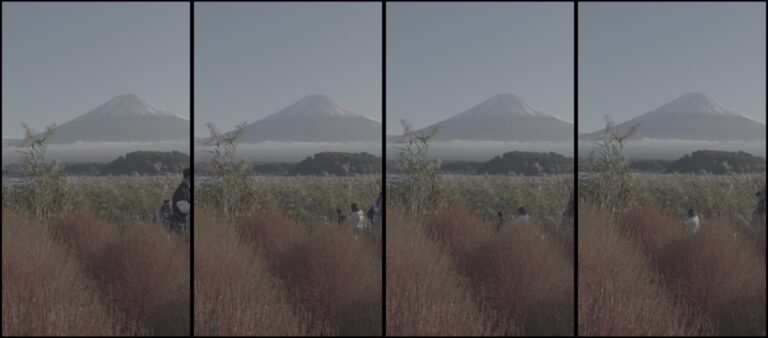
I live in Fujiyoshida, a short drive from Lake Kawaguchi, and the Fujikyu trains that start at Ōtsuki run through my town on their way to the lake. Of the places in the prints, Lake Kawaguchi is the easy one. The lake-in-front, Fuji-behind arrangement of the Misaka print is the view from the north shore, and on a still morning you can see the real mountain upside down in the water, with or without snow. The view from the Kawaguchiko Ōhashi bridge is an easy start, with a footpath on both sides and a short walk from a Red Line sightseeing bus stop. If you come in November, the north shore is also where the Kawaguchiko autumn leaves festival is held.
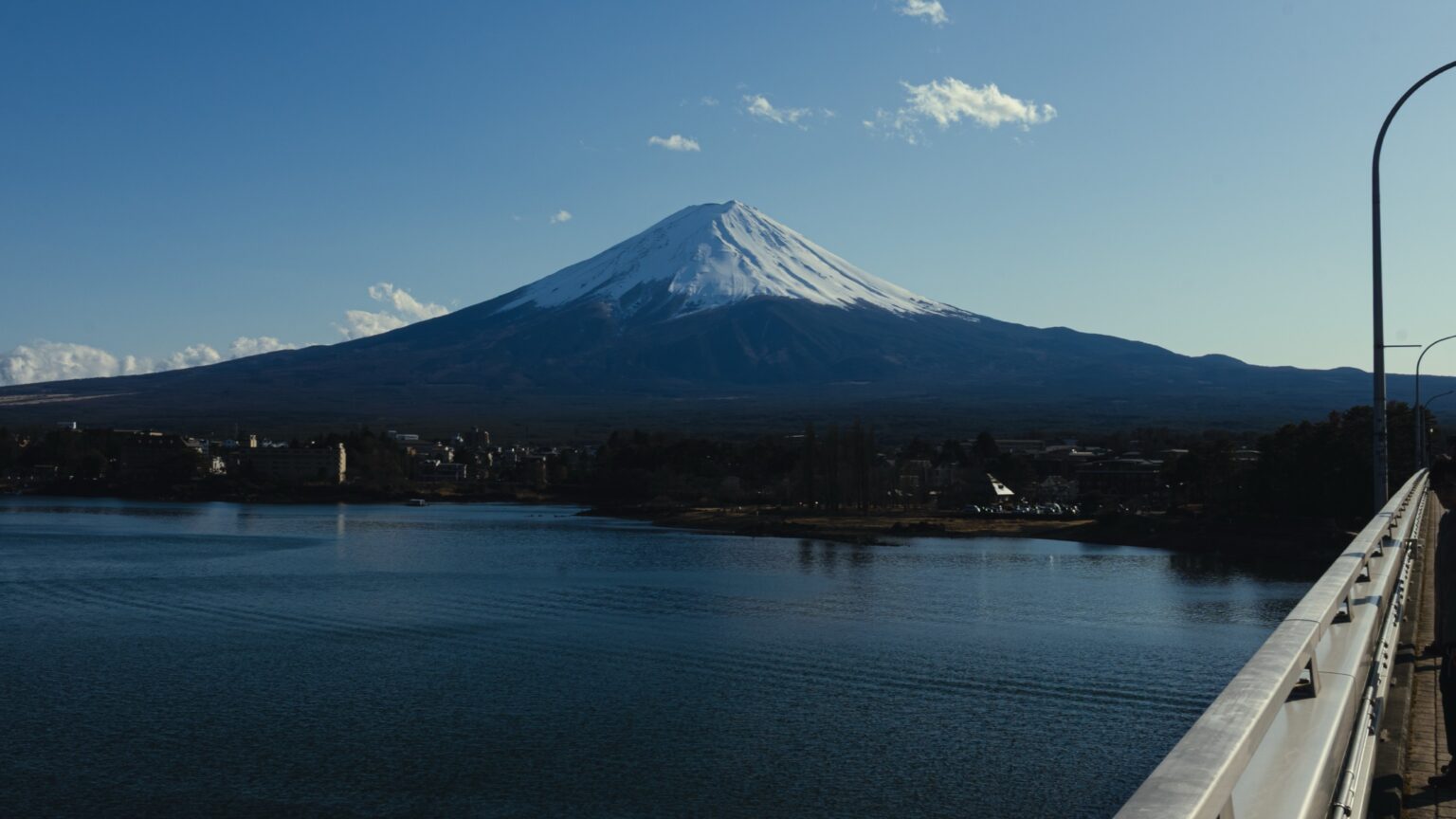
Cloud often hides the mountain, so check today’s Mt Fuji visibility forecast before you set off for a viewpoint.
To be at the lake for a calm early morning, stay the night before. Kawaguchiko or Fujiyoshida: where to stay compares the two bases.
For a morning at the lake, look for a room on the north shore and check the walking route to the water before booking.
Kawaguchiko hotels on Booking.comSome links above are affiliate links, at no extra cost to you.
Where can you see the real prints in Japan?
Originals are shown in short runs. Woodblock prints are easily damaged by heat and light, and the Sumida Hokusai Museum limits each original print to 30 days on display a year, which is why its permanent gallery shows full-size high-definition replicas. Check a museum’s list of works before you go.
Sumida Hokusai Museum · Ryōgoku, Tokyo
The 10th-anniversary special exhibition runs to 23 November 2026 in two halves. According to the museum’s list of works, Hokusai’s Mishima Pass in Kai Province and the Great Wave are in the first half, to 18 October, and the Red Fuji in the second, 21 October to 23 November. Adults ¥1,500, which also covers the permanent gallery of replicas that day (¥400 on its own). Closed Mondays; when a Monday is a holiday it opens and closes the next weekday instead (13 October), and the special exhibition rooms are closed on 20 October for the changeover. Five minutes’ walk from exit A3 of Ryōgoku Station on the Toei Ōedo Line.
Tokyo National Museum · Ueno, Tokyo
Hiroshige: New Perspectives on Edo Japan runs from 29 September to 20 December 2026 in three parts, each showing a whole series: the Tōkaidō to 25 October, the Kiso Road from 27 October, and One Hundred Famous Views of Edo from 25 November. The museum’s list of works puts “Sunrise at Mount Fuji Viewed from Hara” and “View of Mount Fuji on the Left at Yoshiwara” in Part One. Adults ¥1,500, university students ¥500, free for under-18s and those aged 70 and over; the ticket also covers the collection galleries that day. Closed Mondays (open 12 October, 2 November and 23 November) and on 13 October, 24 November and 15 December.
Not for these prints this autumn: the Tokyo Fuji Art Museum in Hachiōji owns all five Hokusai Kai prints, and its collection entries are the source of several identifications above, but its displays from 3 October to 27 December are Sue ware and Western paintings. The Yamanashi Prefectural Museum in Fuefuki, which showed these Fuji series in 2007 and 2011, closes its permanent galleries from 1 November and the whole building from 1 December to 1 January 2027. The Shizuoka City Tōkaidō Hiroshige Museum in Yui is closed until the end of March 2027; meanwhile a satellite space at the Tōkaidō Yui-juku Kōryūkan in Yui Honjin Park shows modern recut reproductions of Hiroshige’s Tōkaidō set.
In my own town, Fujiyoshida’s Fujisan Museum has an exhibition on 800 years of the Yoshida climbing trail: the first part ran until 23 September, and the second part runs from 17 October 2026 to 18 January 2027. Hokusai drew more than Fuji, too. His pictures for the Hyakunin Isshu poems, two of them autumn scenes, are in what momiji means.
Hokusai and Hiroshige’s Fuji: short answers
How many prints are in Hokusai’s Thirty-six Views of Mount Fuji?
Forty-six. The series began as 36 views, and ten more were added later under the same title. All are horizontal ōban woodblock prints, about 25 by 37.5 centimetres.
When did Hokusai make Thirty-six Views of Mount Fuji?
Around 1830–32, when he was about seventy. Museums give slightly different ranges: the Metropolitan Museum and the Tokyo Fuji Art Museum say c. 1830–32, the Art Institute of Chicago c. 1830–33, and the Edo-Tokyo Museum 1831–34.
Is “Reflection in Lake at Misaka” Lake Kawaguchi?
Yes. The Tokyo Fuji Art Museum’s collection database describes it as Lake Kawaguchi and Fuji seen from Misaka, now part of Fuefuki City, and gives the English title as “Mt. Fuji Reflected in Lake Kawaguchi in Kai Province”. The mountain is in summer, but its reflection is snow-covered, which the museum calls a landscape that could not exist.
Where was Hokusai’s Red Fuji drawn?
No one knows for certain. The Tokyo Fuji Art Museum says theories differ, and suggests the light from the east points to the north face, seen from near Lake Kawaguchi. The title, Gaifū kaisei, means “south wind, clear sky”.
Which Hokusai prints show Yamanashi?
Five have Kai Province (Kōshū) in their titles: Reflection in Lake at Misaka, Mishima Pass, Kajikazawa, Inume Pass and Dawn at Isawa. Today they correspond to Lake Kawaguchi, Kagosaka Pass (thought to be), the Kajikazawa area of Fujikawa Town (thought to be), Uenohara City and Fuefuki City. A sixth, The Back of Fuji from the Minobu River, is also set in Yamanashi, though its title doesn’t name the province, and one museum places the Red Fuji near Lake Kawaguchi.
What is the difference between Hokusai’s and Hiroshige’s Thirty-six Views of Mount Fuji?
Hokusai’s set, from around 1830–32, is horizontal and runs to 46 prints. Hiroshige’s 1858 set is vertical, with 36 prints and censor’s seals dated 1858, the year he died; he had also made a smaller horizontal set in 1852. Both artists have prints titled after Kai, and both drew Misaka and Inume.
Where can I see original Hokusai prints in Tokyo?
The Sumida Hokusai Museum’s special exhibition, to 23 November 2026, includes prints from Thirty-six Views; according to its list of works, Mishima Pass in Kai Province and the Great Wave are shown to 18 October and the Red Fuji from 21 October. Its permanent gallery shows full-size replicas, because each original print is displayed for no more than 30 days a year. For Hiroshige, the Tokyo National Museum’s exhibition runs to 20 December 2026. Displays change, so check the museum’s list before you go.
Can you visit the places in Hokusai’s Kai Province prints?
Yes. Lake Kawaguchi is easy by train and bus, and the Misaka Pass road climbs from the lake’s north side. Kagosaka Pass, thought to be the Mishima Pass of Hokusai’s title, is on Route 138 above Lake Yamanaka. Inume is in Uenohara City and Isawa in Fuefuki City, and the Kajikazawa print is thought to show the river near Kajikazawa, now part of Fujikawa Town. The passes and the Kōfu-side towns are easiest to link by car.
Sources
The museum catalogue entries and official pages behind this article, checked 6 October 2026
- Tokyo Fuji Art Museum collection database (Japanese): Reflection in Lake Kawaguchi (Kōshū Misaka suimen), Mishima Pass, Kajikazawa, Inume Pass, Dawn at Isawa, South Wind, Clear Sky, The Great Wave; access, works on view and current exhibitions
- Art Institute of Chicago: Hokusai, The Great Wave and Hokusai, Shower Below the Summit (series notes, 46 prints); Hiroshige, Hara: Mount Fuji in the Morning and Yoshiwara: Mount Fuji on the Left; prints reproduced here: Misaka Pass, Ōtsuki Plain, Inume Pass (public domain)
- The Metropolitan Museum of Art, prints reproduced here (public domain): Reflection in Lake at Misaka, The Great Wave, Mishima Pass, Kajikazawa (and a second impression), Inume Pass
- Museum of Fine Arts, Boston — Hiroshige, Misaka Pass in Kai Province (publisher, date and censor’s seal); Edo-Tokyo Museum — Kōshū Misaka suimen (date, publisher)
- Sumida Hokusai Museum (Japanese): Hokusai’s life, permanent gallery and display limits, 10th-anniversary special exhibition and its list of works (PDF), access
- Tokyo National Museum — Hiroshige: New Perspectives on Edo Japan and its English list of works; ColBase: Hiroshige, Inume Pass in Kai (1852 set) and Yumeyama in Kai (1852 set)
- Yamanashi Prefectural Museum (Japanese) — exhibitions and closure notice; past exhibition catalogues in the National Diet Library: Hokusai and Hiroshige (2007), Hiroshige’s Kōshū diary report (2008); 2011 exhibition record, National Art Center art commons
- Yamanashi Prefectural Library digital archive — note on Kōshū Mishima-goe (Japanese)
- Fujikawa Town History and Culture Museum Shio no Hana — Fuji River boat transport and access (Japanese)
- Shizuoka City Tōkaidō Hiroshige Museum — closure notice and satellite museum; Fujisan Museum, Fujiyoshida — exhibitions; Fujikyu Railway — station list (Japanese)
- Place and background notes, Japanese Wikipedia: Misaka Pass, Kagosaka Pass, Inume-juku, Kajikazawa, Fugaku Hyakkei (Dazai), Utagawa Hiroshige (1841 journey, 1859 sale); English Wikipedia: Hiroshige’s Thirty-six Views of Mount Fuji (list of the 1858 prints)
Join travelers discovering Japan's hidden side
Weekly dispatches from off-the-beaten-path Japan — spots and stories you won't find in guidebooks.
No spam. Unsubscribe anytime.
Welcome aboard!
You're in. See you in your inbox soon.