Japan · Food & Drink · Convenience-Store Culture
Japan published its own cup noodle ranking on 30 August 2026, and Nissin’s Cup Noodle won it with 13.0% of 177 votes, ahead of Nissin Raoh and Nissin Men Shokunin tied on 7.3% each. The more useful result is buried below the top three: four of the six most-voted cups use non-fried noodles, the premium tier most visitors never notice.
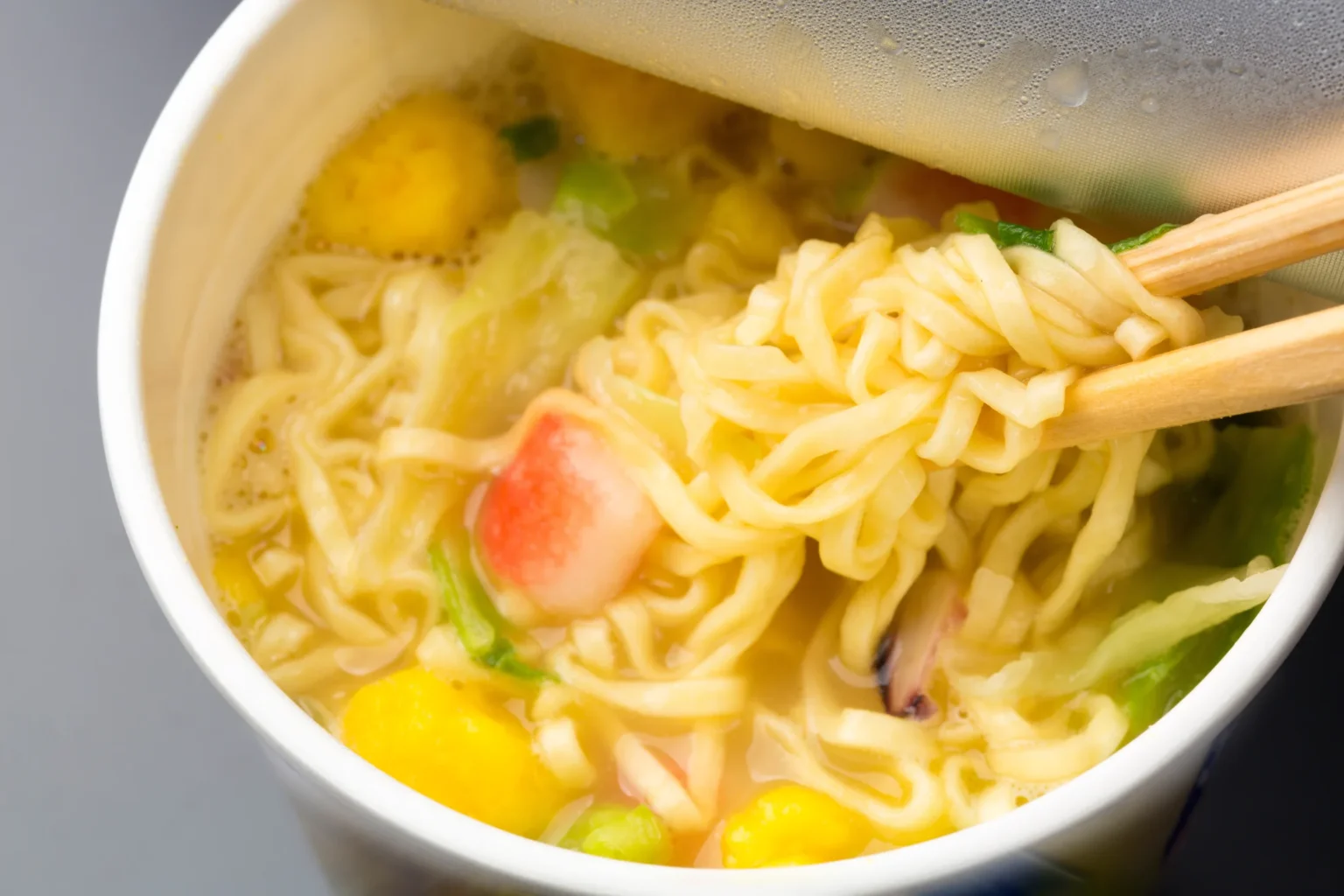
The ranking comes from Netlab, the research arm of ITmedia, which surveyed people in their thirties and younger nationwide on 3 June 2026 and collected 177 valid responses. That is a small sample, and I would rather say so plainly than dress it up — but it is a Japanese vote rather than a foreign listicle, and the shape of the result is worth your attention.
So I took the ranking as a starting point and did the work a poll cannot do for a traveller. I opened every maker’s official product page and wrote down the current 2026 price, the noodle type, and — the part that matters most, and that I could not find set out anywhere in English — exactly which animals are in each cup.
What 177 Japanese people actually voted for
Nissin took first place and both of the tied second places. Below is the full top ten as published. Second, fourth, sixth and ninth are all exact ties, so there is no third, fifth, seventh or tenth place in this ranking.
| Rank | Cup | Maker | Share of vote | Noodle |
|---|---|---|---|---|
| 1 | Cup Noodle (カップヌードル) | Nissin | 13.0% | Fried |
| 2= | Raoh (日清ラ王) | Nissin | 7.3% | Non-fried |
| 2= | Men Shokunin (日清麺職人) | Nissin | 7.3% | Non-fried |
| 4= | Menzukuri (麺づくり) | Toyo Suisan | 6.8% | Non-fried |
| 4= | Super Cup (スーパーカップ) | Acecook | 6.8% | Fried |
| 6= | Maruchan Seimen Cup (マルちゃん正麺 カップ) | Toyo Suisan | 5.1% | Non-fried |
| 6= | Gotsumori (ごつ盛り) | Toyo Suisan | 5.1% | Fried |
| 8 | Sapporo Ichiban Donburi (サッポロ一番 どんぶり) | Sanyo Foods | 4.5% | Fried |
| 9= | Kinchan Noodle (金ちゃんヌードル) | Tokushima Seifun | 3.4% | Fried |
| 9= | Maruchan QTTA | Toyo Suisan | 3.4% | Fried |
Thirty products received votes in total. The tail is full of names a visitor will still see on the shelf and should not dismiss: Sugakiya’s cup ramen from Nagoya, Myojo’s Charumera and Yamadai’s Sugomen all on 2.8%, and Acecook’s Wakame Ramen — a seaweed cup that has been in production for decades — down on 1.7%.
One thing to understand about the ranking. Netlab votes are cast for a series, not a single cup — people voted for “Gotsumori”, not for a specific Gotsumori flavour. Where a series has many flavours I have verified one representative product and named it, because ingredients differ sharply between flavours in the same range. If you avoid a particular meat, check the cup in your hand rather than trusting the series.
Why are four of Japan’s top six cup noodles non-fried?
Because non-fried noodles taste closer to a ramen shop, and in Japan that is the whole competition. This is the single most useful thing to understand before you stand in front of a Japanese cup noodle shelf, and it is invisible if you cannot read the packet.
A conventional instant noodle is flash-fried in oil to drive the water out. That is what makes it keep for months, and it is also what gives cheap instant ramen its faintly oily character. Both cups tied for second, one of the two tied for fourth and one of the two tied for sixth do not do that. Their noodles are dried with hot air instead — Toyo Suisan’s Menzukuri page describes a temperature- and humidity-controlled drying process, Nissin markets Men Shokunin under the line “just like fresh noodles,” and Maruchan Seimen Cup uses a patented method the company brands as keeping boiled fresh noodles as they are.
How to spot it on the packet. Look at the ingredients block, the one headed 原材料名. If the very first word is 油揚げめん, the noodle was fried. If it just says めん, it was not. That two-character difference separates the two halves of the Japanese cup noodle aisle.
Non-fried does not automatically mean expensive, which surprised me when I lined the prices up. Raoh at ¥314 and Maruchan Seimen Cup at ¥298 sit at the premium end, but Men Shokunin is non-fried and costs ¥184 — less than the fried Cup Noodle at ¥248. The cheapest cup in the top ten is also one of the best ones, which is not how this usually works.
Once you know the distinction, the Japanese ranking stops looking random. Netlab illustrated its Raoh entry with Amazon reviews saying things like “I stopped going out to ramen restaurants” and “the quality is too high.” Those are shoppers’ words rather than the survey’s, but they explain the pattern: Japanese buyers are not ranking snacks, they are ranking substitutes for a ¥1,000 bowl.
Japanese buyers are not ranking snacks. They are ranking substitutes for a ¥1,000 bowl of ramen.
The top ten, cup by cup
Prices below are each maker’s own suggested retail price, before consumption tax, as published on their official product pages on 30 August 2026. Nissin raised suggested prices from April 2026 shipments, and Toyo Suisan and Tokushima Seifun from July, though not every product in every range was affected — so older reviews and older shelf photos will show lower numbers. Food in Japan is taxed at the reduced 8% rate, and shops set their own shelf prices anyway, so treat these as the reference point rather than the till total.
1. Cup Noodle — Nissin, ¥248
The original, and still the one Japan votes for. It launched on 18 September 1971 and was the world’s first cup-type instant noodle. Nissin’s own history page records that grocery stores would not stock it at first, so the sales team pushed it through night-shift workplaces like fire and police stations instead. In its fiftieth year on sale the brand passed 50 billion servings worldwide, and it is sold in around 100 countries.
The famous cubes of “mystery meat” have an official answer, and it is less mysterious than the nickname suggests. Nissin describes 謎肉 as pork and soy-derived ingredients mixed with vegetables, minced and freeze-dried into seasoned pork mince. In March 2024 the company sold a version of the cup filled with nothing else, which tells you how comfortable they are with the joke.
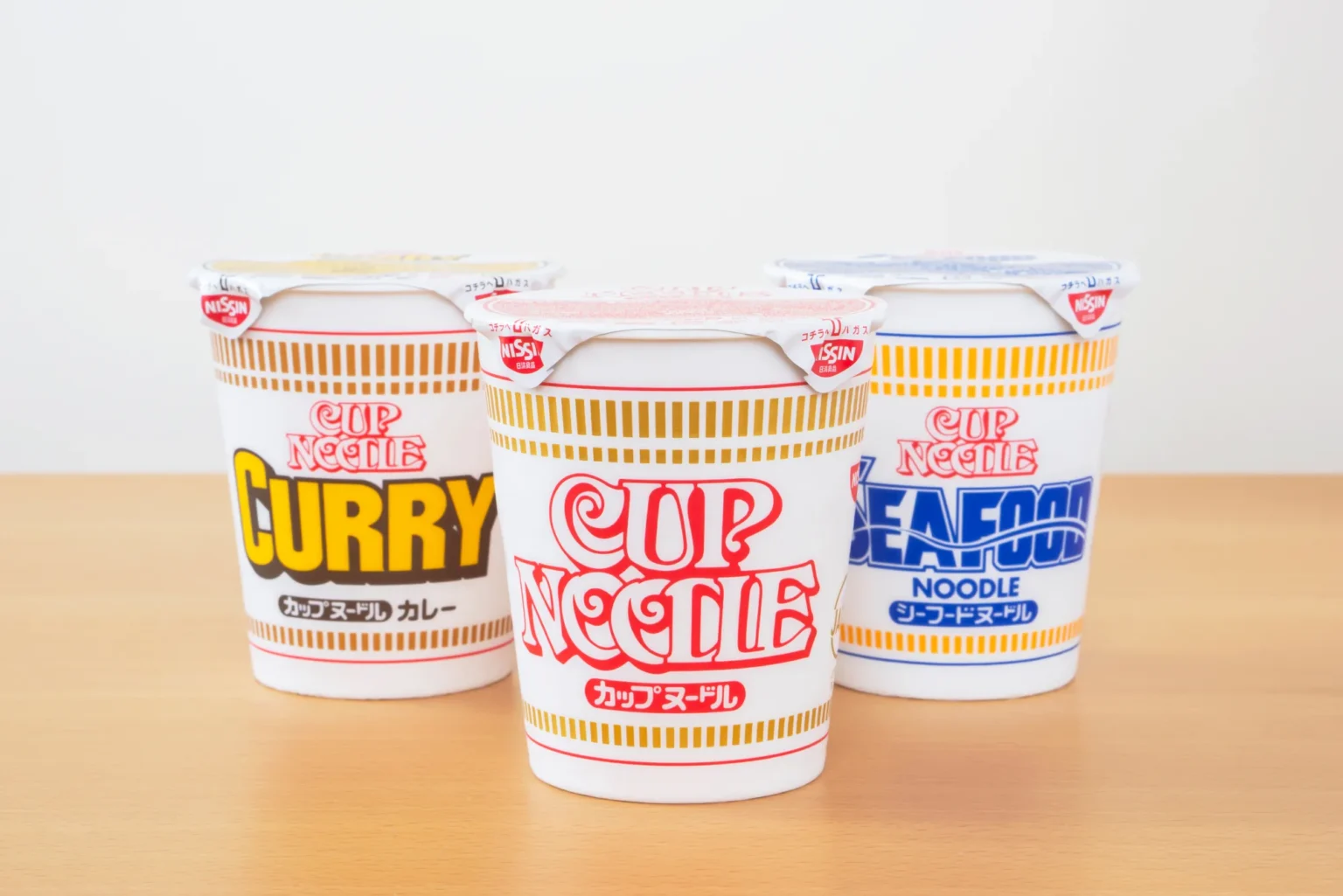
One detail worth knowing before you photograph your souvenir: the Japanese cup says CUP NOODLE in the singular, while the export versions say CUP NOODLES. Curry and Seafood are not novelty flavours here, they are core lineup and have been for decades. If you buy only one cup in Japan, and you are not avoiding pork, buy the Seafood.
2= Raoh — Nissin, ¥314
The most expensive cup in the top ten and the one that behaves least like instant food. The name means king of ramen — Nissin’s US site spells it out — and the brand has been the company’s engineering laboratory since 1992, when the first Raoh used retort-pouched fresh-type noodles rather than dried ones at all. That original was discontinued in August 2010 and relaunched a month later as the non-fried version sold today.
The current flagship is 背脂醤油, a soy broth finished with pork back fat, and at 113g it is a substantial bowl. If you want to understand why Japanese people rate cup ramen at all, this is the cup to spend ¥314 on.
2= Men Shokunin — Nissin, ¥184
The quiet one, and my pick for best value in the entire ranking. Nissin has sold it since 2000 and says it is the best-selling non-fried cup noodle in Japan by servings, citing Intage market data for 2024. Its noodles are made with whole-grain wheat flour, and it is the cheapest cup in the top ten by a clear margin — ¥184 against Raoh’s ¥314 in the same non-fried category.
The shoyu is the flagship. If you are buying a case to take home rather than a single cup, this is the one where the maths works.
4= Menzukuri — Toyo Suisan, ¥248
Maruchan’s answer to Men Shokunin, born the same year as Raoh in 1992 with just two flavours, soy and miso. The brand page makes an argument I find persuasive: because the noodles are never fried, no frying oil leaches into the broth, so the soup tastes cleaner. The flagship 鶏ガラ醤油 is built on chicken broth, though it contains pork as well — more on that below.
4= Super Cup — Acecook, ¥266
The hungry one. Launched on 23 July 1988, in an era when 500,000 cups a year counted as a hit, and it shipped 800,000 in its first four months. The 1.5x in the name refers to 90g of noodles, the same portion as a full packet of bag ramen, and the industry press credits it with moving cup noodles in Japan from snack to actual meal.
It is fried, unashamedly, and it is what you buy at 1am. Acecook has announced a renewal of the whole five-flavour lineup for 7 September 2026 at the same ¥266, so visitors this autumn will see new packaging.
6= Maruchan Seimen Cup — Toyo Suisan, ¥298
The fastest-selling cup in Toyo Suisan’s history: launched on 5 October 2015, it shipped a million cases inside a month. The bag version that made the name famous arrived in 2011, and the series passed 2.5 billion cumulative servings as of 31 January 2026.
Careful if you are comparing older reviews. The flagship soy flavour was renamed from 芳醇こく醤油 to 芳醇醤油 at the tenth-anniversary renewal released on 22 September 2025. It is the same lineage, not a different product — but the old name now returns dead listings on shopping sites.
6= Gotsumori — Toyo Suisan, open price
The budget monster, and the only entry in the top ten with no price at all. Toyo Suisan sells the entire Gotsumori line as an open-price product, meaning the company publishes no suggested retail price and each shop decides for itself. That is precisely why it sits at the cheap end of every shelf.
The best-known product in the range is not a soup at all but a sauce yakisoba, and that is the one I have verified for this article: 130g of noodles, 171g total, 784 kcal, with a sachet of karashi mayonnaise. The name comes from a phrase meaning a hefty, huge serving, and in 2020 they went further still and released a 200g version. Other Gotsumori flavours — the champon and the corn miso ramen among them — have quite different ingredients.
8. Sapporo Ichiban Donburi — Sanyo Foods, ¥236
A cup built as a tribute to a bag noodle. Sanyo Foods launched the Donburi bowl line in November 1998 for the thirtieth birthday of Sapporo Ichiban Miso Ramen, and the stated brief was to recreate the bag noodle’s taste in a cup. The parent brand goes back to January 1966. There is also a mini-bowl version, which is the right size for a hotel room when you have already eaten dinner.
9= Kinchan Noodle — Tokushima Seifun, ¥247
The one you will probably struggle to find where you are staying. It gets its own section below.
9= Maruchan QTTA — Toyo Suisan, ¥236
The youngest brand in the ranking, launched nationwide on 27 March 2017 — not 2016, which circulates widely and is wrong; Toyo Suisan’s own 2016 news archive contains no QTTA entry. The name is a joke you appreciate after eating one: it comes from 「はぁ〜、食った」, the contented sigh you exhale when you are properly full.
It is also the only cup in the top ten whose allergen table marks beef, which matters if beef is what you avoid.
Which Japanese cup noodles contain pork?
Cup Noodle, case of 20
The winner of the ranking, in the 78g original size. The obvious first order, and the one that survives being handed out to other people.
Check the case on Amazon Japan
Men Shokunin shoyu, case of 12
The cheapest way into the non-fried tier, and the best-value cup in the top ten. Start here if you want to taste what Japan actually ranks highly.
Check the case on Amazon Japan
Raoh seabura shoyu, case of 12
The premium end. Buy this one if you want to hand somebody a cup and watch them work out that instant ramen is not what they thought.
Check the case on Amazon Japan
All of them. Every cup in this top ten contains pork, chicken or both, and there is no halal-certified or vegetarian option anywhere in the ranking. I checked each maker’s official ingredient and allergen pages individually rather than assuming, because this is the question that actually ruins a trip if you get it wrong.
| Cup (flavour verified) | Pork | Chicken | Beef | Fish or shellfish |
|---|---|---|---|---|
| Cup Noodle, original | Yes | Yes | No | Shrimp |
| Raoh, 背脂醤油 | Yes | Yes | No | Mackerel |
| Men Shokunin, 醤油 | Yes | Yes | No | Fish-paste topping |
| Menzukuri, 鶏ガラ醤油 | Yes | Yes | No | Niboshi powder, naruto |
| Super Cup 1.5x, しょうゆ | Yes | Yes | No | Seafood seasoning in broth |
| Maruchan Seimen Cup, 芳醇醤油 | Yes | Yes | No | Seafood extract |
| Gotsumori, sauce yakisoba | Yes, as refined lard | No | No | No |
| Sapporo Ichiban, みそどんぶり | Yes | Yes | No | Bonito seasoning |
| Kinchan Noodle | Yes | Yes | No | Shrimp, seafood extract |
| Maruchan QTTA, しょうゆ | Yes | Yes | Yes | Shrimp |
Two rows deserve a second look, because between them they expose how Japanese labelling can mislead a careful reader.
The allergen box is not an ingredients list. Gotsumori’s sauce yakisoba is fried in refined pork lard, which appears in its 原材料名 block — yet pork is not marked in its allergen table. Super Cup works the other way round: a seafood seasoning sits in the broth ingredients while no fish or shellfish is marked in the allergen table. Japanese law only compels makers to declare a short list of allergens, and pork, chicken and general seafood seasonings are not on it. If you avoid a meat for religious or ethical reasons rather than allergic ones, the allergen table will quietly let you down. Read 原材料名 instead, and look for 豚, ラード, ポーク, 鶏, チキン, ビーフ and 魚介.
Halal-certified instant noodles are made in Japan — they are simply not in this ranking, which reflects what the general public buys. If pork is a hard line for you, treat the ordinary cup noodle aisle as off-limits by default and look for specialist halal shops or the small halal corner that some larger supermarkets carry, rather than relying on finding one. The same caution applies to the broth in a real ramen shop, which is worth knowing before you go looking for tonkotsu at Ichiran’s headquarters in Fukuoka.
Worth knowing before you commit: the same shelf carries bag noodles at roughly half the price per serving, usually with more noodle in them. I put the two formats side by side, with the makers’ own prices and weights, in bag noodles versus cup noodles.
Where do I buy cup noodles in Japan, and what should they cost?
Buy them at a supermarket or a discount store rather than a convenience store, if price is what you care about. When Netlab ran a basket comparison, the same cup noodle cost ¥199 at a supermarket and ¥300 at a convenience store. The konbini is the most expensive way to buy a cup in Japan and the most convenient one, and those two facts are the entire decision.
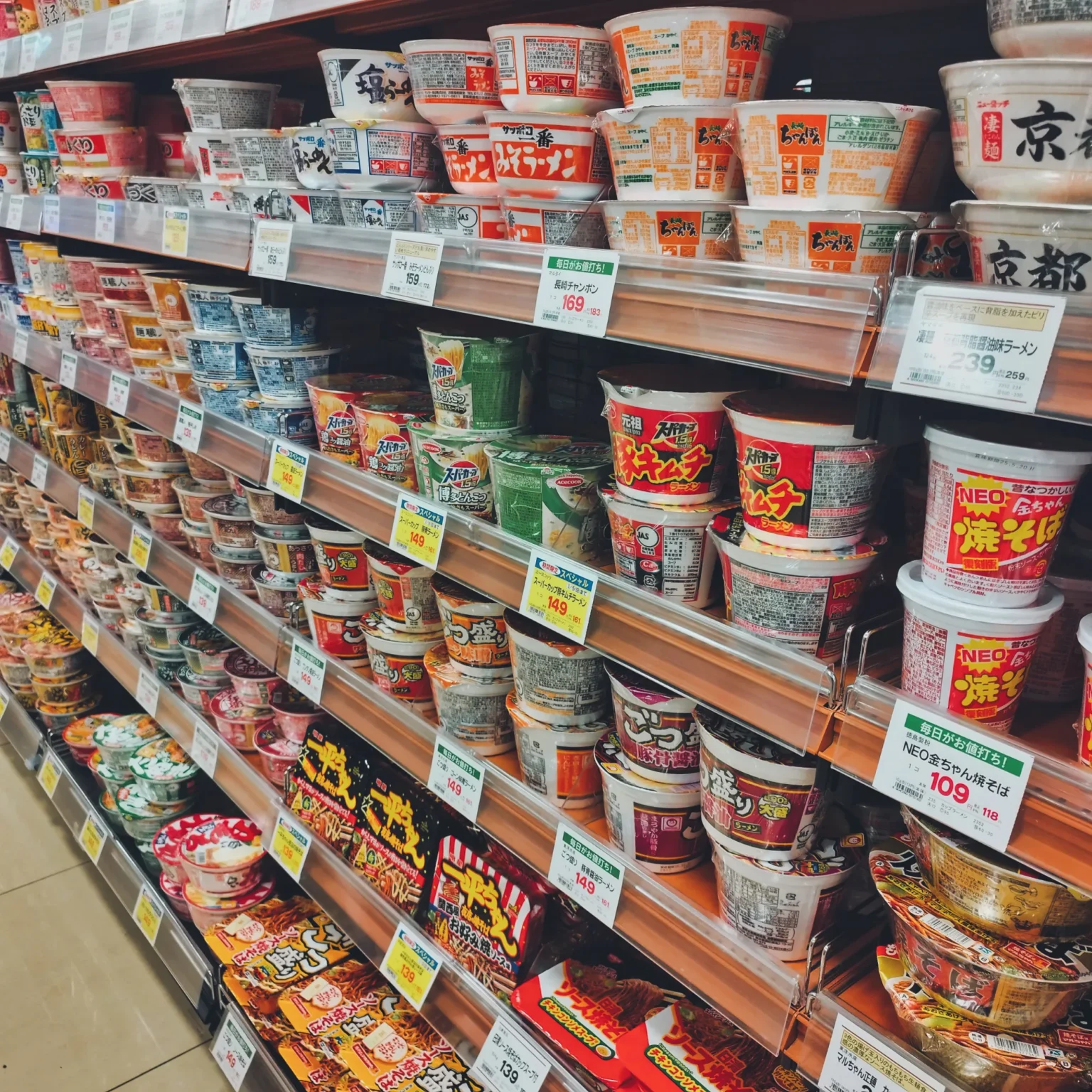
Supermarket
The best combination of price and range. Look for Ito-Yokado, Life, Maruetsu, Summit or any local chain. Shelf prices are set by the shop, so the same cup varies between branches of one chain.
Don Quijote
Open late, often past midnight, and stocks multi-packs alongside single cups across a very wide price range. The practical option if you are shopping after a day out and want a case to take home.
Convenience store
Closest to the maker’s suggested price, and open at 3am. Worth it for one cup at the moment you want it, not for stocking up.
Drugstore and 100-yen shop
Easy to overlook. Welcia, Sundrug and Matsumoto Kiyoshi price food competitively and often have a tax-free counter; Daiso stocks a small instant noodle shelf at around ¥100.
Prices in this article are the maker’s suggested price before tax. Add Japan’s reduced 8% consumption-tax rate for food to approximate a till price, then expect the actual shelf tag to be lower at a supermarket and close to the reference at a convenience store.
Buying tax-free changes on 1 November 2026. The ¥5,000 minimum spend per shop per day stays, but Japan switches to a refund system: you pay the tax-inclusive price at the register and claim the tax back after customs confirms at the airport that you are exporting the goods. The old split between “consumables” and “general goods” — which is where food like cup noodles sat, with its sealed-bag rule — is being abolished. Practical read: keep tax-free cup noodles unopened and in your hand luggage for the customs check rather than eating them in the hotel. Our guide to tax-free shopping in Japan goes through the changeover in detail.
Buying a case online
If you would rather not carry twelve cups across Tokyo, Amazon Japan delivers cases and will send them to a hotel — the address format matters, and we walk through it in our guide to getting Amazon Japan delivered to your hotel. These three are the domestic products described above rather than export versions.
How do you actually eat one in Japan?
Fill to the line inside the cup with boiling water, close the lid, wait the number of minutes printed on the front, stir, eat. The printed time is not a suggestion — three minutes for most fried cups, and the non-fried ones above generally want longer, which is stated on each lid.
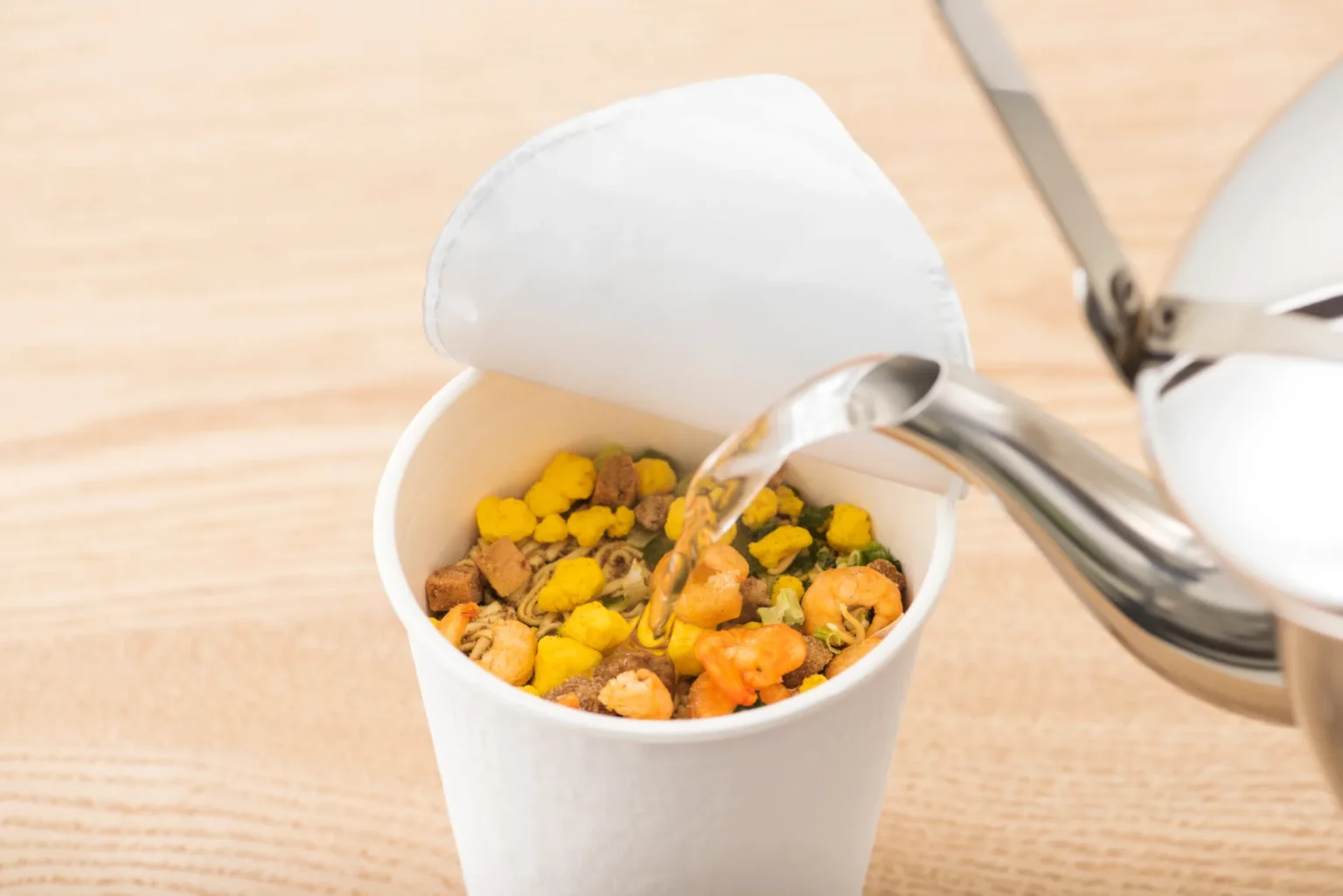
Find the fill line
It is moulded into the inside wall of the cup, not printed on the outside. Fill to it and no further; extra water thins the soup and there is no fixing it afterwards.
Weigh the lid down
The lid lifts as steam builds. Japanese cups often have a tab, and if not, rest your chopsticks across the top. Uncovered noodles cook unevenly.
Check for sachets
Many cups hide a liquid soup or oil sachet under the lid that goes in after the water, not before. Yakisoba types like Gotsumori are drained first, then sauced.
Slurping is fine
Pulling air in with the noodles cools them and is entirely normal here. Talking with a full mouth is not, and neither is walking down the street eating.
Convenience stores keep a hot-water pot in the store — 7-Eleven’s own customer FAQ describes one held at around 90°C — and it is there as a courtesy for people who buy something in that shop, not as a public tap. Utensils work the same way: they are handed over at the till at each store’s discretion. One genuinely useful piece of policy if you are not confident with chopsticks: FamilyMart switched its default utensil to bamboo chopsticks across its stores in October 2022, but stated at the time that it would keep providing forks on request specifically for overseas customers, small children, and people who need them.
Most Japanese business hotels put an electric kettle in the room with tea or coffee, which makes a cup noodle the most reliable late meal in the country once the restaurants have closed. It is worth checking the amenity list at a very old or ultra-budget property rather than assuming. If you would rather eat something better at that hour, Tokyo has options — Onigiri Bongo in Otsuka is the one I send people to.
The top-ten cup that is hardest to find in Tokyo
Kinchan Noodle is the outlier of this ranking, and the reason is geography. It is made by Tokushima Seifun, a flour miller in Tokushima on Shikoku, and it launched in June 1973. The maker’s own company history says it was produced and sold nationwide from the start, but the market told a different story: distribution settled across western Japan, and in eastern Japan — roughly from Niigata and Kanagawa northwards — it is hard to find on an ordinary supermarket shelf.
Its two strongest markets outside Shikoku are, oddly, Shizuoka and Okinawa. It reached Okinawa in 1973 and stayed.
A cup noodle that took 3.4% of a national vote while being hard to buy in the capital tells you something about how regional Japan still is.
What makes it worth seeking out is that almost nothing about it has changed. Tokushima Seifun deliberately keeps the old-style printing and the Showa-era colouring, so the cup you pick up today looks like the one sold fifty years ago. There is also a running campaign: a collectible crane seal on the base of the cup, which you collect to enter for a ¥10,000 cash prize. The 2026 round was announced on the company’s site in February.
Where to look for it. Anywhere in Shikoku, and in supermarkets across the Chugoku and Kansai regions. If you are heading to Hiroshima or through Shizuoka, check the instant noodle shelf — it is the cheapest souvenir on this page and the only one that will make a Japanese person ask where you found it.
Where can I see how cup noodles were invented?
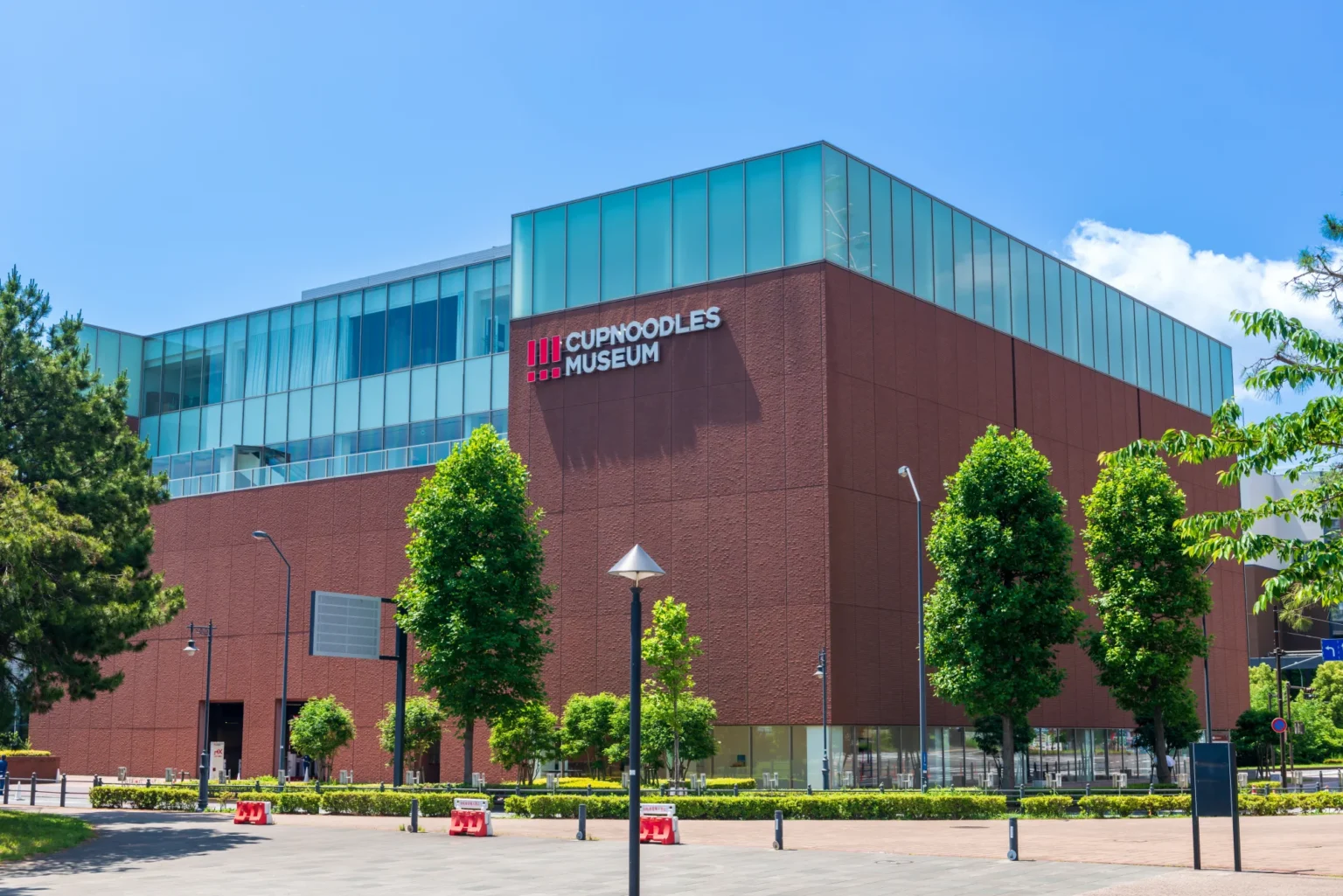
At two museums, both run by Nissin, and the free one is the more historically important of the pair. Momofuku Ando invented the first instant ramen in a shed in his own back garden in Ikeda, Osaka, after a year of research; Chicken Ramen went on sale on 25 August 1958. The cup format followed thirteen years later.
| Yokohama | Osaka Ikeda | |
|---|---|---|
| Admission | ¥500 adults; free for high-school age and younger | Free |
| Hours | 10:00–18:00, last entry 17:00 | 9:30–16:30, last entry 15:30 |
| Closed | Tuesdays and New Year period | Tuesdays and New Year period |
| Design your own cup | ¥500 per cup | ¥500 per cup |
| Make ramen from scratch | ¥1,200 age 12+, ¥600 primary school; reservation required | ¥1,200 age 12+, ¥600 primary school; reservation required |
| Nearest station | Minatomirai or Bashamichi, 8 min walk | Ikeda on the Hankyu Takarazuka Line, 5 min walk |
The headline activity at both is the My CUPNOODLES Factory, where you design a cup and choose the soup and toppings that go into it — four soups and twelve toppings at Yokohama. It costs ¥500 per cup on top of admission, takes about 45 minutes, and runs on numbered tickets issued in order of entry, with the desk closing for the day once they are gone. Each visitor can make one cup. Ticketing rules differ between the two sites and change from time to time, so check the official page for the museum you are visiting before you travel — and either way, arrive early.
Pick the right museum for what you want. Yokohama is bigger, glossier, easier to reach from Tokyo, and costs ¥500. Ikeda is free, about twenty minutes from Umeda, and holds a faithful recreation of the shed where Ando actually worked. If you care about the history rather than the gift shop, go to Ikeda.
Can I take Japanese cup noodles home?
Often not, and the reason is the thing you have just spent this article learning: nearly all of them contain pork, chicken or beef. Many countries regulate meat products in passenger baggage regardless of how processed they are, and a cup whose soup base contains pork extract counts as a meat product for that purpose. The rules differ sharply by destination.
| Destination | What the official rule says |
|---|---|
| European Union | The strictest. Travellers from outside the EU may not bring in any meat or dairy products; the exemptions cover infant food, medical foods, pet food, honey and fish, not meat-flavoured noodles. Undeclared meat products are confiscated and destroyed, with fines or prosecution possible. |
| United States | CBP states you may not import meats or meat products from most countries, and that this extends to “food products that have been prepared with meat,” naming things like bouillon and soup mixes. Declare all food on arrival. |
| Australia | Commercially packaged instant noodles are permitted if shelf stable, but noodles containing ingredients derived from cattle, sheep, goats or pigs need a manufacturer’s label confirming the country of manufacture is approved as free of foot-and-mouth disease. Declare all food. |
Check your own border agency before you buy the case, not after. These rules change, and how a specific product is treated can turn on its exact ingredients and country of manufacture — Australia’s biosecurity system in particular assesses noodles case by case. Search your own government’s site for “instant noodles” or “meat products” before you commit to a suitcase full, and declare food on arrival either way. Declaring an item that turns out to be prohibited normally costs you the item; not declaring it can cost a great deal more.
If you want something easier to carry across a border, note that Gotsumori’s sauce yakisoba is the outlier here: no chicken, no beef and no fish, with pork present only as refined frying lard. That still makes it a pork-derived product and does not exempt it from anything — but it is the one worth reading the label on if your destination’s rules turn on specific declared meats. A cup with no meat-derived ingredients at all is a better bet than any cup on this list, and you will find those on the same shelf if you read 原材料名.
Common questions
Are Japanese cup noodles better than the ones sold overseas?
They are different products rather than simply better ones. Export versions are reformulated for local markets and local regulations, and the entire non-fried premium tier — Raoh, Men Shokunin, Menzukuri, Maruchan Seimen Cup — is largely a domestic Japanese category. That tier took four of the six most-voted places in Japan’s own ranking, and it is the genuine reason to buy cup noodles in Japan rather than at home.
How much does a cup noodle cost in Japan in 2026?
Between ¥184 and ¥314 before tax for the cups in this ranking that carry a suggested price, with Nissin Men Shokunin cheapest and Nissin Raoh most expensive; Gotsumori has no suggested price because Toyo Suisan sells it as an open-price item. Food carries Japan’s reduced 8% consumption tax. Nissin raised suggested prices from April 2026 shipments and Toyo Suisan and Tokushima Seifun from July, so figures you read from 2025 or earlier are now low.
Is there a vegetarian or halal Japanese cup noodle?
Not in this top ten. All ten contain pork, chicken or both, and none is halal certified. Halal instant noodles are made in Japan and some larger supermarkets carry a halal corner, but you will not find a certified option among the mainstream best-sellers. Read the 原材料名 ingredients block rather than the allergen chart: Japanese law requires only a short list of allergens to be declared, and pork, chicken and seafood seasonings are not on it, so a cup can contain lard or fish seasoning without either appearing in the allergen table.
What is the “mystery meat” in Cup Noodle?
Seasoned pork mince. Nissin officially describes 謎肉 as pork and soy-derived ingredients combined with vegetables, then minced and freeze-dried. The nickname is affectionate rather than sinister, and Nissin has leaned into it — in March 2024 the company sold a version of the cup filled with nothing but the cubes.
Which cup noodle should I buy if I can only buy one?
Nissin Men Shokunin shoyu at ¥184 if you want to understand why Japan rates cup ramen, because it is the cheapest way into the non-fried tier. Nissin Cup Noodle Seafood if you want the icon and are not avoiding pork. Nissin Raoh at ¥314 if the point is to be impressed rather than to save money.
Can I get hot water for a cup noodle at a Japanese convenience store?
Usually, if you bought the cup in that store. The hot-water pot is standard store equipment — 7-Eleven’s own FAQ describes one held at about 90°C — but it is framed as a service for customers rather than a public amenity, and the store absorbs the cost, so it is not a guaranteed nationwide entitlement. Ask at the counter rather than helping yourself, and use your hotel kettle if it matters. Chopsticks or a fork are handed over with the purchase at the staff’s discretion; at FamilyMart you can specifically ask for a fork instead of chopsticks.
Is the CupNoodles Museum worth visiting with children?
Yes, and it is one of the better rainy-day options near Tokyo. Yokohama charges ¥500 for adults and is free for high-school age and younger, and the ¥500 design-your-own-cup workshop is the part children remember. Go early: it runs on numbered tickets issued in order of entry and closes once they are gone. The Osaka Ikeda museum is free and has the same workshop, plus a from-scratch Chicken Ramen workshop at ¥1,200 for age 12 and up that needs booking in advance.
Related reading
Natto, explained
The other Japanese food that divides visitors, and what the science actually says about it.
What is natto?
Hand-kneaded ramen in Tokyo
The opposite end of the noodle spectrum: a shop in Ogikubo that still kneads by hand.
Temomi Ramen Juhachiban
The supermarket run
How Japanese fans stock up before a day out, and what they actually put in the bag.
Koshien game-day guide
Ramen as a 45-minute experience
Kombu ramen above a kelp shop that has been trading in Kyoto since 1902.
Kombu Men Kiichi, Nishijin
Sources checked
Ranking and survey method: Netlab (ITmedia Research), published 30 August 2026 — survey conducted 3 June 2026 with Voice Note, respondents nationwide in their thirties and younger, 177 valid responses; the shopper quotes Netlab uses to illustrate its entries are Amazon reviews, not survey comments. Prices, noodle types, ingredients and allergen tables: official product pages at nissin.com, maruchan.co.jp, maruchanseimen.jp, acecook.co.jp, sanyofoods.co.jp and kinchan.co.jp, all read on 30 August 2026. Company histories, launch dates and 2026 price revisions: each maker’s official history and news-release pages. Museum admission, hours and workshop prices: cupnoodles-museum.jp official pages. Convenience-store hot water and utensil policy: 7-Eleven Japan’s customer FAQ and FamilyMart’s own news releases. Tax-free thresholds and the November 2026 refund-method changeover: Japan Tourism Agency and National Tax Agency. Import rules: US Customs and Border Protection, the Australian Border Force, and the European Commission’s Your Europe portal.
Join travelers discovering Japan's hidden side
Weekly dispatches from off-the-beaten-path Japan — spots and stories you won't find in guidebooks.
No spam. Unsubscribe anytime.
Welcome aboard!
You're in. See you in your inbox soon.