
Onigiri Bongo 2026: Menu, Wait Times & 5 Must-Try Fillings
There’s a small, unassuming shop near Otsuka Station where people stand in line for two to five hours — for a rice ball. Onigiri Bongo has been making onigiri since 1960, and the current Kita-Ōtsuka shop reopened in 2022 — it is one of Tokyo‘s most famous casual counters, packed from open to close. The rice is Niigata Iwafune-grown Koshihikari. The seaweed is crisp until the exact moment you bite it. The fillings — 56 of them — include everything from pickled plum to salmon roe still in its membrane. I’m Nobutoshi from hiddenjapan-gems.com, and this is your complete 2026 guide to one of Tokyo’s most beloved casual restaurants, including updated prices and how to minimize your wait time. If you’re planning your first trip to Tokyo, start with our guide to getting around Japan before you go.
Table of Contents
Quick Facts
| Detail | Info |
| Name | Onigiri Bongo (おにぎり ぼんご) |
| Founded | 1960 |
| Location | 2-27-5 Kita-Otsuka, Toshima-ku, Tokyo |
| Nearest station | Otsuka Station (JR Yamanote Line), 2-minute walk |
| Hours | 9:00 AM – 9:00 PM |
| Closed | Sundays (Open on National Holidays) |
| Rice | Niigata Koshihikari |
| Fillings | 56 varieties |
| Price range | ¥400–¥800 per onigiri |
| Weekday Lunch Set | 2 onigiri + tofu miso soup: ¥900 / 3 onigiri set: ¥1,300 (9:00 AM – 2:00 PM) |
| Payment | Cash only |
| Seating | 9 counter seats only |
| Wait time | 1–5 hours (varies by day/time) |
| Phone | 03-3910-5617 |
Why Onigiri Bongo Is Worth the Wait
Onigiri is the most common Japanese food in the world. You can buy one at any convenience store for ¥150. So why would anyone wait four hours for one at Bongo?
Three reasons.
1. The rice is exceptional. Bongo uses Niigata Koshihikari — widely considered the best Japanese short-grain rice — cooked to the precise texture where each grain holds its shape while remaining soft and slightly sticky. When the rice is still warm and loosely packed (Bongo’s signature style), it releases a subtle sweetness that a convenience store onigiri simply can’t match.
2. The fillings are generous and real. A Bongo onigiri isn’t a small pocket of filling buried in rice. The filling is visible from both open ends — often overflowing. Salmon roe that glistens like rubies. Mentaiko (spicy cod roe) mounded on top of fresh salmon flakes. Sujiko (salmon roe still in its ovarian membrane) in portions that most izakaya would charge ¥1,500 for.
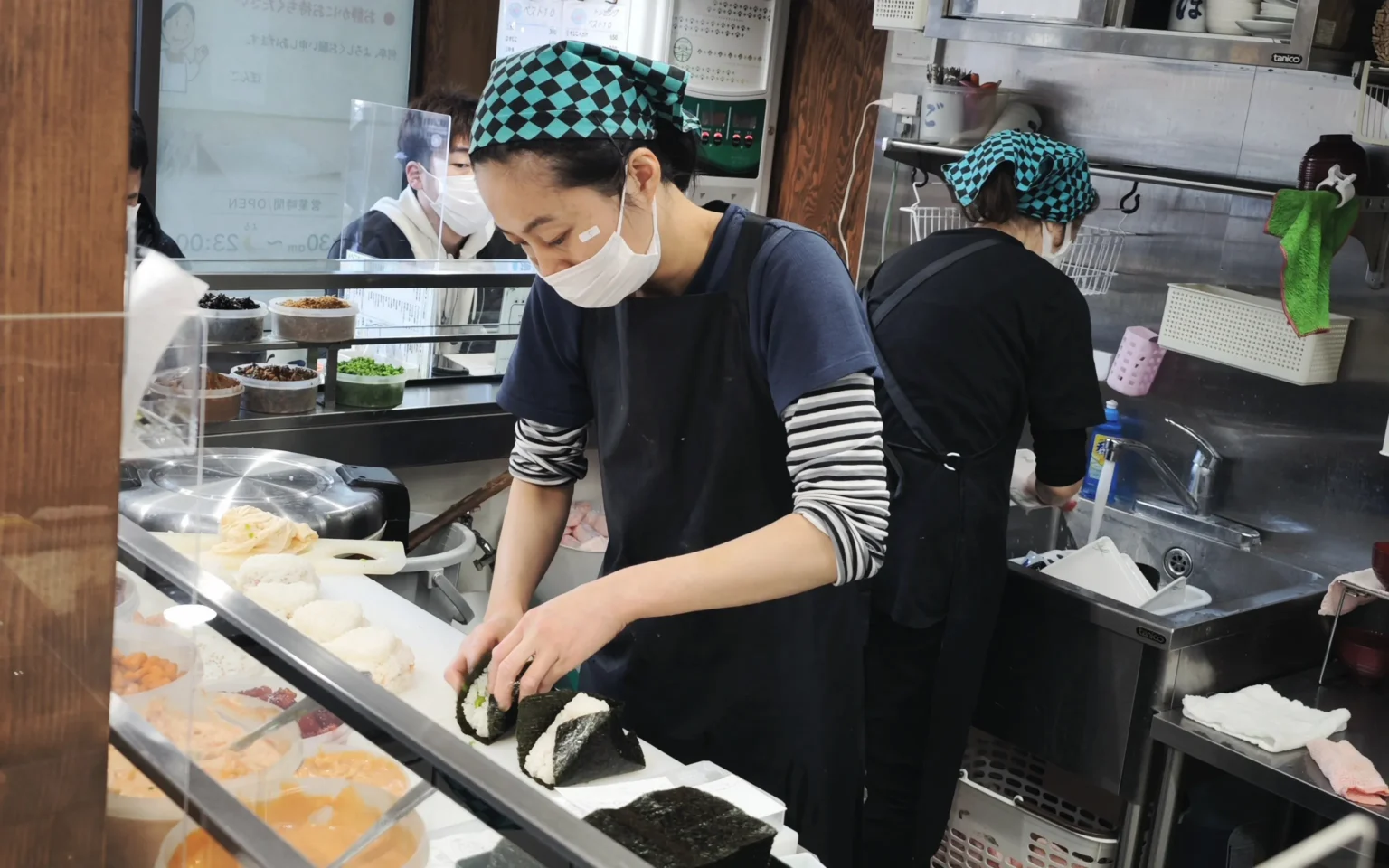
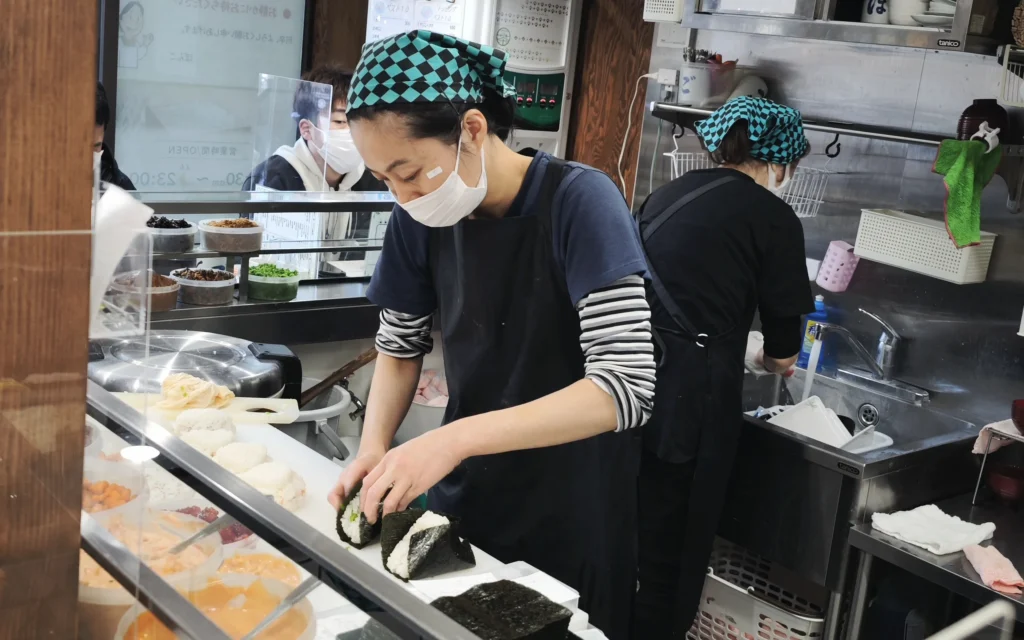
3. It’s made in front of you. You watch the chef shape each onigiri by hand, one at a time, with rice just transferred from the cooker. There’s no assembly line, no pre-made stock, no shortcuts. This is onigiri as handmade food in the oldest sense of the word.
The Shop: What to Expect
Onigiri Bongo is small. Much smaller than photos suggest.
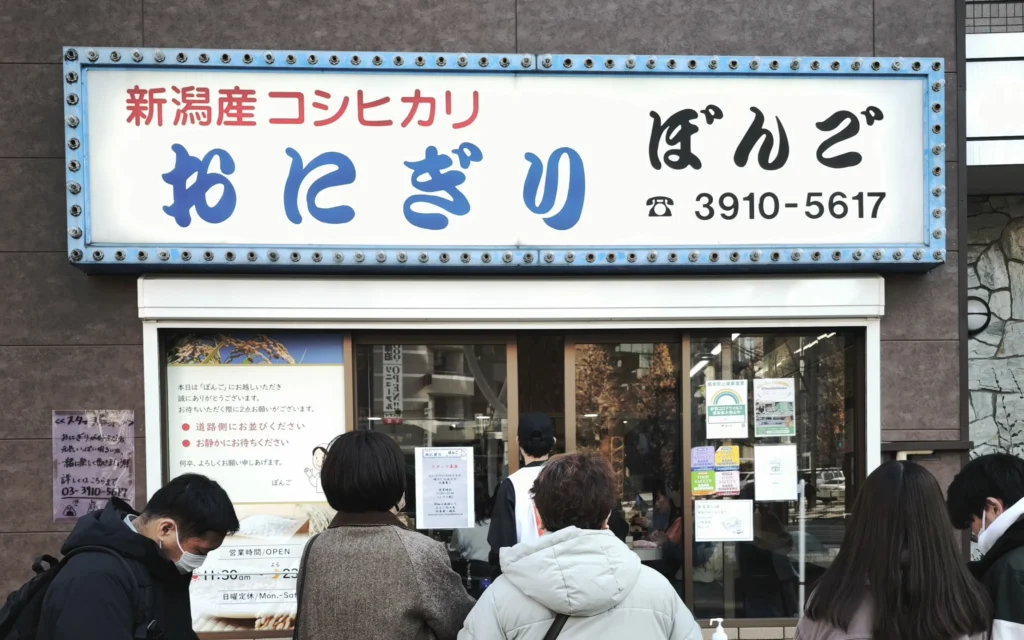
The facade is unmistakable: a bright blue signboard with the shop name in Japanese, the phone number painted in bold, and — almost always — a line of people outside. The counter inside seats nine. There are no tables. You sit, you eat, you leave. That’s the system.
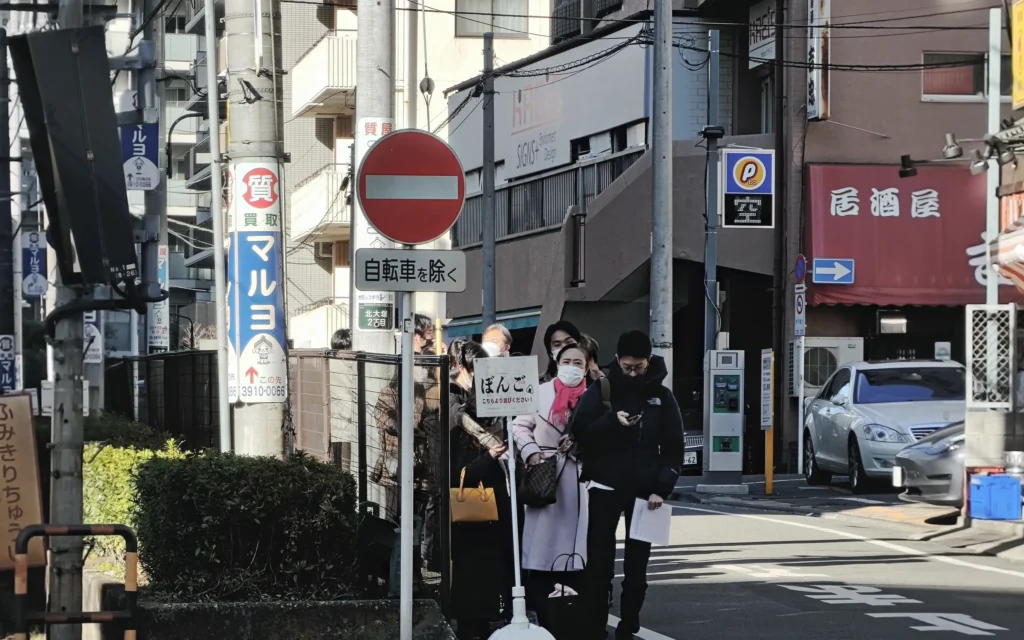
The queue forms along the sidewalk outside and sometimes wraps around the block. Staff hand out menu sheets to people in line so you can decide your order before you reach the counter — a critical courtesy given the wait and the complexity of the menu.
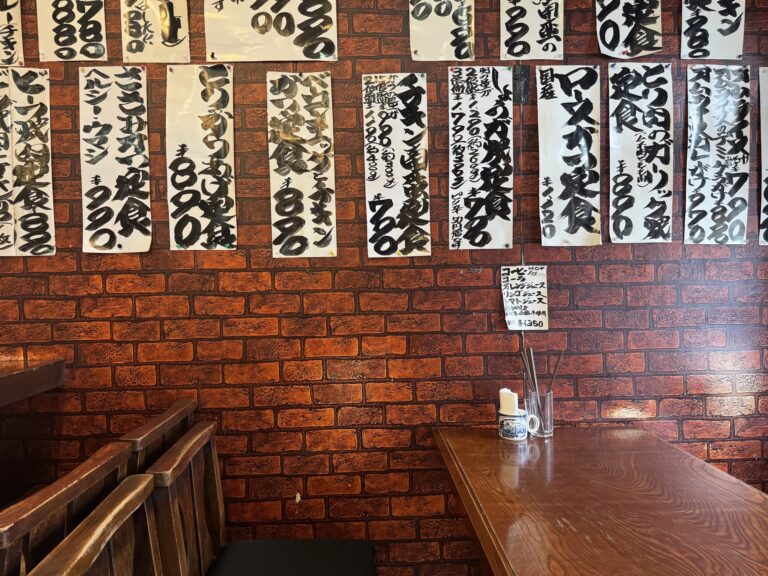
The interior is functional, not decorative. Fluorescent lighting, a visible rice cooker, steel prep surfaces, and walls covered in handwritten menu strips showing every filling and every price.
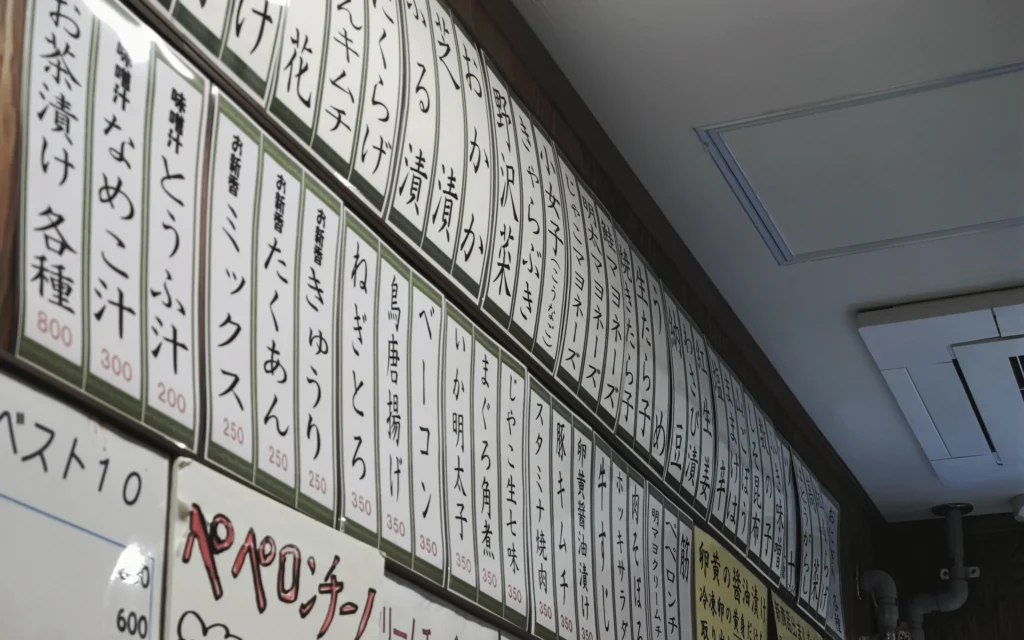
This wall is part of the experience. Look up from your counter seat and you’re surrounded by 56 hand-written menu cards — salmon, umeboshi, sujiko, mentaiko, negitoro, natto, bacon, cheese, pepperoncino, ham and egg. Some are in red ink (popular), some in black, some have small illustrations. It feels like a diner that accumulated its menu over 66 years, one filling at a time.
How the Onigiri Are Made
This is the part that makes Bongo different from every other onigiri shop.
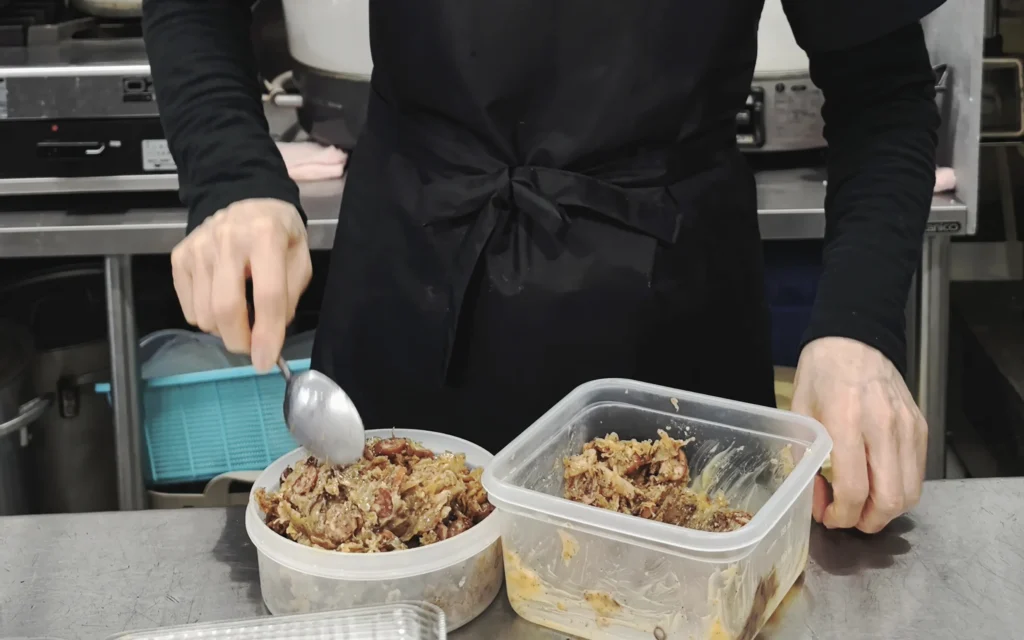
When you order, the chef:
1.Scoops filling from dozens of pre-prepared containers lined up behind the counter. Each filling is house-made or carefully sourced — the sujiko is cured in-house, the mentaiko is premium grade, the salmon is flaked fresh.
2.Takes fresh rice from the cooker — always warm, never refrigerated.
3.Shapes the onigiri by hand in about 30–60 seconds. The shaping is loose, not pressed. This is a defining feature of Bongo’s style: the rice holds together just enough to be called an onigiri, but air pockets remain throughout, keeping the texture light.
4.Wraps the rice in a sheet of crisp nori seaweed.
5.Places the onigiri in front of you, still warm.
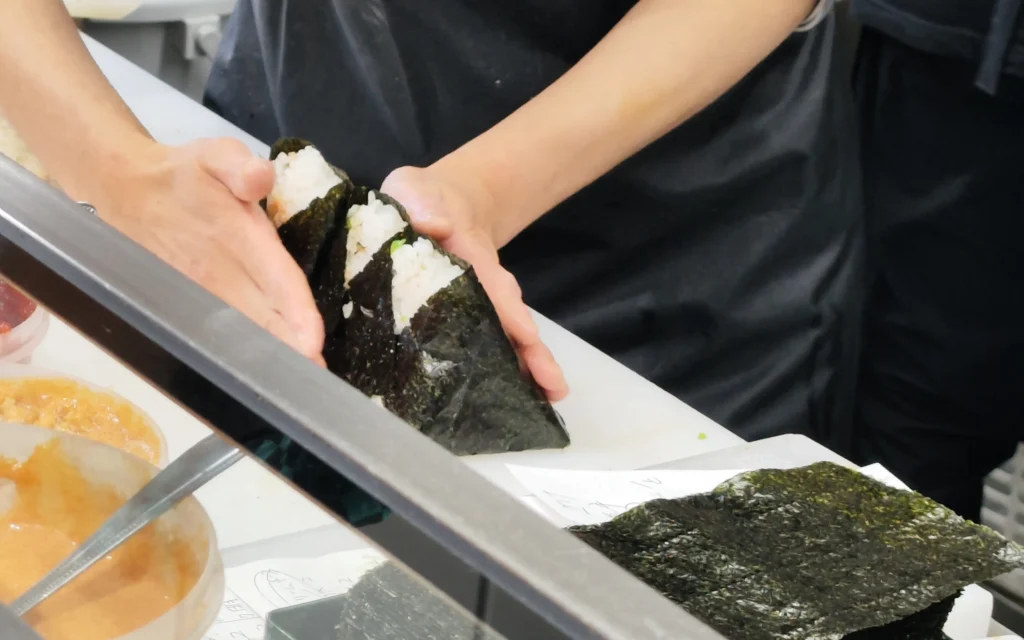
You eat it immediately. That’s important. A Bongo onigiri at minute one — with hot rice and crisp nori — is a different food from the same onigiri at minute 10, when the nori has softened and the rice has cooled slightly. Both are delicious, but the first bite of the first minute is the peak experience.
The Menu: 56 Fillings & Updated 2026 Prices
Each filling is priced on its own — ¥400 for most classics, more for premium roe and meat. Prices have crept up in recent years, so ¥400 is the baseline. Here is the full line-up:
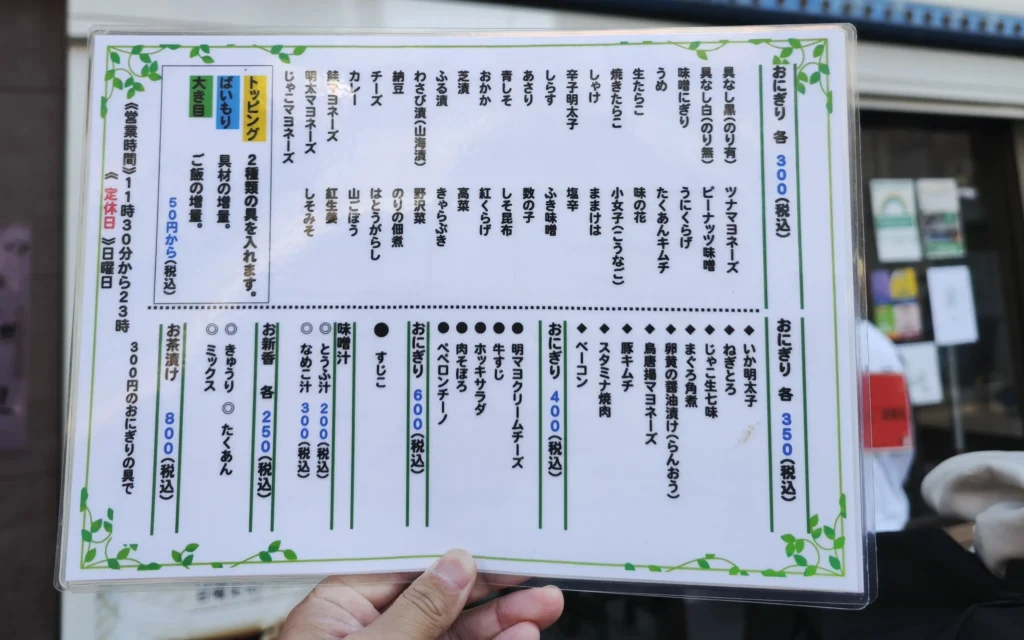
| Filling | Price |
|---|---|
| Classics & everyday (¥400) | |
| しゃけ / Shake Flaked grilled salmon — the entry point | ¥400 |
| うめ / Ume Sour pickled plum | ¥400 |
| 昆布 / Kombu Sweet-savory simmered kelp | ¥400 |
| おかか / Okaka Soy-seasoned bonito flakes | ¥400 |
| しそ昆布 / Shiso kombu Kelp with shiso | ¥400 |
| 高菜 / Takana Pickled mustard greens | ¥400 |
| 青しそ / Aojiso Green shiso leaf | ¥400 |
| のりの佃煮 / Nori tsukudani Simmered seasoned nori | ¥400 |
| ツナマヨ / Tuna mayo Tuna mayonnaise | ¥400 |
| 鮭マヨ / Shake mayo Salmon mayonnaise | ¥400 |
| 明太マヨ / Mentai mayo Spicy pollock roe mayonnaise | ¥400 |
| Roe & seafood | |
| 生たらこ / Nama tarako Salted raw pollock roe | ¥400 |
| 焼きたらこ / Yaki tarako Grilled pollock roe | ¥400 |
| 辛子明太子 / Karashi mentaiko Spicy marinated pollock roe | ¥400 |
| あさり / Asari Simmered short-neck clams | ¥400 |
| いか明太子 / Ika mentaiko Squid with spicy pollock roe | ¥450 |
| しらす / Shirasu Baby sardines | ¥450 |
| じゃこマヨ / Jako mayo Baby sardines with mayo | ¥450 |
| ねぎとろ / Negitoro Chopped tuna with spring onion | ¥450 |
| 数の子 / Kazunoko Herring roe | ¥450 |
| まぐろ角煮 / Maguro kakuni Sweet-savory simmered tuna | ¥450 |
| うにくらげ / Uni-kurage Jellyfish in sea-urchin dressing | ¥450 |
| ホッキサラダ / Hokki salad Surf-clam salad | ¥550 |
| すじこ / Sujiko Salt-cured salmon-roe clusters — the signature | ¥800 |
| うなぎ / Unagi Grilled eel in sweet-savory sauce | ¥800 |
| Meat & egg | |
| 卵黄醤油漬け / Rankō shōyu-zuke Soy-marinated egg yolk — a cult favourite | ¥450 |
| ベーコン / Bacon Bacon | ¥450 |
| 豚キムチ / Buta kimchi Pork with kimchi | ¥450 |
| スタミナ焼肉 / Stamina yakiniku Richly seasoned grilled beef | ¥450 |
| 鳥唐揚げマヨ / Tori-karaage mayo Fried chicken with mayo | ¥450 |
| 牛すじ / Gyūsuji Slow-simmered beef tendon | ¥500 |
| 肉そぼろ / Niku soboro Sweet-savory seasoned minced meat | ¥500 |
| Creamy & modern | |
| チーズ / Cheese Cheese | ¥400 |
| カレー / Curry Japanese-style curry | ¥400 |
| ピーナッツ味噌 / Peanut miso Peanuts in sweet miso | ¥400 |
| 明太マヨクリームチーズ / Mentai mayo & cream cheese Spicy roe, mayo and cream cheese | ¥500 |
| ペペロンチーノ / Peperoncino Garlic-chili seasoning | ¥500 |
| じゃこ生七味 / Jako nama-shichimi Baby sardines with fresh seven-spice | ¥500 |
| Pickles, Shōwa classics & adventurous | |
| 芝漬 / Shibazuke Shiso-pickled vegetables | ¥400 |
| わさび漬 / Wasabizuke Wasabi pickle | ¥400 |
| 山ごぼう / Yamagobō Pickled mountain-vegetable root | ¥400 |
| 紅生姜 / Beni shōga Red pickled ginger | ¥400 |
| たくあんキムチ / Takuan kimchi Pickled radish with kimchi | ¥400 |
| きゃらぶき / Kyarabuki Simmered butterbur stems | ¥400 |
| 小女子 / Kōnago Simmered sand-lance fish | ¥400 |
| 味の花 / Aji no hana Simmered savory tsukudani | ¥400 |
| 葉唐辛子 / Ha-tōgarashi Seasoned chili-pepper leaves | ¥400 |
| ふき味噌 / Fuki miso Butterbur in savory miso | ¥400 |
| しそみそ / Shiso miso Shiso in savory miso | ¥400 |
| 紅くらげ / Beni-kurage Red-seasoned jellyfish | ¥400 |
| 納豆 / Nattō Fermented soybeans | ¥400 |
| 塩辛 / Shiokara Salt-fermented squid | ¥450 |
| 野沢菜 / Nozawana Pickled nozawana greens | ¥450 |
Around 50-plus fillings are on the wall at any time (Bongo counts ~56 with seasonal and combination options). Prices are the 2026 takeout list; two fillings can be combined in one onigiri from +¥50. Last checked: August 2026 — reconfirm on the official site, as fillings rotate and prices creep up.
Set options (Weekday Lunch: 9:00 AM – 2:00 PM):
•2 onigiri (¥400 each) + tofu miso soup: ¥900 (Saves ¥100)
•3 onigiri (¥400 each) + tofu miso soup: ¥1,300 (Saves ¥100)
•Add a second filling to any onigiri: +¥50 and up
•If you order onigiri over ¥400, you just pay the difference.
Miso soup options:
•Tofu miso (とうふ汁): ¥200 (Refills are free with set menus!)
•Nameko mushroom miso (なめこ汁): ¥300 (or +¥100 to upgrade from a set)
Everything is in Japanese only. No English menu. Staff are patient with foreign customers but don’t typically speak English — point at what you want or photograph the menu translation ahead of time. A local Japan eSIM keeps a translation app and Bongo’s latest updates working while you wait.
Must-Try Fillings (Nobutoshi’s Picks)
With 56 options, choosing is overwhelming. Here are my honest picks:
1. Sujiko (すじこ) — ¥800 — THE signature
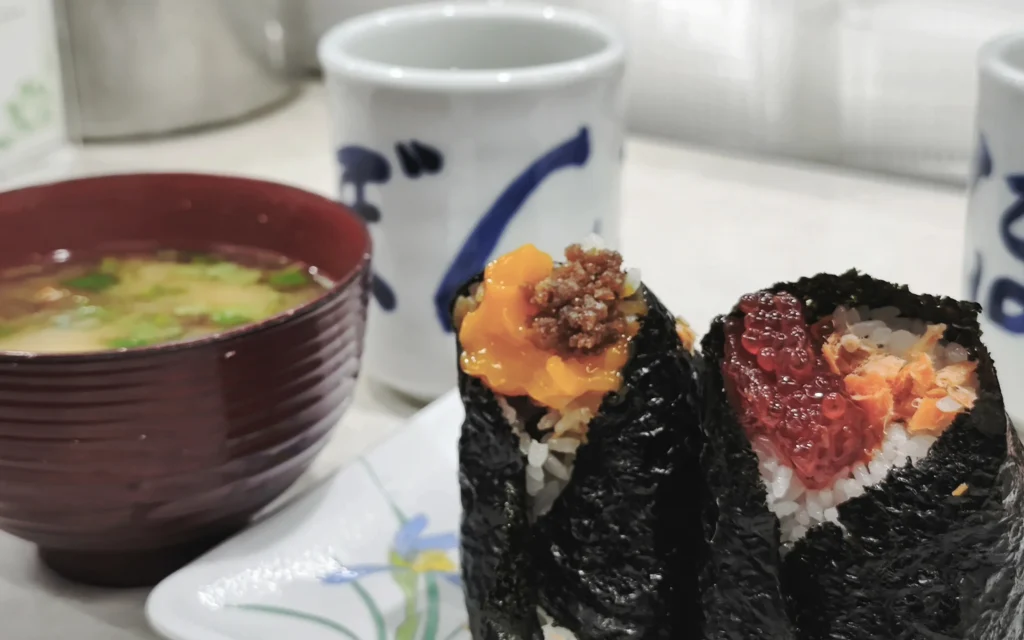
The reason many people come here specifically. Sujiko is salmon roe still connected inside its ovarian membrane — saltier and more concentrated than ikura (individual roe). The taste is intensely oceanic, slightly salty, with a dense texture that releases oil across your tongue. Bongo cures the sujiko in-house.
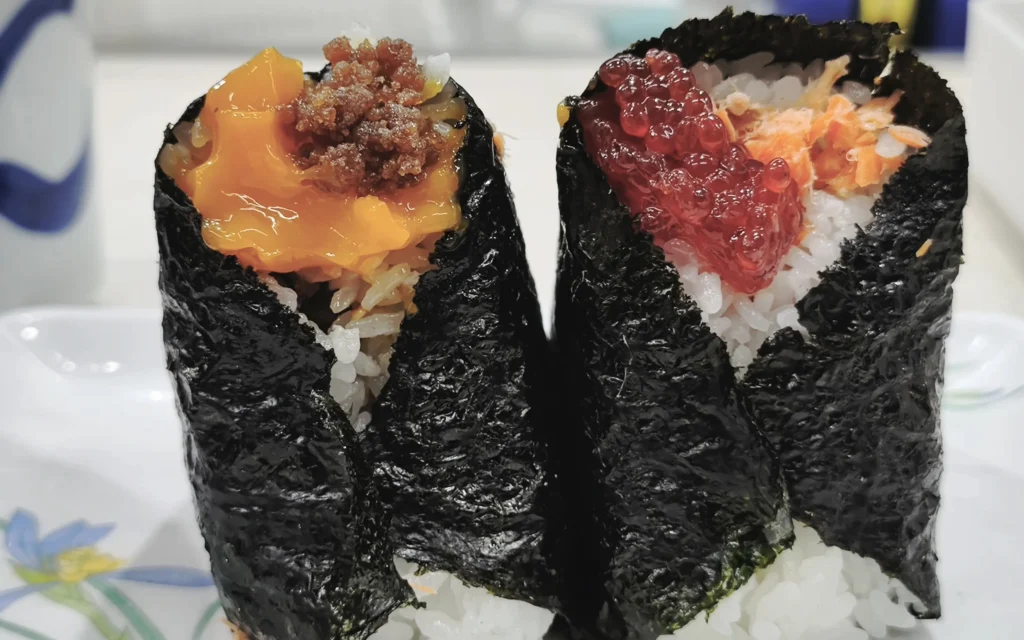
2. Tamago Zuke + Soboro (egg yolk soy-cured + meat floss)
The yellow onigiri in the photo above. This is a soy-cured egg yolk that sits on top of a bed of finely seasoned ground meat (soboro). When you bite into it, the egg yolk breaks and mixes with the warm rice and soboro. It’s one of the most Instagrammed onigiri at Bongo and genuinely delicious.
3. Shake (鮭) with Mentaiko (明太子) — double filling
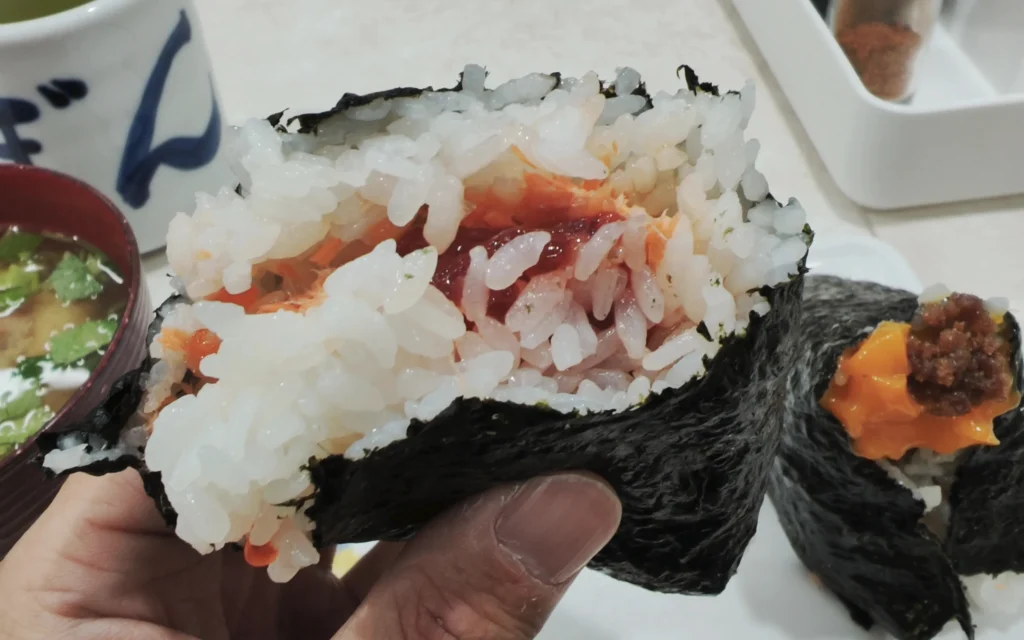
The classic pairing. Fresh salmon flakes with spicy cod roe. Bongo’s salmon is cooked in-house and flakes into the rice naturally — not the mealy, fridge-cold salmon you get at convenience stores. Adding the mentaiko on top doubles the flavor density.
4. Negitoro — ¥450
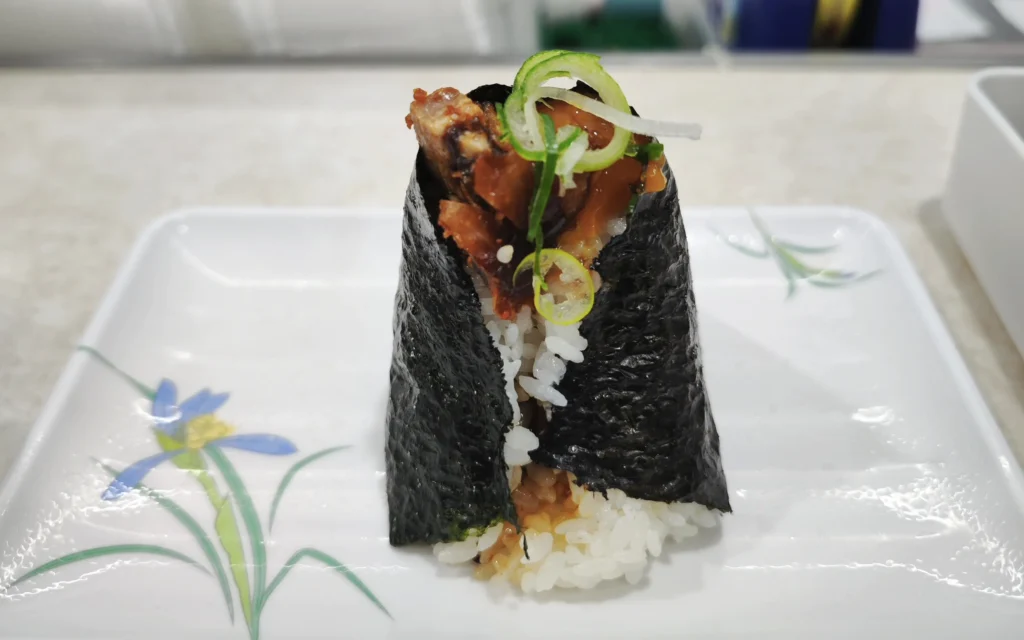
Chopped fatty tuna with green onion, served almost sashimi-fresh. At ¥450 this is a premium onigiri, but the tuna quality is serious — more like what you’d get at a mid-range sushi counter than a rice ball shop.
5. Pepperoncino — ¥500
Italian-Japanese fusion that shouldn’t work but absolutely does. Garlic, chili, olive oil, and fresh herbs mixed into the rice. It sounds wrong. It tastes amazing. Order this if you want to understand how Bongo thinks about onigiri as a living, evolving food rather than a fixed tradition.
My recommendation for a first visit:
Order the 2 onigiri + tofu soup set (¥900, weekdays only) and pick sujiko (pay the ¥400 difference) + one other (shake with mentaiko, or the tamago-zuke with soboro). This gives you Bongo’s signature plus a personal preference without overcommitting. If you love it, order a third.
How the Wait Works
Bongo’s wait time is the most-discussed aspect of the shop. Here’s the reality:
Typical wait times:
| Day/Time | Expected wait |
| Weekday morning (9:00 AM – 11:00 AM) | 30–60 min (sweet spot) |
| Weekday lunch (11:30 AM – 1:30 PM) | 1–2 hours |
| Weekday afternoon (3:00 PM – 5:00 PM) | 30–60 min (sweet spot) |
| Weekday evening (6:00 PM – 9:00 PM) | 2–3 hours |
| Saturday & Holidays | 3–5 hours |
| Rainy days | 50–70% of normal wait |
The process:
1.Arrive at the shop. The line is on the sidewalk outside.
2.Join the back of the line. A staff member will come around periodically to hand out menu sheets.
3.Study the menu (use a translation app for the Japanese fillings).
4.Wait. There’s no number system — you physically hold your place in line.
5.When you reach the counter, you’re seated and asked for your order immediately.
6.Your onigiri is made fresh in front of you, usually within 5 minutes.
7.You eat, pay in cash, and leave. Total time at the counter: ~15–20 minutes.
Strategies to reduce wait:
•Weekday mornings (9:00 AM – 11:00 AM) or afternoons (3:00 PM – 5:00 PM) are the best windows.
•Rainy days cut wait times significantly.
•Sundays closed — don’t make the trip without checking the day.
Ordering Strategy for First-Timers
The menu is overwhelming. Here’s how to handle it:
Step 1: Decide your commitment.
•Casual visit: 2 onigiri set (¥900 on weekdays)
•Enthusiast visit: 3 onigiri set (¥1,300 on weekdays)
Step 2: Pick one signature filling.
Sujiko (¥800) is the signature. If salmon roe isn’t your thing, choose tamago-zuke (soy egg yolk) or mentaiko.
Step 3: Pick one comfort filling.
Shake (salmon), ume (pickled plum), or okaka (bonito flakes) — something you know you’ll enjoy even if the signature is too intense.
Step 4: Add miso soup.
Tofu miso (¥200) or nameko (¥300). The warm broth complements the onigiri and gives you a beat between rice balls.
What NOT to do:
•Don’t order all premium fillings at once — the flavors get overwhelming
•Don’t order too much — you can’t take Bongo onigiri home comfortably (the nori softens)
•Don’t skip the miso soup — it’s part of the experience
How to Get There
By train:
1.Take the JR Yamanote Line to Otsuka Station (大塚駅)
2.Exit the North exit
3.Walk 2 minutes north along the main street
4.Bongo is on the right side, just before a residential area
Otsuka Station is 5 stops from Shinjuku on the Yamanote Line (~10 minutes) and 1 stop from Ikebukuro (~2 minutes). If you’re using an IC card like Suica or PASMO, tap in and out at the gates — no paper ticket needed.
By Toden Arakawa streetcar:
The old Toden Arakawa streetcar line runs near Otsuka. You can ride it as an old-Tokyo experience and get off at Otsuka Ekimae station. The line has its own nostalgic appeal — worth combining with your Bongo visit.
From Southeast Asian hubs: Direct flights from Singapore (Scoot, ~7h), Bangkok (AirAsia X, ~6h), Kuala Lumpur (AirAsia X, ~7h), and Jakarta (Zipair, ~7.5h) land at Narita or Haneda. From either airport, take the train to the JR Yamanote Line, which stops directly at Otsuka. If you need to buy a JR ticket, the process is straightforward.
Address in Japanese (for taxis):
東京都豊島区北大塚2-27-5
Tokyo-to, Toshima-ku, Kita-Otsuka 2-27-5
No parking available. Don’t drive.
Takeout: How to Skip the Line
Takeout (持ち帰り): Available. You can phone ahead to order onigiri for pickup, which lets you skip the line entirely. The catch: you must speak Japanese to place the order over the phone, and the takeout onigiri will have slightly softer nori than the dine-in version. Pickup time is specified at the time of ordering.
Phone: 03-3910-5617
(Note: Phone reservations are first-come, first-served. Internet orders are not accepted.)
Dine-in reservations: Not accepted. The counter is first-come, first-served.
Pro tip: If you’re staying at a hotel in Ikebukuro, Shinjuku, or central Tokyo, having a Japanese-speaking friend or hotel concierge place a phone order on your behalf is the easiest way to experience Bongo without waiting.
Practical Tips
•Cash only. No credit cards, no IC cards, no QR payment. Bring ¥3,000–5,000.
•No photos inside the kitchen/prep area. Photography of your own onigiri is fine. Ask before photographing staff. For more on this topic, read our Japan photography etiquette guide.
•Small bags only. The counter is tight — large suitcases and backpacks should be left elsewhere.
•Children are welcome but note that there are no high chairs and the wait is demanding.
•English menu: Not provided. Download a translation app and photograph the menu wall, or use Google Translate’s camera mode.
•Allergies: Most fillings involve fish, seafood, or egg. If you have seafood allergies, skip okaka (it is bonito — fish — flakes) and stick to umeboshi, takuan, kombu, or the vegetarian options — and note that the rice cooker and prep surfaces are not allergen-free.
•Vegetarian options exist — umeboshi, takuan, kombu, shiso, natto (fermented soybeans), wakame. Confirm “niku/sakana nashi” (no meat/fish) if strict.
•Eat on-site for the best experience. The onigiri quality degrades within 10–15 minutes as the nori softens.
•Nearby: Otsuka is an old working-class Tokyo neighborhood with good cheap restaurants and an authentic Showa-era feel. If the wait is long, explore the area rather than standing in line the entire time. If you’re visiting in winter, combine your trip with Tokyo’s winter illuminations — Ikebukuro is just one stop away.
Tips for Southeast Asian visitors:
•Weather gap: Tokyo in winter averages 5–7°C — far colder than Singapore’s 27°C or Bangkok’s 30°C. Bring layers if visiting between December and March.
•Cash is king here. Bongo is cash only. While most Tokyo shops accept IC cards, Bongo does not. Withdraw yen at any 7-Eleven ATM (international cards accepted, English interface available).
•Halal options are limited. Bongo’s fillings are predominantly seafood and meat-based. Umeboshi (pickled plum), kombu (kelp), and takuan (pickled radish) are the safest plant-based choices, but cross-contamination cannot be ruled out.
•Budget-friendly alternatives nearby: If the wait is too long, Otsuka’s convenience stores (7-Eleven, FamilyMart, Lawson) sell decent onigiri for ¥150–¥250 — a useful comparison to appreciate what makes Bongo different.
•Visa: Singapore and Malaysia passport holders enter Japan visa-free for up to 90 days. Thailand and Indonesia get 15 days with a biometric passport — and Indonesia’s waiver only works if the passport is registered in advance, online or at a Japanese embassy. Rules shift; check MOFA’s visa-exemption list for your nationality.
Make a Trip Out of It
Bongo is a 20-minute Yamanote ride from Tokyo Station. If the wait is long, anchor the day around something nearby.
Strategic FAQ
How long is the wait at Onigiri Bongo?
Typically 1–2 hours during weekday lunch, 2–3 hours on weekday evenings, and 3–5 hours on Saturdays and holidays. The shortest waits are weekday mornings (9:00–11:00 AM) and afternoons (3:00–5:00 PM).
Can I make a reservation at Onigiri Bongo?
Dine-in reservations are not accepted. Takeout orders can be placed by phone (03-3910-5617) in Japanese for pickup at a specified time.
How much does a meal at Onigiri Bongo cost?
A standard weekday lunch set of 2 onigiri and tofu miso soup is ¥900. A more substantial meal with 3 premium onigiri runs ¥1,500–¥2,000. Individual onigiri range from ¥400 to ¥800 depending on the filling.
Does Onigiri Bongo have an English menu?
No. The menu is in Japanese only, with 56 fillings listed on handwritten cards. Use a translation app or photograph the menu wall for Google Translate.
What is Onigiri Bongo’s most famous filling?
Sujiko (¥800) — salmon roe still in its natural ovarian membrane. It’s the premium filling that reviews and TV features highlight most.
Is Onigiri Bongo Michelin-rated?
Onigiri Bongo is not currently listed in the Michelin Guide (which covers only one onigiri shop, Asakusa Yadoroku). It is, however, one of Tokyo’s most famous casual restaurants, featured across major Japanese media and guidebooks.
Can I get takeout from Onigiri Bongo?
Yes. Call 03-3910-5617 (Japanese only) and place a takeout order for pickup at a specified time. Hotel concierges can often place this call on your behalf.
What’s the best time to visit Onigiri Bongo?
Weekdays between 9:00-11:00 AM or 3:00-5:00 PM have the shortest waits. Avoid Saturdays, holidays, and peak meal hours of 11:30 AM-1:30 PM and 6:00-8:00 PM.
How do I get to Onigiri Bongo from Tokyo Station?
Take the JR Yamanote Line to Otsuka Station (about 20 minutes from Tokyo Station). Exit the North exit and walk 2 minutes north along the main street. The shop is on the right.
Is Onigiri Bongo worth the wait?
For onigiri enthusiasts and food travelers, yes. For casual visitors on a tight Tokyo itinerary, a 4-hour wait is hard to justify — use the weekday off-peak windows or the phone-order takeout strategy instead.
Onigiri is ordinary food in Japan. You buy it at 7-Eleven. It’s what your mother made for your school lunch. It costs ¥150.
What Bongo has done — and what makes the 4-hour wait make sense to the people who do it — is take this ordinary food and execute it with such care that the result feels like discovering onigiri for the first time. The rice grains are distinct. The nori snaps. The sujiko bursts on your tongue like a better version of the ocean. It’s the same food you’ve eaten hundreds of times, rendered in a way that makes you question whether you’ve ever really eaten it at all.
I don’t think everyone needs to wait 4 hours for a rice ball. But if you’re in Tokyo, have an afternoon to spare, and want to understand why the Japanese treat their most ordinary foods with such quiet seriousness — Bongo is one of the clearest answers in the city.
Bring cash. Go on a weekday afternoon. Order the sujiko.
Related articles on Hidden Japan Gems:
•Japan Photography Etiquette: Taking Photos Without Causing Trouble
•How to Travel Around Japan 2026
•Tokyo Winter Illuminations 2025–2026
•IC Cards in Japan (Suica/PASMO/ICOCA)
•Kabukicho Night Walking Guide
Sources checked
onigiribongo.info (official), Tabelog, Time Out Tokyo, Hanako Web
For another Tokyo neighborhood institution worth the trip, the hand-kneaded bowls at Temomi Ramen Juhachiban in Ogikubo are exactly the kind of old-school spot I keep coming back to.
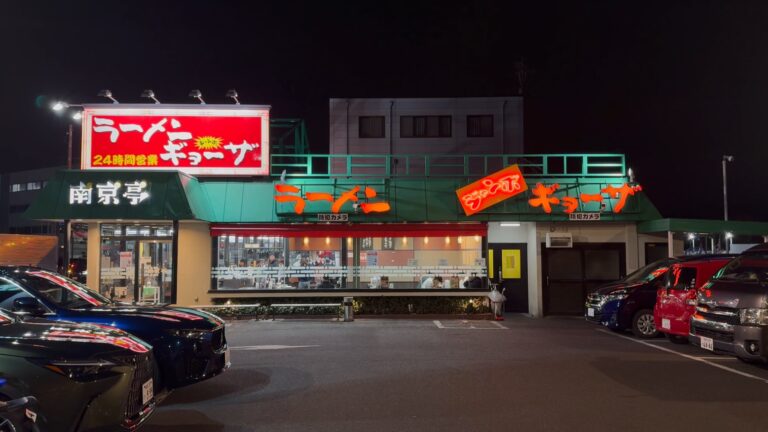
Nankintei, Kunitachi
Another everyday Tokyo classic – a 24-hour Chinese diner famous for jumbo gyoza.
Imahana, Setagaya
A Shōwa-era set-meal diner with a wall of hand-brushed menus.
Harmonica Yokocho, Kichijōji
A maze of tiny bars and eateries, best after dark.
Imakin Shokudō, Aso
Beyond Tokyo: a famous Kumamoto diner for akaushi (red beef) rice bowls.
Top-rated, well-reviewed places, booked through Agoda:
Takinoya, Mitaka (soba)
More everyday Tokyo eating — a tatami-room soba-ya in Mitaka.
Resol Poshtel Tokyo Asakusa
Agoda 9.6/10 · 2★ · 2,668 reviews
MIMARU Tokyo Asakusa Station
Agoda 9.5/10 · 3.5★ · 1,240 reviews
Palace Hotel Tokyo
Agoda 9.5/10 · 5★ · 918 reviews
We may earn a commission from Agoda bookings, at no extra cost to you.
Join travelers discovering Japan's hidden side
Weekly dispatches from off-the-beaten-path Japan — spots and stories you won't find in guidebooks.
No spam. Unsubscribe anytime.
Welcome aboard!
You're in. See you in your inbox soon.