Nagano · Shrines
Suwa Taisha is not one shrine with three annexes. It is four shrines of equal rank, spread around Lake Suwa, and its own FAQ puts it plainly: 「四社で諏訪大社です」 — the four together are Suwa Taisha. There is no prescribed order for visiting them.
There is one thing to get right before you book anything, and the shrine’s English page gets it backwards.
Which side of the lake is which
Start here, because this is the part that decides which station and which hotel make sense.
The Upper Shrine — Kamisha, made up of Maemiya and Honmiya — sits south of Lake Suwa, nearest Chino Station. The Lower Shrine — Shimosha, made up of Harumiya and Akimiya — sits north, at Shimosuwa. The Japanese page states this directly, and the shrine’s own route map draws it that way: Harumiya and Akimiya at the top of the lake by Shimosuwa Station, Honmiya and Maemiya at the bottom by Chino.
The English landing page says the opposite. It carries one descriptive sentence, repeated word for word under all four of its section headings — About Suwa Taisha, The Four Shrines, Conferred goods and Main ritual Events — and that sentence reads “Suwa Taisha is formed of two major locations, Kamisha and Shimosha, located to the north and south of Lake Suwa respectively.” Kamisha north, Shimosha south. The wrong way round.
The same sentence under four different headings is the sort of thing that happens to a page before anyone has filled it in, and I would not read intent into it. Its access panel also lists only the two head offices, Honmiya and Akimiya; the other two appear on that page only in the footer. I raise it because a reversed compass bearing is the one kind of error a reader acts on before arriving.
Kamisha is south of Lake Suwa. Shimosha is north.
I am not guessing at which is right. The shrine’s Japanese page reads 「諏訪湖の南側に上社前宮・本宮、北側に下社春宮・秋宮が鎮座しています」 — Kamisha Maemiya and Honmiya on the south side, Shimosha Harumiya and Akimiya on the north — and the same sentence appears on its four-shrine page. Its own route map draws it the same way. Checked 7 September 2026.
| Shrine | Side of the lake | Nearest station |
|---|---|---|
| Kamisha Maemiya | South | Chino |
| Kamisha Honmiya | South | Chino |
| Shimosha Harumiya | North | Shimosuwa |
| Shimosha Akimiya | North | Shimosuwa |
Kamisuwa Station sits on the eastern shore between the two groups, which makes it a reasonable base but the nearest station to none of the four.
Four shrines, no head shrine
The FAQ answers the question most visitors arrive with. Asked which of the four is the main one, the shrine replies that there is no ranking between them at all — Honmiya and Maemiya of the Upper Shrine, Harumiya and Akimiya of the Lower Shrine, and that is the whole of it. Asked whether there is a correct order, the answer is equally short: there is no rule, visit in whatever order is easiest.
If a multi-shrine circuit sounds familiar, Togakushi’s five shrines are another multi-shrine circuit elsewhere in Nagano.
The split into Upper and Lower is older than the name Suwa Taisha. What was administrative was the joining, not the dividing: they were two separate shrines — Kamisuwa and Shimosuwa — until the early Meiji period, when they came under state administration and were made one. One explanation for the names is simply north and south of the lake; another is which lay closer to the capital.
What you are actually bowing to
Three of the four have no conventional main hall at all. The shrine’s Japanese page is precise about which: 「なかでも本宮、春宮、秋宮は本殿を持たず、自然そのものを御神体とする」 — Honmiya, Harumiya and Akimiya have no honden, and take nature itself as the object of worship. At Kamisha Honmiya that means the mountain behind it; at Shimosha Harumiya a cedar; at Shimosha Akimiya a yew. Kamisha Maemiya is the exception and does have a honden of its own. This is the single thing most worth knowing before you go.
At Honmiya the two thatched buildings beyond the Nunobashi corridor are the Hōden — East on the left, West on the right. The shrine calls them the most important buildings at Honmiya, and the equivalent of a main hall in an ordinary shrine; the deity’s portable shrine is kept inside, and the two are rebuilt alternately at each Onbashira. They are not a museum and you do not go in.
The four, and what to look for at each
Kamisha Maemiya
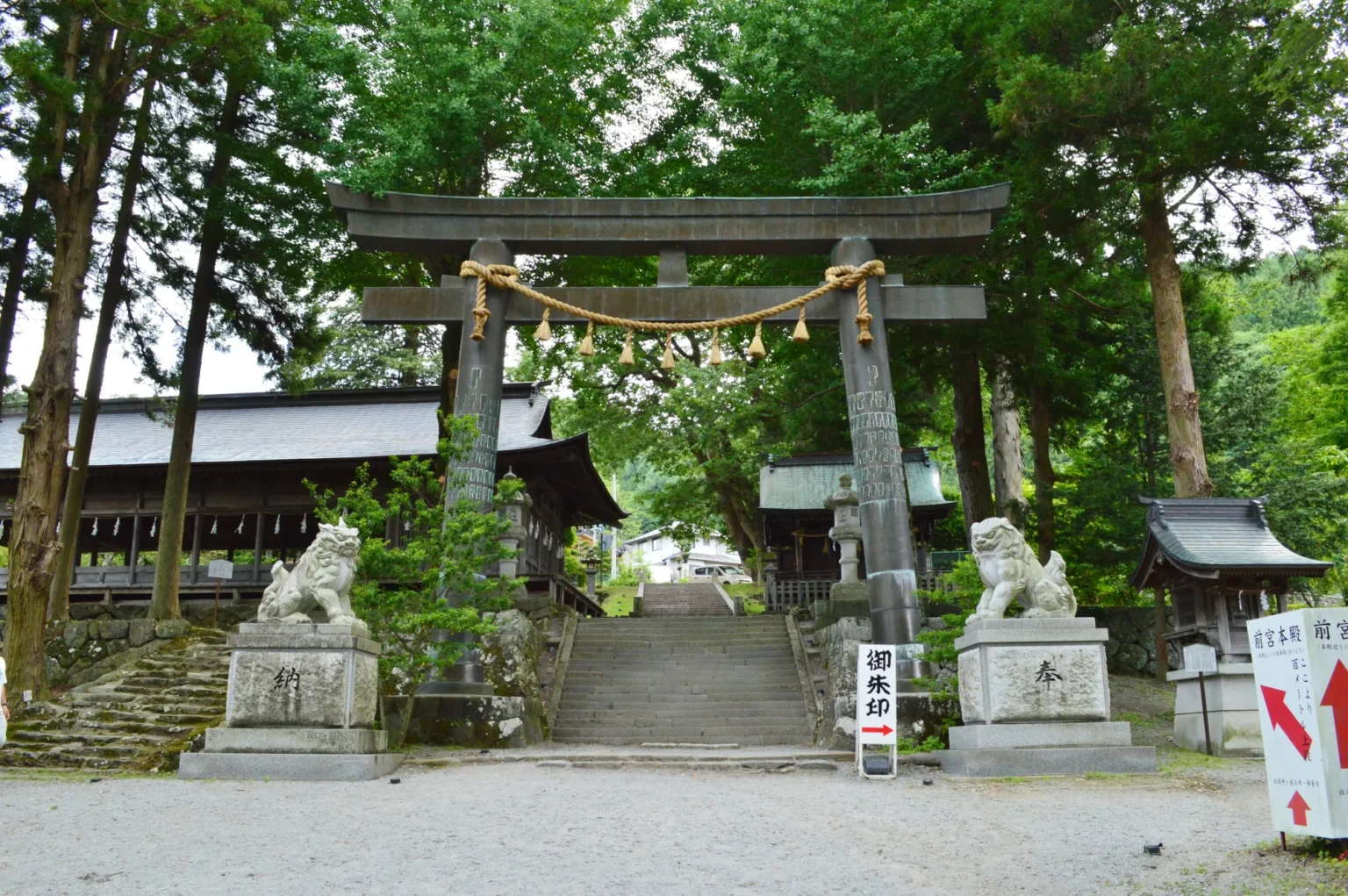
The earlier of the two Upper shrines: the shrine records that the focus of Kamisha’s rites moved from Maemiya to Honmiya in the Muromachi period. Its deity is Yasakatome-no-kami. The thing to find is the Suiga stream, which runs beside the onbashira pillars — the shrine describes it as fed by a source about a kilometre away as the crow flies, and treats it as its sacred water. The amulet desk here keeps the shortest hours of the four, 9:00 to 16:30, so if you are doing all four in a day, do not leave it until last.
Kamisha Honmiya
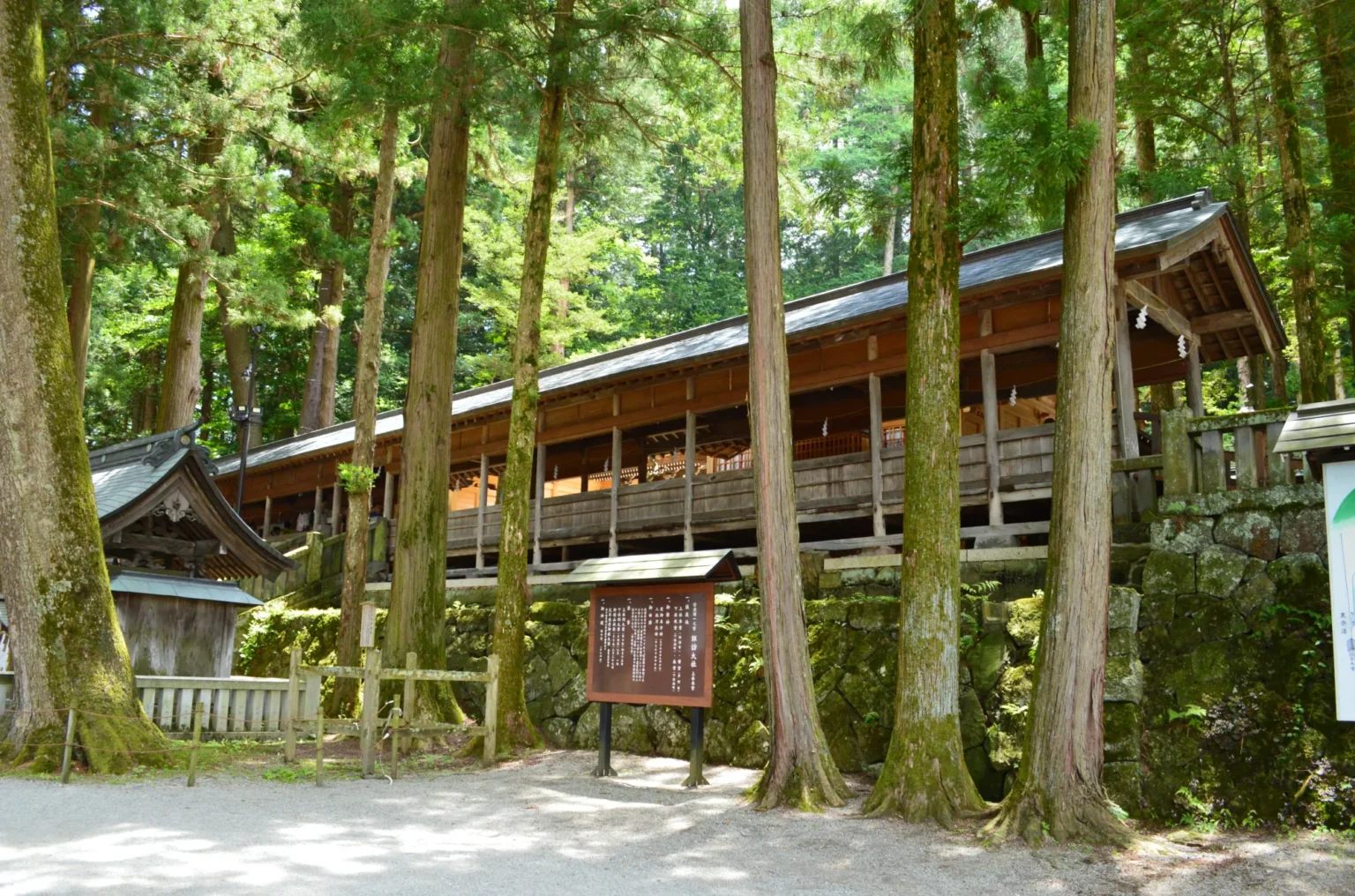
Dedicated to Takeminakata-no-kami, and the focus of Kamisha’s rites since the Muromachi period. More of its buildings survive than at any of the other three, by the shrine’s own account, and it is the one where the layout rewards slowing down. You approach along the Nunobashi — a roofed corridor about 70 metres long, which takes its name from the cloth once laid along it, because until the Meiji Restoration only the Upper Shrine’s high priest walked this way. Beyond it stand the two thatched Hōden. The shrine records a belief that at least three drops of water fall from their roof even in the worst drought — counted among the seven wonders of Suwa, and, in the shrine’s own words, the root of its being widely revered as a guardian of water.
Honmiya also has a treasure museum — a separate paid building holding the shrine’s collection, and not to be confused with the Hōden. Akimiya has the other one; the remaining two shrines have none.
Shimosha Harumiya
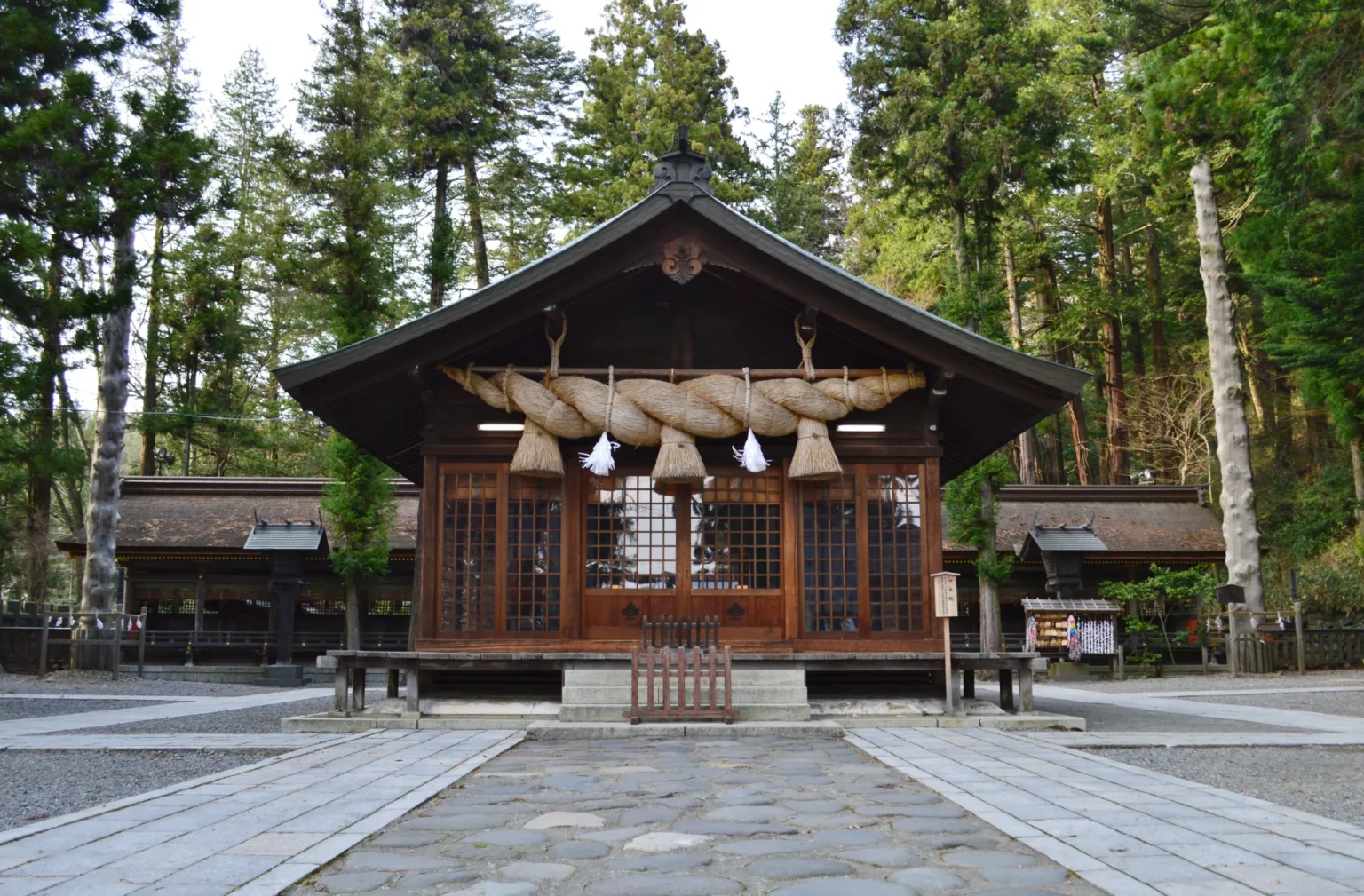
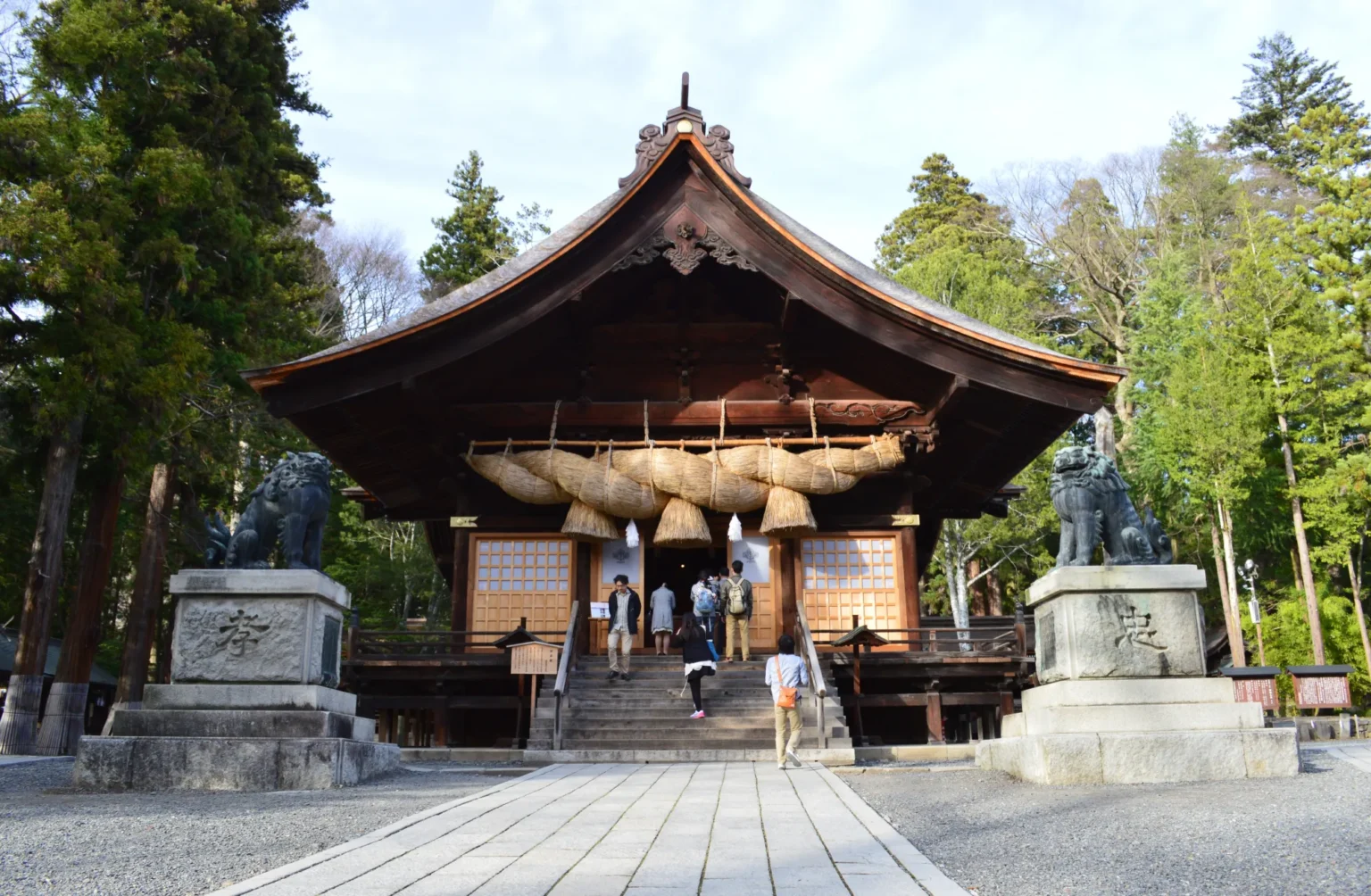
Compare this photograph with the first one in this article. Harumiya and Akimiya are near-twins — the same building type, the same rope, different scale. The cedar named above as Harumiya’s object of worship has a name and a place you can stand in front of: the Musubi-no-sugi, the “cedar of binding”, which forks into two trunks about ten metres up while remaining one tree at the root. It stands to the right of the approach as you come through the granite torii, and the shrine calls it Harumiya’s sacred tree.
Harumiya is also the jumping-off point for the walk most visitors remember. Cross the red Ukishima bridge from the precinct and follow the river for about three minutes and you reach the Manji stone Buddha, a squat figure with a huge natural boulder for a body and a disproportionately small head, which the shrine’s own guide describes as a soft expression on a humorous figure. It sits in the middle of rice fields. The Shimosuwa tourism association gives that three-minute figure; it is the shortest worthwhile detour on the whole circuit.
Shimosha Akimiya
The one in this article’s opening photograph. Beyond the kagura hall and its rope, the thing to look for is the Goshinyu — a purification basin fed by natural hot spring water from Shimosuwa rather than cold water, running out of a dragon’s mouth. The shrine calls it unusual in Japan, and notes the water runs a little hot.
A test you can run yourself
Suwa Taisha’s crest is the kaji leaf — a paper mulberry leaf. Look at the base of the leaf on the amulets, the lanterns and the curtains: the Upper Shrine’s crest has four roots, the Lower Shrine’s has five. The shrine states this in its own FAQ. When you spot the crest, look at the roots drawn beneath the leaf and count them. It costs nothing but attention, and it is the one difference between Upper and Lower you can see with your own eyes.
The stamps, and what completing the set gets you
Each of the four issues its own goshuin, and all four designs differ. The shrine asks anyone coming from far away to visit all four, and anyone doing the circuit to receive each shrine’s stamp.
There is a reward. The FAQ states that those who receive the goshuin of all four shrines are given a commemorative item — 「記念の品」 — without saying what it is, and I have not been able to confirm what is currently given. Collect the four and find out.
One practical warning from the shrine itself: the amulet desks get congested at New Year and during the long holiday weeks. That is also when Maemiya’s shorter hours bite hardest — see our hatsumode guide if you are coming in the first days of January, and the New Year closures calendar for what else is shut.
Onbashira: the reason for the four pillars
Each of the four shrines has four huge log pillars, one at each corner of its precinct. They are not all equally easy to find: at Honmiya the first stands just outside the fence at the end of the Nunobashi, while the third sits back in the garden behind Izuhaya-sha. They are replaced in a festival held in the years of the Tiger and the Monkey — every sixth year in practice, which the shrine states in the traditional style as every seventh. The last was 2022. The next is 2028.
| Onbashira in numbers | Official figure |
|---|---|
| Pillars felled and raised | 16 — four at each of the four shrines |
| Largest pillar | Close to 17 m, about 13 tonnes |
| Haul distance | About 25 km for the Upper Shrine’s eight, about 20 km for the Lower Shrine’s eight |
| People per pillar | 1,000 to 2,000 |
| Participants overall | Around 200,000 parishioners |
| Traditional hauling method | Human power, without vehicles or rollers |
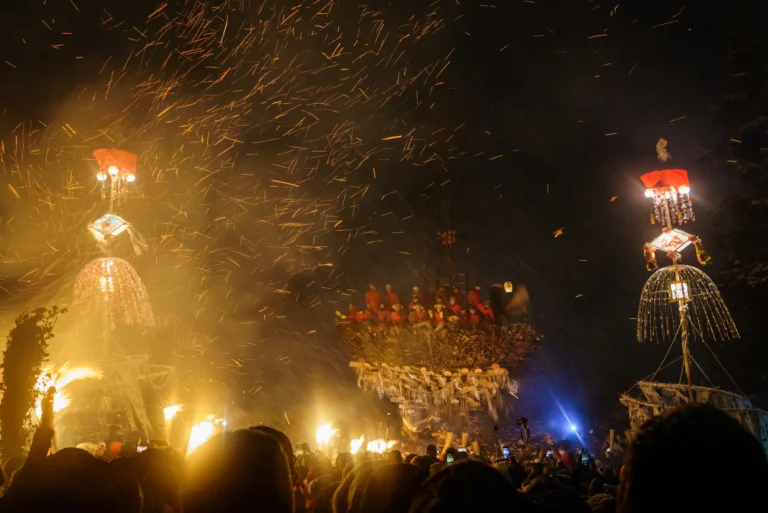
The festival’s two visible stages are the Yamadashi, the haul down from the mountains in early April, and the Satobiki, the procession into each shrine in early May, ending with the pillars raised by hand at the four corners. The shrine dates province-wide organisation of the festival to 804, and records that Takeda Shingen took a particular interest in it.
Outside a festival year the pillars standing in each precinct are the previous festival’s, and they stay something to look for on an ordinary visit. The shrine’s calendar runs to more than two hundred rites a year, so a quiet week is not an empty one.
Hours, money and the practical shape of a visit
The single most useful fact: the shrines themselves never close. The precincts are not gated, and you can walk into any of the four at any hour, free. What keeps hours are the amulet desks, the two treasure museums and the prayer reception.
| Shrine | Amulet desk | Treasure museum |
|---|---|---|
| Kamisha Maemiya | 9:00–16:30 | — |
| Kamisha Honmiya | 8:30–17:00 | 9:00–16:00 |
| Shimosha Harumiya | 8:30–16:30 | — |
| Shimosha Akimiya | 8:30–17:00 | 9:30–15:00, closed 1–3 Jan |
Treasure museum admission is ¥500 for adults and ¥300 for children, or ¥800 and ¥500 for a combined ticket covering the museums at both Honmiya and Akimiya. Prayers and blessings are taken from 9:00 to 16:00, and individuals do not need to book.
Doing all four in a day
Treat it as two pairs. Harumiya and Akimiya are both walkable from Shimosuwa Station and close enough to each other to do on foot. Honmiya and Maemiya are the southern pair, about 1.7 km apart — roughly a twenty-minute walk, by the Suwa tourism association’s figure. The gap that needs planning is between the pairs, across the lake.
Getting to Suwa
The shrine gives about 2 hours 35 minutes from Shinjuku by the Azusa limited express to Shimosuwa, Kamisuwa or Chino, and about 2 hours 30 by car on the Chuo Expressway to the Okaya or Suwa interchange. From Nagoya it is about 2 hours 40 by train via Shiojiri. Whether a rail pass pays for that is a separate question — we did the arithmetic in JR Pass vs individual tickets.
Around the Lower Shrine
The Wata-no-yu spring, at the junction of the Nakasendo and Koshu Kaido, is said to have been opened by the goddess Yasakatome. Its water is supposed to cloud when someone impure enters — one of the Lower Shrine’s seven wonders. The Honjin Iwanami-ke preserves a Nakasendo post-station garden.
For a longer Nagano itinerary
Suwa pairs naturally with the rest of the basin and the highlands beyond it. Zenkoji is the prefecture’s other great pilgrimage site, Unno-juku is an Edo post town away to the north-east, reached via Ueda, and our Nagano high country guide sorts the alpine options by altitude.
Around the Upper Shrine
The Jinchokan Moriya Historical Museum holds documents kept by the Moriya family, who served as senior priests from medieval times to the Edo period, including some forty Takeda documents. The building is by the Suwa-born architect Terunobu Fujimori. Suwa City Museum sits by Honmiya’s great torii and has a footbath outside.
Where to stay
Which side of the lake you sleep on decides how the day works. Shimosuwa puts you within walking distance of two of the four shrines and the Manji Buddha. Kamisuwa Onsen is the larger base on the eastern shore, between the two groups. Both are hot-spring towns, so compare individual inns rather than assuming one side has the baths.
Shimosuwa, by the Lower Shrine Kamisuwa Onsen Matsumoto, for an onward stay
Common questions
Do I have to visit all four shrines?
No. There is no obligation and no ranking — the shrine’s FAQ states that none of the four outranks the others. It does ask visitors coming from far away to see all four, and there is a keepsake for people who collect all four stamps. If you only have time for one, Honmiya has more surviving buildings than any of the other three, by the shrine’s own account.
Is there a correct order?
The shrine says there is none: visit in whatever order is convenient. In practice geography decides it. Do the two southern shrines together and the two northern shrines together, in whichever pair your transport reaches first.
Which side of Lake Suwa is the Upper Shrine on?
South. Kamisha Maemiya and Honmiya are on the southern side, nearest Chino; Shimosha Harumiya and Akimiya are on the northern side at Shimosuwa. Note that the shrine’s own English landing page states this the wrong way round, so check the Japanese page or the map if you see a contradiction elsewhere.
How much does it cost to visit?
Nothing. The four precincts are not gated and have no admission charge, and the shrine states they are open at any hour. You only pay if you enter one of the two treasure museums — ¥500 for an adult, ¥300 for a child, or ¥800 and ¥500 for a ticket covering both — or if you receive an amulet or a goshuin.
What do you get for collecting all four goshuin?
A commemorative item. The shrine’s FAQ confirms it is given to anyone who receives the goshuin of all four shrines, but does not identify it, and I have not confirmed what is currently being given. Bear in mind the amulet desks keep shorter hours than the precincts: Maemiya’s window is the shortest at 9:00–16:30, and Harumiya’s also shuts at 16:30.
When is the next Onbashira festival?
2028. It is held in the years of the Tiger and the Monkey, every seventh year by the traditional count, and the last was in 2022. Sixteen fir pillars are hauled by hand — the largest close to 17 metres and about 13 tonnes — and raised at the four corners of each of the four shrines. The shrine describes the haul as taking place in early April and the procession into the shrines in early May, but the Upper and Lower shrines run to separate dates, so check the published 2028 schedule before booking.
Why is there no main hall to look at?
For three of the four, because the object of worship is not inside a building. At Kamisha Honmiya it is the mountain behind the shrine; at Shimosha Harumiya a cedar; at Shimosha Akimiya a yew. The shrine presents this as a surviving older form of nature worship. Maemiya is the exception and does have a honden. At Honmiya the two thatched Hōden beyond the Nunobashi corridor serve the role a main hall plays elsewhere, and they are rebuilt alternately at each Onbashira. They are separate from the paid treasure museum on the same site.
Sources
The primary pages behind every figure above
- Suwa Taisha — visiting guide (desk and treasure museum hours, deities, geography), first-visit guide (objects of worship, the Suiga stream, the Hōden, the cedar of binding, the hot-spring purification basin, museum admission), FAQ (no ranking, no set order, the four-shrine keepsake, the kaji crest and its four or five roots, Meiji unification), four-shrine page and route map (the Wata-no-yu spring, the Moriya museum, Suwa City Museum, Honjin Iwanami-ke), about page (which three shrines have no honden), Onbashira, access, and the English page as it stood on 7 September 2026
- Suwa Taisha — Kamisha Honmiya page (the Nunobashi’s length and the origin of its name, the pillars’ positions, and Honmiya having the most surviving buildings of the four)
- Shimosuwa Tourism Association — the Manji stone Buddha, the vermilion Ukishima bridge, the three-minute walk from Harumiya, and the Lower Shrine’s seven wonders
- Suwa Tourism Association — the 1.7 km distance between Honmiya and Maemiya
- Photographs: Wikimedia Commons, each credited to its author with its licence linked in the caption
Join travelers discovering Japan's hidden side
Weekly dispatches from off-the-beaten-path Japan — spots and stories you won't find in guidebooks.
No spam. Unsubscribe anytime.
Welcome aboard!
You're in. See you in your inbox soon.