Nagano · Chubu
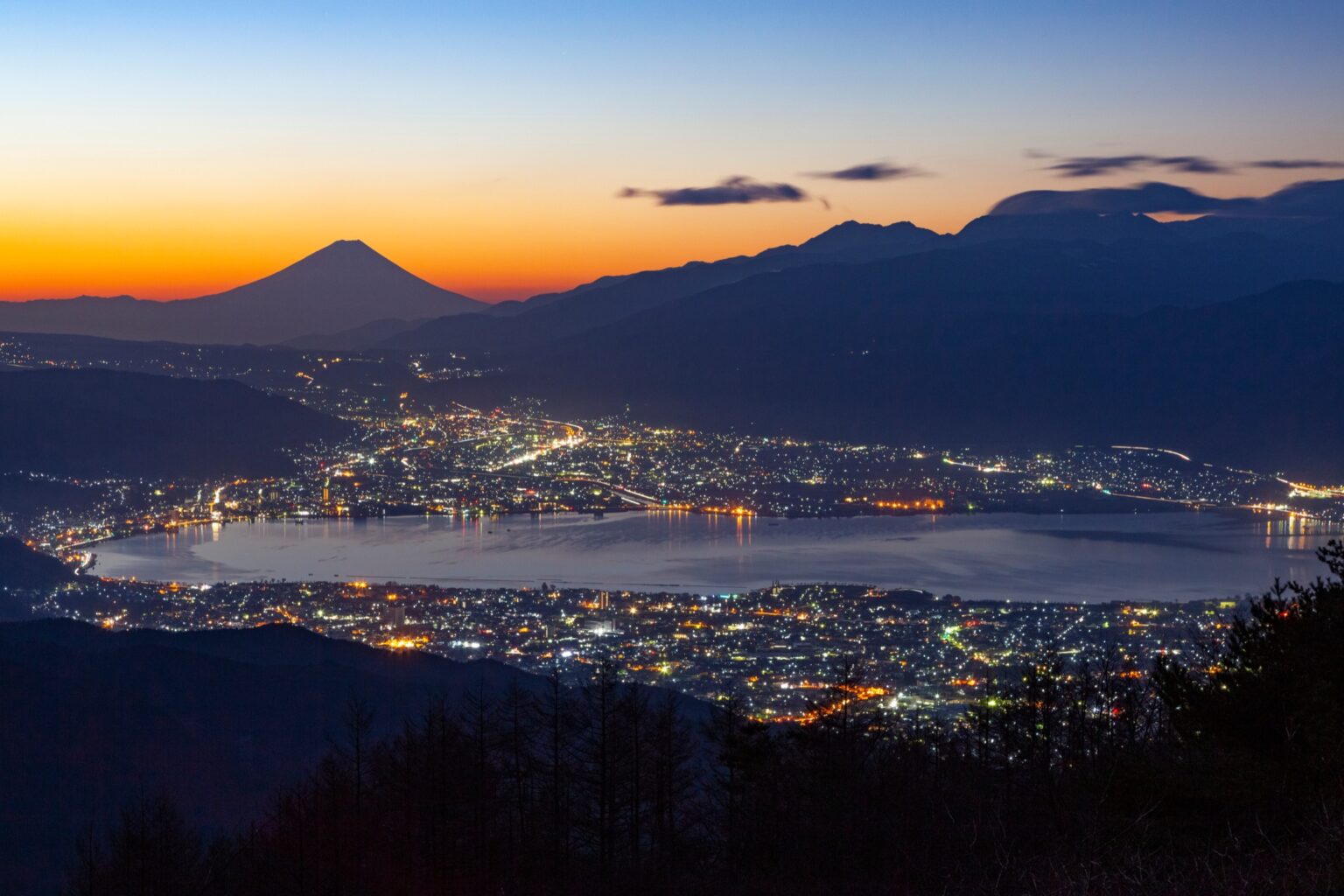
Lake Suwa — Nagano’s largest lake, about 16 km around and 759 metres above sea level — sits in a mountain basin a little over two hours from Shinjuku by limited express, and from the hills above it you can watch Mt. Fuji rise over a lake ringed with city lights. It also hosts one of Japan’s biggest lakeside fireworks shows (around 40,000 shells every August 15), a lakeside hot-spring town, a geyser, a flat 16 km cycling loop, and a winter ice legend, the omiwatari, that warmer winters have kept away for eight years running.
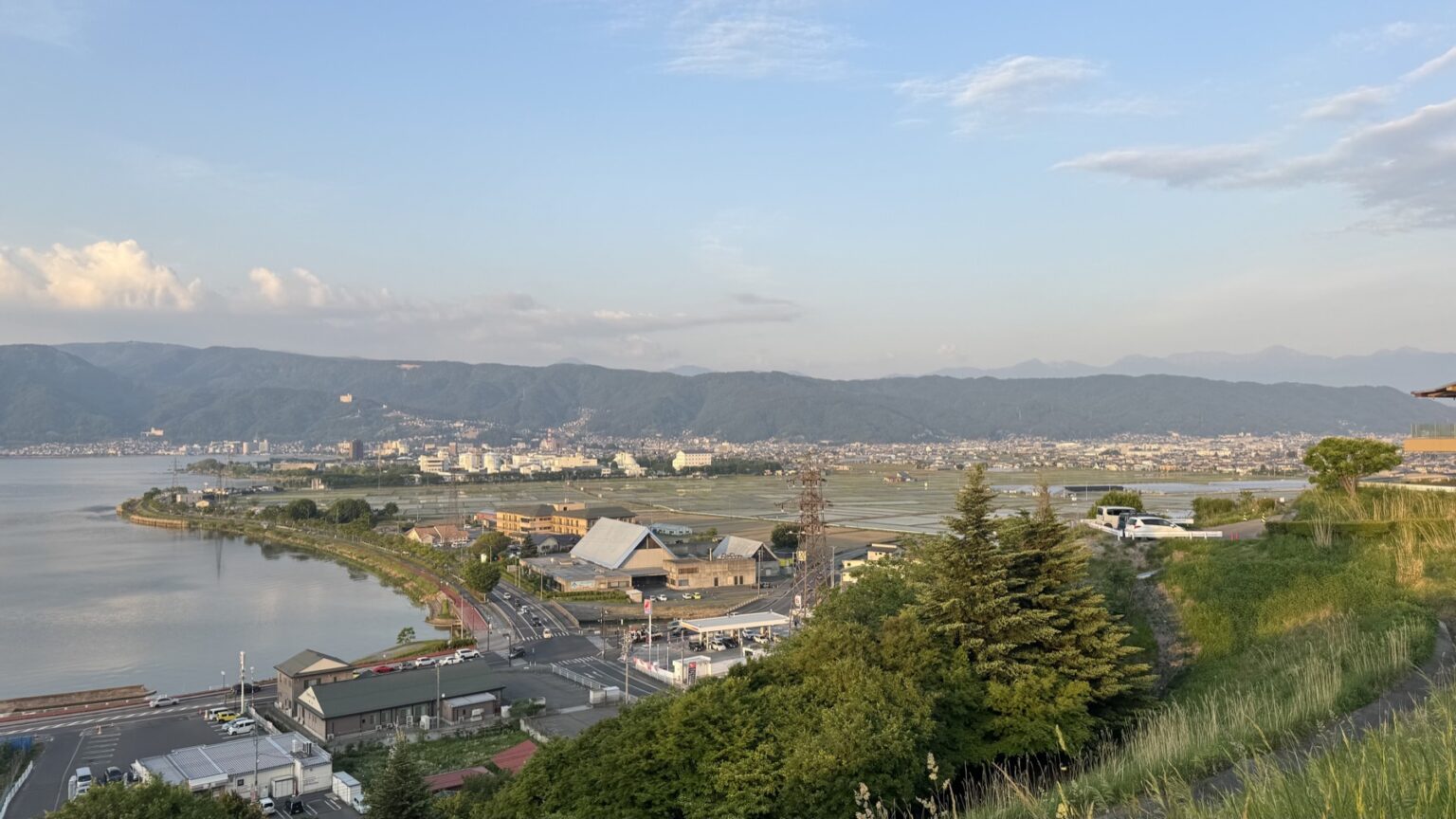
I came to Suwa for the water at the end of the day. The lake turns glassy and pink at dusk, the mountains fold in on every side, and the whole basin feels a long way from the bullet-train rush even though Matsumoto and the Kiso valley are right next door. Most foreign visitors know it, if at all, as the lake behind the film Your Name — but there’s a real, easygoing day or two here beyond the photo spot.
Part of the full Mt. Fuji travel guide.
Mt. Fuji over the lake: Takabocchi and Tateishi Park
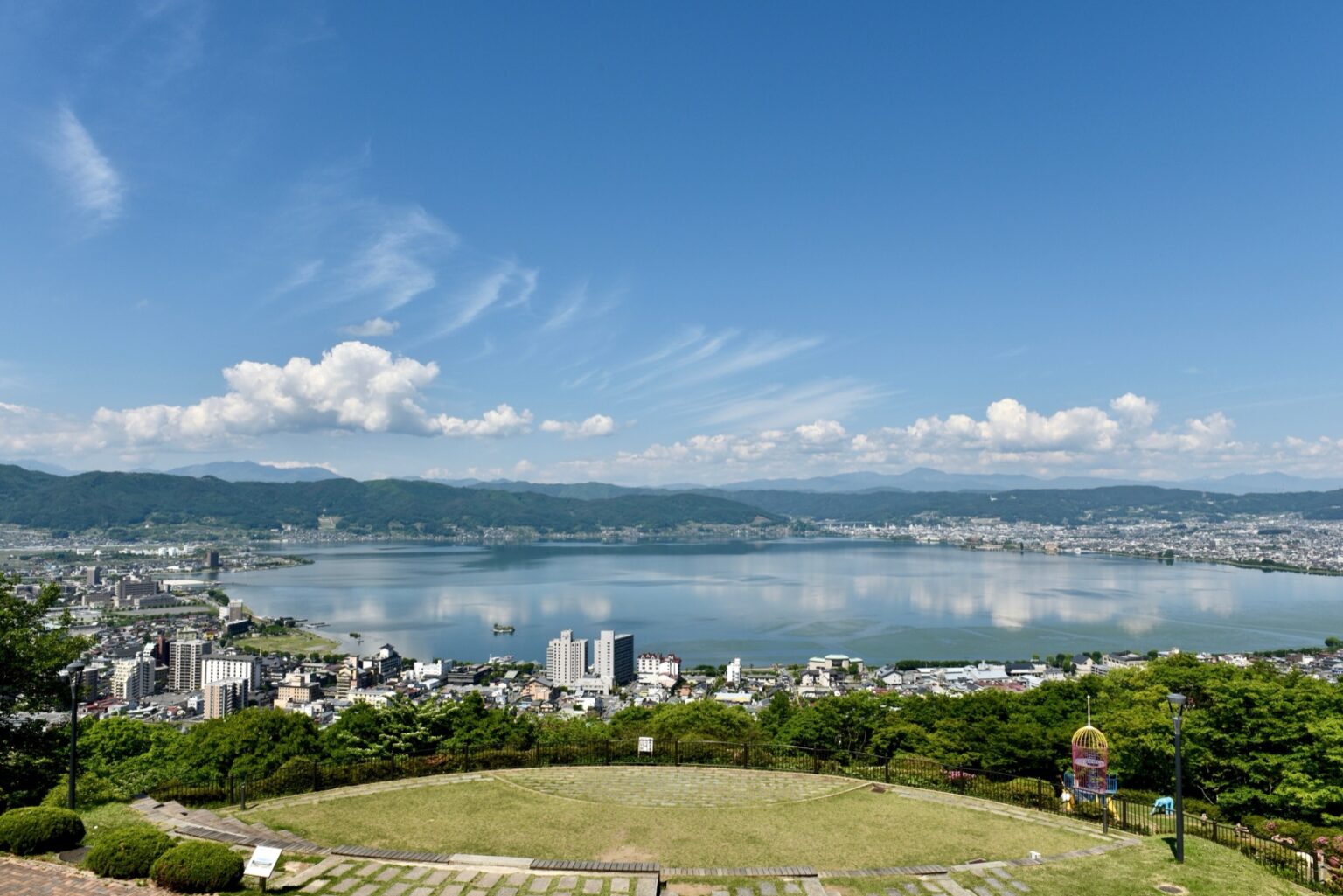
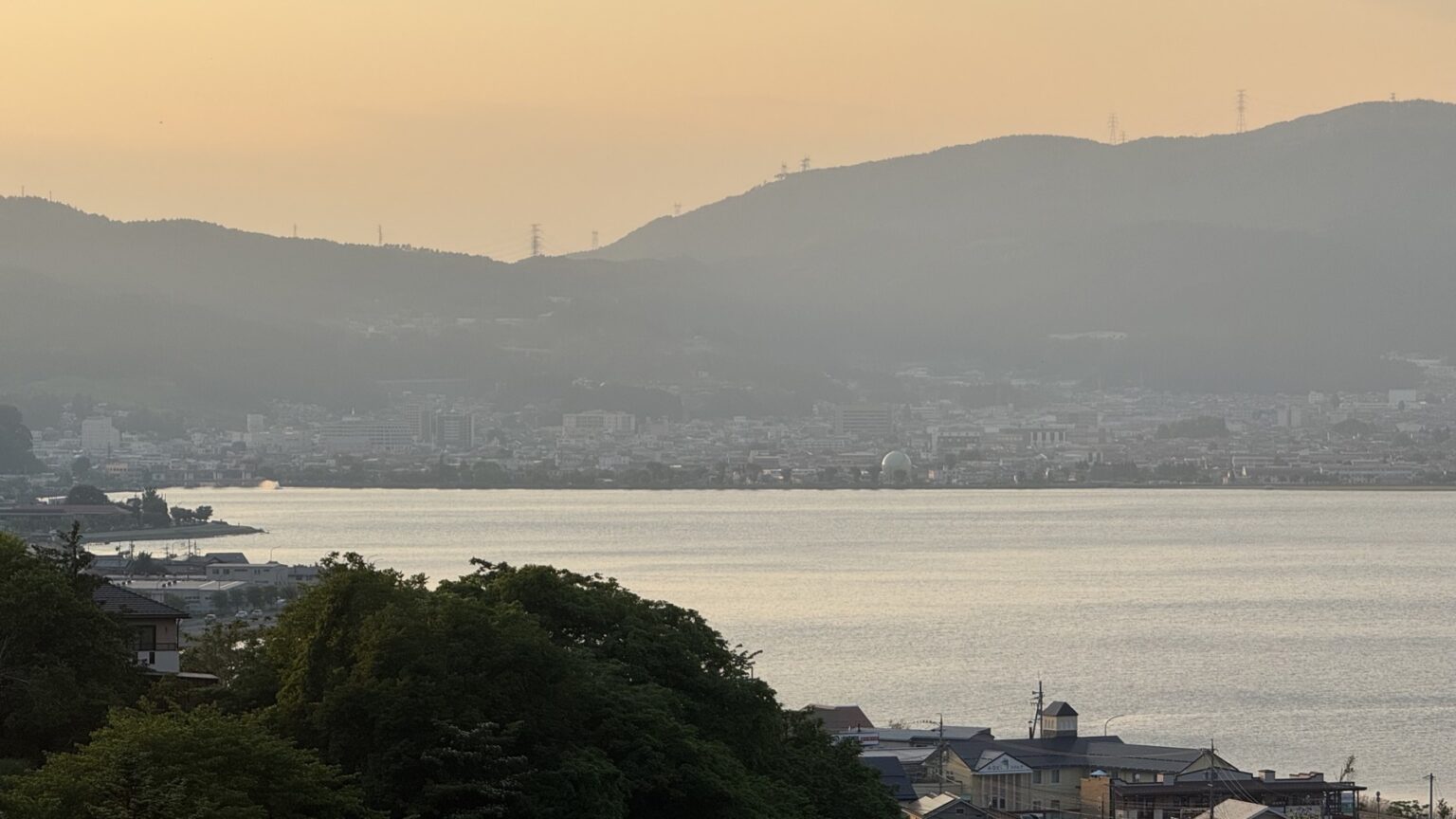
The image that draws photographers to Suwa is Mt. Fuji standing over the lake with the towns glittering below — and there are two places to catch it. Takabocchi Highlands (高ボッチ高原), a grassy 1,665 m plateau above Shiojiri on the west side, gives the wide, postcard version: the Alps, the South Alps, Lake Suwa, and Fuji on the horizon all at once, often above a sea of clouds on autumn mornings. Tateishi Park (立石公園), a free hillside park right above Suwa city, gives the closer, lights-of-the-town version that fans tie to the film Your Name.
Things to do around the lake
🚲 Loop the lake (Suwa-ichi)
A flat 16 km path circles the whole shore — walk part of it or ride the full loop, locals call it “Suwa-ichi.”
⛴️ Sightseeing boat
The swan-shaped cruiser does a 25-minute lap of the lake from the Kamisuwa shore.
♨️ Lakeside hot springs
Kamisuwa Onsen lines the eastern shore, with free public footbaths right by the water.
💨 The geyser
A free hot-spring geyser erupts on a set timetable through the day near the boat pier.
🔮 Suwa Glass Village
A lakeshore glass-art museum, shop and hands-on glassblowing studio.
⛩️ Suwa Taisha
One of Japan’s oldest shrines, spread across four sites around the basin.
Walking or cycling the shore (Suwa-ichi)
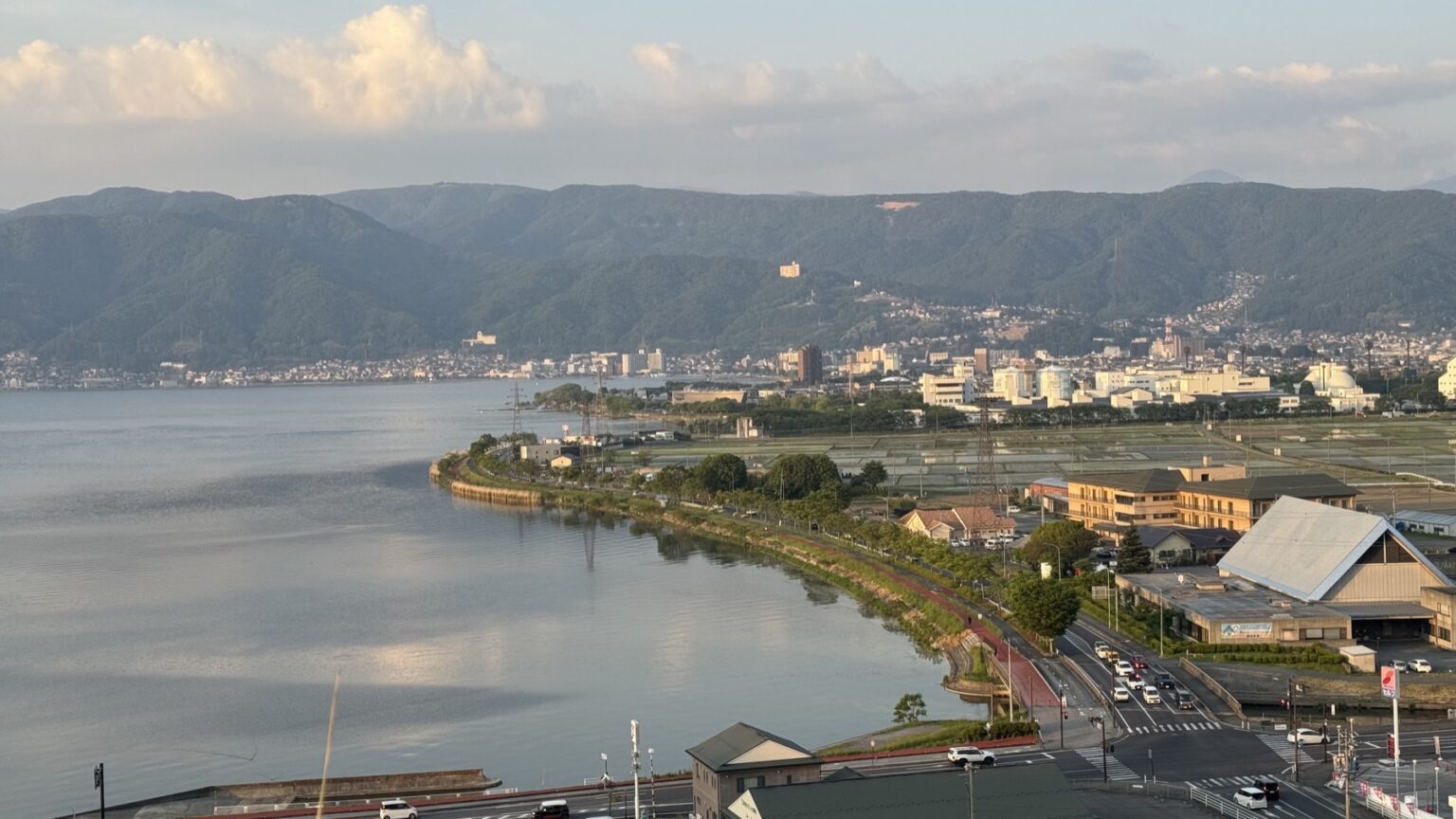
The nicest free thing to do here is simply go around the lake. A continuous path rings the whole 16 km shoreline — a soft urethane jogging lane that’s kind on the knees, with lighting for evening laps, and a cycling road that was finally joined into one full loop in April 2024. It’s flat the whole way, so a relaxed ride around takes a couple of hours with stops; rental bikes and e-bikes are easy to find near Kamisuwa Station. Doing the full circuit even has a local nickname, “Suwa-ichi” (諏訪一周).
The sightseeing boat, the geyser and the glass village
If you’d rather get out onto the water, the sightseeing boat runs a 25-minute loop from the Kamisuwa shore on the swan-shaped Suwan and the newer Suwako Star Mine cruisers.
| What | Cost | Hours / times | Notes |
|---|---|---|---|
| Sightseeing boat (25 min) | ¥1,100 adult / ¥550 child | Departs 9:30, 10:30, 11:30, 14:30, 16:00 | From the Kamisuwa lakeshore pier |
| Geyser (間欠泉) | Free | Erupts ~9:30, 11:00, 12:30, 14:00, 15:30 (+17:00 Apr–Sep) | Center open 9:00–18:00 (Apr–Sep) / –17:00 (Oct–Mar) |
| Suwa Glass Village | Museum ¥600 (shop & studio free) | 10:00–18:00 (Apr–Sep) / –17:00 (Oct–Mar) | Closed Tue & Wed; junior-high and under free |
Sleeping by the water: Kamisuwa Onsen
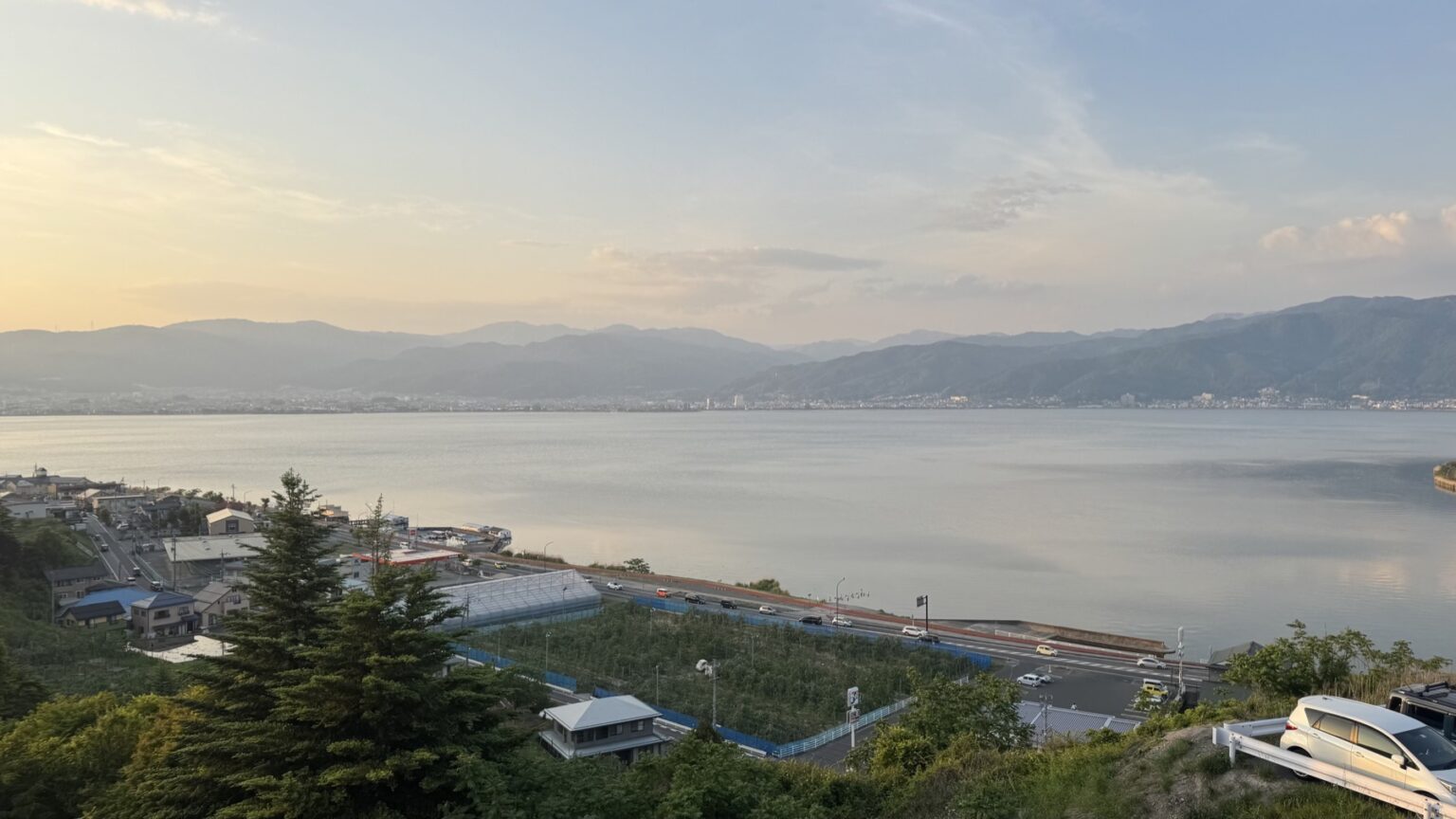
Suwa is a hot-spring town as much as a lake. Kamisuwa Onsen runs along the eastern shore by the station, and a row of ryokan and hotels look straight out over the water — many with rooftop or lake-view baths. Even if you’re just passing through, there are free public footbaths along the lakeside park: pull off your shoes, soak your feet, and watch the light go down over the far mountains. It’s the cheapest good thing in town.
Sleeping by the water — Kamisuwa Onsen
The ryokan and hotels along the eastern shore put you a short walk from the station with hot-spring baths and lake-view rooms. Book well ahead for the August 15 fireworks — the lakefront rooms go months in advance.
Japan’s biggest lakeside fireworks
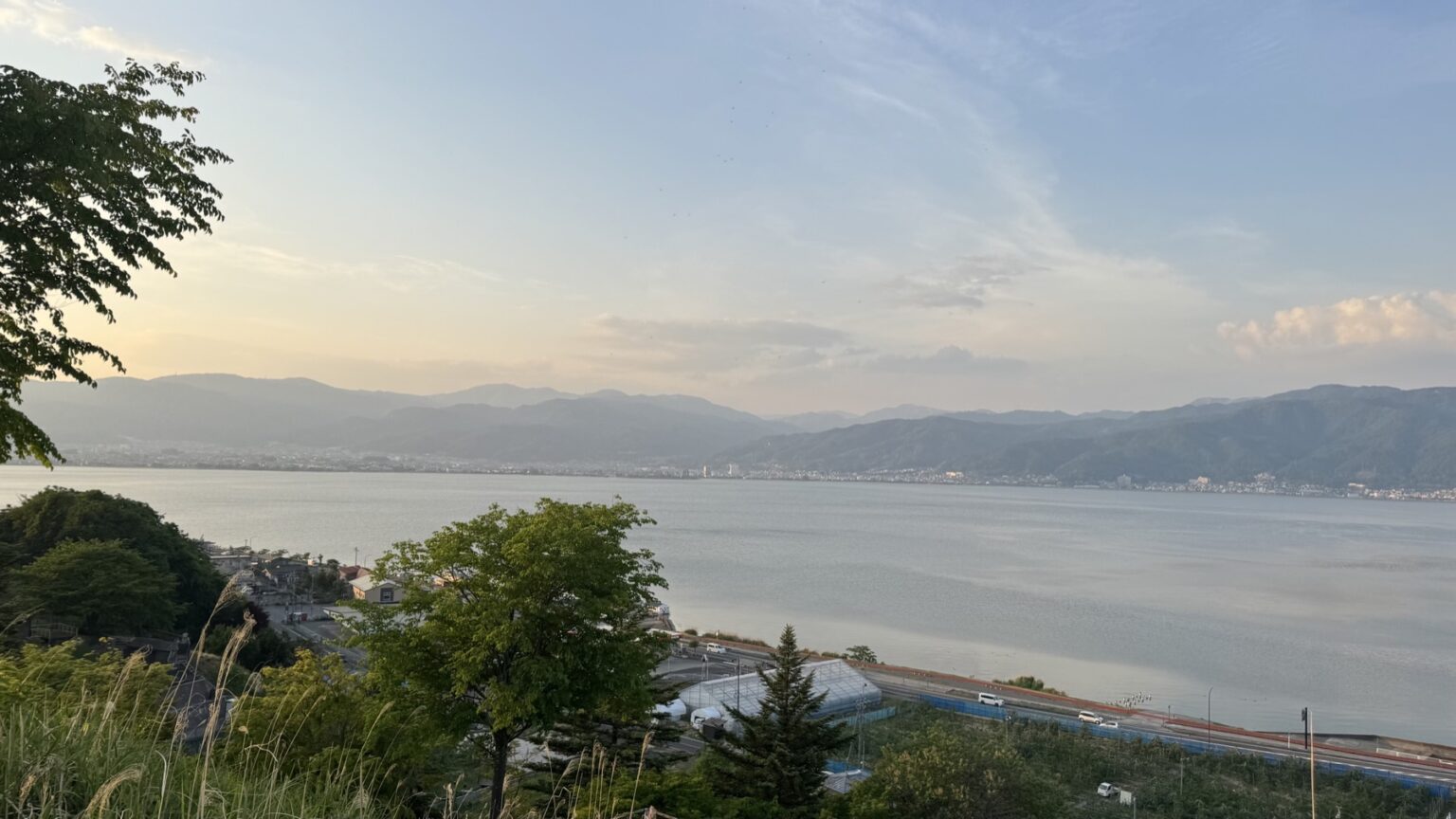
One night a year the quiet basin turns into one of the loudest places in the country. The Lake Suwa Fireworks Festival (諏訪湖祭湖上花火大会) launches around 40,000 shells over the water on August 15, with its signature suijō star-mine barrages fired low off the lake so they bloom and reflect on the surface — and the surrounding mountains throw the booms back like thunder. It’s one of the largest fireworks shows in Japan, and the town fills accordingly.
Omiwatari: the ice road of the gods (that no longer comes)
Suwa’s oldest wonder is a winter one. When the lake froze hard, the ice would crack and buckle into a jagged ridge running shore to shore — the omiwatari (御神渡り), said in local belief to be the path left by a god crossing the lake to a goddess on the far side. Priests at Yatsurugi Shrine (八剣神社) still hold a centuries-old rite to read the ridge and divine the year ahead, and they have kept a written record of the lake’s freezing since the 1400s — one of the longest climate records anywhere.
Here’s the honest part: you almost certainly won’t see it. Warmer winters mean the lake rarely freezes solid now, and in February 2026 the shrine declared an ake-no-umi (“open sea”) — no omiwatari — for the eighth winter in a row. The last true crossing formed in the winter of 2017–18. It’s worth knowing as the story behind the lake rather than something to plan a trip around.
While you’re here: Suwa Taisha
The lake shares its basin with Suwa Taisha (諏訪大社), among the oldest shrines in Japan, unusual for being split across four separate precincts — two “upper” and two “lower” — on either side of the water. Every six years it stages the wild Onbashira festival, when huge fir trunks are dragged down the mountains and riders ride them down the slopes (next held in 2028). Walking between the four halls makes a good half-day on foot or by bike — I’ve laid out the route in the four shrines of Suwa Taisha.
Getting to Lake Suwa
From Tokyo it’s the Limited Express Azusa from Shinjuku to Kamisuwa Station (上諏訪) — a little over two hours, around ¥6,090 reserved. Kamisuwa is the lake’s main base, on the hot-spring shore; Shimosuwa (下諏訪), one stop on, is closest to the lower Suwa Taisha shrines. The same Azusa line carries on to Matsumoto and its black castle about 30 minutes further, which makes the two an easy pair. By car, Suwa IC on the Chuo Expressway is minutes from the shore.
Jigokudani Snow Monkey Park
Elsewhere in Nagano: the hot-spring snow monkeys of Jigokudani. For a winter trip including them, see our Nagano itinerary with Zenkoji and Nozawa Onsen.
🏯 Matsumoto Castle
Japan’s oldest five-tier keep, 30 minutes on from Suwa on the same Azusa line. Matsumoto Castle guide →
⛩️ Suwa Taisha’s four shrines
Walk the four precincts around the basin. The four shrines on foot →
🏔️ Kamikochi
The alpine valley up beyond Matsumoto — a classic Nagano day. Kamikochi walking guide →
🏮 Narai-juku
A preserved post town on the old Nakasendo, down the line toward Kiso. Narai-juku access →
🗻 Is Mt. Fuji out today?
Before the early climb to Takabocchi, check the mountain. Mt Fuji visibility forecast →
Can you really see Mt. Fuji from Lake Suwa?
Yes, from the hills above it — Takabocchi Highlands and Tateishi Park both look out over the lake to Mt. Fuji about 100 km away. It only shows on clear, dry days, so autumn and winter are far better than hazy summer.
Is Lake Suwa the lake from Your Name?
Lake Suwa and these overlooks are widely cited as a real-world inspiration for the lake town in the film, and Tateishi Park has become a fan pilgrimage spot. The film itself is fictional, but the resemblance is why many visitors come.
How do you get to Lake Suwa from Tokyo?
Take the Limited Express Azusa from Shinjuku to Kamisuwa Station — a little over two hours, about ¥6,090 reserved. Kamisuwa is the main lakeside base; Shimosuwa is one stop further for the lower Suwa Taisha shrines.
When are the Lake Suwa fireworks?
The main Lake Suwa Fireworks Festival is held on August 15, launching around 40,000 shells over the water from about 7 pm. Smaller nightly “Summer Night” fireworks run through the season, and a New Fireworks Competition follows in early September.
Can you walk or cycle around Lake Suwa?
Yes — a flat, continuous 16 km path rings the whole lake, with a soft jogging lane and a cycling road joined into a full loop in 2024. Rental and e-bikes are easy to find near Kamisuwa Station; a relaxed ride around takes a couple of hours.
What is the omiwatari, and can I see it?
The omiwatari is a ridge of cracked ice that forms when the lake freezes solid, tied to a local legend of a god crossing the water. Warmer winters mean it rarely forms now — as of February 2026 it had not appeared for eight winters running, the last in 2017–18 — so it’s best treated as the lake’s backstory, not a sight to plan around.
Is the geyser worth a stop?
It’s free and right by the boat pier with a free footbath beside it, so it’s an easy add-on. Just temper expectations: it once reached 50 metres but today’s eruptions are much smaller and not always reliable, on a set timetable through the day.
Join travelers discovering Japan's hidden side
Weekly dispatches from off-the-beaten-path Japan — spots and stories you won't find in guidebooks.
No spam. Unsubscribe anytime.
Welcome aboard!
You're in. See you in your inbox soon.