Kyoto Prefecture · Fukuchiyama · Mount Oe at dawn
The Oeyama sea of clouds is the autumn morning fog that fills the valleys below Mount Oe (832 m) in Fukuchiyama, northern Kyoto Prefecture, and the city names Onitake Inari Shrine, at the mountain’s eighth station, as the place to watch it: early mornings from late October to December, after a sunny day that lets the ground cool overnight. No bus reaches the shrine. Without a car, the way up before sunrise is Oni-Taku, a resident-run car service from Oe Station that you book by phone two days ahead. My timestamped photos run from 6:00 to 7:58 a.m. on 3 November 2021; an untimed photo of the Senjogatake summit sign follows them in the album, and none of the files carries a GPS position.
When does the sea of clouds form over Mount Oe?
Fukuchiyama City’s page for Onitake Inari Shrine, updated 10 April 2025, gives two conditions for a cloud-sea morning (unkai, 雲海, in Japanese): early morning between late October and December, and the morning after a day of good weather, when radiative cooling (the ground losing heat to a clear night sky) is likely. The city’s autumn-leaves page credits the sea of clouds to fog from the Yura River and the Tanba mountains around it.
The city-run pages do not agree on the season:
| Page | What it says |
|---|---|
| Fukuchiyama City, Onitake Inari Shrine (updated 10 April 2025) | Late October to December, early morning; the morning after a fine day with radiative cooling |
| Japan’s Oni Exchange Museum, sightseeing page (no date shown) | Best from mid-October to early November, looking out from Onitake Inari Shrine |
| Fukuchiyama City, autumn leaves of Mount Oe (updated 27 November 2020) | In autumn; the leaves turn from late October to late November |
| Fukuchiyama Tourism Association, Oeyama page (date not shown; checked October 2026) | In autumn, from the eighth-station shrine, the mountains look like islands in milky white |
Late October to early November is where all four overlap, and my frames below are from 3 November. The city’s own shrine page runs on to December. Oni-Taku, though, stops running to the shrine after 30 November; if you plan to drive in December, check the road conditions first. None of these pages puts a probability on a clear morning, so I don’t give one. If your dates allow, keep a second morning free.
Dawn on 3 November 2021, frame by frame
My frames from that morning are time-stamped 6:00:58 to 7:58:07, Japan time. The files kept the time but no GPS position and no camera model, so I don’t assign the dawn frames to a precise viewpoint; the only frame with a place name in it is the untimed summit sign. The National Astronomical Observatory of Japan (NAOJ) lists sunrise in Kyoto city at 6:20 that day; that is a reference time for the city, not the sunrise seen from the mountain.
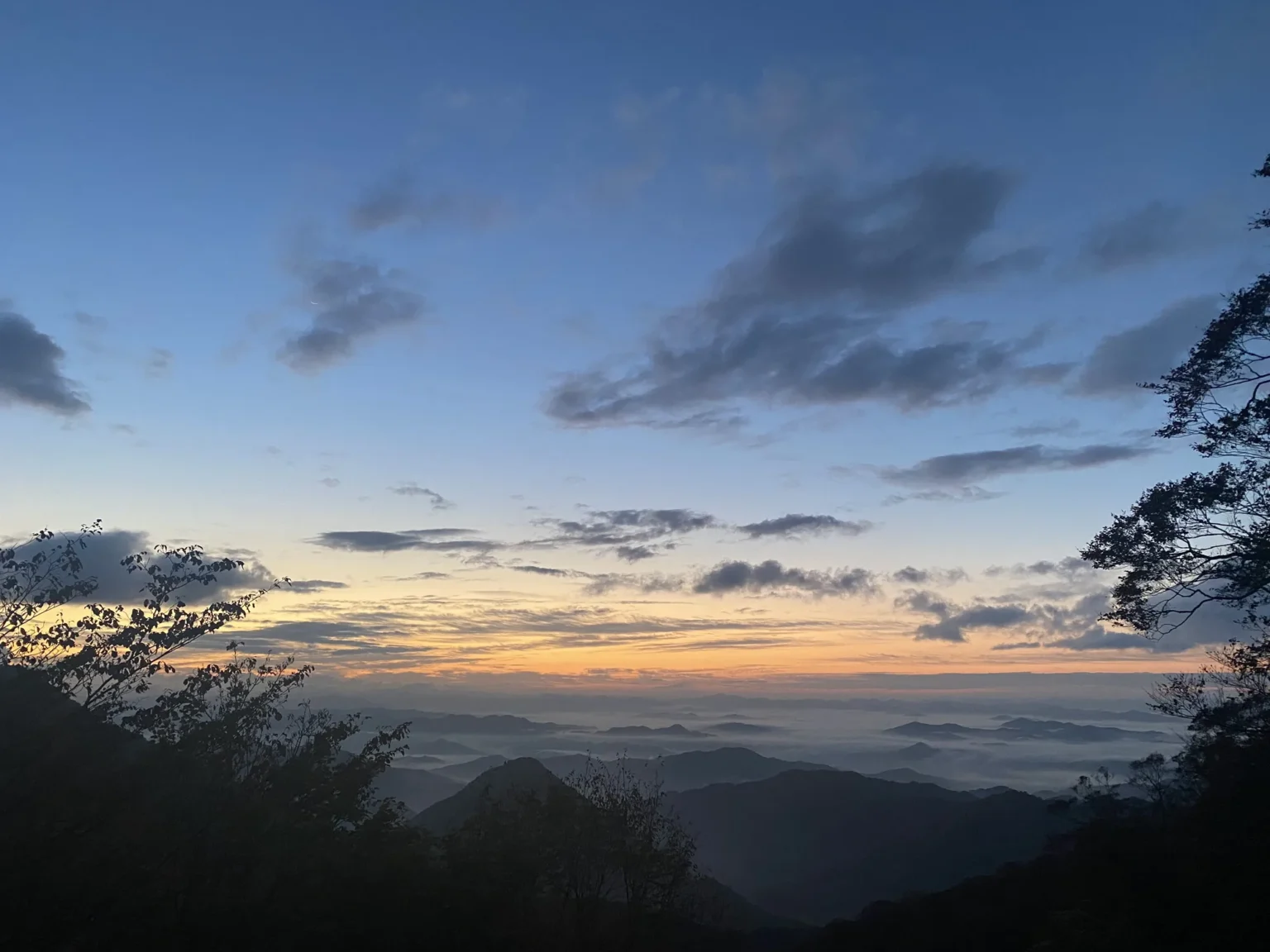
| Time (JST) | In the frames |
|---|---|
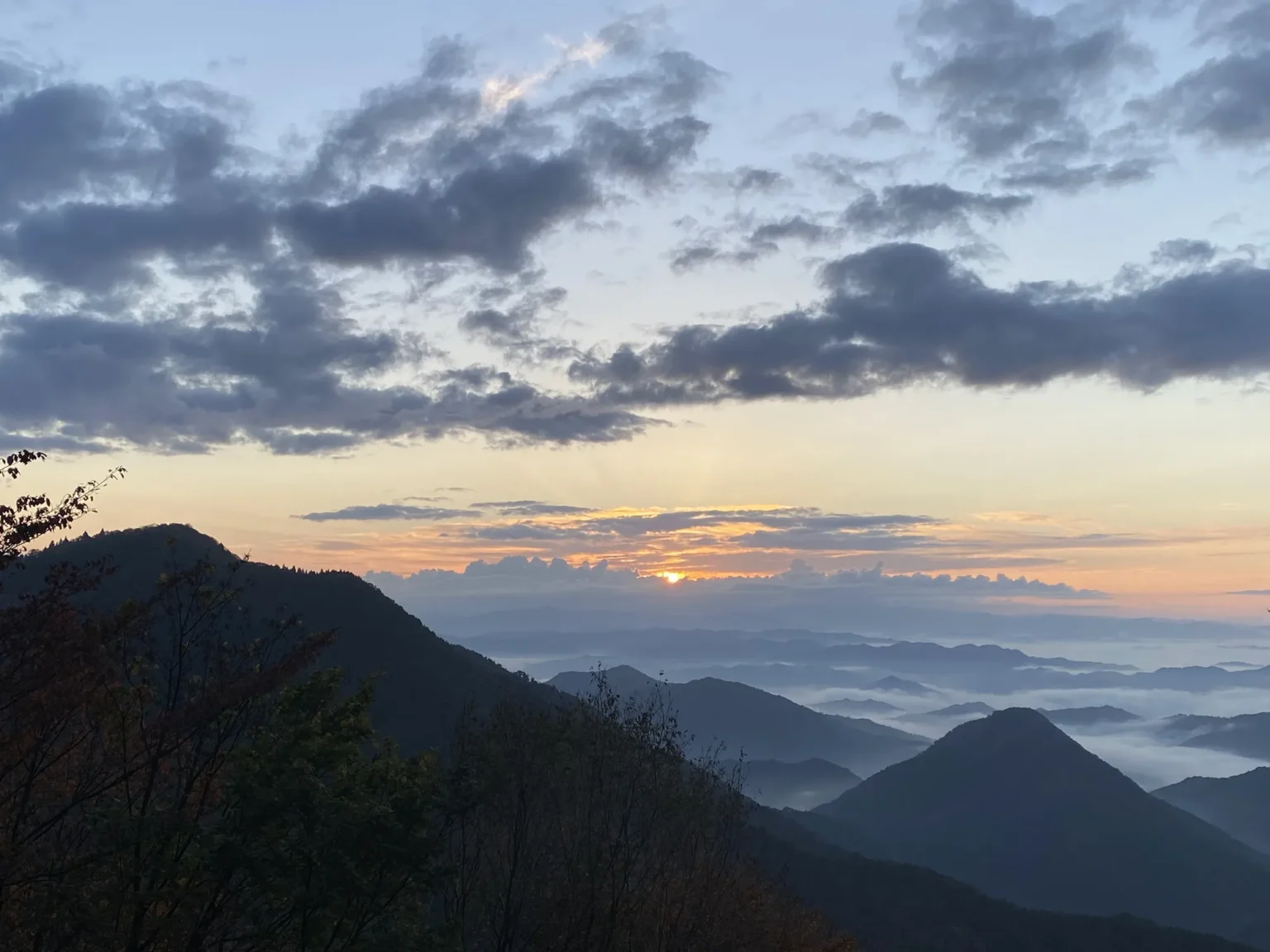
| 6:00–6:02 | Blue sky, an orange band on the horizon, fog lying in the valleys between dark ridges |
| 6:29 | The glow brightens behind a line of cloud on the horizon |
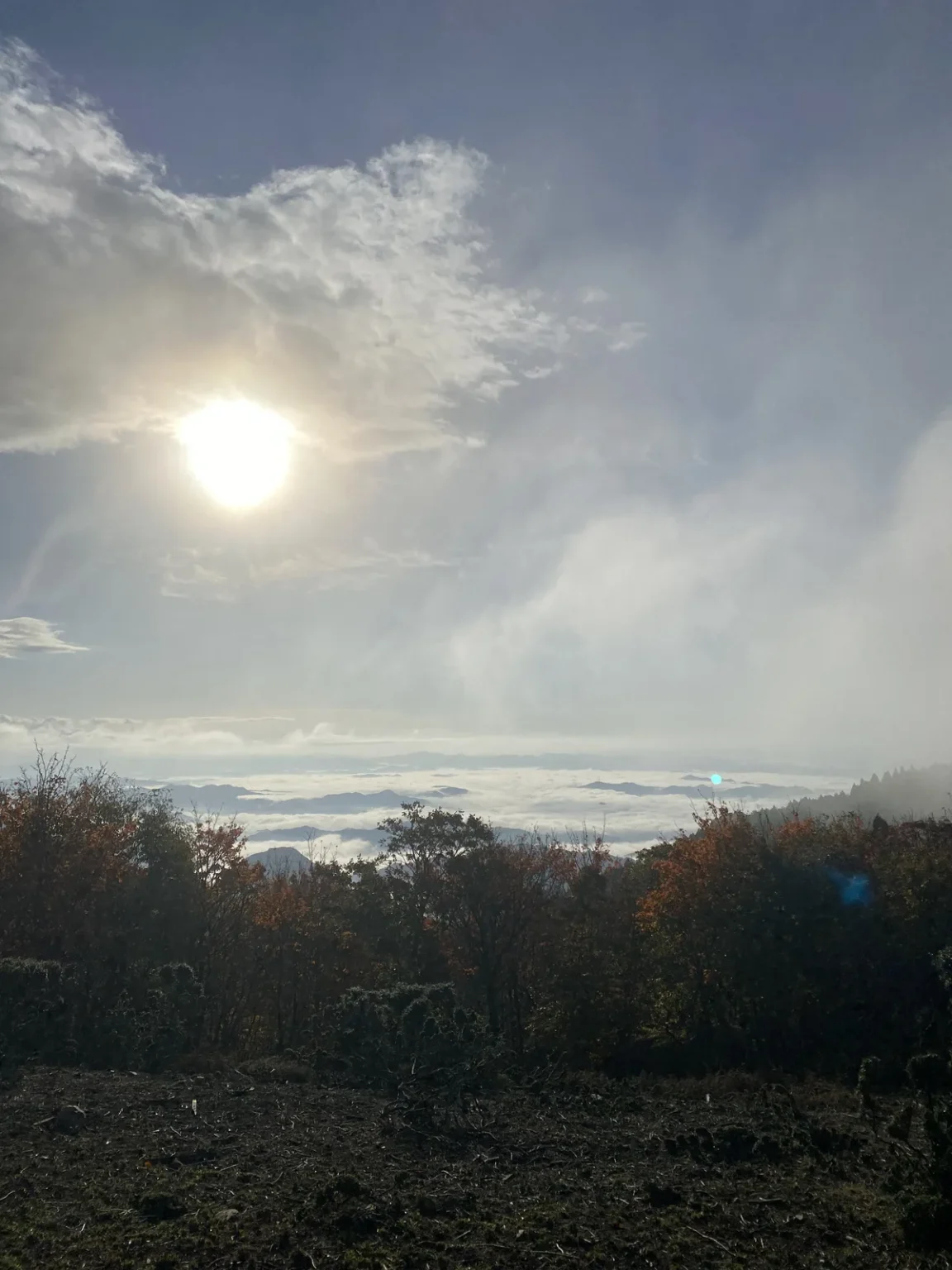
| 6:31 | The sun appears over that cloud bank; a pointed peak stands out of the fog (top photo) |
| 6:35–6:40 | The sun climbs; the fog below shows white across the valleys |
| 6:41 | Sunbeams cross a slope of autumn trees with the fog beyond; a 9-second video clip pans the same view |
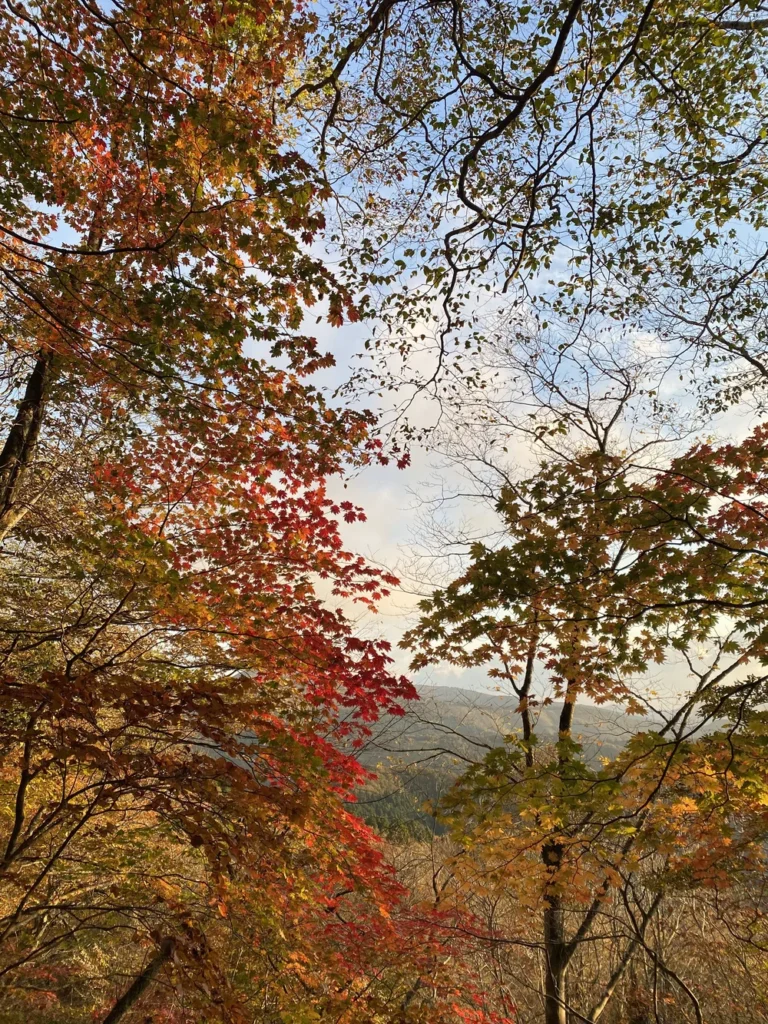
| 6:50–6:53 | A forest path under red and yellow maples |
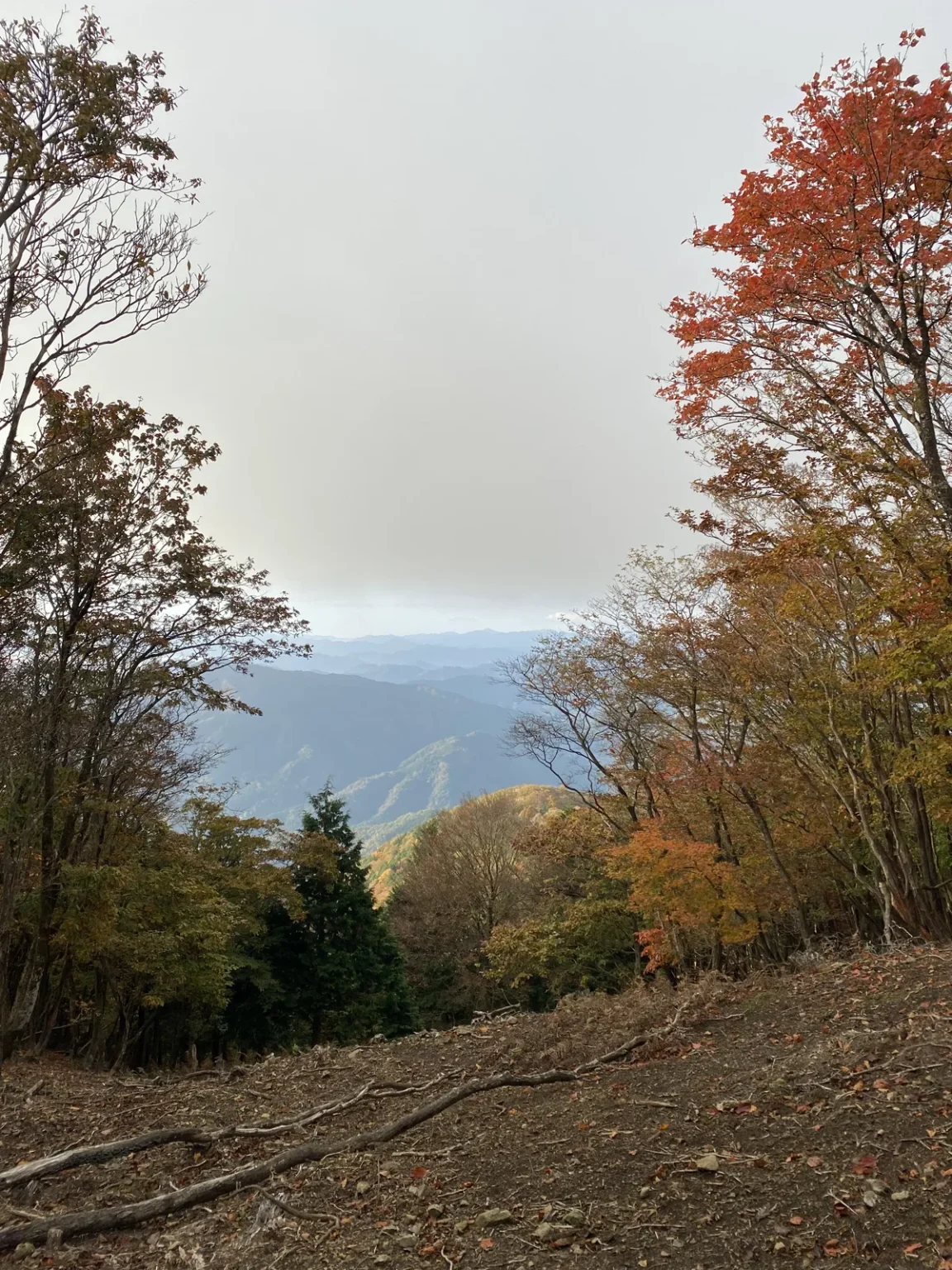
| 7:26 | A gap in the trees on a dirt path: blue-grey ridges below a white sky |
| 7:54–7:58 | The sun shows through moving mist, with a layer of cloud still lying below |
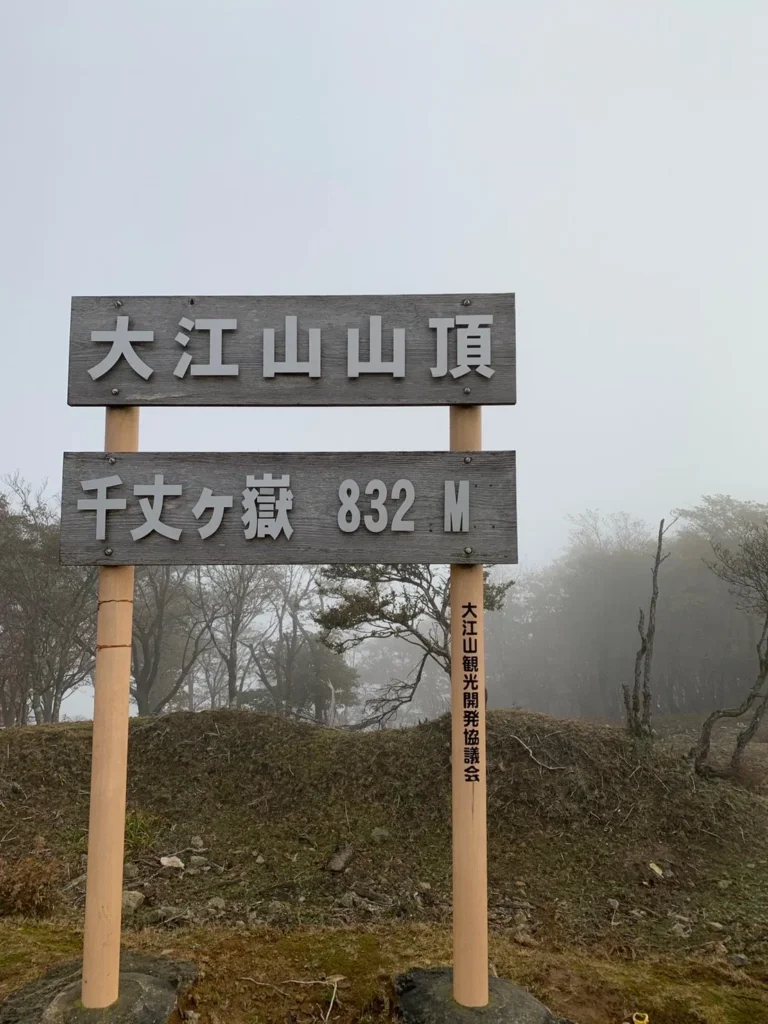
| No timestamp | The summit sign, 千丈ヶ嶽 832 M; the frame is numbered after the 7:58 one |
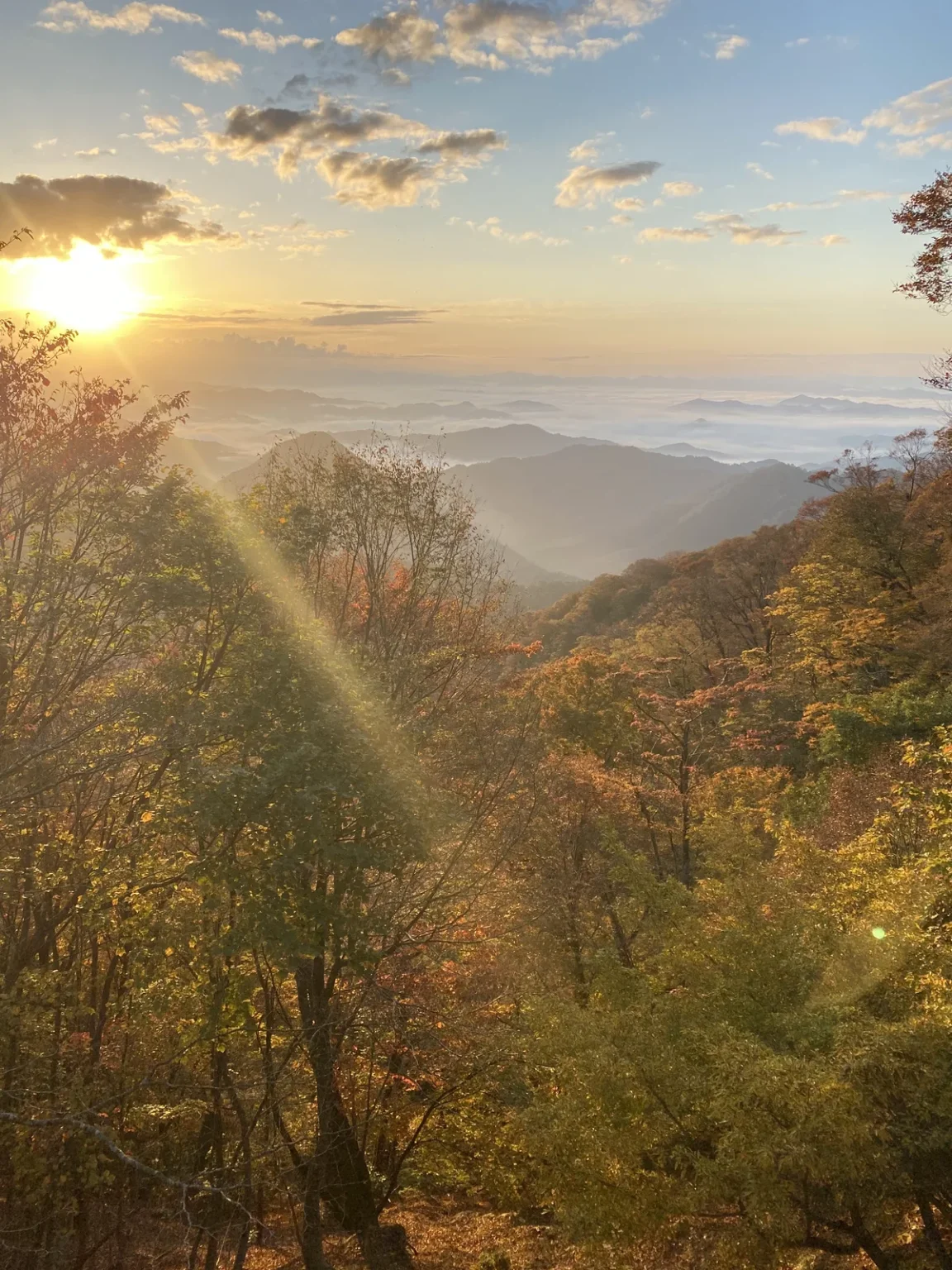
The fog was in place at 6:00, about 20 minutes before the listed sunrise, and by 7:54 mist was crossing the ridge in frame. Be in position before the sky starts to lighten, not at sunrise. The maples by the path were red at 6:53 on 3 November, inside the city’s late October to late November leaf window; for this year’s colour reports across Japan, the live koyo tracker follows the official forecasts.
Onitake Inari Shrine, the city’s viewpoint, and other places on Mount Oe
The viewpoint the city names is Onitake Inari Shrine (鬼嶽稲荷神社), at the eighth station, or hachigome, of Mount Oe, in 大江町北原, Fukuchiyama. Senjogatake is the main peak of a ridge, mostly 600 to 800 m high, that runs east to west and has been part of the Tango-Amanohashidate-Oeyama Quasi-National Park since 3 August 2007. The city describes the forest around it as old-growth beech and mizunara oak and says it was chosen as one of Japan’s 100 forests for forest bathing. The oni museum’s page says a cave below the shrine is where mountain ascetics are said to have trained.
The shrine’s goshuin, the seal visitors collect, is available on set days only. The city’s schedule for fiscal 2026 still has 12 and 25 October and 3 and 23 November to come, 9:30 a.m. to 3:30 p.m., as pre-written slips, and notes that the days can change.
Onitake Inari Shrine (鬼嶽稲荷神社)
The cloud-sea viewpoint on the city’s pages, at the eighth station. Oni-Taku drives up here from 5:00 a.m. on weekends and holidays, 1 May to 30 November.
Onigajo (鬼ヶ城, 544 m)
Oni-Taku’s page lists it with the shrine for cloud-sea trips. The tourism association says the top has a view from Mount Oe across to central Fukuchiyama, has a shelter, and is reached by trail from the temple 室尾谷山観音寺. Ibaraki-doji is said to have lived here and raided the area together with Shuten-doji on Mount Oe.
Senjogatake summit (832 m)
The Geospatial Information Authority of Japan lists 832 m; the sign says 832 M, and two city pages give 832.4 m and 832.5 m. My last timed frames, 7:54–7:58, come just before the summit-sign frame and show mist moving over a ridge.
Nabezuka rest area
The city says you can drive from Shuten-doji no Sato to this rest area, then walk 1.1 km to Nabezuka (763 m) or 0.6 km to Hatogamine (746 m), watching for bears. The city does not describe it as a cloud-sea viewpoint.
In early November you arrive in the dark: NAOJ’s sunrise for Kyoto city is 6:17 on 1 November 2026 and 6:31 on 15 November. Two small things help with that part of the morning.
For a start in the dark
How do I get to Onitake Inari Shrine for sunrise without a car?
Book Oni-Taku (鬼タク). Neither the city bus nor the first train of the day gets you near the shrine before sunrise; Oni-Taku can: usually on Saturdays, Sundays and public holidays, and on weekdays in school holidays for passengers travelling with primary or junior-high pupils, from 5:00 a.m. between 1 May and 30 November. It is a service in residents’ own cars run by the Oe town-planning residents’ council, with a local taxi firm, Fukufuku Taxi, taking bookings and managing operations (Fukuchiyama City, page updated 1 August 2026).
- Stay in Oe the night before. The first Miyafuku Line train from Fukuchiyama leaves at 6:29 and departs Oe at 6:51 (Kyoto Tango Railway timetable from 14 March 2026), after sunrise all through October and November. The city describes the tourist service as running from Oe Station across Oe town, so if you sleep away from the station, ask on the phone where they can collect you.
- Phone 0773-33-5533 by 5 p.m. two days ahead. The line takes calls Monday to Saturday, 8:30 a.m. to 5 p.m., and not on Sundays or holidays. For a Saturday dawn, call by Thursday; for a Sunday dawn, by Friday.
- Settle the plan before you call. The city asks callers to decide where they want to go and at what times first. Bookings are made by phone; if you don’t speak Japanese, ask your accommodation to make the call.
- Pay per person. Oe Station to the shrine counts as 12 km or more: ¥1,500 per adult, ¥750 per primary-school child, free under school age. Every passenger pays, even in a shared car.
The museum’s sightseeing page gives about 40 minutes by car from Oe Station to the shrine area. That is an undated estimate, not a guaranteed dawn arrival, so confirm the pickup point and expected arrival time when you book. Bookings are taken by phone from Monday to Saturday only, so if the two-day deadline falls on a Sunday or public holiday, call by 5 p.m. on the last reception day before the deadline: for Tuesday 3 November 2026, call by 5 p.m. on Saturday 31 October.
| Date (2026) | Sunrise, Kyoto city (NAOJ) |
|---|---|
| 15 October | 6:02 |
| 1 November | 6:17 |
| 15 November | 6:31 |
| 30 November | 6:45 |
| 15 December | 6:57 (no Oni-Taku to the shrine) |
City bus, Oeyama-no-ie line
Weekdays only; no service on Saturdays, Sundays, holidays or 29 Dec–3 Jan. The first bus leaves Oe-ekimae at 7:24 and reaches Oeyama-no-ie at 7:42 (timetable revised 1 April 2022, still the one the city links). From there the city gives about 1 hour 30 minutes on foot to the shrine; the tourism association’s Oe page says about an hour.
Kyoto Tango Railway
Oe Station is on the Miyafuku Line between Fukuchiyama and Miyazu. The earliest train from Fukuchiyama leaves Oe at 6:51 and the first from the Miyazu side at 6:22; from either, neither scheduled train gives you a pre-sunrise connection to the shrine.
Oni-Taku
Saturdays, Sundays and holidays (not 29 Dec–3 Jan), 8:30 a.m. to 5 p.m.; for cloud-sea trips to the shrine or Onigajo, from 5:00 a.m. between 1 May and 30 November. During school holidays it also runs on weekdays for passengers travelling with primary or junior-high pupils.
Oeyama Green Lodge
The lodging the city lists at Shuten-doji no Sato, at the foot of the mountain: a training and lodging centre for up to 76 guests, closed on Tuesdays. Bookings on 0773-56-0095.
One older city page, last updated 1 October 2021 and still online, gives Oni-Taku as ¥800 one way. The transport division’s page, updated 1 August 2026, gives ¥1,000 under 12 km and ¥1,500 at 12 km or more, and names Oe Station to the shrine as a 12 km-plus trip. Plan on the higher figure.
Driving to the shrine
A car isn’t tied to Oni-Taku’s days or its 30 November end, though it doesn’t guarantee the road is open in winter. The museum’s access page gives the approach: leave the Maizuru-Wakasa Expressway at Fukuchiyama IC or the Kyoto-Jukan Expressway at Maizuru-Oe IC, follow Route 175 into Oe-cho, then turn onto Prefectural Road 9 toward Miyazu. The museum is about 15 minutes from Oe Station, and the museum’s undated sightseeing page puts the shrine area about 40 minutes by car from Oe Station; check road conditions and timing before relying on it.
For a self-drive dawn
Before you drive up in the dark
Who was Shuten-doji? The story Mount Oe is known for
In the telling published by Japan’s Oni Exchange Museum, Shuten-doji (酒呑童子, often written Shuten Doji in English) led a band of oni on Mount Oe. Around the year 1000, in the reign of Emperor Ichijo, he defied imperial authority and carried off noblewomen from the capital, until a party of six warriors was sent to the mountain to kill him.
“The capital flourished, but that prosperity belonged to a handful of regent-family nobles; the world was in deep disorder and ordinary people lived in fear.” The museum’s opening to the story, in my translation.
The party
Minamoto no Yorimitsu (the city’s PDF reads the name Raiko) led Fujiwara no Yasumasa and the four retainers known as the Shitenno: Sakata no Kintoki, Watanabe no Tsuna, Urabe no Suetake and Usui no Sadamitsu.
The disguise and the sake
They travelled dressed as yamabushi, mountain ascetics. On the way, the gods of Sumiyoshi, Hachiman and Kumano, disguised as old men, guided them and gave them a sake called jinben kidokushu (神便鬼毒酒). By a river they met a noblewoman washing bloodstained clothes, who told them where the oni lived.
The feast
Shuten-doji welcomed them with blood for sake and human flesh. They served the gods’ sake to him and his oni until they were drunk, killed him and his followers, freed the captive women and returned to the capital.
The head
The head was carried back to be shown on a riverbank as a warning. At 老の坂, on the border between Tanba and Yamashiro provinces, it grew too heavy to lift and was buried there.
How the story spread
The museum dates the oldest picture of Shuten-doji to the 14th century: the Katori-bon Oeyama Ekotoba scroll (香取本大江山絵詞), an Important Cultural Property held by the Itsuo Art Museum. A Noh play, Oeyama, followed in the Muromachi period, with Shuten-doji as the lead role and Yorimitsu in the supporting one. The story became widely known after the Otogizoshi tales were printed in the early Edo period, then moved into illustrated books, puppet theatre and kabuki. From the Meiji era to the early Showa era it was in school Japanese textbooks and songs, and Mount Oe in Tanba became known as the mountain of oni. The museum also notes that other places claim his birth: Echigo, today’s Niigata, where the temple 国上寺 in Tsubame keeps its own scroll, and Ibuki in Omi, today’s Shiga.
Two older stories on the same mountain
Fukuchiyama City lists three oni-quelling legends for Mount Oe. The oldest, from fragments of the Tango Fudoki, has Hikoimasu-no-kimi, younger brother of Emperor Sujin, defeating a tsuchigumo called Kugamimi no Mikasa. The second has Prince Maroko, a younger brother of Prince Shotoku, defeating oni at 三上ヶ嶽, an old name for the mountain. Shuten-doji is the third.
Japan’s Oni Exchange Museum and Shuten-doji no Sato
Japan’s Oni Exchange Museum (日本の鬼の交流博物館) stands at the foot of the mountain in Shuten-doji no Sato and covers the Mount Oe oni legends, oni in performing arts from around Japan and oni masks from around the world. A 2024 notice from the museum counted about 3,000 items collected since it opened in 1993.
| Item | 2026 detail |
|---|---|
| Hours | 9:00–17:00, last entry 16:30 |
| Closed | Mondays (Tuesday if Monday is a holiday), the day after a public holiday, 28 December–4 January |
| Adult | ¥330 (¥260 each in groups of 15 or more) |
| High-school student | ¥220 (group ¥170) |
| Primary and junior-high pupil | ¥160 (group ¥130) |
| Address and phone | 福知山市大江町佛性寺909; 0773-56-1996 |
The museum says holders of the specified disability certificates, plus one carer, pay half; ask in advance about documentation issued outside Japan. Outside stands an oni roof tile 5 m tall and weighing 10 tonnes, fired in 130 parts by members of a national association of oni-tile makers; the tourism association calls it the largest in Japan. On weekdays the city bus stops at Oeyama-no-ie, about two minutes’ walk away; by car it is about 15 minutes from Oe Station.
Fitting Mount Oe into a Tango or Kyoto trip
Oe is on the Kyoto Tango Railway between Fukuchiyama and Miyazu, and the Hashidate limited express stops there on its way to Amanohashidate. From Kyoto, JR limited expresses reach Fukuchiyama in about 75 minutes; the 7:32 Kinosaki No. 1 arrives at 8:47 in the railway’s March 2026 connection table.
North to the Tango coast
Past Amanohashidate, the boat-house village is covered in Ine no Funaya: boat-house village access and cruises, and lunch further west in Yama-ichi, a sushi lunch on the Tango Peninsula.
West to Kinosaki
JR Kinosaki limited expresses from Kyoto run through Fukuchiyama; Kinosaki Onsen’s open baths and day pass is one stop-over after an Oe morning.
Back in Kyoto
A November dawn on Mount Oe falls in Kyoto’s busiest month; Kyoto in November 2026: bookings, prices and crowd timing covers the city side.
Clothes and later dates
For a pre-dawn wait in November, see what to wear in Japan in November. For a trip in the first days of December, Japan in December 2026 has weather and events.
FAQ
Can I see the Oeyama sea of clouds without a car?
Yes, usually on Saturdays, Sundays and holidays (and on weekdays in school holidays with a pupil) from 1 May to 30 November, by booking Oni-Taku from Oe Station by phone (0773-33-5533) by 5 p.m. two days ahead (calls aren’t taken on Sundays or holidays). Cloud-sea trips start from 5:00 a.m., and Oe Station to Onitake Inari Shrine costs ¥1,500 per adult. The city bus runs on weekdays only and arrives too late for dawn.
What time should I be at Onitake Inari Shrine?
Before the sky starts to lighten. On 3 November 2021 the fog was already in the valleys at 6:00, about 20 minutes before NAOJ’s sunrise time for Kyoto city, and by 7:54 mist was crossing a ridge in the frame. In 2026, Kyoto city’s sunrise is 6:17 on 1 November and 6:31 on 15 November.
Can you see the sea of clouds on Mount Oe in December?
Fukuchiyama City includes December in its window of late October to December. Oni-Taku stops running to the shrine after 30 November; if you plan to drive in December, call the tourism association’s Oe branch (0773-56-1102) about the road before you go.
How is Mount Oe different from the Takeda Castle sea of clouds?
Takeda’s draw is a castle ruin in Asago, Hyogo, that appears to float, seen from a ridge across the valley. Mount Oe has no castle: you look out over the fog from a mountain shrine at the eighth station, and no bus or train reaches it before sunrise.
How much is Japan’s Oni Exchange Museum?
¥330 for adults, ¥220 for high-school students and ¥160 for primary and junior-high pupils in 2026. It is open 9:00–17:00 with last entry at 16:30, and closed on Mondays (Tuesday if Monday is a holiday), the day after a public holiday and 28 December–4 January.
Who was Shuten Doji in the Mount Oe legend?
An oni leader who, in the story told by the museum, defied imperial authority and carried off noblewomen from Kyoto around the year 1000. Minamoto no Yorimitsu (Raiko) and five companions, disguised as mountain ascetics, got him drunk on a sake given by the gods and killed him on Mount Oe.
Sources
The primary sources behind the figures above, checked on 4 October 2026
- Fukuchiyama City: Onitake Inari Shrine (conditions, bus, goshuin days); Oni-Taku (updated 1 August 2026); museum page with the older Oni-Taku fare (updated 1 October 2021); Oe bus timetables and Oeyama-no-ie line PDF; autumn leaves of Mount Oe; Mount Oe; three oni legends and Shuten-doji legend PDF; Oeyama Green Lodge
- Japan’s Oni Exchange Museum: home; hours and fees; access; the legends; about Mount Oe; sightseeing (cloud sea)
- Fukuchiyama Tourism Association: Oeyama, beech forest and cloud sea; Oe area; Fukuchiyama’s ten mountains (Onigajo); 2026 festival notice (3 October 2026)
- Fukuchiyama Regional Promotion Corporation: Shin-Doji Bridge closure (30 August 2026)
- Kyoto Tango Railway: timetables from 14 March 2026 (Miyafuku Line and Oe Station departures)
- National Astronomical Observatory of Japan: sunrise in Kyoto city, November 2021, October, November and December 2026
- Geospatial Information Authority of Japan: Japan’s main mountain heights (31 March 2026 list)
- Kyoto Prefecture: Tango-Amanohashidate-Oeyama Quasi-National Park
Join travelers discovering Japan's hidden side
Weekly dispatches from off-the-beaten-path Japan — spots and stories you won't find in guidebooks.
No spam. Unsubscribe anytime.
Welcome aboard!
You're in. See you in your inbox soon.