Japanese Food Culture · Kyoto
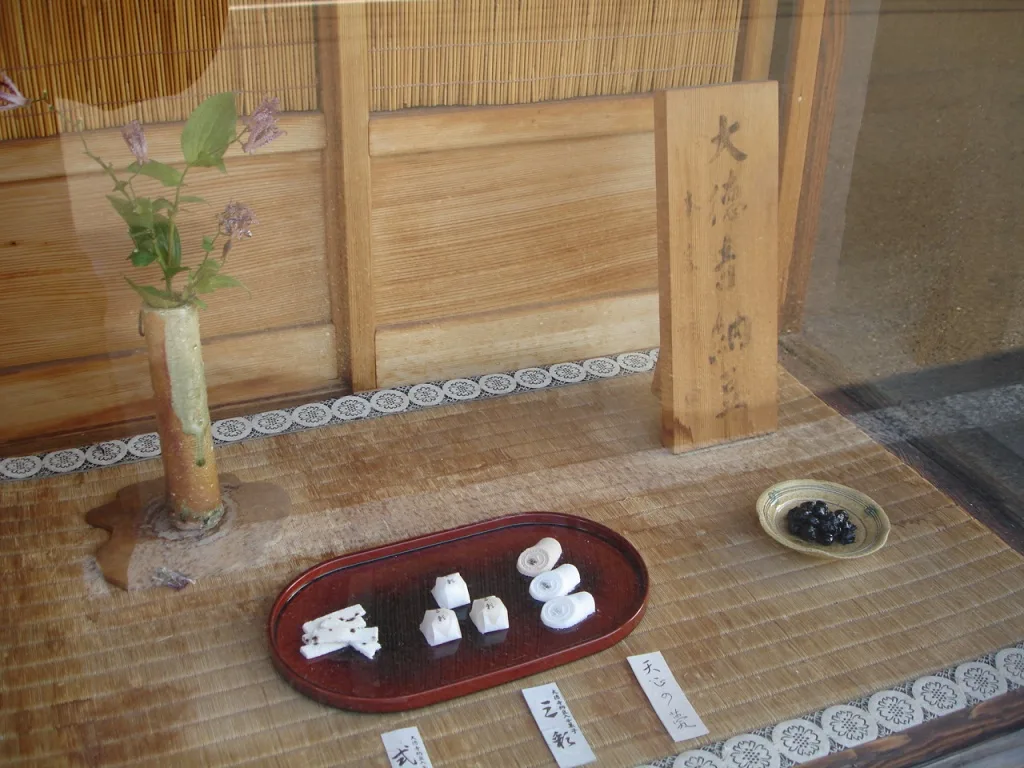
Daitokuji natto (大徳寺納豆) is natto with no strings at all. The soybeans are fermented with koji mould, salted and dried in the sun until they become small black nuggets that taste salty, sour and deep, closer to miso than to the sticky natto in every Japanese supermarket. Japanese calls this family tera natto, temple natto, because temples made it. This guide covers two places in Kyoto where you can buy it. Daitokuji Ikkyu, a shojin-cuisine house in front of Daitokuji, sells Daitokuji natto from ¥500 for 50 grams under what it says is its registered trademark. Ikkyuji, the temple where the Zen monk Ikkyu spent his last years, sells Ikkyuji natto only through the temple itself. Keihoku, the third name on Kyoto’s natto map, belongs to the other kind: in this forested north-west corner of the city, the legend involves a retired emperor and sticky beans wrapped in straw, and the local dish is natto folded into rice cakes for New Year. The three are far apart, so this guide treats them as three separate trips.
What temple natto is
Japanese dictionaries describe one process with small variations. Nihon Kokugo Daijiten defines tera natto as steamed soybeans inoculated with koji mould to make koji beans, soaked in brine to ferment, then dried. It is named for the temples that made it, it is also called shiokara natto, “salty natto”, and the dictionary names Ikkyu natto (Daitokuji natto) and Hamana natto as the famous ones. For Daitokuji natto itself the same dictionary adds the season and the sun: it is made in summer, the beans are fermented in a warm room, salted, then set out in the sun to ferment further, and the result is black, salty and sour. Tradition says the method came from the monk Ikkyu, which is why it is also called Ikkyu natto.
Heibonsha’s World Encyclopedia gives the modern method: soybeans boiled until soft are inoculated with soy-sauce koji mould, the koji beans spend three to four months in brine, and then they are lifted out and dried. The beans come out very dark, with a flavour the encyclopedia likens to Hatcho miso. They are eaten as they are with sake, or ground into dengaku miso or worked into the bean paste of wagashi, where, the encyclopedia says, their particular bitterness and astringency lift the flavour. Britannica’s Japanese encyclopedia, describing hamanatto from the same family, puts the salt at about 10 percent and points out that the microbe, not just the recipe, separates it from sticky natto.
Nipponica, Shogakukan’s encyclopedia, says the salty kind came from China while sticky natto is Japan’s own. The salty kind was once called kuki (豉), the imperial kitchens were already making it in the Nara period, and the name shiokara natto appears in the late-Heian Shin Sarugakuki. Because temples made so much of it, it became temple natto. Ikkyuji’s own shop describes its natto as Chinese douchi that came to Japan, the same fermented black beans that season mapo tofu.
In Kansai, Heibonsha’s encyclopedia notes, the plain word “natto” often meant the salty kind.
Sticky natto or temple natto: the difference in one table
In my natto guide I split natto into two lineages by how it is fermented: the sticky family and the salt-and-koji family. Hikiwari and yukiwari are cuts and second agings inside the sticky family, a different layer altogether. Kyoto happens to have both lineages, which is the point of this page.
| Sticky (itohiki) natto | Temple natto (tera natto) |
|---|---|
| Fermented by natto bacteria, Bacillus subtilis var. natto, for about a day | Fermented by koji mould, then months in brine and drying |
| Pale, glossy beans in a web of threads | Black, wrinkled beans, no threads |
| No salt in the beans; you add the sauce | Salt is part of the process; Britannica puts hamanatto at about 10% salt |
| A refrigerated food | Kept like umeboshi or salted kombu, says Daitokuji Ikkyu |
| Stirred and eaten by the pack, over rice | A few beans at a time: with tea, with sake, on rice, in cooking |
| In Kyoto: Keihoku’s straw-natto legend and natto mochi | In Kyoto: Daitokuji and Ikkyuji |
Kyoto and natto, in numbers. In the government household survey (2023–25 average, households of two or more, in the 52 prefectural capitals and designated cities), Kyoto City households spent ¥3,921 a year on natto, 41st of 52. The national figure is ¥4,759 and Fukushima City, at the top, spends ¥7,102. The Agriculture Ministry’s page on Kyoto’s natto mochi says the same thing in words: Kansai does not eat much natto, but in Keihoku it is still part of everyday life. The wider map, from Mito to the Tohoku cities, is in the natto guide and the Mito natto day trip.
Daitokuji · north Kyoto
What you get: Daitokuji natto from the shop in front of the temple, shojin cuisine by reservation.
From Kyoto Station: city bus 205 or 206 to Daitokuji-mae, about 50 minutes.
Ikkyuji · Kyotanabe
What you get: Ikkyuji natto from the temple itself, and Ikkyu’s grave and gardens.
From Kyoto Station: Kintetsu express to Shin-Tanabe in 25 minutes, then a bus or a five-minute taxi.
Keihoku · Ukyo Ward
What you get: the sticky-natto legend, natto mochi and Jōshōkōji.
From Kyoto Station: JR bus to Shuzan, about an hour and a half, then a local bus. A day of its own.
Daitokuji: Daitokuji natto from the shop in front of the temple
Daitokuji, in Kyoto’s Kita Ward, is the head temple of the Daitokuji school of Rinzai Zen, founded in 1315 by Shūhō Myōchō. Rinnō-net, the joint site of the Rinzai and Ōbaku head temples, says it was laid waste in the Ōnin War and restored by Ikkyu, and that twenty sub-temples stand in the precinct today. Ikkyu’s tie to the temple is direct: Ikkyuji’s own history says he became abbot of Daitokuji at 81 and kept living at Ikkyuji, travelling in from there.
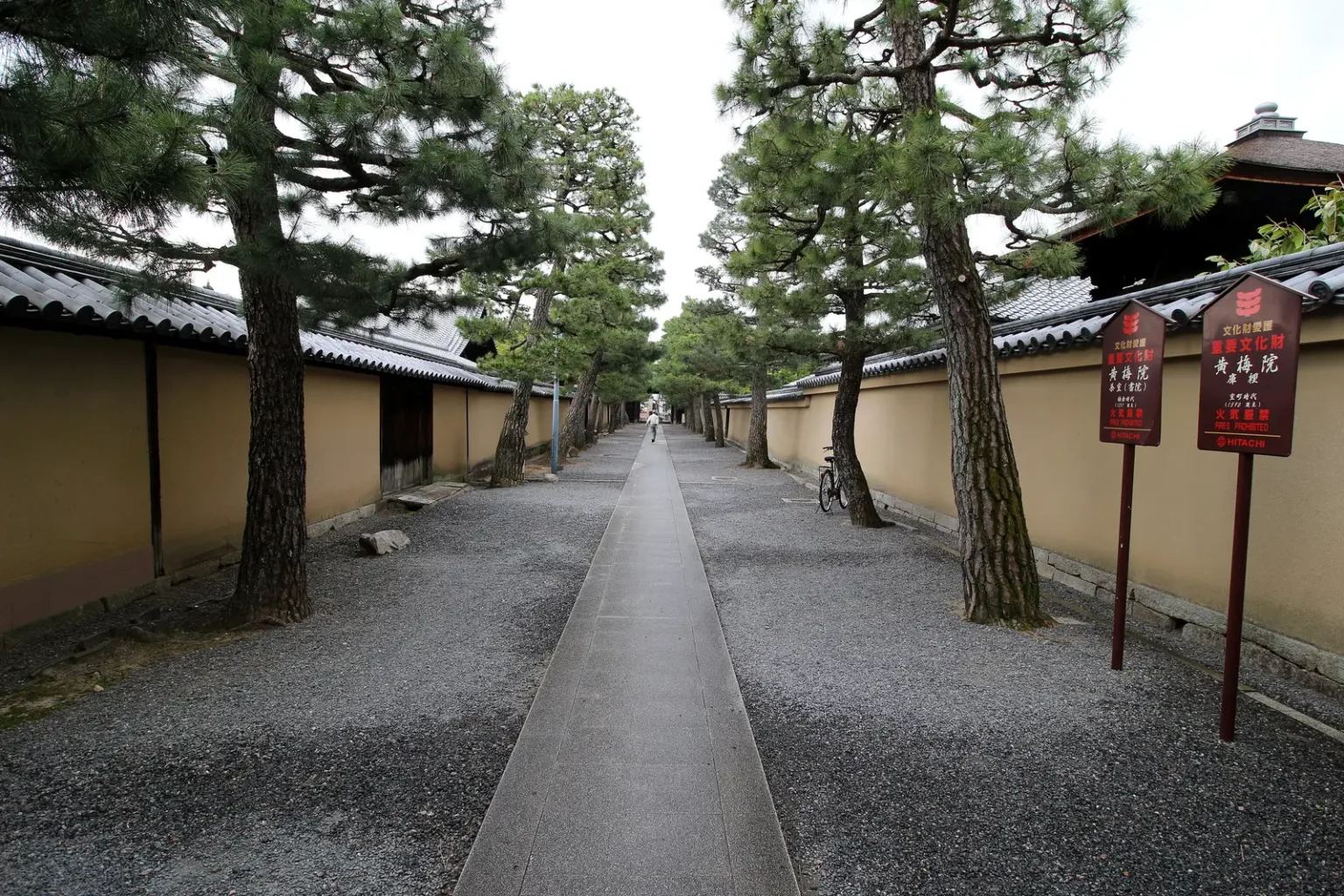
The natto comes from Daitokuji Ikkyu (大徳寺一久), in front of the temple; its own pages give the address as 紫野大徳寺下門前町20, Murasakino Daitokuji Shimo-monzen-chō 20. It describes itself as the cook of Daitokuji’s shojin cuisine since the Bunmei era (1469–1487), says that, by family tradition, the monk Ikkyu passed on the recipe and gave the shop its name, 一久 (Ikkyu), and says it holds the registered trademark for 大徳寺納豆. Its own page calls the natto handmade in the old way and lists it by weight, tax included:
| Daitokuji natto at Daitokuji Ikkyu | Price |
|---|---|
| 50 g, bag | ¥500 |
| 100 g, bag | ¥900 |
| 130 g, paper box | ¥1,300 |
| 160 g, paper box | ¥1,600 |
| 260 g, wooden box | ¥2,800 |
The natto counter is open from 9:00 to 18:00. Closing days are irregular: the shop closes in line with Daitokuji’s own event schedule, and the site’s news line announces new prices for both the natto and the meals, so check the list again close to your visit. The shojin meals are by reservation only, from ¥6,050 for an engaku-mori box (served 12:00–16:00) to formal honzen trays from ¥9,680, service included.
The shop’s suggestions for eating it are the most useful thing on its page. Take a bean after the sweet in a tea ceremony, or with green or bancha tea. Have it with sake, beer or whisky, on cucumber with cheese, or after chocolate. Put it on hot rice, chazuke or rice porridge where you would use umeboshi or salted kombu. Use it instead of soy sauce on sticky natto or grated daikon. Stir a little into mapo tofu, miso ramen or miso soup, or use it instead of salt in fried rice, pasta and salad. Store it in a lidded jar or pot rather than the fridge, which the shop says dries it out too much.
Getting there. From Kyoto Station, city bus 205 or 206 runs to Daitokuji-mae in about 50 minutes. The faster route is the Karasuma subway to Kitaōji, about 15 minutes, then bus 1, 102, 204, 205 or 206 from the Kitaōji bus terminal to Daitokuji-mae, about five minutes. The temple is right at the stop. Other shops near the temple also sell Daitokuji natto and sweets made with it; their details could not be verified from their official pages at the time of writing, so they are not listed here.
Finding your way around Kyoto
Ikkyuji: natto from the temple where Ikkyu died
Ikkyuji is the everyday name of Shūon-an, a Rinzai temple of the Daitokuji school in Kyotanabe, between Kyoto and Nara. Ikkyu rebuilt a ruined older temple here in the 1450s and named his hermitage Shūon-an, “repaying a teacher’s kindness”. The temple’s history says he spent the second half of his life here, kept living here after becoming abbot of Daitokuji, and died here in 1481 at the age of 88. His grave is in the grounds, and a wooden statue in the abbot’s hall is said to carry his own hair and beard.
The temple’s English page says Ikkyu himself made the natto that had come from China, helped spread it among ordinary people, and that priests have made it for generations since. Its shop text calls Ikkyuji natto the natto whose method Ikkyu is said to have passed on, known at Daitokuji as Daitokuji natto. The temple’s FAQ says Ikkyuji natto is sold only by the temple, though the online food shop ethelvine says it sells the temple’s natto in its own containers (a 50 g pack listed at ¥1,242 on 7 October 2026). Besides buying it there, you can order by phone for cash on delivery, with postage and a COD fee on top, or use the temple’s online shop, which posts by Japan Post’s domestic Click Post; both ship to addresses in Japan. The online shop lists a 50 g bag at ¥800, though it showed as sold out when I checked on 6 October 2026.
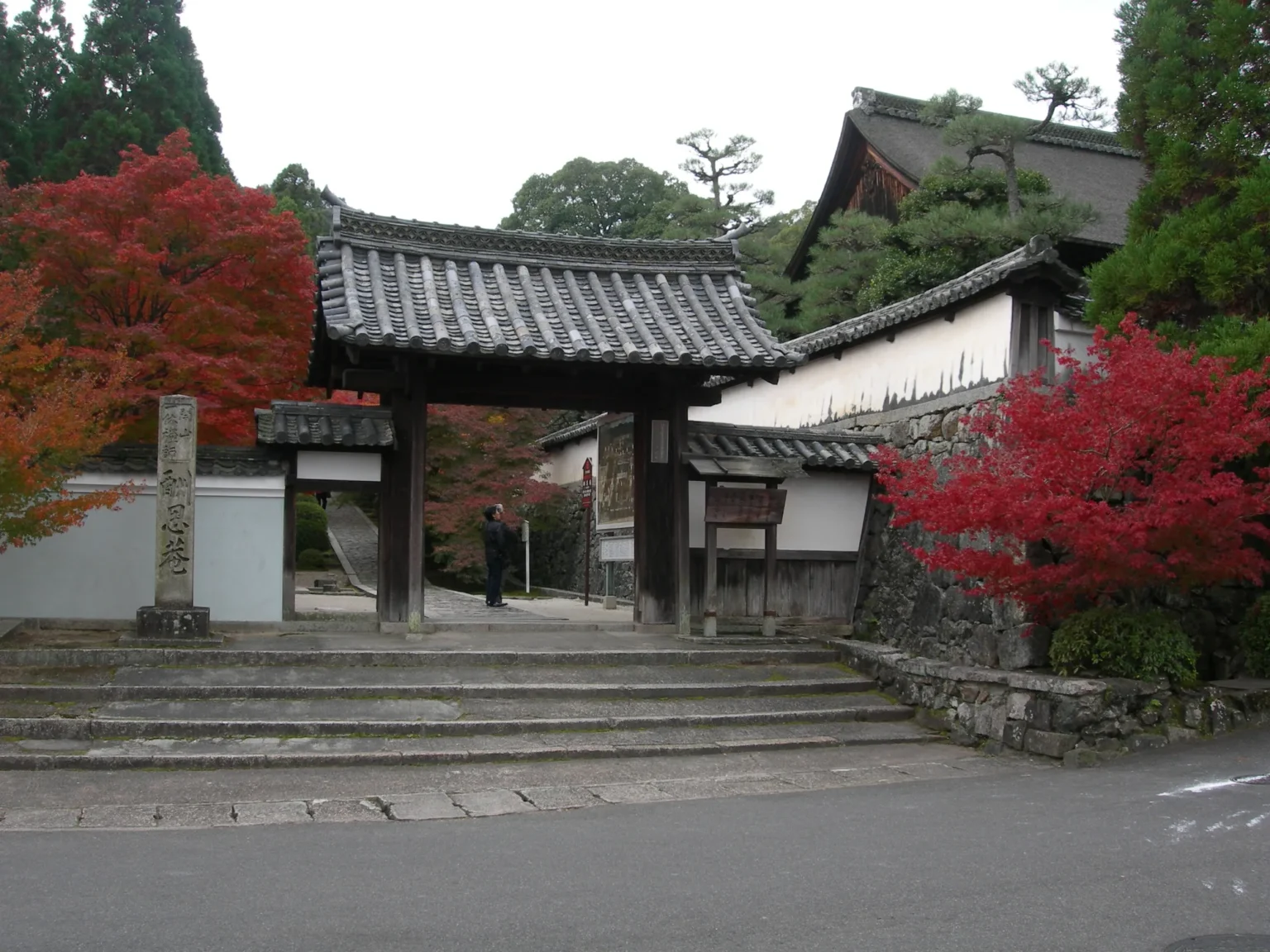
The temple is open 9:00–17:00, last entry 16:30, with the treasure hall open 9:30–16:30. Admission is ¥600 for adults, ¥300 for high-school and junior-high students and ¥200 for elementary pupils. The grounds have some steps and are not barrier-free, and pets are not allowed. Shojin meals can be booked by phone at least two days ahead, between 10:00 and 17:00; the temple says it cannot take requests in English or other languages.
Ikkyuji is also a maple temple. In 2025 it held ticketed evening light-ups on six November nights, 18:00 to 20:30, for ¥1,000 per adult, sold only as advance tickets online with no same-day entry. When I checked on 6 October 2026, its events page had not yet posted 2026 dates. For timing the season, see Kyoto in November; for the word itself, what momiji means.
Getting there. From Kintetsu Kyoto Station, next to JR Kyoto Station, the Kintetsu express reaches Shin-Tanabe in about 25 minutes. From Shin-Tanabe’s west exit, Keihan Bus route 66 leaves from stand 4 and takes about ten minutes (check the times at the stand); a taxi takes about five, which is the option the temple’s own FAQ gives, and walking the 1.5 km takes about 25 minutes. JR Kyotanabe Station is 1 km away, about 20 minutes on foot, and is the easier station from Osaka. The temple’s page also lists Keihan’s Choku-Q Kyoto bus from the Hachijō side of Kyoto Station, but it only works one way, in the morning. On Keihan’s timetable from 1 April 2026, two daytime buses leave Kyoto Station for the Ikkyuji stop, about 40 minutes away: at 9:50 and 10:45 on weekdays, and at 9:45 and 10:45 at weekends and on holidays. The buses back towards Kyoto leave in the early morning, plus one at 16:03 on weekdays, so plan to return by Kintetsu from Shin-Tanabe. Daitokuji and Ikkyuji both start from Kyoto Station, so an early start can fit them into one day. Keihoku cannot be added to that day.
A base near Kyoto Station
All three trips in this guide start at Kyoto Station: the Kintetsu line to Shin-Tanabe, the 205 and 206 buses to Daitokuji, and the JR bus to Keihoku. A hotel within walking distance of the station saves a transfer on each of them. From Kyoto Station covers other trips from the same hub.
Keihoku: the sticky-natto legend in the mountains
Keihoku is the old town of Keihoku, merged into Kyoto City’s Ukyo Ward in 2005: about the size of Osaka City, 93 percent forest, at the head of the Katsura River. Timber from here was rafted down to build the capitals at Nagaoka and Heian. Its natto story is about the sticky kind, and it is told as a legend.
The Agriculture Ministry’s regional food database tells it like this. Many places in Japan claim to be natto’s birthplace, and Kyoto Prefecture is said to be one. The retired Emperor Kōgon, living as a monk at Jōshōkōji in Keihoku, was eating boiled beans the villagers had given him wrapped in straw. Day by day the beans began to pull threads, and they turned out to be delicious. A picture scroll kept at the temple shows the abbot serving straw-wrapped natto, and because the beans were later presented to the Imperial Palace as a delicacy, the story goes, they were called natto, “delivered beans”. The word itself is about three centuries older: the Shin Sarugakuki, written around 1061–65, already uses it. The local maker, Yamaguni Sakigake Center, tells a slightly different version: the villagers gave him their year-end miso beans in a straw bundle, and when threads appeared he salted them, found them good and shared them back.
Kōgon himself is history. Kotobank’s encyclopedias record him as the first emperor of the Northern Court (reigned 1331–1333), who late in life retired to the temple in Yamaguni, now part of Ukyo Ward, and died there in 1364; his tomb is on the hill behind it. The ministry adds a later layer: Yamaguni’s farmer-soldiers, the Yamaguni-tai who fought in the Boshin War of 1868–69, are said to have carried natto, which is where the name Yamaguni natto comes from. Natto wrapped in filling rice cake was popular with those soldiers too, and the old natto mochi are said to have been as big as your face, eaten over the first three days of the year.
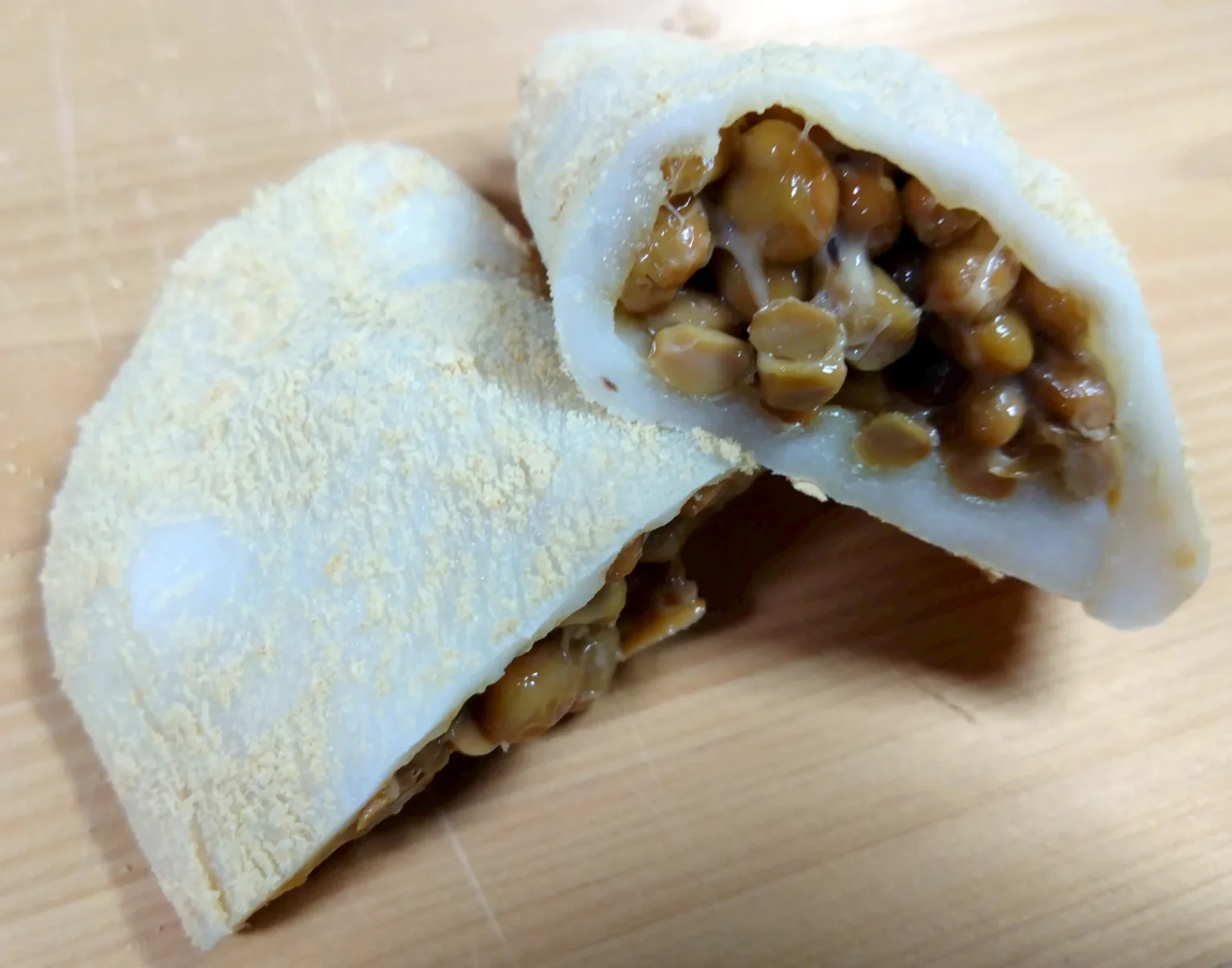
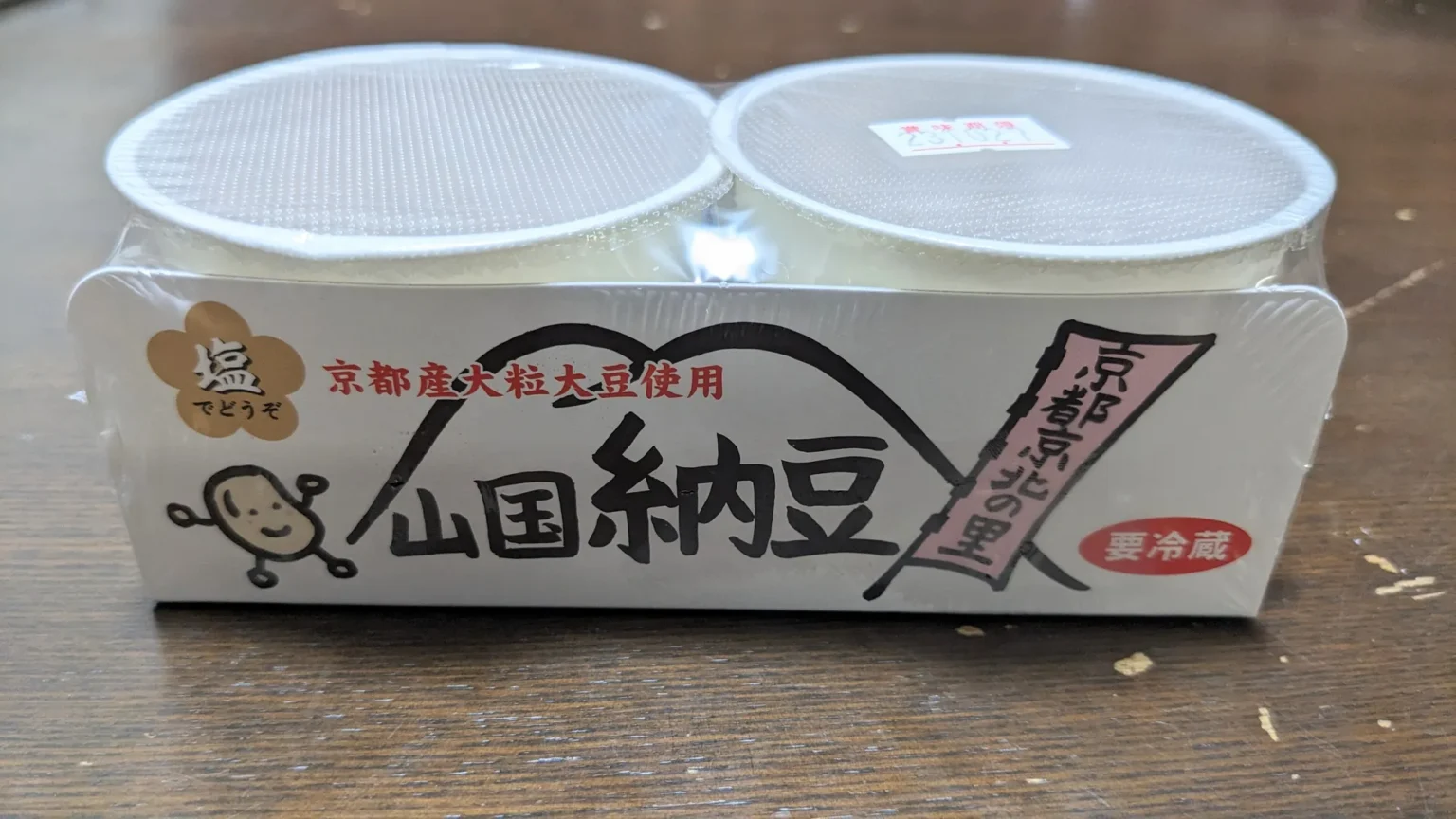
Both the ministry and Yamaguni Sakigake Center say people in Keihoku still eat natto mochi at New Year; Sakigake says it takes the place of zōni, the New Year soup most of Japan eats. Sakigake makes its natto from Keihoku-grown soybeans and packs it with salt instead of the usual sauce (tare), to let people try the local way of eating it. Its amigasa natto mochi, named for its woven-hat shape, lists natto bacteria among the ingredients: this is the sticky lineage, nothing like the black beans at Daitokuji.
Michi-no-eki Woody Keihoku
The roadside station in Shuzan, the centre of Keihoku, has a Keihoku natto corner and a natto mochi corner. The shop is open 9:00–18:00 and closes only over the New Year holidays. It is a minute’s walk from the Keihoku Gōdō Chōsha-mae stop on the JR bus.
Yamaguni Sakigake Center
The maker of Yamaguni natto and natto mochi, in the Tō district east of Shuzan, about ten minutes by Furusato Bus according to the Keihoku navigation site. Open 9:00–17:00, closed Saturdays, Sundays and holidays, with some seasonal and event openings. The Keihoku navigation site, updated January 2025, mentions a natto vending machine at the shop front.
Jōshōkōji
Kōgon’s temple, with his tomb behind it. The Keihoku navigation site lists 9:00–16:00 and a donation of about ¥500, on a page last updated in 2021, so confirm before you go. Its Kokonoe-zakura cherry, a national natural monument, peaks around mid-April, and the maples colour in autumn.
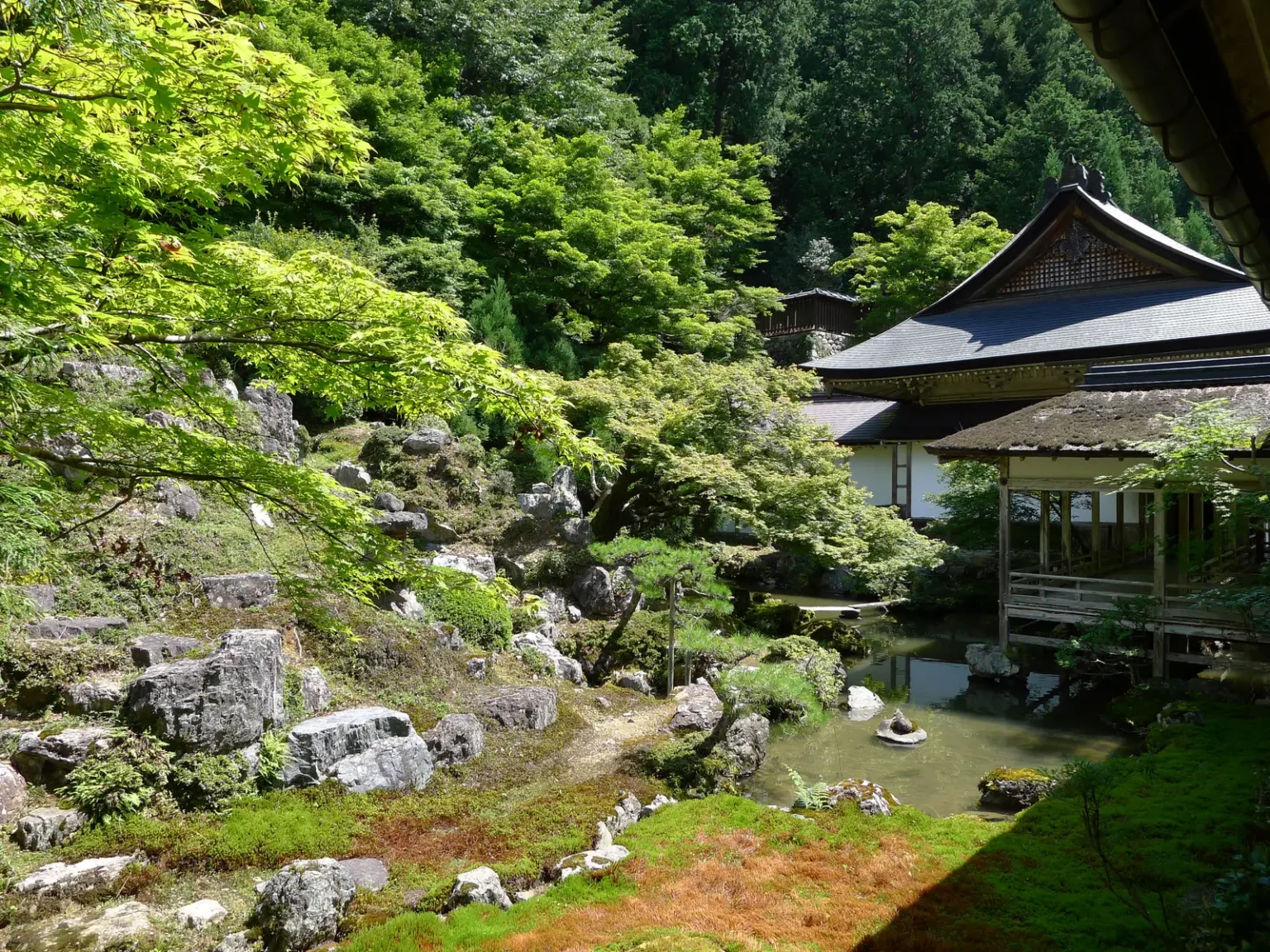
Getting to Keihoku
West Japan JR Bus runs the Takao-Keihoku line from Kyoto Station to Shuzan in about 1 hour 20 minutes to 1 hour 30 minutes; most departures pass Ryoanji, and all of them pass Takao and its maple temples. The adult fare is ¥1,080 each way. The Shuzan Free Ticket, sold at the Kyoto Bus Ticket Center at the central exit of JR Kyoto Station, covers a same-day round trip on JR buses for ¥1,850. The ¥1,100 subway-and-bus day pass only covers the JR bus between Kyoto Station and Toganoo, so it does not get you to Shuzan.
From Shuzan, the Keihoku Furusato Bus on the Yamaguni–Kuroda line (山国・黒田線) reaches Yamaguni Goryō-mae, the stop for Jōshōkōji, in 12 to 16 minutes, passing through the Tō district on the way. It suspends service from 29 December to 3 January.
Plan Keihoku around the weekend bus. On weekdays the Yamaguni–Kuroda line runs several times a day. At weekends it runs three times each way (timetable revised 1 April 2026), it does not wait for a late JR bus, and not every run connects from Kyoto. The JR times below are departures from Kyoto Station.
Saturdays: only the 12:40 from Shuzan works for a temple visit. Take the 11:10 JR bus (Shuzan 12:36), which leaves a four-minute change; the local bus reaches Yamaguni Goryō-mae at 12:56. The 7:32 leaves Shuzan before the first JR bus arrives, and the 15:55 reaches the temple stop at 16:11, after Jōshōkōji closes at 16:00. Back: the 13:55 from Yamaguni Goryō-mae (Shuzan 14:12, then the 15:05 JR bus), or the 17:11 (Shuzan 17:27, then the 17:30 or 18:15 JR bus).
Sundays and holidays: the 6:45 JR bus (Shuzan 8:04) connects to the 8:15, which arrives before the temple opens at 9:00; the 8:30 JR bus (Shuzan 9:56) connects to the 10:00, another four-minute change. The 14:00 leaves before the 12:40 JR bus arrives, so for it take the 11:10 JR bus and wait in Shuzan, where the roadside station is. Back: the 11:16 (Shuzan 11:32, then the 12:05 JR bus) or the 15:16 (Shuzan 15:32, then the 16:45 JR bus).
Sakigake Center is closed at weekends, so on a Saturday or Sunday the roadside station in Shuzan is the dependable place to buy natto and natto mochi. The Kyoto in November guide lists Keihoku among the quieter districts the city promotes.
Kyoto temple natto: short answers
What is Daitokuji natto?
Daitokuji natto (大徳寺納豆) is temple natto made in front of Daitokuji in Kyoto: soybeans fermented with koji mould, salted and dried in the sun until black. It has no strings and tastes salty, sour and miso-like. Tradition credits the Zen monk Ikkyu with the method, which is why dictionaries also call it Ikkyu natto.
Is temple natto the same as regular natto?
No. Regular natto is fermented for about a day by natto bacteria, which make the sticky threads. Temple natto is fermented with koji mould, soaked in brine for months and dried, so it is dark, salty and dry, with no threads. Encyclopedias trace the salty kind to China and call sticky natto Japan’s own.
Where can I buy Daitokuji natto?
Daitokuji Ikkyu, in front of Daitokuji in Kyoto’s Kita Ward, says it holds the trademark for 大徳寺納豆 and sells it from 9:00 to 18:00: ¥500 for 50 g up to ¥2,800 for 260 g in a wooden box. It closes on irregular days that follow the temple’s event schedule. The bus stop is Daitokuji-mae.
Can I buy Ikkyuji natto anywhere else?
Mostly not. Ikkyuji says its natto is sold only by the temple, though the online food shop ethelvine says it sells the temple’s natto in its own containers (¥1,242 for 50 g on 7 October 2026). From the temple, you can buy it in Kyotanabe, order by phone for cash on delivery, or try the temple’s online shop (both ship within Japan), which listed a 50 g bag at ¥800 but showed it as sold out on 6 October 2026.
Is Keihoku natto temple natto?
No. Keihoku’s legend, told by the Agriculture Ministry, is about boiled beans in straw that began to pull threads while the retired Emperor Kōgon was living at Jōshōkōji. Its local natto and natto mochi are the sticky kind.
How do you eat temple natto?
A few beans at a time. Daitokuji Ikkyu suggests eating it after the sweet in a tea ceremony, with sake or beer, on hot rice, chazuke or porridge instead of umeboshi, on sticky natto instead of soy sauce, or a little in mapo tofu and miso soup. Heibonsha adds dengaku miso and wagashi bean paste.
Can I visit Daitokuji, Ikkyuji and Keihoku in one day?
Not sensibly. Daitokuji and Ikkyuji both start from Kyoto Station and can share an early-starting day. Keihoku is about an hour and a half away by JR bus, and the local bus to Jōshōkōji runs only three times each way at weekends; on Saturdays only one of those, the 12:40 from Shuzan after the 11:10 JR bus from Kyoto Station, works for a temple visit. Give Keihoku a day of its own.
Can I take temple natto home?
It travels better than fresh natto: Daitokuji Ikkyu calls it a naturally preserved food, to be kept like umeboshi or salted kombu and not in the fridge. Food rules still differ by destination, so declare it on arrival and check your country’s official guidance before you fly.
If temple natto has made you curious about the sticky kind, the beginner’s method is in the natto guide, and the town that made sticky natto famous is a day trip from Tokyo. For the rest of the city, start with my Kyoto guide.
New to natto? How it is made, how to eat it, and the regional map this page belongs to.
Read the natto guideSources
The dictionaries, official pages and timetables behind this article, checked 6 October 2026
- Kotobank (Nihon Kokugo Daijiten, Daijisen, Nipponica, Heibonsha World Encyclopedia, Britannica Japan): 大徳寺納豆, 寺納豆, 納豆, 浜納豆, 光厳天皇, 酬恩庵
- Daitokuji Ikkyu — Daitokuji natto, shop information and access, shojin cuisine (Japanese)
- Rinnō-net — Daitokuji (Japanese)
- Shūon-an Ikkyuji — official site, access and admission, FAQ, events, English page, online shop
- Ministry of Agriculture, Forestry and Fisheries, Uchi no Kyōdo Ryōri — 納豆餅 (Kyoto Prefecture) (Japanese)
- Statistics Bureau of Japan, Family Income and Expenditure Survey — city rankings, 2023–25 average (natto, rank06.xlsx)
- Yamaguni Sakigake Center — natto and natto mochi history, Yamaguni natto, amigasa natto mochi, company and hours (Japanese)
- Kyoto Keihoku Navi (Keihoku Jichi Shinkōkai) — about Keihoku, Jōshōkōji, Yamaguni Sakigake Center (Japanese)
- Kyoto Keihoku Furusato Kōsha — Keihoku Furusato Bus timetables (Yamaguni–Kuroda line, revised 1 April 2026) and Michi-no-eki Woody Keihoku (Japanese)
- West Japan JR Bus — Takao-Keihoku line, fares and Shuzan Free Ticket, with the timetable revised 1 April 2026 (Japanese)
- Photographs — Keisuke Mutoh on Flickr (CC BY 2.0); Braveheart, Ogiyoshisan (public domain), Spedi-sit, ツムラ and Indiana jo on Wikimedia Commons, credited in each caption
Join travelers discovering Japan's hidden side
Weekly dispatches from off-the-beaten-path Japan — spots and stories you won't find in guidebooks.
No spam. Unsubscribe anytime.
Welcome aboard!
You're in. See you in your inbox soon.