
Hyogo · Kinosaki Onsen · Public baths, bath pass, winter
Kinosaki Onsen is a hot-spring town in Toyooka, northern Hyogo, with seven public bathhouses by official count, of which six can open in winter 2026–27: Satono-yu, by the station, has been closed since 1 April 2024, and Toyooka City expects it back around March 2030. By my count from the operator’s timetable, once Kono-yu reopens (scheduled for 28 October 2026), an inn bath pass reaches all six on a one-night stay on any night of a regular week except a Wednesday or Thursday.
How many Kinosaki Onsen baths are open this winter?
Six of the seven once Kono-yu reopens, which the operator’s October calendar schedules for 28 October 2026. Until then it’s five, because Kono-yu is still under repair. The official count hasn’t changed: the bath operator still lists “the seven sotoyu” (城崎温泉の7つの外湯) and Toyooka City’s tourism site still counts seven, with Satono-yu marked as closed. So think of it as seven by name and six in practice.
The six neighbourhood baths are run by the Kinosaki-cho Yushima property ward (城崎町湯島財産区), a public body administered through Toyooka City’s Kinosaki Onsen Division; I’ll call it “the operator” from here on. Satono-yu is different — it’s a city-owned facility, and it’s the one that’s gone for years.
The table runs from the station end of town to the far end. Each bath’s weekly closing day sits next to its name, with opening hours on the right.
| Bath | Weekly closing day | Hours |
|---|---|---|
| Satono-yu | Closed long-term | None |
| Jizo-yu | Monday | 7:00–23:00 |
| Yanagi-yu | Thursday | 15:00–23:00 |
| Ichino-yu | Wednesday | 7:00–23:00 |
| Goshono-yu | Thursday | 7:00–23:00 |
| Mandara-yu | Wednesday | 15:00–23:00 |
| Kono-yu (under repair) | Tuesday | 7:00–23:00 |
Kono-yu has been closed for repairs since 11 May 2026 and is scheduled to reopen on 28 October 2026. Last entry at all six is 22:30, half an hour before closing. The operator’s own per-bath pages still print 22:40, but its bath list, the tourism association and the city’s pages all give 22:30, the time that took effect on 1 October 2024.
Satono-yu. The station-side bath closed after its last day of business on Sunday 31 March 2024. In its February 2026 policy address to the city council, Toyooka City said asbestos newly found during demolition, and time needed for talks with related agencies, had pushed the demolition into fiscal 2026, and that the rebuilt Satono-yu is now expected to open around March 2030 — about a year later than planned. The city’s 2025 plan had put the renewal opening in fiscal 2028 (April 2028–March 2029), with a note that the schedule could change. “Around March 2030” is still the city’s outlook, not a fixed date.
What it means for you: once Kono-yu reopens, the rest of this guide’s counts apply. If you’re going before 28 October, five baths are in service, but not all on the same day: by my count from the operator’s October calendar, from 15:00 there are five open on Tuesdays and Fridays to Sundays, four on Mondays and Wednesdays, and three on Thursdays. The exception is Monday 12 October, the Sports Day holiday, when the calendar has Jizo-yu opening from 15:00, which makes five. See the note under “Which night should you book in Kinosaki Onsen?”
- The operator’s own English page lists Jizo-yu (spelled Zizo-Yu) as “Closed every Friday”. Its Japanese pages and the October calendar say Monday. The same page still describes Goshono-yu’s “expansive glass ceiling”; the roof came off when Goshono-yu was rebuilt as a fully open-air garden bath, reopening on 2 November 2020.
- Visit Kinosaki’s winter article, updated in January 2026, still suggests Satono-yu for an open-air soak in falling snow.
- JNTO’s Kinosaki page gives the day pass as 1,300 yen “as of November 2021”. It has been ¥1,500 since 1 April 2023.
- japan-guide still lists private family baths at Jizo-yu and Ichino-yu for 3,000 yen per 40 minutes. The operator’s price was ¥3,500, and both are suspended.
- The Real Japan says the inn pass works “until 10am” on checkout day; Toyooka City’s tourism site says 13:00.
- The Tokyo Chapter, one of the pages Google’s AI Overview linked for “kinosaki onsen” in US results in September 2026, still gives the pass as 1,300 yen and single baths as 700 yen.
- Inside Kyoto still recommends Sato-no-Yu and tells readers without a reserved seat to look for unreserved cars. The Kinosaki and Kounotori trains have been all-reserved since 12 March 2022.
Kinosaki’s open baths by day of the week, and before 15:00
Once Kono-yu reopens (scheduled for 28 October), all six are open Friday to Sunday in a regular week, five on Mondays and Tuesdays, and four on Wednesdays and Thursdays. Before 15:00 the numbers drop to four Friday to Sunday and three Monday to Thursday, because Mandara-yu and Yanagi-yu don’t open until 15:00 on any day.
This is my count from the operator’s timetable for a regular week, checked on 28 September 2026. The evening picture is in the middle column; on a phone, the morning list sits to its right.
| Day | 15:00–23:00 | 7:00–15:00 |
|---|---|---|
| Monday | 5 — all but Jizo-yu | 3 — Kono-yu, Goshono-yu, Ichino-yu |
| Tuesday | 5 — all but Kono-yu | 3 — Goshono-yu, Ichino-yu, Jizo-yu |
| Wednesday | 4 — Kono-yu, Goshono-yu, Jizo-yu, Yanagi-yu | 3 — Kono-yu, Goshono-yu, Jizo-yu |
| Thursday | 4 — Kono-yu, Ichino-yu, Jizo-yu, Mandara-yu | 3 — Kono-yu, Ichino-yu, Jizo-yu |
| Friday to Sunday | 6 — all six | 4 — Kono-yu, Goshono-yu, Ichino-yu, Jizo-yu |
No bath has a regular closing day on Friday, Saturday or Sunday — “regular” matters, because the calendar moves. In October 2026, for instance, the operator’s calendar swaps Ichino-yu’s and Goshono-yu’s closing days on the 14th and 15th for the autumn festival.
The operator posts a monthly closure calendar on its Japanese top page (the October 2026 one was dated 15 September) and notes that it can change and that corrections sometimes lag. For the day itself, the tourism association’s live bath page shows each bath’s crowd level and whether it’s open today and tomorrow. Visit Kinosaki, Toyooka City’s official tourism website, shows a crowd-status panel in English during opening hours.
Where they are, from the station end. Satono-yu (closed) stands beside Kinosaki Onsen Station. Walk along Ekidori and cross the Otani River, and Jizo-yu is the first open bath — about 360 m from the station in a straight line on OpenStreetMap. Yanagi-yu (about 430 m), Ichino-yu (460 m), Goshono-yu (620 m) and Mandara-yu (720 m) follow, each a little further from the station, and Kono-yu is the innermost bath, about 875 m out, at the same end of town as the ropeway. The tourism association puts Jizo-yu to Kono-yu, the two ends, at a 15-minute walk, and the ropeway operator says the station to its boarding station takes about 20 minutes on foot.
The ryokan bath pass: when it starts and when it ends
At most inns in Kinosaki you’re handed a bath pass at check-in, and it works until 13:00 on checkout day — that’s what Toyooka City’s tourism site and Visit Kinosaki’s FAQ both say (both are run by the city’s tourism organisation, Toyooka Tourism Innovation). The ryokan association’s older, undated FAQ says the pass works “until checkout” instead. Ask your inn which applies to you.
Here’s what the pass does over one stay, from check-in to the afternoon you leave.
Check-in day
The pass starts at check-in. Some inns hand it over early: Shinzan’s FAQ, for one, says its pass works from 14:00, before its 15:00 room check-in. It carries a barcode that’s scanned at each bath’s entrance.
Evening
Any bath open that day, until the 22:30 last entry.
7:00 next morning
Kono-yu (once it reopens, scheduled for 28 October), Goshono-yu, Ichino-yu and Jizo-yu open, minus whichever is on its closing day.
13:00 on checkout day
The pass ends, at most inns.
15:00
Mandara-yu and Yanagi-yu open, except on their closing days (Mandara-yu Wednesday, Yanagi-yu Thursday) — ¥800 a bath from here, or a ¥1,500 day pass.
Whether your pass ends at 13:00 or at checkout makes no difference to the night-by-night count below, as long as checkout is after 7:00: before 15:00 only the baths that open at 7:00 can be open either way.
Some inns don’t include the pass at all. Toyooka’s tourism site and the ryokan association both say “except some inns” without naming them, and I didn’t find a published list on the operator, tourism association, ryokan association or Toyooka tourism pages when I checked on 28 September 2026. Ask before you book — the questions are under “Where to stay” below.
Which night should you book in Kinosaki Onsen?
Book any night except Wednesday or Thursday if you want all six of Kinosaki’s open public baths on one inn bath pass, once Kono-yu reopens. On a one-night stay in a regular week, the evening and the next morning together cover every bath on a Monday, Tuesday, Friday, Saturday or Sunday night; a Wednesday night misses Mandara-yu and a Thursday night misses Yanagi-yu.
Here’s the count night by night. The bath you’d miss is in the middle column; the evening and next-morning numbers behind it are on the right.
| Night | Missed on the pass | Evening / next morning |
|---|---|---|
| Monday | None — all six | 5 / 3 |
| Tuesday | None — all six | 5 / 3 |
| Wednesday | Mandara-yu (¥800 from 15:00 on Thursday) | 4 / 3 |
| Thursday | Yanagi-yu (¥800 from 15:00 on Friday) | 4 / 4 |
| Friday | None — all six | 6 / 4 |
| Saturday | None — all six | 6 / 4 |
| Sunday | None — all six | 6 / 3 |
This is my count from the operator’s timetable (checked 28 September 2026), for regular weeks once Kono-yu reopens. It assumes you arrive in time to visit, that evening, every bath that will be shut the next morning: Kono-yu, Mandara-yu and Yanagi-yu on a Monday night; Ichino-yu, Mandara-yu and Yanagi-yu on a Tuesday; Mandara-yu and Yanagi-yu on a Friday or Saturday; and Jizo-yu, Mandara-yu and Yanagi-yu on a Sunday. The two gaps come from the same pair of baths: Mandara-yu and Yanagi-yu open only at 15:00, so they have to be done in the evening, and Mandara-yu closes on Wednesdays, Yanagi-yu on Thursdays. If you sleep on one of those nights you can still pay ¥800 for the missing bath once it opens the next afternoon, or stay two nights.
In a regular week, sleep on a Monday, Tuesday, Friday, Saturday or Sunday and one bath pass reaches all six. A Wednesday costs you Mandara-yu; a Thursday costs you Yanagi-yu.
Holidays and the year-end can change the result. Thursday 11 February 2027 is a holiday: if Yanagi-yu opens that evening, as the city’s holiday rule suggests, a Thursday-night stay that week would reach all six — the February calendar will say. For the year-end, see last winter’s New Year hours.
Going before 28 October? Kono-yu is still closed, and while it is, the operator opens Mandara-yu from 15:00 on its Wednesday closing day instead (7, 14 and 21 October 2026). By my count from the October calendar, that means any night from 1 to 27 October except a Thursday reaches all five open baths; a Thursday night still misses Yanagi-yu.
A one-night plan that reaches all six
For a Friday, Saturday or Sunday night, when all six are open in the evening:
Evening: the two 15:00 baths first
Mandara-yu and Yanagi-yu never open in the morning, so give them your evening, and on a Sunday night add Jizo-yu, which is shut on Monday mornings. Then add whichever of the others you like before the 22:30 last entry.
Dinner between baths
If you eat out, Orizuru’s counter serves dinner 17:00–21:00 (last order 20:00) and is closed on Tuesdays and the second and fourth Wednesdays. Course meals need a reservation.
Morning: the far end
Kono-yu, Goshono-yu, Ichino-yu and Jizo-yu open at 7:00 (Jizo-yu not on Mondays). Kono-yu is at the ropeway end of town, and the ropeway’s first car goes up at 9:10.
13:00: the pass ends
After checkout, the tourist centre in front of the station stores bags for ¥500 each and is open 9:00–17:00 (as listed by the tourism association on 28 September 2026), if you want the afternoon free before your train.
Once you’ve picked the night, the inn is the next decision: choosing an inn that includes the pass.
Where to stay: choosing a Kinosaki Onsen ryokan that includes the pass
Book an inn in town whose plan includes the bath pass. It’s the detail that decides whether your baths are already paid for, and a booking-site listing may not mention it.
Two kinds of place to sleep, compared on the pass; the right-hand column covers the trip in from the station.
| Where you sleep | The bath pass | From the station |
|---|---|---|
| An inn in the onsen town | Most give one at check-in; check your plan includes it | Free check-in bus run by the ryokan association; bags delivered to member inns for ¥200 each |
| A larger hotel outside the centre | Ask. Some inns outside town run transfers in so guests can do the bath crawl | Their own transfers, where offered |
If you book a room-only plan, check its wording: the official pages I checked give no rule on whether room-only plans include the pass, and at least one sold on Visit Kinosaki says it does.
Why are the big hotels outside town? The ryokan association’s FAQ says large hotels can’t be built in the town centre, to protect the townscape. Its free bus from the station is for check-in only, not for rides after a walk or a bath. The same FAQ lists hours for it but notes that they’re “currently changed”, so ask at the tourist centre in front of the station for the day’s times.
Send your inn these three questions before you pay:
1. Does this plan include the sotoyu pass?
“Does this plan include the sotoyu (外湯) bath pass?” Some plan names on the tourism association’s booking pages say 外湯券付 (pass included); a plan without that label isn’t necessarily without the pass.
2. From when, and until what time?
“From what time can we use the pass on the day we arrive, and until what time on the day we leave?” At most inns the answer should be 13:00 on checkout day; the ryokan association’s FAQ says until checkout, and some inns start the pass at 14:00 on the day you arrive.
3. Are you a ryokan association member?
“Are you a member of the ryokan association?” Only member inns take the ¥200-a-bag luggage delivery from the tourist centre at the station.
Also on the bill: your inn collects a bathing tax (入湯税) of ¥150 per person per day; under-12s are exempt, and paying at a public bath counter carries none. Your inn may add a hot-spring use fee as well. Toyooka City’s rate table puts it at ¥280 per adult guest (¥140 per child) for inns in the Yushima district, and Shinzan’s FAQ, for one, lists the ¥150 tax plus a ¥280 bathing fee, ¥430 per adult per night, on top of its room rate, so check what your price includes. Toyooka is also planning an accommodation tax of ¥200 per person per night from fiscal 2028 at the earliest, according to the mayor’s statement to the city council on 28 August 2026, and Sun TV reported on 7 September 2026 that the city plans to put the ordinance to its March 2027 council. It doesn’t apply this winter.
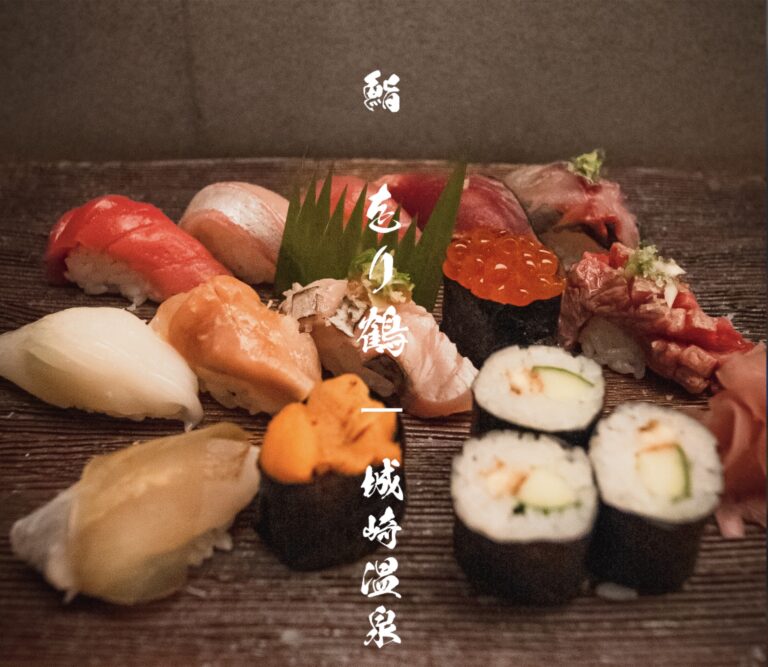
On timing: Visit Kinosaki’s FAQ says most ryokan on its booking pages open bookings 4 to 6 months ahead (checked 28 September 2026). If you stay at a ryokan you can wear the yukata and geta it provides between baths — Visit Kinosaki recommends changing into them once you’ve checked in — though everyday clothes are fine too. My Japanese ryokan stay guide covers booking, meals and prices in general, and my comparison of hotel booking sites in Japan sets the main sites side by side. For dinner outside the inn, I’ve written up the ¥8,800 course at Orizuru, a sushi counter in Kinosaki Onsen.
Picked your night? Now find the inn
Neither button opens a Kinosaki search: type “Kinosaki Onsen” as the destination and enter your night. If a listing doesn’t mention the inn’s bath pass, send the inn the three questions above before you pay.
Is Kinosaki’s ¥1,500 day pass worth it on a day trip?
Yes, as soon as you use two baths: two single entries cost ¥1,600, so the day pass saves ¥100 on two baths and ¥900 on three. It’s sold at every bathhouse counter and gives unlimited entry to every bath that’s open that day.
Adult and child prices share the right-hand column, adult first.
| Ticket | Adult · child |
|---|---|
| Single entry | ¥800 · ¥400 |
| Day pass | ¥1,500 · ¥750 |
The day pass is the 一日入浴券, also called Yumepa. “Child” means age 3 to the end of primary school under the city ordinance that sets the fees; from middle-school age you pay the adult price. Visit Kinosaki’s English FAQ says the child day-pass price covers “middle school age and younger”, which doesn’t match the ordinance, and says under-3s are free. The prices rose on 1 April 2023, from ¥700 a bath and ¥1,300 for the day pass, which is why older pages still show those figures.
What you’ll find open depends on when you arrive. In a regular week once Kono-yu reopens, it’s four baths before 15:00 Friday to Sunday and three Monday to Thursday; from 15:00 it’s six Friday to Sunday, five on Mondays and Tuesdays and four on Wednesdays and Thursdays, as in the table of open baths by day. Before Kono-yu reopens, the October calendar has three baths open before 15:00 on Tuesdays and Fridays to Sundays and two on the other days; the afternoon counts for that period are under “How many Kinosaki Onsen baths are open this winter?”. Even two baths are enough for the day pass to pay for itself.
Visit Kinosaki’s FAQ says many public bathhouses are cash-only, so carry yen. If you drive, the city car parks at the station, Kono-yu and Kiyamachi give an hour free instead of the usual 30 minutes when you show the parking ticket at a bath counter; after that it’s ¥100 per 30 minutes, capped at ¥1,000 per 12 hours, according to Toyooka’s tourism site. If you’re carrying bags, JR West lists coin lockers at Kinosaki Onsen Station.
What older guides list that is closed now
If a guide sends you to any of these, it’s out of date. Satono-yu had a sauna and closed at 21:00, so a guide that mentions either is describing the bath before it closed.
Satono-yu, the station-side bath
Closed for rebuilding since 1 April 2024.
Satono-yu’s foot bath
No longer usable since 16 October 2025.
Family baths at Ichino-yu and Jizo-yu
Suspended, with no reopening date (notice of 4 February 2026).
Literature Museum (Bungeikan) and its hand-and-foot bath
Closed since 14 September 2026, until further notice.
Daishi-yama trail, Atago-yama entrance
Closed after a landslide, with no restoration date (notice of 17 March 2026).
Toyooka City’s tourism list of foot baths (October 2025) still shows four, but the Literature Museum’s is now closed (see above), which leaves three: beside Ichino-yu (7:00–23:00, closed Wednesdays, with a hand bath), at Yanagi-yu (15:00–23:00, closed Thursdays) and in Yakushi Park near the ropeway (24 hours). I didn’t find a live status page for them, so treat that October 2025 list as the latest I could find.
Getting to Kinosaki Onsen from Kyoto, Osaka and Kobe
By JR limited express, with every seat reserved: about 2 h 20 min from Kyoto, 2 h 40 min from Osaka and 2 h 30 min from Sannomiya. Kinosaki Onsen is on the JR San’in Main Line, and the closest shinkansen changes are Kyoto, Shin-Osaka or Himeji.
From Kyoto, take the Limited Express Kinosaki direct to Kinosaki Onsen (2 h 20–35 min; four direct trains a day on JR West’s timetable for 15 October 2026; ¥5,370).
Osaka to Kinosaki Onsen: take the Limited Express Kounotori (spelled Konotori on JR West’s English pages) from JR Osaka (2 h 39–44 min; four direct trains on Thursday 15 October 2026; ¥6,140). It starts at Shin-Osaka, 2 h 46–49 min from there, for the same ¥6,140.
From Kobe, take the Limited Express Hamakaze from Sannomiya (2 h 26–33 min; only two a day on 15 October 2026; ¥5,810). The later one, Hamakaze 3, doesn’t run on 26–28 October or 4–6 November 2026.
From Tokyo, the tourism association’s route is the Tokaido Shinkansen to Kyoto and the Kinosaki from there, about 4 h 40 min in all. JR West’s fare search for 15 October 2026 priced one routing at ¥18,550 (4 h 43 min): the Nozomi to Kyoto, the Hashidate to Fukuchiyama and the Kounotori on to Kinosaki Onsen, with two changes.
By bus from Osaka, Zentan’s highway bus from Umeda (Hankyu Sanbangai) costs ¥4,100 one way for an adult, with a seat reservation required.
The three rail fares in the table below are adult tickets for a reserved seat on a direct train on 15 October 2026, from JR West’s own fare search. Journey times sit in the middle column, the trains on the right.
| From | Time · fare (normal season) | Train |
|---|---|---|
| Kyoto | 2 h 20–35 min · ¥5,370 | Limited Express Kinosaki; 4 direct on 15 Oct 2026 |
| Osaka | 2 h 39–44 min · ¥6,140 | Limited Express Kounotori; 4 direct on 15 Oct 2026 (5 on Sat 17 Oct) |
| Sannomiya (Kobe) | 2 h 26–33 min · ¥5,810 | Limited Express Hamakaze; 2 on 15 Oct 2026 |
The base fare doesn’t change with the season, but the seat charge does: from Kyoto, JR West’s fare search gave ¥5,170 for the same trip in the off-peak season (29 September 2026) and ¥5,570 in the peak season (16 October 2026), and the busiest days add ¥400 to the normal-season charge. The timetable I checked runs only to 9 November, so look up winter dates on JR West’s fare search once they come into range.
Do the rail passes pay? I compared them against those fares.
JR West Kansai WIDE Area Pass
¥12,000 for 5 days (child ¥6,000) on JR West’s English page, for foreign passport holders visiting as temporary visitors; its map covers Kinosaki Onsen. At normal-season fares for 15 October 2026 a return is ¥10,740 from Kyoto, ¥12,280 from Osaka and ¥11,620 from Sannomiya, so on its own the pass pays only from Osaka, by ¥280. The seat charge is ¥200 less a leg off-peak and ¥200 or ¥400 more at busier times, which can flip that: an off-peak Osaka return comes to ¥11,880, under the pass, and a peak-season Sannomiya return to ¥12,020, over it, while Kyoto stays under ¥12,000 even on the busiest days. Price your own dates, or add other trips within the 5 days.
Japan Rail Pass
It covers these limited expresses, but the 7-day pass is ¥50,000 online (¥53,000 from overseas agencies from 1 October 2026). A Tokyo–Kinosaki return at ¥37,100 falls short of that on its own, and pass holders can’t ride the Nozomi without a special ticket.
The highway bus has its own caveats. Heavy snow cancelled some runs last winter — several early departures on 9 February 2026, announced the evening before on Zentan’s official X account — and some runs between Kinosaki Onsen and Osaka are currently suspended because of a driver shortage (Zentan route page, checked 28 September 2026). My guide to travelling Japan in heavy snow covers delays and cancellations in general.
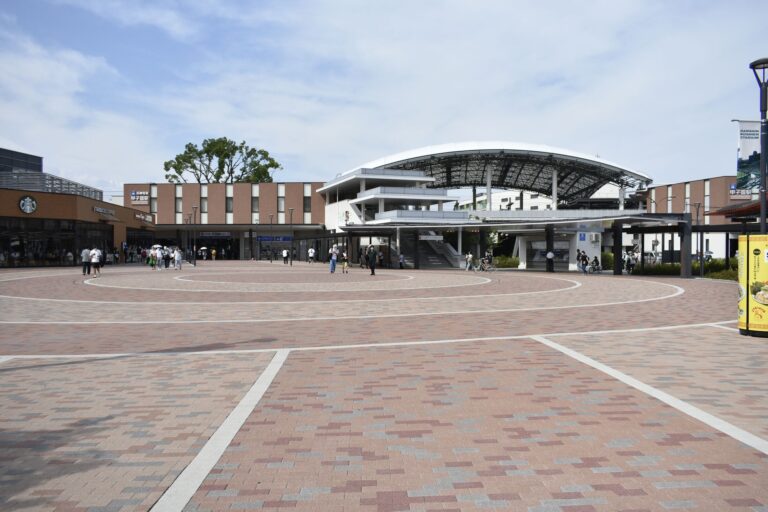
At Kinosaki Onsen Station, the tourist centre out front delivers check-in bags to association-member inns for ¥200 each, and the ryokan association’s free check-in bus leaves from the station.
Kinosaki’s bathhouse rules: tattoos, private baths and phones
Tattoos are allowed at the public baths: Visit Kinosaki says all of them accept tattoos of any size, with no need to cover them, and the tourism association’s official X account said in Japanese on 22 May 2024 that all of Kinosaki’s public baths are tattoo friendly. The operator’s own pages that I checked on 28 September 2026 don’t mention tattoos either way. Inns’ own baths can have different rules, so ask yours. Two English guides updated in 2026 say visible tattoos are generally not permitted, or not allowed at most of the baths; the town’s official English site says otherwise.
As of 28 September 2026 there’s no private bath at the public bathhouses. The family baths at Ichino-yu and Jizo-yu (40 minutes, ¥3,500, up to three people) are suspended because the facilities need large-scale repairs, and no reopening date appears on the operator’s or the association’s pages. If you want to bathe privately, ask whether your inn has a private bath and on what terms.
Bring
Yen for single entries, and a small towel — or buy a face towel at the counter for ¥200.
Free at the baths
Hair dryer, rinse-in shampoo and body soap. Bath towels are rented for ¥300; hand yours back at the last bath you visit.
Men and women
The baths are separated by gender, and Goshono-yu’s two sides swap between men and women daily. Hyogo Prefecture’s public-bath standard has restricted mixed bathing from about age 7 since 1 April 2024 (the limit used to be 10), so Visit Kinosaki’s FAQ line that children up to 10 may use the other side is out of date.
Timing
Last entry is 22:30 at every bath. Mandara-yu and Yanagi-yu open at 15:00; the other four at 7:00.
If this is your first public bath, my guide to onsen etiquette in Japan covers how to use one, tattoos and private baths, and my Japanese sento guide covers the etiquette of Japan’s everyday public baths.
Kinosaki Onsen winter: snow, crab season and New Year hours
Snow is normal from December to February. The Japan Meteorological Agency’s Toyooka station, about 10 km south of the baths, averages 82 cm of snowfall over January, and its January mean temperature is 3.3 °C (1991–2020 normals). Visit Kinosaki defines winter as mid-December to early March and adds that snowfall is hard to predict.
The Toyooka station’s normals for the three snowiest months; the deepest-snow column is on the right.
| Month | Snowfall over the month | Deepest snow on the ground |
|---|---|---|
| December | 34 cm (mean 5.9 °C) | 16 cm |
| January | 82 cm (mean 3.3 °C) | 34 cm |
| February | 74 cm (mean 3.7 °C) | 36 cm |
These figures are for Toyooka, not Kinosaki itself; treat them as a guide for the area. For a soak in falling snow, Goshono-yu is the one fully open-air garden bath among the six, in the operator’s words. Visit Kinosaki’s winter article also names Satono-yu, which is closed. Ichino-yu’s cave bath is semi-open-air, and the operator’s photo of Kono-yu’s garden bath (the women’s side) shows the rock pool under a wooden roof.
For New Year, here’s what happened last winter, 2025–26.
Mon 29 December 2025
Jizo-yu opened from 15:00 on its closing day.
Tue 30 December 2025
Kono-yu opened from 15:00 on its closing day.
Wed 31 December 2025
Ichino-yu and Mandara-yu closed (their usual day).
Thu 1 January 2026
Goshono-yu and Yanagi-yu closed (their usual day).
Every other operating bath followed its usual schedule on each of those days (Toyooka’s tourism site, posted 16 December 2025). That fits Visit Kinosaki’s FAQ, which says the baths keep their regular schedules over Christmas and New Year. This season the weekdays shift — 29 December is a Tuesday, 31 December a Thursday and 1 January 2027 a Friday — and the 2026–27 notice hadn’t been posted on the operator, tourism association or Toyooka tourism sites when I checked on 28 September 2026. Last year’s appeared in mid-December. The ropeway runs over New Year, from 29 December to 5 January.
Beyond the baths: the ropeway, Onsen-ji and what’s closed
The one thing I’d fit between baths is the ropeway up Daishi-yama: ¥1,200 return to the summit, first car at 9:10, last ride up at 16:50, closed on the second and fourth Thursdays of each month (it runs if that day is a holiday).
Ropeway fares; the child fare, for ages 6 to the end of primary school, is in the right-hand column (from junior high school it’s the adult fare).
| Ticket | Adult | Child |
|---|---|---|
| Return to the summit | ¥1,200 | ¥600 |
| Return to the Onsen-ji stop | ¥750 | ¥370 |
| One way to the summit | ¥620 | ¥300 |
Cars leave at 10, 30 and 50 minutes past the hour; the 12:30 runs on Sundays and holidays only, and the 17:10 runs down only. The ride takes about 7 minutes including the stop at Onsen-ji, and there are 97 steps from the ropeway entrance up to the lower station. The ropeway operator doesn’t recommend walking up the approach to Onsen-ji — about 500 steps — because bears may be about. Some booking and listing sites still show the old ¥910 return fare; it rose to ¥1,200 on 1 April 2023.
I rode it on the afternoon of Monday 26 August 2024; my camera’s timestamps put me at the lower station at 14:50 and at the top at 14:57, which squares with the ropeway operator’s “about 7 minutes”.
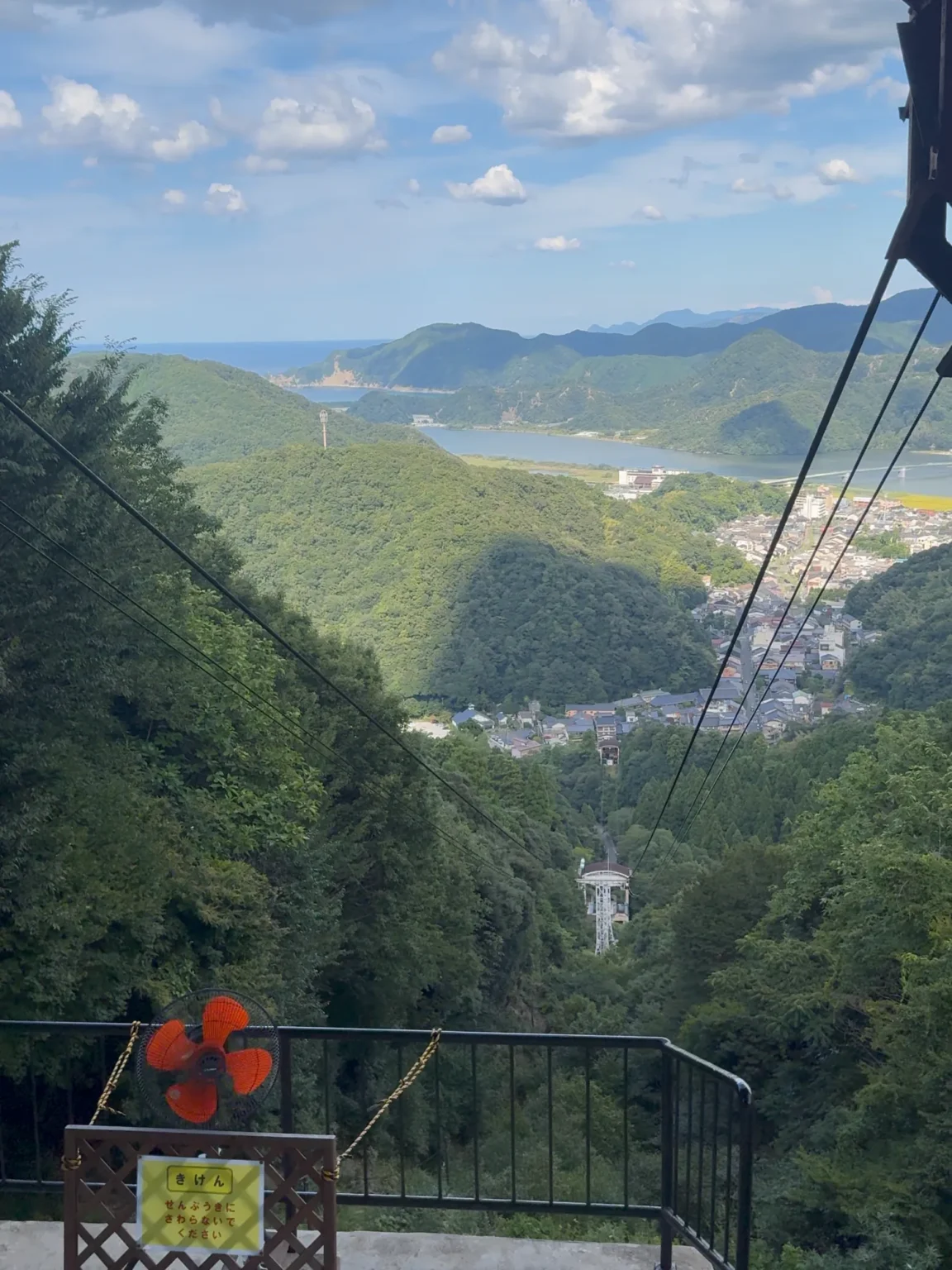
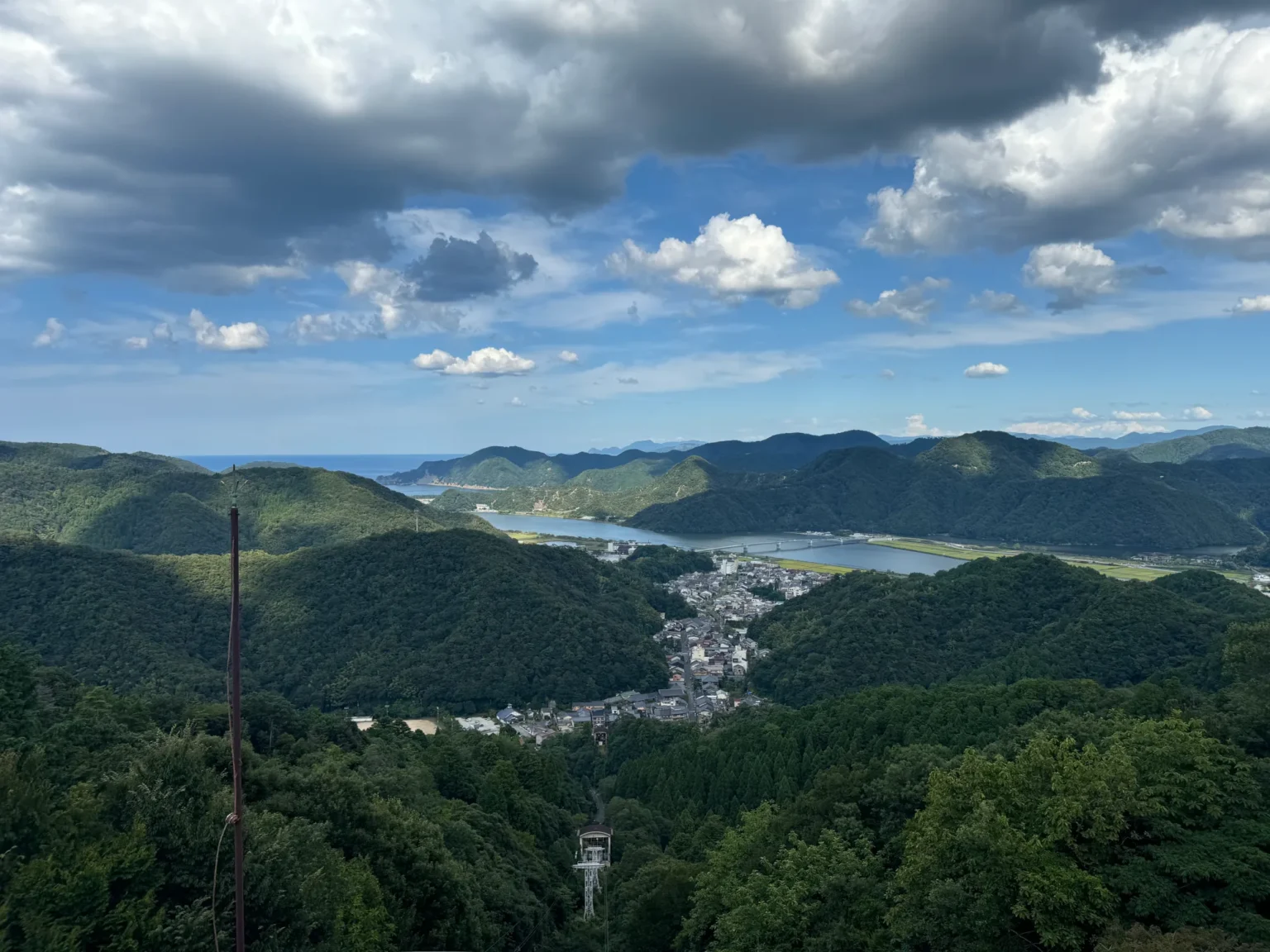
From the top the whole town fills one wooded valley below you, the Maruyama River runs beyond it with a long bridge across, and the Sea of Japan lies along the horizon. The cables drop past a lattice tower toward the rooftops, and by the platform railing an orange fan stood above a yellow sign on a wooden lattice, written all in hiragana: きけん せんぷうきに さわらないで ください — “danger, don’t touch the fan”.
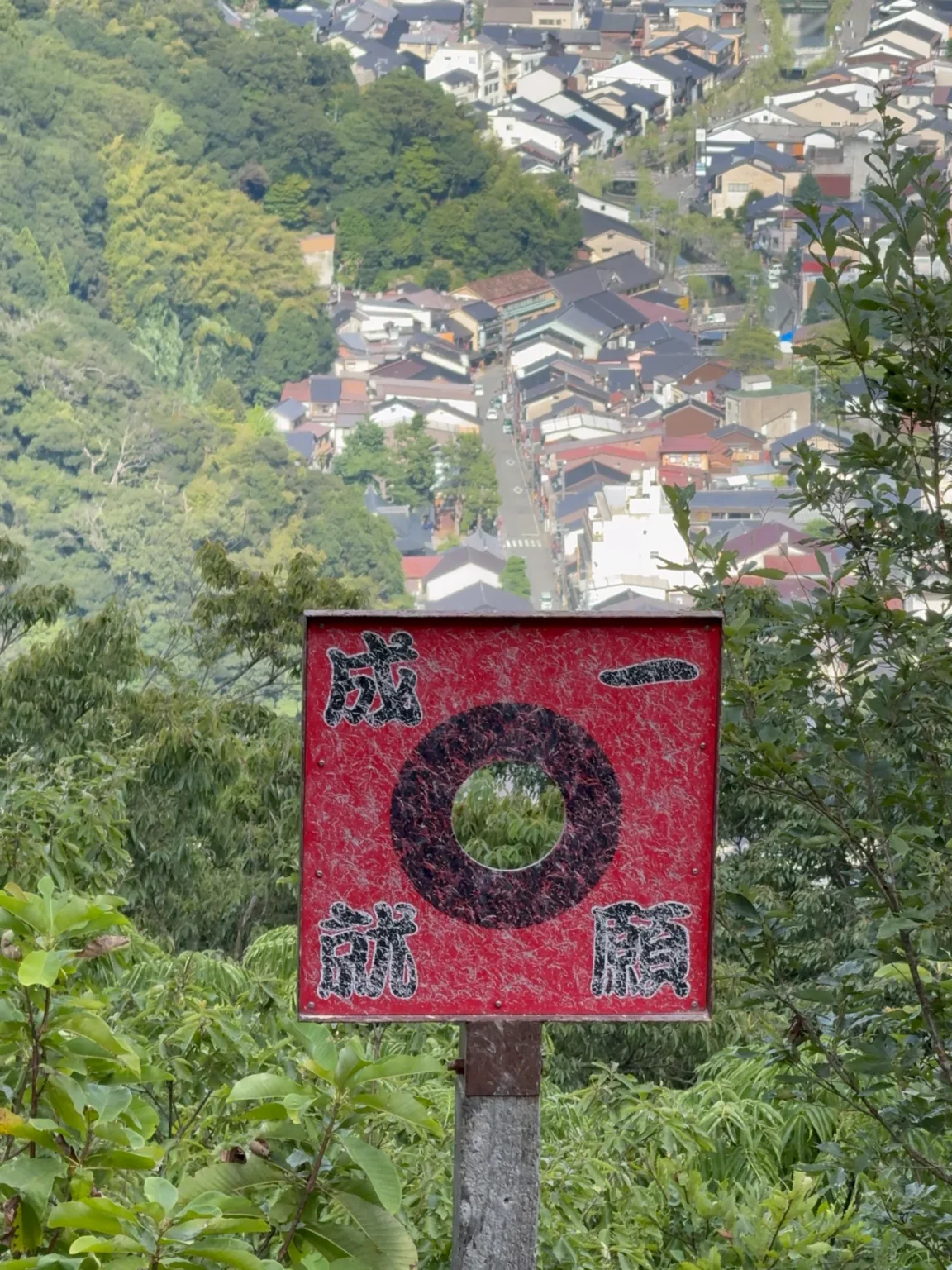
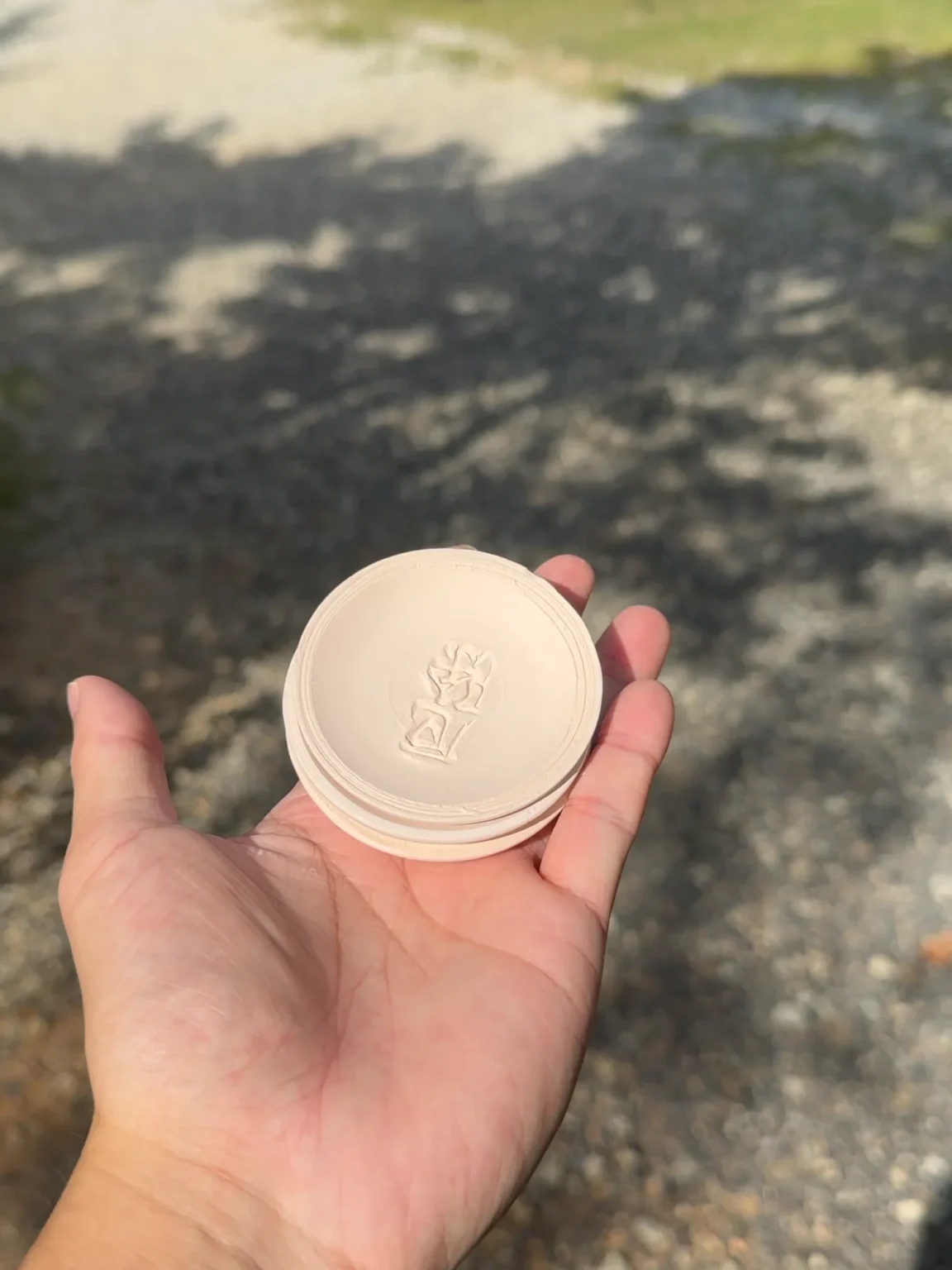
At the summit’s kawarake-throwing spot, around 15:22, my camera caught a small stack of unglazed clay discs held in a hand, the top one stamped with a character too faint to read, and a red square target on the slope below painted 一願成就 — “one wish fulfilled”. Far below the target you can pick out the town’s rooftops and its main street. The camera says I stayed up top until 15:24. The ropeway operator’s map also lists an observation deck, the Miharashi Terrace Café and Onsen-ji’s inner hall at the summit.
Back in town I spent the rest of that August afternoon, until about 17:40, among the baths along the river.
The ropeway’s halfway stop, Onsen-ji, is a station built for visitors to the temple; the ropeway operator’s map lists the main hall, the Tahoto pagoda, the Hokyointo and the treasure hall there. Kinosaki counts its 1,300 years from Onsen-ji’s founder, the priest Dochi, whose 1,000 days of prayer are said to have brought forth the spring at today’s Mandara-yu in 720; he founded the temple in 738. An older legend credits a stork. Each bath has its own story:
Kono-yu
Named after a stork (kounotori) said to have healed an injured leg in the spring about 1,400 years ago. Garden open-air bath; scheduled to reopen on 28 October 2026.
Mandara-yu
The spring said to have appeared after Dochi’s 1,000 days of prayer. Pottery tubs outside; opens at 15:00, closed Wednesdays.
Goshono-yu
Named for Ankamon-in, elder sister of Emperor Go-Horikawa, whose bath here is recorded in the Masukagami; Toyooka’s tourism site dates it to 1267. Fully open-air since it reopened in 2020.
Ichino-yu
Its name comes from the Edo-period physician Kagawa Shutoku, who praised Kinosaki’s water as the best in the land. Modelled on a Momoyama-style kabuki theatre, with a semi-open-air cave bath.
Yanagi-yu
Said to spring from beneath a willow transplanted from West Lake in China. The operator describes its water as a little hotter and its tub a little deeper than the others.
Jizo-yu
A Jizo statue is said to have come out of its spring. The building is designed around a stone lantern and basalt columns; it’s the nearest open bath to the station.
Two other things are closed: the Kinosaki Literature Museum, with its hand-and-foot bath, since 14 September 2026, and the Atago-yama entrance to the Daishi-yama hiking course, behind the museum, after a landslide on 26 December 2025 (tourism association notice of 17 March 2026, still posted on 28 September 2026).
If Kinosaki is one stop on a longer trip, these are the guides I’d read next:
The rest of Kansai
My itinerary for 7 days in Kansai beyond Kyoto covers Kifune and Kurama, Ohara, Nara, Lake Biwa, the Kumano Kodo and Osaka. Kinosaki isn’t one of its stops; add a night here from Kyoto or Osaka.
Ine’s boat houses
Elsewhere on the Sea of Japan side: Ine no Funaya’s boat-house village, its access and cruises.
Tottori’s dunes
The Tottori Sand Dunes: activities, access and entry.
An early start
Takeda Castle’s sea of clouds, and when to see it.
Kinosaki Onsen FAQ
Is Kinosaki Onsen tattoo friendly?
Yes, at the public bathhouses. Visit Kinosaki, Toyooka City’s official tourism website, says all of them accept tattoos of any size with no need to cover them, and the tourism association said on its official X account in May 2024 that all of them are tattoo friendly. Inns’ own baths may have different rules, so ask yours.
How much is the Kinosaki Onsen day pass?
¥1,500 for an adult and ¥750 for a child aged 3 to the end of primary school. It’s sold at every bathhouse counter, gives unlimited entry that day to every bath that’s open, and pays for itself from the second bath, since single entries are ¥800.
Is Satono-yu open?
No. Satono-yu, the bath beside Kinosaki Onsen Station, has been closed since 1 April 2024 for rebuilding, and Toyooka City expects it to reopen around March 2030. Its foot bath has been out of use since 16 October 2025.
Can I use the baths on my checkout morning?
Yes, if your inn includes the pass: at most inns it works until 13:00 on checkout day, according to Toyooka’s tourism site and Visit Kinosaki, so confirm your inn’s terms. Before 15:00 only the baths that open at 7:00 are open — Kono-yu (once it reopens, scheduled for 28 October 2026), Goshono-yu, Ichino-yu and Jizo-yu, minus whichever is on its closing day. Mandara-yu and Yanagi-yu open at 15:00 on their operating days, at ¥800 each once the pass has ended.
How many public baths are open in Kinosaki Onsen?
Six of the seven can open in winter 2026–27, once Kono-yu reopens from its repairs; the operator’s October calendar schedules that for 28 October 2026, while other official pages still list it as closed until 30 October, or due to reopen in November. Until then it’s five. Satono-yu, beside the station, has been closed since 1 April 2024, and each open bath closes one day a week, so in a regular week only four are open on Wednesdays and Thursdays.
Are the public baths in Kinosaki separated by gender?
Yes. Every bathhouse has separate men’s and women’s sides, and at Goshono-yu the two sides swap daily. Hyogo Prefecture’s public-bath standard has restricted mixed bathing from about age 7 since 1 April 2024, so a child of about 7 or older should use their own side, whatever older pages say.
How long is it from Osaka to Kinosaki Onsen?
About 2 h 40 min on the Limited Express Kounotori from JR Osaka, with every seat reserved; the normal-season fare was ¥6,140 on JR West’s fare search for 15 October 2026. Zentan’s highway bus from Umeda costs ¥4,100 one way.
Choose the night first and the inn second.
In a regular week once Kono-yu reopens, a Monday, Tuesday, Friday, Saturday or Sunday night at an inn that includes the pass gets you all six baths without paying at a counter, as long as the evening covers the baths shut the next morning; a Wednesday or Thursday gets you five, plus ¥800 the next afternoon if you want the sixth. Check the operator’s calendar for your month before you pay, and have a look at the live bath page the week you go.
Sources
The primary sources behind the bath counts, times, fees and fares above
- Bath operator (Kinosaki-cho Yushima property ward) — top page and closure notices, bath list, hours and closing days, October 2026 closure calendar (PDF), fees, amenities and parking, bathing rules
- Hyogo Prefecture — mixed-bathing age limit in public baths, from 1 April 2024
- Toyooka City — Satono-yu long-term closure, mayor’s policy address, 27 February 2026, mayor’s policy address, 28 August 2026 (accommodation tax), Satono-yu redevelopment plan, bath fee ordinance, Jizo-yu facility page (holiday rule), bathing tax, fees from April 2023, including the inns’ hot-spring use fee
- Toyooka City tourism — Kinosaki’s public baths and the inn pass, 2025–26 New Year bath hours, 2026–27 crab season, foot baths, car parks
- Kinosaki Onsen Tourism Association — live bath status, Kono-yu closure, family baths suspended, Satono-yu foot bath, Literature Museum closure, Atago-yama landslide, April 2023 fee changes, luggage service, access
- Kinosaki Onsen ryokan association — FAQ (pass, check-in bus, transfers)
- Shinzan (an inn in Kinosaki) — FAQ in English (bath pass hours), FAQ in Japanese (bathing tax and fee)
- Visit Kinosaki — FAQ, tattoos, Must‑Visits Pass, seasons
- JR West — Kinosaki Onsen station timetable, Kinosaki Onsen station facilities, fare search, all-reserved change, 12 March 2022 (PDF), Kansai WIDE Area Pass; JR Group — Japan Rail Pass coverage and prices
- Zentan Bus — Kinosaki–Osaka highway bus, snow cancellations, 9 February 2026, Kinosaki–Izushi direct bus timetable, Toyooka free pass
- Kinosaki Onsen Ropeway — fares and timetable, Q&A (walking time, steps, ride time); Onsen-ji
- Japan Meteorological Agency — Toyooka normals, 1991–2020; Cabinet Office — national holidays 2026–27; Orizuru
How to read the operator’s closure calendar: it’s a PDF linked from the operator’s Japanese top page, one month at a time. Columns are the six baths; 休湯日 means a regular closing day, 臨時休湯 a one-off closure, 臨時開湯 a one-off opening and 工事休湯 a closure for works.
Join travelers discovering Japan's hidden side
Weekly dispatches from off-the-beaten-path Japan — spots and stories you won't find in guidebooks.
No spam. Unsubscribe anytime.
Welcome aboard!
You're in. See you in your inbox soon.