Fukuoka · Dazaifu
Dazaifu Tenmangu, just outside Fukuoka, is the head shrine of Sugawara no Michizane — deified as Tenjin, the god of learning — and students come from across Japan to pray for exam success beneath its plum trees. It began as his mausoleum in 905, with the first shrine building raised in 919. Right now it is in a rare moment: a once-in-generations rebuilding of the main hall has just been completed, and the striking “forest-roofed” temporary shrine that stood in its place is being dismantled through the summer of 2026.
Who was Sugawara no Michizane?
Michizane (845–903) was a brilliant scholar and statesman of the Heian court who was demoted and exiled to Dazaifu, where he died. After his death, a series of disasters in the capital were blamed on his angry spirit, and he was gradually enshrined and elevated as Tenjin — a deity of learning, culture and the warding-off of misfortune. Today that makes Dazaifu Tenmangu the place students pray before entrance exams, and the shrine explicitly offers exam-success prayers. It is a Shinto shrine, not a temple, and the deity is a real historical person raised to divine status.
The renovation, and what you’ll actually see now
This is the part to understand before you go, because it’s changing. The shrine’s main hall (honden) underwent its first major rebuild in around 124 years. During the work, a temporary worship hall (kariden) — designed by architect Sou Fujimoto, with living trees planted across its roof so it read as a floating slice of forest — stood in front of the main hall and drew visitors in its own right from May 2023.
The takeaway: don’t travel expecting either a pristine main hall on show or the famous temporary shrine intact — you are visiting during the hand-over between the two. Everything else below (the gate, the bridges, the plum trees, the approach) is unaffected and worth the trip on its own.
How to pray, and what to see
The standard Shinto method at the main worship hall is two bows, two claps, one bow, after a small coin offering. Beyond that, the grounds reward a slow wander:
The taiko bridges
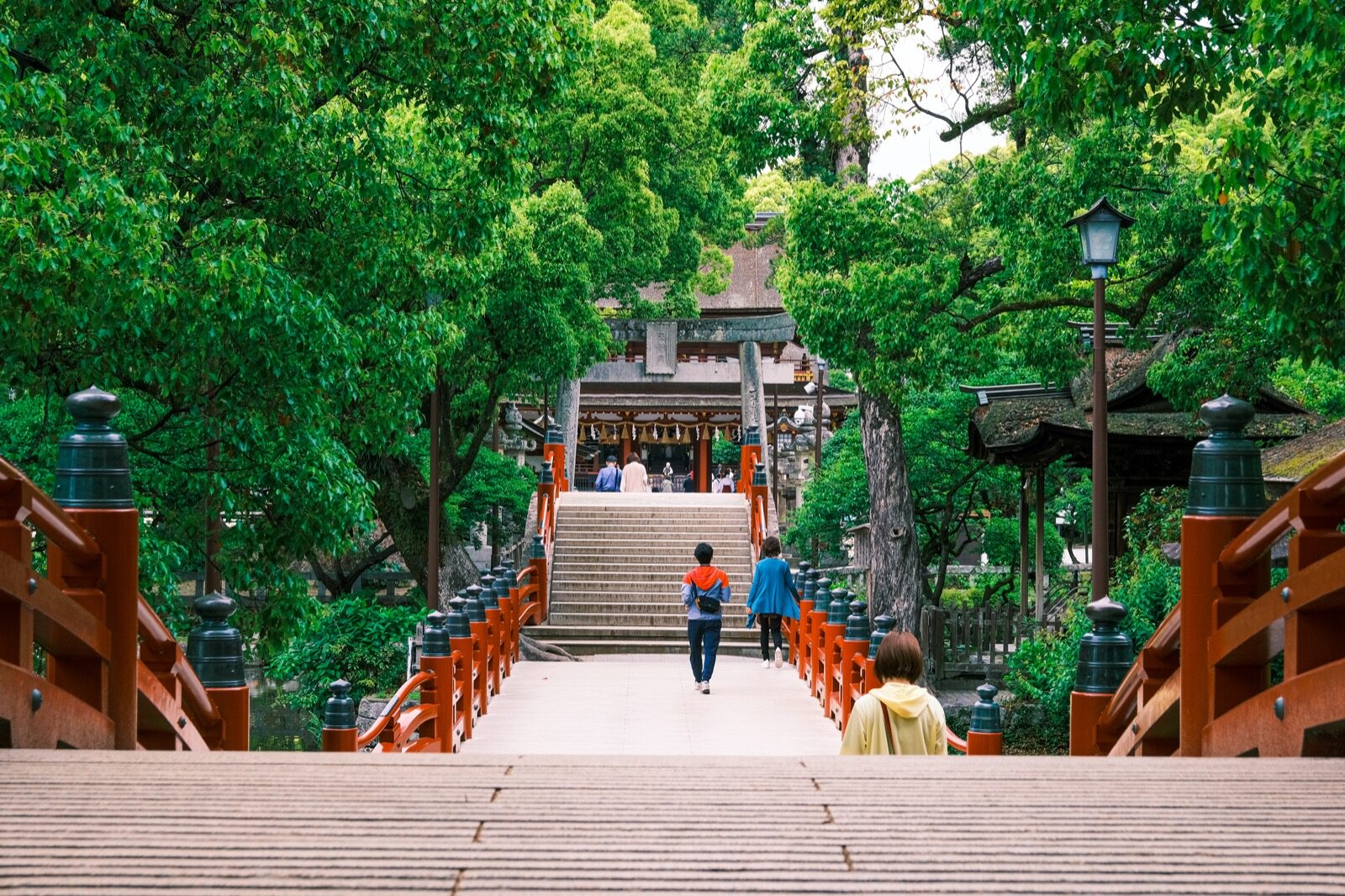
Three bridges — arched, flat, arched — cross the Shinji-ike pond on the approach, said to represent the past, present and future. The vermilion arches over water are the shrine’s signature view.
The bronze oxen
Eleven bronze nade-ushi (“stroking oxen”) sit around the grounds; the custom is to rub the head to pray for wisdom. You’ll spot the polished, shiny heads.
The romon gate
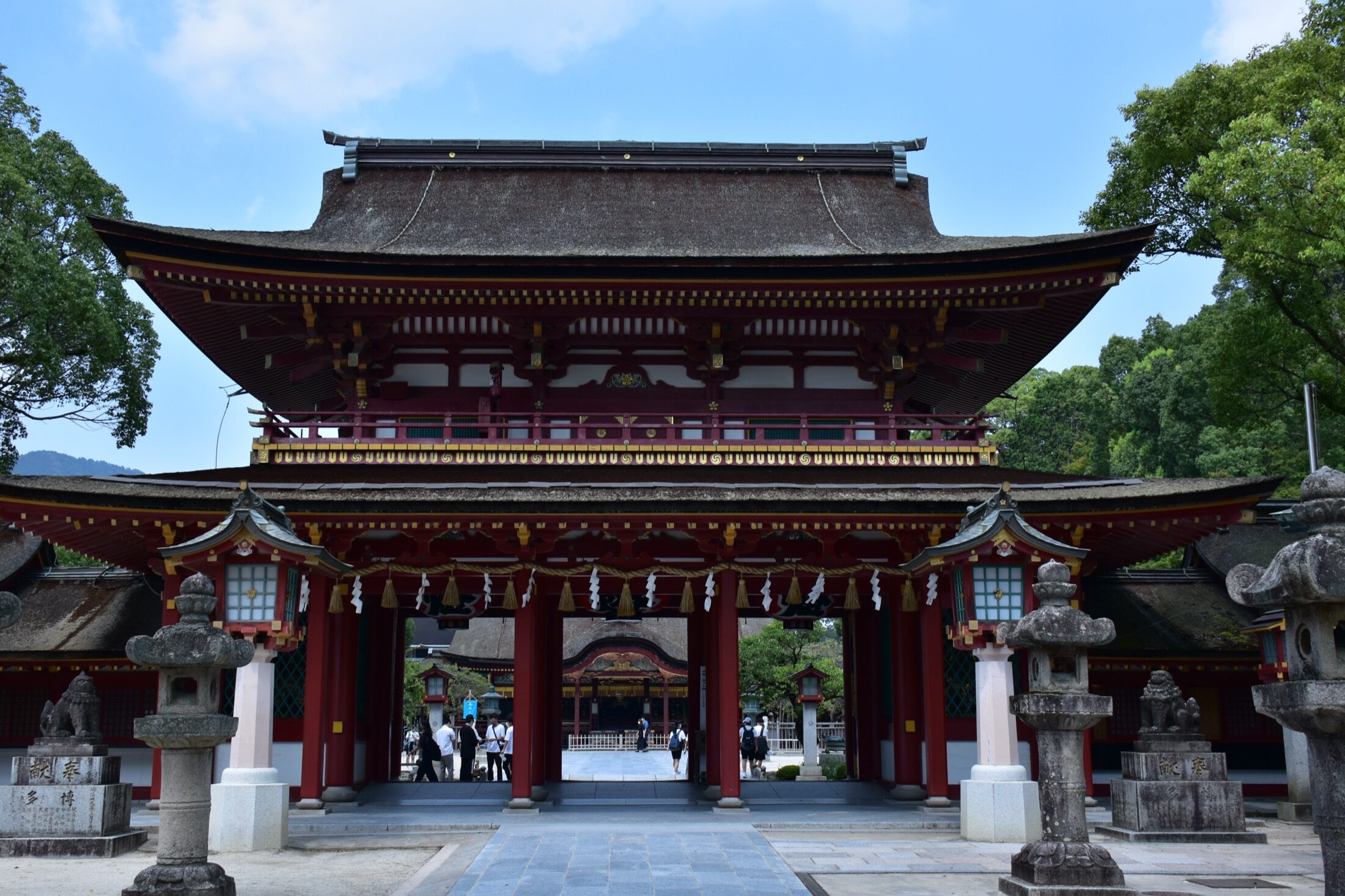
The two-storey vermilion gate before the main sanctuary is one of the most photographed structures here, framed by stone lanterns.
The treasure hall
The Homotsuden houses shrine treasures and materials on Michizane (adult ¥500). The grounds themselves are free to enter.
Plum trees and the flying-plum legend
Michizane loved plum blossom, and the shrine is planted with around 6,000 plum trees of some 200 varieties. The most famous is the tobiume, the “flying plum” that stands to the right of the main hall: legend says the tree so missed its master that it flew from Kyoto to Dazaifu in a single night to be near him. The blossoms usually peak in late winter to early spring (roughly late January into March, weather depending), which is the shrine’s most beautiful — and busiest — season. The local sweet, umegae-mochi (a grilled rice cake stamped with a plum crest), is sold all along the approach.
Getting there from Fukuoka
Fukuoka itself is one of Japan’s best-value trip bases — often cheaper than Kyoto for reaching Kyushu. Here’s how we pick base cities that cost less than Kyoto.
By train (usual way)
From Nishitetsu Fukuoka (Tenjin) station it’s about 35 minutes: take the Nishitetsu line, change at Nishitetsu-Futsukaichi to the Dazaifu line, and get off at Dazaifu — the shrine is a 5-minute walk up the approach.
By direct bus
The “Tabito” sightseeing bus runs from Hakata Bus Terminal in about 45 minutes, and from Fukuoka Airport’s international terminal in about 25 minutes.
On the approach
From Dazaifu station you walk the omotesando — souvenir and umegae-mochi shops, plus the Kengo Kuma-designed Starbucks — straight to the torii and grounds.
Next door
The Kyushu National Museum is about a 10-minute walk from the main sanctuary, easy to combine into the same visit.
Planning a Dazaifu day trip?
Hours and when to go
Opening times shift with the season: the gates open at 6:00 (after the spring equinox) or 6:30 (after the autumn equinox), and close at 19:00 in spring and autumn, 19:30 in summer, and 18:30 in winter. The grounds are busiest at New Year — when the shrine keeps extended and even 24-hour hours over 1–3 January and asks visitors to use public transport — and during plum season. For a calmer visit, a weekday morning outside those windows is ideal, and it’s also when the light on the vermilion gate and bridges is best.
Questions travelers ask
Can I still see the Sou Fujimoto temporary shrine?
Possibly not for much longer. The main-hall renovation is complete and the forest-roofed temporary shrine is being dismantled, with removal work scheduled from mid-May through around early September 2026. Check the shrine’s official site right before you go — by the time you visit it may be partly or fully gone.
What is Dazaifu Tenmangu famous for?
It’s the head shrine of Tenjin, the deified scholar Sugawara no Michizane, so it’s Japan’s most famous shrine for praying for academic and exam success. It’s also known for its ~6,000 plum trees and the flying-plum legend.
How do I get there from Fukuoka?
About 35 minutes by Nishitetsu train from Tenjin, changing at Nishitetsu-Futsukaichi for the Dazaifu line, then a 5-minute walk. There’s also the direct “Tabito” bus from Hakata (~45 min) and from Fukuoka Airport’s international terminal (~25 min).
Is there an entrance fee?
No — entering the shrine grounds is free. The treasure hall (Homotsuden) charges ¥500 for adults, with discounts for students.
When do the plum blossoms bloom?
Usually from late winter into early spring — roughly late January through March, depending on the year’s weather. It’s the shrine’s most scenic season and also its most crowded.
What else is nearby?
The Kyushu National Museum is about a 10-minute walk, and the omotesando approach — with the Kengo Kuma Starbucks and umegae-mochi shops — is right at the shrine. Together they make an easy half-day from Fukuoka.
Join travelers discovering Japan's hidden side
Weekly dispatches from off-the-beaten-path Japan — spots and stories you won't find in guidebooks.
No spam. Unsubscribe anytime.
Welcome aboard!
You're in. See you in your inbox soon.