
Kanagawa · Samukawa · Sagami Line · hatsumode 2027
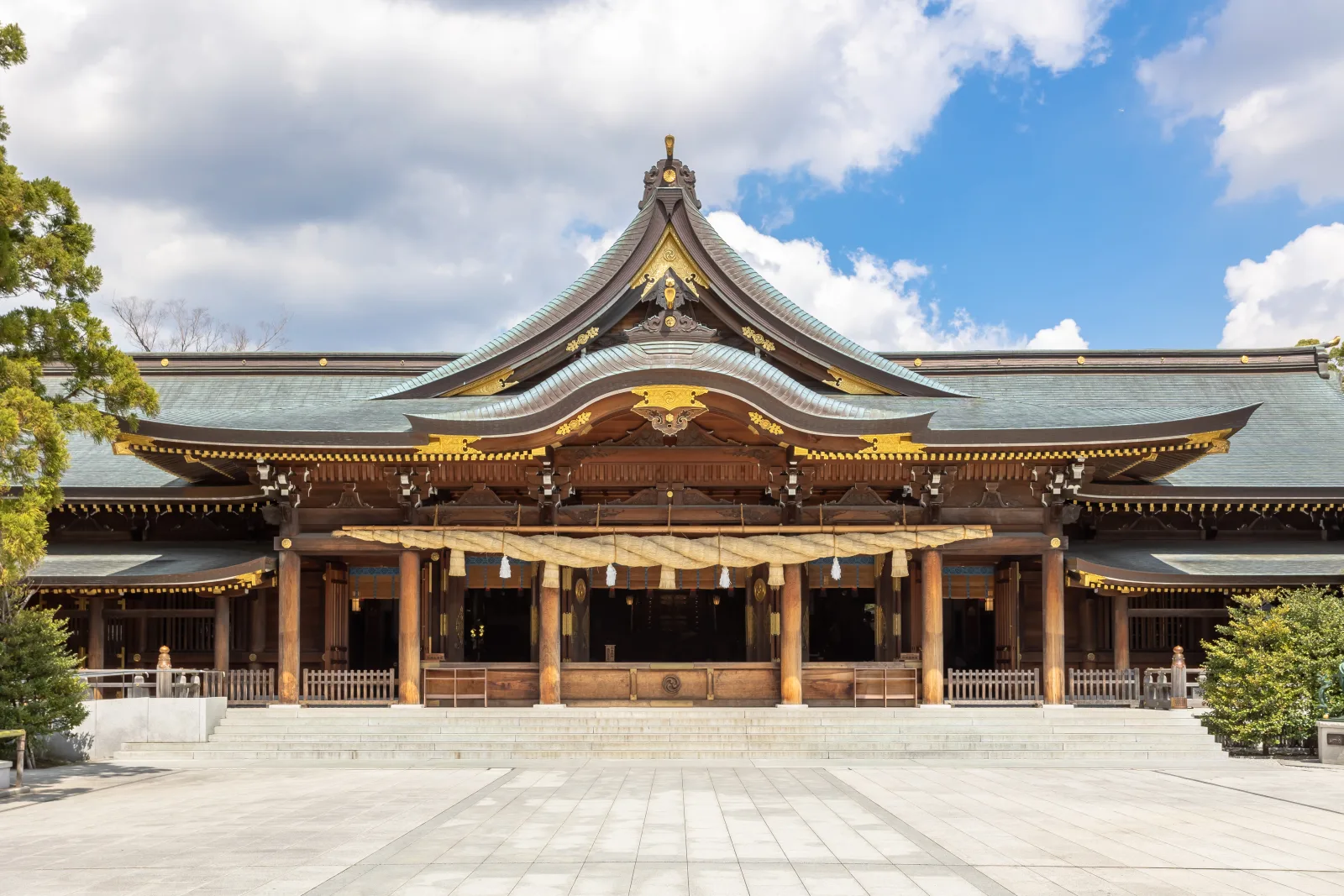
Samukawa Shrine, the Ichinomiya of old Sagami Province, describes its deity as the country’s only guardian of happo-yoke, protection against misfortune from every direction. Prayers start at ¥3,000; you apply at the reception hall on the day (the New Year 2024 notice said same-day reception only). New Year 2027 hours were not posted on 17 October 2026, so the 2024 and 2026 arrangements below are labelled examples. Take the JR Sagami Line to Miyayama, not Samukawa.
Unless noted otherwise, the information below comes from the shrine (samukawajinjya.jp, with “jya”) and its newsletter Sagami, and train times from JR East’s October 2026 timetable. Removed New Year notices were read in the Internet Archive and carry their year.
What Samukawa Shrine is
The shrine enshrines two deities, Samukawa-hiko-no-mikoto and Samukawa-hime-no-mikoto, worshipped together as Samukawa Daimyojin. It is called the Ichinomiya, the leading shrine, of Sagami Province. Records the shrine cites place offerings in the reign of Emperor Yuryaku (456–479) and a shrine building in 727, and on that basis it gives its age as “at least about 1,600 years”. In the Engishiki register of 927 it is the only shrine of the highest rank, myojin taisha, among Sagami’s thirteen.
In Japanese the shrine describes itself as zenkoku yuitsu no happo-yoke no shugoshin (全国唯一の八方除の守護神), “the only guardian deity of happo-yoke in the whole country”. Happo means every direction. The happo-yoke page defines it as a divine virtue of Samukawa Daimyojin, found nowhere else in the country, that removes all misfortune arising from the land, the layout of a house, directions and the choice of days, and brings success to family business and good fortune. The slogan reads: “great troubles made small, small troubles made none, and good things made as large as possible.”
The main buildings face south-west, which is unusual, and the shrine stands south-west of Edo, on what was the city’s ura-kimon, the “back demon gate” direction. Minamoto no Yoritomo, Takeda Shingen and the Tokugawa shoguns are among its recorded worshippers. A helmet that Shingen is said to have offered in October 1569 is kept here.
Samukawa Town’s website puts the shrine’s visitors at about 2 million a year (page updated 1 June 2026). The happo-yoke page says people come “from Hokkaido in the north to Okinawa in the south” for the happo-yoke prayer.
Happo-yoke prayers: how they work for visitors
A prayer (kigan) starts with a conversation at reception: a priest asks what is worrying you or what you hope for (a move, a trip, a business, your family) and chooses the prayer to match. The happo-yoke page adds that first-timers are sometimes surprised to be talking with a priest at all.
| Step | What you do |
|---|---|
| 1. Form | Fill in the prayer application form (御祈祷申込用紙), red-framed part only. It is a Japanese PDF on the shrine’s site; blank forms are also at the hall. |
| 2. Kyakuden | Go to the kyakuden, the reception hall and waiting rooms, and hand the form to a priest. “Come to the kyakuden first,” says the precinct guide. |
| 3. Wishes | Keep it to about two wishes; some can only be taken alone. Joint applications under several names are not accepted. |
| 4. Fee | Choose the level and pay. The prayer takes place in the main hall complex; its worship hall seats 216 at once. |
| 5. Afterwards | You receive the items for your level. Prayer recipients may enter the Shinen garden behind the main hall (early March to 13 December). |
| Level (fee) | What you take home |
|---|---|
| Chu-shiki, ¥3,000 or more | Named talisman, amulet, sacred soil, chopsticks, food offering, sacred sake |
| Tai-shiki, ¥5,000 or more | As above plus the happo-fuda, a set of nine talismans for the centre and eight directions of a home |
| Toza-shiki, ¥10,000 or more | Adds a gohei wand and a happo-yoke door plaque |
| Ichidai-shiki, ¥30,000 or more | The same set, with an Ichidai-shiki gohei |
| Eidai-shiki, ¥50,000 or more | The same set with an Eidai-shiki gohei, plus food from the offering table |
The fees are minimums (以上). Each level is limited in number, and the prayer page warns that at busy times “such as year-end and New Year” some may not be available.
A wish written in simple Japanese on a note before you go keeps the talk at reception short.
Hatsumode 2027: what is posted so far
New Year 2027 details (prayer hours, parking, buses, traffic control) were not listed on samukawajinjya.jp when checked on 17 October 2026. The standing festival calendar lists the New Year rites every year, and the October 2026 newsletter adds the December dates:
| Date | At the shrine |
|---|---|
| Sun 20 Dec 2026 | New Year nebuta lantern put up on the Shinmon gate (newsletter, 1 Oct 2026) |
| Thu 31 Dec 2026, 13:00 | Year-end great purification, then the Joya-sai; a thanksgiving rite after the Joya-sai |
| Fri 1 Jan 2027, 0:00 | A big drum opens the year; Happo-yoke-sai and the first prayer service in the main hall |
| Fri 1 Jan 2027, 6:00 | Saitan-sai, the New Year’s Day rite |
| Sat 2 Jan 2027, 20:00 | Tsuina-sai, the rite to drive out evil; the bows and arrows offered at it are given to attendees afterwards as charms against misfortune |
| Sun 3 Jan 2027, 8:00 | Genshi-sai |
| Fri 8 Jan 2027, 10:00 | Musa-yumi-sai: two priests take turns shooting at a large target, three times, to divine the year’s fortune |
| To 23 Feb 2027 | The nebuta stays on the gate until 23 February |
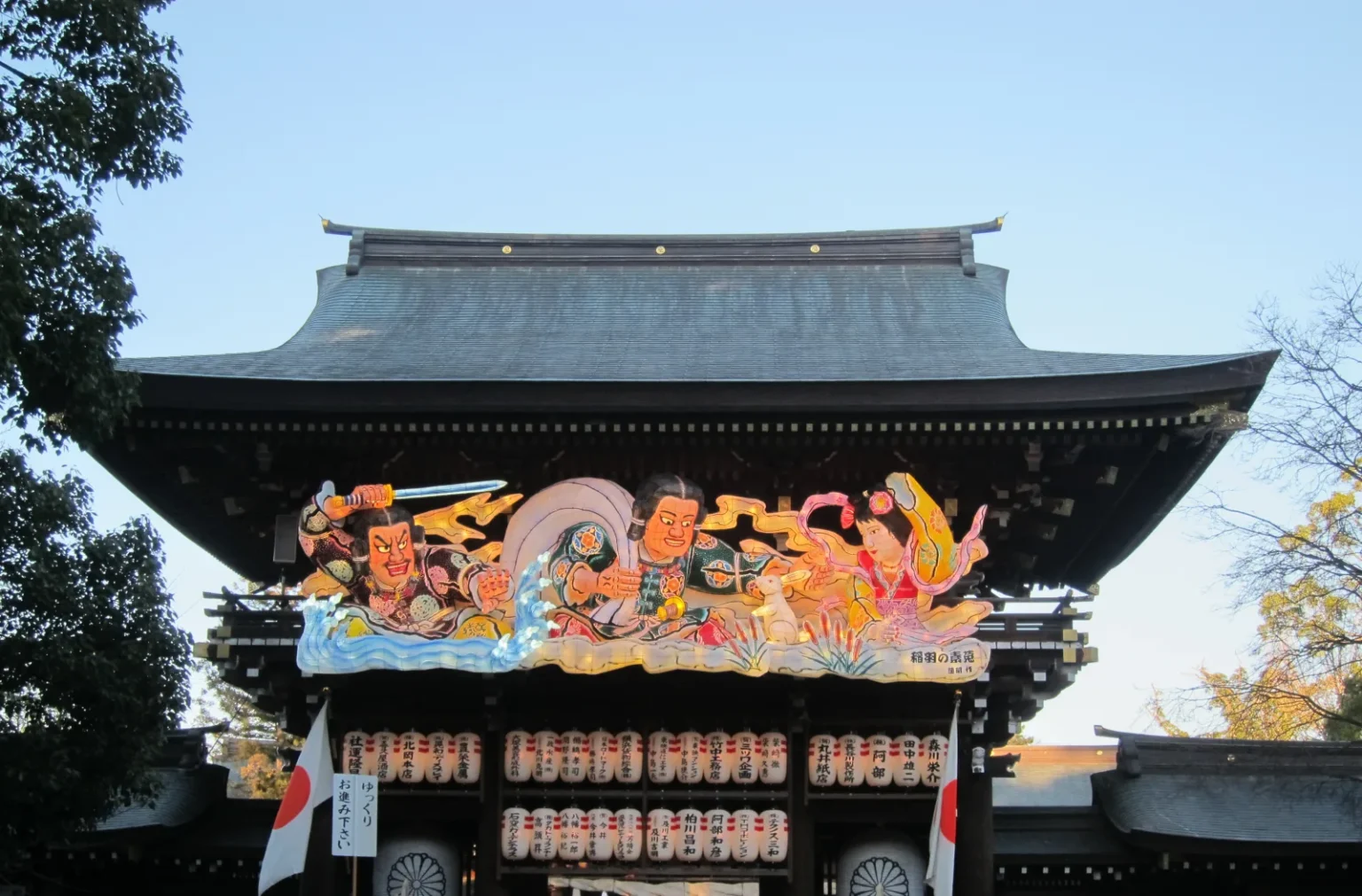
The January 2024 and January 2026 newsletters name an Aomori nebuta artist as the maker; the 2024 nebuta was 9.0 m wide and 2.7 m high with 500 LED bulbs. For the 2025 season it went up and was first lit at 16:30 on Friday 20 December 2024; in the 2026 season it was lit from sunset to 22:00, all day on 1–3 January, and until 19:00 from 1 February. For what else is on that month, see our Japan in December 2026 guide.
2026 example and 2024 example: New Year hours
In 2023 and 2025 the shrine posted its New Year hours in early December and later removed them. I found no archived copy of its notice on 2026 prayer hours (dated 3 December 2025), so the prayer times below are the 2024 example; the amulet office times are the 2026 example.
| Day | Prayers (2024 example) · amulet office (2026 example) |
|---|---|
| 31 Dec | Prayers 8:00–17:00, then again from 23:45 (31 Dec 2023, for New Year 2024) |
| 1 Jan | Prayers until 17:00 (2024). Amulet office from 0:00 to the end of the last prayer; a night office from 20:00 on 1 Jan to 6:30 on 2 Jan (2026) |
| From 2 Jan | Prayers 6:30–17:00 (2024). Amulet office from 6:30 on 2–5 Jan (2026) |
| January weekdays later on | Prayers from 7:30 (2024: from 9 Jan). Amulet office from 7:30 (2026: from 6 Jan) |
| January weekends and holidays | Prayers from 6:30 (2024); amulet office from 6:30 (2026) |
| February onward | Prayers 8:00–17:00 (2024); amulet office 8:00–16:30 (2026) |
In 2026 the special New Year amulets went on sale from 1 January only, could not be mailed, and 15 kinds had sold out by 18 January. Over the 2026 New Year the shrine also paused online prayer applications from 28 November 2025 to 4 February 2026 and closed the doll-offering hall from 1 to 5 January.
Which day and time should you go?
The shrine’s 1 January 2024 newsletter named the crowded days: the first three days of January, Saturdays, Sundays and holidays in January and February, and taian days, the lucky days of the old six-day calendar, and asked visitors to avoid them as far as possible. I found no official hourly queue-time figures.
| Day (2026–27) | What the sources say |
|---|---|
| Thu 31 Dec | Rites from 13:00. On 31 Dec 2023, prayers resumed at 23:45 for the turn of the year. No overnight trains in the 2025–26 example (see below) |
| Fri 1 Jan (holiday) | Rites at 0:00 and 6:00; one of the crowded first three days. The 2026 direct bus ran by day only, not overnight |
| Sat 2 – Sun 3 Jan | Crowded days; Tsuina-sai at 20:00 on the 2nd, then two or three trains an hour each way (Saturday timetable, October 2026) |
| Mon 4 – Fri 8 Jan | Weekdays outside the first three days; in 2026 the shrine listed car parks 2, 3 and 4 as usable from the 4th. Musa-yumi-sai on the 8th |
| Sat 9 – Mon 11 Jan | A Saturday, Sunday and Coming of Age Day holiday: on the 2024 crowded-days list |
| Weekdays from Tue 12 Jan | Not on the 2024 crowded list unless a taian day; prayers from 7:30 in the 2024 example |
| February | Weekends, holidays and taian days were on the 2024 crowded list; the nebuta is up until 23 February |
A weekday from 4 January that is not a taian day avoids the dates flagged as crowded in the shrine’s 2024 newsletter. For the midnight drum, arrive on 31 December and expect crowds at the turn of the year. Read the late-train note below first: the 2025–26 all-night service did not include the Sagami or Tokaido lines, the last Tokyo-bound connection on the October 2026 timetable leaves Miyayama at 23:09, and the 2026–27 New Year timetable had not been published on 17 October 2026. For a late-night visit in winter, disposable hand warmers (Amazon Japan) are worth carrying.
Getting there
The shrine is on the JR Sagami Line between Chigasaki on the Tokaido Line and Ebina on the Odakyu and Sotetsu lines. Get off at Miyayama; it is 5 minutes on foot. The access notice adds, in bold, that the nearest station is not Samukawa Station.
| From | Route and time (route diagram on the shrine’s access page) |
|---|---|
| Shinagawa | JR Tokaido Line to Chigasaki (45 min), Sagami Line to Miyayama (about 15 min) |
| Shinjuku | Odakyu Line rapid to Ebina (40 min), Sagami Line to Miyayama (about 20 min) |
| Yokohama | JR Tokaido Line to Chigasaki (about 30 min), or Sotetsu Line rapid to Ebina (35 min), then the Sagami Line |
| Odawara | JR Tokaido Line rapid to Chigasaki (about 20 min), Sagami Line to Miyayama (about 15 min) |
A sample Saturday or holiday trip from Tokyo
These trains are on JR East’s Saturday and holiday timetable for October 2026. JR East often runs special timetables over New Year (see our New Year closures guide for what else changes), so check again in late December.
| Time | Train |
|---|---|
| 7:35 | Tokyo, Tokaido Line for Odawara (Yokohama 8:02) |
| 8:30 | Chigasaki; 20 minutes to change |
| 8:50 | Chigasaki, Sagami Line for Hashimoto |
| 9:04 | Miyayama (departure time; the train arrives a minute or so earlier); 5 min walk |
| 13:06 | Miyayama, Sagami Line for Chigasaki (arr. 13:17) |
| 13:30 | Chigasaki, Tokaido Line (Yokohama 14:02, Tokyo 14:28) |
The 7:46 from Tokyo reaches Chigasaki at 8:47, three minutes before the same Sagami Line train; that change is too tight to rely on. For Shinjuku on the way back, the Shonan-Shinjuku Line special rapid leaves Chigasaki at 13:23 and reaches Shinjuku at 14:19.
Yokohama is on both routes: about 30 minutes to Chigasaki on the Tokaido Line, or 35 to Ebina on the Sotetsu rapid.
Yokohama stays on Booking.com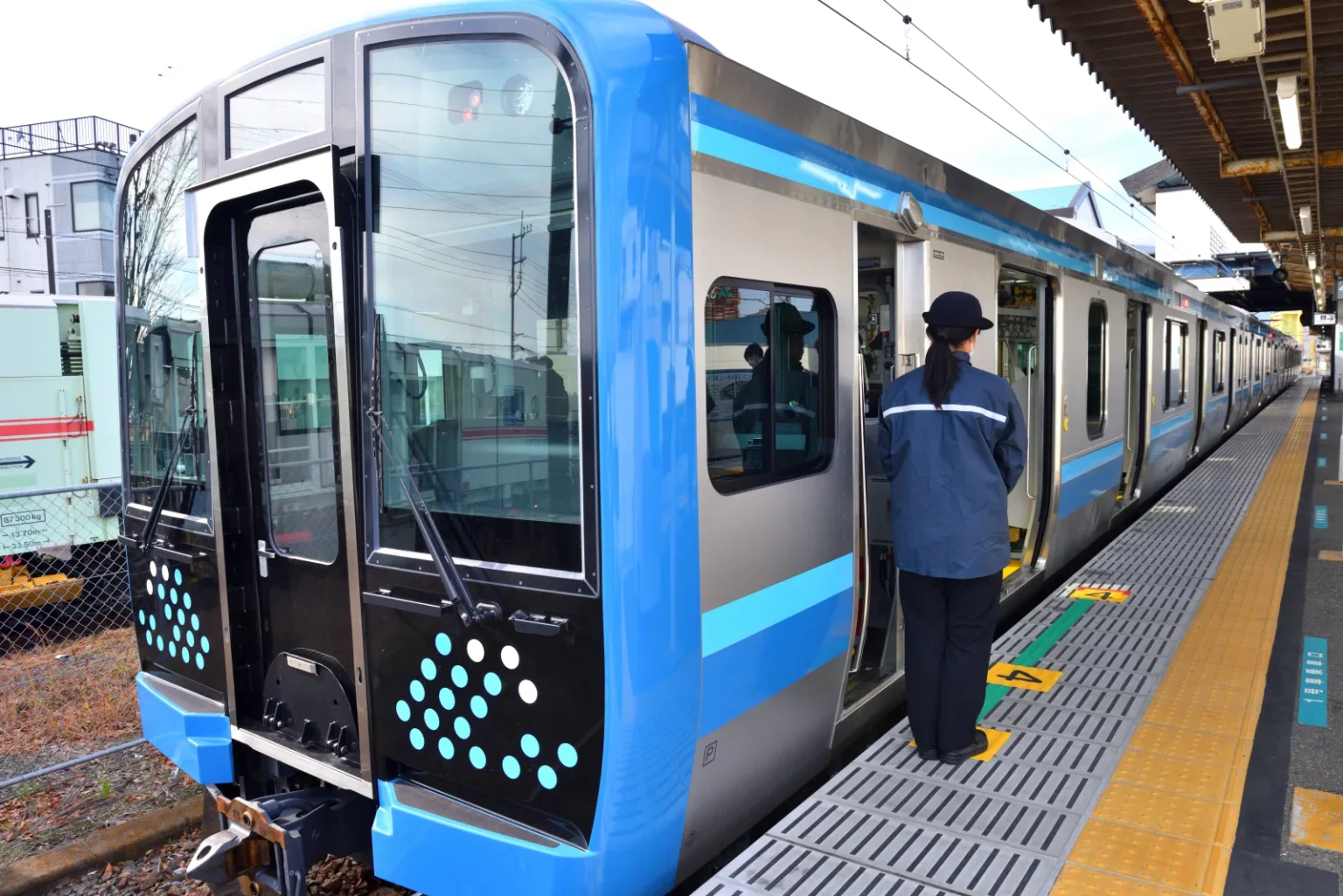
By bus
The route bus from Ebina Station (East Exit, stop 2) towards Samukawa Station takes about 20 minutes to Samukawa Jinja Sando, a 5 min walk from the shrine. It is infrequent: 10 round trips on weekdays and 6 on weekends and holidays, as of April 2026. Over the 2025–26 season it ran a detour from 27 December to 29 March, with the Sando stop moved and two shrine-area stops skipped.
2026 example, direct bus: Sotetsu Bus ran a non-stop bus from Ebina Station (East Exit terminal, stop 0) to the shrine’s Sanshuden on 1–3 January 2026, daytime only, with no overnight service on New Year’s Eve. Buses left Ebina from 8:00 to 16:00, every 10 minutes from 10:00, and the shrine from 8:40 to 17:00. The adult fare was ¥500. No 2027 notice had been posted by 17 October 2026.
If you plan to show your wish on a phone at reception, mobile data keeps a translation app working, and the same phone shows JR East’s Miyayama timetable for the train back.
See eSIM optionsAround the precinct
Shinchi Bridge and third torii
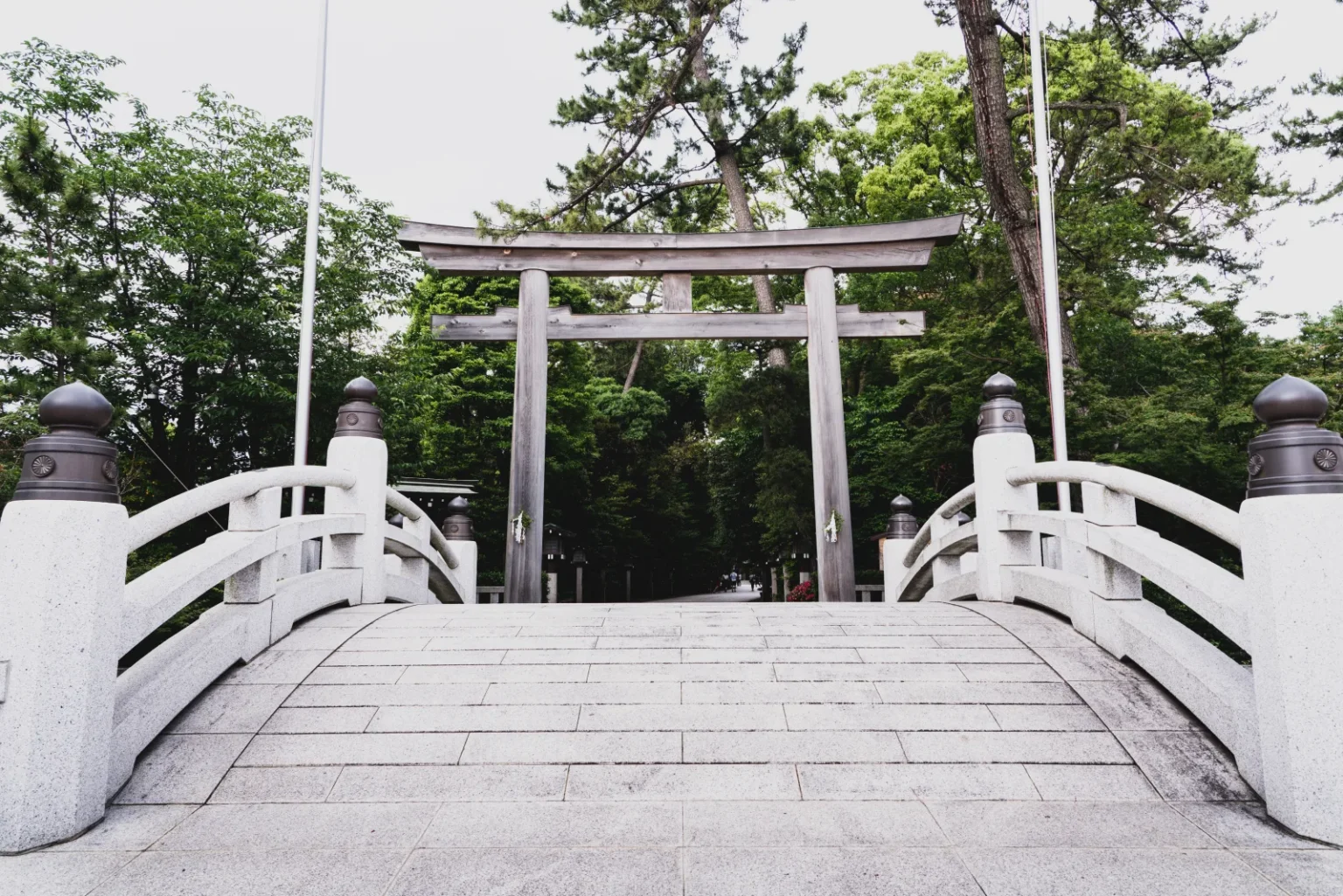
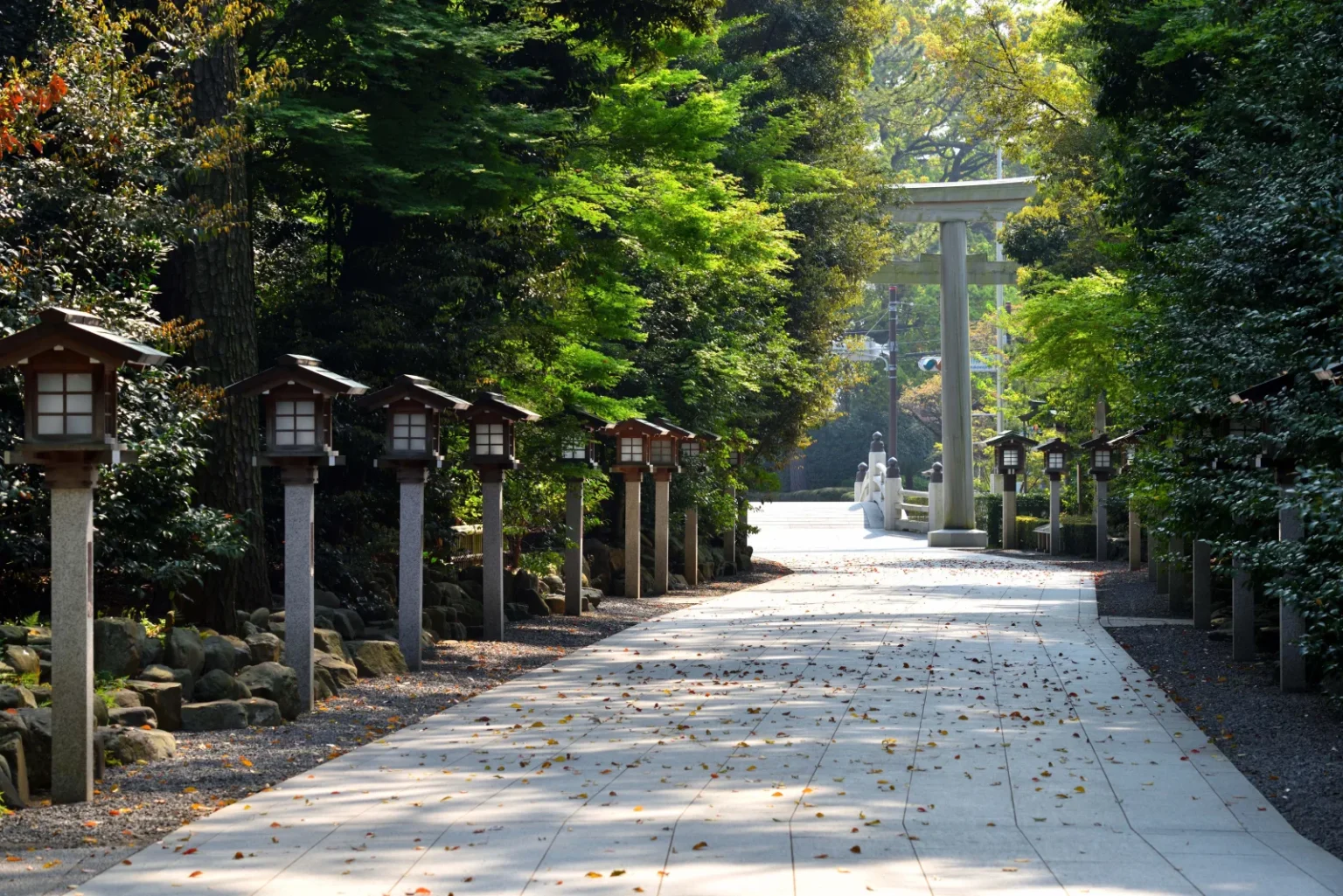
An arched bridge over the sacred pond, rebuilt in 2011, and a cypress torii from 1990. The start of the inner approach.
Shinmon gate
A two-storey gate completed in 1993. The New Year nebuta goes up on 20 December (2026 newsletter) and stays until 23 February.
Main hall
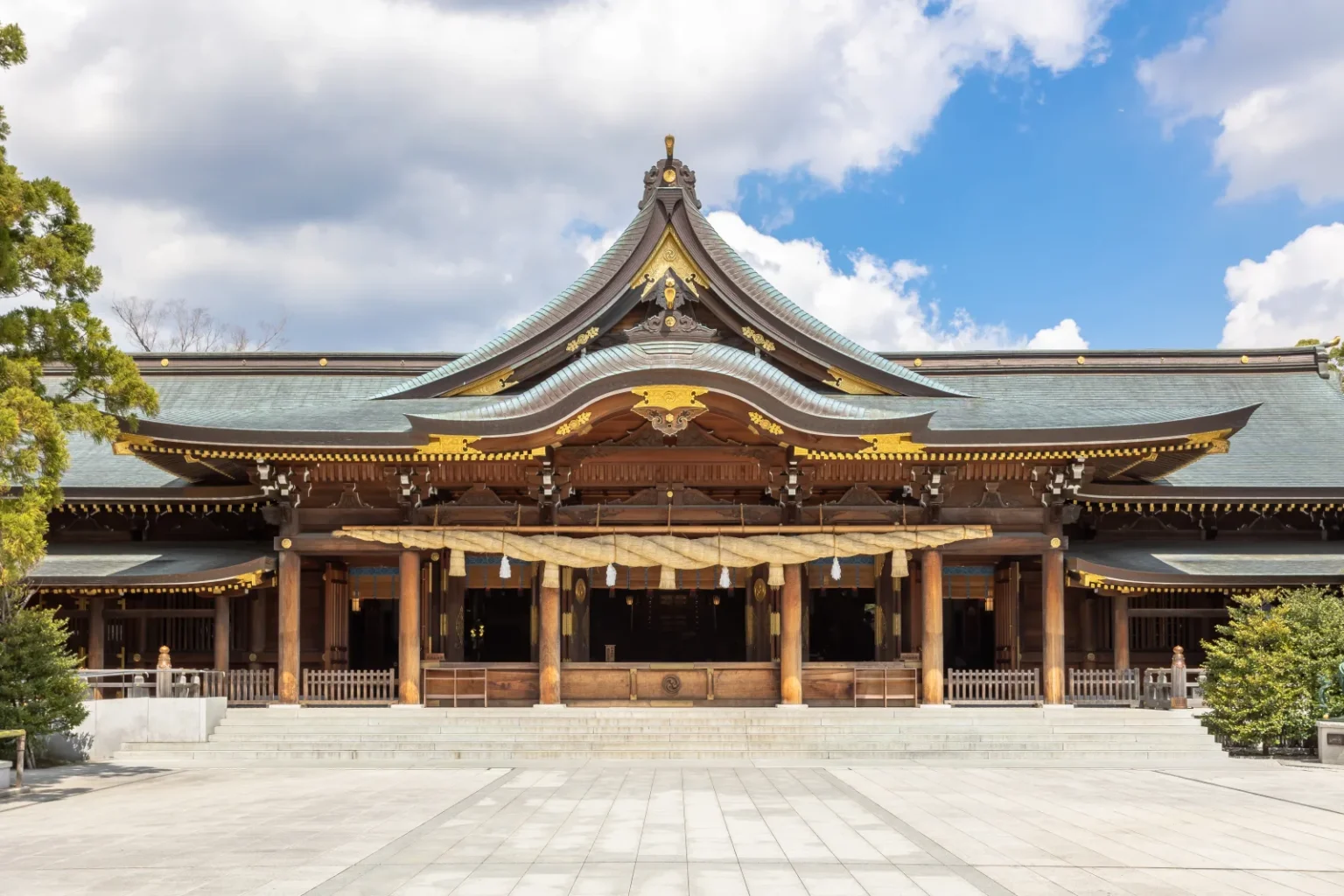
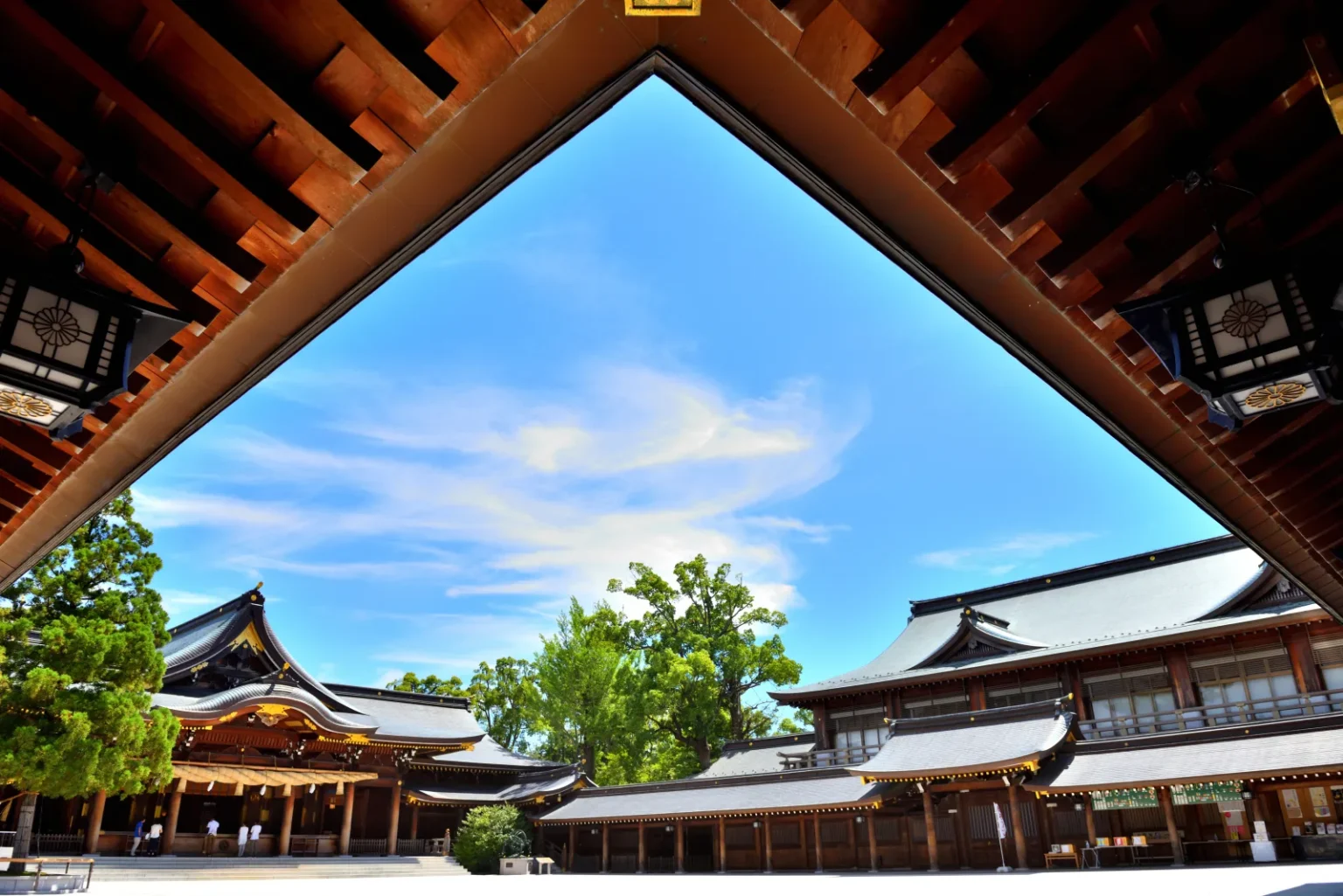
All hinoki cypress, completed in October 1997; the worship hall seats 216. Two cedars beside it are the sacred trees.
Armillary sphere
A replica to the right of the worship hall, with dragons at its corners: star watching once set calendars and lucky days.
Kyakuden
Prayer reception and waiting rooms, built in 1992, with two floors and a basement. Go here first if you want a prayer.
Doll-offering hall
Dolls and soft toys accepted 9:00–16:00, burnable items only, from ¥1,000 per offering (一件), more if you wish. North of car park 1.
Across the road from the precinct is Miyayama Shrine, a subsidiary shrine that brought together seven small local shrines. Chinju-no-mori Koyo, by the precinct, has souvenirs on the ground floor and a restaurant upstairs.
The Shinen garden: prayer recipients only, closed in winter
Kantakeyama Shinen is the garden behind the main hall, opened in August 2009 around Naniwa-no-koike, a spring directly behind the main sanctuary that is linked with the shrine’s origins; on 2 January its water is drawn for the Tsuina-sai. Entry is limited to people who have received a prayer.
| Item | Details |
|---|---|
| Season | Early March to 13 December; closed Mondays, open on national holidays |
| Hours | 9:00–16:00, last entry 15:30 |
| Warakutei teahouse | 9:30–15:30; matcha and a sweet from ¥500 |
| Hotoku museum | Exhibits on happo-yoke belief, 9:00–16:00 |
| Winter 2025–26 (example) | Closed to the end of February 2026; reopening planned for 1 March 2026 |
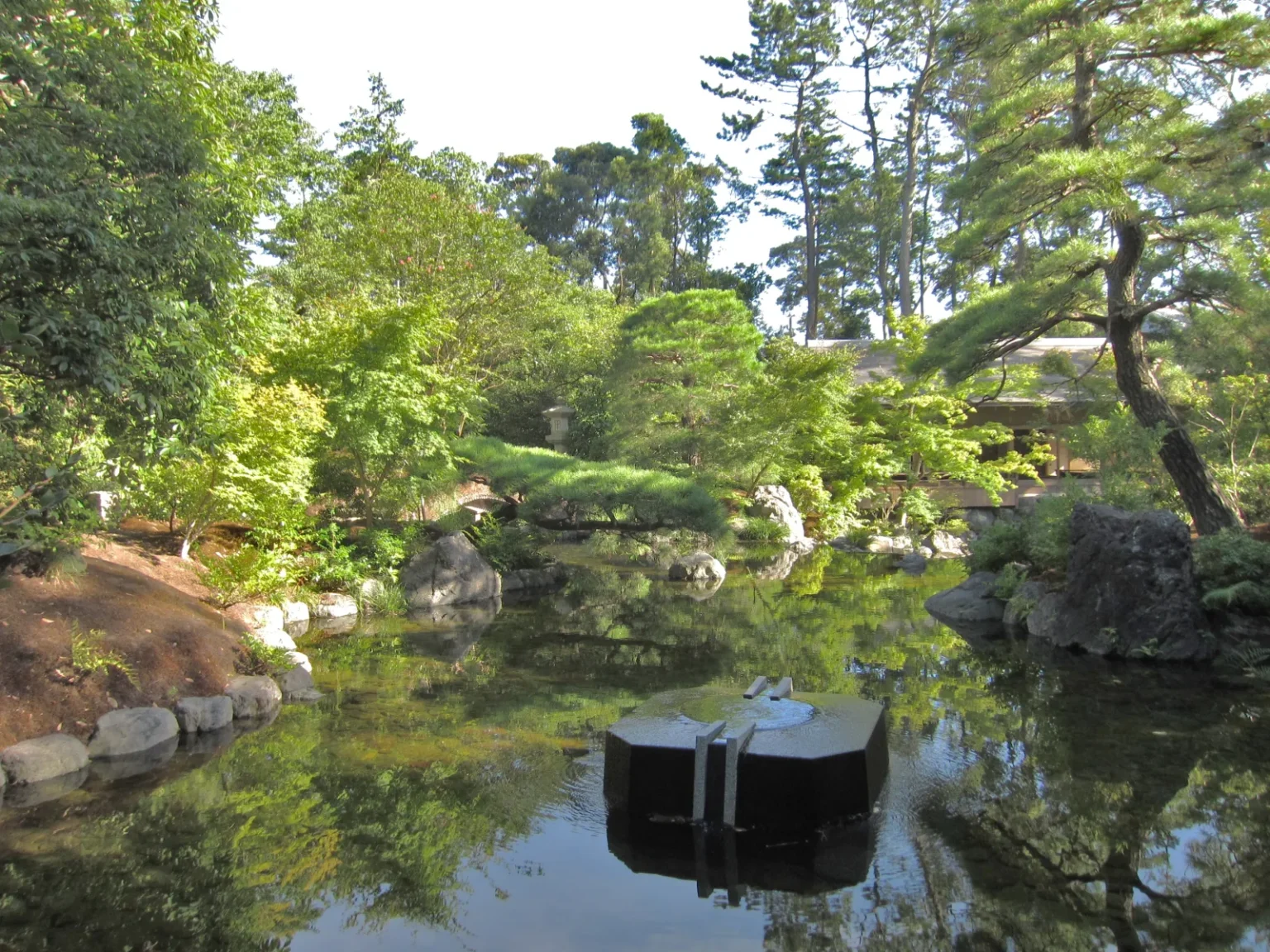
The garden is closed at New Year: it shuts after 13 December and, in the 2025–26 winter, was planned to reopen on 1 March. The photography rules, written for commercial shoots, list the garden among the places where photography is not allowed.
Other dates through 2027 (standing festival calendar)
| Date | Event |
|---|---|
| 10–23 Nov 2026 | 59th chrysanthemum and photo exhibition |
| Setsubun day, Feb 2027 | Setsubun-sai at 11:00 and 14:00, with bean throwing from a special stand in the outer court |
| 30 Jun 2027, 14:00 | Summer purification; walk through the grass ring three times |
| Marine Day, Mon 19 Jul 2027 | Hamaori-sai: about 40 portable shrines on the Chigasaki coast at Nango beach (茅ヶ崎海岸南湖の浜) |
| 15 Aug 2027, 17:30 | Sagami Takigi Noh, torchlit Noh held since 1970 |
| 19–20 Sep 2027 | Annual festival; horseback archery at 14:00 on the 19th |

Etiquette, amulets and practical notes
For the basics of a New Year visit, purification, offering and the bow-clap-bow, see our hatsumode guide. If you draw a fortune slip, our omikuji guide explains the grades and what to do with a bad one. For bowing, clapping and the water basin, see shrine and temple etiquette.
- Amulets: the amulet office is normally open 8:00–16:30. The amulet page lists a happo-yoke ofuda talisman at ¥1,000, happo-yoke good-luck amulets in pouch and card versions, five colours each, at ¥1,000, a small happo-yoke amulet at ¥500 and a travel-safety amulet at ¥1,000.
- Goshuin: the right side of the stamp carries the shrine crest and the words 八方除. The offering is up to you. At New Year only pre-written slips are given, and none are mailed.
- Old amulets: return them at the Nosatsuden, the hall for returned talismans.
- Photos: the photography rules of 10 October 2026 are written for commercial shoots, which need a permit on the day. They bar photography inside the main sanctuary, the kyakuden, the Shinen garden and the Sanshuden, and ask that no one hold a spot near the offering box for long.
- The approach: after trees fell on the approach in July 2026, the shrine asked people to watch overhead, especially in strong wind or after heavy rain.
Plan around these limits
- Driving in January: the 2026 notice warned that the 5-minute drive from the interchange could take about an hour at busy times, and the access notice asks weekend and holiday visitors to use public transport.
- The garden in winter: closed after 13 December until early March.
- English: no English-language prayer service is stated on the shrine’s pages.
- The 0:00 rites: on the October 2026 timetable the last Tokyo-bound connection leaves Miyayama at 23:09, before the rites begin; check the 2026–27 New Year timetable in December.
Questions travellers ask
When is the best time for hatsumode at Samukawa Shrine?
The shrine’s January 2024 newsletter named the first three days of January, weekends and holidays in January and February, and taian days as crowded. A weekday from 4 January 2027 that is not a taian day avoids all of those. For the year-turn rites, be there for 0:00 on 1 January 2027. In the 2025–26 season JR East’s all-night service did not include the Sagami or Tokaido lines, and on the October 2026 timetable the last Tokyo-bound connection is Miyayama 23:09, then Chigasaki 23:35, a train that ends at Shinagawa, not Tokyo Station. The 2026–27 New Year timetable had not been published when checked on 17 October 2026; check it in December.
How crowded is it on 1 January?
The first three days of January were on the shrine’s 2024 list of days that are very crowded every year, and Samukawa Town puts the shrine’s visitors at about 2 million a year. I found no official count for New Year’s Day and no official hourly queue-time figures. The shrine’s access notice asks visitors on weekends and holidays to use public transport.
How do I get there from Tokyo?
From Tokyo Station, the JR Tokaido Line reaches Chigasaki in about 55 minutes (the 7:35 on JR East’s October 2026 Saturday and holiday timetable; the shrine’s route diagram gives 45 minutes from Shinagawa). Then take the Sagami Line to Miyayama, about 15 minutes, and walk 5 minutes. From Shinjuku, the Odakyu Line rapid to Ebina takes 40 minutes, then the Sagami Line about 20. Miyayama, not Samukawa Station, is the stop.
What is happo-yoke, and do I need to book a prayer?
The shrine defines happo-yoke as protection from misfortune from every direction, including the land, a house’s layout and the choice of days, and calls it a divine virtue of Samukawa Daimyojin found nowhere else in the country. You apply on the day at the kyakuden; for New Year 2024 the shrine said prayers were not by reservation and were taken on the day only. Fees start at ¥3,000.
Can foreigners receive a prayer, and is there English?
No nationality condition appears on the shrine’s Japanese or English prayer pages (checked 17 October 2026); you apply at the kyakuden like everyone else. The English pages explain happo-yoke and the fees, but mention no English prayer service or interpreter. Items from online prayers are not sent abroad.
Is the shrine open all night on New Year’s Eve?
In the New Year 2024 example, prayer reception ran through the night: from 23:45 on 31 December 2023 to 17:00 on 1 January 2024. In the 2026 example the amulet office opened at 0:00 on 1 January. The 2027 hours were not posted on 17 October 2026; the 0:00 rites are on the standing calendar. Neither the 2026 direct bus nor JR East’s 2025–26 overnight trains served the shrine.
Can I visit the Shinen garden in winter?
No. It is open from early March to 13 December, closed on Mondays except holidays, from 9:00 to 16:00, and only to people who have received a prayer. In the 2025–26 winter it was closed until the end of February 2026 and planned to reopen on 1 March 2026.
Hatsumode in Japan
How the first shrine visit of the year works, from purification to amulets.
Omikuji Guide
Reading a shrine fortune slip and what to do with it.
New Year’s Day at Okunitama Shrine
Another Kanto shrine on 1 January, in Fuchu, western Tokyo.
Sources
- Checked 17 October 2026 — Samukawa Shrine (samukawajinjya.jp): about the shrine; deities; history; happo-yoke (English); prayers and fees; prayer application form; online prayer; amulets; goshuin; precinct guide; Kantakeyama Shinen; festival calendar; access (route diagram); notices, including car, train and bus access (dated 3 January 2026, re-dated 4 January 2026), photography rules (10 October 2026), fallen trees (17 July 2026); newsletter Sagami nos. 535 (1 January 2024), 543 (1 January 2026) and 546 (1 October 2026) (no. 535 is no longer listed on that page; read from an archived copy)
- Checked 17 October 2026 — JR East, overnight trains on 31 December 2025 – 1 January 2026 (JRE Media, updated 17 December 2025)
- Internet Archive copies of removed shrine notices: New Year 2024 prayer hours (6 December 2023); New Year 2026 amulets and office hours (16 December 2025); visitors from 4 January 2026 (3 January 2026); online prayer pause (24 November 2025); doll hall in January 2026; 2025 nebuta
- Sotetsu Bus, Samukawa Shrine hatsumode direct bus, 1–3 January 2026 and its timetable (PDF), checked 17 October 2026
- Checked 17 October 2026 — Samukawa Town: Ebina–Samukawa bus year-end detour (updated 11 November 2025); Ebina–Samukawa bus guide (4 April 2026); about 2 million visitors a year (updated 1 June 2026); New Year 2022 traffic control (Internet Archive)
- Checked 17 October 2026 — JR East online timetable (October 2026): Miyayama, Sagami Line towards Hashimoto (weekdays, Saturdays and holidays) and towards Chigasaki (weekdays, Saturdays and holidays); Chigasaki, Tokaido Line towards Tokyo (weekdays, Saturdays and holidays); the 23:09 from Miyayama; train pages for the 7:35 from Tokyo, the 8:50 from Chigasaki, the 13:06 from Miyayama, the 13:30 and the 13:23 from Chigasaki
Join travelers discovering Japan's hidden side
Weekly dispatches from off-the-beaten-path Japan — spots and stories you won't find in guidebooks.
No spam. Unsubscribe anytime.
Welcome aboard!
You're in. See you in your inbox soon.