Yamagata Prefecture · Zao Onsen · Winter 2026–27
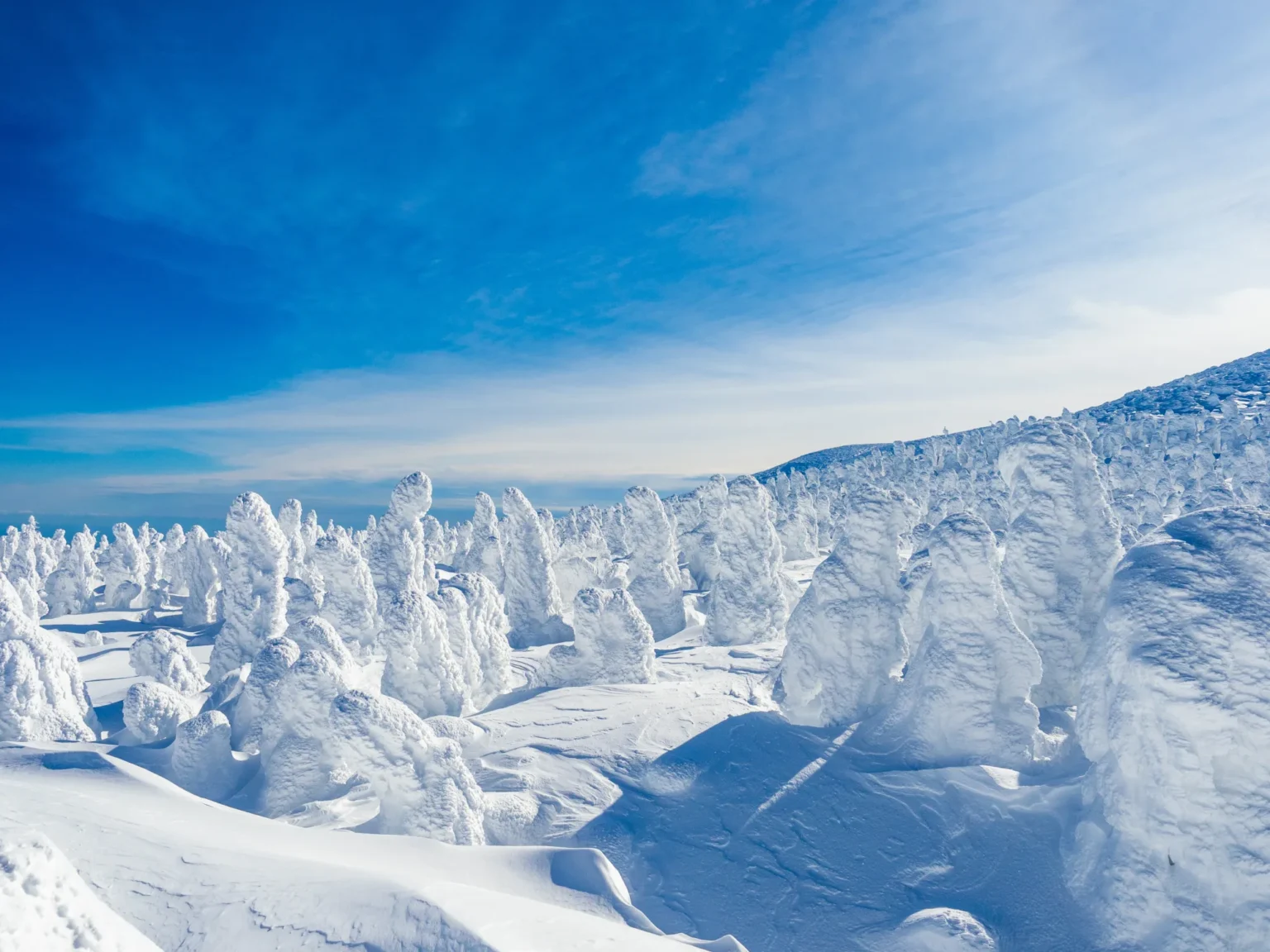
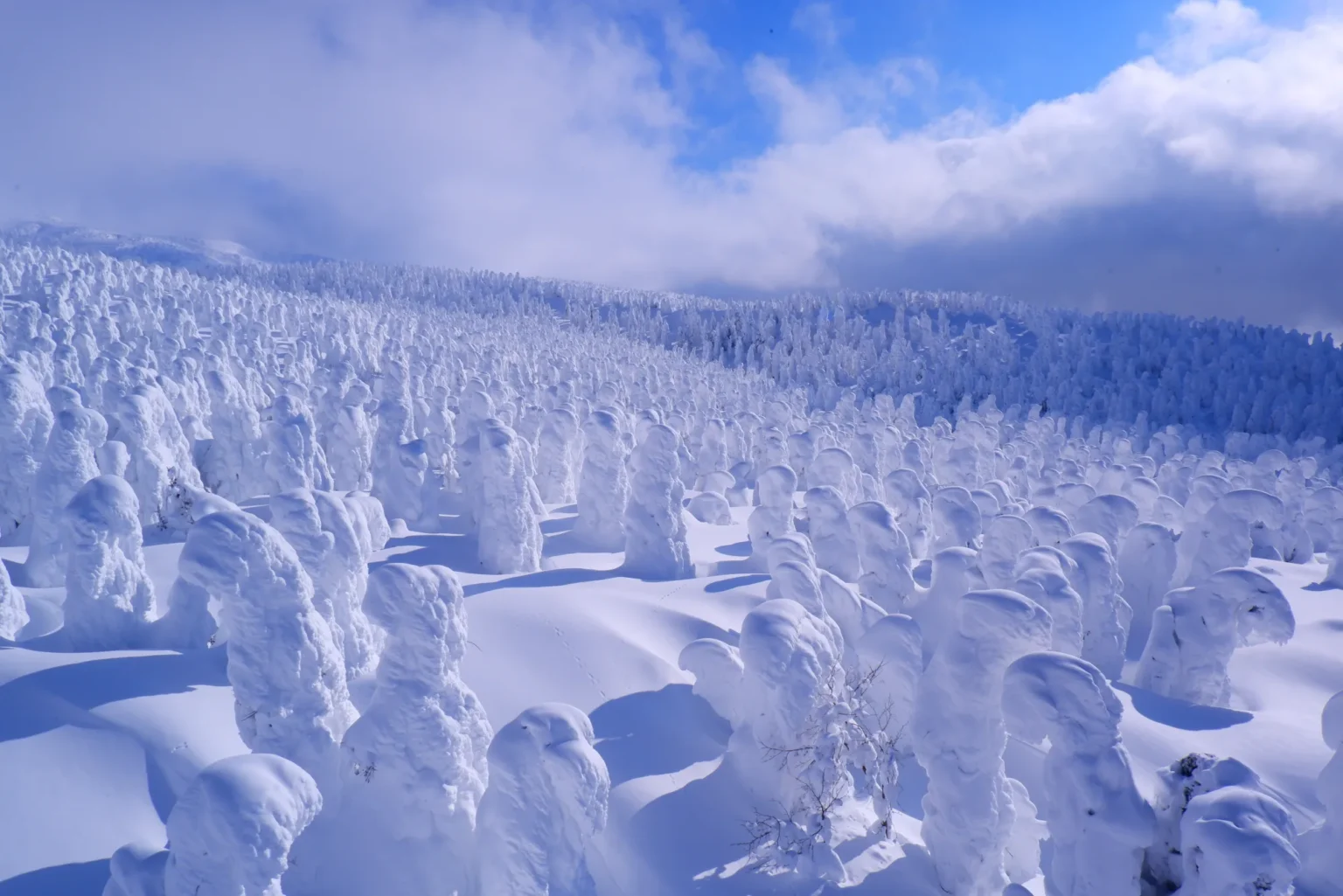
Zao’s snow monsters (juhyo, 樹氷) are Maries’ firs buried in rime and snow on the mountains above Zao Onsen in Yamagata. Zao Ropeway, the operator of the main route up, says they grow through January, peak in February and start to collapse in March. To see them, ride the Zao Ropeway from Zao Onsen to Jizo Sancho Station (1,661 m): ¥4,400 return for adults on the operator’s current fare table, which shows no season year. For 2026–27 the ropeway lights them up only on 31 set nights within 26 December 2026 to 23 February 2027, 17:00–21:00; its 2026–27 flyer gives the night fare as ¥4,600. From Tokyo, take the Yamagata Shinkansen to Yamagata (2 hours 22 minutes to 3 hours 5 minutes in the October 2026 timetable), then a Yamako bus of about 33–37 minutes up to Zao Onsen: about 3 to 3¾ hours of riding, plus the change at Yamagata. The Miyagi side of the range has its own snowcat tours from Sumikawa.
What are Zao’s snow monsters?
They are trees, not sculptures. Zao Ropeway’s page on juhyo explains that they form on Aomori todomatsu (Maries’ fir, Abies mariesii), a conifer of the subalpine zone. Winter monsoon winds from Siberia pick up moisture over the Sea of Japan, drop snow on the Asahi range, cross the Yamagata basin and rise again over Zao. Inside those clouds, many droplets stay liquid below 0°C. When they hit the branches they freeze into feathery ice, called “shrimp tails” in Japanese because of their shape; snow then packs into the gaps, and the whole mass hardens. Repeat that all winter and a fir becomes a monster.
The ropeway’s English page describes Zao’s juhyo as “one of the world’s largest”; that is the operator’s own description. On the ropeway’s light-up map, the juhyo field is drawn around the upper line and Jizo Sancho Station.
When are the snow monsters at their best?
Zao Ropeway gives a four-stage season:
| Month | What the operator says |
|---|---|
| November–December | Early stage: the firs start to be coated in rime and snow |
| January | Growth: shrimp tails build towards the wind, and snow keeps sticking |
| February | Peak: rime and snow are at their heaviest, and the juhyo are at their largest |
| March | Decline: warmer air thins them, and rain can bring them down all at once |
The operator puts the peak in February, so if you can pick only one week, aim for February. The night light-up is a separate question: it runs only on 31 set nights within 26 December to 23 February (see the calendar), and its first nights fall in the growth stage. The ski area plans to open on 12 December 2026, snow permitting, so the slopes open before the monsters reach full size.
For the rest of the month-by-month picture across Japan, see Japan in December 2026; Zao in December is early-season, not peak.
Yamagata side or Miyagi side?
The Zao range sits on the border of Yamagata and Miyagi prefectures, and both sides sell snow-monster trips. They are different places with different operators. Photos online are often labelled just “Zao”, so check which side a tour goes to before you book.
Yamagata side: Zao Onsen
Zao Ropeway runs from Zao Sanroku Station, at the edge of the hot spring town, to Juhyo Kogen Station (1,331 m, 7 minutes), then on to Jizo Sancho Station (1,661 m, 10 minutes). The juhyo field is around the upper line and the summit station. Daytime rides, the night light-up and the Night Cruiser snowcat tour all start here, and you can stay in Zao Onsen’s ryokan.
Miyagi side: Sumikawa
Mountain Field Miyagi Zao Sumikawa, above Togatta Onsen in Zao Town, runs daytime snowcat tours called “Miyagi Zao no Juhyo Meguri”. A snowcat climbs for about 45 minutes from the ski area to a juhyo field higher up, stops there for about 10 minutes, and comes back.
Which Zao Ropeway ticket do you need in the daytime?
For the snow monsters you need a ticket all the way to Jizo Sancho Station. A ticket to Juhyo Kogen only covers the lower line, which runs below the main juhyo field.
| Zao Ropeway fare | Adult / child |
|---|---|
| Zao Sanroku – Jizo Sancho (both lines), return | ¥4,400 / ¥2,200 (one way ¥2,200 / ¥1,100) |
| Zao Sanroku – Juhyo Kogen (lower line only), return | ¥2,200 / ¥1,100 (one way ¥1,200 / ¥600) |
Adult means junior-high age and over; child, elementary school. The fare table on the winter pages does not name a season, while the night fare on the 2026–27 flyer is ¥4,600, so check the window price on the day. Skiers: the ski day ticket’s coverage of the upper line was unconfirmed on 11 October 2026 (see below). The return ticket to the summit can be bought online as a “juhyo viewing” ticket, with priority boarding on the lower line going up, valid once on each of the four legs.
Hours. The Japanese winter page lists the lower line 8:30–17:00 and the upper line 8:45–16:45, with the last departure from Zao Sanroku for a summit return at 16:00. The English page gives different winter hours (11 December–31 March: 8:15–16:45 and 8:30–16:30). Both say times can change and that the ropeway stops in bad weather. To be safe, be at Zao Sanroku before 15:30.
Can you see the snow monsters at night?
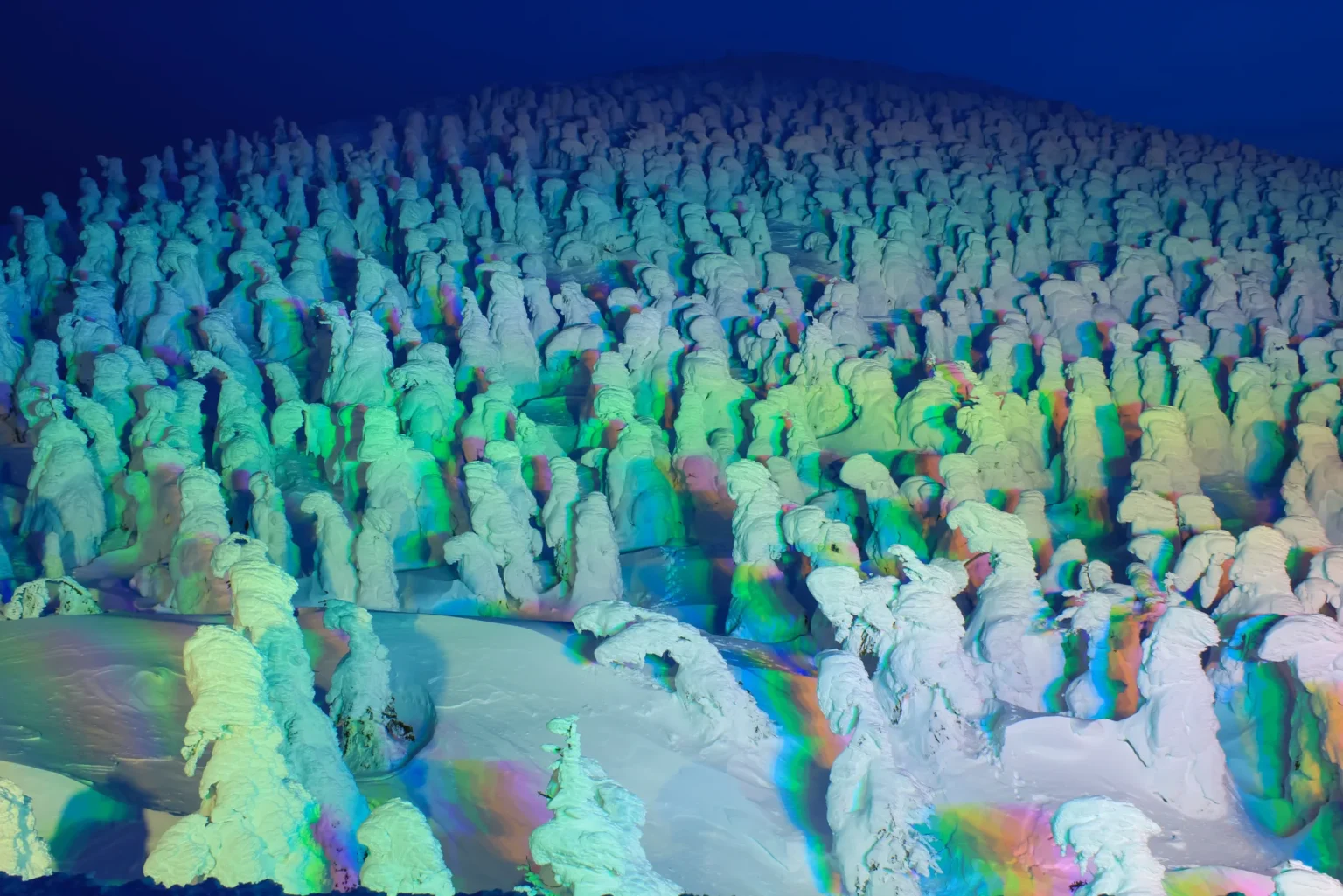
Yes, on the light-up nights. Zao Ropeway’s 2026–27 flyers, posted on 4 October 2026, give the dates. The flyer’s area map marks two viewing points: at Jizo Sancho Station and along the upper line near Juhyo Kogen Station. At night you may view only the areas the operator allows: inside the ropeway and in and around its stations.
| Juhyo light-up, 2026–27 | Details from the operator’s flyer |
|---|---|
| Season | Saturday 26 December 2026 to Tuesday 23 February 2027, 31 nights only |
| December nights | 26, 27, 30, 31 |
| January nights | 1, 2, 3, 9, 10, 11, 16, 17, 22, 23, 24, 29, 30, 31 |
| February nights | 5, 6, 7, 10, 11, 12, 13, 14, 19, 20, 21, 22, 23 |
| Hours | 17:00–21:00; last ride up leaves Zao Sanroku at 19:45 |
| Fare | Zao Sanroku – Jizo Sancho return: ¥4,600 adult, ¥2,300 child (6–11) |
| Rules | No skis or snowboards; viewing only inside and around the ropeway stations; groups of 20 or more must book; cancelled in bad weather or if the juhyo collapse |
Most of the nights are Fridays to Sundays and holidays, plus the New Year days and a few February weekdays, so a midweek trip in January can miss them. The flyer says groups of 20 or more must book; for individual visitors, check how to buy on the ropeway’s site before you go.
The Night Cruiser snowcat tour (Juhyo Genso Kairo)
The ropeway also runs a heated snowcat, the Night Cruiser, into the lit-up field on the same 31 nights. This is the tour the operator calls “Juhyo Genso Kairo” (樹氷幻想回廊, roughly “corridor of juhyo fantasy”).
- What the ticket covers: a return ride on the lower line plus the snowcat. The snowcat leaves Juhyo Kogen Station, turns at the top of tower 4 on the upper line, and comes back. The operator says it does not go to Jizo Sancho Station.
- Price: ¥8,000 adult, ¥7,000 child (age 1 to elementary school).
- Departures: 17:00, 18:00, 19:00 and 20:00 from Zao Sanroku Station; 36 people per departure; about 70–80 minutes in all, about 30 minutes of it in the snowcat. Check in at the Zao Sanroku window 20 minutes before.
- Booking: required. Bookings open 7 days before the date, from 14:00 on the release day. Use the tour-ticket application link at the bottom of the ropeway’s tour page: the page notes that the QR code in the posted flyer image cannot be read. The ropeway’s notice of 4 October 2026 says bookings go through JTB’s local-tour plan site, and that phone bookings are not accepted.
- Cancellations: the tour is cancelled if the juhyo on the route collapse.
Booking a tour instead
Some tours include transport or tickets, but what is included differs from product to product. Before you pay, check three things: which side of Zao it goes to (Yamagata or Miyagi), whether it includes the ropeway to Jizo Sancho or only a snowcat, and the departure city.
Compare guided trips by side of the mountain, inclusions and departure city.
Zao snow-monster tours on KlookGetting to Zao Onsen from Tokyo
By rail, change to a bus at Yamagata Station: Zao Onsen has no railway station. JR’s Zao Station on the Ou Main Line is a different place, down in the city, so don’t get off there expecting the ropeway.
Yamagata Shinkansen (Tsubasa), Tokyo to Yamagata
In JR East’s timetable for October 2026, Tsubasa trains from Tokyo reach Yamagata in 2 hours 22 minutes (the 9:24 from Tokyo, arriving 11:46) to 3 hours 5 minutes (the 18:48, arriving 21:53, which does not run every day); most take 2 hours 36–55 minutes, for example the 9:00 from Tokyo, arriving 11:38. The JR East timetable lists every Tsubasa car as reserved, so book a seat. The winter timetable may differ, so check the date of your trip.
Does the Japan Rail Pass cover it? The train, yes: the official JR Pass site lists all Yamagata Shinkansen trains as covered, in ordinary and Green cars. The bus from Yamagata Station to Zao Onsen is run by Yamako Bus, not JR, and the Zao Ropeway is a separate company, so you pay both. Whether the pass is worth buying depends on the rest of your trip; JR Pass vs individual tickets does the sums.
Zao as one stop on a longer rail trip? The pass covers the Tsubasa, not the bus or the ropeway.
Japan Rail Pass on KlookYamako bus, Yamagata Station to Zao Onsen
The bus runs between Yamagata Station and Zao Onsen Bus Terminal. The Zao Onsen Tourism Association’s English access page, which is undated, shows a timetable that matches archived copies from 2019, 2022 and 2024: departures roughly every hour, no reservation, and these times: Yamagata Station to Zao Onsen about 33–37 minutes; Zao Onsen to Yamagata Station about 37–45 minutes. The same page still shows a ¥1,000 fare. The Tohoku District Transport Bureau approved ¥1,200 for adults on this route from 1 April 2024; I could not confirm the current fare. Yamako Bus’s own website did not load when I tried it on 11 October 2026, so check the winter timetable there or at the station before you travel.
From Sendai
- To the Yamagata side by train: JR’s Senzan Line runs from Sendai to Yamagata roughly hourly. In JR East’s October 2026 timetable the rapids take 1 hour 21–24 minutes to Yamagata and the locals about 1 hour 25 minutes to 1 hour 40 minutes. It is a JR line, so the Japan Rail Pass covers it. Then take the Yamako bus to Zao Onsen as above.
- A direct winter bus? The tourism association’s access page listed a reserved winter bus between Sendai Station and Zao Onsen in its archived 2018–19 version (8:00 from Sendai, 9:40 at Zao Onsen; 16:30 back); it was hidden in archived copies of the page from winter 2019–20, 2022 and 2024, and I found no 2026–27 schedule. Treat it as unconfirmed.
- To the Miyagi side by bus: Sumikawa’s bus page describes a reserved bus called “Juhyo-go” from the tour and shuttle-bus stop at Sendai Station’s east exit, leaving at 9:10 and arriving back there at 17:40, timed for the 11:30 snowcat tour. On 11 October 2026 the bus-and-tour package prices on that page were still labelled with last season’s dates, so I treat the bus days, times and package prices as unconfirmed for 2026–27. Confirm them when you book (phone 0224-85-3055, 10:00–15:00).
Sumikawa snowcat tours, 2026–27
| Miyagi Zao no Juhyo Meguri | Details from Sumikawa’s tour page |
|---|---|
| Season | Saturday 19 December 2026 to Sunday 7 March 2027; bookings from Sunday 1 November 2026, by phone |
| Departures | 11:30 (back 13:30) and 13:30 (back 15:30); about 45 min each way, about 10 min at the juhyo field |
| Standard class, adult | ¥6,000 (19–25 Dec), ¥7,000 (26 Dec–31 Jan), ¥9,000 (1 Feb–7 Mar); child ¥5,000 |
| Deluxe class, adult | ¥9,000 / ¥10,000 / ¥12,000 for the same periods; child ¥8,000 |
| Included | Snow-boot rental during the tour; pay on the day in cash or by card |
| Cancellation fees | 40% three days before, 50% two days before, 60% the day before, 100% on the day |
The tour dates and prices in this table are from Sumikawa’s 2026–27 tour page. Sumikawa notes that the snowcat may change route or stop in bad weather, and that once you have boarded it gives no refund or compensation if the juhyo cannot be seen, for example because warm weather or rain has brought them down. If you are building a wider loop through Sendai, Yamadera and Ginzan Onsen, see the Tokyo to Tohoku 5-day itinerary.
How cold is it, and what if the wind closes the ropeway?
Zao Ropeway’s description of the winter weather is blunt. In January and February there are few clear days, the wind blows from the northwest to west at an average of 10–15 m/s, and average temperatures are −10 to −15°C: a world of blizzards, which is exactly what grows the juhyo. The light-up flyer says it is around −10°C near the summit viewing area, with a risk of strong wind day and night, and the juhyo page warns that it drops below −10°C at night.
- Dress for wind, not just cold. A windproof shell, an insulated layer, gloves, a hat that covers your ears, and boots with grip.
- Expect stoppages. Both the ropeway and the light-up stop in bad weather. Check the operation status on the ropeway’s site on the morning of your trip, and give yourself a spare day if Zao is the reason for the trip.
- Snow can stop buses and trains too. For general preparation for snow anywhere in Japan, not Zao-specific, see what to do before heavy snow lands.
For frost on trees in Hokkaido, see Tomamu’s Frost Tree Terrace. The Sapporo Snow Festival 2027 runs from 4 to 11 February 2027, in the month the ropeway names as Zao’s peak.
Are the snow monsters disappearing?
Some of the trees have died, and this is documented. According to the Forestry Agency’s Tohoku Regional Forest Office, from around autumn 2013 the larvae of a moth (トウヒツヅリヒメハマキ) and a bark beetle (トドマツノキクイムシ) spread through the firs near the summit of Mount Jizo, and many of them died. Because these are the firs that become juhyo, the Yamagata Forest Office has been replanting. From June to October 2021, it moved native seedlings 20–30 cm tall from 1,300–1,400 m, where damage was light, to around 1,600 m, where it was worst. The office reported that the 82 seedlings planted on trial since 2019 were growing roughly as planned, and at a field visit in September 2025 it said that seedlings grow slowly and the forest will take many years to recover.
For a 2026–27 visit: many firs near the summit have died since around 2013, and the regeneration work is continuing. The operator itself warns that the juhyo may not be visible in some weather, and that the night events stop if they collapse. The Forestry Agency documents I checked on 11 October 2026 give no current count of the trees, and I have not checked one elsewhere, so I give no number.
Where to stay: Zao Onsen
Zao Onsen is the hot spring town at the foot of the ropeway. The tourism association describes its water as a strongly acidic sulphur spring and claims about 1,900 years of history. It lists three public bathhouses, Kamiyu, Shimoyu and Kawarayu, open 6:00–22:00 all year, where you pay into a box at the door. If you have not used a Japanese public bath before, read onsen etiquette in Japan first; tattoos, washing before you get in and towels are all covered there.
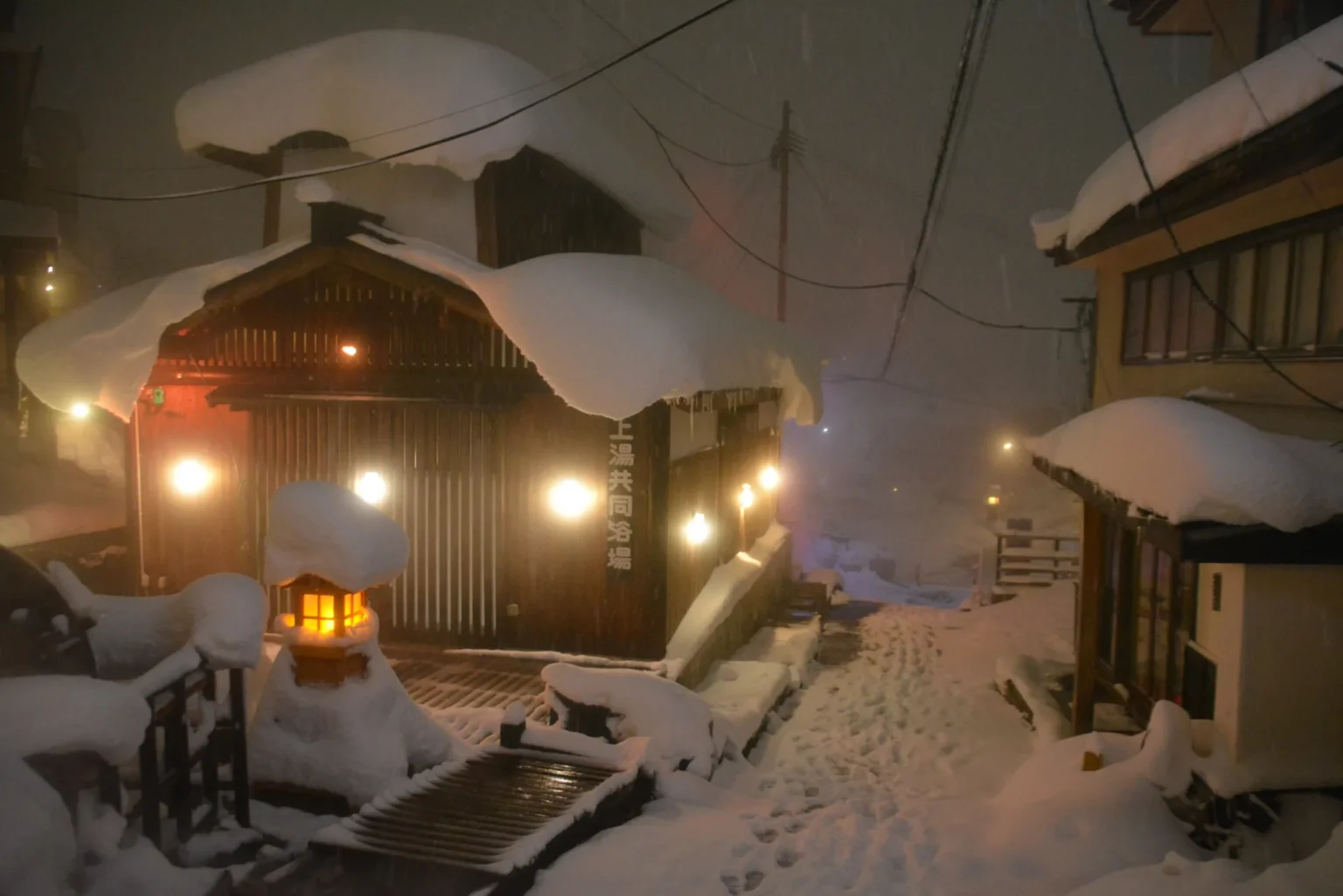
Staying in town makes the snow monsters easier. You can be at the ropeway when it opens if the morning is clear, you can try again the next day if the wind closes it, and you can stay out for the light-up without worrying about the last bus. If you want a light-up night, check the calendar above before you book the room.
Stay in Zao Onsen near the ropeway, and match the dates to a light-up night.
See Zao Onsen hotels and ryokan on Booking.comFAQ
When is the best time to see the Zao snow monsters?
February. Zao Ropeway says the juhyo grow through January, reach their peak in February, and start to thin and collapse in March. The 2026–27 light-up is a separate matter: it runs only on 31 set nights within 26 December 2026 to 23 February 2027.
How much is the Zao Ropeway to see the snow monsters?
¥4,400 return for adults (¥2,200 for children) from Zao Sanroku Station to Jizo Sancho Station on the operator’s current winter fare table, which shows no season year. On 2026–27 light-up nights the 2026–27 flyer gives ¥4,600 for adults and ¥2,300 for children aged 6 to 11. Whether a ski day ticket covers the ride to Jizo Sancho was unconfirmed on 11 October 2026; ask at the ticket window before you buy.
What are the Zao snow monster light-up dates for 2026–27?
Only on 31 set nights between Saturday 26 December 2026 and Tuesday 23 February 2027, 17:00–21:00, with the last ride up at 19:45: 26, 27, 30 and 31 December; 1–3, 9–11, 16, 17, 22–24 and 29–31 January; and 5–7, 10–14 and 19–23 February.
Does the night snowcat tour go to the summit?
No. The Juhyo Genso Kairo tour (¥8,000 for adults) includes a return ride on the lower line and a snowcat ride from Juhyo Kogen Station to the top of the upper line’s tower 4 and back. To see the light-up from Jizo Sancho Station as well, you need a separate light-up ticket, and you must be able to ride up before the last departure at 19:45; after a late snowcat departure you cannot go up to the summit.
Does the Japan Rail Pass cover the trip to the Zao snow monsters?
It covers the Yamagata Shinkansen from Tokyo to Yamagata and the JR Senzan Line from Sendai. It does not cover the Yamako bus from Yamagata Station to Zao Onsen, the Zao Ropeway or Sumikawa’s snowcat tours.
Can I see the snow monsters as a day trip from Sendai?
Possibly, but check the buses first. For the Yamagata side, the JR Senzan Line takes about 1 hour 20 minutes to 1 hour 40 minutes to Yamagata, then the Yamako bus goes up to Zao Onsen; confirm the 2026–27 winter bus times in both directions. For the Miyagi side, Sumikawa’s snowcat tours run 19 December 2026 to 7 March 2027, and its page describes a Juhyo-go bus from Sendai Station’s east exit at 9:10; confirm that bus’s 2026–27 days, times and price with Sumikawa when you book.
Sources
The primary sources behind the figures above, checked on 11 October 2026
- Zao Ropeway: juhyo, winter weather and season stages; fares, hours and line specifications; English page (winter hours); online tickets; Juhyo Genso Kairo tour, with the 2026–27 flyers; news (light-up and tour notices of 4 October 2026)
- Zao Onsen ski area (Zao Sakudo Association): 2026–27 lift tickets and rules and price list PDF (1 September 2026)
- Zao Onsen Tourism Association: access and bus timetable (undated); hot spring and public baths; ski courses
- Mountain Field Miyagi Zao Sumikawa: 2026–27 snowcat tour dates and prices; Juhyo-go bus from Sendai; access and Zao Echo Line winter closure
- JR East: Tokyo Station, Yamagata Shinkansen departures; Sendai Station, Senzan Line departures
- Japan Rail Pass: train accommodations and scope of validity
- Tohoku District Transport Bureau, Yamagata office: Yamako Bus fare approval, 4 March 2024 (PDF)
- Forestry Agency, Tohoku Regional Forest Office: regenerating the Aomori todomatsu forest (PDF); field visit report, 2 September 2025 (PDF)
Join travelers discovering Japan's hidden side
Weekly dispatches from off-the-beaten-path Japan — spots and stories you won't find in guidebooks.
No spam. Unsubscribe anytime.
Welcome aboard!
You're in. See you in your inbox soon.