
Tokyo · Setagaya · Walked and photographed
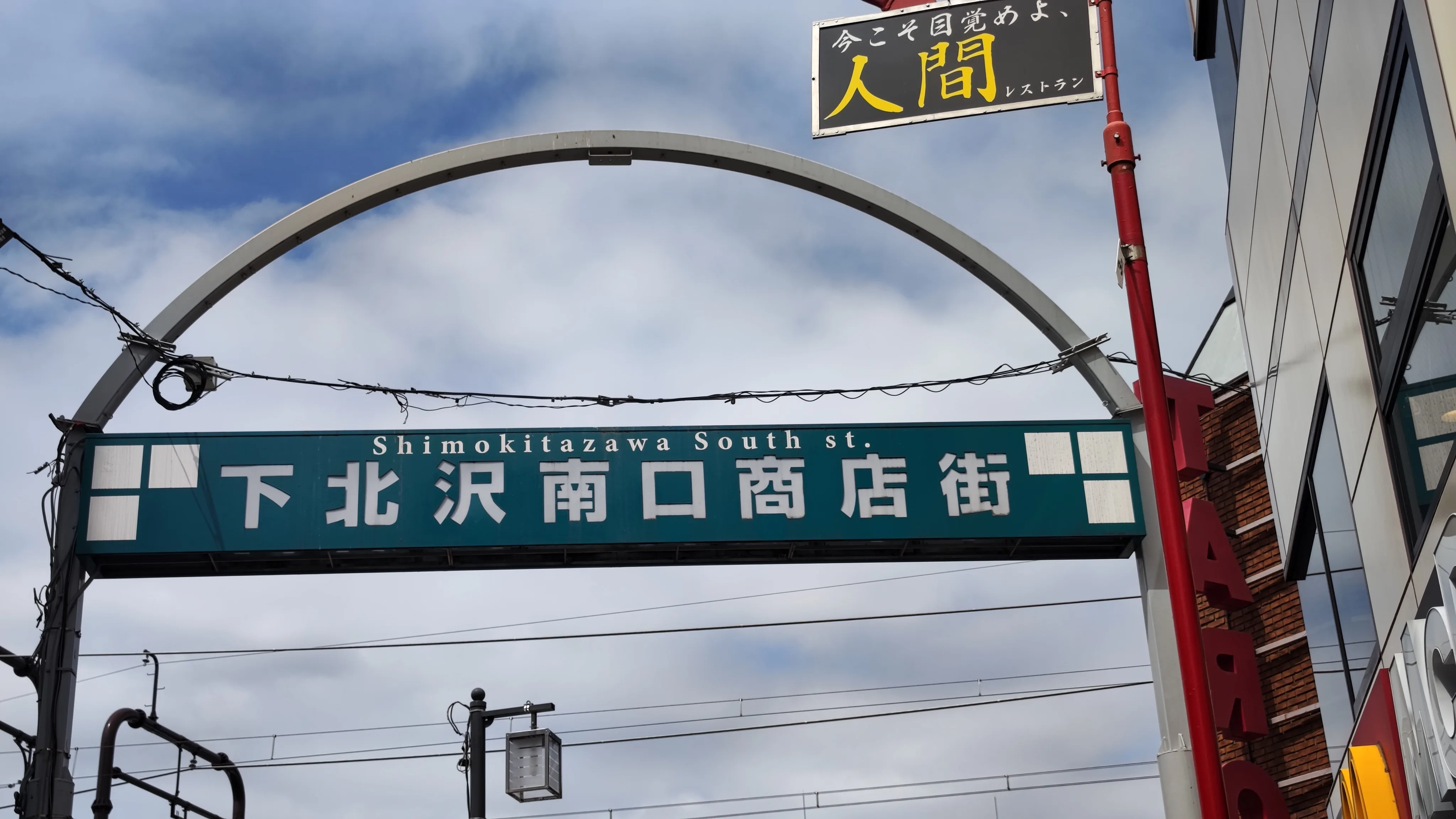
On 20 May 2026 I photographed a 23-minute walk through the streets south and east of Shimokitazawa Station — 32 frames between 17:30:39 and 17:53:25, all of them shown here with their timestamps. Then I checked what they appear to say against Odakyu’s, Keio’s, Setagaya City’s and the shopping-street associations’ own published pages, because coloured paving, festival banners and English guidebook listings are all easy to misread without that.
 Open this photograph at full resolution, opens in a new tab
What is on this page, and what is not
Many English-language guides approach Shimokitazawa as a shop list. This one does not, because I did not walk in with a list. I came out of the station in the early evening and photographed what was in front of me until I got back to the Keio entrance. All 32 frames are here, numbered and timestamped in shooting order. The four landscape frames — 16, 22, 25 and 32 — are shown full-width beside the sections they illustrate rather than inside the strips; the numbering still follows the order the camera recorded them. Every photograph opens at full resolution in a new tab if you want to read a sign or a price tag for yourself.
| This page gives you | This page does not give you |
|---|---|
| 32 consecutive frames with times, covering 23 minutes | Coverage of the whole neighbourhood — most of Shimokitazawa’s vintage shops are north of the station |
| Price signage I photographed and can quote | A recommended-shops ranking |
| Shop names only where the sign is legible in the frame | Names guessed from location |
| Opening hours from the associations’ own directories | Hours for the individual shops in these photos, which most do not publish |
| A reconstruction of the walk by clock time | A route map — the camera recorded no GPS |
Checkpoint 1 of 5 · 17:30–17:33
What do the streets actually look like?
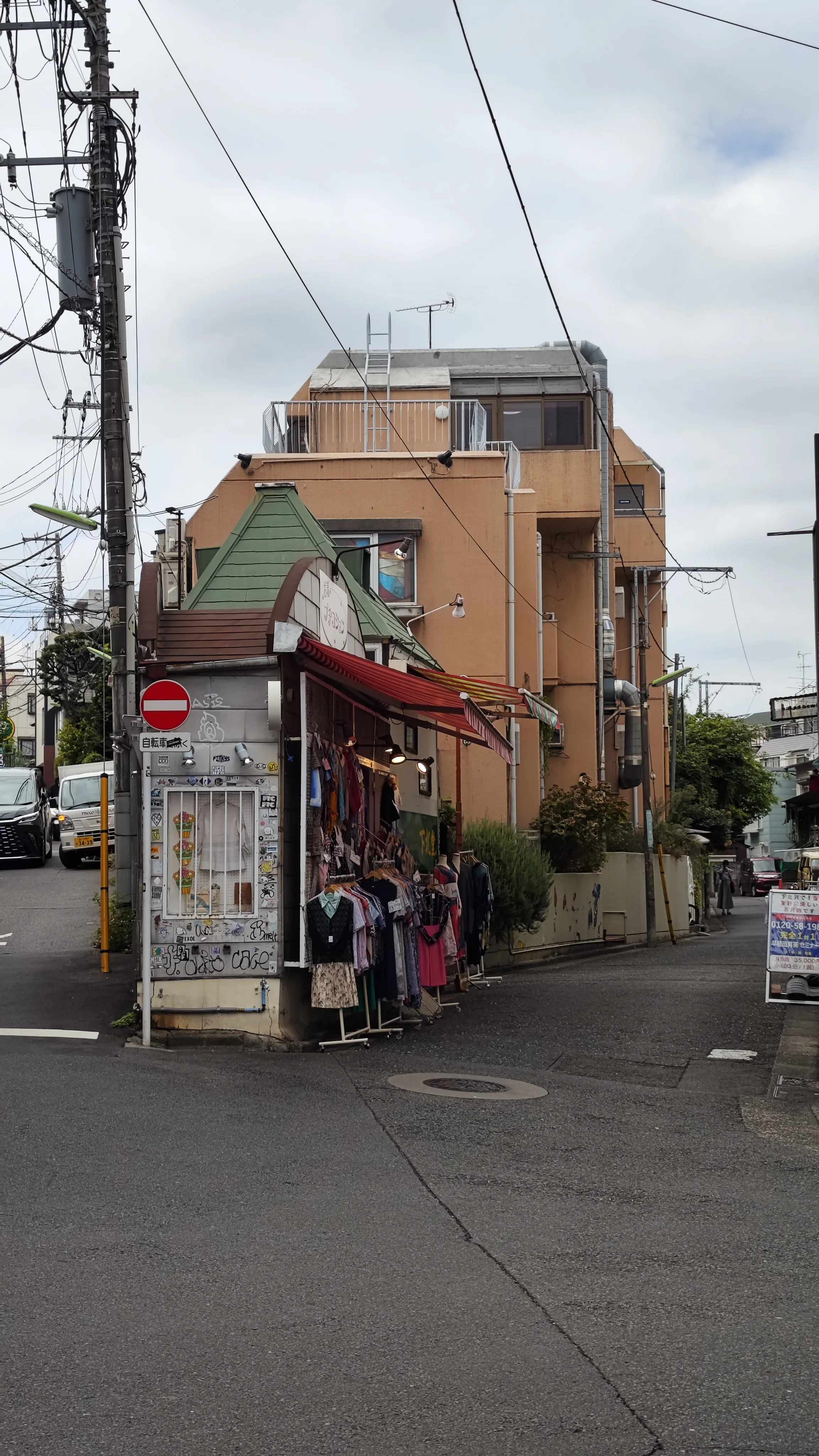
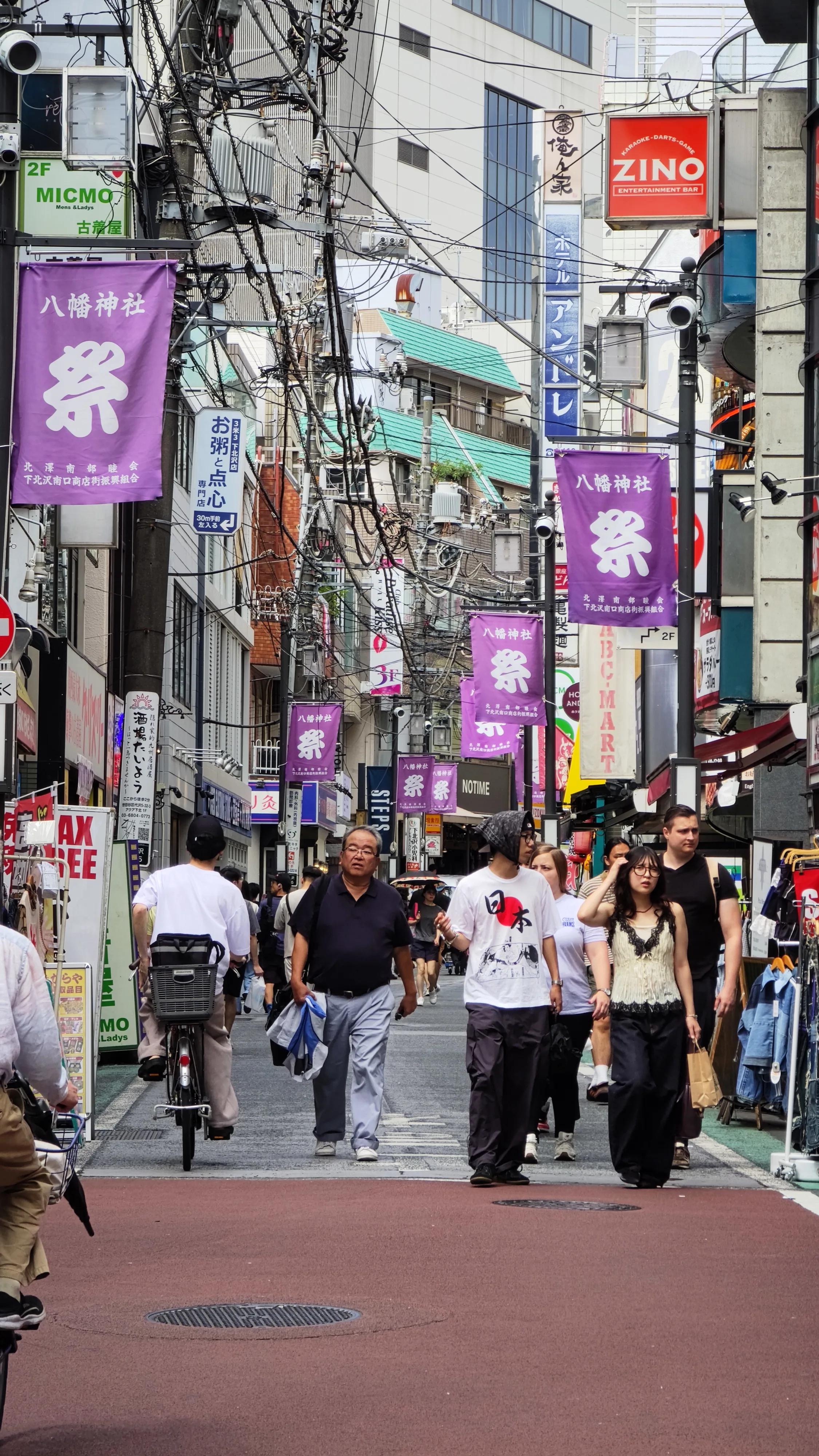
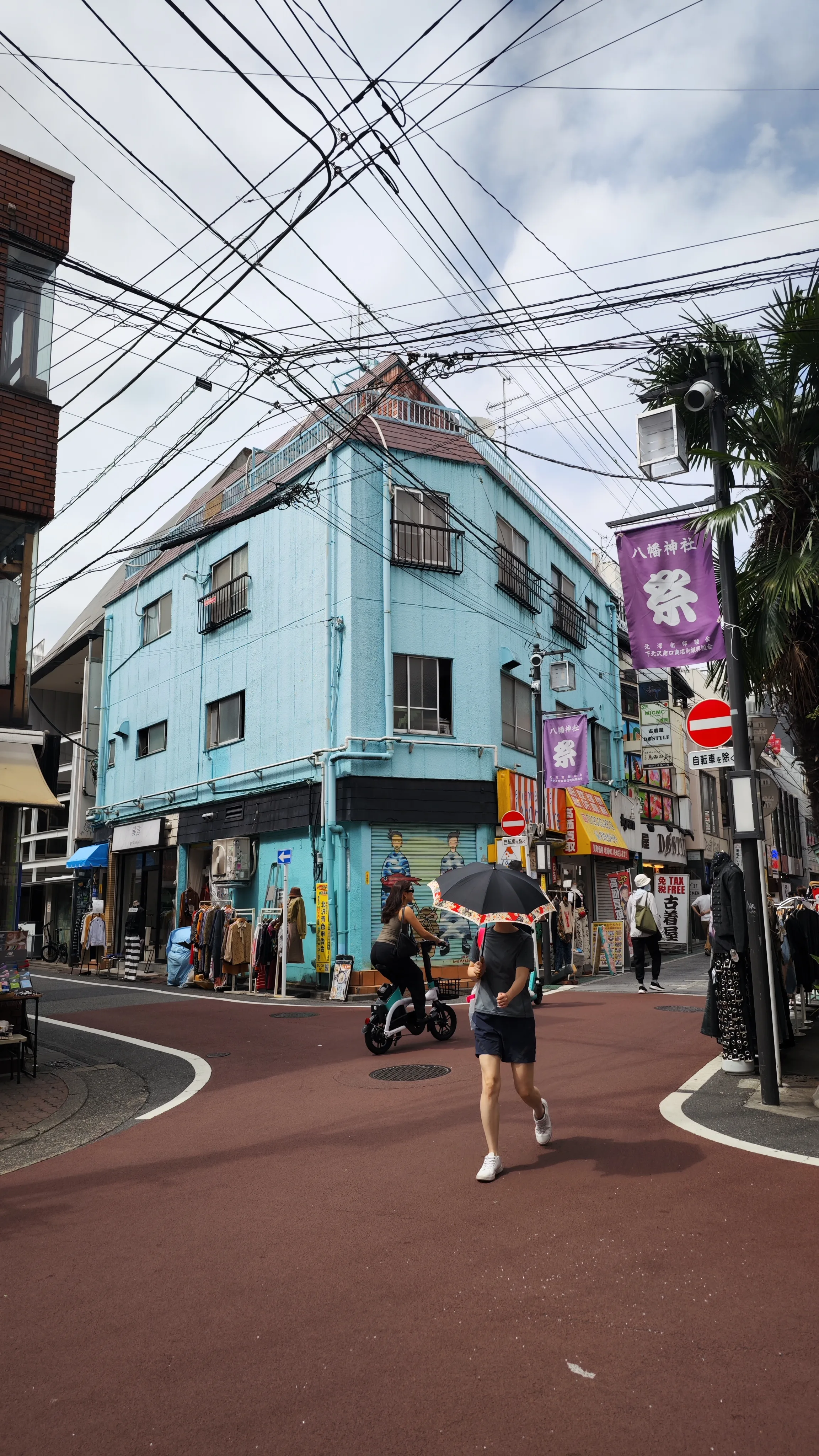
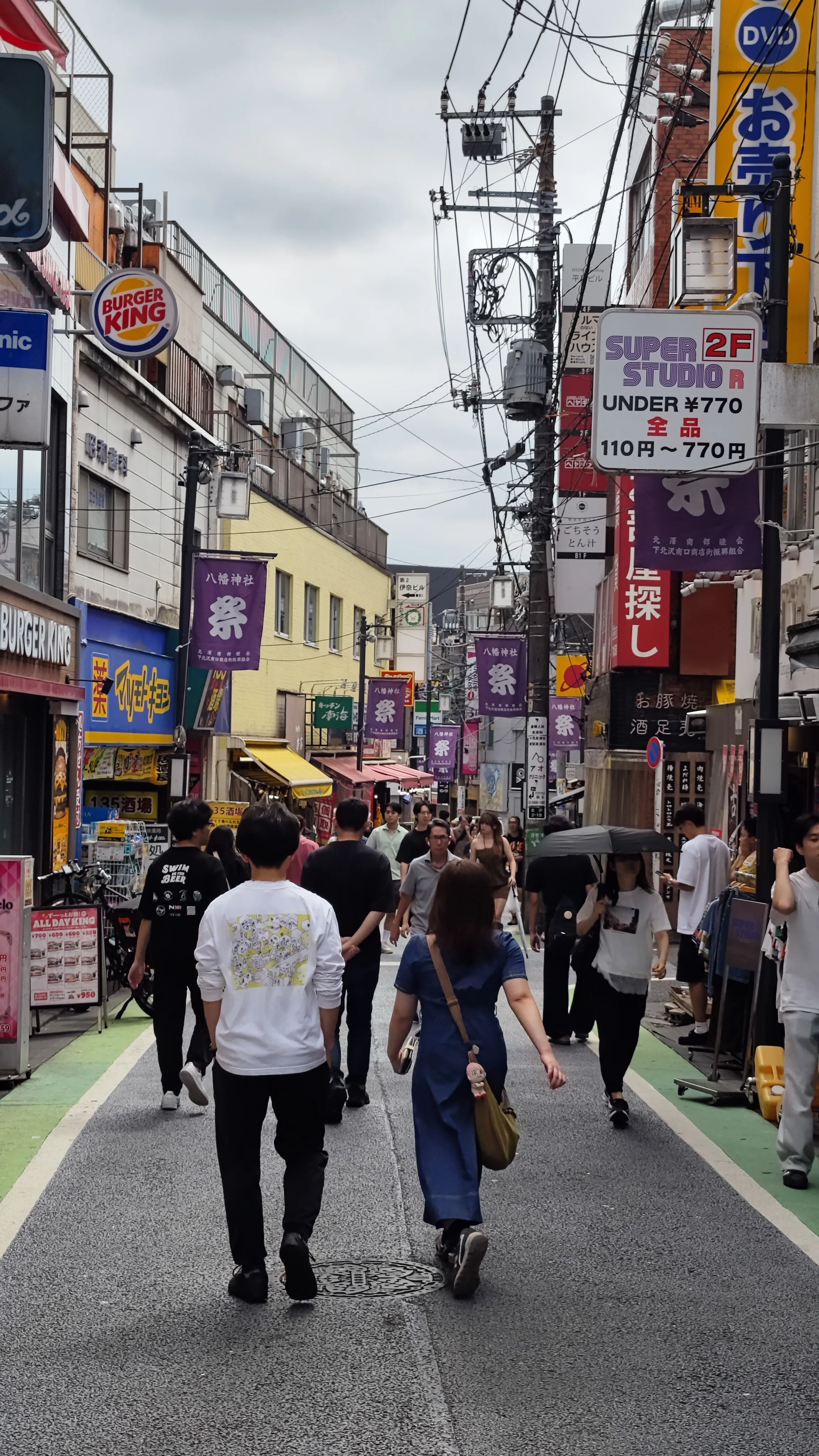
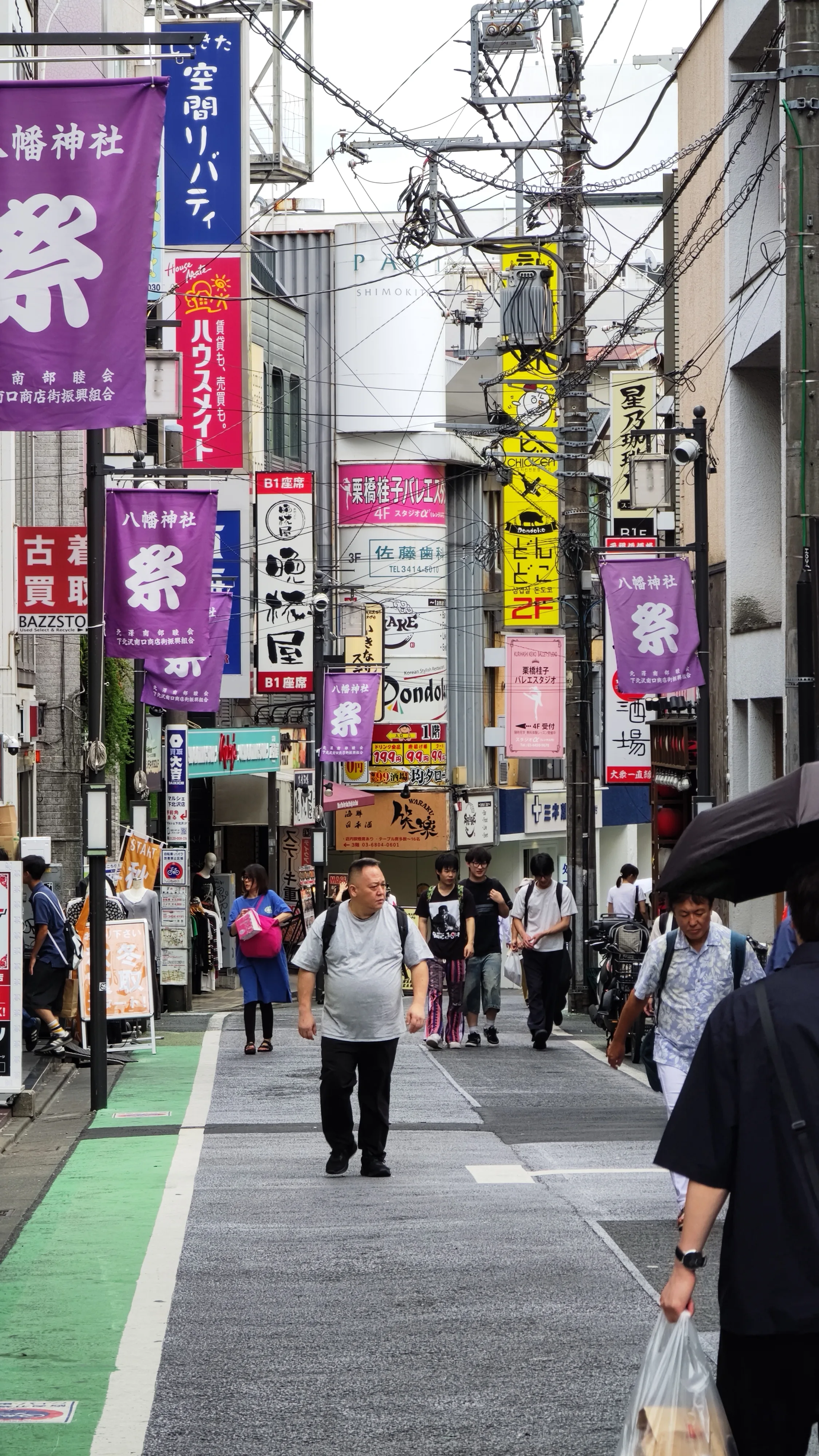
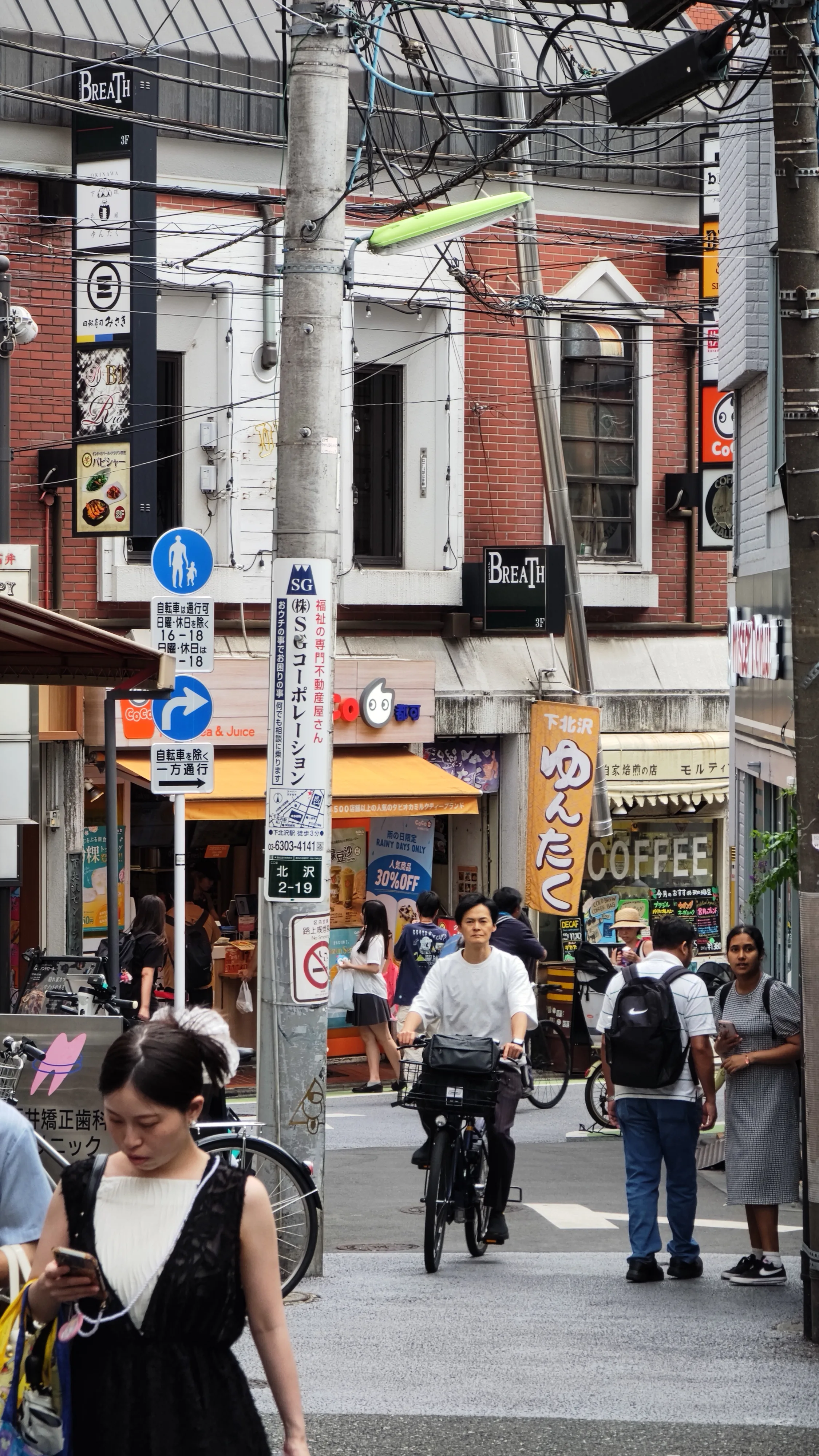
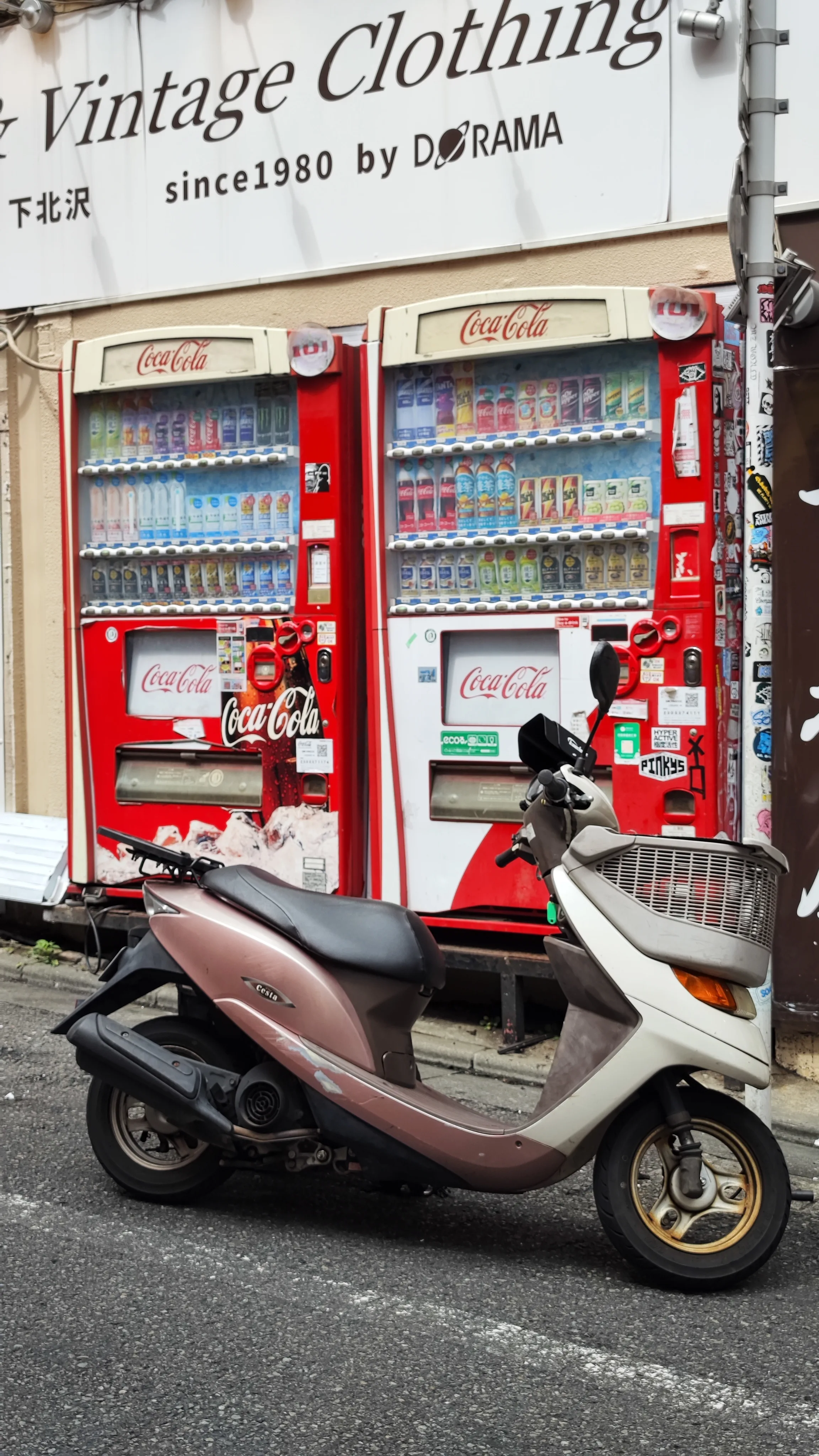
Low-rise, narrow, and crossed overhead by utility lines. Setagaya City’s own draft policy on traffic in the district puts a figure on the second of those: 「駅前の商店街通りは幅員6メートル未満の狭い道路が中心」 — the shopping streets in front of the station are mostly under six metres wide. I did not measure anything, but that description matches the scale in the frames below, and it is why one delivery van changes the whole street.
Horizontal photo strip. Swipe sideways, or give it keyboard focus and use the left and right arrow keys.
 Open this photograph at full resolution, opens in a new tab
 Open this photograph at full resolution, opens in a new tab
 Open this photograph at full resolution, opens in a new tab
 Open this photograph at full resolution, opens in a new tab
 Open this photograph at full resolution, opens in a new tab
 Open this photograph at full resolution, opens in a new tab
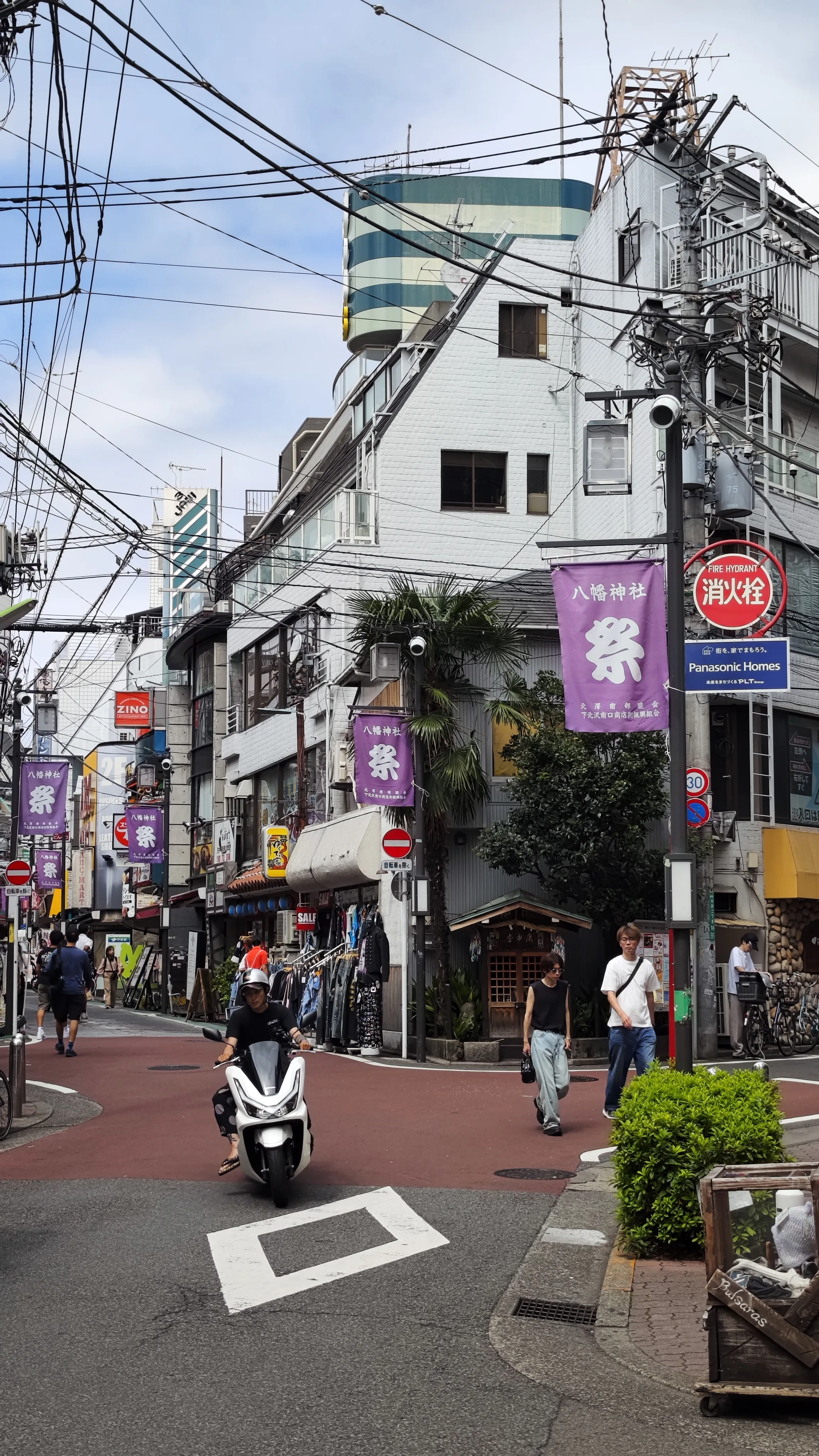
Does the red surface mean the street is pedestrian-only?
Not by itself. Coloured paving carries no single legal meaning in Japan, and from the published pages I checked I could not confirm what vehicle restrictions, if any, apply to each of the streets in these photographs. Setagaya City’s Zone 30 register lists Daizawa 1–3 chōme for this district rather than these streets, but Zone 30 is a 30 km/h speed measure and a separate instrument from a pedestrian-only designation. The Tokyo Metropolitan Police page on designated pedestrian roads names the Akihabara, Ginza and Shinjuku areas, and it is a guide to those areas rather than a register of every local time restriction in Tokyo. Kitazawa Police Station, which covers Shimokitazawa, publishes no traffic-regulation page at all.
So: read the signs at the entrance to each street, including the supplementary plates that carry the hours, and do not infer anything from the colour under your feet. What the ward does state is an intention rather than a rule — its machizukuri page for the station area, last updated 12 February 2026, records that plans adopted in 2004 and 2006 aim at 「歩行者が主体の安全・快適で、回遊性のある魅力的な商業空間の形成」, an attractive commercial area in which pedestrians are the principal users.
Checkpoint 2 of 5 · 17:34–17:36
Is it really a vintage district, or is that just the reputation?
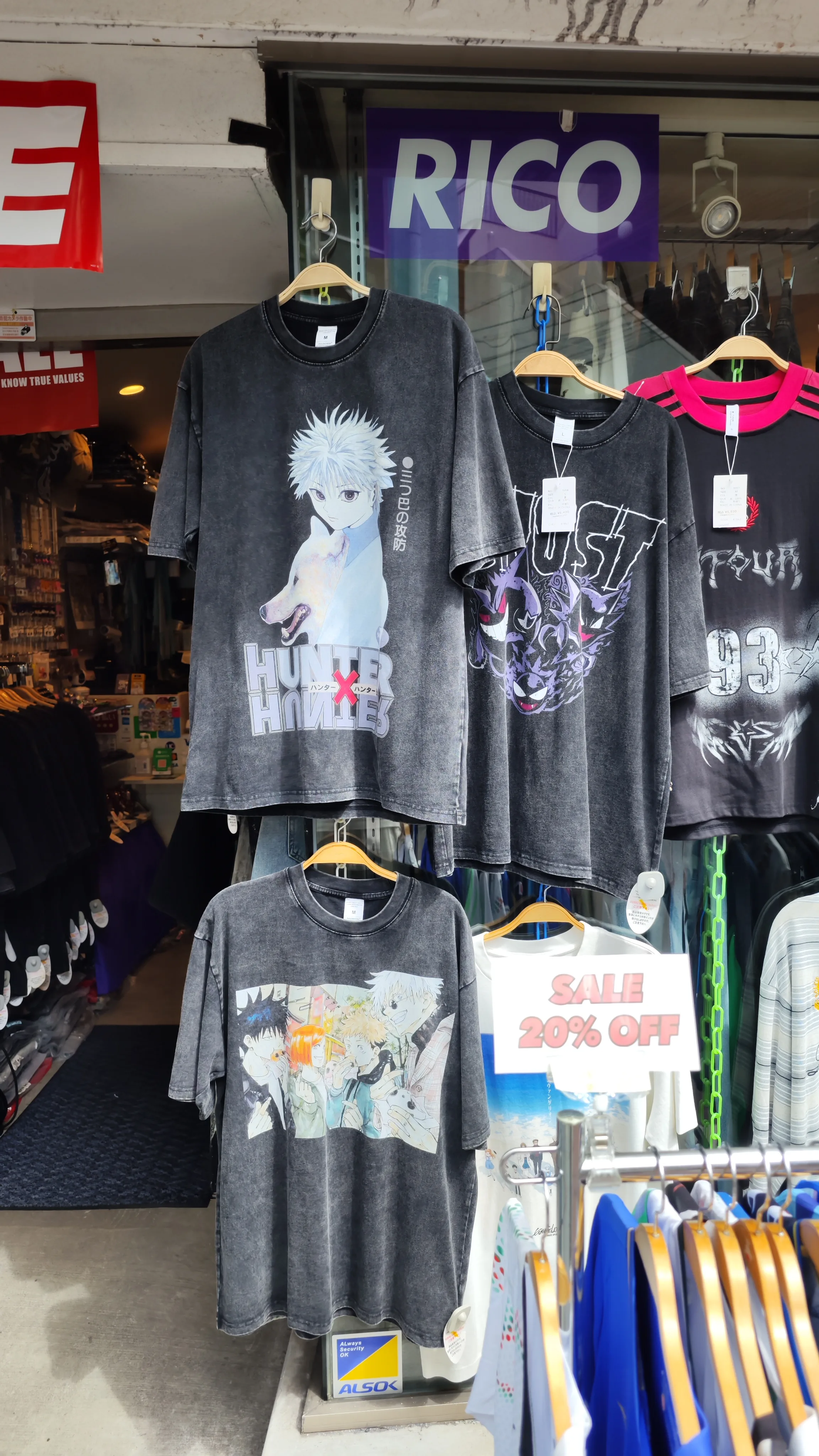
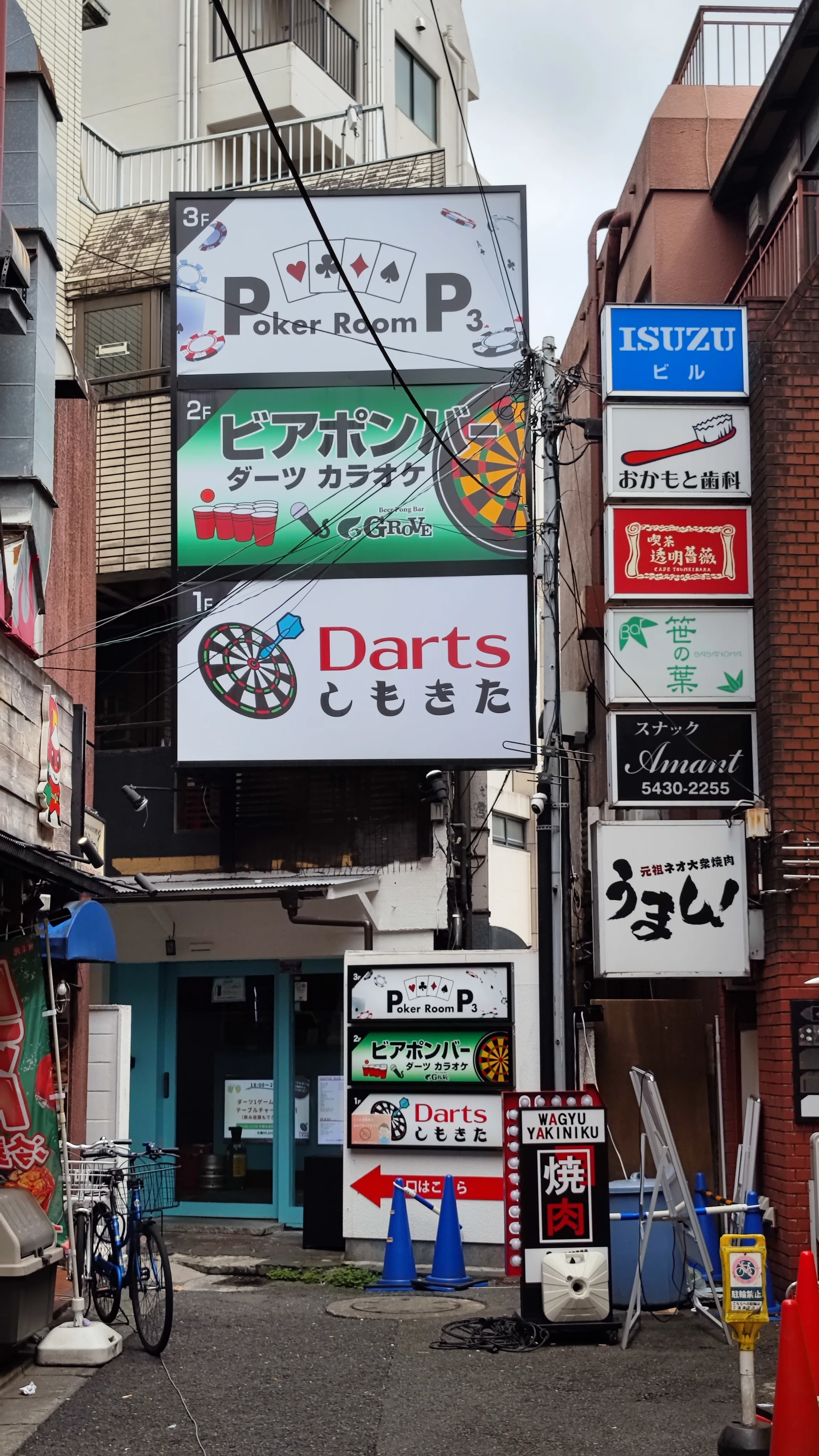
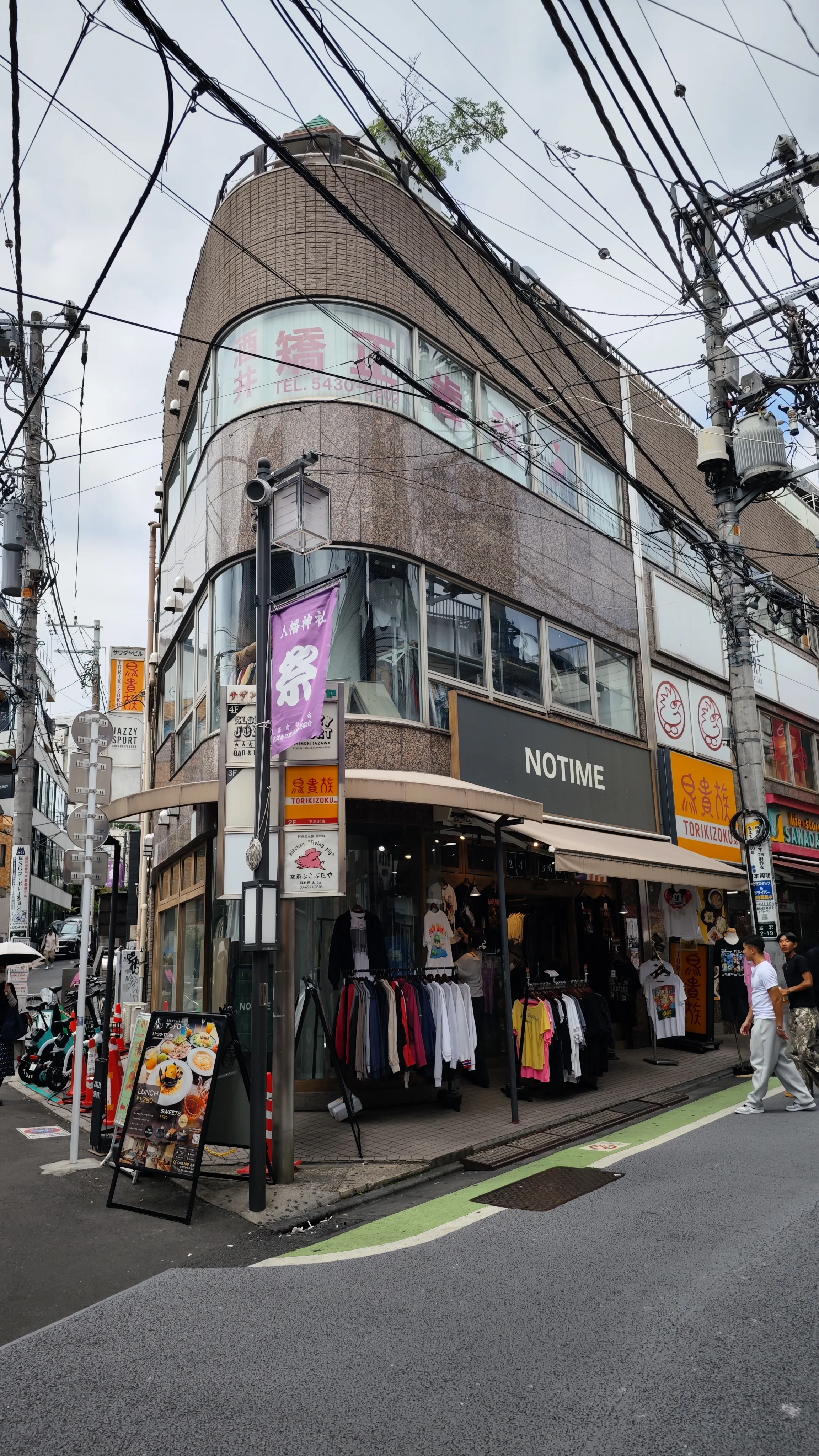
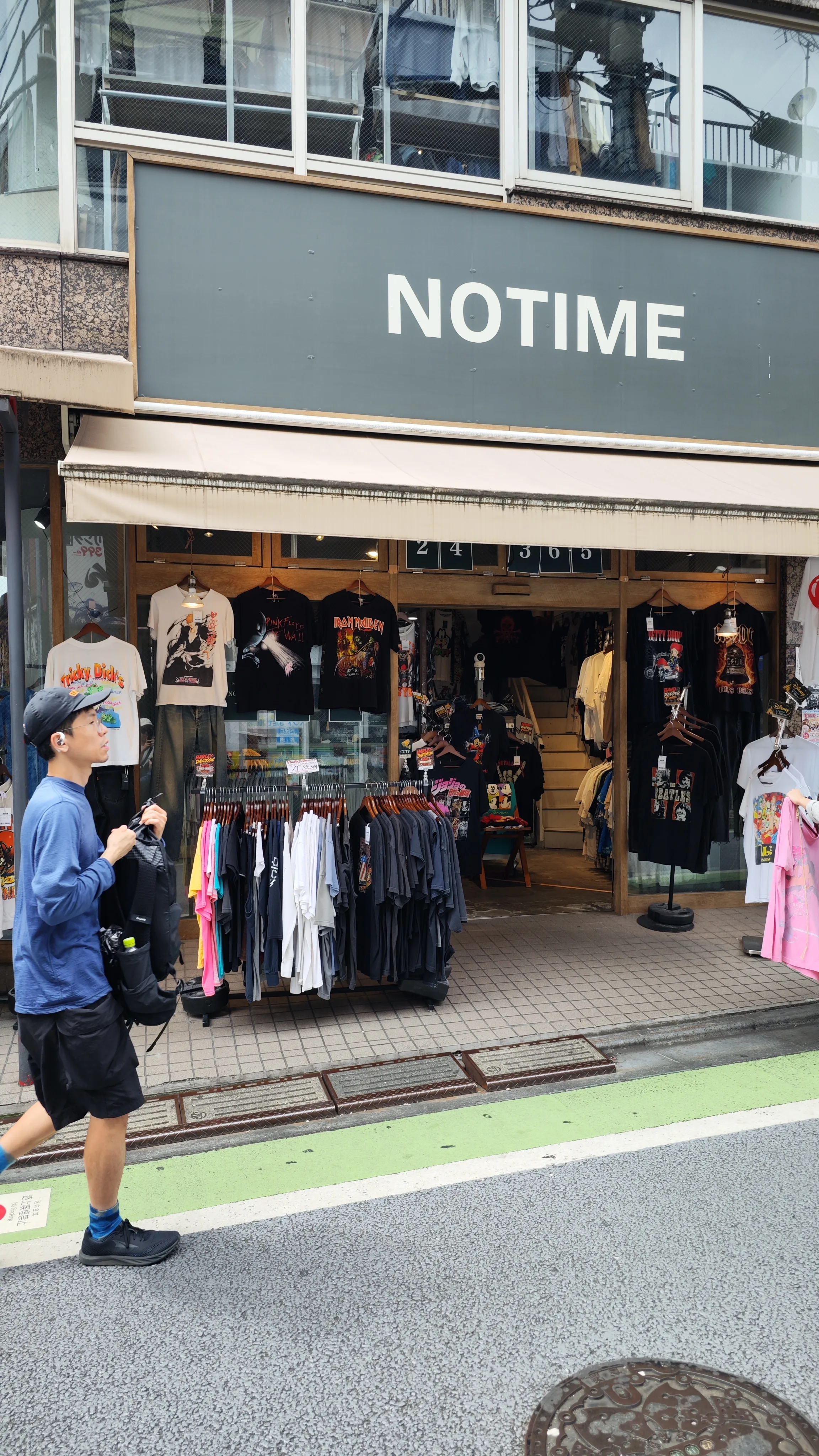
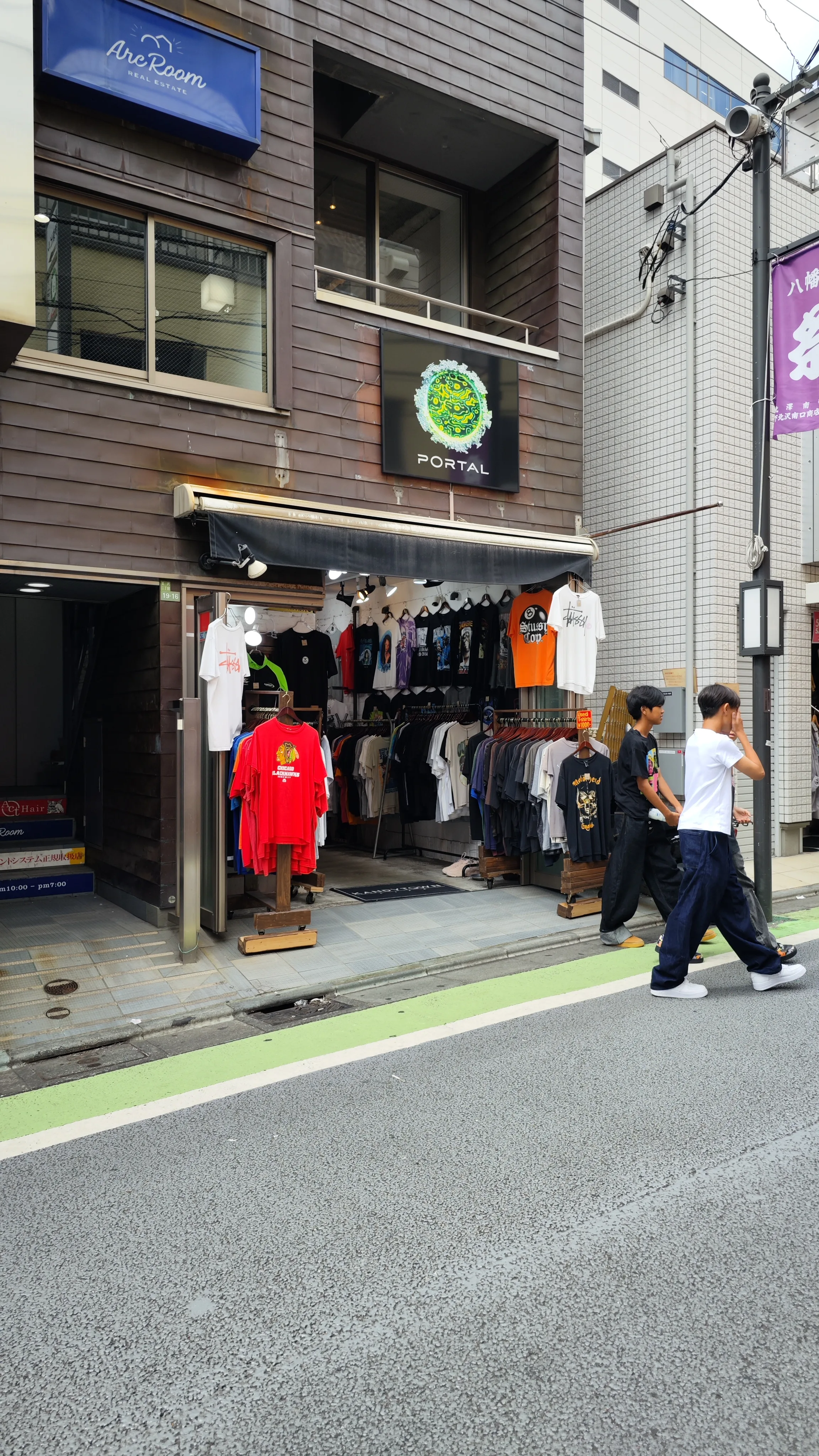
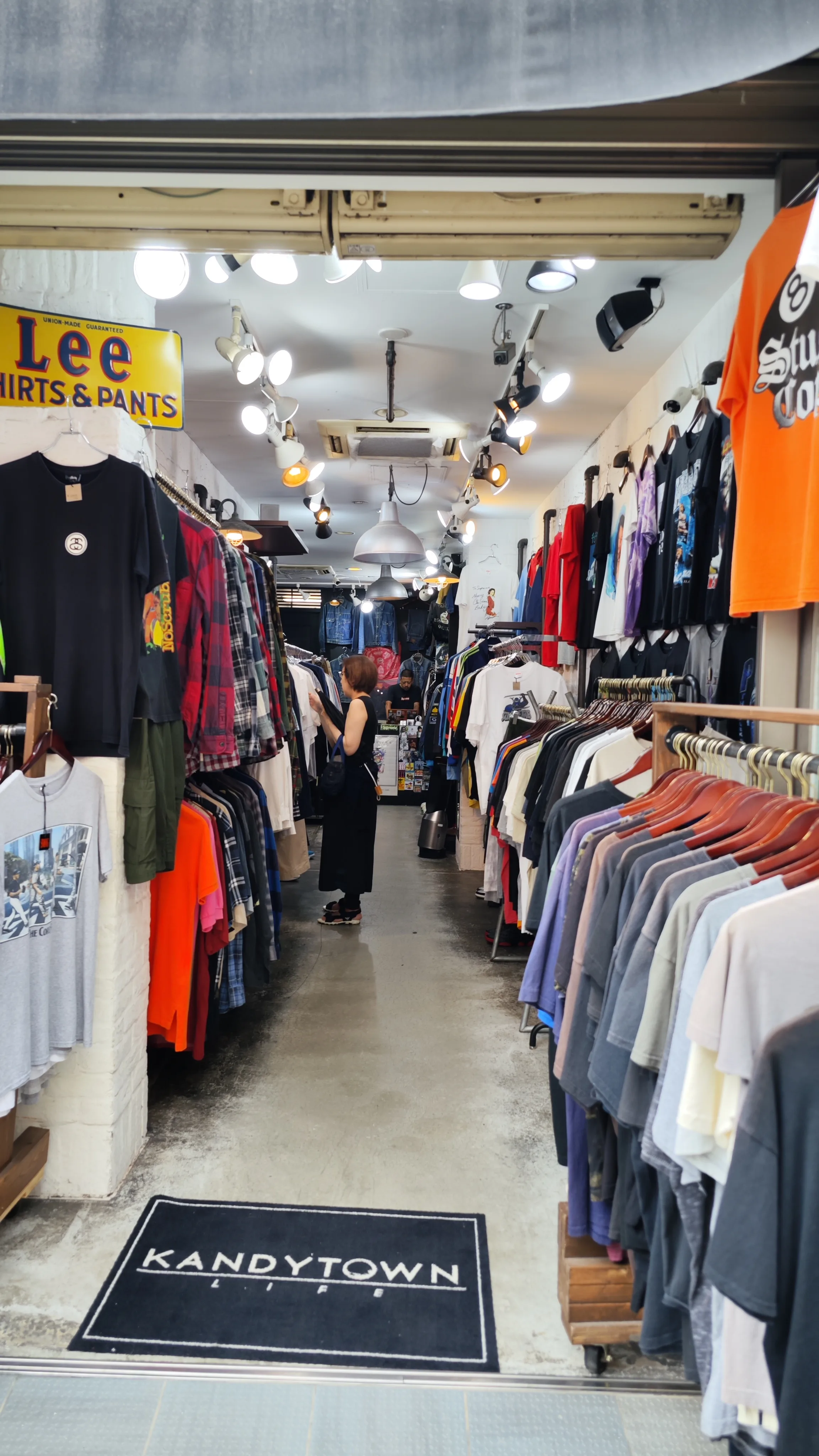
It is real, but I could find no public official count of vintage shops, so treat any round number you are given with suspicion. Setagaya City’s shopping-street register — 122 streets ward-wide, last updated 11 May 2026 — publishes no breakdown by trade. The associations count members, not shop types: the South Exit association’s directory tags exactly four member shops as 古着, and Ichiban-gai’s 183-entry directory folds clothing, used clothing and kimono rental into a single 26-entry category. The Shimokitazawa Shopping Streets Federation gives roughly 760 member shops across all six streets and all trades, as of November 2023.
The only dedicated directory I found is a private one. #シモフル, run by 下北沢倶楽部, listed 163 vintage shops on 1 September 2026, and says on its own page that it is still working toward listing them all. Its area tags account for all 163: 84 north, 50 south, eight by the east exit, four each around Don Quijote, Ichiban-gai and the south exit, three each around Ohsho and ura-kita, two oku-kita and one on Higashi-dōri. That is a directory count rather than an authoritative total — but the north–south split is worth knowing before you plan a walk, because I spent my 23 minutes almost entirely in the smaller half.
Horizontal photo strip. Swipe sideways, or give it keyboard focus and use the left and right arrow keys.
 Open this photograph at full resolution, opens in a new tab
 Open this photograph at full resolution, opens in a new tab
 Open this photograph at full resolution, opens in a new tab
 Open this photograph at full resolution, opens in a new tab
 Open this photograph at full resolution, opens in a new tab
 Open this photograph at full resolution, opens in a new tab
What do things actually cost?
Make the early shift work
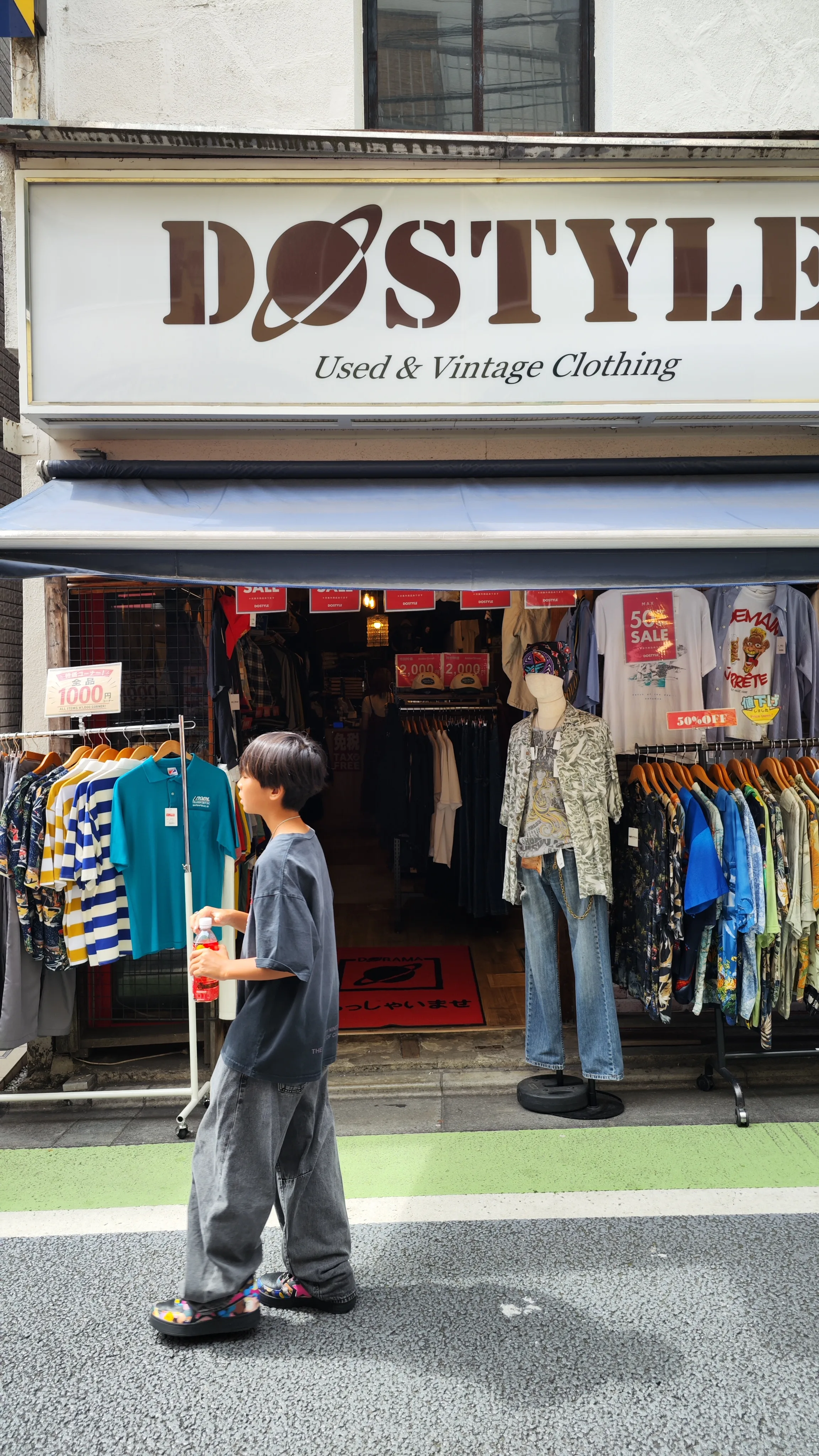
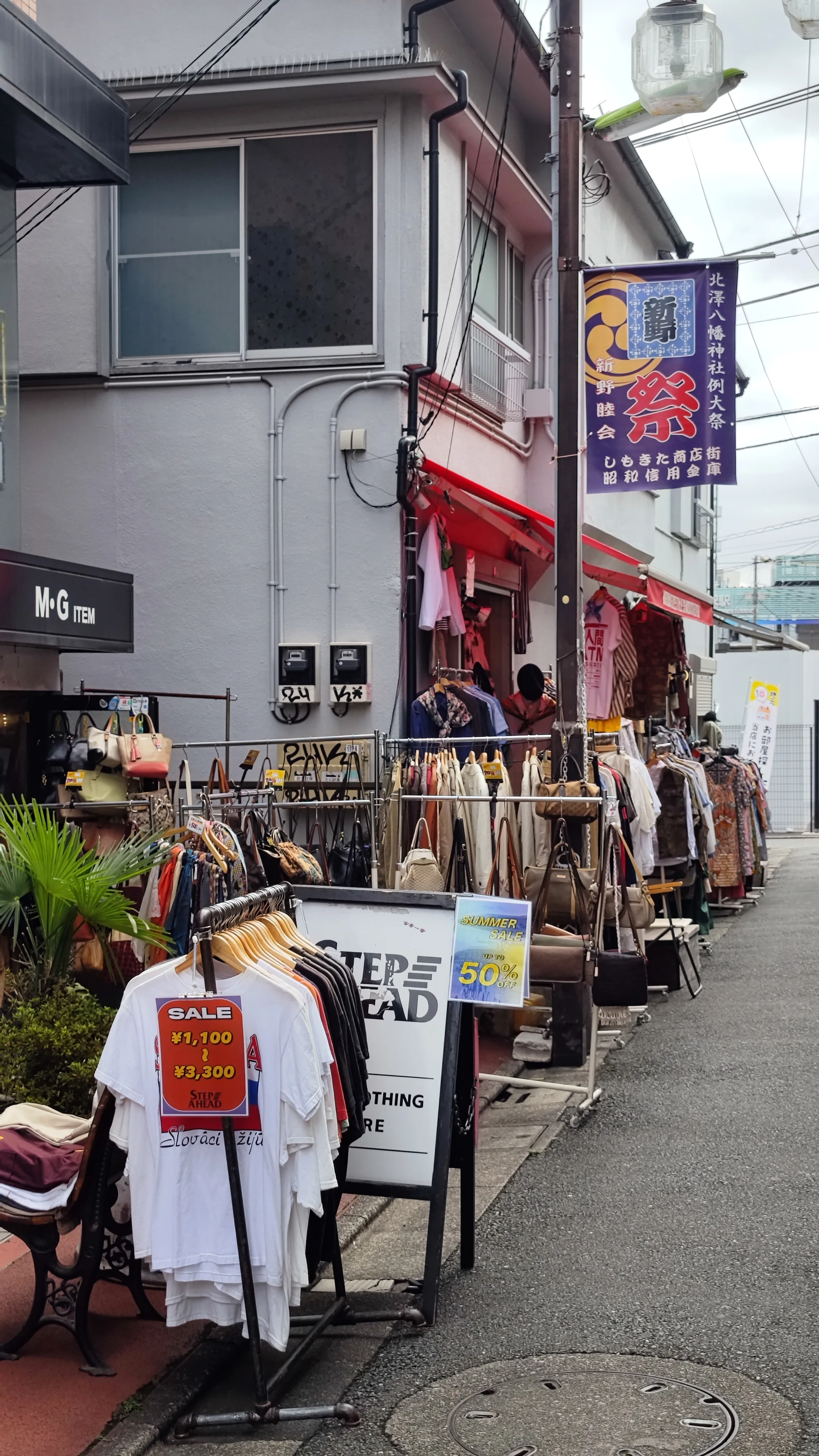
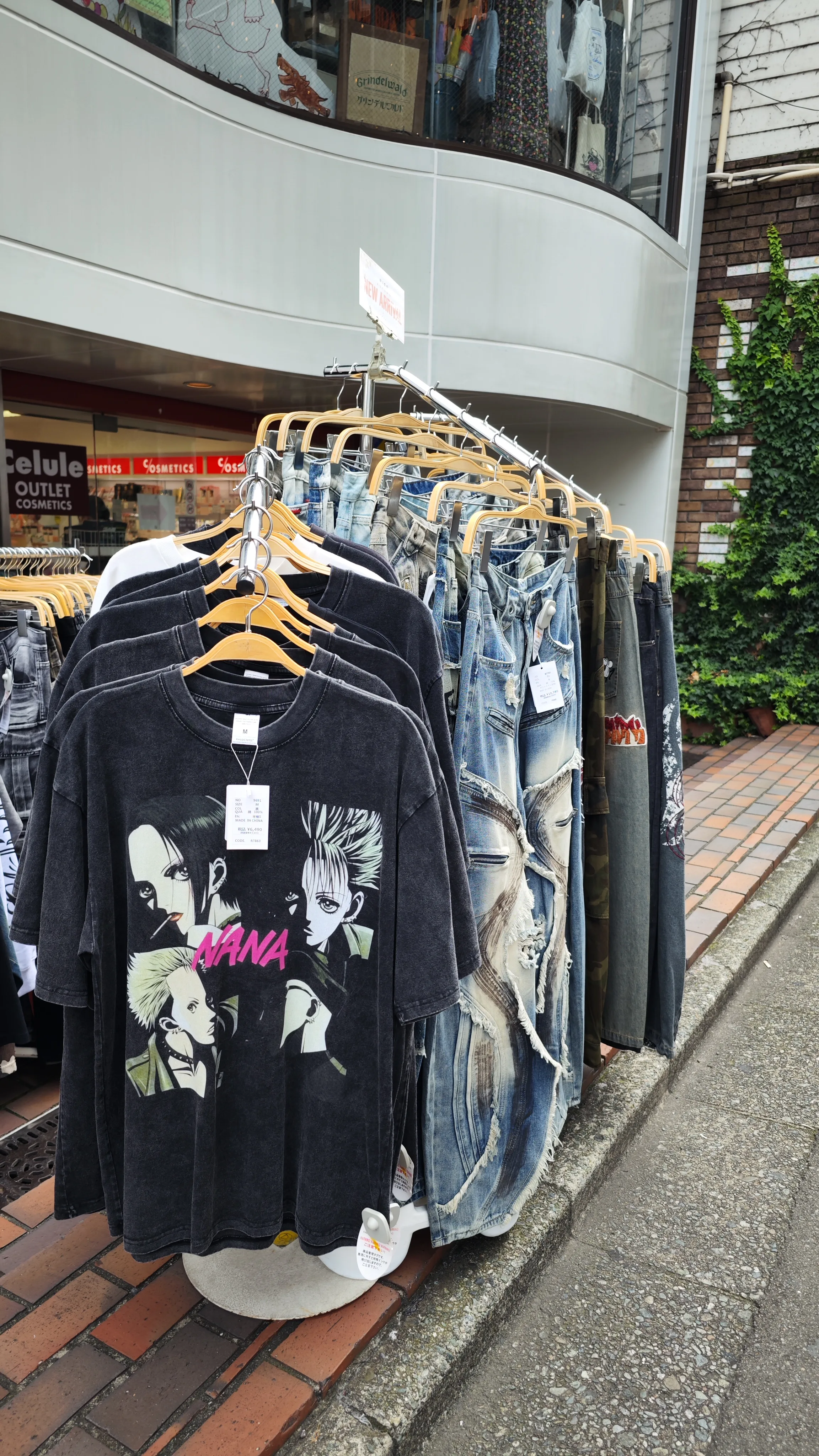
Prices are legible in three places in my frames. These are what the signs said on 20 May 2026; shops change them, so read the numbers as a scale rather than a quote.
| Sign, as photographed | What it said | Frame |
|---|---|---|
| SUPER STUDIO, 2F | UNDER ¥770 · 全品 110円〜770円 — everything in the shop between ¥110 and ¥770 | 15 |
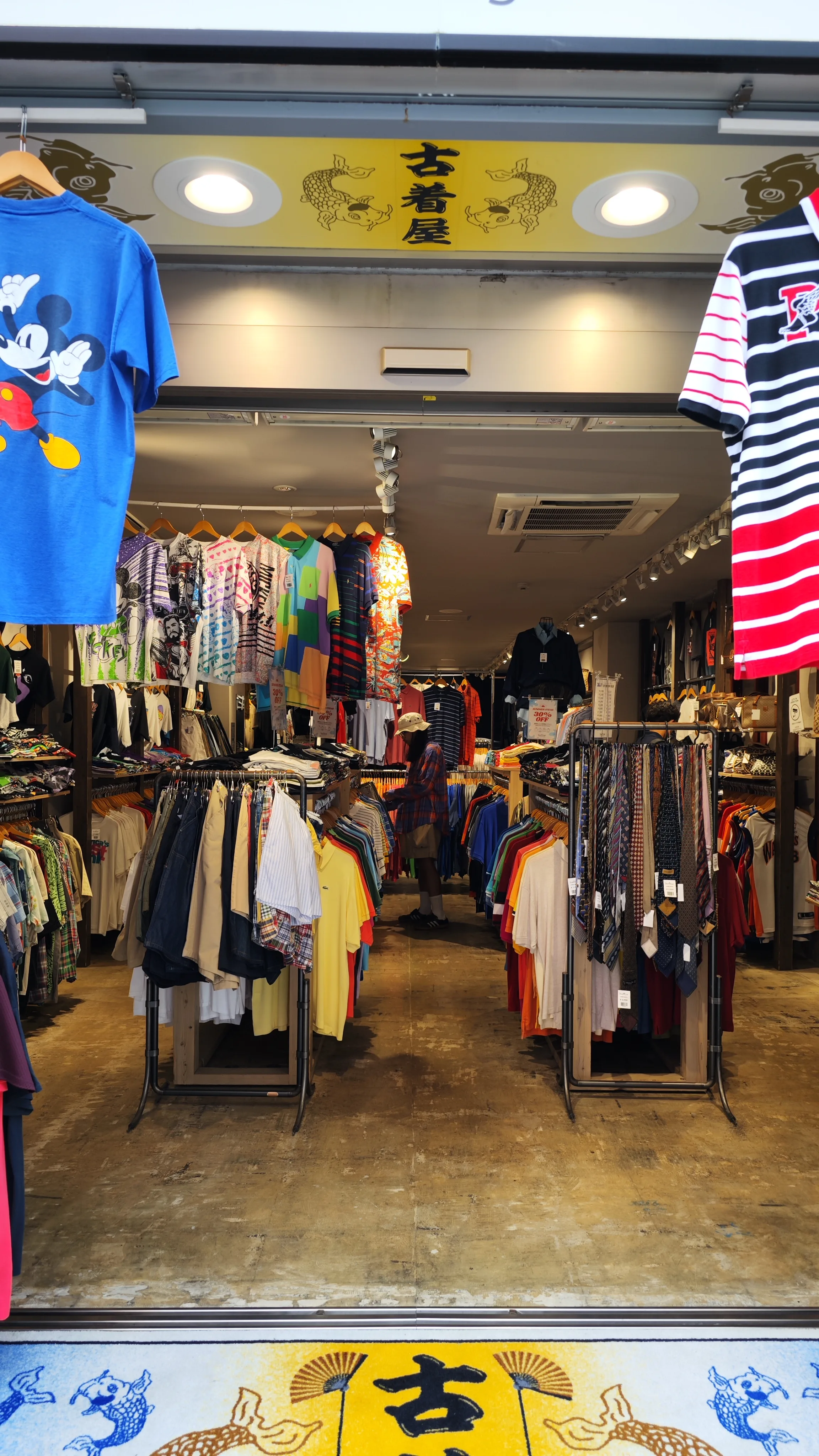
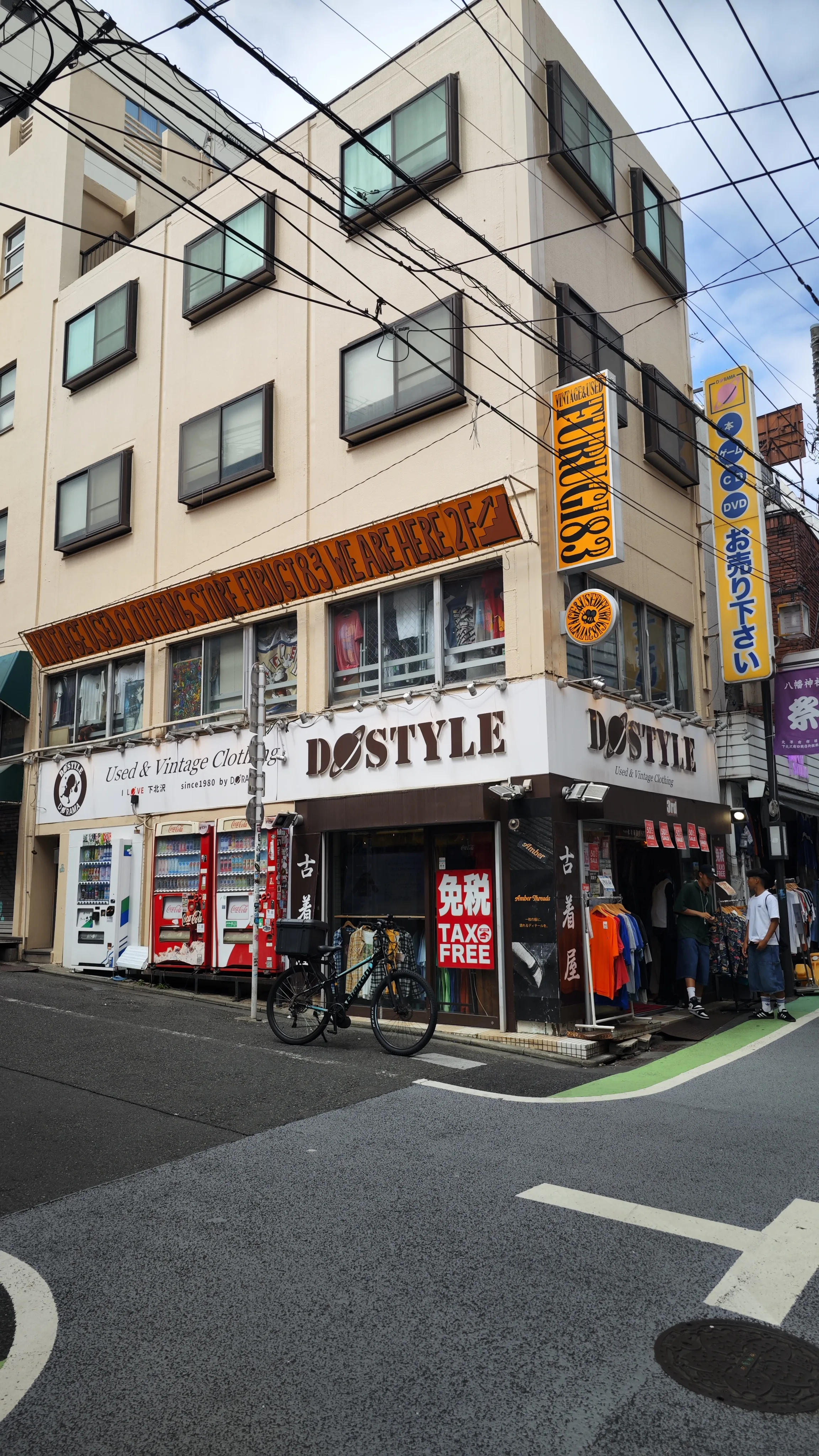
| DOSTYLE, street level | 全品1000円コーナー — an all-¥1,000 rail; window notices reading ¥2,000 and MAX 50% SALE | 13, 14 |
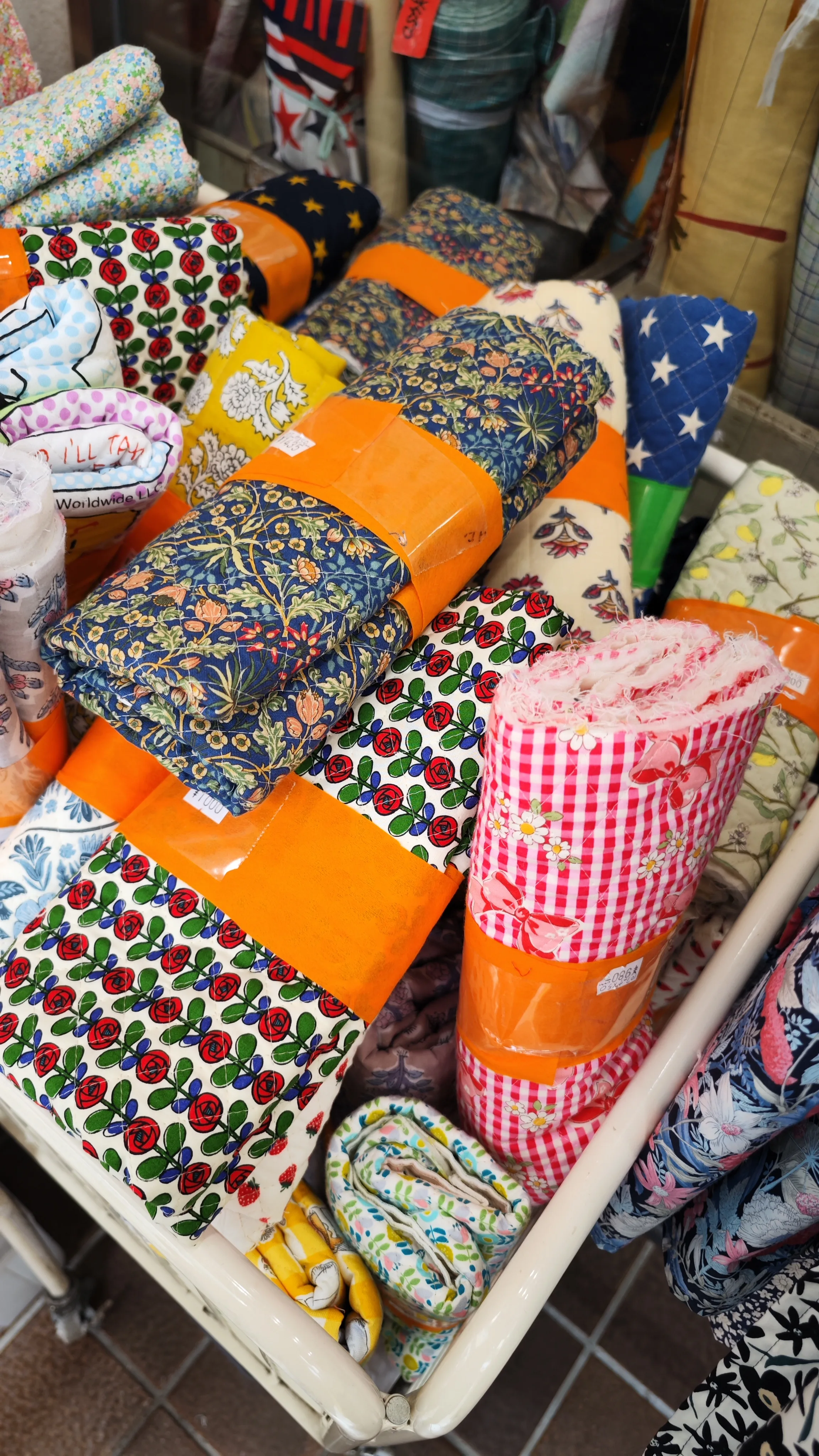
| Fabric shop, outdoor stack | Handwritten tags on taped bolts; the legible one reads ¥1,000 | 28 |
DOSTYLE is one of the four shops the South Exit shopping street association itself lists under 古着 in its member directory, alongside 古着屋3peace, ピーマックス and Flaps — so that name is association-verified rather than read off a shopfront and hoped for. At the other end of the same neighbourhood, Ichiban-gai’s directory lists RAGTAG, which trades in used designer brands and opens 11:00–20:00.
Horizontal photo strip. Swipe sideways, or give it keyboard focus and use the left and right arrow keys.
 Open this photograph at full resolution, opens in a new tab
 Open this photograph at full resolution, opens in a new tab
 Open this photograph at full resolution, opens in a new tab
 Open this photograph at full resolution, opens in a new tab
 Open this photograph at full resolution, opens in a new tab
Why are there festival banners in May?
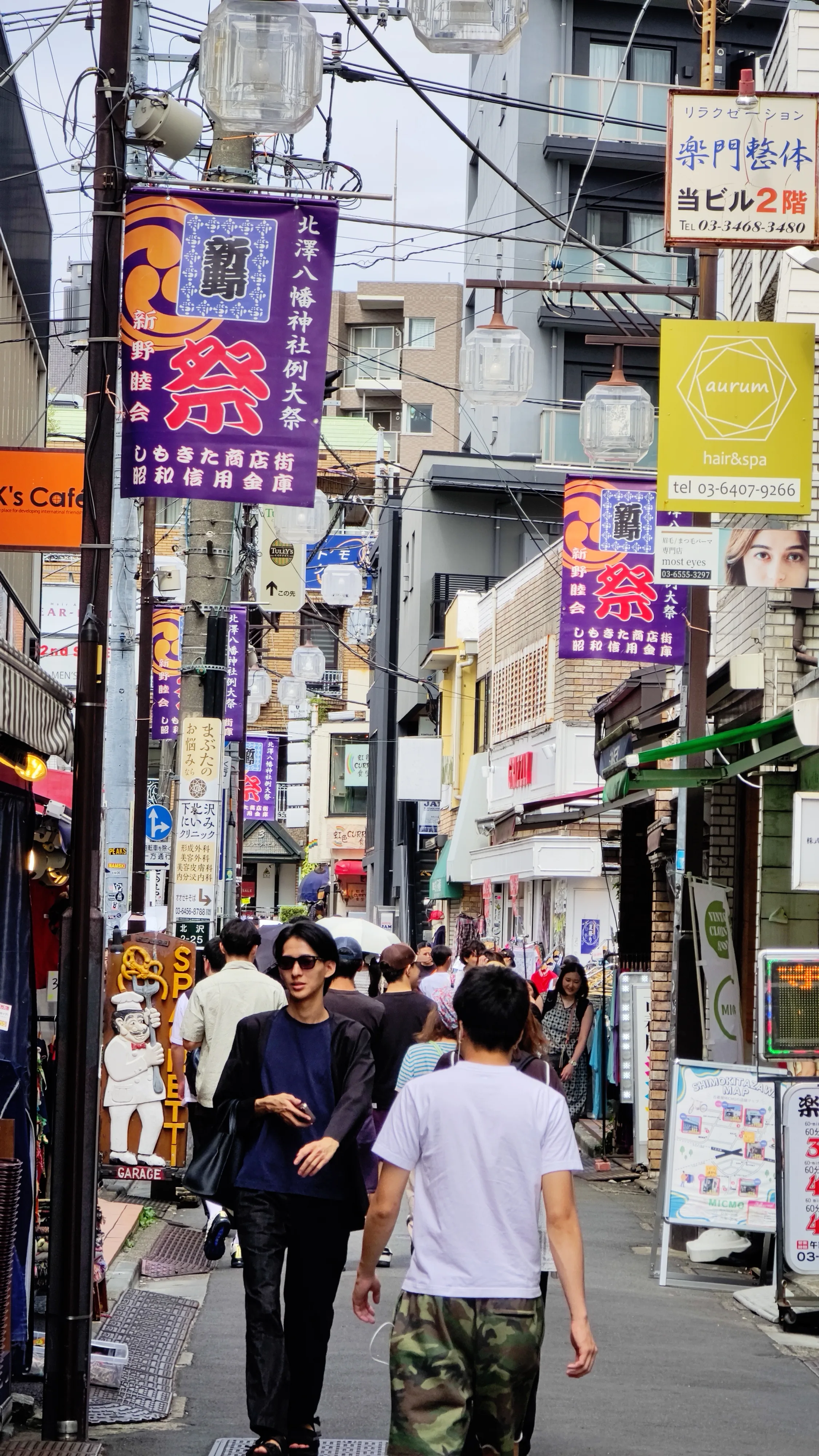
The banners refer to the shrine festival, but they do not mean the festival was taking place on 20 May — and that is the single thing in my photographs I would most likely have got wrong. The purple banners in frames 02, 03, 15, 18 and 23 read 八幡神社 祭 and carry two names in smaller type, 北澤南部睦会 and 下北沢南口商店街振興組合: a neighbourhood association and a shopping street, not a date. Kitazawa Hachiman Shrine’s annual festival, 北澤八幡秋まつり, is held on the first Saturday and Sunday of September. In 2026 that is 5 and 6 September. My photographs are dated 20 May, and I could not establish when these particular banners were put up.
If you do come for the festival, you will be standing in these frames. The South Exit association publishes the route: 「下北沢南口商店街とあずま通りには南部睦のお神輿が出ます」 — the Nanbu-mutsu mikoshi comes out onto the South Exit shopping street and Azuma-dōri. The shrine’s own festival page gives the main day, 6 September, as children’s mikoshi from 12:00, adults’ mikoshi from 13:00 and the ceremony at 14:30, with some 23 portable shrines across the parish.
Checkpoint 3 of 5 · 17:42–17:50
When do the shops open — and is 5:30pm a good time?
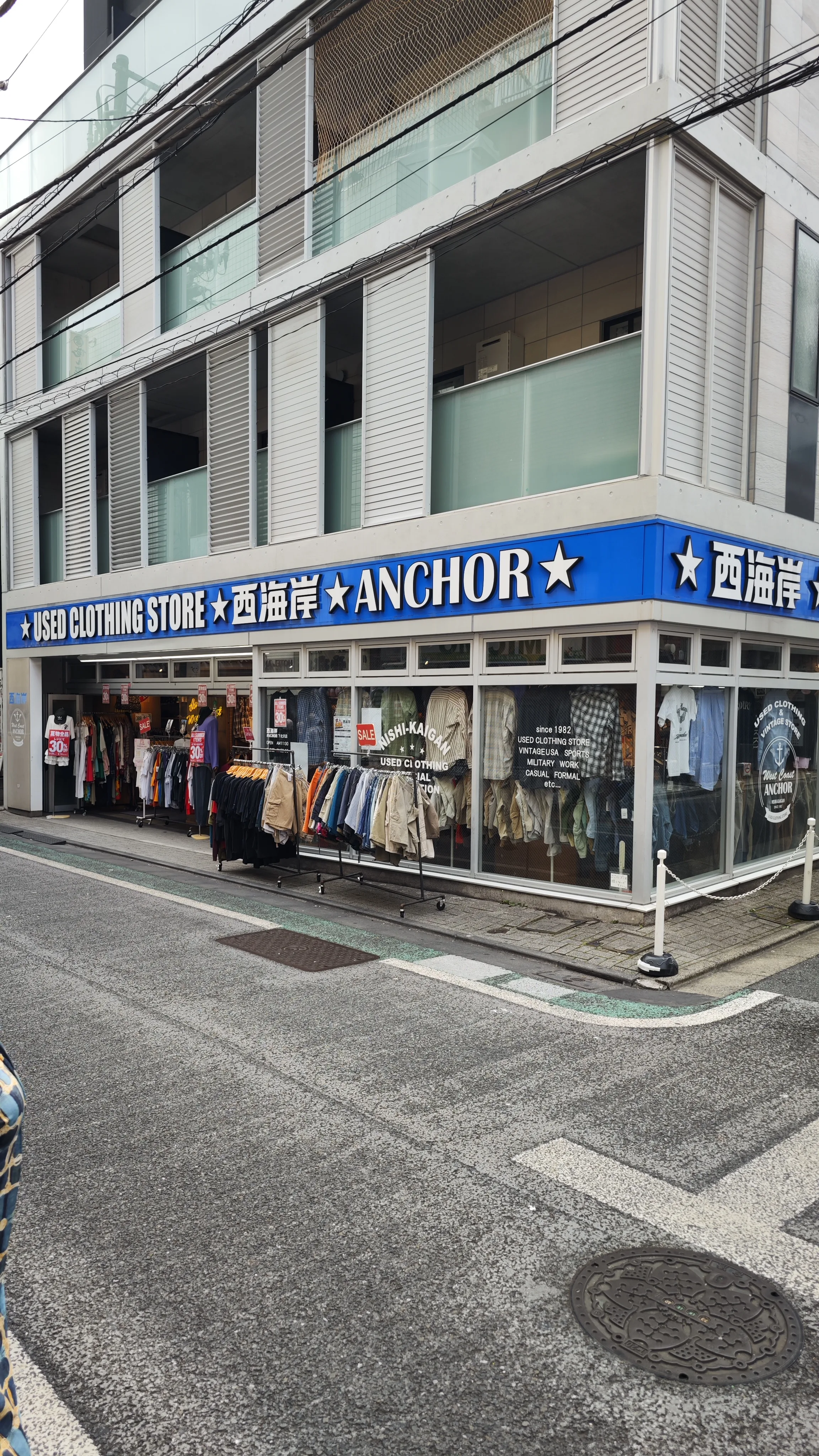
Late morning at the earliest, and yes. Two association-published samples give the shape. Flamingo’s own store list shows five Shimokitazawa branches on identical hours: 12:00–21:00 on weekdays, 11:00–21:00 at weekends and holidays. Ichiban-gai’s directory is the only association-run directory I found that publishes hours for a set of fashion shops — of its twelve, ten open between 11:00 and 12:30, and the two latest open at 13:00 and 14:00. All twelve close between 20:00 and 21:00.
That is a seventeen-shop fashion sample, not the whole neighbourhood — cafés, restaurants and the station’s own retail keep different hours entirely. But within it the pattern is clear enough to plan around: if shopping is the priority, most of these shops do not open until around noon. On closing days, none of the twelve Ichiban-gai listings gives a fixed weekly one, though six state 不定休, irregular — which means there is no day to write off in advance, and equally no guarantee a particular shop is open. Check a shop’s own posts the same day if you are making a special trip for it.
My walk started at 17:30, two to three hours before closing, with the light still good — late-May sunset in Tokyo is around 18:50. The South Exit association makes the point on its own site: 「夜遅くまで沢山のお店が営業している」, many shops trade until late.
Horizontal photo strip. Swipe sideways, or give it keyboard focus and use the left and right arrow keys.
 Open this photograph at full resolution, opens in a new tab
 Open this photograph at full resolution, opens in a new tab
 Open this photograph at full resolution, opens in a new tab
 Open this photograph at full resolution, opens in a new tab
 Open this photograph at full resolution, opens in a new tab
Where does the station actually put you?
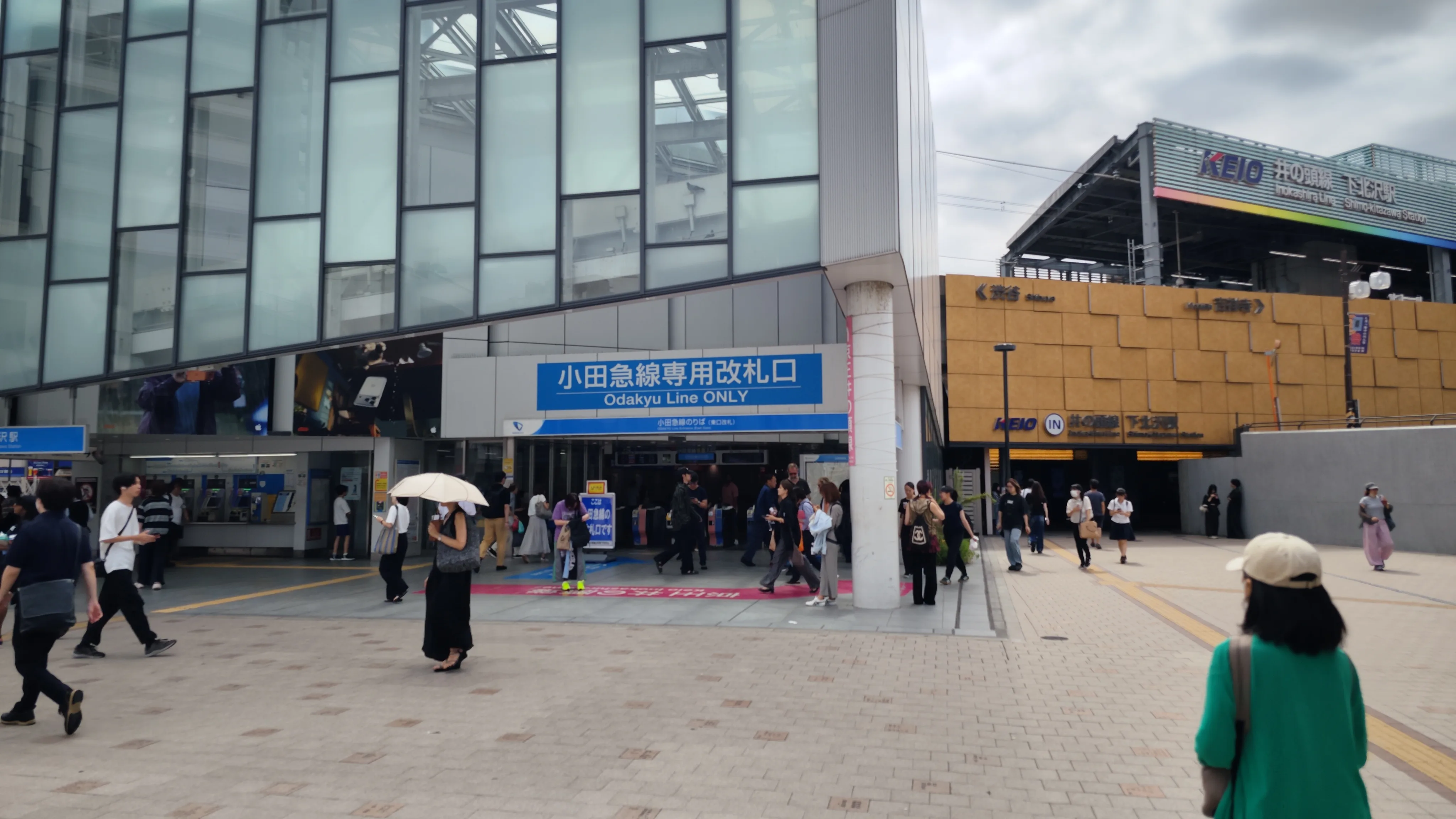
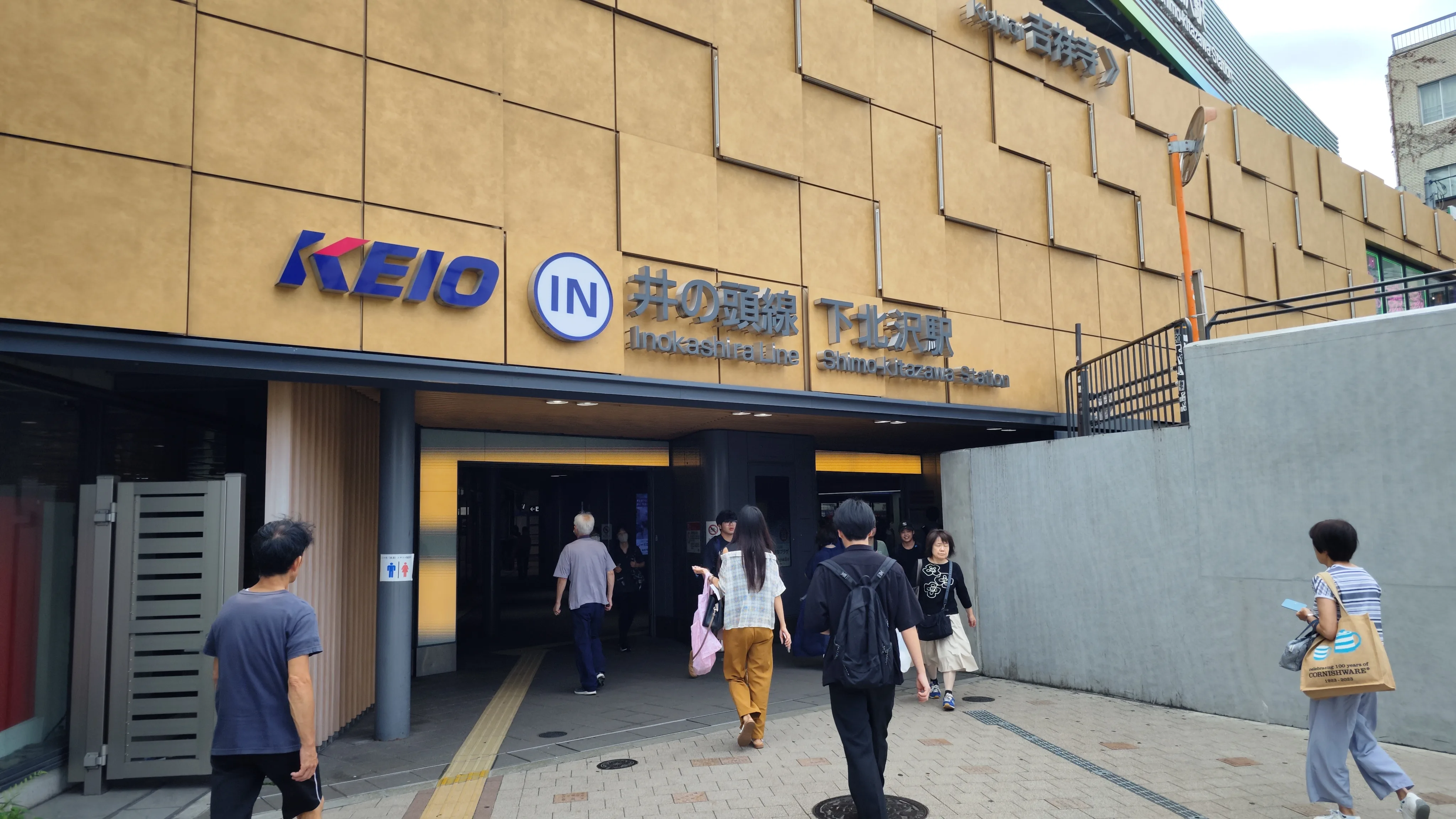
Shimokitazawa is two stations wearing one name, and the geometry is genuinely confusing. The Odakyu Odawara Line runs underground on two levels — B1F for locals and Chiyoda Line through services, B2F for the Rapid Express and Express — while the Keio Inokashira Line runs above ground on the second floor. Both operators’ official diagrams carry the same warning: 「※ホームが狭いのでご注意ください」, the platforms are narrow.
The Odakyu went under from the first train on Saturday 23 March 2013, when the roughly 2.2 km stretch from Yoyogi-Uehara to Umegaoka was switched after the last train the night before and all nine level crossings in it were removed. The upper underground track level opened on 3 March 2018, completing the quadruple-track layout. The Inokashira Line above it sits on a viaduct, and Mikan Shimokita — the Keio complex beside the station — describes its own site as that line’s former embankment. It is a separate Keio project, not part of Odakyu’s redevelopment, and the two are easy to conflate.
 Open this photograph at full resolution, opens in a new tab
| Getting there | Service | Time | Fare (ticket / IC) |
|---|---|---|---|
| Shibuya → Shimokitazawa | Keio Inokashira Express | 3 min | ¥140 / ¥140 |
| Shinjuku → Shimokitazawa | Odakyu Rapid Express | 7 min | ¥170 / ¥167 |
| Kichijōji → Shimokitazawa | Keio Inokashira Express | 12 min | ¥210 / ¥209 |
Those are fast scheduled runs excluding waiting time, checked on the operators’ own journey planners for a weekday departure on 1 September 2026; slower services take longer. Shimokitazawa is the first stop from Shibuya on an Express — on a Local it comes after Shinsen, Komaba-Tōdaimae and Ikenoue. All six Odakyu service categories listed for the station stop here (Local, Semi Express, Commuter Semi Express, Express, Commuter Express and Rapid Express); scheduled Romancecar services do not. If you want to know how the two fare scales work, our guide to IC cards in Japan covers it.
You can tap a bank card
Contactless credit-card travel works at every station on the Odakyu, Keio and Inokashira lines with no registration. It is charged at the adult paper-ticket fare, calculated in ¥10 units rather than the ¥1-unit transport-IC fare, and child fares are not available through it.
Lockers, Keio side
Keio’s operator lists 42 PASMO-compatible lockers in two banks: beside the ticket machines outside the Central gate, 19 standard, five medium and four large; outside the West gate, 12 standard, one medium and one large. ¥600, ¥700 and ¥1,000 per day, first to last train, with live vacancy counts online.
If the lockers are full
ecbo cloak lists shop drop-offs within one to three minutes of the station at ¥500 a day for bag size and ¥800 for suitcase size — a karaoke branch open 24 hours is among them.
A live translation display
Odakyu’s English site states that in FY2025 Shimokitazawa and Katase-Enoshima were the two stations to get its Cotopat system, which transcribes a spoken conversation in real time and displays it in up to seven languages.
Checkpoint 4 of 5 · 17:50–17:52
The back alleys, and one shop I am not going to name
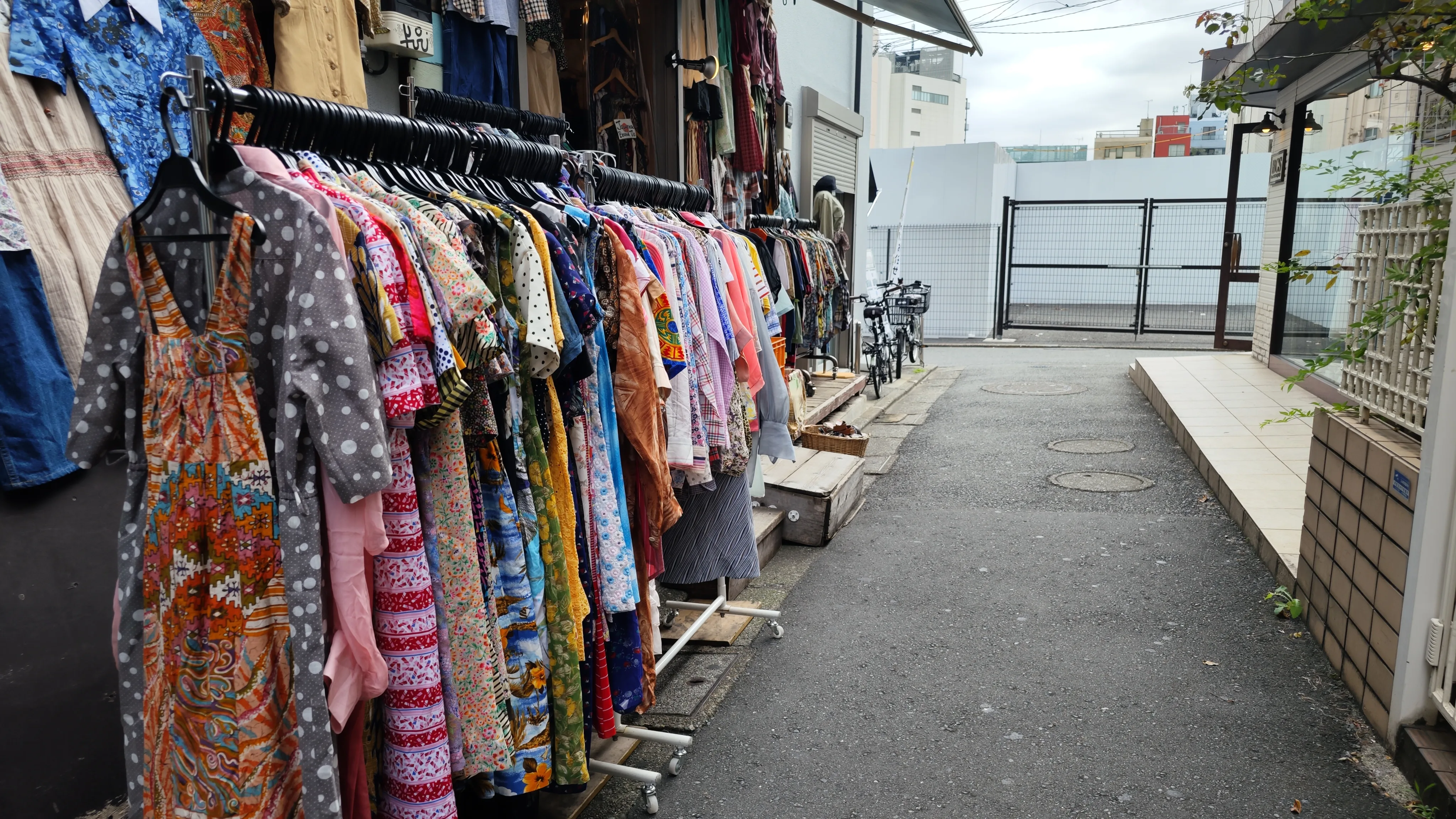
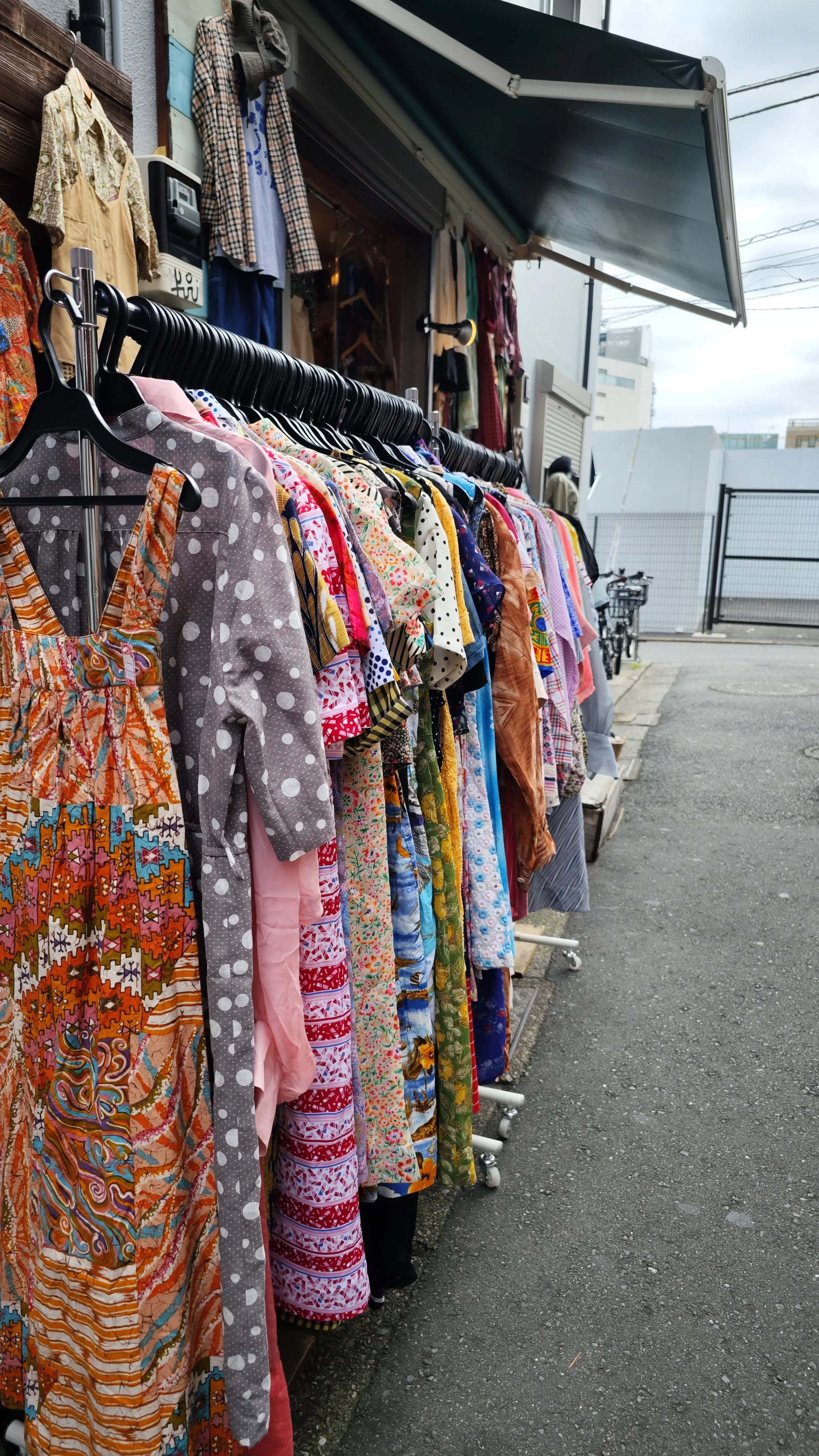
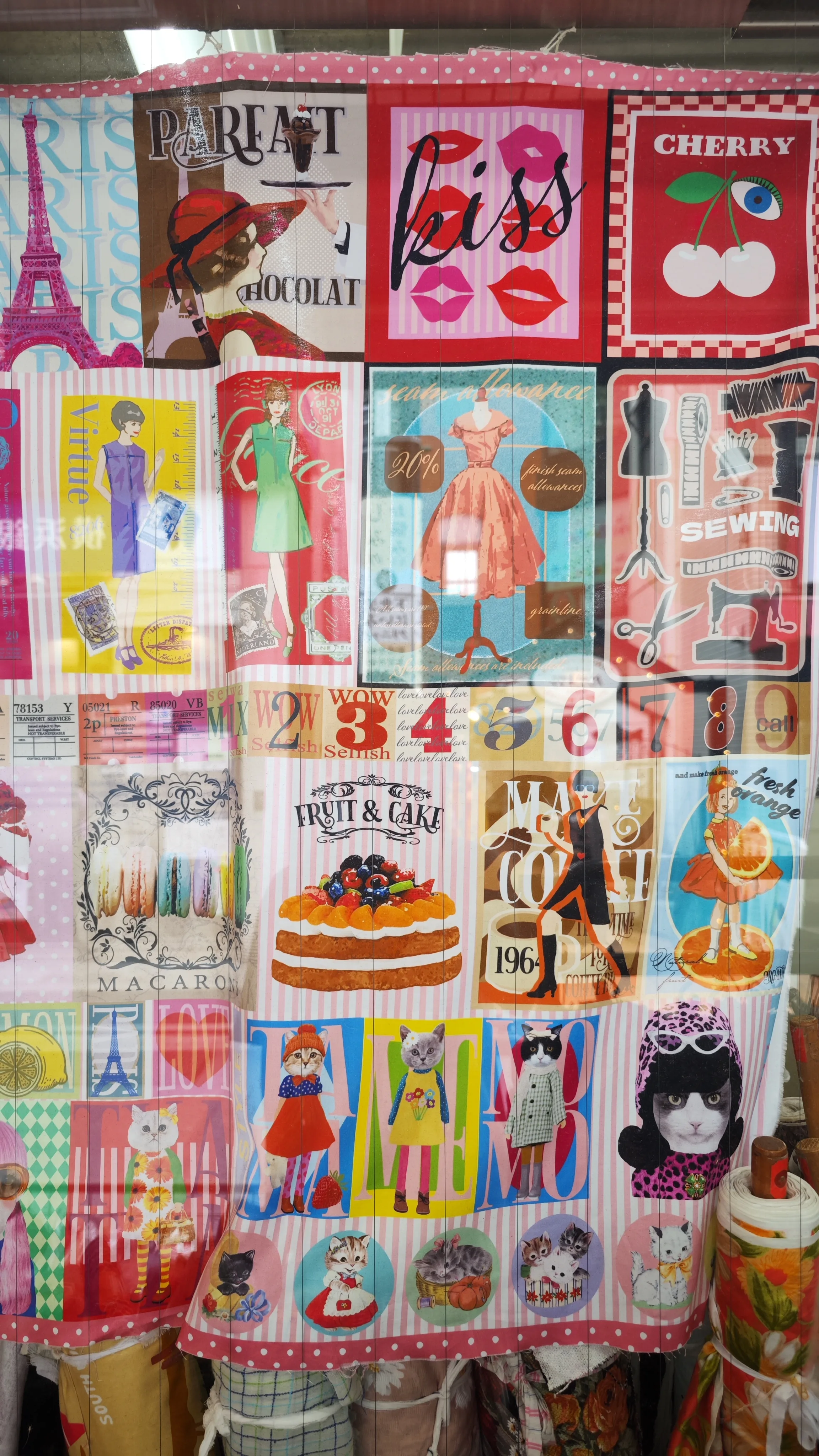
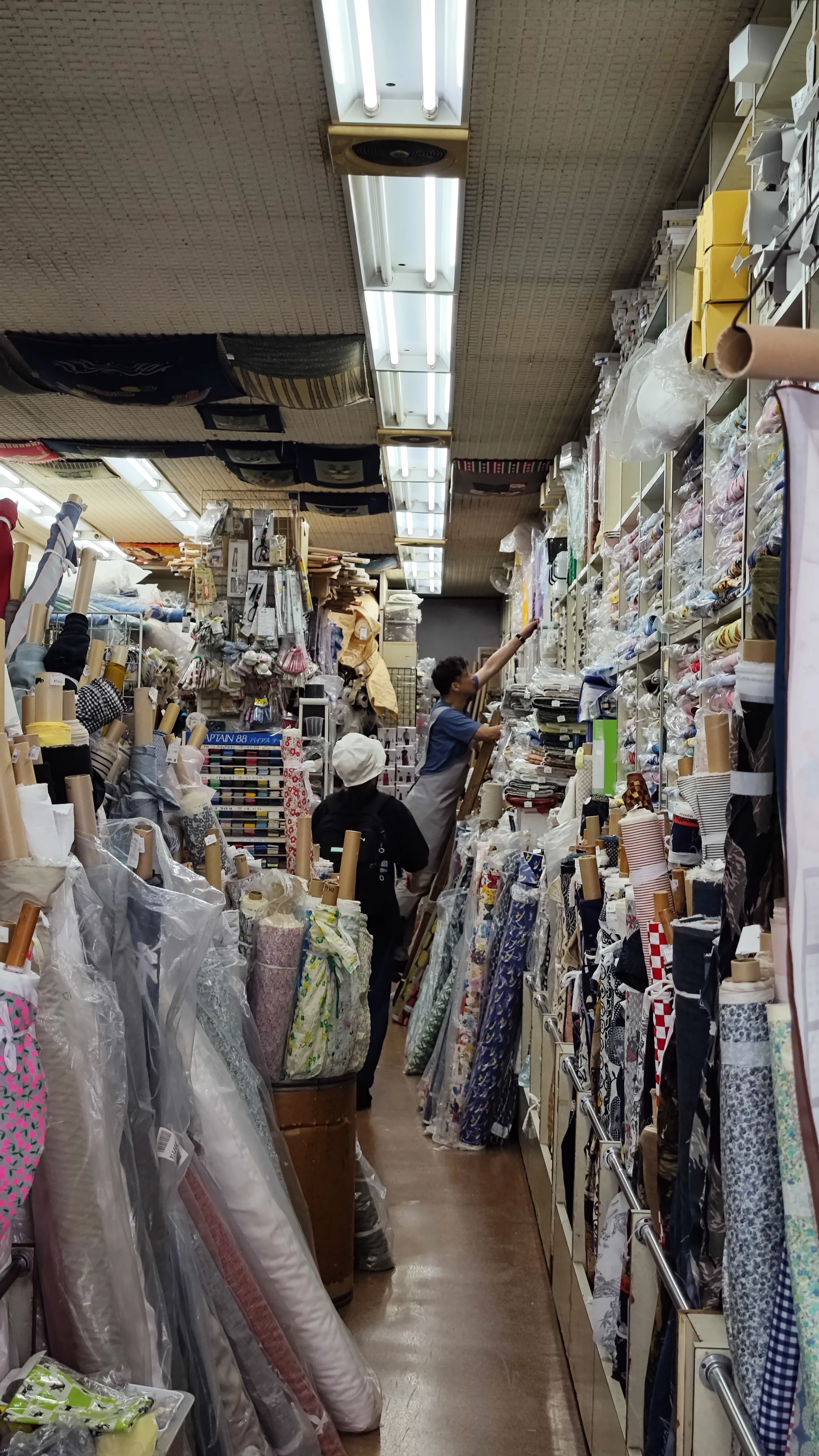
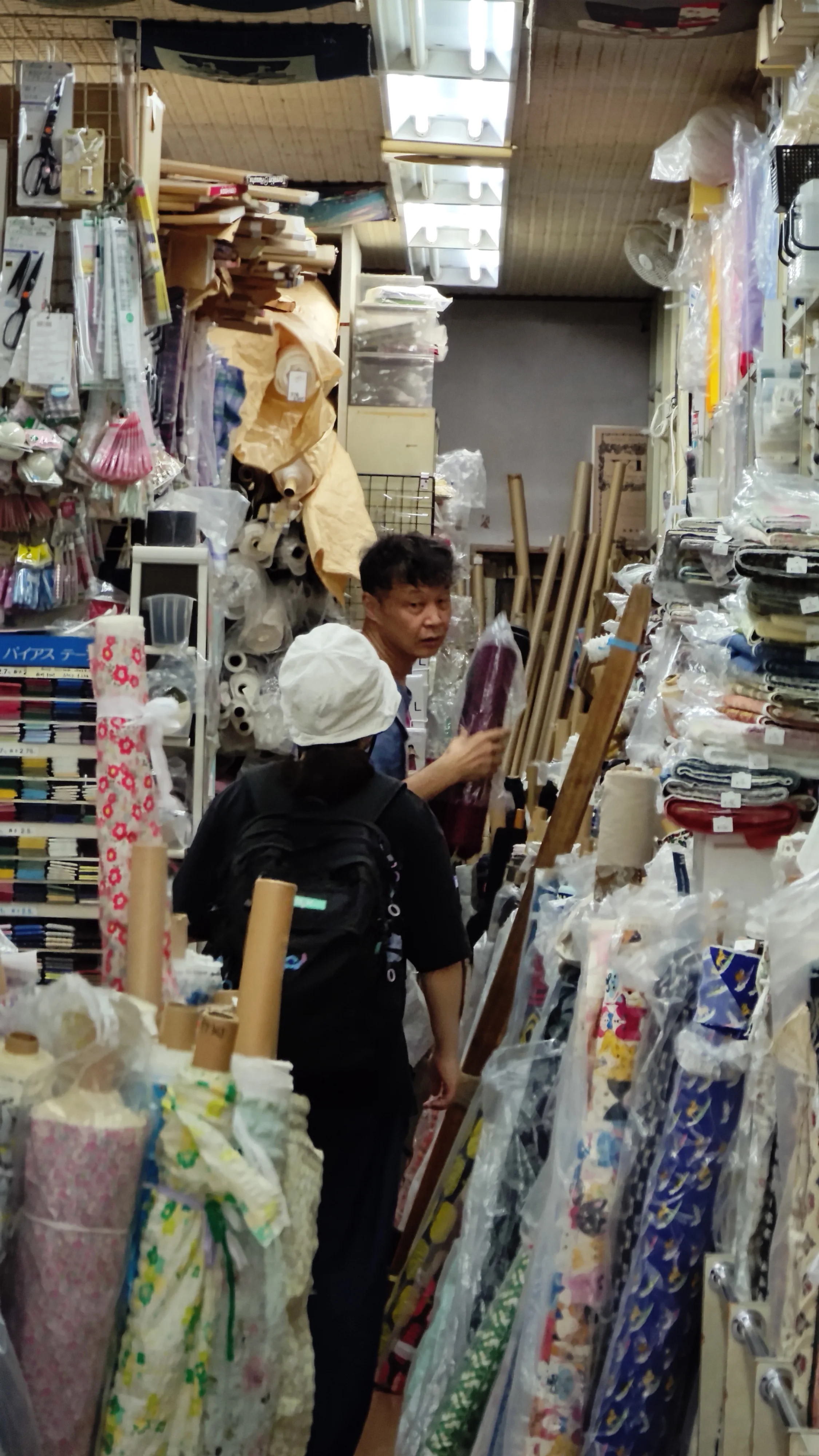
The final three minutes went off the shopping street into service alleys and then into a fabric shop packed floor to ceiling with bolts of printed cotton. It was the most interesting thing I saw, and it is the one place I cannot identify for you honestly. I did not photograph a sign. There is a long-established fabric wholesaler-retailer about a minute from the east side of the station whose trade and position would fit, but its own website no longer resolves and secondary listings disagree on both its founding year and its opening hours. So: no name, no hours, no founding date. If you find it, you will know.
One documented change nearby: Yuzawaya, a major Japanese fabric and craft chain, opened a Shimokitazawa branch in November 2016, and Shimokitazawa no longer appears in its official store list. That records the chain’s departure. It does not by itself tell you how many independent fabric shops the area has kept or lost, and the one in frames 28 to 31 was plainly trading.
 Open this photograph at full resolution, opens in a new tab
Horizontal photo strip. Swipe sideways, or give it keyboard focus and use the left and right arrow keys.
 Open this photograph at full resolution, opens in a new tab
 Open this photograph at full resolution, opens in a new tab
 Open this photograph at full resolution, opens in a new tab
 Open this photograph at full resolution, opens in a new tab
 Open this photograph at full resolution, opens in a new tab
 Open this photograph at full resolution, opens in a new tab
Do you need cash, and can you claim tax back?
Cash is often recommended as a precaution for Shimokitazawa vintage shops, and the only dataset I can find suggests card acceptance is widespread. On the #シモフル directory’s payment filters on 1 September 2026, of its 163 listed shops, 162 were listed as taking cash, 156 as taking credit cards, 94 other e-money, 81 transit IC such as Suica and PASMO, and 69 QR codes. Those are registered listings rather than tested transactions, but roughly 96 per cent card acceptance is not a cash-only district. Carry some cash as a backup for the smallest independents, but you are unlikely to need to plan the day around an ATM.
Tax-free is a harder question, because the rules change on 1 November 2026. Until 31 October 2026 the current system applies: only shops individually licensed as 輸出物品販売場 can offer it, you must be a non-resident within six months of entry, and general goods — which is what used clothing is — need ¥5,000 or more excluding tax at one store on one day. Japanese price tags show the tax-inclusive figure, so that threshold is about ¥5,500 on the label.
The redevelopment everyone writes about is not in these photographs
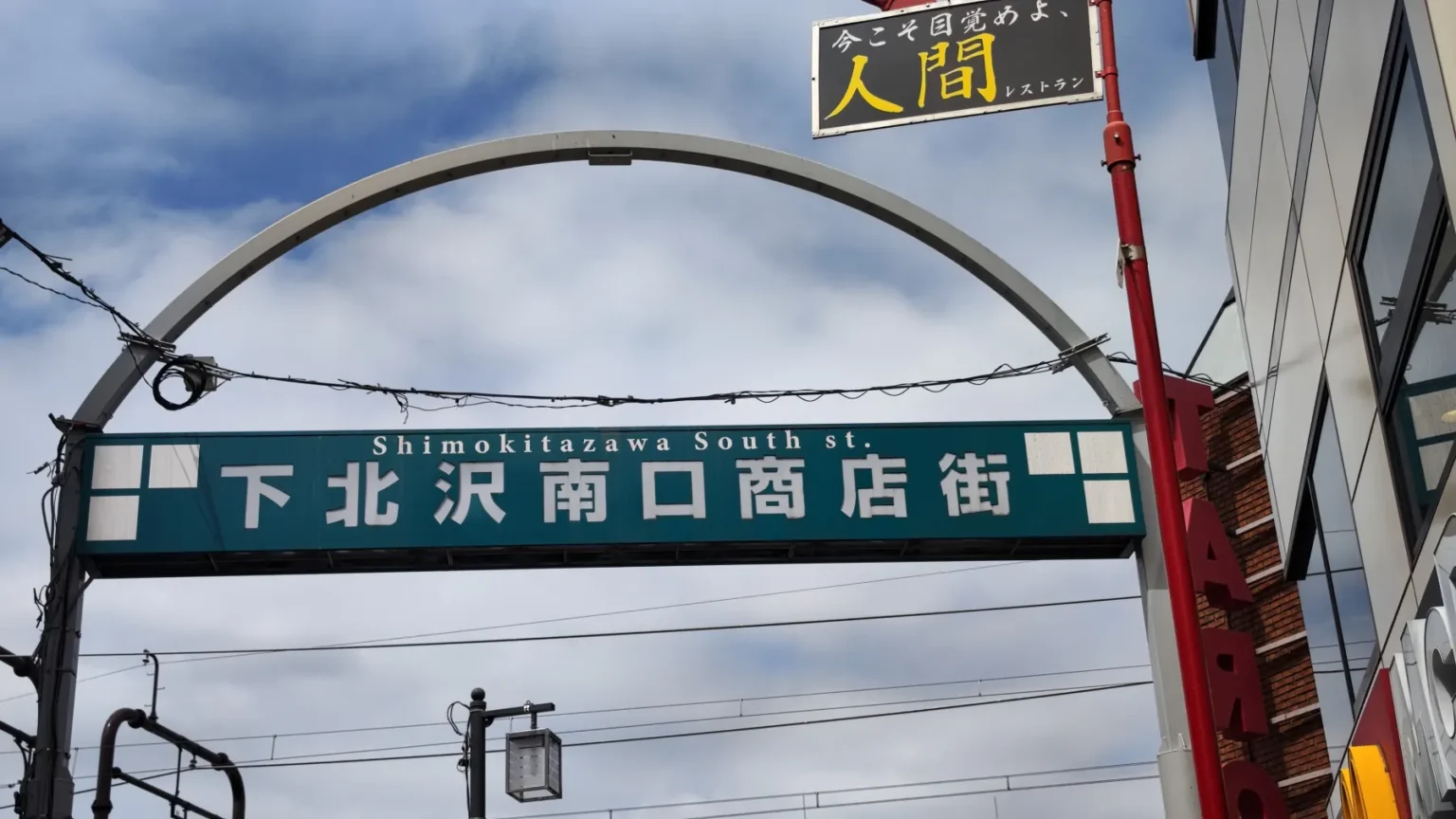
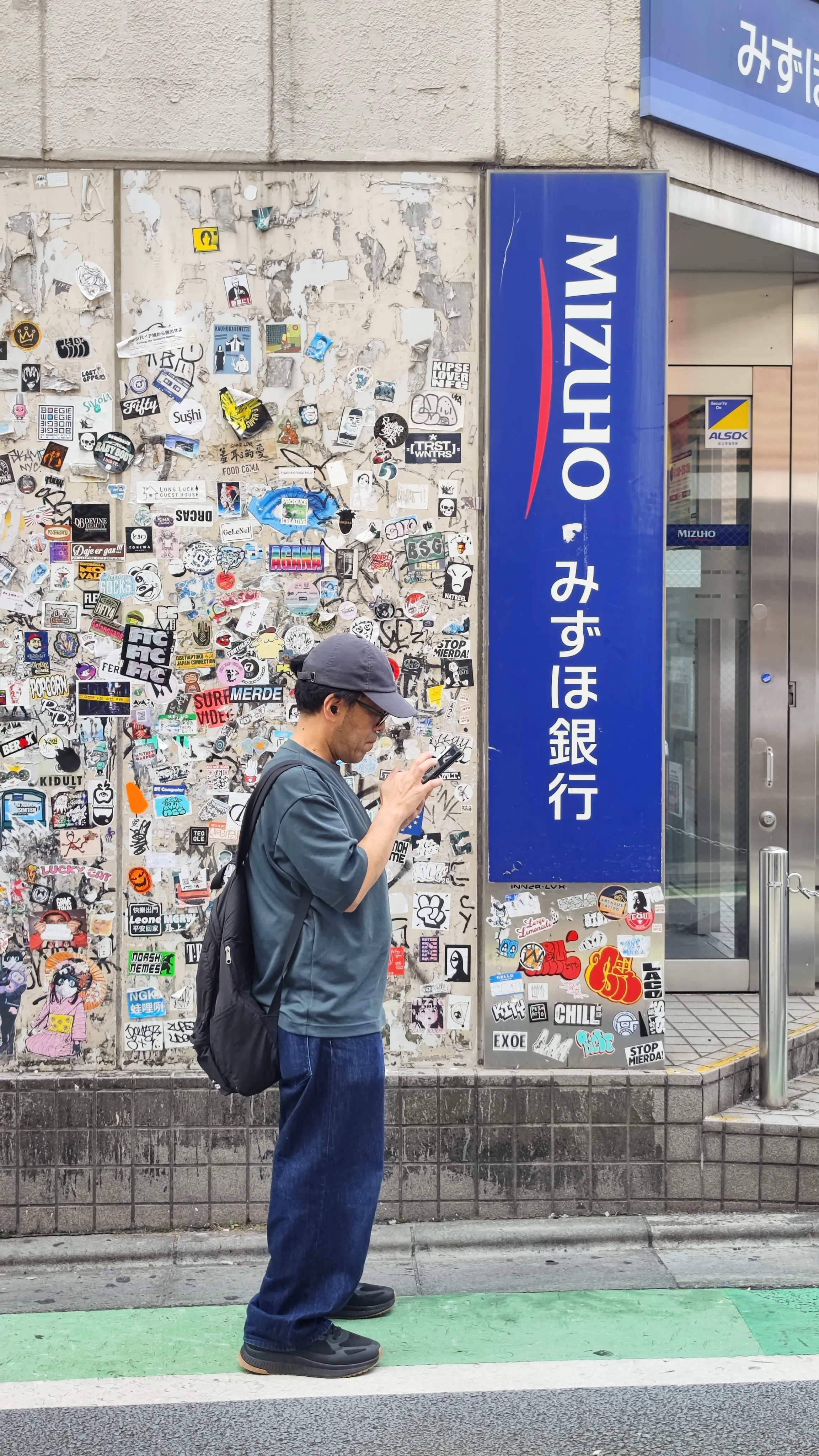
Worth stating plainly, because the two are easy to conflate. Odakyu’s 下北線路街 (Shimokita Senrogai) is a strip roughly 1.7 km long and about 27,500 m², built on the railway land freed between Higashi-Kitazawa and Setagaya-Daita, with thirteen developments that reached full opening on 28 May 2022. Mikan Shimokita is Keio’s, opened 30 March 2022. Neither appears in my 32 frames. The arch, the red streets, the wires, the sticker wall and the fabric shop are all in the pre-existing shopping streets.
| Development | Opened | Built by | English page? |
|---|---|---|---|
| BONUS TRACK | 1 April 2020 | Odakyu (Senrogai) | None found |
| reload | 16 June 2021 | Odakyu (Senrogai) | None found |
| MUSTARD HOTEL SHIMOKITAZAWA | 16 September 2021 | Odakyu (Senrogai) | Yes |
| Mikan Shimokita | 30 March 2022 | Keio | Yes |
| Senrogai, full opening | 28 May 2022 | Odakyu | None found |
That last column is the practical one. Checking on 1 September 2026, I found no publisher-provided English page or language switch linked from the main navigation of senrogai.com, reload-shimokita.com, bonus-track.net or te-fu.jp. Mikan Shimokita has one, and describes itself there as “an ever-changing district”. So on the sites I checked, the Keio development offers an English page and the Odakyu ones do not.
Checkpoint 5 of 5 · 17:53
Where to stay, and what else is on the line
For most people, not in Shimokitazawa. It is three minutes from Shibuya and seven from Shinjuku, so it works as a half-day off a central base rather than as a base itself. If you are still choosing where to sleep, Shibuya hotels (opens in a new tab) put you one express stop away, and Tokyo-wide listings on Agoda (opens in a new tab) are worth comparing against the property’s own page, since rates and cancellation terms move with the date.
If you do want to wake up here, the Odakyu strip has exactly two bookable properties and they sit at opposite ends of the scale. MUSTARD HOTEL SHIMOKITAZAWA has 60 rooms in seven styles, all capped at two people, a coffee roaster on the ground floor from 07:00, and a record player in every room with 300 records to borrow. Yuen Bettei Daita is a 35-room onsen ryokan by Setagaya-Daita Station, eight minutes from Shimokitazawa’s south-west exit, with an open-air bath fed by water brought from a Hakone source. Neither publishes rates on its own site, so compare on Shimokitazawa’s accommodation listings (opens in a new tab).
For the rest of the day, Shibuya Sky (opens in a new tab) is three minutes back down the Inokashira Line and works well after an afternoon here; an eSIM (opens in a new tab) is worth sorting before you find yourself reading a Japanese-only shop page in the street. Twelve minutes further out on the same line is Kichijōji’s Harmonica Yokochō, a drinking alley with the same narrow, dense character as these streets, and Inokashira Park at the end of it.
 Open this photograph at full resolution, opens in a new tab
Related reading. If the secondhand trade is what brought you here, we have written about it in three other shapes: the independent recycle shops of Kyoto, the warehouse end of the business at Hard Off and Off House in west Tokyo, and the open-air weekend version at the Oi Racecourse flea market. Staying in Setagaya, Imahana is a Shōwa-era set-meal diner, and for the opposite of a vintage street — one building, floor by floor, everything new — there is BEAMS Japan in Shinjuku.
Questions I had, answered
How long do I need in Shimokitazawa?
My walk covered part of the south side in 23 minutes and did not touch the north side, where the only directory I found places more than half its listings. Half a day is a fair allowance if you want to browse rather than photograph, and the useful window is roughly 12:00 to 20:00.
Which station exit should I use?
It depends which railway you arrive on, because the two do not share a paid area. Odakyu has East, Central and South-West gates and its platforms are underground; Keio has West and Central gates and its platforms are on the second floor. Odakyu labels its Central gate as the Keio transfer. The streets in these photographs run from the south and east sides.
Do I need cash?
Less than you have been told. On the only directory I found that publishes payment methods, 156 of 163 listed Shimokitazawa vintage shops were shown as accepting credit cards and 81 as accepting transit IC cards. Carry some cash for the smallest independents.
Can I buy used clothing tax-free?
Until 31 October 2026, eligible purchases are normally processed tax-free at the till in a licensed shop, if you are a non-resident within six months of entry and spend ¥5,000 or more excluding tax at one shop in one day — roughly ¥5,500 on the price tag. From 1 November 2026 you pay the tax-inclusive price first and the retailer arranges a refund once Customs confirms the export on departure.
Are those festival banners a sign something is happening?
Not necessarily. They refer to the September shrine festival — 5 and 6 September in 2026 — but their presence alone is not evidence that anything is taking place that day. Mine were photographed on 20 May.
Sources
- Fares, journey times, station layout, service types: Odakyu Shimokitazawa station page and diagrams; Keio distance-band fare table; both operators’ own journey planners, queried for a weekday departure on 1 September 2026.
- Undergrounding and quadruple-tracking: Odakyu release No. 12-40, 31 January 2013 (PDF); Odakyu release No. 17-72, 15 December 2017.
- Senrogai, BONUS TRACK, reload, MUSTARD HOTEL: Shimokita Senrogai facility list and Odakyu’s Senrogai News releases Vol. 2, 8, 10, 13 and 15.
- Mikan Shimokita: Mikan Shimokita About page; Keio release of 21 January 2022.
- Festival dates and mikoshi: Kitazawa Hachiman festival organising committee; Shimokitazawa South Exit shopping street association.
- Opening hours: Flamingo store list; Shimokitazawa Ichiban-gai fashion directory.
- Shop and payment counts: #シモフル directory, read 1 September 2026; Setagaya City shopping-street register.
- Streets, Zone 30 and the station square: Setagaya machizukuri page; Zone 30 register; station-square project page; Tokyo Metropolitan Police pedestrian roads; Sangenjaya Ginza on the Chazawa-dōri mall.
- Tax-free: Japan Tourism Agency; National Tax Agency leaflets on the 1 November 2026 refund system.
- Lockers and left luggage: Keio Chika locker service; ecbo cloak Shimokitazawa page.
- Toyo Hyakkaten: closure notice; annex site.
Join travelers discovering Japan's hidden side
Weekly dispatches from off-the-beaten-path Japan — spots and stories you won't find in guidebooks.
No spam. Unsubscribe anytime.
Welcome aboard!
You're in. See you in your inbox soon.